
Accounting Terms Glossary
A balance sheet records assets, liabilities, and equity, governed by the accounting equation: assets equal liabilities plus equity. Assets are resources expected to bring future benefit, liabilities are obligations owed to outside parties, and equity is the residual owner interest after debts. Each is split into current and non-current items.
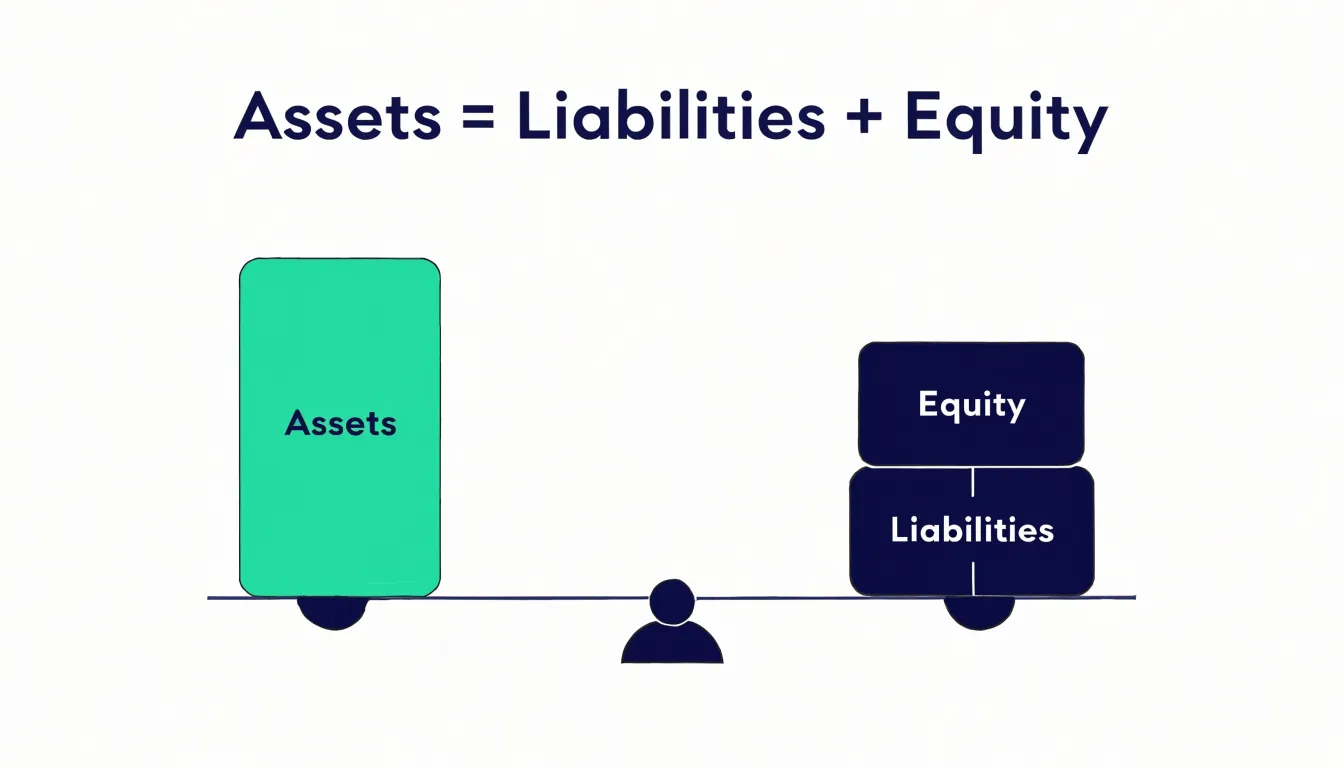
Table of Contents
- Basic balance sheet vocabulary covering assets liabilities and equity
- Why does double entry bookkeeping matter for small business owners
- Income statement terms
- Essential cash flow vocabulary for tracking money in and out
- Cost accounting concepts
- How do tax accounting terms apply to everyday business operations
- Auditing and internal control terms explained in plain English
- Key metrics and financial ratios used to evaluate company performance
Basic balance sheet vocabulary covering assets liabilities and equity
A balance sheet vocabulary begins with the accounting equation, the foundation on which every set of financial statements rests: assets equal liabilities plus equity. This relationship captures the idea that everything a business owns was funded either by borrowing or by the owners’ stake in the business. Learning the terms that make up this equation gives readers the language they need to read and interpret a balance sheet with confidence.
Assets are the resources a business controls and expects to bring future economic benefit. Common examples include cash, inventory, accounts receivable, equipment, vehicles, and property. Within the assets category, a key distinction separates current from non-current items. Current assets are those expected to be converted into cash, sold, or used up within one year or the normal operating cycle, such as cash on hand, short-term investments, receivables, and inventory. Non-current or long-term assets are held for longer periods and support ongoing operations; they include property, plant, equipment, and intangible assets like patents or goodwill.
Liabilities represent obligations a business owes to outside parties, arising from past transactions and requiring future payment or performance. Accounts payable, accrued wages, short-term loans, and taxes owed are typical examples. The same current versus non-current split applies here. Current liabilities are due within a year or the operating cycle, while non-current liabilities, such as long-term debt or lease obligations, fall due further in the future. This classification helps readers assess a company’s short-term liquidity and longer-term solvency.
Equity, sometimes called owner’s equity or shareholders’ equity, is the residual interest in the assets after deducting liabilities. It reflects what the owners have invested plus accumulated profits retained in the business, less any distributions or losses. Equity acts as the balancing figure in the accounting equation, tying the statement together.
Together, these definitions of assets, liabilities, equity, and the current versus non-current distinction form the essential vocabulary for reading any balance sheet. Mastery of these terms prepares readers to move on to more advanced concepts such as ratios, working capital, and financial analysis.
Why does double entry bookkeeping matter for small business owners
Double entry bookkeeping is the system that sits underneath almost every set of business accounts, and understanding the idea behind it helps small business owners make sense of what their bookkeeping records are actually doing. At its core, the concept is simple: every transaction has two sides, and both must be recorded for the books to stay in balance. When a business receives cash from a customer, two things happen at once. Cash increases, and so does the income or the reduction of what the customer owes, depending on how the sale was structured. One side of the entry reflects where the value came from, and the other reflects where it went. The two entries are always equal in amount, which is why the system is described as double entry.
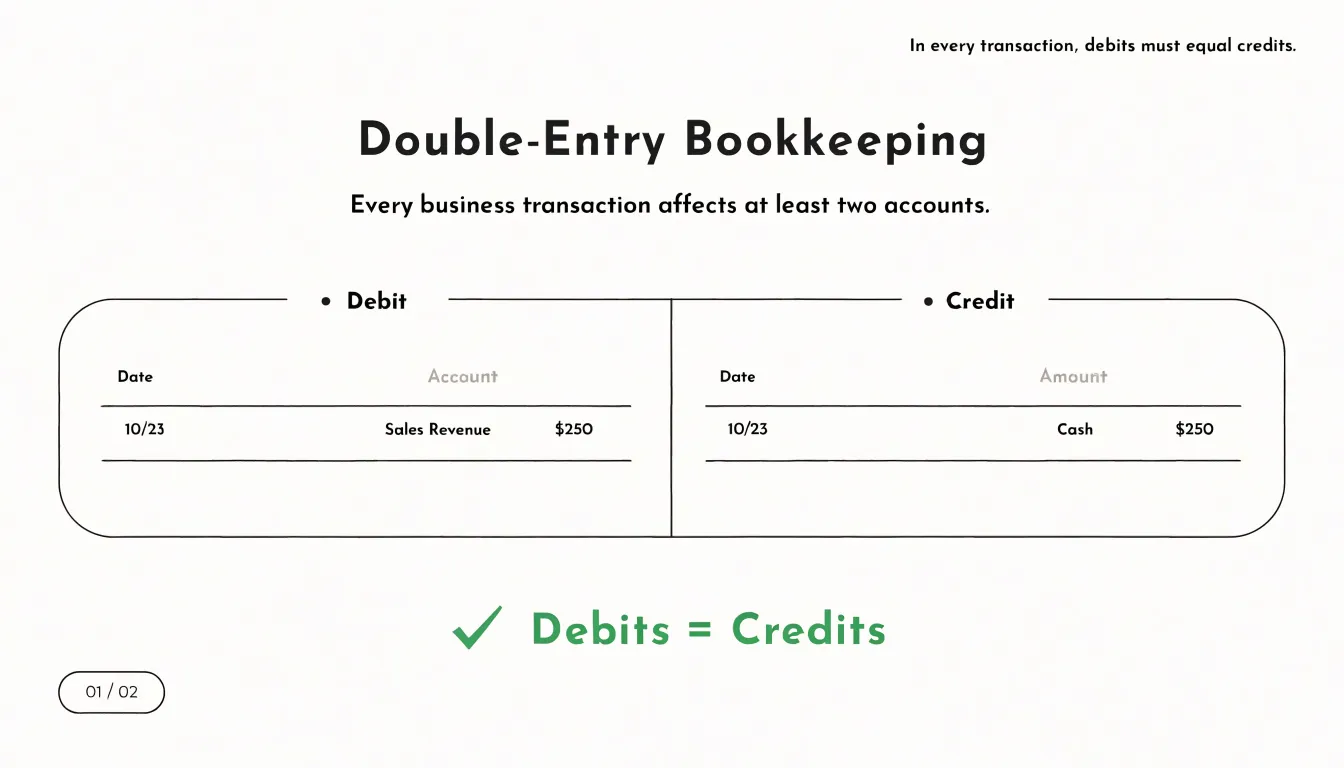
The reason every transaction has two sides is that a business is a separate economic entity from its owner. Anything that flows into the business must have come from somewhere, and anything that flows out must have gone somewhere. Recording only one side of a transaction leaves the records incomplete and the underlying story half told. By capturing both sides, double entry bookkeeping creates a complete trail that shows the effect of each transaction on the business as a whole.
The practical benefit for a small business owner shows up most clearly when something goes wrong. Because every debit must have a matching credit, the totals on both sides of the ledger should agree at all times. If they do not, an error exists somewhere in the records, and the owner knows to investigate. This built-in check catches common mistakes such as a transaction entered only once, a figure transposed when typed, or an amount recorded in the wrong account. Without that balancing mechanism, errors can sit unnoticed in the records for months and distort the picture of how the business is performing.
Double entry also supports accurate record keeping over the long term. It gives the owner a reliable basis for producing financial statements, tracking what the business owns and owes, and preparing for tax obligations. Records built on double entry entries are easier to audit, easier to reconcile against bank statements, and easier to hand over to an accountant at year end. For a small business owner, that structure turns bookkeeping from a pile of receipts into a dependable record of the business’s financial position.
Income statement terms
The income statement, sometimes called the profit and loss statement, is the financial report that summarizes a company’s performance over a specific period, such as a month, quarter, or year. It answers a straightforward question: did the business earn more than it spent? Understanding its core terms gives readers a clear picture of how profitability is measured and reported.
Revenue sits at the top of the statement and represents the total amount earned from selling goods or services before any costs are deducted. Also called sales or turnover, revenue reflects the volume and price of what a business sells. Expenses are the costs incurred to generate that revenue, including the cost of goods sold, wages, rent, utilities, marketing, and depreciation. Subtracting total expenses from revenue produces net income, the well-known bottom line that shows whether the business made a profit or a loss for the period.
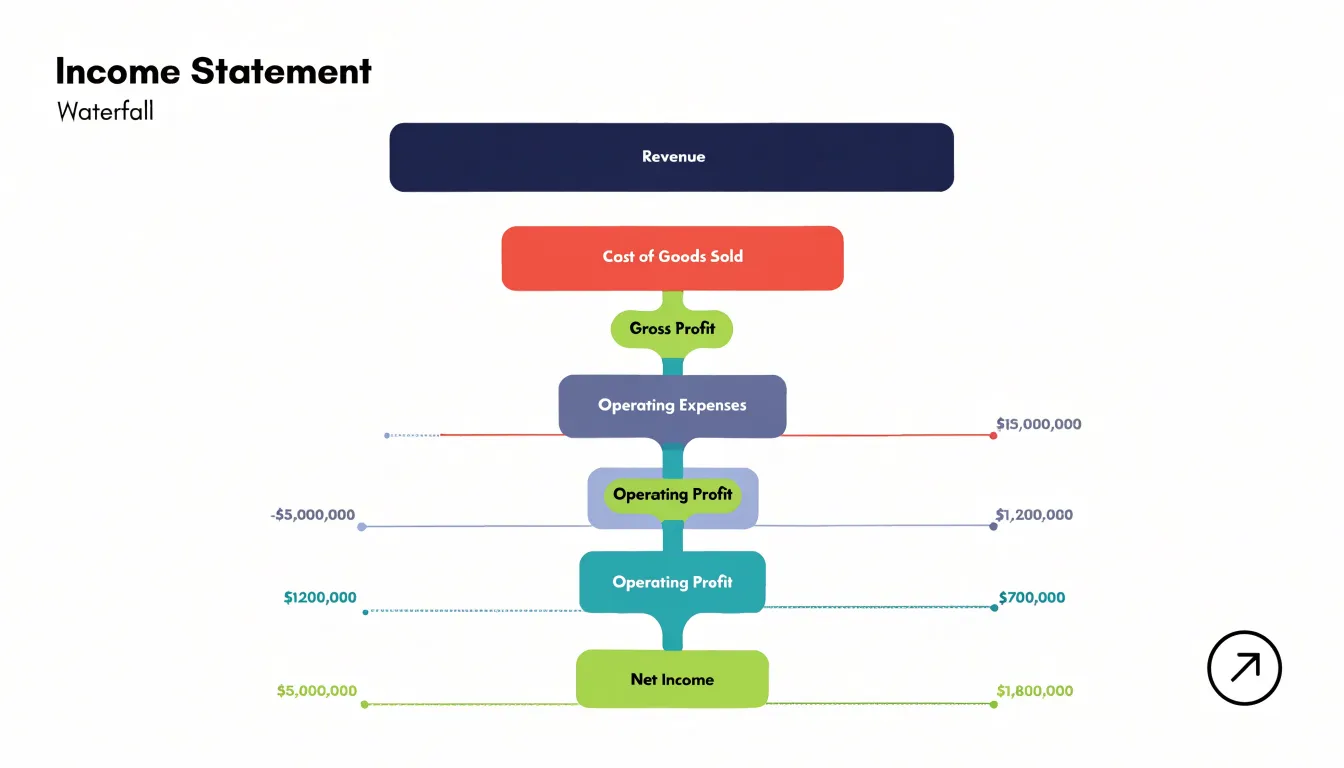
Gross profit occupies a middle position on the statement. It equals revenue minus the cost of goods sold, the direct costs tied to producing or purchasing what was sold. Gross profit shows how efficiently a company turns its inventory and production inputs into sales before administrative and other operating costs are considered. Operating profit then deducts general and administrative expenses, leaving a measure of earnings from core operations.
Profit margins put these figures into perspective by expressing profit as a percentage of revenue. The gross profit margin divides gross profit by revenue, revealing how much remains from each sale after direct costs. The net profit margin divides net income by revenue, showing the share of each sales dollar that becomes bottom-line profit. A company with a high gross margin but a low net margin may be spending heavily on overhead, while a thin net margin can indicate intense competition or rising costs. Comparing margins across periods and against industry peers helps readers judge whether profitability is improving, and understanding these income statement terms forms the foundation for that analysis.
Essential cash flow vocabulary for tracking money in and out
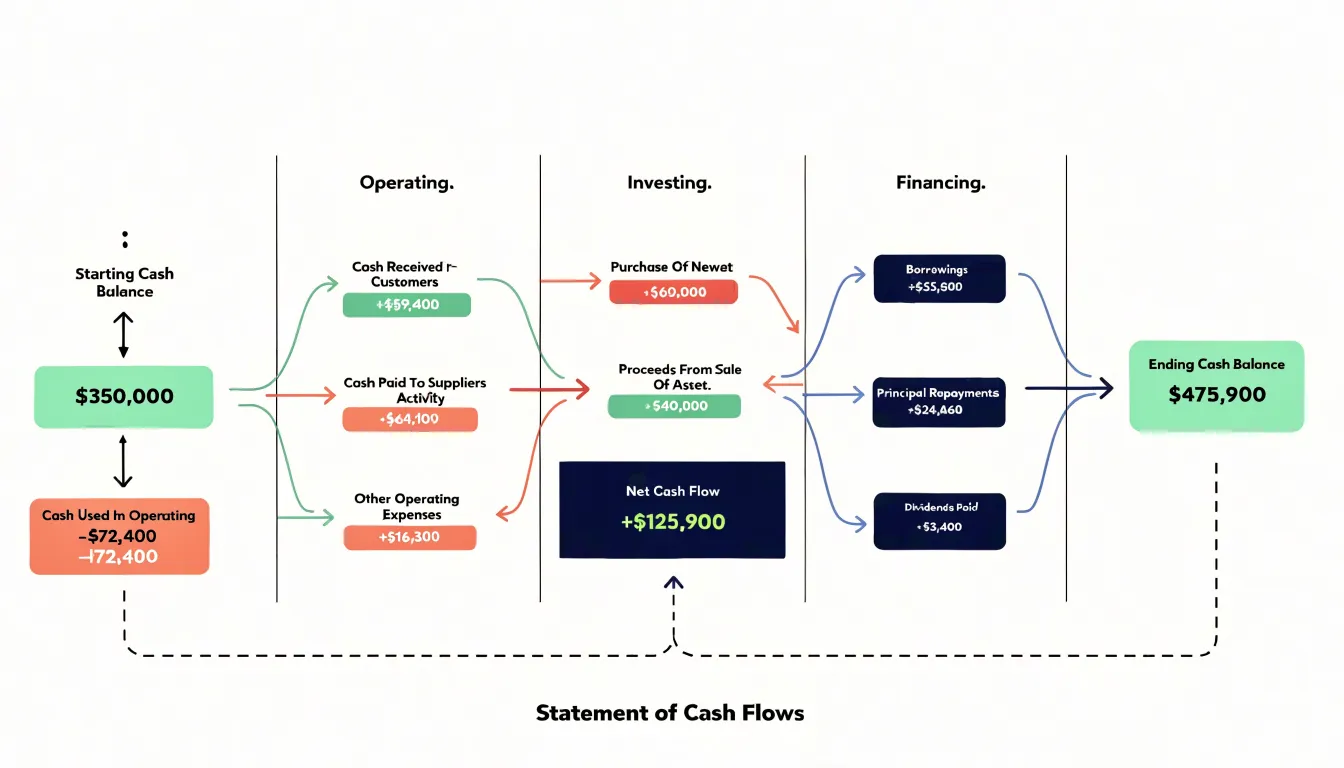
Cash flow vocabulary is fundamental to understanding how money moves through a business. Operating cash flow represents the cash generated or used by a company’s core business activities—selling goods, providing services, paying suppliers and employees. It is the lifeblood of daily operations and a key indicator of financial health. Investing cash flow tracks cash used for or generated from long-term investments, such as purchasing equipment, buying property, or selling assets. This category reflects a company’s growth strategy and capital allocation. Financing cash flow captures cash from debt and equity financing, including loans, repayments, dividend payments, and share issuances. Together, these three components form the statement of cash flows, which reconciles the beginning and ending cash balances. A common point of confusion is the difference between cash flow and profit. Profit, as reported on the income statement, is an accounting measure that includes non-cash items like depreciation and accrued revenues. Cash flow, in contrast, tracks actual cash receipts and payments. A business can be profitable on paper yet struggle with cash shortages if customers pay slowly or inventory ties up cash. Conversely, a company might show a loss but still have positive cash flow due to timing differences. Understanding these terms helps stakeholders assess liquidity, solvency, and operational efficiency. For example, strong operating cash flow suggests a company can fund its operations without external financing. Negative investing cash flow might indicate investment in future growth, while positive financing cash flow could signal reliance on debt. By mastering this vocabulary, readers can interpret financial statements more accurately and make informed decisions about a company’s financial stability and performance. The glossary aims to demystify these concepts, providing clear definitions and practical context for each term.
Cost accounting concepts
Cost accounting concepts give businesses a framework for understanding where money goes and how each expense connects to the products or services they deliver. At the foundation are direct costs, which can be traced to a specific item with confidence. For a furniture maker, the lumber and hardware that go into a table are direct costs, as are the wages of the workers assembling it. Indirect costs cannot be tied to any single product. The factory supervisor’s salary, the electricity that powers the whole building, and the maintenance of shared equipment fall into this category because they support the entire operation rather than one item.
Overhead is the broad pool of indirect expenses required to keep the business running. Rent, insurance, administrative salaries, utilities, and depreciation on buildings and machinery all belong here. Managing overhead means keeping this pool visible and under control, since it tends to grow quietly over time and can erode margins if left unexamined.
Fixed and variable costs describe how expenses respond to changes in activity. Fixed costs stay constant within a relevant range of production, such as a monthly lease payment or salaried staff. Variable costs rise and fall with output, like raw materials or packaging. Some costs are mixed, containing both elements: a utility bill may have a base charge plus usage-based charges. Separating these components helps businesses forecast how costs will behave as volume changes.
Allocating costs to products or services is the practical step that connects these concepts to decision-making. Direct costs are assigned straightforwardly. Indirect costs and overhead must be distributed using an allocation base, such as direct labor hours, machine hours, or square footage. A common approach is to calculate a predetermined overhead rate and apply it to each product based on its use of the allocation base. The goal is a reasonable, consistent estimate of the full cost of each item, which then informs pricing, profitability analysis, and budgeting. Accurate allocation reveals which products genuinely earn their keep and which may be quietly draining resources through heavy overhead consumption.
How do tax accounting terms apply to everyday business operations
Tax accounting terms shape the daily financial life of a business, influencing everything from routine purchases to long-term planning. Deductions, credits, and taxable income are not abstract concepts; they guide how owners and managers record transactions and make spending decisions. A deduction is an expense that reduces taxable income, such as rent, supplies, or wages. When a business incurs these costs, it must keep precise records—receipts, invoices, and logs—to substantiate the deduction if audited. This record-keeping becomes a daily habit: filing receipts by category, noting business purpose, and separating personal from business expenses. Without this discipline, legitimate deductions may be lost, increasing the tax bill.
Credits differ from deductions in that they directly reduce the tax owed, dollar for dollar. Common credits include those for research activities, hiring certain employees, or investing in energy-efficient equipment. Because credits often require specific documentation, businesses must track qualifying activities throughout the year. For example, if a company purchases solar panels, it needs to retain certification and cost records to claim the energy credit. This tracking influences purchasing decisions: a business might choose a qualifying model over a non-qualifying one to capture the credit.
Taxable income is the result of subtracting deductions from gross income. It serves as a running scorecard for financial health and tax liability. Day-to-day decisions—such as whether to buy or lease equipment, or whether to expense an item immediately or depreciate it—affect taxable income in the current year and beyond. Understanding these terms helps managers time purchases, manage inventory, and plan cash flow. For instance, accelerating deductible expenses into the current year can lower taxable income, while deferring income may achieve a similar effect. These choices require accurate, timely records so that the tax position is clear at any point.
Ultimately, tax terms are woven into the fabric of daily operations. They dictate how transactions are documented, how spending is prioritized, and how profit is measured. By integrating tax awareness into routine record-keeping, businesses can avoid surprises, optimize their tax position, and make informed financial decisions that support growth.
Auditing and internal control terms explained in plain English
Auditing vocabulary often sounds more intimidating than the concepts behind it. An audit is simply an independent examination of a company’s financial records, carried out to determine whether the statements present a fair picture of the business. For small business owners, the purpose is less about catching people out and more about giving lenders, investors, or tax authorities confidence that the numbers can be trusted. Many small companies encounter audits through their bank before securing a loan, through grant applications, or because a regulator requires one once revenue crosses a certain threshold.
Internal controls are the routines and safeguards a business puts in place to keep its records accurate and its assets safe. A locked cash drawer, a numbered invoice system, monthly bank reconciliations, and approval steps before payments go out all count as internal controls. They do not need to be elaborate; the goal is to make errors visible quickly and to make fraud difficult to hide. Well-designed controls also protect owners from honest mistakes, such as duplicate payments to a supplier or invoices that never get recorded.
Segregation of duties is one of the most important controls, and it means splitting tasks so that no single person controls an entire transaction from start to finish. The person who writes cheques should not also reconcile the bank account, and the person who approves a purchase should not be the one who records it. In a small team this can be difficult, so owners often rotate duties, require a second signature above a set amount, or have the owner personally review bank statements each month.
Materiality is the idea that auditors focus on amounts large enough to influence a reader’s decisions. A five-dollar discrepancy in a stationery account is unlikely to change anyone’s view of the business, while a five-thousand-dollar error in reported profit probably would. Materiality thresholds are set at the start of an audit and guide how much testing is needed in each area.
Together these terms describe a simple system: controls keep daily records reliable, segregation of duties prevents any one person from overriding them, and materiality tells auditors where to concentrate their effort. Understanding this vocabulary helps small business owners prepare for audits calmly and build habits that keep their books dependable throughout the year.
Key metrics and financial ratios used to evaluate company performance
Key metrics and financial ratios translate the raw numbers on financial statements into meaningful indicators of how well a business is performing. Ratios allow you to compare figures that would otherwise be difficult to interpret on their own, and they give you a consistent basis for tracking performance over time or benchmarking against competitors in the same industry.
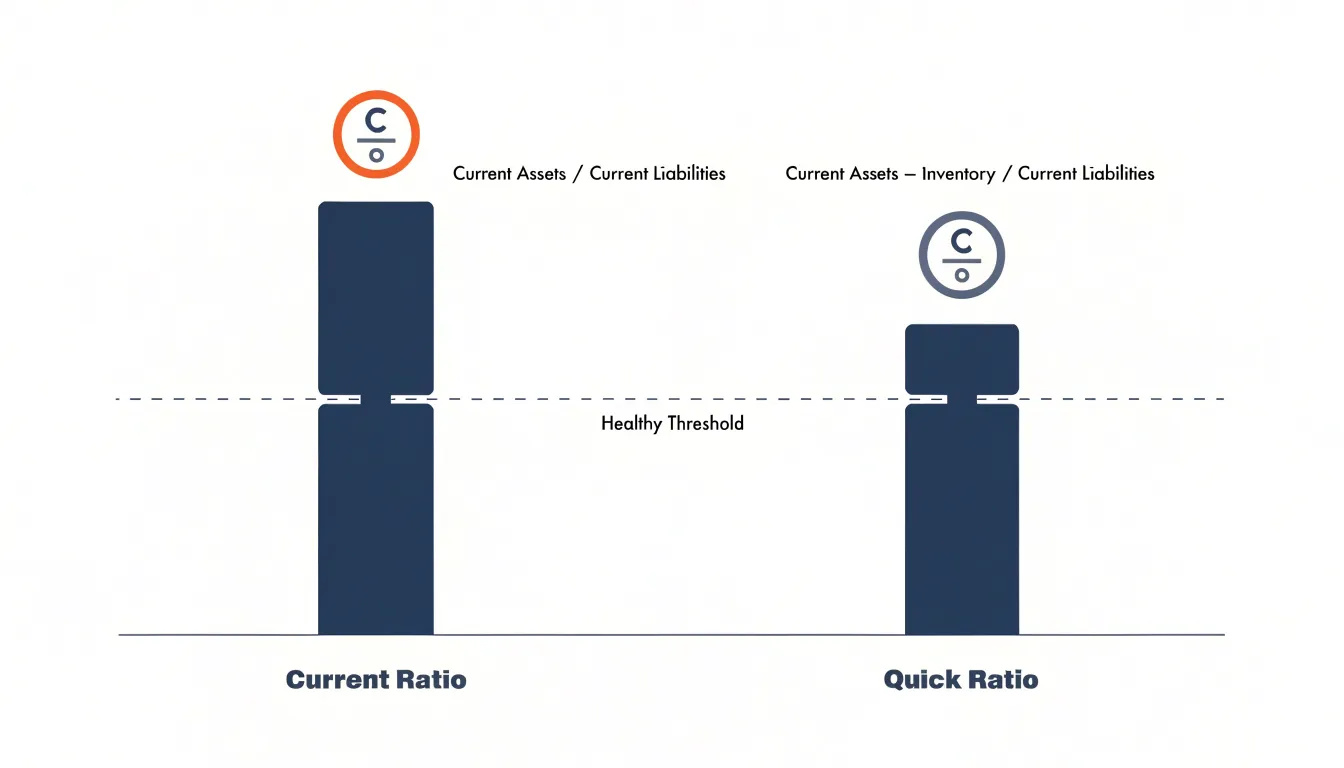
Liquidity ratios measure a company’s ability to meet its short-term obligations as they come due. The current ratio compares current assets to current liabilities, while the quick ratio strips out inventory to focus on the most liquid assets. A business that consistently falls below healthy thresholds in these measures may struggle to pay suppliers, cover payroll, or service debt in the near term, even if it looks profitable on paper.
Profitability ratios assess how effectively a company converts revenue into earnings. Gross profit margin shows how much remains after the direct cost of goods sold, revealing pricing power and production efficiency. Net profit margin captures the bottom line after all expenses, taxes, and interest. Return on assets and return on equity go further by showing how much profit the business generates relative to the resources invested in it, which helps investors and managers judge whether capital is being deployed well.
Efficiency ratios examine how productively a company uses its assets. Inventory turnover indicates how quickly stock moves, while receivables turnover shows how promptly customers pay. Days sales outstanding and asset turnover round out the picture by linking operating activity to the balance sheet. Slow turnover in these areas often signals tied-up cash, obsolete inventory, or weak collection practices.
Used together, these ratios form a diagnostic toolkit. Comparing them across several periods reveals trends that single statements hide, and comparing them against industry norms puts performance in context. A company might show strong margins alongside deteriorating liquidity, for example, pointing to a working capital problem that warrants attention. By reading liquidity, profitability, and efficiency ratios side by side, analysts, lenders, and managers can build a well-rounded view of financial health and identify areas requiring corrective action before small issues grow into serious problems.
Frequently Asked Questions
What is the accounting equation?
The accounting equation is assets equal liabilities plus equity. It reflects the idea that everything a business owns was funded either by borrowing or by the owners’ stake in the business.
What is the difference between current and non-current assets?
Current assets are expected to be converted into cash, sold, or used up within one year or the normal operating cycle, such as cash, short-term investments, receivables, and inventory. Non-current assets are held for longer periods and support ongoing operations, including property, plant, equipment, and intangible assets like patents or goodwill.
Why does double entry bookkeeping matter for small business owners?
Double entry bookkeeping matters because every transaction has two sides and both must be recorded for the books to stay in balance. That built-in check helps catch mistakes such as a transaction entered only once, a figure transposed when typed, or an amount recorded in the wrong account.
What is the difference between gross profit and net income?
Gross profit equals revenue minus the cost of goods sold, the direct costs tied to producing or purchasing what was sold. Net income is total expenses subtracted from revenue and shows whether the business made a profit or a loss for the period.
What is the difference between cash flow and profit?
Profit is an accounting measure that includes non-cash items like depreciation and accrued revenues, while cash flow tracks actual cash receipts and payments. A business can be profitable on paper yet struggle with cash shortages if customers pay slowly or inventory ties up cash.
What is segregation of duties?
Segregation of duties means splitting tasks so no single person controls an entire transaction from start to finish. For example, the person who writes cheques should not also reconcile the bank account, and the person who approves a purchase should not be the one who records it.