Accounts Payable
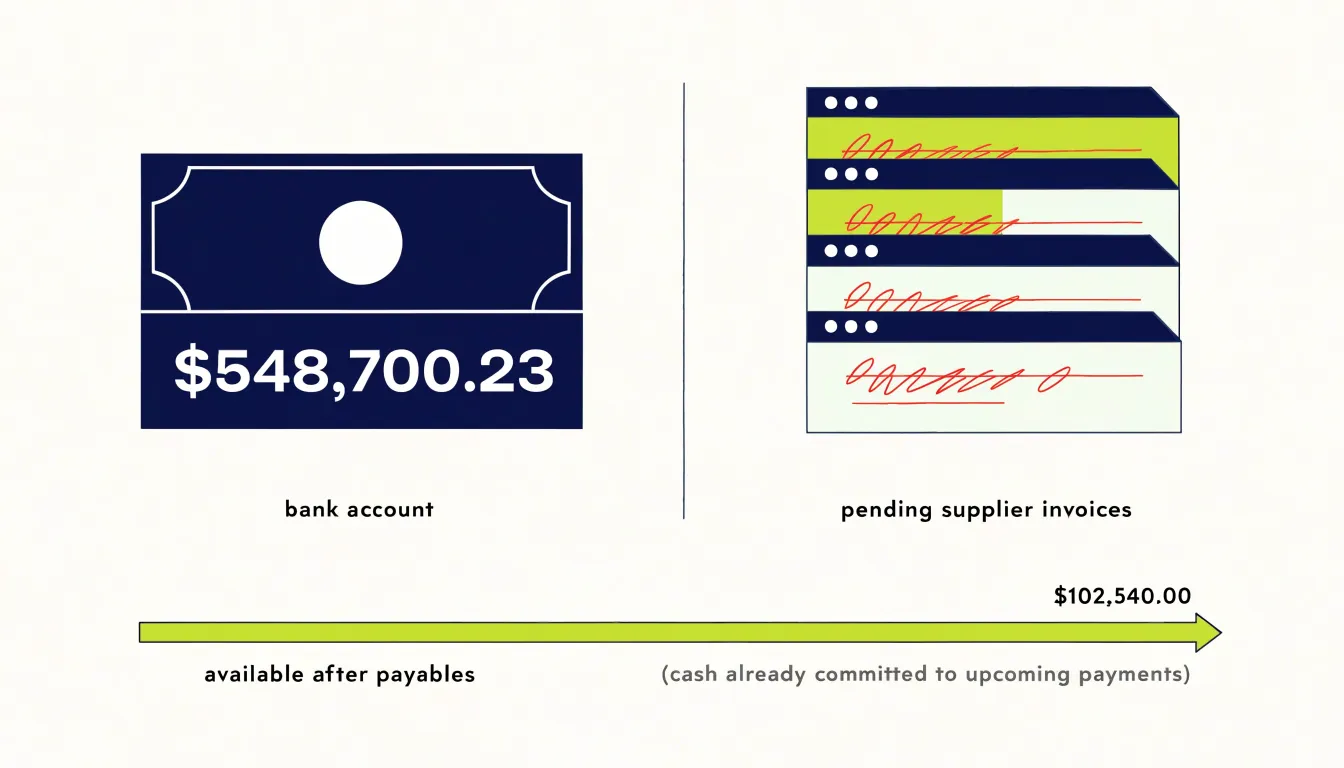
Accounts payable is money a business owes suppliers for goods or services received but not yet paid, recorded as a current liability on the balance sheet. It represents cash still in the bank but already committed to upcoming invoices, so managing payment timing, three-way matching, and approval controls protects cash flow and prevents overpayments.
Table of Contents
- What accounts payable means for your business cash flow
- How accounts payable differs from accounts receivable
- The step-by-step accounts payable workflow
- How three-way matching prevents costly billing errors
- Common manual processing mistakes that hurt your bottom line
- Cash versus accrual accounting for tracking short-term debt
- Streamlining approvals
- Essential internal controls to protect your business against invoice fraud
What accounts payable means for your business cash flow
Accounts payable represents money your business owes to suppliers and vendors for goods or services already received but not yet paid for. On the balance sheet it appears as a liability, and in practical terms it is a claim on your cash that has not yet come due. Every invoice sitting in your payables queue is cash that is still in your bank account but already spoken for. Understanding this distinction is essential because the money in your operating account can create a misleading sense of financial comfort when a significant portion of it is effectively committed to upcoming payments. Businesses that lose sight of their payables obligations often find themselves caught short when several invoices converge on the same due date.
Managing payment timing is one of the most direct levers you have over cash flow health. Paying too early depletes your cash balance unnecessarily, removing funds from the business before they are required. Paying too late, on the other hand, can damage supplier relationships, trigger late fees, and in some cases jeopardize favorable terms or supply continuity. The goal is deliberate timing: scheduling payments to land on or just before their due dates so that cash remains available for other operational needs in the interim. This requires visibility into what is owed, when it is due, and what cash is expected to arrive in the same window. A simple payables schedule aligned with your receivables forecast gives you that picture and helps you avoid the scramble of reactive payment decisions.
Stretching payables within agreed terms is a legitimate and widely used method for freeing up working capital. If a supplier offers net 45 or net 60 terms, taking full advantage of that window keeps cash in your business longer, where it can fund inventory, cover payroll, or absorb unexpected expenses. The discipline lies in staying within the terms and communicating openly with suppliers if circumstances require adjustment. Used consistently, this approach converts your payables into a flexible source of short-term liquidity and helps smooth the natural peaks and troughs of business cash flow.
How accounts payable differs from accounts receivable
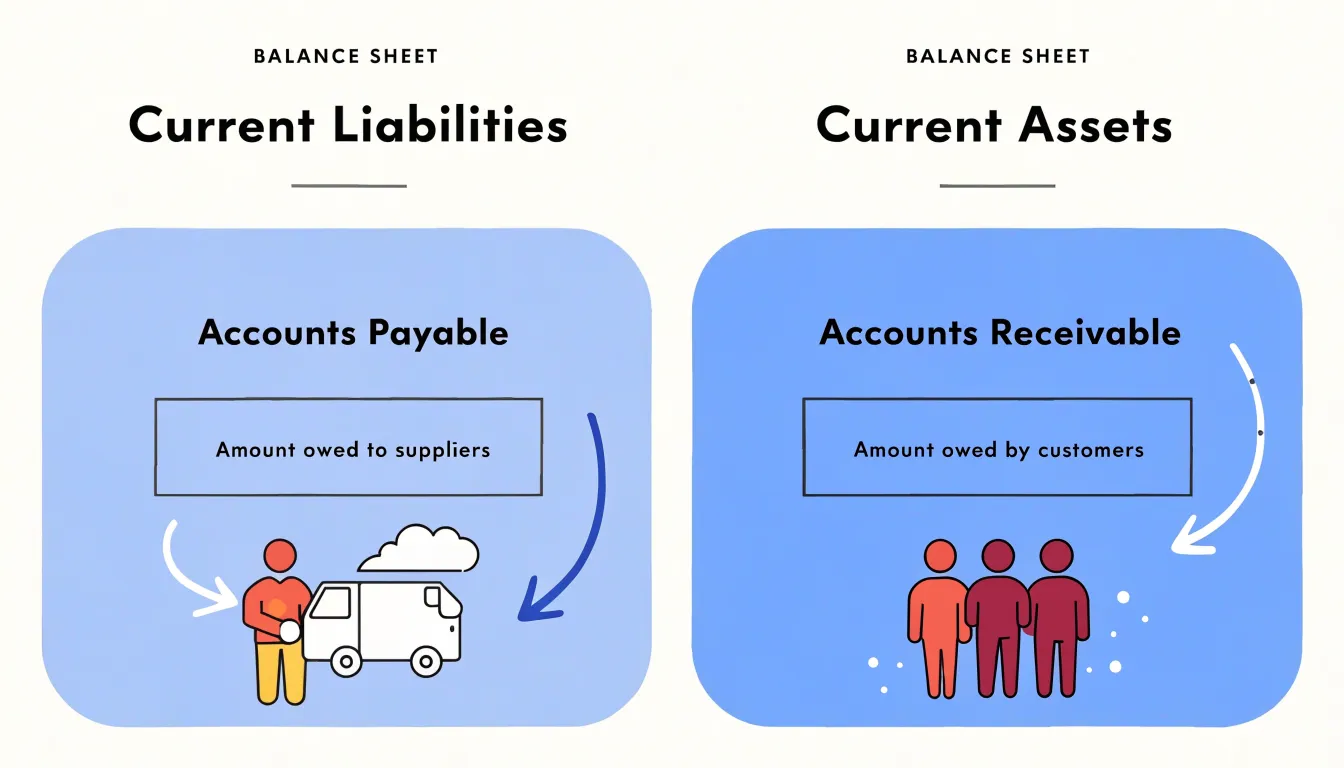
Accounts payable and accounts receivable are two fundamental concepts in business finance that often get confused, yet they represent opposite sides of the same coin. Accounts payable refers to the money a business owes to its suppliers, vendors, and other creditors for goods or services that have been received but not yet paid for. These are short-term liabilities, typically listed under current liabilities on the balance sheet. In contrast, accounts receivable represents the money that customers owe to the business for goods or services that have been delivered but not yet paid for. These are short-term assets, listed under current assets on the balance sheet.
The key distinction lies in the direction of the obligation: accounts payable is money going out, while accounts receivable is money coming in. This directional difference means they sit on opposite sides of the balance sheet. Accounts payable is a liability because it represents a future outflow of cash, whereas accounts receivable is an asset because it represents a future inflow of cash. Understanding this distinction is crucial for managing cash flow effectively. A business must carefully track both to ensure it has enough liquidity to meet its obligations while also collecting what it is owed in a timely manner.
Both accounts payable and accounts receivable are critical indicators of a company’s financial health. High accounts payable relative to cash reserves can signal potential liquidity issues, especially if payment terms are short. Conversely, high accounts receivable can indicate sales success but also carries the risk of bad debts if customers default. Efficient management of both ensures smooth operations: paying suppliers on time maintains good relationships and may secure favorable terms, while collecting receivables promptly improves cash flow. Together, they provide a snapshot of the company’s working capital cycle—the time between paying for goods and receiving payment from customers. By understanding and balancing these two accounts, businesses can maintain a healthy cash flow, avoid financial distress, and support sustainable growth. In essence, accounts payable and receivable are mirror images that, when managed well, keep the financial engine running smoothly.
The step-by-step accounts payable workflow
The accounts payable workflow begins with purchase order creation, where a department initiates a request for goods or services. This document specifies quantities, prices, and terms, serving as a control mechanism to ensure purchases are authorized and budgeted. Efficiency tip: use pre-approved templates and automated PO generation from requisitions to reduce manual entry and errors. Next, goods receipt occurs when the items are delivered. The receiving department verifies the delivery against the PO, noting any discrepancies in quantity or condition. This step is critical for three-way matching later. To keep it efficient, implement mobile receiving with barcode scanning that instantly updates the system. Invoice capture follows, where suppliers submit invoices. These can arrive via mail, email, or electronic data interchange (EDI). The goal is to capture invoice data accurately and quickly. Efficiency tip: adopt optical character recognition (OCR) and automated invoice ingestion to minimize manual keying and accelerate processing. Approval routing is the stage where the invoice is matched to the PO and goods receipt (three-way match) and then routed to appropriate managers for approval based on company policy. Bottlenecks often occur here. To streamline, configure workflow automation with predefined approval hierarchies and escalation rules, and enable mobile approvals for remote managers. Payment scheduling involves determining when to pay approved invoices, taking advantage of early payment discounts while optimizing cash flow. Efficiency tip: use a calendar-based system with automated reminders and integrate with treasury systems to align payments with cash availability. Finally, reconciliation ensures that payments match invoices and that records are accurate. This includes bank reconciliation and resolving discrepancies. Efficiency tip: automate reconciliation with bank feeds and AI-powered exception handling to quickly identify and resolve mismatches. Throughout the workflow, maintaining clean master data, fostering supplier collaboration, and leveraging cloud-based AP automation software can significantly enhance speed and accuracy. By optimizing each step, organizations can reduce cycle times, capture discounts, and improve vendor relationships.
How three-way matching prevents costly billing errors
Three-way matching is the practice of comparing three separate documents before an invoice is approved for payment: the purchase order issued by the buyer, the receiving report confirming what was actually delivered, and the vendor’s invoice. Each document originates from a different point in the procurement cycle, so together they create an independent trail that a single source cannot fake or overlook. The purchase order establishes what was authorized, the receiving report records what physically arrived, and the invoice states what the vendor claims is owed. Only when all three agree does the payment proceed.
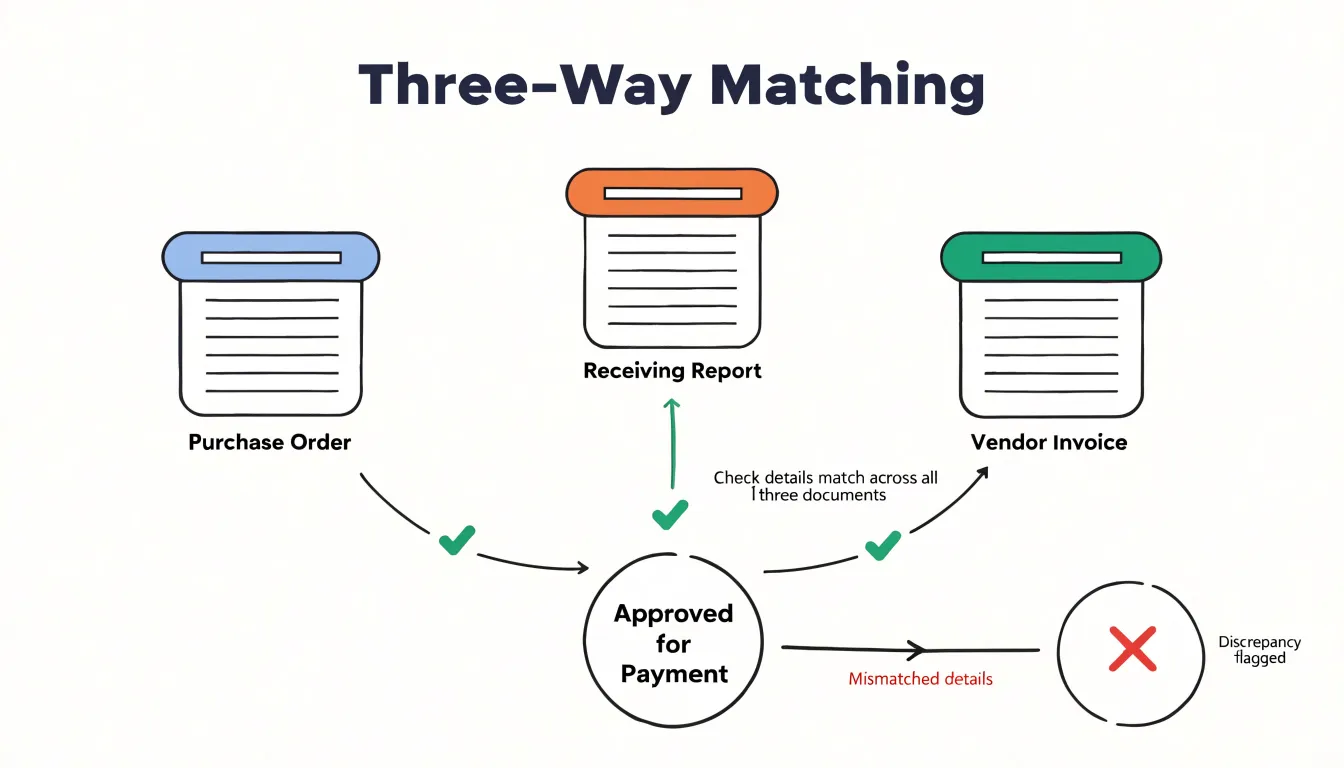
The power of this control lies in the discrepancies it surfaces. A vendor might bill for more units than were shipped, apply a higher unit price than the purchase order specified, or add freight and handling charges that were never negotiated. Matching the invoice against the purchase order catches pricing and quantity variances, while matching it against the receiving report catches short shipments and items that were ordered but never delivered. Duplicate charges are another common problem, particularly in high-volume environments where the same invoice can enter the system twice under slightly different reference numbers. A disciplined matching routine flags invoices lacking a corresponding order or receipt, which is exactly the signature of a duplicate submission.
Without this cross-check, overpayments tend to accumulate quietly. A company that pays from the invoice alone is essentially trusting the vendor’s own record of the transaction. Small unit-price differences and partial shipments can slip through month after month, and by the time the pattern is discovered the overpayment may be difficult to recover. Three-way matching closes that gap by requiring evidence from both the buying and receiving sides of the business before funds leave the company.
For these reasons, three-way matching is treated as a critical internal control in accounts payable. It supports accurate financial reporting, protects cash flow, deters fraudulent invoicing, and creates an audit trail that satisfies external auditors. Organizations that enforce the control consistently typically find that the modest additional effort at the invoice stage pays for itself many times over in prevented overpayments.
Common manual processing mistakes that hurt your bottom line
Manual accounts payable processes introduce a range of recurring errors that quietly erode an organization’s bottom line. Data entry mistakes are among the most frequent, as staff manually key invoice details such as amounts, vendor names, and due dates into accounting systems. Even a small transposition error can result in overpayment, misapplied credits, or incorrect general ledger postings that require hours of reconciliation to untangle. Missed early payment discounts represent another significant cost. Many vendors offer terms such as 2/10 net 30, which reward prompt payment with a percentage reduction. When invoices sit in a manual queue awaiting approval, these windows close, and the organization forfeits savings that can amount to thousands of dollars annually across a high-volume vendor base. Duplicate payments occur when the same invoice is entered more than once or paid through separate channels, and they are notoriously difficult to detect without systematic matching controls. Recovering duplicate payments often requires time-consuming vendor outreach and can strain supplier relationships. Late fees compound the problem when invoices are misfiled or approvals stall, turning an on-time obligation into an expensive one and sometimes triggering penalties or service interruptions. Lost invoices create a different kind of exposure: undetected liabilities that surface later, disputed charges, and damaged credit standing with key suppliers. The cumulative financial impact of these errors extends beyond the immediate amounts involved, encompassing administrative time spent researching and correcting mistakes, audit findings, and reduced negotiating leverage with vendors. Avoiding these pitfalls begins with structured controls. Centralizing invoice receipt through a single intake channel reduces the risk of lost documents. Automated three-way matching between purchase orders, receipts, and invoices catches discrepancies and duplicates before payment runs. Workflow-based approval routing with automated reminders helps capture discounts and avoid late fees. Regular vendor statement reconciliations and periodic audits of payment data further strengthen accuracy. Establishing clear segregation of duties and maintaining an up-to-date vendor master file round out a control environment that minimizes manual error and protects the organization’s cash position.
Cash versus accrual accounting for tracking short-term debt
Accounts payable represents money a business owes to suppliers and vendors for goods or services received but not yet paid for. How that obligation is recorded depends heavily on the accounting method in use. Under cash-basis accounting, transactions are recorded when cash actually changes hands. A business using this method does not record an accounts payable entry at the moment an invoice arrives. Instead, the expense appears in the books only when the payment is made. Until then, the obligation exists operationally but is invisible in the financial records. This simplicity suits very small businesses with few transactions, yet it means the books show no formal liability for unpaid bills sitting in the inbox.
Accrual accounting takes a different approach by recording expenses when they are incurred, regardless of when payment occurs. When a supplier delivers materials or completes a service, the business records the expense and creates a corresponding liability in accounts payable. The cash outflow comes later, at which point the payable is reduced and cash is credited. This matching of costs to the periods in which they generate value gives a more faithful representation of economic activity, and it is the method required under generally accepted accounting principles for most businesses of meaningful size.
The timing difference between the two methods has real consequences for how short-term obligations appear. Accrual accounting captures every unpaid supplier invoice as a current liability on the balance sheet, so the accounts payable balance reflects the full extent of near-term payment commitments. A reader of those statements can see exactly how much the business owes and when it comes due, which supports cash flow planning and lender or investor analysis. Cash-basis records, by contrast, can make a company look more liquid than it is, because obligations are absent until the moment they are settled. A business with substantial unpaid invoices may show a healthy cash position while carrying commitments that will soon draw that cash down.
For tracking short-term debt and managing working capital, accrual accounting provides the clearer picture. It surfaces obligations as they arise, allows aging reports that flag overdue payables, and keeps the balance sheet aligned with reality. Cash-basis accounting remains useful for monitoring actual liquidity, yet on its own it leaves a gap in visibility over what the business owes.
Streamlining approvals
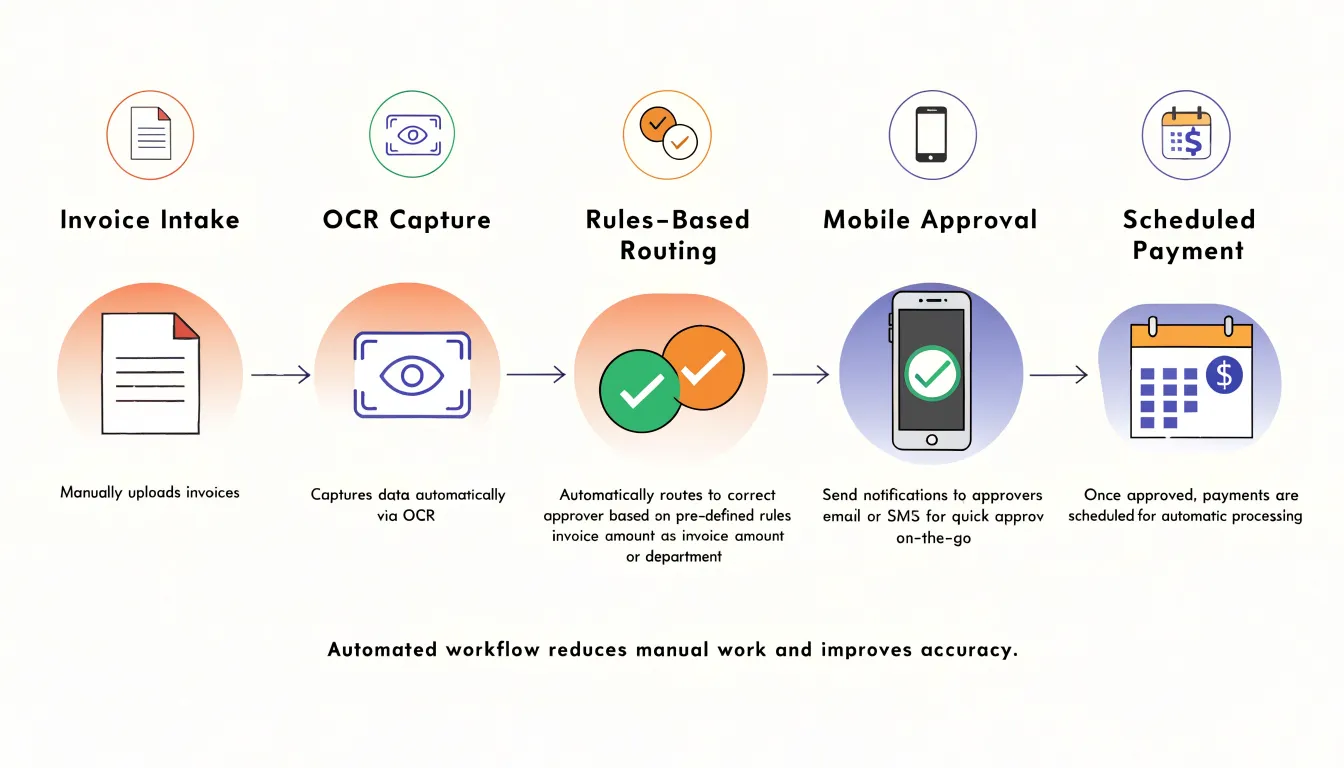
Streamlining approvals through automation transforms the accounts payable function from a bottleneck into a strategic advantage. Automated invoice capture eliminates manual data entry by using optical character recognition and machine learning to extract key details from paper and digital invoices, routing them directly into the system. This reduces processing time from days to hours and minimizes errors that occur with manual entry. Once captured, automated approval workflows ensure invoices are routed to the correct approvers based on predefined rules such as amount, department, or vendor. Approvers receive notifications and can approve from any device, eliminating the delays of chasing signatures and lost paperwork. Payment scheduling further accelerates the cycle by allowing payments to be timed for optimal cash flow and vendor terms. Together, these automation benefits cut processing time dramatically, lower costs associated with manual labor and late payment penalties, and reduce error rates. The result is faster, more accurate vendor payments that strengthen relationships. Vendors appreciate predictable, on-time payments, which can lead to better terms and priority service. By streamlining approvals, AP automation frees staff to focus on higher-value tasks like analysis and vendor management, turning AP into a source of competitive advantage.
Essential internal controls to protect your business against invoice fraud
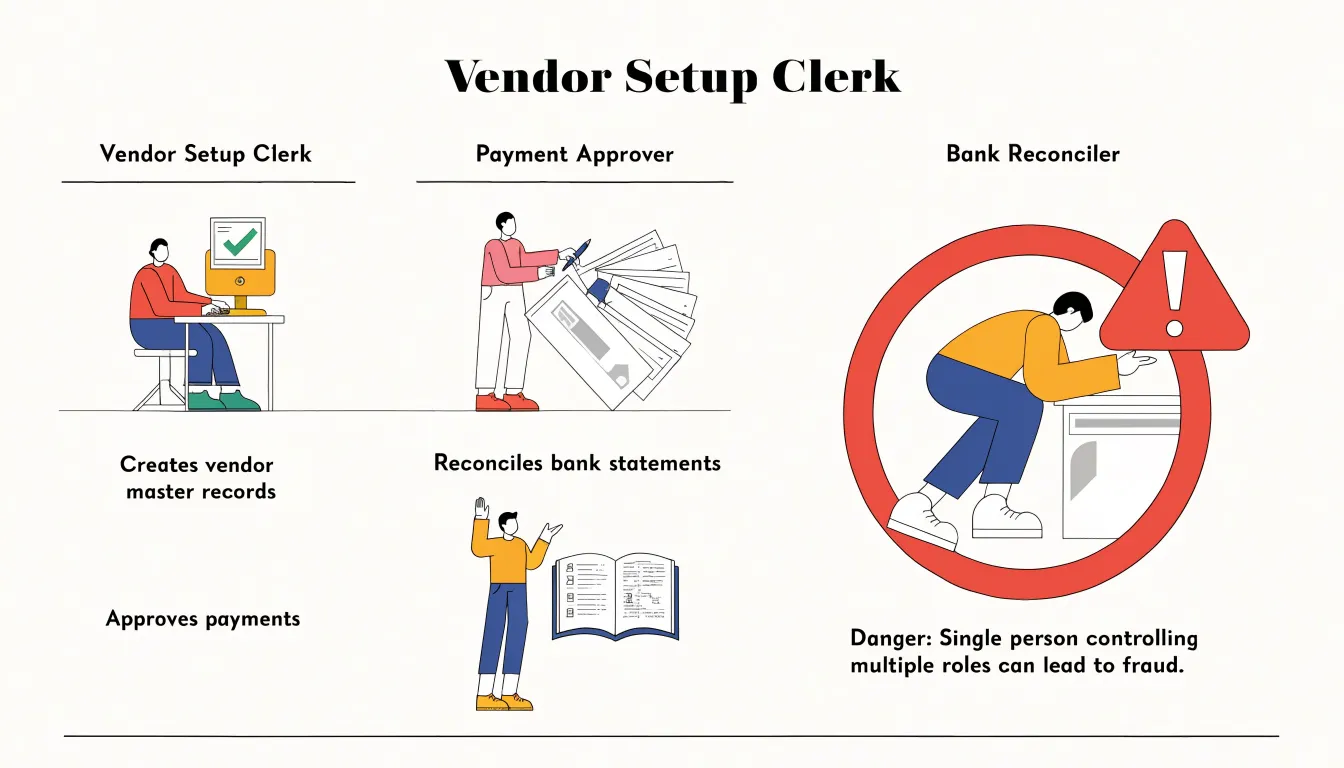
Invoice fraud succeeds when a single person controls too much of the payment process, so the foundation of any defense is segregation of duties. The individual who enters a vendor into the system should not be the same person who approves payments or reconciles the bank account. When responsibilities are split across several employees, collusion becomes necessary to push a fraudulent invoice through, which sharply reduces the opportunity for a lone bad actor to divert funds. Small teams can rotate duties periodically or have an owner or senior manager review transactions, preserving the separation of functions even with limited staff.
Approval thresholds add a second layer of protection by tying spending authority to dollar amounts. Low-value invoices might require a single sign-off, while larger payments demand escalating levels of authorization. This structure forces scrutiny on the transactions that carry the greatest financial exposure and makes it harder for a fabricated high-value invoice to slip through unnoticed. Thresholds should be documented in a written policy and configured directly in the accounting system so that approval requirements cannot be bypassed.
Vendor verification is particularly important against altered payment details, a common fraud in which criminals impersonate a legitimate supplier and request a change to bank account information. Confirming any change request through a known phone number, independent of the contact details in the email, blocks this attack. New vendors deserve similar checks, including confirmation of business registration and tax identification, before they are added to the master file.
Regular audits close the loop by testing whether controls actually function. Reconciling statements, reviewing vendor master file changes, and sampling paid invoices for proper documentation surface anomalies early. Together these safeguards create overlapping checks that make fake invoices, duplicate payments, and payment redirection far more difficult to execute and far easier to detect.
Frequently Asked Questions
What is accounts payable?
Accounts payable is money your business owes to suppliers and vendors for goods or services already received but not yet paid for. It appears as a liability on the balance sheet and represents a claim on cash that has not yet come due.
What is the difference between accounts payable and accounts receivable?
Accounts payable is money going out and represents a short-term liability, while accounts receivable is money coming in and represents a short-term asset. Accounts payable is what the business owes suppliers, whereas accounts receivable is what customers owe the business.
What are the steps in the accounts payable workflow?
The workflow begins with purchase order creation, followed by goods receipt, invoice capture, approval routing with three-way matching, payment scheduling, and reconciliation. These steps help ensure purchases are authorized, invoices are accurate, and payments are properly recorded.
How does three-way matching work?
Three-way matching compares the purchase order, the receiving report confirming what was delivered, and the vendor’s invoice before an invoice is approved for payment. This cross-check helps catch pricing and quantity variances, short shipments, items never delivered, and duplicate charges.
Why is accrual accounting better for tracking short-term debt?
Accrual accounting records expenses when they are incurred and captures unpaid supplier invoices as current liabilities, so the accounts payable balance reflects near-term payment commitments. Cash-basis accounting does not record an accounts payable entry when an invoice arrives, which can make a company look more liquid than it is.
How can businesses protect against invoice fraud?
Businesses can use segregation of duties, approval thresholds tied to dollar amounts, vendor verification, and regular audits. To guard against altered payment details, confirm any change request through a known phone number independent of the contact details in the email.