
Accrual Accounting
Accrual accounting records revenue when it is earned and expenses when they are incurred, regardless of when cash changes hands. Sales are booked at delivery and costs at obligation, with unpaid amounts held as accounts receivable or payable. This matching gives a truer picture of profitability and is required under GAAP and by larger businesses.
Table of Contents
- The Fundamental Difference Between Cash and Accrual Bookkeeping
- How Accrual Accounting Tracks Income and Expenses
- Revenue Recognition
- What Are Accounts Receivable and Accounts Payable
- Which Businesses Are Required to Use Accrual Accounting
- Signs Your Small Business Has Outgrown Cash Basis Accounting
- The Key Advantages of Matching Costs to Revenue
- Drawbacks to Consider
The Fundamental Difference Between Cash and Accrual Bookkeeping
The distinction between cash and accrual bookkeeping rests on a single question: at what moment does a transaction enter the books? Under cash basis accounting, the answer is tied to the movement of money. Revenue is recorded when payment is actually received, and expenses are recorded when they are actually paid. The bookkeeper watches the bank account, and entries follow the flow of cash in and out. Under accrual basis accounting, the answer is tied to the timing of the underlying economic event. Revenue is recorded when it is earned, meaning when goods or services have been delivered and the business has a right to payment, and expenses are recorded when they are incurred, meaning when the obligation arises, regardless of when cash changes hands.
A simple example makes the contrast concrete. Suppose a consulting firm completes a project and sends an invoice to its client in December, and the client pays that invoice in January. On a cash basis, December passes with no entry for this work at all. The revenue appears in January, the month the check arrives or the transfer clears. On an accrual basis, December is the month that matters. The firm has performed the service, so it records the revenue in December alongside an accounts receivable balance representing the client’s outstanding obligation. When the payment arrives in January, the entry changes shape: cash increases and accounts receivable decreases, with no new revenue recognized because it was already booked.
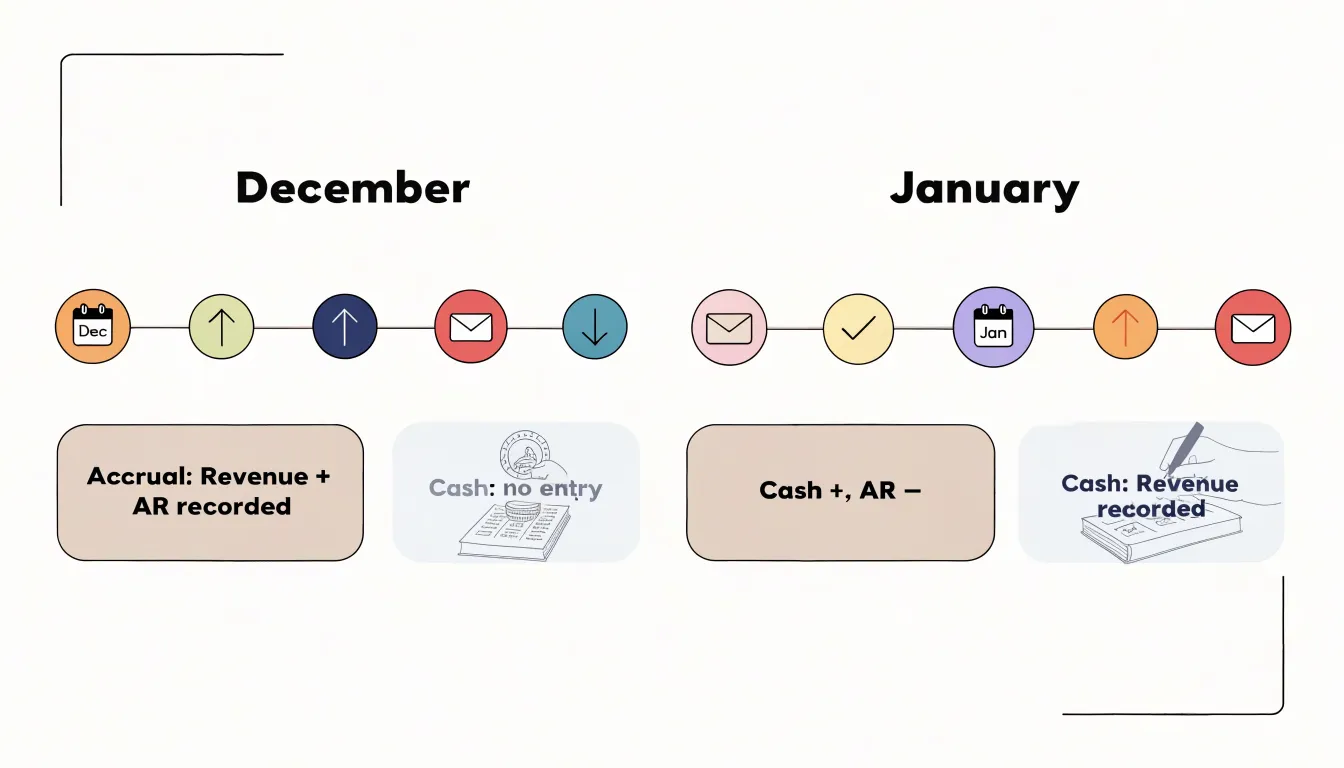
The same logic runs in reverse on the expense side. If the firm receives a supplier’s invoice in December but pays it in January, cash basis accounting records the expense in January, while accrual accounting records it in December alongside an accounts payable balance. Each method therefore produces a different picture of any given month. Cash basis reports track liquidity as it happens and are simple to maintain, which suits very small operations. Accrual basis reports match revenue to the expenses that helped generate it within the same period, giving a more complete view of profitability and financial position. That matching is why accrual accounting is the standard for larger businesses and is required under generally accepted accounting principles.
How Accrual Accounting Tracks Income and Expenses
Accrual accounting records economic activity when it occurs, and the journal entry is the instrument that gives that principle its practical shape. Every transaction is captured as a debit and a credit of equal value, posted to the general ledger accounts it affects. When a business delivers goods to a customer on credit, the entry debits accounts receivable and credits revenue at the moment of delivery, regardless of when cash arrives. When a supplier invoice is received for services already consumed, the entry debits the relevant expense and credits accounts payable. These daily entries build a continuous record of obligations and claims that exists independently of the bank balance, which is what allows the income statement to reflect activity for a period rather than merely cash movements.
At the close of an accounting period, the books rarely match economic reality without adjustment. Adjusting entries reconcile the ledger with what has actually been earned or consumed. Accruals capture items that have occurred but are not yet recorded: unbilled revenue earned in the final days of a month, or wages owed to staff for days worked but not yet paid. Deferrals handle the reverse situation, where cash has changed hands before the economic event: a customer prepayment sitting as a liability until the service is delivered, or an insurance premium paid upfront that is released to expense month by month. Each adjustment moves a portion of value from one account to another so that revenue and expense land in the period they belong to.
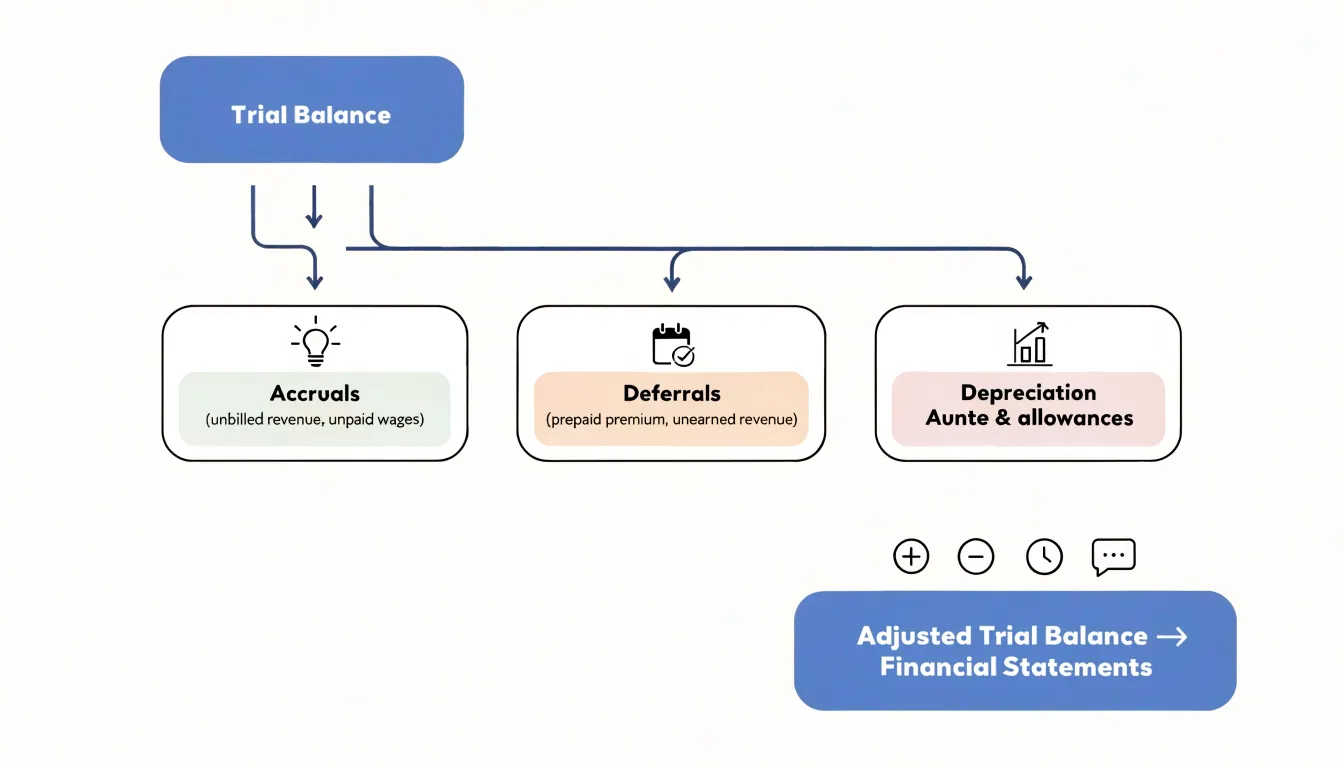
The cumulative effect is a set of books that stays accurate at period end even when cash timing diverges sharply from operational timing. Depreciation, amortization, and allowances for doubtful debts follow the same logic, spreading or anticipating costs to match the periods they benefit. Accountants rely on these entries because they preserve the matching of revenue with the expenses incurred to generate it, and they keep the balance sheet honest about what the entity owns and owes. The mechanics are repetitive and rule-bound, yet they are the reason accrual statements can be compared across periods and trusted by lenders, investors, and managers making decisions on the numbers.
Revenue Recognition
The revenue recognition principle sits at the heart of accrual accounting. It holds that revenue should be recorded when it is earned, regardless of when cash actually changes hands. In practice, this means a business may book income on its financial statements weeks or even months before the corresponding payment arrives in its bank account. The principle exists to give a more accurate picture of economic activity during a given period, since cash movements alone can distort how a business appears to be performing.
Revenue is generally considered earned when the goods or services have been delivered to the customer and the company has satisfied its obligation. The precise moment depends on the arrangement. For a product sale, revenue is typically recognized at the point of delivery or transfer of ownership. For services, revenue is often recognized as the work is performed, which may mean spreading recognition across the life of a contract rather than booking everything at signing.
Several common scenarios illustrate how this works. Retainers are a familiar example: a client pays an upfront fee to secure ongoing services. Under accrual accounting, the business does not recognize the full retainer as revenue on the day the cash arrives. Instead, it records a liability, often called unearned revenue, and recognizes portions as the work is completed over the covered period. Deposits follow a similar logic. A customer deposit for a future order remains a liability until the goods or services are delivered, at which point the revenue can be recognized. Multi-month contracts, such as a year-long service agreement billed in advance, require the business to allocate revenue across each month or milestone as performance obligations are fulfilled.
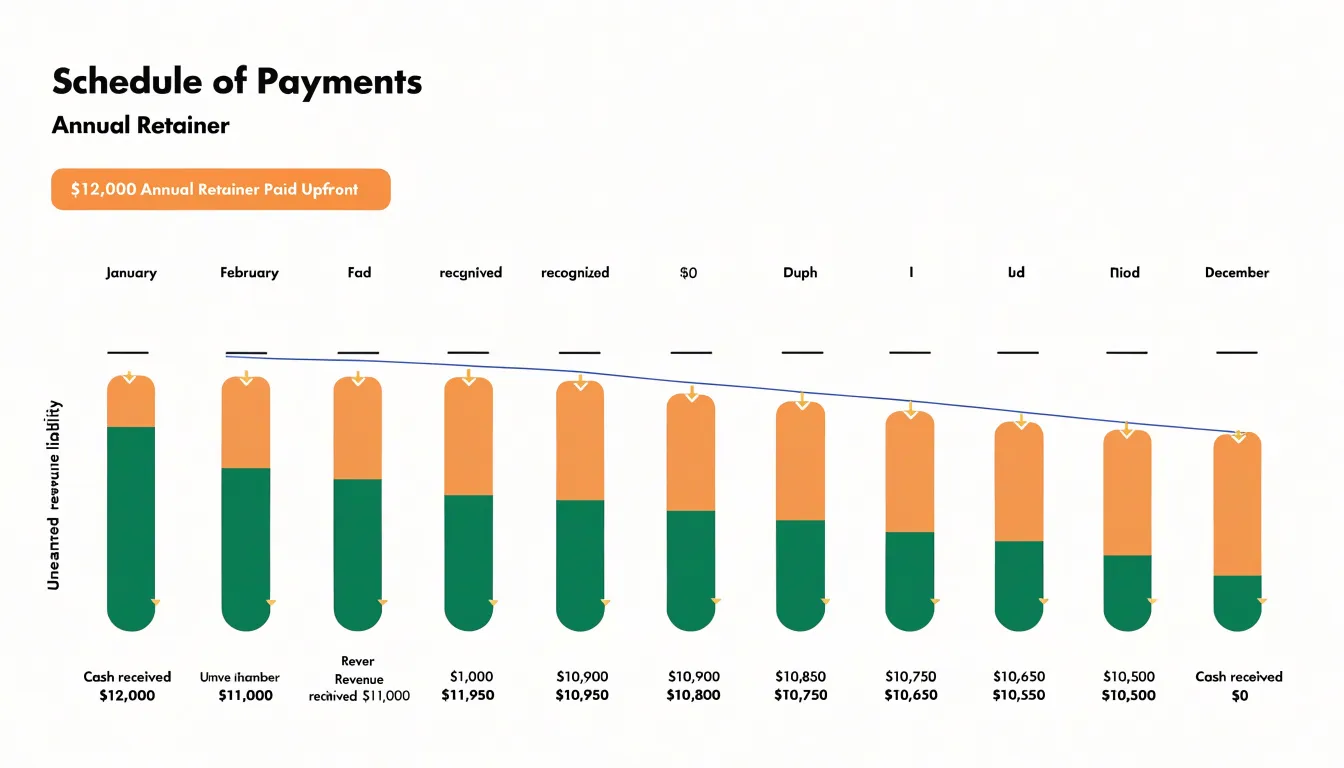
These patterns connect directly to the matching principle, since costs tied to the work are recorded in the same periods as the associated revenue. The result is a set of financial statements that reflects when value was actually created for customers, giving owners and investors a clearer view of the business’s underlying performance than a simple tally of cash receipts would provide.
What Are Accounts Receivable and Accounts Payable
Accounts receivable and accounts payable are two fundamental concepts in accrual accounting, representing the amounts owed to and by a company. Accounts receivable (AR) refers to the money that customers owe to a business for goods or services that have been delivered but not yet paid for. When a company makes a sale on credit, it records the revenue at the time of the sale, even though cash has not yet been received. The unpaid amount is recorded as an asset on the balance sheet under current assets, reflecting the expectation that the customer will pay in the future. Accounts payable (AP), on the other hand, represents the money that a company owes to its suppliers or vendors for goods or services that have been received but not yet paid for. When a company purchases on credit, it records the expense at the time of purchase, and the unpaid amount is recorded as a liability on the balance sheet under current liabilities, reflecting the obligation to pay the supplier in the future.
On the balance sheet, AR is presented as a current asset because it is expected to be converted into cash within a year, typically through customer payments. AP is presented as a current liability because it represents an obligation that is expected to be settled within a year, usually through cash payments to suppliers. These two accounts are essential for understanding a company’s short-term financial health, as they directly impact liquidity and working capital.
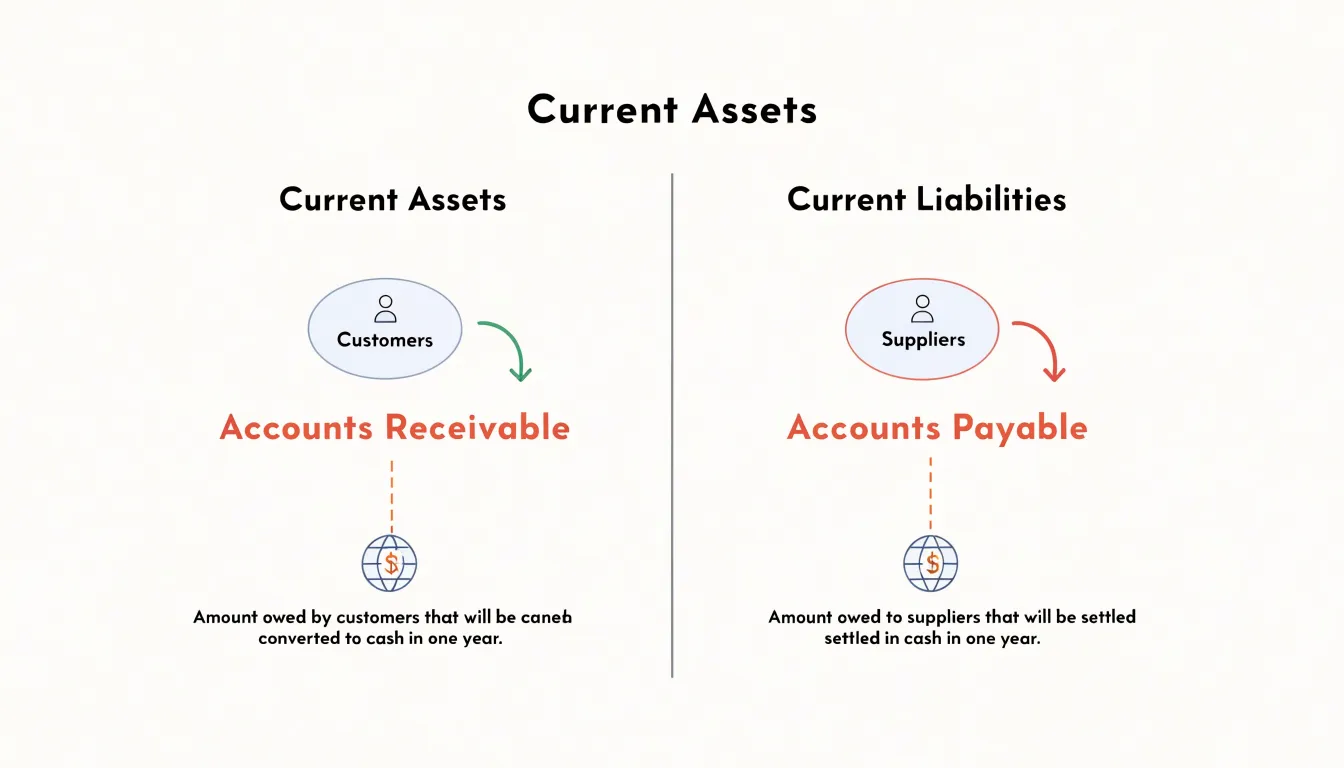
AR and AP are the backbone of accrual-based reporting because they allow revenue and expenses to be recognized when they are earned or incurred, rather than when cash changes hands. This matching of revenues and expenses provides a more accurate picture of a company’s profitability and financial position over a given period. Without AR and AP, accrual accounting would not be possible; the entire system relies on tracking these receivables and payables to ensure that financial statements reflect economic reality rather than just cash flows. Moreover, AR and AP are critical for managing cash flow and maintaining good relationships with customers and suppliers. Effective management of these accounts ensures that a company can meet its short-term obligations while also collecting what it is owed in a timely manner.
Which Businesses Are Required to Use Accrual Accounting
The IRS does not require every business to use accrual accounting, but it does impose mandatory accrual rules on certain entities once they cross specific thresholds. The central test is the gross receipts test. Under current rules established by the Tax Cuts and Jobs Act, a business generally qualifies as a small business taxpayer, and may use the cash method, if its average annual gross receipts for the prior three tax years do not exceed $29 million (adjusted annually for inflation). Once average gross receipts exceed that ceiling, the business generally must use an accrual method and account for inventory under the uniform capitalization rules, unless another exception applies. Certain entity types face stricter treatment. C corporations, partnerships with C corporation partners, and tax shelters are subject to the accrual requirement regardless of size, meaning a tax shelter cannot rely on the gross receipts test to remain on the cash method. Farming businesses also have a special threshold, historically set at $25 million in gross receipts, above which accrual accounting and the uniform capitalization rules apply.
Beyond the general thresholds, several industries carry their own accrual requirements. Tax shelters themselves, defined broadly to include syndicates, are among the entities required to use accrual methods. Dealers in securities and commodities must generally use accrual accounting, though they may elect mark-to-market treatment. In the retail and manufacturing sectors, businesses that maintain inventory must use an accrual method to account for purchases and sales, with small business taxpayers under the gross receipts threshold able to use simpler inventory rules or treat inventory as non-incidental materials and supplies. The construction industry is another area where accrual requirements can apply, particularly for larger contractors using the percentage-of-completion method, although residential and smaller contractors may qualify for exceptions. Nonprofit organizations have separate rules, with the IRS generally requiring accrual for organizations with gross receipts above certain levels, while smaller charities may use cash accounting. The practical effect is that a business must track its average annual gross receipts carefully across the three-year testing period, because crossing the threshold triggers a change in method that requires IRS approval and can affect the timing of income and deductions for years to come.
Signs Your Small Business Has Outgrown Cash Basis Accounting
Several practical signals reveal when a small business has outgrown cash basis accounting. Inventory is often the first indicator. Once a company holds meaningful stock, cash basis reporting obscures the true cost of goods sold, because purchases are recorded when paid rather than when the related revenue is earned. The result is a distorted profit picture that swings wildly from month to month and makes margins difficult to interpret. Businesses that carry inventory typically need accrual records to match costs against the sales they generate.
Investor interest provides another clear signal. When outside parties begin asking for financial statements, they usually expect accrual-based reporting that reflects receivables, payables, and obligations in the period they occur. A cash basis balance sheet that omits unpaid bills and uncollected revenue raises questions and can slow or derail conversations with potential backers. Lending requirements work the same way. Banks and credit unions frequently require accrual statements from growing businesses, particularly when reviewing loan applications or setting credit lines, because accrual figures offer a more complete view of financial position and repayment capacity.
Growing accounts receivable balances form a third indicator. As sales increase and customers begin buying on credit, cash basis accounting records revenue only when payments arrive. A business with substantial outstanding invoices may look cash-poor on paper even while sales are strong, and the resulting statements fail to show the assets the company actually holds. Watching receivables climb while reported income lags is a reliable cue that the accounting method no longer matches how the business operates.
Other practical signs include increasing complexity in vendor terms, multi-period contracts, and the need to track prepaid expenses or accrued liabilities. Each of these situations involves timing differences between cash movement and economic activity, which is precisely the territory accrual accounting is designed to handle. When owners find themselves mentally adjusting cash basis numbers to understand performance, that adjustment work is itself evidence the method has become a constraint. Recognizing these indicators early allows a business to plan the transition deliberately rather than scrambling to convert records under pressure from a lender, investor, or auditor.
The Key Advantages of Matching Costs to Revenue
Matching costs to revenue sits at the heart of accrual accounting and explains much of its analytical power. When a business records revenue in the period it is earned and records the related expenses in that same period, the income statement reflects the actual economics of the transactions rather than the timing of cash movements. A company that delivers a large project in December but collects payment in February still recognizes the cost of materials, labor, and subcontractors in December. The result is a profit figure that shows what the business truly earned from that work, giving owners, managers, and investors a more accurate view of profitability than a cash-based snapshot could provide.
This matching discipline also improves comparability across periods. When every period carries its own costs and its own revenues, month-to-month and year-over-year figures line up on a consistent basis. Seasonal businesses, project-based firms, and companies with long production cycles can compare one quarter against another without distortion from payment timing, inventory build-ups, or deferred billing. Stakeholders reviewing trends can trust that a spike or dip in profit reflects changes in the underlying business rather than the arbitrary timing of invoices and checks. That consistency is essential for benchmarking performance and for evaluating whether margins are holding steady over time.
The truer profitability picture feeds directly into better decision-making. Managers can see which products, customers, or contracts actually generate margin once all associated costs are assigned to the period, which supports pricing decisions, resource allocation, and the choice of which lines to grow or retire. Accrual figures also underpin more reliable forecasting. Budgets built on matched revenue and expense data project future performance from a realistic baseline, and the balance sheet’s accruals and deferrals reveal obligations and earned-but-unbilled amounts that cash records would hide. Lenders and investors rely on this same clarity when assessing creditworthiness or valuing a business, since matched figures show the earning capacity of the enterprise rather than its momentary cash position. In each of these ways, matching costs to revenue converts raw transactions into information that supports sound financial judgment.
Drawbacks to Consider
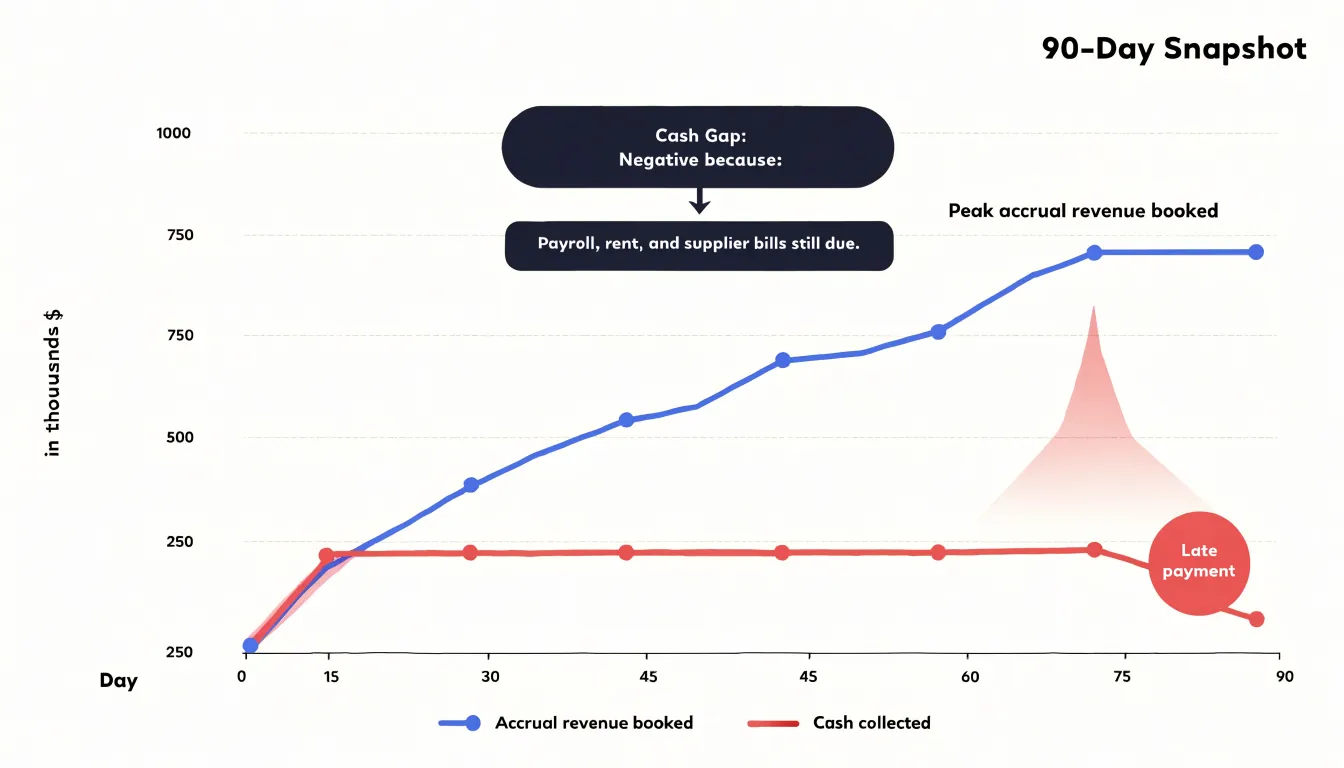
Accrual accounting can present a rosy picture of profitability even when the bank account is running low. Because revenue is recorded when it is earned and expenses when they are incurred, a company might report a healthy net income while simultaneously facing a cash crunch. For instance, a business that invoices clients on 60-day terms will book revenue immediately, but the cash may not arrive for two months. In the meantime, payroll, rent, and supplier bills must be paid in cash. The result is a misleading sense of financial health: the income statement shows profit, but the cash flow statement reveals a different reality. This disconnect can lead to poor decisions, such as overspending on new equipment or hiring staff based on paper profits that have not yet turned into cash.
The added complexity and cost of bookkeeping under accrual accounting further strain resources, especially for small businesses. Unlike cash-basis accounting, which simply tracks money in and out, accrual requires careful tracking of accounts receivable, accounts payable, accrued expenses, and deferred revenue. This demands robust accounting systems, often requiring specialized software or professional bookkeepers. The time and expense of managing these entries can be substantial. For a small team, the administrative burden may divert attention from core operations. Moreover, the need for adjusting entries at period-end—such as recording depreciation or accruing unpaid wages—adds another layer of complexity that can introduce errors if not handled meticulously.
The risk of misreading liquidity is perhaps the most dangerous drawback. Stakeholders, including managers, investors, and lenders, might glance at a profit figure and assume the business is flush with cash. However, liquidity refers to the ability to meet short-term obligations, and accrual profits do not guarantee that. A company with high sales on credit may have strong earnings but weak cash flow, leading to a false sense of security. If a sudden expense arises or a major customer delays payment, the business could face a liquidity crisis despite its profitable appearance. Without a clear understanding of the timing differences between accrual earnings and cash movements, decision-makers may fail to maintain adequate cash reserves or arrange necessary credit lines. In essence, accrual accounting, while valuable for long-term financial reporting, can obscure the immediate cash position and lead to dangerous misinterpretations of financial health.
Frequently Asked Questions
What is the difference between cash basis and accrual basis accounting?
Cash basis accounting records revenue when payment is received and expenses when they are paid. Accrual basis accounting records revenue when it is earned and expenses when they are incurred, regardless of when cash changes hands.
Under accrual accounting, when is revenue recognized?
Revenue is recorded when it is earned, regardless of when cash actually changes hands. In practice, revenue is generally considered earned when goods or services have been delivered and the company has satisfied its obligation.
What are accounts receivable and accounts payable?
Accounts receivable is money customers owe a business for goods or services delivered but not yet paid for, and it is recorded as a current asset. Accounts payable is money a company owes suppliers or vendors for goods or services received but not yet paid for, and it is recorded as a current liability.
Which businesses are required to use accrual accounting?
The IRS does not require every business to use accrual accounting, but a business generally may use the cash method if its average annual gross receipts for the prior three tax years do not exceed $29 million, adjusted annually for inflation. Above that ceiling, a business generally must use an accrual method and account for inventory under the uniform capitalization rules unless another exception applies. C corporations, partnerships with C corporation partners, and tax shelters are subject to the accrual requirement regardless of size.
How do I know if my small business has outgrown cash basis accounting?
Inventory is often the first indicator, because cash basis reporting can obscure the true cost of goods sold once a company holds meaningful stock. Other signs include investor interest, lending requirements, growing accounts receivable balances, increasing complexity in vendor terms, multi-period contracts, and the need to track prepaid expenses or accrued liabilities.
What are the drawbacks of accrual accounting?
Accrual accounting can present a rosy picture of profitability even when the bank account is running low, because revenue may be recorded before cash arrives. It also adds complexity and cost through tracking receivables, payables, accrued expenses, deferred revenue, and period-end adjusting entries. The risk of misreading liquidity is another drawback, since accrual profits do not guarantee that a business can meet short-term obligations.