
Accrual vs Cash Accounting
Cash accounting records revenue when payment is received and expenses when bills are paid, while accrual accounting records revenue when it is earned and expenses when they are incurred, regardless of when cash changes hands. The difference is timing: accrual matches revenue to the period it is earned, giving a truer picture of profitability.
Table of Contents
- How Cash and Accrual Accounting Differ in Practice
- Cash Accounting and How It Tracks Real Time Money Flow
- Accrual Accounting
- How Your Accounting Method Impacts Your Tax Obligations
- Cash vs Accrual
- Key Business Factors That Force You to Choose One Method
- Transitioning Your Business from Cash to Accrual Accounting
How Cash and Accrual Accounting Differ in Practice
The core conceptual difference between cash and accrual accounting comes down to timing—specifically, the moment at which a transaction is recognized in the books. Under cash accounting, transactions are recorded when money actually changes hands. Revenue is booked when payment is received, and expenses are booked when bills are paid. Under accrual accounting, transactions are recorded when the underlying economic event occurs, regardless of when cash moves. Revenue is booked when it is earned, and expenses are booked when they are incurred.
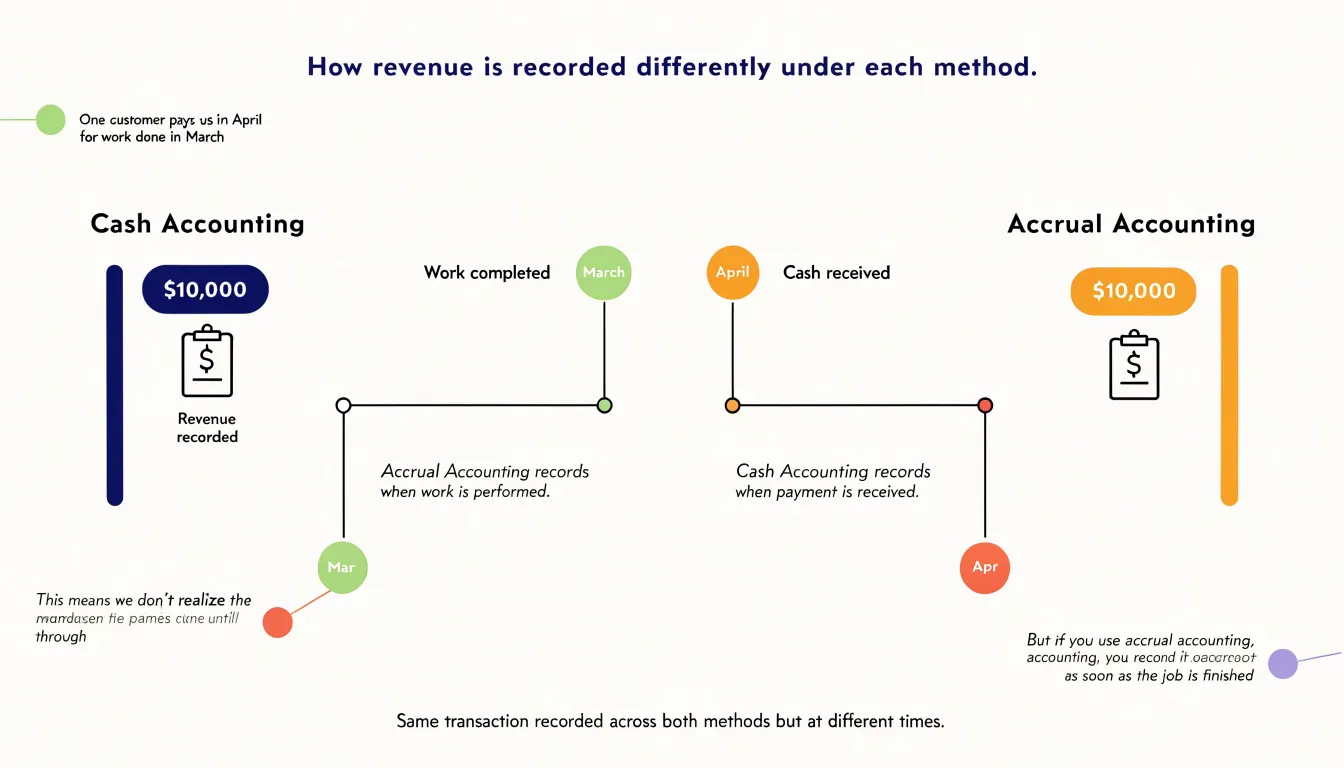
A simple example makes this concrete. Suppose a consulting firm completes a project for a client in March and invoices the client $10,000, with payment due in April. The client pays on time in April. Under cash accounting, the firm records nothing in March. The $10,000 of revenue appears in the books only in April, when the payment lands in the bank account. The March income statement shows no trace of the work that was actually completed that month.
Under accrual accounting, the firm records the $10,000 as revenue in March, when the service was delivered and the right to payment was established. An entry is made to accounts receivable, an asset on the balance sheet representing money owed by the client. When the client pays in April, the cash account increases and accounts receivable decreases by the same amount. No new revenue is recorded in April, because the revenue was already recognized in March. The April transaction is simply the conversion of a receivable into cash.
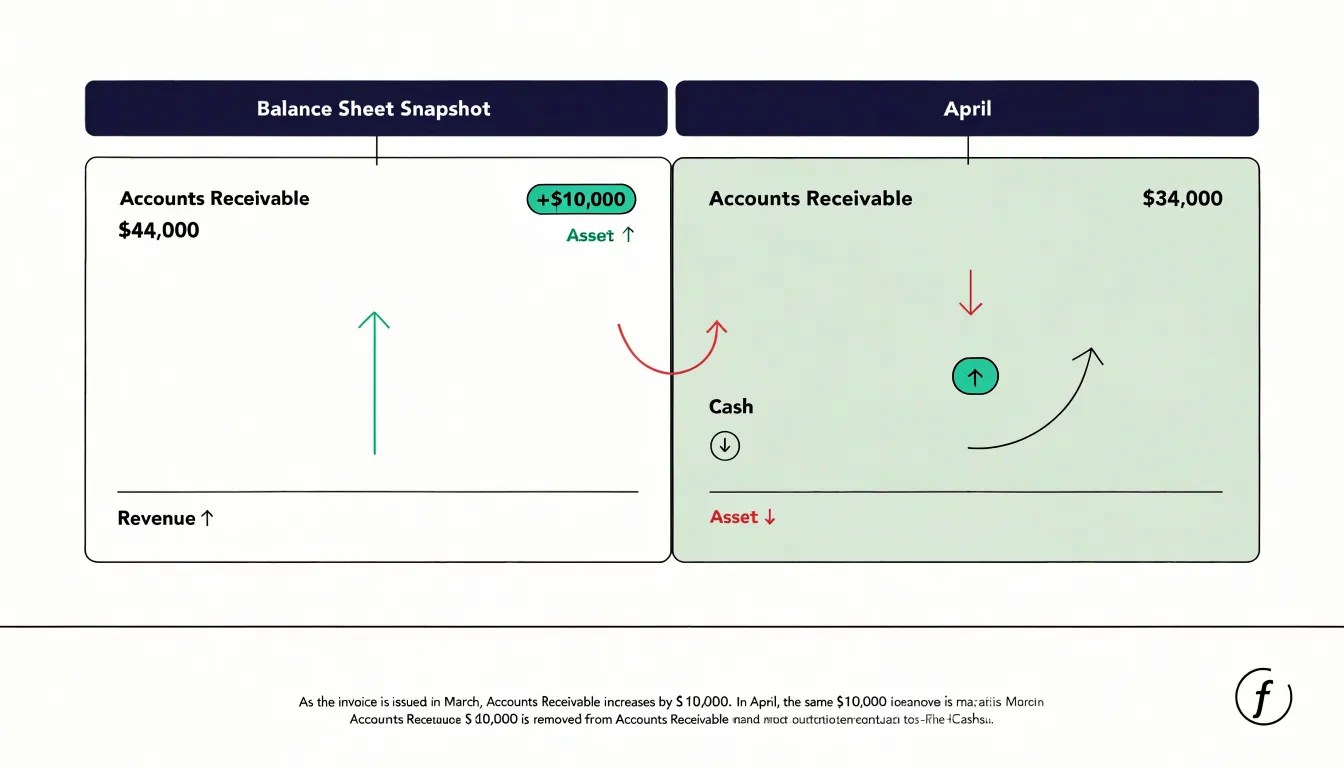
The same logic applies to expenses. If the firm receives a $2,000 software bill in March for services used that month but does not pay until April, accrual accounting records the expense in March alongside a liability, while cash accounting records it only in April when the payment is made.
This timing difference ripples through the financial statements. Cash accounting produces a picture of liquidity—what actually came in and went out. Accrual accounting produces a picture of economic activity—what was earned and what was consumed during the period. For the consulting firm, March looks profitable under accrual accounting and empty under cash accounting, even though the underlying business reality is identical. Understanding this timing distinction is the foundation for interpreting any set of financial statements.
Cash Accounting and How It Tracks Real Time Money Flow
Cash basis accounting records every transaction at the moment money changes hands. Income is entered when a customer payment actually arrives, and expenses are entered when a bill is actually paid. A business using this method can open its books at the end of the day and see exactly how much cash came in and how much went out, because the ledger mirrors the bank account. This direct link between the records and the money itself makes the system easy to understand and easy to maintain, even for someone with no formal accounting training. For small businesses, that simplicity carries real benefits. Recording a transaction takes only a moment, there are fewer accounts and adjustments to manage, and the books can be kept in a simple spreadsheet or basic software. The resulting statements answer the question owners care about most in the short term: how much money do we have right now? A cash basis profit and loss statement shows the actual inflow and outflow over a period, which makes it useful for monitoring weekly or monthly cash flow and for spotting whether receipts are keeping pace with payments. Tax treatment is often straightforward as well, since many jurisdictions tax small businesses on cash actually received and expenses actually paid, so the accounting records align with the tax return. The limitations appear when a business needs to look beyond the immediate balance. Because the method ignores promises to pay and obligations not yet settled, it can paint a misleading picture of financial health. A strong month of cash receipts might reflect invoices from three months earlier, while a weak month might simply mean customers are paying slowly rather than that sales have fallen. Large purchases are recorded as expenses the day they are paid, which can make a profitable period look poor, and obligations such as unpaid supplier invoices or taxes owed are invisible until the money leaves. For a business seeking a loan, an investor, or a buyer, cash basis statements provide little insight into revenue trends, outstanding debts, or the durability of earnings, and they can obscure the long-term trajectory that outside parties need to evaluate.
Accrual Accounting
Accrual accounting centers on the matching principle, a foundational concept that directs businesses to record revenues in the same period as the expenses that helped generate them. Under this approach, revenue is recognized when it is earned, meaning when goods or services have been delivered and the earning process is substantially complete, rather than when payment arrives. Likewise, expenses are recorded when they are incurred, meaning when the obligation arises or the resource is consumed, rather than when the invoice is paid. The result is that each period’s income statement pairs the money brought in with the costs that made that money possible, creating a coherent story of what the business accomplished during that window of time.
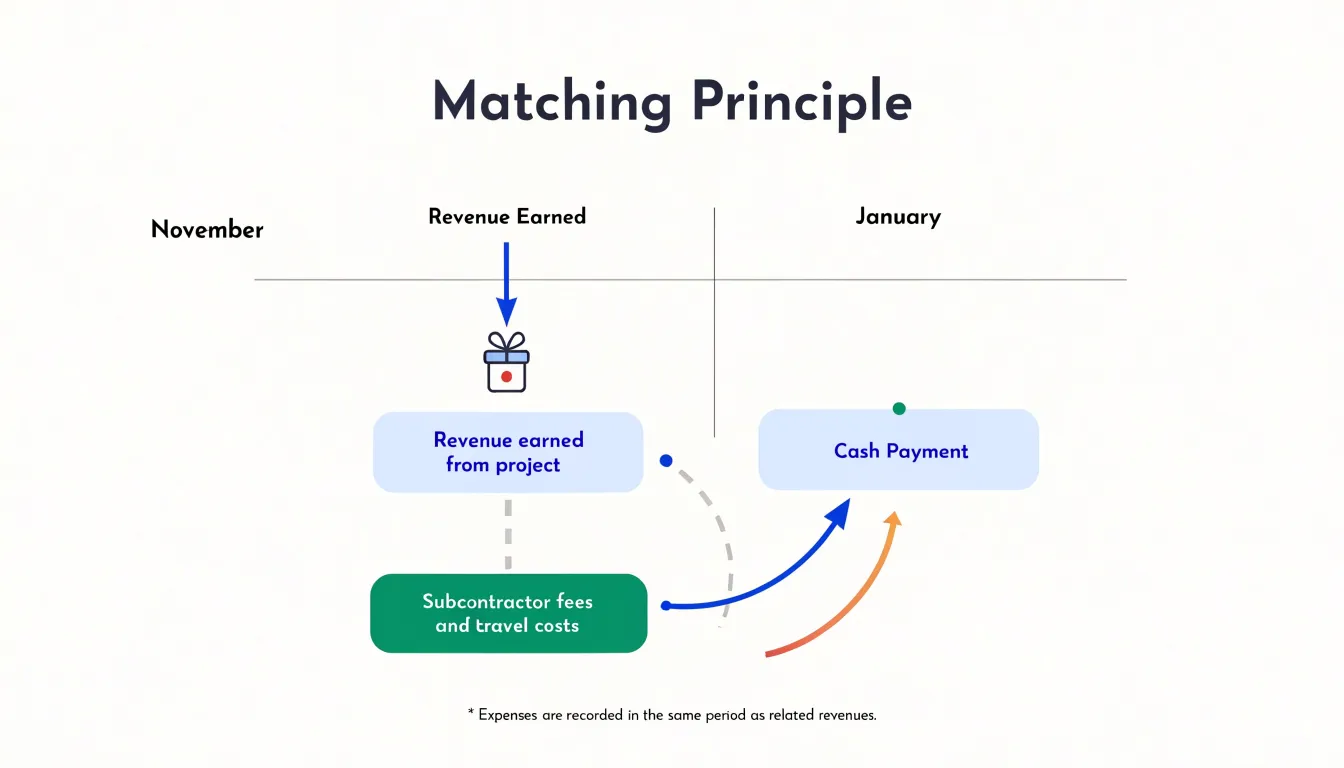
A practical illustration helps clarify how this works. Suppose a consulting firm completes a project in November and sends an invoice that the client pays in January. Under accrual accounting, the firm records the revenue in November, when the work was performed, and also records any costs tied to that project, such as subcontractor fees or travel, in the same month. The cash arrives later, but the economic activity belongs to November. Similarly, if the firm receives a utility bill in December for power used in December but does not pay it until January, the expense still lands in December. Cash movement and economic activity are tracked separately, and the income statement reflects the latter.
This separation is what gives accrual accounting its diagnostic power. By aligning revenue with the costs that produced it, the method reveals whether operations are genuinely profitable during a given period. A company can show strong cash inflows simply by collecting old receivables while its current sales slump, or it can look cash-poor while booking robust new business that has not yet been billed. Accrual figures cut through these timing distortions and show the underlying economics. Stakeholders relying on the financial statements, including owners, lenders, and investors, gain a clearer view of margin trends, operating efficiency, and the sustainability of earnings. The matching principle ultimately transforms the income statement from a simple record of bank activity into a meaningful measure of business performance.
How Your Accounting Method Impacts Your Tax Obligations
The accounting method you select determines when income and expenses are recognized for tax purposes, which in turn shapes the timing and amount of your taxable income. Under the cash method, revenue counts as taxable income in the year you actually receive payment, and expenses are deductible when you pay them. A business using the cash method that completes a large job in December but does not collect until January reports that income in the following tax year. Under the accrual method, revenue is recognized when earned and expenses when incurred, regardless of when cash changes hands. That same December job becomes taxable income in the current year even though the invoice remains unpaid, which can create a tax bill on money you have not yet received. Well-managed accrual businesses set aside reserves for exactly this scenario and monitor receivables closely so that cash is available when estimated payments come due.
The Internal Revenue Service generally requires a business to use the same accounting method for tax purposes that it uses in keeping its books, and once a method is adopted it must be applied consistently. Changing methods requires IRS consent, typically through the filing of Form 3115, and certain businesses above specified revenue thresholds must use the accrual method or an inventory-based hybrid. Sole proprietors, partnerships, and small business corporations below those thresholds often retain the flexibility to choose the cash method, which makes the selection a genuine planning decision rather than a formality.
The impact extends into considerations such as deferred taxes and estimated payments. Accrual taxpayers may owe tax in a year before the corresponding receivables are collected, effectively prepaying tax on income that has not yet converted to cash. Conversely, cash-method businesses can accelerate deductions by paying expenses before year-end and defer income by delaying billing, moves that shift taxable income between periods. Because the choice influences timing, it also influences quarterly estimated tax obligations; a mismatch between projected income and actual cash flow can trigger underpayment penalties. Businesses with significant receivables should project their taxable income under both methods, review the results with a tax advisor, and align their estimated payment schedule with the recognition rules they have adopted.
Cash vs Accrual
Placing the two methods side by side makes the difference in revenue recognition concrete. Consider a consulting firm that completes a $12,000 project in December but receives payment in January. Under cash accounting, no revenue appears in December; the $12,000 is recorded in January when the deposit clears. Under accrual accounting, the $12,000 is recognized in December, when the work was performed and the right to payment was established, with a receivable recorded until the cash arrives. Same transaction, same money, two different months and two different sets of financial statements.
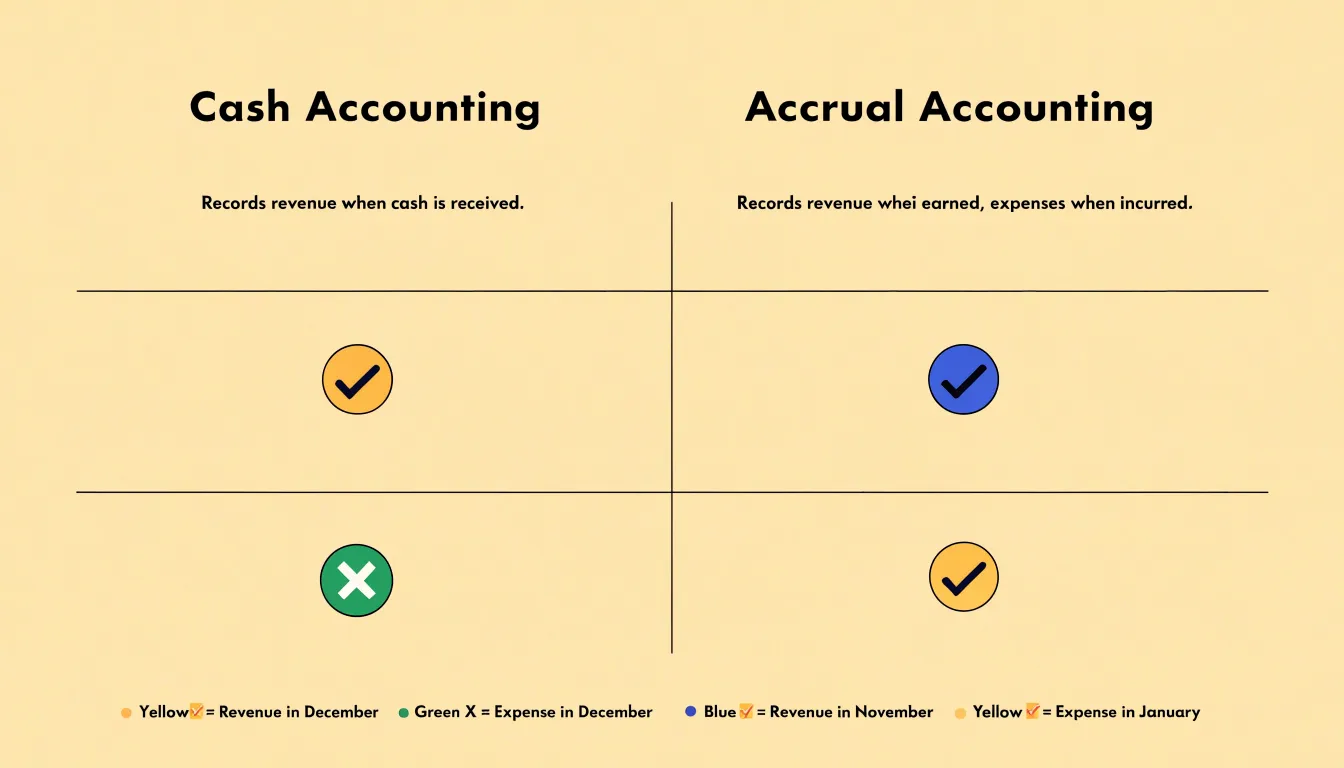
Expenses follow the same pattern. Suppose the firm pays $3,000 in December for software licenses covering the first quarter of the following year. Cash accounting records the full $3,000 as a December expense, because that is when the payment left the account. Accrual accounting records $1,000 in each of the three months the licenses are used, holding the unused portion as a prepaid asset. The expense lands in the periods that actually benefit from it rather than the period in which the invoice was paid.
A final example ties the two together. A retailer sells $5,000 of goods on credit in March and collects in April; it also receives a $2,000 deposit in March for goods delivered in April. Under cash accounting, March revenue is $2,000 and April revenue is $5,000. Under accrual accounting, March revenue is $5,000 and April revenue is $2,000, since the sale was earned in March and the deposit represents an obligation until delivery.
Viewed side by side, the distinction is one of timing and matching. Cash accounting anchors every entry to the movement of money, which keeps records simple and mirrors the bank balance. Accrual accounting anchors entries to the economic event, matching revenue to the period it is earned and expenses to the period they help generate revenue. Over the full life of a business the totals converge, yet in any single reporting period the two methods can produce markedly different pictures of profitability and cash position. Reading the same transactions through both lenses shows why the choice of method shapes everything from monthly management reports to tax obligations and lender conversations.
Key Business Factors That Force You to Choose One Method
Several concrete thresholds and circumstances determine which accounting method a business must use, and understanding them early prevents costly conversions later. The most widely recognized trigger is revenue. In the United States, the Internal Revenue Service requires businesses with average annual gross receipts above a specified inflation-adjusted threshold to use the accrual method for tax purposes. Once a company crosses that line, cash-basis reporting is no longer an option on its federal return, and the business must adjust its bookkeeping systems accordingly. The threshold is updated periodically, so growing companies should monitor it each year rather than assuming their current method remains permissible.
Inventory is another decisive factor. Businesses that maintain significant stock and sell goods to customers generally must use accrual accounting because the method matches the cost of goods sold with the revenue those goods generate. A retailer holding warehouses of merchandise cannot easily represent its true financial position on a cash basis, since purchases and sales often fall in different periods. Companies that carry inventory therefore typically adopt accrual accounting regardless of size, and the operational complexity of tracking stock reinforces that choice.
The legal structure of the business also matters. Corporations other than S corporations and certain tax-exempt entities are generally required to use the accrual method, while sole proprietorships, partnerships, and S corporations have more flexibility. As a business evolves from an LLC into a C corporation, or takes on outside investors through a formal entity structure, the permitted methods narrow. Owners planning such transitions should build accrual capability into their accounting processes ahead of time.
Lenders and investors impose their own requirements. Banks evaluating commercial loans, lines of credit, or equipment financing frequently request accrual-based financial statements because they present receivables, payables, and obligations more completely. Venture capital firms and institutional investors expect accrual reporting during due diligence. A business seeking outside capital may find that cash-basis statements fail to satisfy lenders or understate the complexity of its operations.
Finally, the sheer scale of operations makes cash accounting impractical. As transactions multiply, revenue spans longer contract periods, and customer payment terms extend beyond thirty days, the cash method produces distorted results that obscure profitability. Companies with significant accounts receivable and payable, or with multi-year contracts, need accrual accounting to present an accurate picture to management, creditors, and tax authorities.
Transitioning Your Business from Cash to Accrual Accounting
Transitioning from cash to accrual accounting requires careful planning and execution to ensure a smooth changeover. The first step is to understand the adjustments needed for your accounts receivable and accounts payable. Under cash basis, you record revenue when payment is received and expenses when paid. On an accrual basis, you record revenue when earned and expenses when incurred, regardless of cash flow. Therefore, you must create opening entries for outstanding receivables and payables. This involves identifying all unpaid customer invoices and unpaid bills to vendors as of the transition date. These amounts will be recorded as assets (accounts receivable) and liabilities (accounts payable) on your opening balance sheet. You also need to adjust for other accruals, such as prepaid expenses and accrued liabilities, to accurately reflect your financial position.
A critical step is filing IRS Form 3115, Application for Change in Accounting Method. This form must be submitted with your tax return for the year of change. The IRS requires this form to formally request permission to change your accounting method. Form 3115 includes a section for the automatic change request under the current revenue procedures, which often allows you to make the change without user fees or extensive paperwork. However, you must compute the adjustment under Section 481(a) of the Internal Revenue Code. This adjustment prevents omissions or duplications of income or deductions due to the method change. Typically, you will recognize a positive adjustment (increase in income) or negative adjustment (decrease in income) spread over four years. Proper completion of Form 3115 is essential to avoid penalties and ensure compliance.
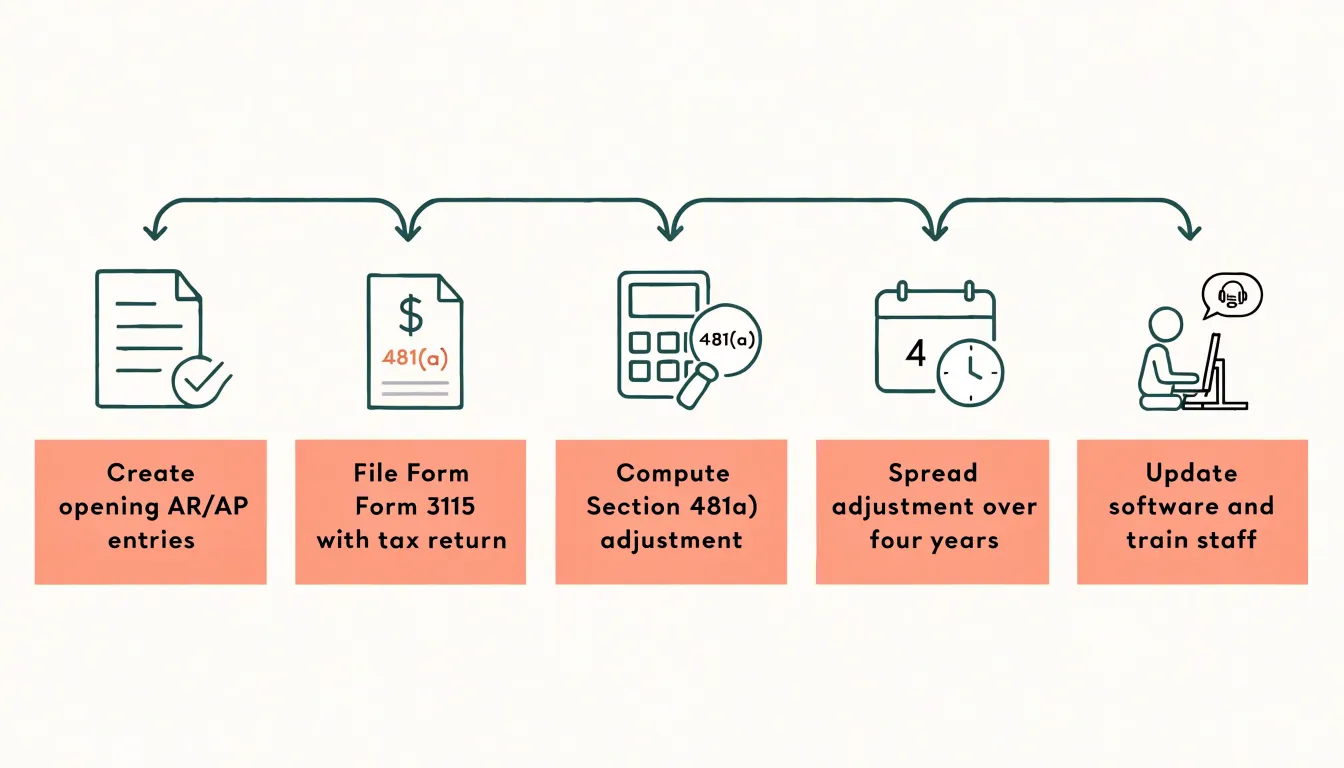
Common pitfalls during the transition include failing to reconcile the opening balances with prior tax returns, overlooking the need to adjust for inventory (if applicable), and not updating accounting software settings. It’s also important to communicate with your accountant or tax advisor to ensure all tax implications are addressed. Another pitfall is not documenting the transition process thoroughly, which can lead to errors in future periods. To avoid these issues, consider creating a detailed transition plan with timelines and responsibilities. Train your staff on the new accrual procedures and update your internal controls to handle accrual-based reporting. Finally, monitor your financial statements closely in the first few months after the transition to catch any errors early. By following these steps and being aware of potential pitfalls, you can successfully transition to accrual accounting and gain better insights into your business’s financial health.
Frequently Asked Questions
What is the main difference between cash and accrual accounting?
Cash accounting records transactions when money actually changes hands, while accrual accounting records transactions when the underlying economic event occurs, regardless of when cash moves. Revenue is booked when earned and expenses when incurred under accrual accounting.
When is revenue recorded under cash vs accrual accounting?
Under cash accounting, revenue is recorded when payment is received. Under accrual accounting, revenue is recorded when it is earned, such as when services are delivered and the right to payment is established.
How does my accounting method affect my tax obligations?
The accounting method determines when income and expenses are recognized for tax purposes, which shapes the timing and amount of taxable income. Under accrual accounting, revenue can become taxable before cash is collected, so businesses may need to set aside reserves and monitor receivables closely.
What factors can force a business to use accrual accounting?
The IRS requires businesses with average annual gross receipts above a specified inflation-adjusted threshold to use the accrual method for tax purposes. Inventory, certain legal structures, lender or investor requirements, and the scale of operations can also make accrual accounting necessary.
Can a business change its accounting method?
The IRS generally requires a business to use the same accounting method for tax purposes that it uses in keeping its books, and once adopted, the method must be applied consistently. Changing methods requires IRS consent, typically through Form 3115.
How do you transition from cash to accrual accounting?
You need to create opening entries for outstanding receivables and payables, and adjust for other accruals such as prepaid expenses and accrued liabilities. The transition also requires filing IRS Form 3115 and computing the Section 481(a) adjustment, which is typically spread over four years.