
Accrued Expenses
Accrued expenses are costs a business has incurred but not yet paid, recorded when the obligation arises rather than when cash leaves the account. Under accrual accounting’s matching principle, they appear in current liabilities on the balance sheet, ensuring expenses are matched to the period in which the related goods or services were consumed.
Table of Contents
- What accrued expenses mean in plain accounting
- Accrued expenses versus accounts payable
- Why the matching principle requires recording unpaid costs
- How to identify unbilled vendor services at month end
- Step by step guide to drafting your first accrued expense journal entry
- Common accrued expense scenarios
- How reversing entries simplify accounting in the following period
- Accrued expenses on the balance sheet
- How to review accrued expense accounts for accuracy
What accrued expenses mean in plain accounting
Accrued expenses represent costs that a business has already incurred even though the money has not yet left its bank account. In plain accounting terms, an expense is recognized when the obligation is created, not when the payment is made. A simple analogy is a household utility bill: you use electricity throughout the month, the meter runs, and the service is consumed day by day, but the bill typically arrives afterward with a payment due date. By the time the bill lands in your mailbox, you have already enjoyed the benefit of the electricity. The cost exists before the cash leaves your wallet, and that gap is exactly what an accrued expense captures. Another familiar comparison is a credit card statement: the purchases happen in real time, the statement arrives later, and the payment happens later still. Accounting follows the substance of what happened, so it records the expense when the benefit is received.
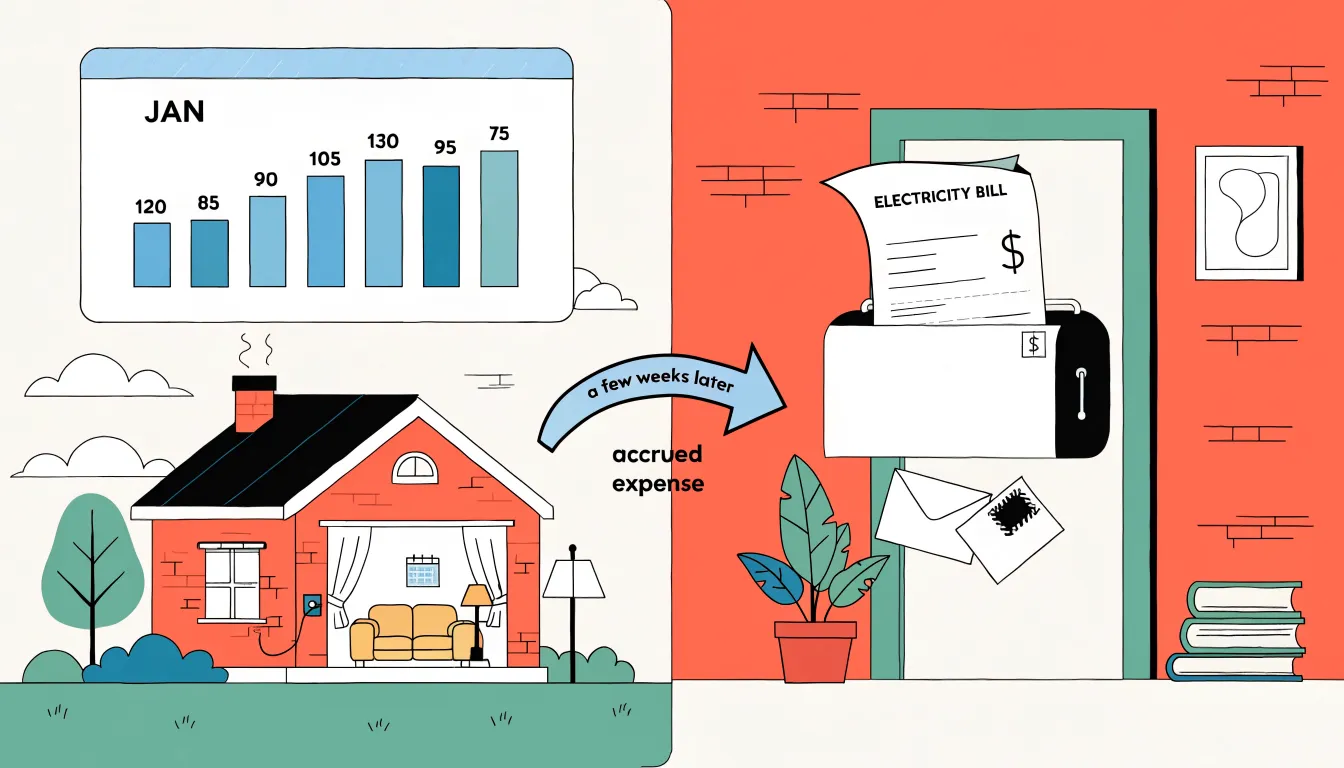
Accrued expenses exist because businesses operate on a timeline that rarely matches the timing of payments. Employees work throughout a pay period and receive wages afterward. Interest on a loan builds up daily even if it is paid quarterly. Suppliers deliver goods or services and send invoices weeks later. If a company only recorded costs when cash changed hands, its financial statements would misstate the economics of a given period: one month might look artificially profitable because bills had not yet been paid, while the next month would look artificially costly when those accumulated bills were settled. Accrual accounting smooths this out by matching expenses to the periods in which the underlying goods or services were actually used, a principle known as matching.
The distinction from cash payments is straightforward. A cash payment is the actual transfer of money, recorded when it occurs. An accrued expense is a recorded liability representing an obligation that has been built up but remains unpaid. When the payment eventually happens, it does not create a new expense; it simply settles the liability that was already on the books. For everyday understanding, think of accrued expenses as a running tab: the consumption is happening now, the accounting acknowledges the cost now, and the cash settlement follows later. This separation of timing is what keeps financial records honest and comparable from one period to the next.
Accrued expenses versus accounts payable
Accrued expenses and accounts payable both appear on the balance sheet as liabilities, and both represent money a business owes to outside parties, yet they arise from different circumstances and are tracked through different accounting processes. A side-by-side comparison along the dimensions of timing, documentation, and recording helps clarify where each fits.
Timing is the first point of distinction. Accounts payable typically cover obligations that have already been formalized by an invoice or bill received from a supplier. The business has the vendor’s paperwork in hand, the amount and due date are known, and payment is simply scheduled for a future date according to the agreed terms. Accrued expenses, by contrast, arise at the end of an accounting period for goods or services that have already been received or consumed but for which no invoice has yet arrived. The expense belongs to the current period under accrual accounting, so an estimate is recorded to match the cost with the revenue it helped generate.
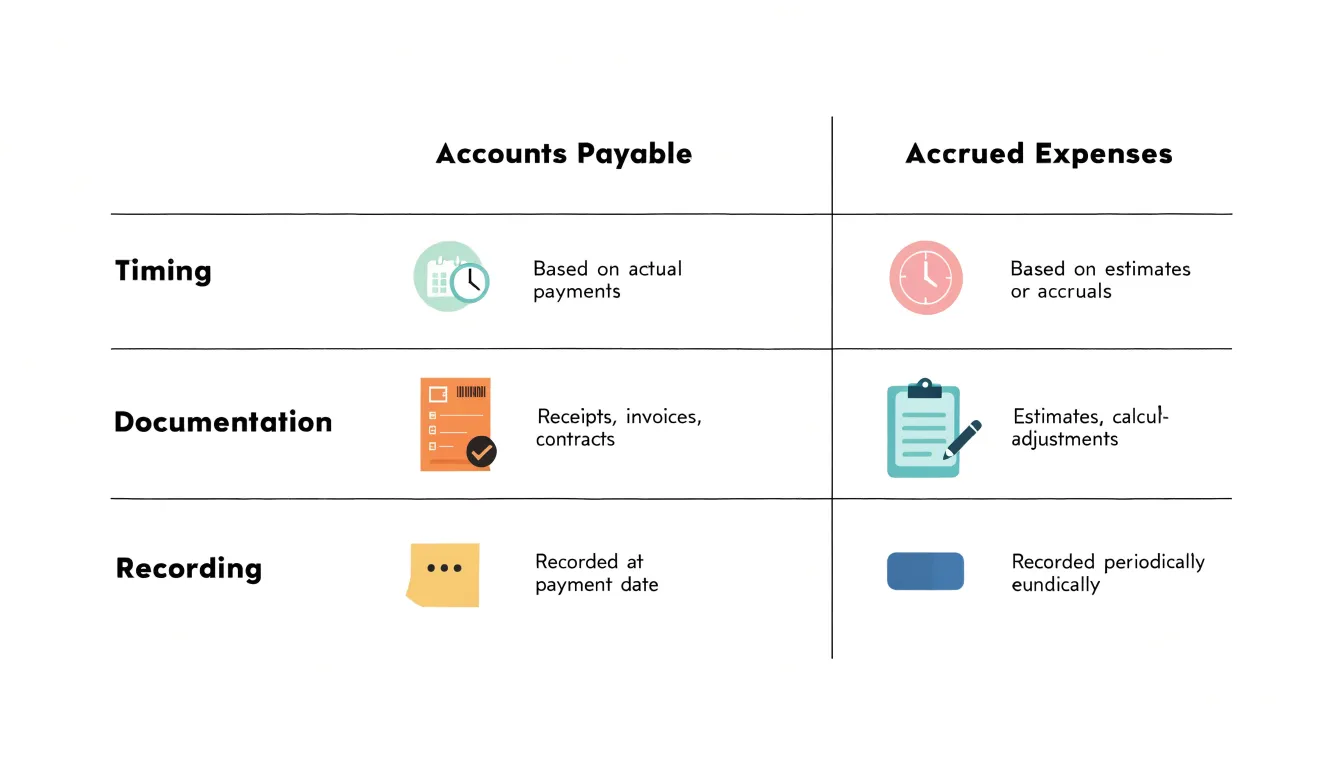
Documentation follows from that timing difference. Accounts payable are supported by an actual invoice, purchase order, or vendor statement, giving the amount a high degree of precision and creating an audit trail tied to a specific document. Accrued expenses often rest on internal evidence: a contract, a recurring billing history, a payroll schedule, or a management estimate of services rendered. Because the vendor’s invoice has not yet been received, the recorded figure may be an approximation that is later trued up when the bill finally arrives.
Recording practice reflects these differences as well. Accounts payable enter the ledger when the invoice is entered and processed, usually through a dedicated payables workflow that routes bills for approval before payment. Accrued expenses are entered through adjusting journal entries at period end, often as part of the month-end close, and are typically reversed at the start of the next period so the eventual invoice can be recorded cleanly without double counting the liability.
In practice, the two categories frequently connect. When the supplier’s invoice arrives for something previously accrued, the accrual is reversed and the amount moves into accounts payable, keeping the total liability accurate at every stage. Understanding the distinction helps readers interpret liability balances, assess how much of what is owed is documented versus estimated, and follow the flow of costs through the closing process.
Why the matching principle requires recording unpaid costs
The matching principle sits at the heart of accrual accounting because it ties every expense to the period in which the related revenue is earned rather than to the moment cash changes hands. When a business incurs a cost that helps generate revenue in a given period, that cost belongs in that period’s income statement, even if the invoice has not yet arrived or the payment has not yet been made. Recording unpaid costs as accrued expenses is the mechanism that makes this possible, ensuring that the expense side of the ledger lines up with the revenue side.
Consider a company that hires a contractor in December to complete work that supports December sales, with the bill arriving in January. Under a strict cash basis, December’s income statement would show the revenue from those sales without any of the associated cost, while January would absorb an expense that generated no revenue that month. The result is an inflated profit in December and an understated profit in January. Neither figure reflects economic reality. Accruing the contractor’s fee in December restores the correspondence between effort and reward, so each period’s profit figure tells a coherent story about what the business actually earned.
Skipping accruals distorts financial statements in several compounding ways. Net income becomes volatile and misleading, swinging between periods based on payment timing rather than performance. The balance sheet also misstates liabilities, because obligations the company has already incurred but not yet paid are omitted, making the business look less leveraged than it is. Comparability suffers as well; two companies with identical operations can report very different results simply because they settle bills on different schedules. Investors and lenders relying on these statements may draw faulty conclusions about profitability, liquidity, and trend.
Accruals also protect the integrity of ratio analysis and budgeting. When expenses land in the correct period, gross margins, operating margins, and expense ratios remain stable and meaningful. Management can compare months and quarters with confidence, and forecasts built on historical patterns hold up better. The matching principle, carried out through consistent accrual entries, keeps the income statement an honest record of the period’s economic activity rather than a haphazard log of when checks were written.
How to identify unbilled vendor services at month end
Identifying unbilled vendor services at month end begins with a disciplined review of the contracts that govern each vendor relationship. Start by pulling the active contract file and comparing the billing terms against the current period. Contracts specify billing frequency, rate structures, and trigger events for invoicing, so a service with quarterly billing or milestone-based invoicing may have been delivered this month without a corresponding invoice. Flag every contract whose billing cycle does not align with the monthly close, since these are the most likely sources of unbilled liabilities. Pay particular attention to contracts with automatic renewals, rate escalations, or usage-based components, as the amounts owed can shift from period to period and are easy to overlook.
Next, reconcile open purchase orders against invoices received. A purchase order with goods or services marked as received but no matching invoice represents a probable unbilled expense. Run a report of all open POs at month end and investigate each one. For service-based POs, confirm with the receiving department whether the work was actually performed during the period. Receiving reports, timesheets, and sign-off documents provide the evidence needed to accrue the expense accurately. Close out or adjust POs that are fully billed so the open PO list stays clean and reliable for future closes.
Vendor communications offer another practical detection method. Review recent email threads, support tickets, and statements of work for indications that services were rendered. Ask operational teams to forward any correspondence confirming delivery, completion, or acceptance of work. Vendor statements, even when they show a zero balance, can reveal pending charges or services in progress. Establish a routine of requesting statements from significant vendors before close, and compare them to your records.
Finally, build a checklist of recurring service categories, such as maintenance, consulting, and utilities, and confirm the status of each with the responsible budget owner. Combining contract review, purchase order reconciliation, and vendor communication creates a reliable system for catching services received but not yet invoiced before they distort the monthly financial statements.
Step by step guide to drafting your first accrued expense journal entry
Drafting your first accrued expense journal entry becomes much simpler when you break the process into a clear sequence of steps. Begin by identifying the expense that has been incurred but not yet invoiced or paid. This typically happens near the end of an accounting period, when a service has been received or a cost has accumulated but the supplier’s bill has not arrived. Review your contracts, utility usage, or service agreements to determine which obligations relate to the current period.
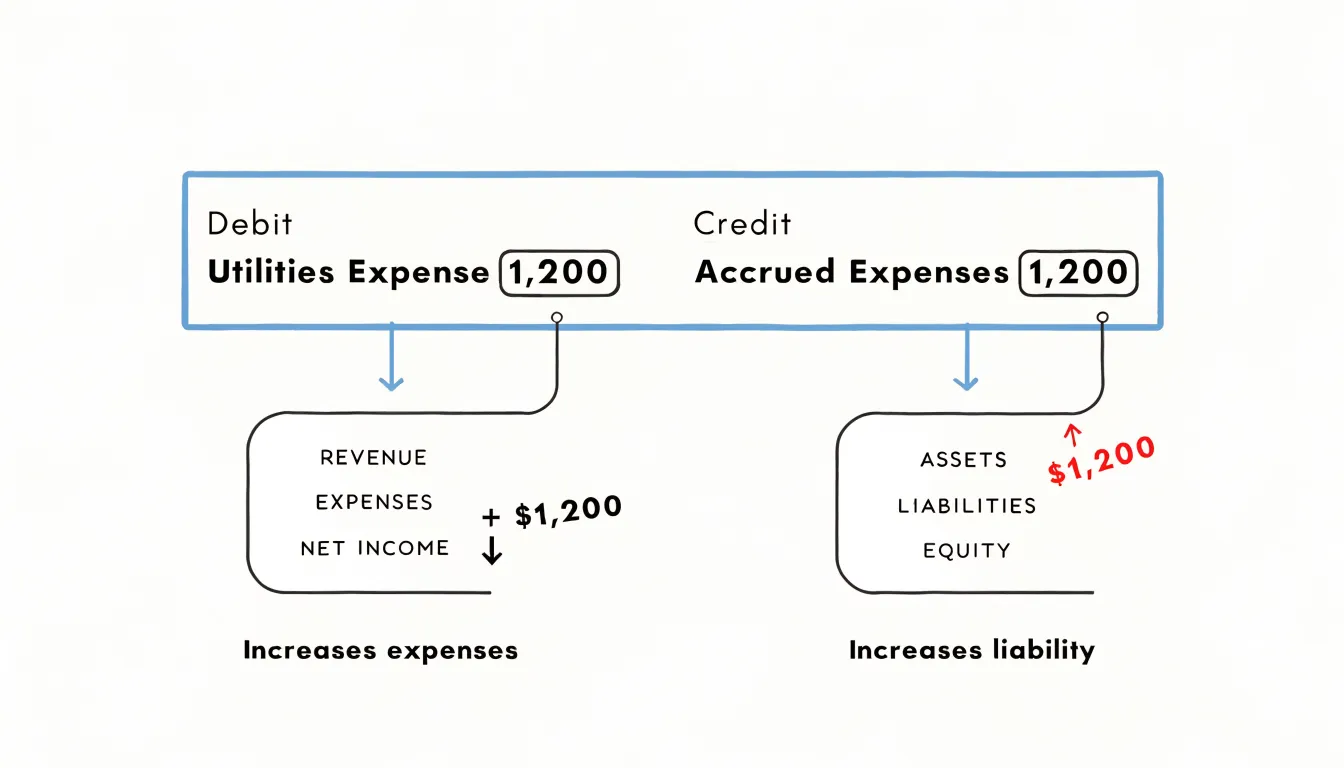
The next step is estimating the amount. Since no invoice exists yet, you will rely on the most reliable information available: the prior month’s bill, a contractual rate, or a meter reading. For example, suppose your business received electricity throughout June, but the utility bill will not arrive until mid-July. Based on last month’s bill and current usage, you estimate the June electricity expense at 1,200. Document the basis for this estimate so the figure can be reviewed and adjusted later.
Once the amount is estimated, select the correct accounts. You will need an expense account and a liability account. The expense account reflects the cost in the period it was incurred, such as Utilities Expense. The liability account captures the obligation owed, typically Accrued Expenses or Accrued Liabilities. Choosing accounts that align with your chart of accounts keeps reporting consistent and makes reconciliation easier.
Now record the journal entry. The entry debits the expense account and credits the liability account for the same amount. Using the electricity example, you would debit Utilities Expense for 1,200 and credit Accrued Expenses for 1,200. The debit increases the expense on the income statement, while the credit increases liabilities on the balance sheet. Confirm that debits and credits balance before posting.
After posting, note the entry in your records with a brief description and the estimation method used. When the actual invoice arrives in July, you will reverse or adjust the accrual and record the real bill, ensuring expenses land in the correct period. Following these steps gives you a reliable, repeatable process for accurate accrual accounting.
Common accrued expense scenarios
Utilities provide one of the clearest examples of accrual in everyday accounting. A company receives its electricity bill after the billing period closes, often well into the following month. Suppose the December electric bill of $2,400 arrives on January 8. Under accrual accounting, the expense belongs to December because that is when the electricity was consumed. At December 31, the accountant records a debit to Utilities Expense of $2,400 and a credit to Accrued Utilities Payable of $2,400. When the bill is paid in January, the payable is debited and cash is credited, with no further effect on expense. If usage varies through the month, the amount can be estimated by taking the prior bill and adjusting for seasonal patterns or known changes in activity.
Payroll is another frequent source of accrued liabilities, particularly when pay periods straddle month-end. Consider a business with a biweekly payroll of $60,000 covering 14 days. If the pay period runs from December 22 through January 4, ten of those days fall in December. The accrued wages for December equal $60,000 multiplied by 10/14, or approximately $42,857. The entry at December 31 debits Salaries and Wages Expense for $42,857 and credits Salaries and Wages Payable for the same amount. Payroll taxes and benefits tied to those wages follow the same logic, so the employer portion of Social Security and Medicare is accrued alongside the wage figure. The remaining four days, about $17,143, become January expense when the pay period concludes.
Interest on debt accrues continuously, even when payment occurs quarterly or at maturity. Assume a company holds a $200,000 loan at 6 percent annual interest, with payments due each quarter. Monthly interest is $200,000 times 0.06 divided by 12, or $1,000. After three months, $3,000 has accrued. If the quarter ends on March 31 and payment is made April 15, the March 31 entry debits Interest Expense for $3,000 and credits Interest Payable for $3,000. The April payment then clears the payable and records any interest for the new period separately. For notes with uneven payment dates, the same formula applies prorated to the exact number of days outstanding, keeping expense matched to the period in which the borrowing cost was incurred.
How reversing entries simplify accounting in the following period
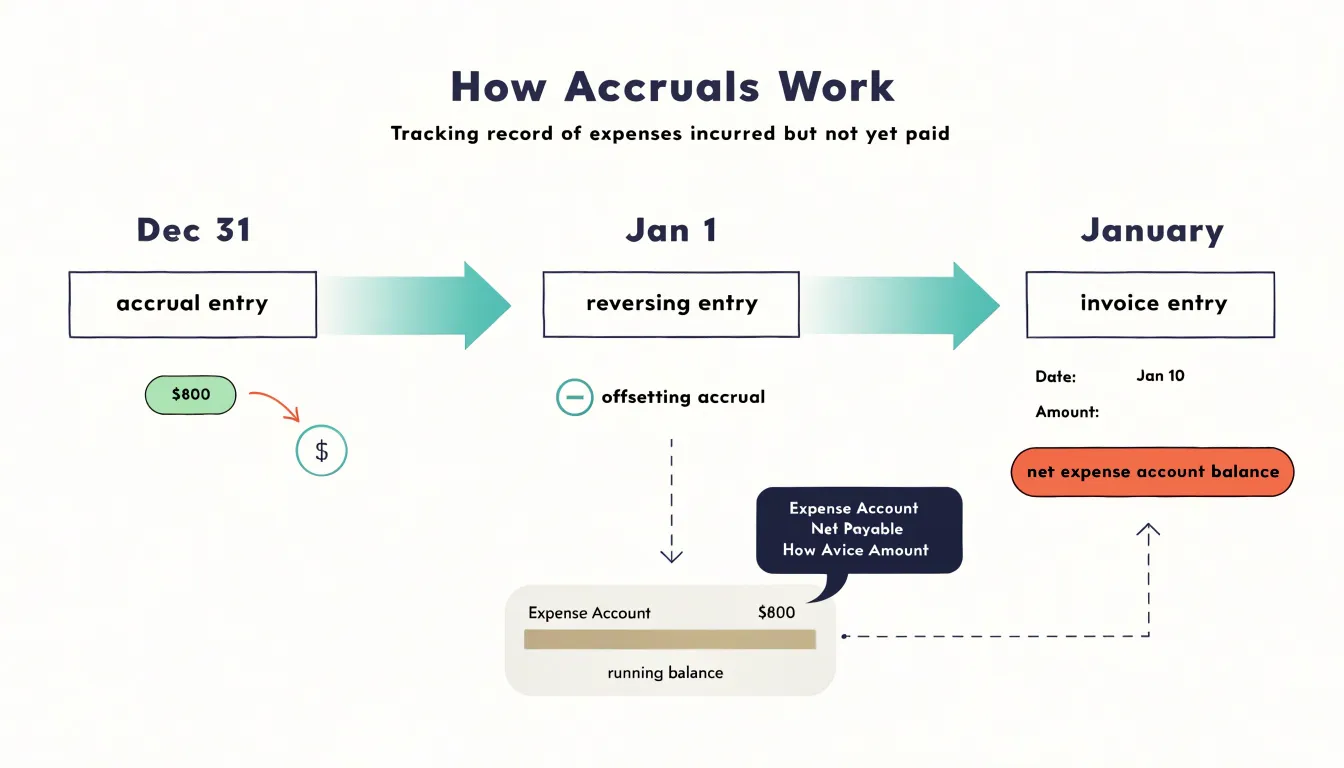
Reversing entries serve a practical bookkeeping purpose at the start of a new accounting period. At the end of a period, a business records an accrual to recognize an expense that has been incurred but not yet invoiced, along with a corresponding liability. That accrual ensures the financial statements of the closing period reflect the expense in the correct timeframe. When the next period begins, however, that accrual remains on the books, and the actual invoice the company eventually receives will also need to be recorded. Without a mechanism to clear the original accrual, the bookkeeper risks recording the same expense twice or allowing the liability account to carry a balance that no longer reflects reality. A reversing entry resolves this by automatically undoing the accrual on the first day of the new period. The expense account is credited and the liability account is debited for the same amount as the original accrual, returning both accounts to a clean state.
The benefit becomes clear when the actual invoice arrives. Suppose a company accrues $5,000 in utilities expense at the end of December, debiting Utilities Expense and crediting Accrued Liabilities. On January 1, a reversing entry debits Accrued Liabilities and credits Utilities Expense for $5,000, which zeroes out the liability account and offsets the expense. When the utility invoice finally arrives in January, the bookkeeper simply records it in the normal way: debiting Utilities Expense and crediting Accounts Payable. Because the reversal has already offset the earlier accrual, the net effect in January is that only the actual invoiced amount remains reflected in the expense account. There is no need to trace back to the original accrual, compare amounts, or post a manual adjustment. Routine invoice entry handles everything.
A sample reversal entry makes the mechanics concrete. On December 31, the accrual is recorded as a debit to Utilities Expense of $5,000 and a credit to Accrued Liabilities of $5,000. On January 1, the reversal is recorded as a debit to Accrued Liabilities of $5,000 and a credit to Utilities Expense of $5,000. When the invoice arrives, the standard entry debits Utilities Expense and credits Accounts Payable. The expense account nets to the invoiced amount, and the liability clears cleanly, keeping the ledger accurate with minimal effort.
Accrued expenses on the balance sheet
Accrued expenses appear on the balance sheet within the current liabilities section, typically grouped alongside accounts payable, short-term debt, and other obligations due within one year. While the exact line item label varies by company, common presentations include “accrued expenses,” “accrued liabilities,” or “other accrued expenses.” This placement reflects the fundamental nature of an accrual: an obligation has been incurred because goods or services were received, but the corresponding payment has not yet been made. Because the obligation is expected to be settled within the operating cycle, usually within twelve months, it belongs in the current liabilities category rather than among long-term obligations. Recognizing accrued expenses in this section keeps the balance sheet aligned with the matching principle, ensuring that expenses are recorded in the period they are incurred regardless of when cash changes hands.
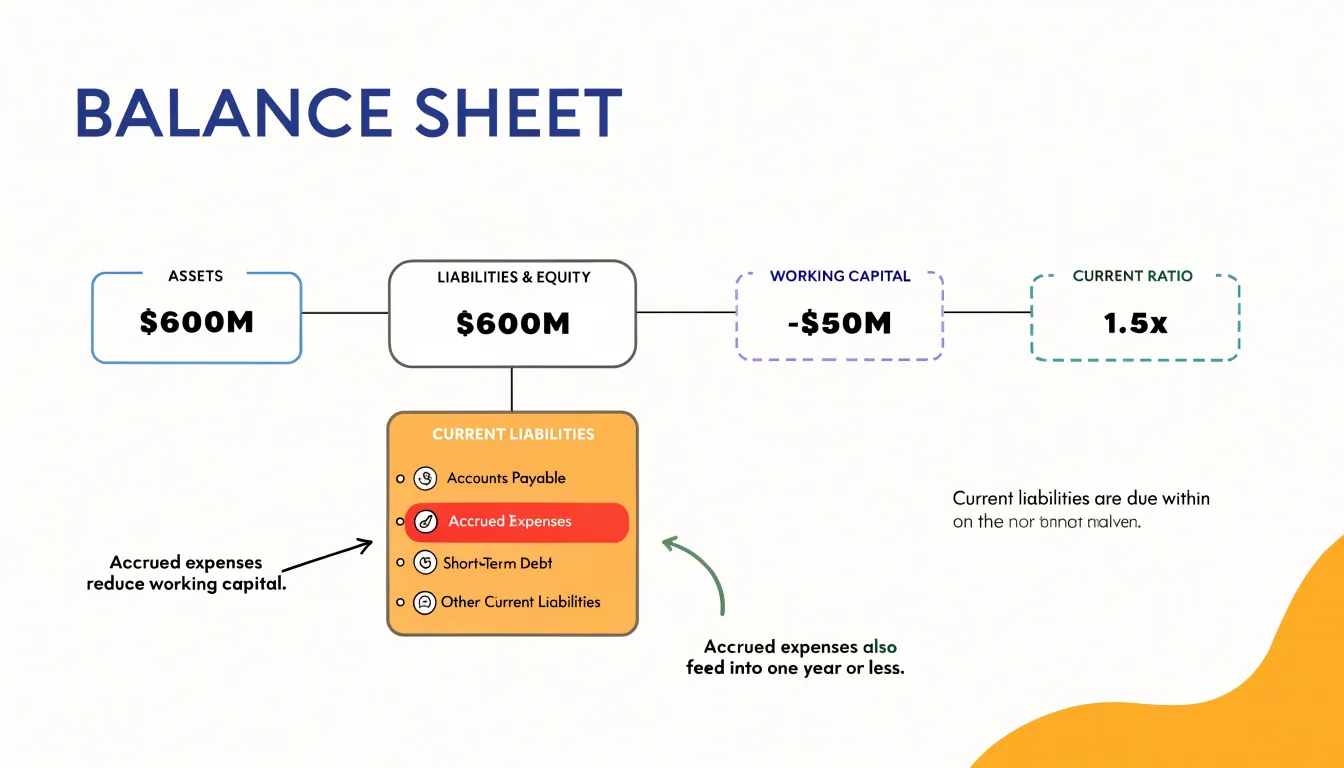
The effect on current liabilities is direct and cumulative. Every accrual recorded increases total current liabilities by the amount of the obligation, whether the accrual relates to wages earned but unpaid, interest that has accumulated on a loan, utilities consumed during the period, or taxes owed but not yet remitted. Because current liabilities serve as the denominator in several liquidity measures, growth in accrued expenses influences ratios such as the current ratio and the quick ratio. Analysts examining these metrics should recognize that accrued expenses are non-debt obligations that arise from normal operations, and their movement often tracks business activity: a growing company typically accrues more wages, more interest, and more taxes as operations expand.
Working capital, calculated as current assets minus current liabilities, is directly reduced by accrued expenses. Each dollar of accrual lowers working capital by a dollar, all else equal. This makes accrued expenses a meaningful input for anyone assessing short-term financial flexibility. A company with substantial accrued liabilities may appear less liquid on paper even though the obligations represent routine operating costs rather than distress. For this reason, trend analysis matters: a sudden spike in accrued expenses can signal timing shifts in payroll or vendor payments, while a sustained increase may simply reflect growth. Understanding where accruals sit on the balance sheet and how they flow into working capital gives readers a clearer picture of a company’s near-term obligations and its operational rhythm.
How to review accrued expense accounts for accuracy
Reviewing accrued expense accounts for accuracy begins with a structured reconciliation process. Start by obtaining the general ledger detail for each accrued expense account and comparing the balance to supporting documentation, such as accrual schedules, contracts, or vendor statements. Verify that each accrual is supported by a valid obligation incurred but not yet invoiced. A checklist helps ensure consistency: confirm the accrual exists for a legitimate business purpose, that the amount is based on a reasonable estimate, and that the period recorded aligns with the matching principle. Next, compare estimates to actual invoices as they arrive. For recurring accruals like utilities or professional fees, match the actual invoice to the accrued amount and investigate significant variances. If the actual invoice is higher or lower than the estimate, adjust the accrual accordingly in the period the invoice is received, ensuring the expense is recorded in the correct period. For stale accruals, review balances that have remained unchanged for multiple periods. These may represent amounts that were over-accrued, obligations that have been settled without proper clearing, or errors. Clear stale accruals by reversing them if the obligation no longer exists, or by applying them against actual invoices if they relate to goods or services received. Document the rationale for each adjustment to maintain an audit trail. Finally, perform a trend analysis of accrued expense balances over time to identify unusual fluctuations. A sudden spike or drop may indicate a missing accrual or a double count. By following this checklist, you can ensure that accrued expenses are accurately stated, that expenses are recognized in the proper period, and that the balance sheet reflects true obligations.
Frequently Asked Questions
What is an accrued expense in simple terms?
An accrued expense is a cost a business has already incurred even though the money has not yet left its bank account. In accounting, the expense is recognized when the obligation is created, not when payment is made.
What is the difference between accrued expenses and accounts payable?
Both appear on the balance sheet as liabilities, but accounts payable typically cover obligations already formalized by an invoice or bill received from a supplier. Accrued expenses arise at the end of an accounting period for goods or services received or consumed but not yet invoiced, so they are often based on an estimate.
Why does the matching principle require recording unpaid costs?
The matching principle ties every expense to the period in which the related revenue is earned rather than to when cash changes hands. Recording unpaid costs as accrued expenses helps ensure the expense side of the ledger lines up with the revenue side.
How do you identify unbilled vendor services at month end?
Review contracts for billing terms that do not align with the monthly close, reconcile open purchase orders against invoices received, and review vendor communications and statements. Build a checklist of recurring service categories and confirm their status with the responsible budget owner.
How do you record an accrued expense journal entry?
Estimate the amount using reliable information such as a prior bill, contractual rate, or meter reading, then debit the expense account and credit the liability account for the same amount. When the actual invoice arrives, reverse or adjust the accrual and record the real bill.
Where do accrued expenses appear on the balance sheet?
Accrued expenses appear within the current liabilities section, typically grouped alongside accounts payable, short-term debt, and other obligations due within one year. They increase total current liabilities and directly reduce working capital, and they can influence liquidity measures such as the current ratio and quick ratio.