
Adjusting Entries
Adjusting entries are journal entries made at the end of an accounting period to record revenue earned and expenses incurred before cash changes hands, ensuring financial statements follow accrual accounting. They update accounts for accruals, deferrals, depreciation, and amortization so each period reflects the economic activity that actually occurred.
Table of Contents
- Why Accrual Accounting Requires Adjusting Entries at Period End
- Accrued Revenue and How to Record Unbilled Income
- Accrued Expenses
- Recording Deferred Revenue When Customers Pay in Advance
- How Prepaid Expenses Gradually Convert Into Operating Costs
- Depreciation and Amortization
- How Adjusting Entries Impact Your Balance Sheet and Income Statement
- Simple Checklist for Preparing an Adjusted Trial Balance
- What Happens If You Forget to Make Period End Adjustments
Why Accrual Accounting Requires Adjusting Entries at Period End
Accrual accounting rests on the principle that revenue is recorded when it is earned and expenses are recorded when they are incurred, regardless of when cash actually changes hands. This stands in contrast to the simpler cash basis approach, and it is precisely this timing independence that makes period-end adjusting entries a necessary part of the accounting cycle. Because business activity rarely aligns neatly with calendar periods, events that economically belong to one accounting period often produce their cash effects in another. Adjusting entries exist to bridge that gap, ensuring that each period’s financial statements reflect the economic reality of what happened during that period rather than the timing of bank transactions.
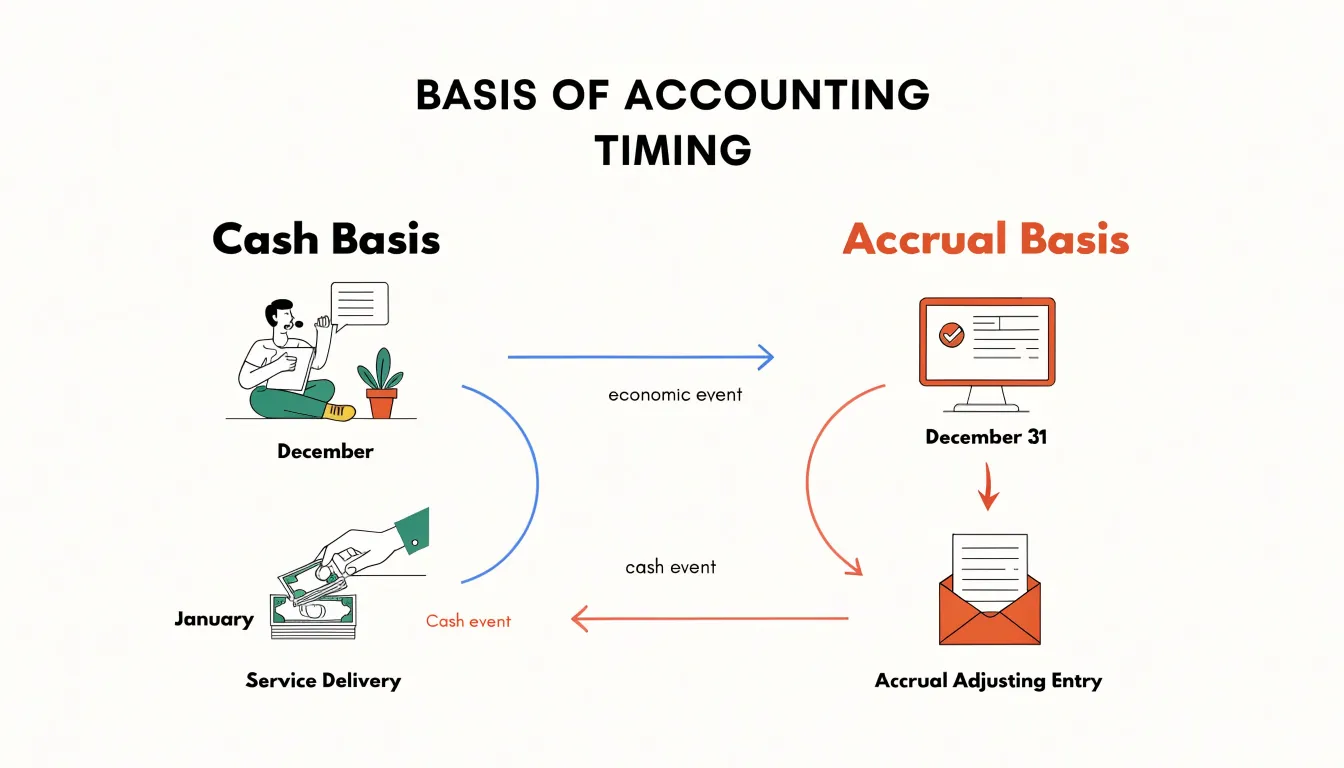
Consider a company that delivers services to a client in December but does not invoice or collect payment until January. Under accrual accounting, the revenue was earned in December, when the work was performed. Without an adjusting entry, December’s income statement would understate revenue and the balance sheet would omit the related receivable. An accrual adjustment records the revenue and the corresponding asset in the correct period, so the financial statements capture the substance of the transaction. The same logic applies to expenses. If a company receives electricity in December but the utility bill arrives in January, the expense belongs to December. An adjusting entry recognizes the expense and a liability in December, keeping both the income statement and balance sheet accurate.
Timing gaps also arise with items that are paid or received in advance. Prepaid expenses, such as insurance premiums or rent paid for future months, initially sit on the balance sheet as assets. As the coverage period elapses, a portion of that asset has been consumed and must be converted into expense through an adjustment. Similarly, unearned revenue collected before services are delivered represents a liability; as the work is completed, an adjustment moves the appropriate amount into revenue. Depreciation follows the same pattern, allocating the cost of long-lived assets across the periods that benefit from their use.
The cumulative effect of skipping these adjustments is significant. Financial statements would mix periods, overstating results in some months and understating them in others, which distorts profitability, misstates assets and liabilities, and undermines comparisons across periods. Period-end adjusting entries therefore serve as the mechanism that reconciles the accrual concept with the practical reality of periodic reporting, keeping the ledger aligned with the matching principle and giving decision-makers reliable, comparable financial information.
Accrued Revenue and How to Record Unbilled Income
Accrued revenue represents income that a business has earned by delivering goods or services, even though the customer has not yet been billed and no cash has been received. Under accrual accounting, revenue is recognized when the earning process is complete, regardless of when payment occurs. This creates a timing gap: the company has fulfilled its obligation, but the administrative step of issuing an invoice may lag behind. For example, a consulting firm might complete a project in December but not invoice the client until January. Without an adjusting entry, December’s financial statements would understate revenue and receivables, distorting profitability and asset balances.
The core issue is that revenue can be earned before it is billed because the earnings process is separate from the billing process. Companies often provide services continuously or deliver products under contracts where invoicing occurs at milestones or after a delay. Similarly, interest on a loan accrues daily even if the bank only sends a statement quarterly. In each case, the economic activity has occurred, and accounting principles require that it be captured in the period it happens. Accrual accounting aims to match revenue with the period in which it is earned, providing a more accurate picture of financial performance and obligations.
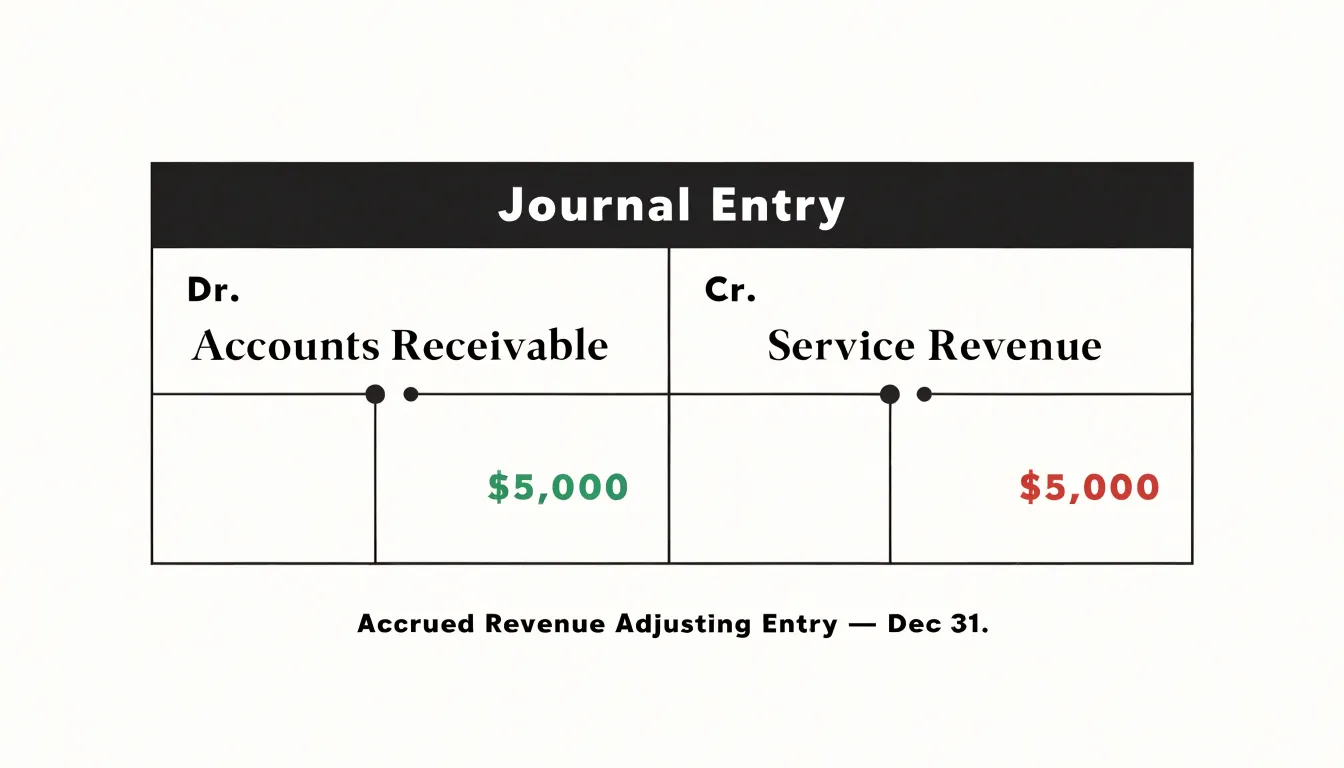
To record accrued revenue, an adjusting journal entry is made at the end of the accounting period. The entry debits an asset account, typically Accounts Receivable or a more specific Accrued Revenue account, and credits a revenue account. This increases both assets and equity, reflecting the right to receive payment and the income earned. For instance, if $5,000 of services have been performed but not yet billed, the entry would be: Debit Accounts Receivable $5,000; Credit Service Revenue $5,000. When the customer is eventually billed and pays, the receivable is already on the books, so the later cash receipt is recorded as a debit to Cash and a credit to Accounts Receivable, with no further impact on revenue. This two-step process ensures that revenue is recognized in the correct period and that the balance sheet accurately shows amounts owed to the business. Adjusting entries for accrued revenue are essential for adhering to the matching principle and for producing reliable financial statements that reflect all economic activity, billed or not.
Accrued Expenses
Accrued expenses represent costs a business has consumed or benefited from during a period even though no invoice has arrived and no cash has changed hands. Two everyday examples illustrate the concept. Employees work through the final days of a pay period, earning wages that will not appear on a paycheck until the following month. Similarly, a company uses electricity throughout December, but the utility bill does not land in the mailbox until mid-January. Under the matching principle, both costs belong to the period in which the benefit was received, so the books must reflect them before the period closes.
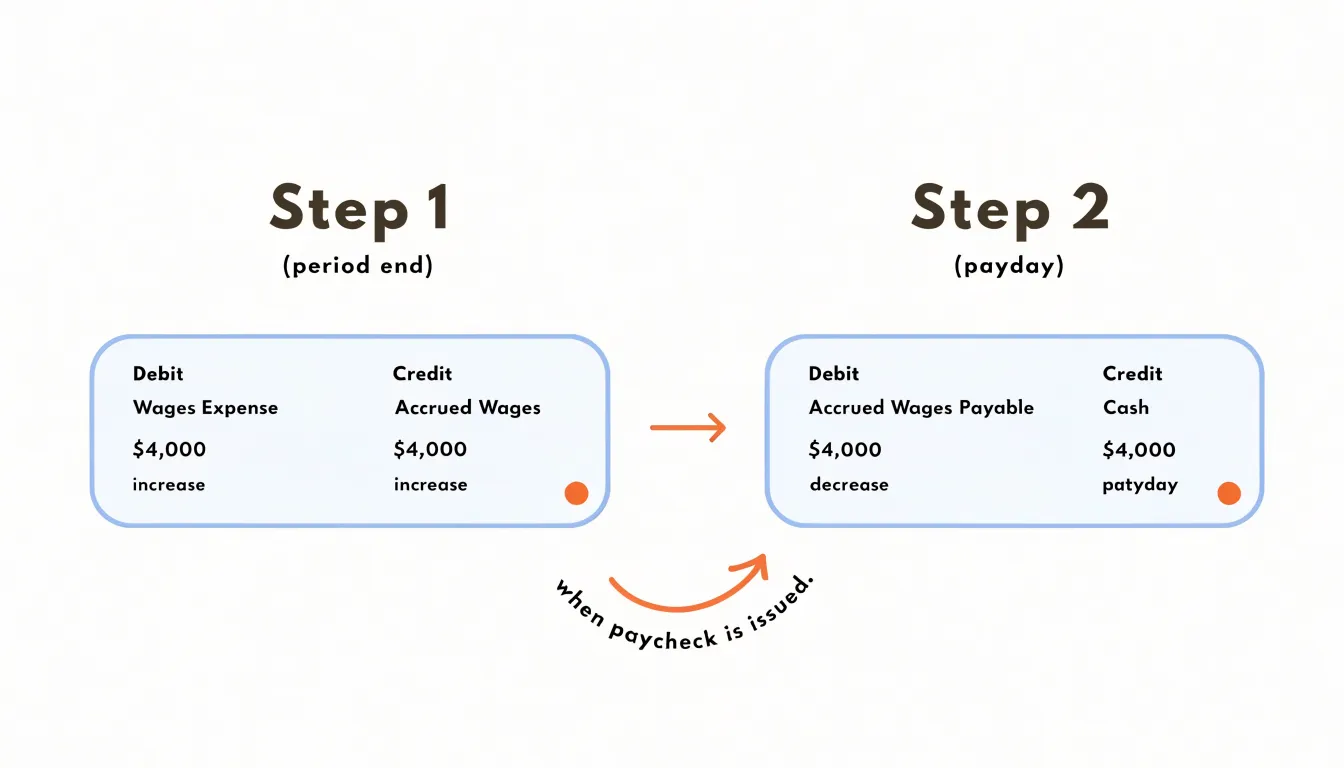
The recording process relies on a two-part adjusting entry made at the end of the accounting period. The first part debits the appropriate expense account, such as Wages Expense or Utilities Expense, which increases the expense reported on the income statement. The second part credits a liability account, typically Accrued Wages Payable or Accrued Utilities Payable, which grows the balance sheet obligation. For example, if employees have earned $4,000 in wages that will not be paid until the next payday, the entry debits Wages Expense for $4,000 and credits Accrued Wages Payable for $4,000. When the paycheck is eventually issued, the company debits the liability to clear it and credits Cash for the amount paid, with no further expense hitting the income statement.
Timing matters because skipping this adjustment understates expenses and overstates net income for the period, while also leaving liabilities off the balance sheet. The result is a misleading picture of both profitability and obligations. Accrued expenses differ from prepaid items in direction: the company owes money rather than having paid in advance. Reversing entries are optional, yet many firms use them on the first day of the next period so that routine cash transactions post cleanly without manual tracking of the earlier accrual. A consistent policy for identifying and calculating unpaid obligations at each period end keeps the financial statements accurate and comparable from one period to the next.
Recording Deferred Revenue When Customers Pay in Advance
When a customer pays in advance for goods or services, the business receives cash before it has done the work that earns that cash. Accounting treats this moment with care because the money is real, but the earnings are incomplete. Until the company delivers the promised service, the payment represents an obligation: the customer is owed performance, and the business must either provide the service or return the funds. For that reason, the initial entry records the cash received alongside a liability account, commonly called Deferred Revenue or Unearned Revenue. Cash increases on the asset side, and the liability account increases on the other side, keeping the balance sheet in equilibrium while making clear that the company still owes something of value.
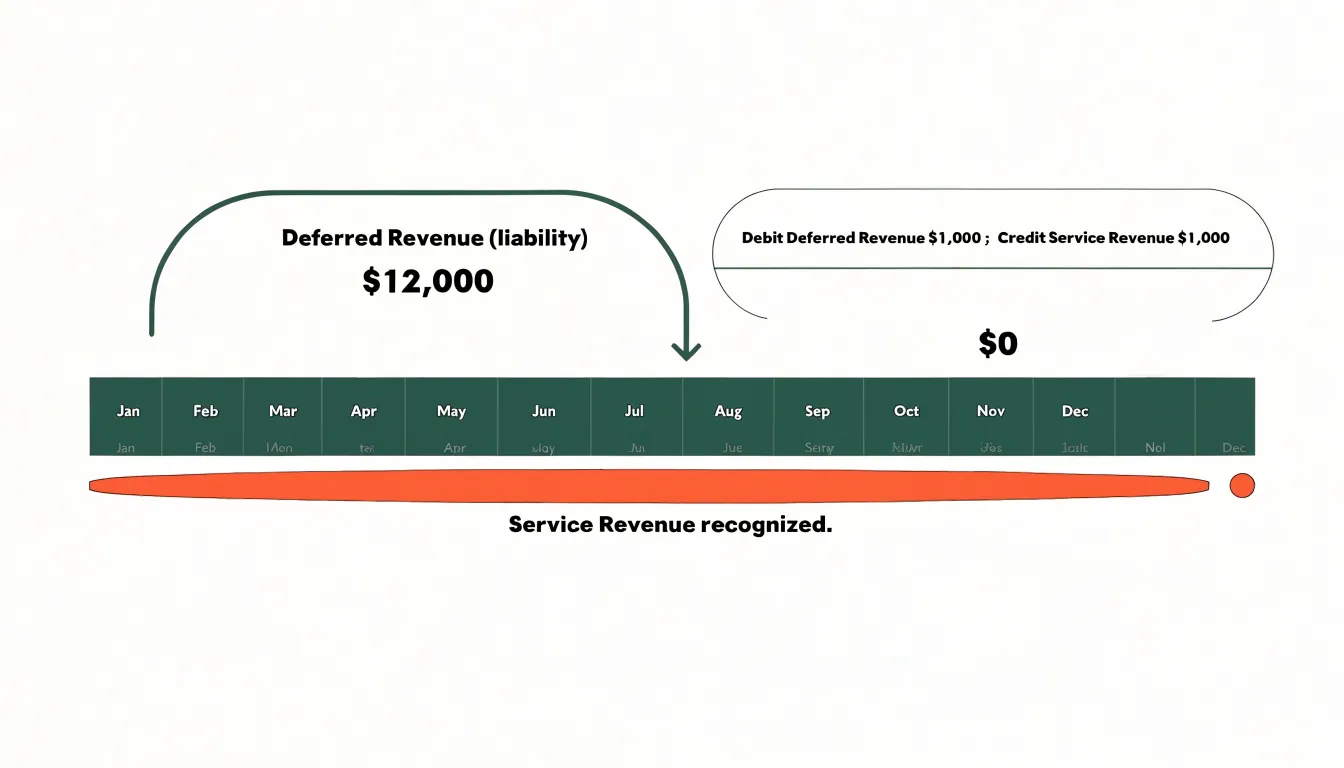
Consider a software firm that bills a client $12,000 for a year of support beginning January 1. On receipt of the payment, the firm debits Cash for $12,000 and credits Deferred Revenue for $12,000. No revenue appears on the income statement at this point, because the earnings process has not yet begun. As each month passes, the firm fulfills one-twelfth of its obligation, and an adjusting entry moves $1,000 out of the liability account and into revenue. The entry debits Deferred Revenue and credits Service Revenue. By December 31, the liability has been drawn down to zero and the full $12,000 has been recognized as revenue, matching the income with the period in which the service was actually provided.
This approach serves the matching principle, which holds that revenue should be reported in the same period as the costs and effort that produced it. It also keeps the balance sheet honest, since the deferred revenue line signals to readers how much future performance the company has promised. If the obligation is settled by refund rather than performance, the liability is debited and cash credited, removing both from the books. Throughout the life of the arrangement, the deferred revenue account acts as a bridge between the cash transaction and the eventual recognition of earned income, helping ensure that reported results reflect genuine accomplishment rather than the mere timing of a customer’s payment.
How Prepaid Expenses Gradually Convert Into Operating Costs
When a business pays for insurance, rent, or another cost that covers a future period, the payment is recorded as a prepaid expense, which is an asset on the balance sheet rather than an immediate cost on the income statement. The logic behind this treatment is that the benefit of the payment extends beyond the current reporting period. A twelve-month insurance policy purchased in one month provides protection throughout the entire year, so charging the full premium to a single month would distort both that month’s expenses and the remaining months, which would appear artificially inexpensive. Recording the payment as an asset preserves an accurate picture of what the company owns and defers recognition of the cost until the coverage is actually consumed.
As each period passes, a portion of the prepaid amount is used up. The asset account is reduced and an equal amount is recorded as an operating expense on the income statement. This gradual transfer is accomplished through an adjusting entry at the end of each reporting period. For example, if a company pays twelve thousand dollars for a one-year insurance policy, one thousand dollars of coverage expires each month. At month end, an adjusting entry debits insurance expense for one thousand dollars and credits prepaid insurance for the same amount. After that entry, the remaining asset balance reflects only the coverage still available for future months.
The same pattern applies to prepaid rent, prepaid software subscriptions, and similar advance payments. The key is to determine the portion of the benefit that has been consumed during the period and to expense exactly that amount. Without the adjusting entry, expenses would be understated and the asset would be overstated, misstating both profitability and the company’s financial position. Over the life of the prepayment, the asset is drawn down to zero while the total cost is recognized in the periods that received the benefit. This matching of cost to the periods it serves is the central purpose of the prepaid expense adjustment.
Depreciation and Amortization
When a business purchases a long-term asset such as machinery, a vehicle, a building, or a patent, the cash outlay can be substantial. Recording that entire cost as an expense in the period of purchase would distort the financial statements, because the asset will generate benefits for many years to come. Depreciation and amortization are the accounting mechanisms that allocate the cost of these long-term assets across the periods that benefit from their use. Depreciation applies to tangible fixed assets like equipment, furniture, and buildings, while amortization applies to intangible assets such as patents, copyrights, and purchased goodwill. Both processes follow the same underlying principle: the expense is spread systematically over the asset’s estimated useful life.
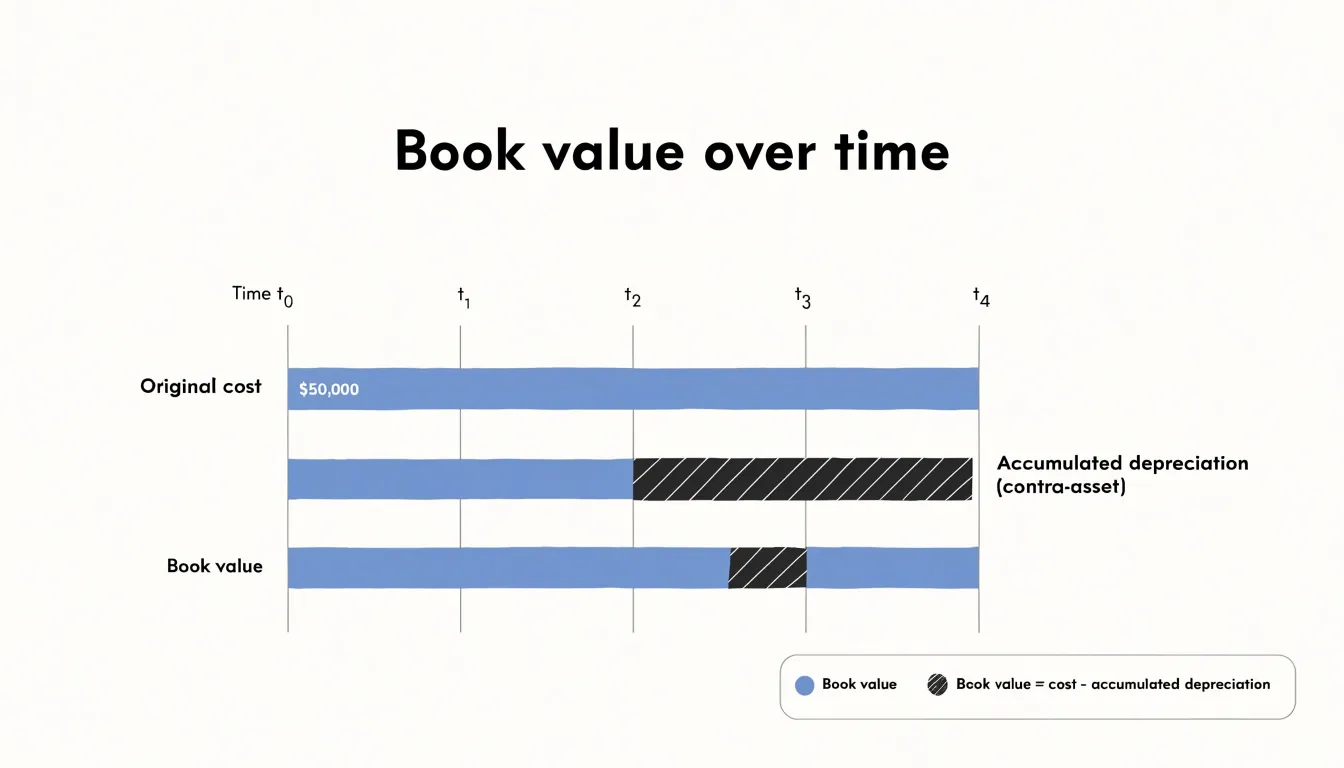
Each accounting period, an adjusting entry records a portion of the asset’s cost as an expense. The entry debits depreciation or amortization expense and credits a contra-asset account, typically accumulated depreciation or accumulated amortization, which reduces the asset’s carrying value on the balance sheet. The original cost remains visible in the asset account, while the accumulated contra account shows how much of that cost has been consumed to date. The difference between the two figures is the book value, which represents the remaining unexpired cost of the asset.
Several methods exist for calculating the periodic charge, including the straight-line method, which spreads the cost evenly, and accelerated methods such as declining balance, which front-load the expense. Whatever method is chosen, it should reflect the pattern in which the asset’s economic benefits are consumed and must be applied consistently. For intangible assets with indefinite lives, such as certain trademarks, no amortization is recorded, though impairment testing still applies.
Because these entries do not involve cash, they are classic examples of adjusting entries that align expenses with revenues under the matching principle. Without them, profitability would swing wildly, with heavy costs concentrated in purchase years and inflated profits thereafter. By allocating long-term asset costs over their useful lives, depreciation and amortization provide a more faithful picture of a company’s periodic performance and its remaining productive capacity.
How Adjusting Entries Impact Your Balance Sheet and Income Statement
Every adjusting entry you record has a dual effect that ripples through both the balance sheet and the income statement. This dual impact is a direct consequence of the double-entry system, where each adjustment involves at least one income statement account and one balance sheet account. For example, when you accrue revenue that has been earned but not yet billed, you increase a receivable asset on the balance sheet and recognize revenue on the income statement. The increase in revenue flows through to net income, which in turn increases equity via retained earnings. Simultaneously, the asset side grows by the same amount as the receivable, so the accounting equation—assets = liabilities + equity—remains in balance. Similarly, accruing an expense, such as wages earned by employees but not yet paid, increases a liability (wages payable) and decreases net income through the expense recognition. The lower net income reduces equity, matching the increase in liabilities, and the equation stays balanced. Deferral adjustments work in reverse: prepaid expenses initially recorded as assets are gradually expensed, reducing assets and increasing expenses, which lowers net income and equity by the same amount. Unearned revenues initially recorded as liabilities are later recognized as revenue, decreasing liabilities and increasing equity through net income. In each case, the adjustment ensures that both the balance sheet and the income statement reflect the correct amounts for the period, and the equality of the accounting equation is preserved because every entry affects at least two accounts in a way that keeps debits and credits equal. This dual effect is why adjusting entries are essential for accurate financial reporting: they update both the statement of financial position and the statement of comprehensive income simultaneously, ensuring that the financial statements articulate properly and that the accounting equation remains in balance after every adjustment.
Simple Checklist for Preparing an Adjusted Trial Balance
Preparing an adjusted trial balance requires a systematic approach to ensure accuracy and completeness. Begin by gathering all adjusting entries that have been journalized but not yet posted. Review each entry for proper documentation and approval. Next, post each adjusting entry to the general ledger accounts, ensuring that debits and credits are correctly recorded. After posting, calculate the new balances for each account, taking into account the adjustments. Then, prepare the adjusted trial balance by listing all accounts and their adjusted balances. Verify that total debits equal total credits; if they do not, investigate discrepancies by tracing back through the posting process. Once balanced, the adjusted trial balance serves as the foundation for preparing the financial statements. Follow this checklist: 1) Obtain all adjusting entries. 2) Post to ledger. 3) Compute adjusted balances. 4) List accounts and balances. 5) Sum debits and credits. 6) Compare totals for equality. 7) Investigate any imbalance. 8) Use the adjusted trial balance to prepare financial statements. This step-by-step sequence helps minimize errors and ensures that the financial statements reflect accurate, up-to-date information.
What Happens If You Forget to Make Period End Adjustments
When period end adjustments are skipped, the financial statements for that period no longer reflect the economic reality of the business. Revenue that was earned but not yet billed stays off the books, so income for the period is understated, while expenses that were incurred but not yet recorded are left out, so profit is overstated in other areas. The net effect can swing in either direction depending on which adjustments were missed, and the statements become an unreliable basis for judging performance. Assets such as accrued receivables, prepaid expenses that should have been consumed, and depreciation on fixed assets will be misstated, and liabilities such as accrued wages, interest, and taxes owed will be understated, which makes the balance sheet look stronger than it truly is. Ratios built from these figures, including liquidity, leverage, and profitability measures, will mislead anyone relying on them.
The difficulty does not stop at the current period. Many adjustments exist precisely to move amounts into the correct period, and skipping them pushes those amounts into the next one. An unbilled receivable left unrecorded this month becomes a larger receivable next month, and an accrued expense left unrecorded this month lands as a heavier expense next month. The following period then carries a distorted opening balance, so its statements are wrong before any new activity occurs, and the trend between periods is obscured. If the same omission repeats each period, errors can compound, with each period inheriting and magnifying the mistakes of the last.
Errors of this kind also undermine the matching principle that accrual accounting depends on, because revenues and the expenses that generated them fall into different periods. Internally, managers may make poor decisions about pricing, staffing, or spending based on figures that do not reflect actual obligations. Externally, lenders, investors, and tax authorities may receive statements that overstate financial health or understate tax liability. Because the errors are rarely isolated to one account, tracing and correcting them later requires careful reconstruction of the missing entries, which is far more costly than having made the adjustments at the close of each period.
Frequently Asked Questions
Why does accrual accounting require period-end adjusting entries?
Accrual accounting records revenue when earned and expenses when incurred, regardless of when cash changes hands, so adjusting entries bridge timing gaps between business activity and calendar periods. They ensure each period’s financial statements reflect the economic reality of what happened rather than the timing of bank transactions.
How do you record accrued revenue that has been earned but not yet billed?
At period end, debit Accounts Receivable or a more specific Accrued Revenue account and credit a revenue account. When cash is later received, debit Cash and credit Accounts Receivable, with no further impact on revenue.
What is the adjusting entry for accrued expenses such as unpaid wages?
Debit the appropriate expense account, such as Wages Expense or Utilities Expense, and credit a liability account like Accrued Wages Payable or Accrued Utilities Payable. When the payment is eventually made, debit the liability and credit Cash, with no further expense hitting the income statement.
How do you account for deferred revenue when a customer pays in advance?
Record the cash received by debiting Cash and crediting Deferred Revenue or Unearned Revenue, which is a liability. As the service is delivered, an adjusting entry debits Deferred Revenue and credits Service Revenue for the portion earned.
How do prepaid expenses gradually become operating costs?
A prepaid expense is initially recorded as an asset, and at each period end an adjusting entry debits the appropriate expense and credits the prepaid asset for the portion consumed. For example, a $12,000 one-year insurance policy becomes $1,000 of insurance expense each month.
How do depreciation and amortization work as adjusting entries?
Depreciation applies to tangible fixed assets and amortization applies to intangible assets, and both allocate the asset’s cost across the periods that benefit from its use. Each period, an adjusting entry debits depreciation or amortization expense and credits accumulated depreciation or accumulated amortization, a contra-asset account that reduces the asset’s carrying value.