
Amortization
Amortization is the gradual reduction of a balance over time, with two distinct meanings in finance. In lending, it is the scheduled repayment of debt principal through fixed payments that shift from interest-heavy to principal-heavy. In accounting, it is the systematic allocation of an intangible asset’s cost over its useful life.
Table of Contents
- Why the word amortization means two completely different things in finance
- Understanding loan amortization through mortgage and auto payments
- How payment schedules split your money between principal and interest
- Asset amortization and spreading business costs over useful life
- Amortization vs depreciation
- Debt reduction vs asset write offs
- Tax impacts of paying off loans versus deducting intangible assets
- Real world examples comparing personal loans to business software patents
Why the word amortization means two completely different things in finance
The word amortization carries a double life in finance, and the reason lies in its etymology. It descends from the Latin “ad” (to) and “mors” (death), through the Old French “amortir,” meaning to kill or extinguish. In its earliest financial usage, dating back to medieval and early modern lending practices, to amortize a debt meant literally to kill it off — to pay it down until it ceased to exist. The term was applied to loans and obligations being retired gradually through scheduled payments, a usage that survives intact today in the language of mortgages and business loans, where an amortization schedule lays out how each payment chips away at principal until the balance is extinguished.
The second meaning emerged from a related but distinct historical thread. In accounting, amortization refers to the systematic allocation of the cost of an intangible asset over its useful life. This usage grew alongside the development of modern accounting standards in the nineteenth and twentieth centuries, as businesses needed a way to spread the expense of assets like patents, copyrights, and goodwill across the periods that benefited from them. The conceptual link to the original Latin is still visible: the asset’s recorded value is gradually “killed off” on the books, period by period, until nothing remains. What changed is the object being extinguished — a liability in one case, an asset’s carrying value in the other.
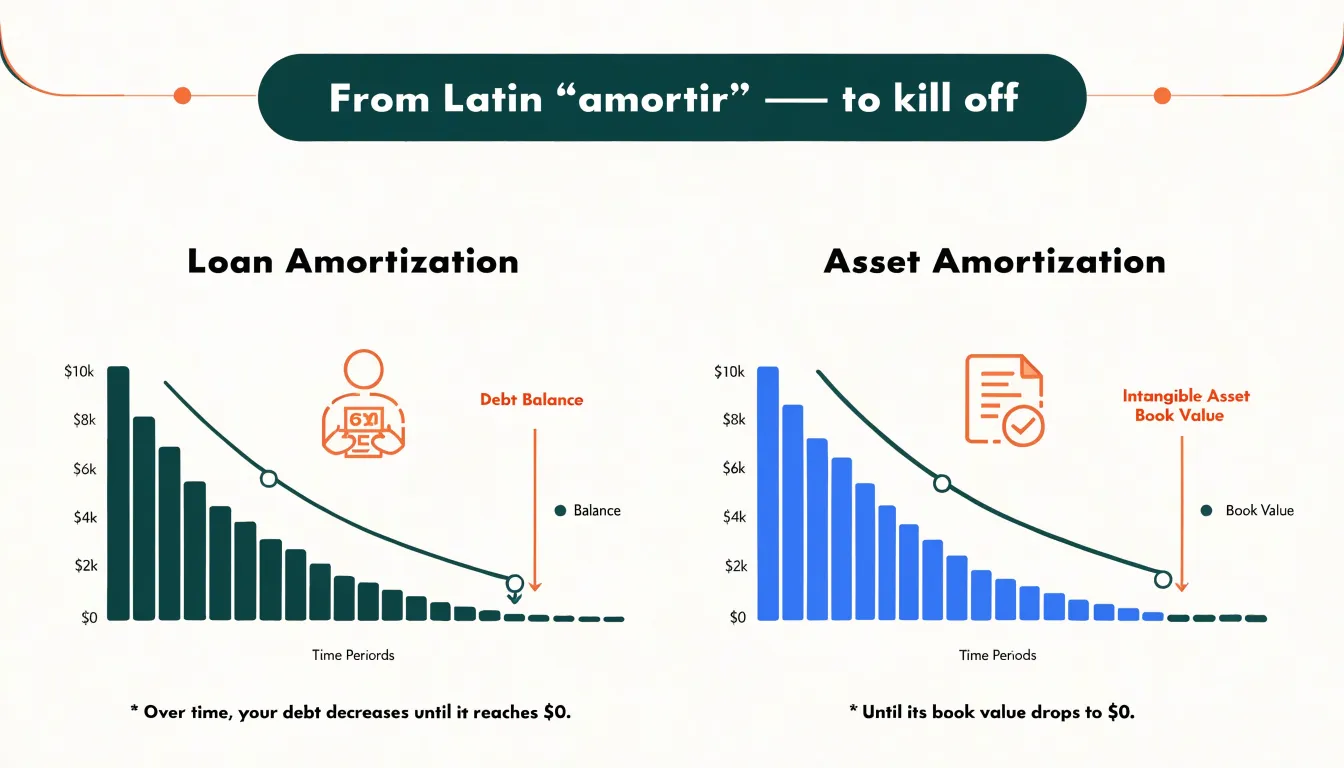
This shared root explains why the same word serves two apparently opposite functions: reducing what you owe and writing down what you own. The distinction is almost entirely contextual. In a conversation about a mortgage, a car loan, or a corporate term facility, amortization describes the repayment structure of debt. In financial statements, tax discussions, or valuation work, it describes the expensing of intangibles such as software, licenses, or acquired brand names. Readers encountering the term should look to the surrounding subject matter — the type of instrument, the financial statement line, the speaker’s frame of reference — to determine which sense is intended, because the word itself will not tell them.
Understanding loan amortization through mortgage and auto payments
Loan amortization becomes clearest when you look at two of the most familiar fixed-rate borrowing arrangements: the mortgage and the auto loan. In both cases, the borrower agrees to repay a set principal amount over a defined number of months at a fixed interest rate, and the lender calculates a level monthly payment that will retire the debt exactly by the end of the term. That single payment never changes, but the way it is divided between interest and principal shifts with every installment, and watching that shift unfold is the best way to understand what an amortization schedule actually does.
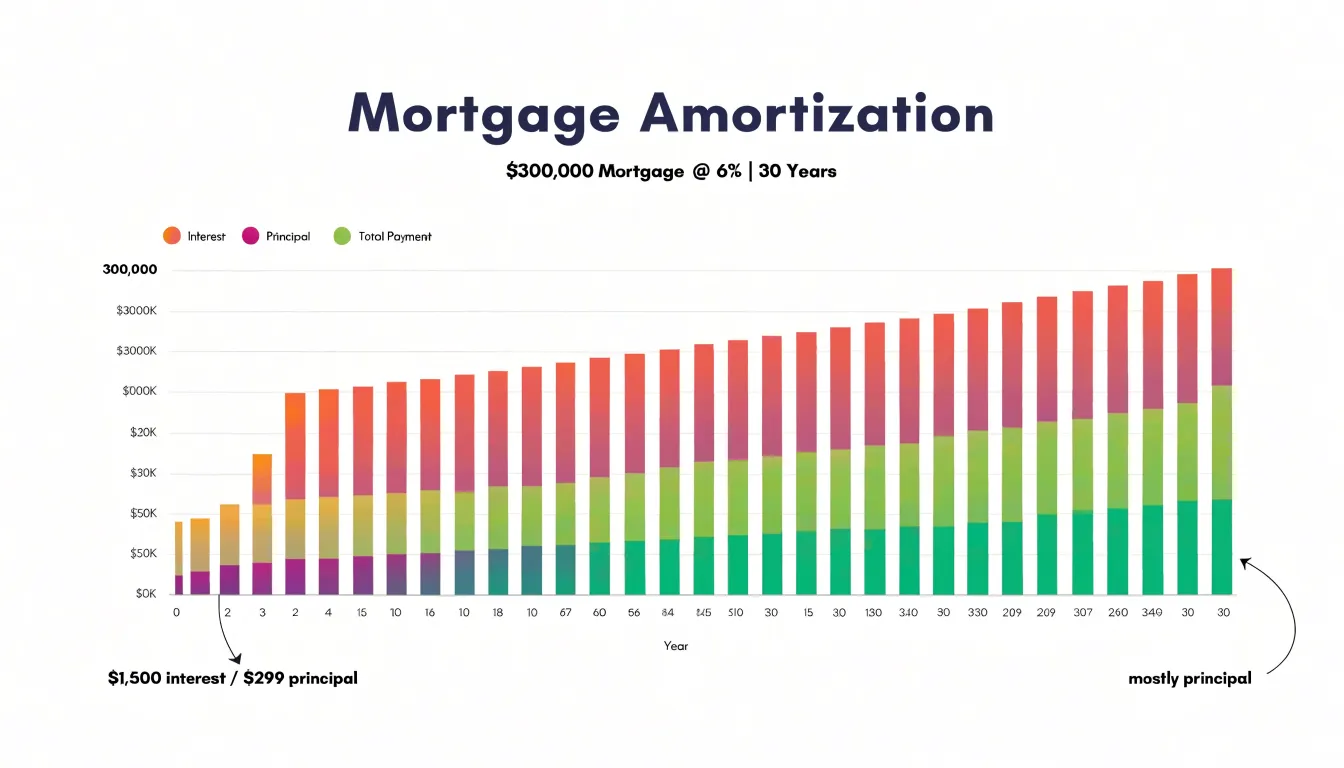
Consider a thirty-year fixed-rate mortgage of $300,000 at 6 percent annual interest. The monthly payment comes out to roughly $1,799. For the very first payment, interest is calculated on the full outstanding balance: $300,000 times 6 percent divided by twelve months, or $1,500. That leaves only about $299 to reduce the principal. By the end of the first year, the borrower has paid more than $21,000 but has chipped away only a few thousand dollars of the loan balance. Fast forward to year twenty-five, and the picture reverses. The outstanding balance is now small enough that interest consumes only a few hundred dollars of the payment, while the bulk goes toward principal. The final payments are almost entirely equity-building.
Auto loans follow the same mechanics on a compressed timeline. A $30,000 five-year loan at 7 percent carries a monthly payment near $594. In the first month, interest takes about $175, leaving roughly $419 for principal. Within a year or two, the interest portion has shrunk substantially, and by the last year most of each payment is principal. Because the term is short, the interest-heavy phase passes quickly, but the early-payment advantage to the lender is just as pronounced in proportional terms.
These examples reveal the central insight of amortization: interest is charged on the balance that remains, so front-loaded interest is simply a consequence of a large opening balance. For borrowers, this means early payments build equity slowly, which matters when considering refinancing, selling, or making extra principal payments. An extra dollar paid in year one of a mortgage saves far more interest than the same dollar paid in year twenty, because it removes a charge that would otherwise compound across decades of remaining payments.
How payment schedules split your money between principal and interest
Every fixed-rate loan carries with it a payment schedule that determines exactly how each installment is divided between interest and principal. The mechanics behind this split come from a straightforward set of formulas. The monthly payment itself is calculated using the formula M = P × [r(1 + r)^n] / [(1 + r)^n − 1], where P is the original loan amount, r is the monthly interest rate (the annual rate divided by twelve), and n is the total number of payments. This formula produces a constant payment amount that, when repeated for the life of the loan, pays off both the interest and the principal in full.
Each individual payment is then broken down according to a simple rule. The interest portion for any given month equals the remaining principal balance multiplied by the monthly interest rate. Whatever is left of the payment after covering that interest goes toward reducing the principal. In the first month, the balance is at its highest, so the interest charge is at its largest and the principal reduction is comparatively small. As the balance declines month after month, the interest portion shrinks and a growing share of each payment is applied to principal.
An amortization table captures this progression line by line. For each row, the table lists the payment number, the beginning balance, the interest paid, the principal paid, and the ending balance. To build the next row, the borrower subtracts the principal portion from the current balance and repeats the interest calculation on the new, lower figure. Running this process across the full term reveals the characteristic shape of amortization: interest dominates the early payments, the midpoint marks a rough balance between the two components, and principal dominates the final stretch.
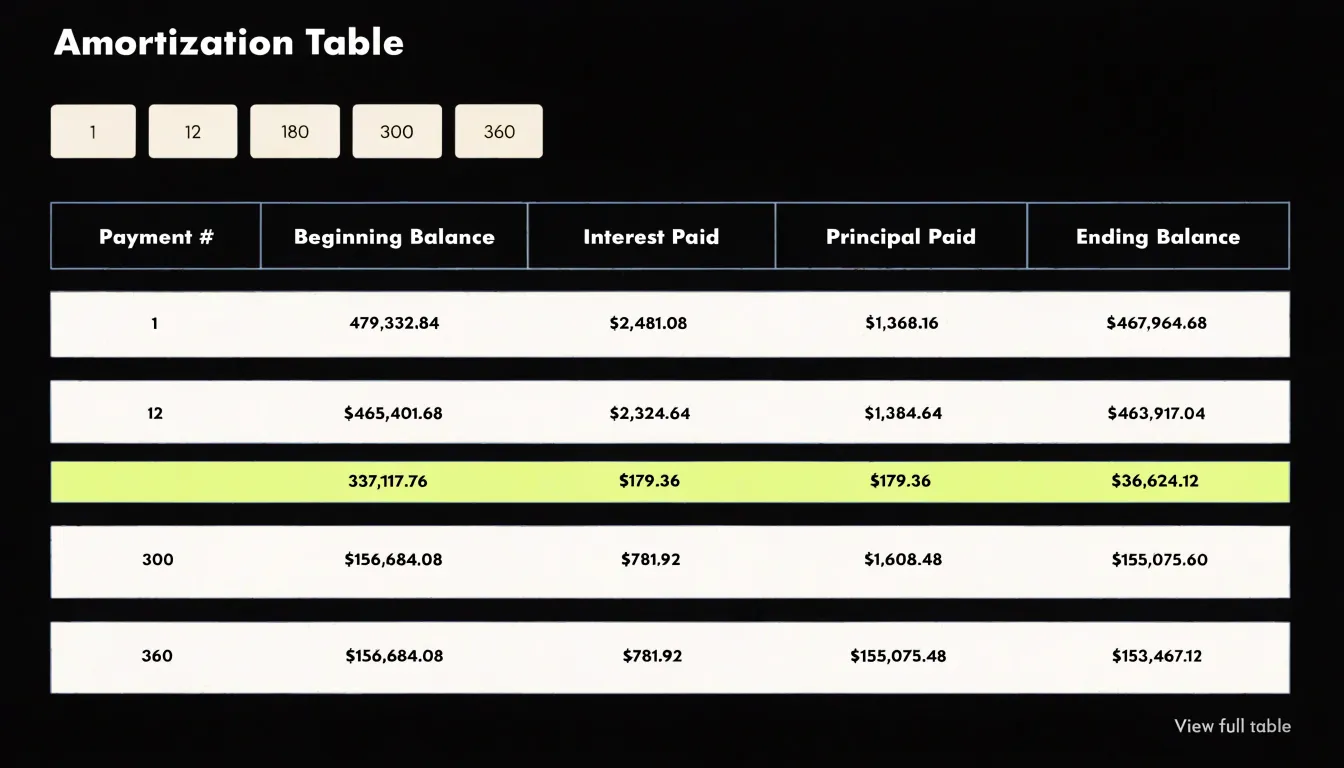
This shifting proportion has practical consequences. Two loans with identical rates and terms can behave very differently depending on where they sit in their schedules, since an early payoff retires mostly interest while a late payoff retires mostly principal. The same dynamics apply to mortgages, auto loans, and personal loans, making the amortization table a reliable map of how each payment moves a borrower toward owning the balance outright.
Asset amortization and spreading business costs over useful life
Asset amortization is an accounting practice that allows businesses to allocate the cost of an intangible asset over its estimated useful life. Intangible assets are non-physical resources that provide long-term value, such as patents, copyrights, trademarks, franchise agreements, and goodwill. Unlike tangible assets like machinery or buildings, which are depreciated, intangible assets are amortized. The goal is to match the expense of acquiring the asset with the revenue it helps generate over time, adhering to the matching principle of accounting.
When a business acquires an intangible asset, it records the cost as an asset on the balance sheet. Each accounting period, a portion of that cost is expensed on the income statement as amortization expense. This systematic allocation reduces the asset’s carrying value on the balance sheet. For example, if a company purchases a patent for $100,000 with a useful life of 10 years, it might record $10,000 in amortization expense annually, using the straight-line method. This approach spreads the cost evenly, reflecting the consumption of the asset’s economic benefits.
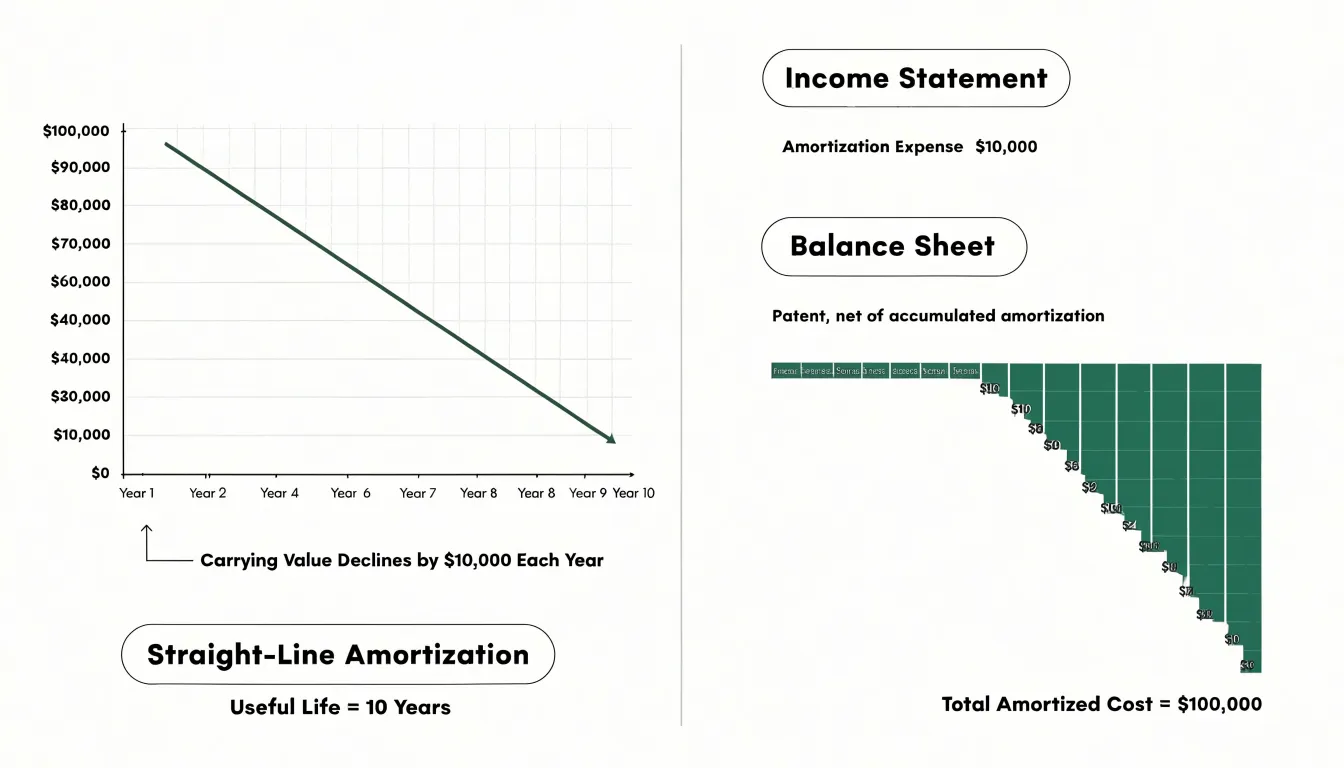
Patents grant exclusive rights to an invention for a limited period, typically 20 years. A business amortizes the patent’s cost over its legal or useful life, whichever is shorter. If the patent is expected to generate benefits for only 10 years due to technological changes, the amortization period would be 10 years. Copyrights protect original works of authorship for a set duration, often the life of the author plus 70 years, but businesses usually amortize them over a shorter period reflecting their expected utility, such as 5 to 10 years.
Goodwill arises when a company acquires another business for more than the fair value of its identifiable net assets. Goodwill represents intangible factors like brand reputation, customer loyalty, and employee relations. Under current accounting standards, goodwill is not amortized but instead tested annually for impairment. However, in some contexts, businesses may amortize goodwill for tax purposes or under certain reporting frameworks. When amortization is applied, it is typically over a period not exceeding 10 years.
The amortization of intangible assets impacts key financial statements. On the income statement, amortization expense reduces net income. On the balance sheet, accumulated amortization reduces the asset’s book value. On the cash flow statement, amortization is added back to net income in the operating activities section because it is a non-cash expense. This allocation provides stakeholders with a clearer picture of the asset’s contribution to revenue and helps in assessing the company’s financial health and performance over time.
Amortization vs depreciation
Amortization and depreciation are closely related accounting concepts, yet each applies to a distinct category of assets with its own characteristics and reporting conventions. Amortization is the systematic allocation of the cost of an intangible asset over its useful life. Intangible assets lack physical substance; familiar examples include patents, copyrights, trademarks, franchise agreements, software licenses, and goodwill acquired in a business combination. Depreciation, by contrast, allocates the cost of tangible assets such as buildings, machinery, vehicles, and equipment. Both processes spread an asset’s cost across the periods that benefit from its use, matching expense to revenue, but the underlying asset types shape how each is handled.
Accounting treatment differs in several practical respects. Intangible assets with finite useful lives are typically amortized on a straight-line basis, because reliably estimating a pattern of consumption is often difficult. The amortization expense appears on the income statement, and the asset is carried at cost less accumulated amortization. Intangibles with indefinite lives, such as certain trademarks or goodwill, are not amortized at all; instead they are tested annually for impairment. Tangible assets offer more flexibility in method, with straight-line, declining-balance, and units-of-production approaches all in common use, selected to reflect how the asset’s economic benefits are consumed.
Determining useful life also follows different logic. For tangible assets, useful life reflects physical wear, technological obsolescence, and expected usage patterns, often supported by engineering estimates or industry norms. Intangible useful lives are frequently bounded by legal or contractual terms, such as the statutory life of a patent or the term of a licensing agreement, though economic factors can shorten the period. Because intangibles can become worthless abruptly, impairment testing plays a larger ongoing role.
On the balance sheet, both accumulated amortization and accumulated depreciation appear as contra-asset accounts that reduce the carrying value of the related asset. The distinction matters for how the remaining book value is interpreted, since intangible carrying amounts often rest on valuation judgments rather than on observable physical condition. Both charges are typically non-cash expenses added back in the operating section of the cash flow statement.
Debt reduction vs asset write offs
Loan amortization and asset amortization both involve the gradual reduction of a balance over time, yet they operate in fundamentally different financial realms. Loan amortization refers to the scheduled repayment of a debt’s principal. Each payment made by a borrower reduces the outstanding liability on the balance sheet. This process directly impacts net worth: as the loan balance declines, liabilities decrease, and equity increases, assuming assets remain constant. For example, a company paying down a mortgage on a building will see its liabilities shrink, thereby boosting its net worth. Additionally, loan amortization affects financial ratios such as the debt-to-equity ratio, which improves as debt is reduced, and the interest coverage ratio, as lower debt leads to lower interest expenses over time.
Asset amortization, by contrast, is an accounting mechanism used to allocate the cost of an intangible asset over its useful life. It is a non-cash expense that reduces the book value of the asset on the balance sheet. Unlike loan amortization, it does not involve any cash outflow. Instead, it reflects the consumption of the asset’s economic benefits. This expense reduces net income on the income statement, which in turn reduces retained earnings and thus equity. Consequently, asset amortization decreases net worth, at least in the short term, as the asset’s value is written off. However, it also lowers taxable income, providing a tax shield that can indirectly benefit cash flow. Financial ratios are affected differently: asset amortization reduces the asset base, which can improve asset turnover ratios, but it also lowers profitability metrics like return on assets due to reduced net income. Moreover, it impacts the debt-to-equity ratio by reducing equity, potentially worsening the ratio.
In summary, loan amortization is a cash-based reduction of liabilities that enhances net worth and improves leverage ratios, while asset amortization is a non-cash allocation that reduces asset book value and net income, with mixed effects on ratios. Understanding these differences is crucial for accurate financial analysis and decision-making.
Tax impacts of paying off loans versus deducting intangible assets
Loan interest and intangible asset amortization both create tax shields, yet they operate under distinct timing rules and deduction mechanics. When a business borrows to finance an acquisition or expansion, the interest paid on that debt is generally deductible from taxable income in the year it accrues, provided the loan is used for business purposes and the interest rate is arm’s-length. This immediate deductibility reduces the effective cost of borrowing, because each interest payment lowers the company’s tax liability for that same period. The cash flow benefit is realized quickly, often quarterly or annually, and it can be substantial for debt-heavy capital structures.
Amortization of intangible assets follows a different schedule. Intangible assets such as patents, copyrights, customer lists, and goodwill acquired in a business combination are capitalized and then amortized over their useful lives, typically 15 years for tax purposes under Section 197 of the Internal Revenue Code for many acquired intangibles. The annual amortization expense is deductible, creating a tax shield that unfolds gradually over the amortization period. Unlike interest, which is deductible as incurred, amortization deductions are fixed by the asset’s tax basis and the applicable recovery period. This means the tax benefit is spread out, providing a steady but slower reduction in taxable income.
The timing distinction matters for cash flow planning. Interest deductions can offset current income immediately, which is valuable for businesses with high taxable profits in the near term. Amortization deductions, by contrast, offer a predictable tax shield over many years, which can be particularly useful for companies expecting stable or rising income. However, if the asset is sold or disposed of before the amortization period ends, any remaining basis may be recovered, but the timing of that recovery depends on the nature of the disposition. Additionally, the deductibility of interest may be limited by rules such as the business interest expense limitation under Section 163(j), which caps deductions based on adjusted taxable income. Amortization deductions are not subject to that limitation, though they may be affected by changes in tax law or the asset’s classification.
In practice, a business comparing debt financing to asset acquisition must weigh the immediate tax benefit of interest deductions against the long-term, steady tax shield of amortization. The choice affects not only the total tax paid but also the timing of cash flows and the predictability of tax obligations. Understanding these timing rules helps in structuring financing and acquisition decisions to optimize after-tax outcomes.
Real world examples comparing personal loans to business software patents
To illustrate how amortization works in different contexts, consider two parallel scenarios: a personal loan and a business software patent. In the first, an individual takes out a $20,000 personal loan at a 6% annual interest rate, to be repaid over five years with monthly payments. Using the standard amortization formula, the monthly payment is approximately $386.66. In the first month, interest of $100 (6% annual rate divided by 12, applied to the $20,000 balance) is charged, and the remaining $286.66 reduces the principal to $19,713.34. Each subsequent month, the interest portion declines slightly as the principal shrinks, while the principal portion grows. By the end of year one, the borrower has paid about $4,640 in total, with roughly $1,100 going to interest and $3,540 to principal. The schedule provides certainty: the borrower knows exactly how much will be owed at any point, and can plan accordingly. If the loan is paid off early, the borrower saves on future interest.
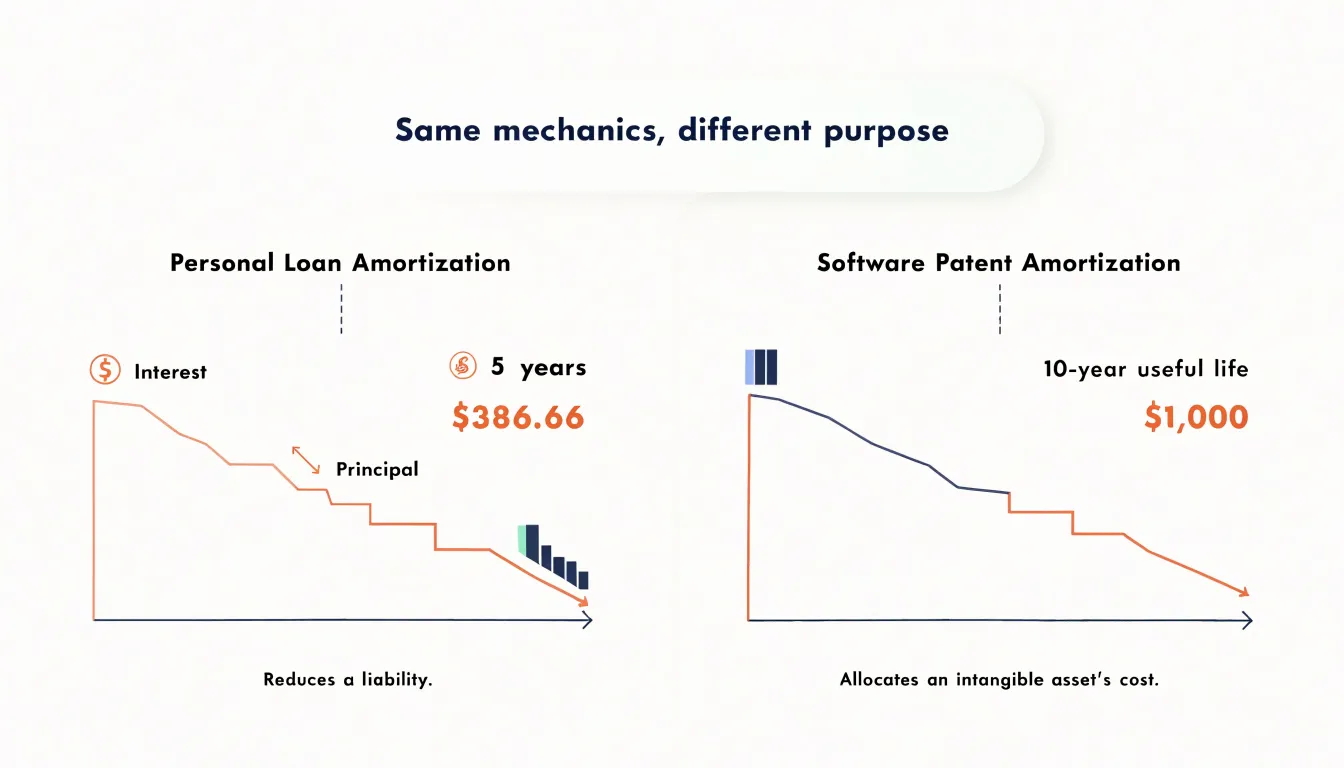
Now consider a business that develops a software patent. The company incurs $120,000 in legal and development costs to secure the patent, which has a legal life of 20 years but an estimated useful life of 10 years due to rapid technological change. For accounting purposes, the company amortizes the patent over 10 years using the straight-line method, resulting in an annual amortization expense of $12,000, or $1,000 per month. Unlike the loan, there is no interest component; amortization here is the systematic allocation of the intangible asset’s cost over its useful life. Each month, the company records a $1,000 expense on its income statement and reduces the patent’s carrying value on the balance sheet by the same amount. After five years, the patent’s book value is $60,000. If the company later determines that the patent’s useful life is only eight years, it must revise the amortization prospectively, increasing the monthly expense to reflect the shorter remaining life.
The key difference lies in the nature of the obligation: the personal loan amortization schedules principal and interest payments to satisfy a debt, while the business patent amortization allocates a capitalized cost to match revenue generation. Both use similar mechanics—a systematic reduction of a balance over time—but serve distinct purposes: one for debt repayment, the other for accounting recognition of an asset’s consumption.
Frequently Asked Questions
What does amortization mean in finance?
Amortization has two meanings in finance: paying down a debt through scheduled payments until the balance is extinguished, or allocating the cost of an intangible asset over its useful life. The intended meaning depends on context, such as a loan discussion versus financial statements or tax work.
How does mortgage amortization work?
In a fixed-rate mortgage, the monthly payment stays the same, but the split between interest and principal changes with each installment. Early payments go mostly to interest because interest is charged on the remaining balance, while later payments go mostly toward principal.
Why are early loan payments mostly interest?
Interest for any given month is calculated on the remaining principal balance, which is highest at the start of the loan. As the balance declines month after month, the interest portion shrinks and a growing share of each payment is applied to principal.
How does amortization work for intangible assets?
Asset amortization is the systematic allocation of an intangible asset’s cost over its useful life, such as patents, copyrights, trademarks, franchise agreements, and software licenses. Goodwill is not amortized under current accounting standards but is tested annually for impairment, though it may be amortized for tax purposes or under certain reporting frameworks, typically over a period not exceeding 10 years.
What is the difference between amortization and depreciation?
Amortization is the systematic allocation of an intangible asset’s cost over its useful life, while depreciation allocates the cost of tangible assets such as buildings, machinery, vehicles, and equipment. Both spread an asset’s cost across the periods that benefit from its use.
How are loan interest and intangible asset amortization treated for taxes?
Business loan interest is generally deductible in the year it accrues if the loan is used for business purposes and the interest rate is arm’s-length. Amortization of many acquired intangibles is deductible over a period typically set at 15 years for tax purposes under Section 197, creating a tax shield that unfolds gradually.