
Basic Accounting Principles Every Owner Should Know
The core accounting principles every owner should know are separating personal and business finances, choosing cash or accrual accounting, double-entry bookkeeping, revenue recognition, the matching principle, conservatism, and the cost principle. Together these rules govern when income and expenses are recorded, how assets are valued, and how reliable financial statements are prepared and reviewed.
Table of Contents
- Why separating personal and business finances prevents tax nightmares
- Cash versus accrual accounting
- Understanding the double entry system without getting lost in math
- What is the revenue recognition principle and when do you report income
- Matching principle
- How the conservative principle protects your business from overestimating profits
- The cost principle
- Essential financial statements every small business owner must review regularly
- Spotting early warnings of cash flow problems on your balance sheet
Why separating personal and business finances prevents tax nightmares
Keeping personal and business finances separate is one of the simplest habits an owner can build, and it quietly protects nearly every other part of the operation. When business income and expenses flow through the same account as groceries, rent, and school fees, the record of what the business actually earned and spent becomes blurry. Tax time turns that blur into a genuine problem, because deductions depend on proof. A business meal, a software subscription, or a tank of fuel can only be claimed if it can be tied clearly to the business. Commingled funds make that connection difficult to establish, and owners routinely lose legitimate deductions simply because they cannot document them convincingly.
Commingling also draws attention during an audit. Reviewers look for patterns, and a personal account used for business activity stands out as inconsistent and hard to follow. Mixed transactions invite questions, stretch out the examination, and can cast doubt on the records as a whole. Beyond tax exposure, there is a legal dimension. Many business structures, including corporations and LLCs, offer owners limited personal liability only when the business is treated as a distinct entity. Paying personal bills from the business account or moving money back and forth without documentation can weaken that separation. In a dispute, a court may look at the commingled records and find that the boundary between owner and company was never respected.
The fix is straightforward and does not require an accounting background. Open a dedicated business checking account and run every business transaction through it. Add a business credit card so purchases are captured automatically on statements that double as expense records. Pay yourself a clear, documented owner’s draw or salary rather than dipping into the account as needs arise. Set a regular rhythm, perhaps monthly, for reviewing statements and sorting receipts, and keep a simple ledger or accounting app that labels each transaction. When capital is contributed to the business, record it the same way. These steps take an afternoon to set up and save hours of reconstruction later, while giving the owner a clear picture of how the business is actually performing.

Cash versus accrual accounting
Cash-basis accounting records transactions when money actually changes hands. A sale becomes revenue on the day the payment arrives, and an expense is logged when the bill is paid. This creates a direct, intuitive link between the bank account and the books, which makes cash-basis appealing to owners who want a clear picture of what is currently available to spend. The timing effect is straightforward: income and expenses land in the period when cash moves, so a slow-paying customer pushes revenue into a later month, and a supplier invoice paid next quarter sits outside the current period until it is settled. For very small businesses, sole traders, and service providers with simple transactions and few receivables, this method keeps bookkeeping lean and reduces the need for tracking outstanding invoices and payables separately.
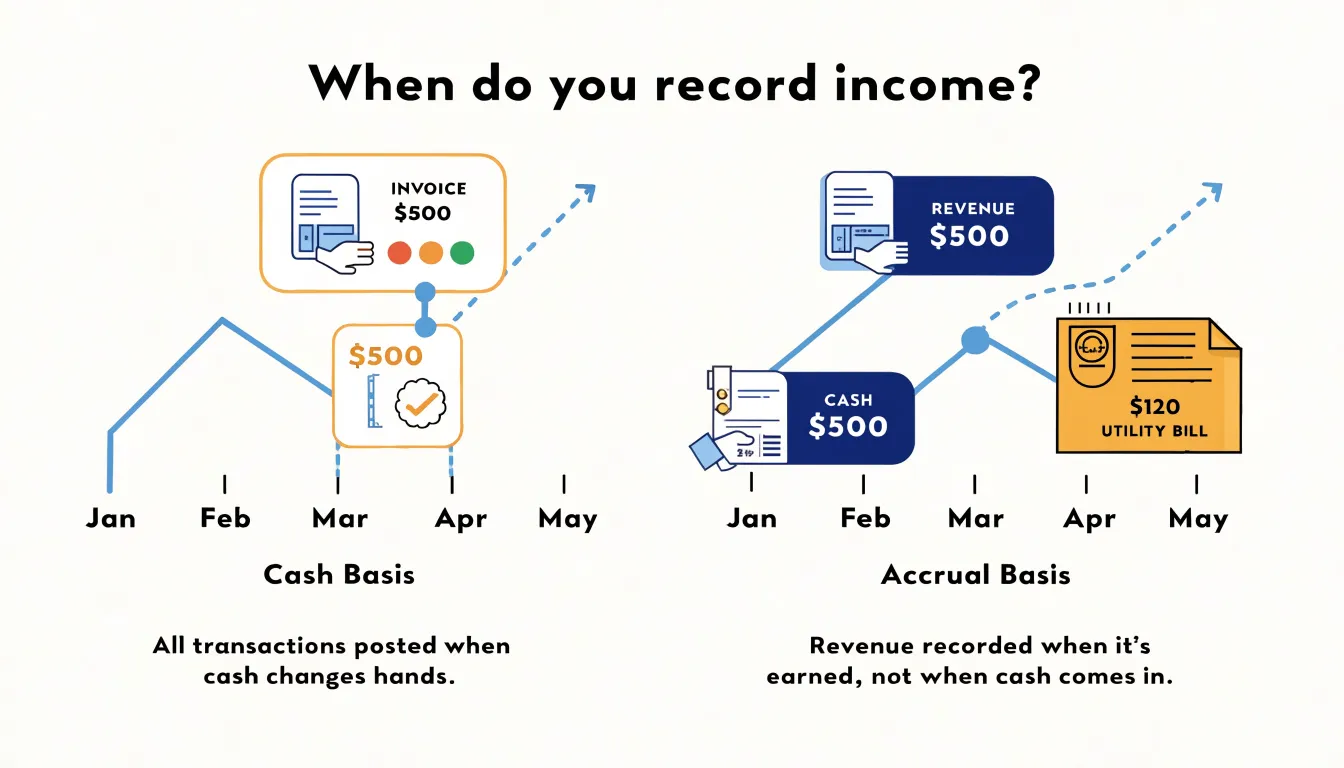
Accrual-basis accounting records revenue when it is earned and expenses when they are incurred, regardless of when cash moves. An invoice issued in March is March revenue even if the client pays in May, and a utility bill for March usage is a March expense even if it is paid in April. This matching of income to the costs that generated it produces financial statements that reflect the underlying economics of a period rather than the timing of payments. The result is a more accurate view of profitability and obligations, which matters as a business grows, holds inventory, extends credit to customers, or carries significant payables. Industries with long project cycles, such as construction, professional services, and manufacturing, typically find accrual reporting more informative because it captures work in progress and committed costs.
Business size and complexity usually guide the choice. Startups and micro-businesses often begin on a cash basis for simplicity, then transition to accrual as transactions multiply, lenders or investors request formal statements, or inventory and credit sales become routine. Some jurisdictions set revenue thresholds that mandate accrual reporting, and tax rules may prescribe which method applies. Many owners run both internally: cash-basis figures for day-to-day liquidity planning and accrual figures for performance analysis. Whichever method fits the workflow, consistency matters. Applying the same basis period to period keeps comparisons meaningful and gives advisors, lenders, and tax authorities a reliable record of how the business is performing.
Understanding the double entry system without getting lost in math
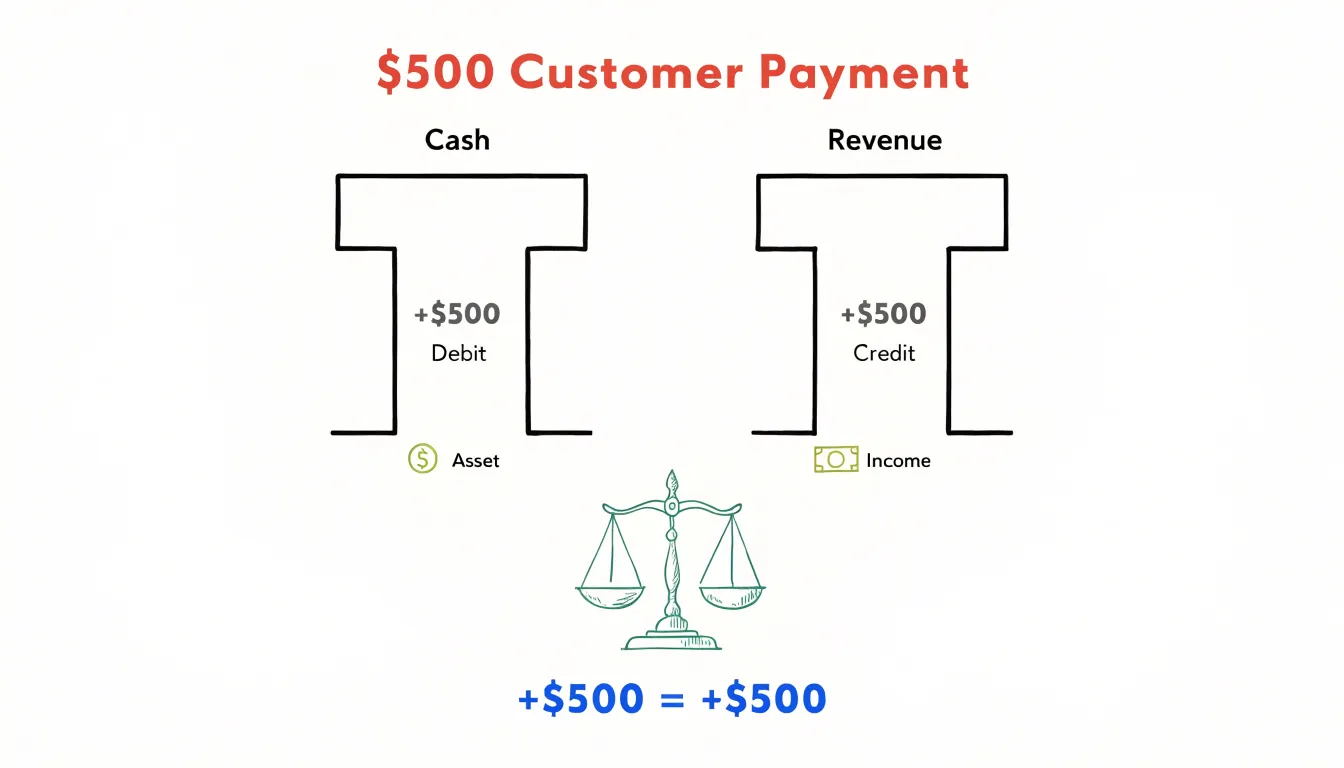
Every financial transaction your business makes touches at least two accounts, and the double entry system is simply the practice of recording both sides of that change. When a customer pays you $500 for a service, two things happen at once: your cash account grows by $500, and your revenue account grows by $500. Write down only one of those facts and your records tell an incomplete story. Write down both and the books stay in agreement with reality. That is the whole idea behind double entry, and it holds true whether you are selling a product, paying a supplier, or taking out a loan.
The terms debit and credit intimidate many owners because they sound like everyday words with moral overtones. In accounting they are neutral directional markers. A debit records value flowing into an account, and a credit records value flowing out of it, though the meaning flips depending on the type of account involved. Assets such as cash and equipment increase with debits. Liabilities such as loans and unpaid bills increase with credits. Revenue increases with credits, and expenses increase with debits. You do not need to memorize formulas. You need to remember that every transaction has two sides, and each side gets recorded in its own account with its own direction.
The practical payoff is balance. Because every debit has a matching credit of equal value, the total of all debits in your ledger always equals the total of all credits. If the two totals drift apart, you know immediately that something was entered incorrectly, and you can trace the problem before it compounds. A missed entry, a transposed number, or a transaction recorded on only one side will disrupt the balance and raise a flag. This built-in check is what makes double entry error-resistant. It will not catch every mistake, such as a payment posted to the wrong expense category, but it reliably catches the mechanical slips that quietly corrupt financial records.
For an owner, the value is confidence. When your books balance, your profit figures, tax filings, and cash flow reports rest on a foundation you can trust. Double entry turns bookkeeping from a guessing game into a system with its own internal alarm, and that alarm gives you a clear signal when something needs attention.
What is the revenue recognition principle and when do you report income
The revenue recognition principle is a core concept in accrual-basis accounting that governs the timing of when income is recorded on your books. Under this principle, revenue is reported when it is earned, meaning when the goods or services you promised to a customer have been delivered or performed, regardless of when the payment actually arrives. The underlying idea is that your financial statements should reflect the economic activity of a period, so that anyone reading them can see what the business actually accomplished during that time. A transaction and the cash that settles it are treated as two separate events, each recorded at the moment it occurs.
Timing differences between earning revenue and collecting cash are common in most businesses. A consulting firm that completes a project in March and invoices the client with thirty-day terms has earned that revenue in March, even though the check may not arrive until April. The March income statement should show the revenue and a corresponding receivable on the balance sheet. A retailer that accepts a deposit in December for a custom order delivered in January has not yet earned the revenue in December; the deposit is recorded as a liability, often called deferred or unearned revenue, and recognized as income once the order ships.
These timing choices have a direct impact on the financial statements. Recording revenue when it is earned gives a more accurate picture of performance for the period, matches income against the expenses incurred to generate it, and supports meaningful comparison across months or years. Cash-basis reporting, by contrast, can make a strong sales month look weak simply because customers have not paid yet, or make a quiet month look strong because old invoices were collected. Lenders, investors, and tax authorities often rely on accrual figures for exactly this reason.
Practical rules follow from the principle. Identify the contract with the customer, determine the obligations you have promised to fulfill, set the transaction price, allocate it to each obligation, and recognize revenue as each obligation is satisfied. Keep careful records of invoices, deposits, and delivery dates so earned and unearned amounts stay clearly separated. Reviewing receivables and deferred balances regularly helps you spot collection problems early and confirm that reported income reflects work actually completed.
Matching principle
The matching principle is the accounting rule that tells you to record each expense in the same period as the revenue it helped produce. Its purpose is to give you a truer picture of profitability. If you record a sale in March but wait until April to record the inventory you sold to make that sale, March looks unusually profitable and April looks artificially weak. Neither month reflects reality. The matching principle fixes this by pairing costs with the income they generated, so each period shows a fair comparison of what came in against what it took to bring it in.
Cost of goods sold is the clearest example. Suppose you run a small furniture business and sell a table in June. You record the sale price as June revenue. Under the matching principle, you also record the cost of the materials and labor that went into that table as a June expense, even if you paid the supplier back in May. The cost belongs to the period that earned the revenue, so the June profit figure reflects the true margin on the sale.
Prepaid expenses work the same way in reverse. If you pay twelve months of insurance in January, recording the full amount as a January expense would distort that month badly. Instead, you record one month’s portion as an expense each month and carry the rest as a prepaid asset on the balance sheet. As each month passes, the expense is matched to the period it protects. The same approach applies to annual software subscriptions, rent paid in advance, and bulk purchases of supplies that will be used over several months.
For a business owner, the practical value is decision-making. Matched numbers show which months, products, or jobs actually made money, and that clarity supports better choices about pricing, staffing, and cash planning. Cash flow and profit are different measures, and the matching principle helps you see the second one clearly. A simple monthly routine of reviewing what you sold, then confirming the related costs have landed in the same period, keeps your books honest and your view of profitability reliable.
How the conservative principle protects your business from overestimating profits
The conservative principle in accounting holds that when two reasonable estimates exist for a financial outcome, the less optimistic one should be chosen. In practice, this means anticipating potential losses as soon as they become reasonably possible, while recognizing gains only once they are verifiably earned. For a business owner, this habit builds a cushion against overestimating profits. If a major customer shows signs of financial distress, conservatism directs you to record an allowance for the likely uncollectible portion of their receivable now, rather than waiting for the account to fail outright. Similarly, inventory that may have become obsolete is written down to its lower realizable value before it sits unsold on the shelves. Revenue, by contrast, waits until the sale is complete and the earnings process is finished. The result is financial reporting that leans toward caution: expenses and obligations appear early, while income appears only when it is solid.
This prudence produces statements that owners and lenders can rely on when conditions tighten. A report shaped by conservative estimates tends to understate rather than overstate profit, so surprises in the actual results are more likely to be pleasant than painful. That reliability matters to investors, who use financial statements to judge whether a company’s earnings are durable. When investors see consistent conservatism, they gain confidence that reported profits are backed by real, completed transactions and that management has not papered over risks. That confidence lowers the cost of capital and steadies the company’s access to funding.
For decision-making inside the business, conservatism acts as an early warning system. Write-downs and loss provisions surface problems while there is still time to respond, whether by tightening credit terms, renegotiating with suppliers, or adjusting pricing. Owners who see a cautious picture can plan cash flow with a margin of safety and avoid commitments built on optimistic projections that may not materialize. The principle does have limits: excessive conservatism can distort results and hide genuine value, so it should be applied with judgment rather than blind pessimism. Used well, it keeps reporting honest, protects the business from inflated expectations, and gives investors and managers alike a firmer footing for their decisions.
The cost principle
The cost principle holds that assets are recorded on the books at the price paid to acquire them, rather than at what they might fetch in the market today. When an owner buys equipment, inventory, or a building, the accounting entry reflects the actual purchase price plus any costs necessary to get the asset ready for use, such as delivery fees, installation charges, or legal expenses. This figure stays on the balance sheet as the asset’s carrying value, subject to depreciation, until the asset is sold or otherwise disposed of. The reasoning behind this approach is rooted in reliability. A purchase price is documented by an invoice, a contract, or a bank record, giving anyone reviewing the financial statements a verifiable number they can trace back to source documents. Market value, by contrast, shifts constantly and often depends on estimates or appraisals that different parties could reasonably dispute. Verifiability matters because lenders, investors, and tax authorities need confidence that the numbers in the financial statements reflect actual transactions rather than subjective judgments. Historical cost also keeps recordkeeping practical and consistent, since owners do not have to revalue every asset each reporting period.
Exceptions to the cost principle arise when historical cost no longer tells a useful story. Impairment is the most common example: if an asset’s value drops significantly and permanently, such as equipment damaged in a fire or inventory that has become obsolete, accounting rules require the owner to write the asset down to its recoverable amount and recognize a loss. Fair value adjustments apply in certain circumstances as well. Businesses that invest in marketable securities, for instance, generally report those investments at their current market price, since quoted prices provide a reliable and readily available measure. Some accounting frameworks also permit revaluation of property and equipment to fair value when an active market exists for the asset. These exceptions share a common thread: they apply when a more current measurement offers information that is both reliable and more relevant to the decisions users of the financial statements need to make. Understanding where the cost principle applies and where it gives way helps owners read their own balance sheets accurately and anticipate how their numbers may change over time.
Essential financial statements every small business owner must review regularly
Every small business owner should make a habit of reviewing three core financial statements on a regular schedule: the balance sheet, the income statement, and the cash flow statement. Together they form a complete picture of your company’s financial health, and each one answers a different set of questions.

The balance sheet is a snapshot of your business at a single point in time. It lists what you own (assets such as cash, inventory, equipment, and accounts receivable) alongside what you owe (liabilities such as loans, supplier balances, and taxes payable) and the owner’s equity that remains. Reviewing the balance sheet tells you whether your business is solvent, how much debt you are carrying, and whether your assets are growing in line with your obligations. Many owners review it monthly, and at minimum quarterly, so that trends in cash reserves and debt levels become visible before they turn into problems.
The income statement, also called the profit and loss statement, covers a period such as a month, quarter, or year. It shows revenue, the costs directly tied to producing that revenue, operating expenses, and the resulting net profit or loss. This statement reveals whether your core operations are profitable, which products or services are carrying the business, and where costs are creeping upward. A monthly review is standard practice, since it lets you compare results against the prior month and the same month last year, spotting seasonal patterns and margin erosion early.
The cash flow statement tracks the actual movement of money in and out of your accounts across operating, investing, and financing activities. Profit on paper does not guarantee cash in the bank, and this statement shows whether you can cover payroll, rent, and supplier bills on time. Reviewing it monthly is essential, and during tight periods a weekly glance can prevent unpleasant surprises.
Used together on a consistent schedule, these three statements support informed decisions about pricing, hiring, borrowing, and spending, and they give you the evidence you need when speaking with lenders, investors, or your accountant.
Spotting early warnings of cash flow problems on your balance sheet
Your balance sheet offers a reliable early-warning system for cash flow trouble, provided you know which lines to watch and review them regularly. The first indicator is the cash line itself. A steady decline in cash reserves across several reporting periods deserves attention, even when the business appears profitable on paper. Profits recorded on the income statement can sit tied up in unpaid invoices or unsold stock, leaving little actual money in the bank. Comparing the cash balance month over month and against upcoming obligations, such as payroll, loan payments, and supplier bills, gives a clear sense of whether the business can meet its commitments.
Accounts receivable days is the second warning sign. This figure measures how long, on average, customers take to pay. When the number creeps upward, money that should be flowing into the business is sitting with customers instead. A rise from thirty days to forty-five days may seem modest, but across a full customer base it can leave a substantial amount of cash locked up. Tracking this metric each month and comparing it to your stated payment terms reveals whether collections are slipping and which customers are contributing to the delay.
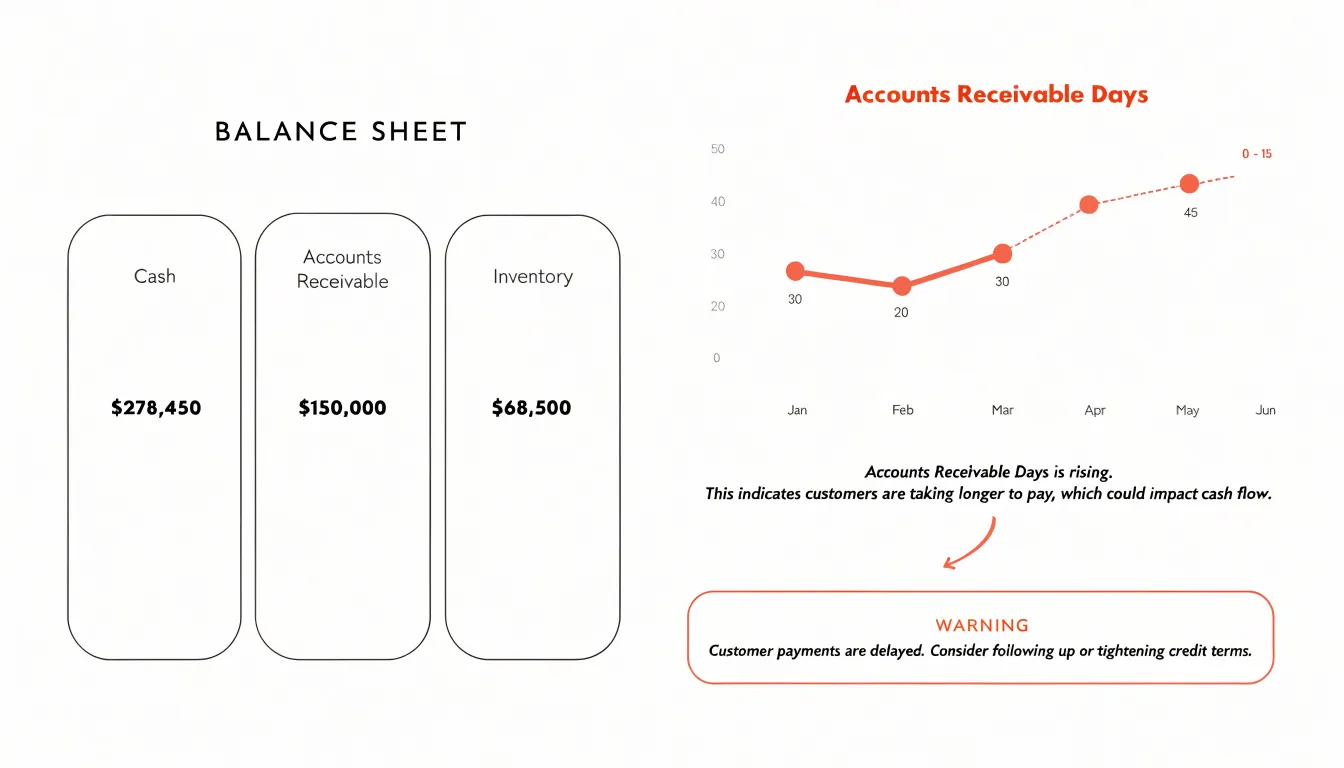
Rising inventory levels form the third indicator. Stock that sits on shelves or in a warehouse represents cash that has already been spent but not yet recovered through sales. When inventory grows faster than sales, the business is tying up money in goods that may take months to move, and some of that stock may never sell at full price. Monitoring inventory turnover alongside sales growth helps distinguish healthy stockpiling ahead of a busy season from a buildup that signals weakening demand.
Once these indicators appear, prompt action limits the damage. Tighten credit terms and follow up on overdue invoices consistently. Review inventory purchasing and consider discounting slow-moving stock to release cash. Negotiate longer payment terms with suppliers where possible, and delay non-essential spending. Building a short-term cash flow forecast that projects receipts and payments week by week gives you visibility over the months ahead. Reviewing the balance sheet monthly, rather than annually, turns these figures into a practical tool for protecting the financial health of the business.
Frequently Asked Questions
Why should I keep my business and personal finances separate?
Keeping business and personal finances separate makes it clear what the business earned and spent, and it helps protect legitimate deductions because deductions depend on proof. Commingled funds can draw audit attention and may weaken the limited personal liability that structures such as corporations and LLCs are meant to provide.
What is the difference between cash-basis and accrual accounting?
Cash-basis accounting records transactions when money actually changes hands, while accrual-basis accounting records revenue when it is earned and expenses when they are incurred, regardless of when cash moves. Accrual reporting matches income to the costs that generated it and gives a more accurate view of profitability, while cash basis can keep bookkeeping lean for very small businesses with simple transactions.
How does double-entry bookkeeping work?
Double-entry bookkeeping means every financial transaction touches at least two accounts, with both sides recorded. Because every debit has a matching credit of equal value, total debits always equal total credits, and if the totals drift apart it signals an entry error, though it will not catch every mistake such as a payment posted to the wrong expense category.
When should I record revenue under the revenue recognition principle?
Under accrual-basis accounting, revenue is reported when it is earned, meaning when the goods or services promised to a customer have been delivered or performed, regardless of when payment arrives. A deposit for an order not yet delivered is recorded as a liability, often called deferred or unearned revenue, and recognized as income once the order ships.
What is the matching principle in accounting?
The matching principle says to record each expense in the same period as the revenue it helped produce, so profitability reflects what came in against what it took to bring it in. For example, the cost of inventory sold is recorded in the same period as the sale, and prepaid expenses are recorded one month’s portion at a time rather than all at once.
Which financial statements should a small business owner review regularly?
Small business owners should regularly review three core financial statements: the balance sheet, the income statement, and the cash flow statement. Together they show solvency, profitability, and actual money movement, and reviewing them on a consistent schedule supports decisions about pricing, hiring, borrowing, and spending.