
Bookkeeping vs Accounting
Bookkeeping is the recording function that captures every transaction accurately and keeps ledgers, reconciliations, and the general ledger current, while accounting interprets that data through financial statements, tax planning, compliance, and strategic analysis. Bookkeepers handle day-to-day transaction entry and bank reconciliation; accountants provide analysis, reporting, and advisory work. Bookkeeping comes first, and accounting builds on it.
Table of Contents
- Core financial differences between keeping records and analyzing data
- The primary responsibilities of a day to day bookkeeper
- The Accountant Role
- How required skill sets and credentials differ for each profession
- Software tools and technology preferences across both roles
- Which financial service does your business need right now
- Cost Comparisons
- Clear signs your business is ready to transition to an accountant
Core financial differences between keeping records and analyzing data
Bookkeeping and accounting occupy distinct positions within the financial life of a business, and the difference between them shows up most clearly in what each one does with financial data. Bookkeeping is the recording function. It captures every transaction as it happens — a sale, a purchase, a payment to a supplier, a deposit from a customer — and enters it into the books with accuracy and consistency. The bookkeeper’s job is to make sure each figure is in the right place, that accounts reconcile, and that the records reflect what actually occurred. The output of this work is a clean, complete trail of financial activity: ledgers, journals, and eventually a trial balance that confirms the numbers add up.

Accounting begins where that record ends. The accountant takes the organized data produced by bookkeeping and interprets it. This means preparing financial statements, analyzing trends, comparing performance across periods, and drawing conclusions about the health of the business. An accountant might look at the recorded sales and expenses and determine the profit margin, assess whether costs are rising faster than revenue, or evaluate whether the business can support new debt. The accountant transforms raw entries into meaning — answering questions about profitability, liquidity, and financial position that the individual transactions cannot answer on their own.
Each function contributes a necessary piece of the financial picture. Bookkeeping provides the factual foundation: without accurate records, any analysis rests on unreliable ground. Accounting provides the interpretive layer: without analysis, the records remain a mass of entries with no narrative. The bookkeeper ensures that every dollar is accounted for; the accountant ensures that those dollars tell a coherent story about how the business is performing and where it is heading.
This division also shapes how the two roles approach their work. Bookkeeping is largely mechanical and procedural, governed by consistent rules for recording. Accounting is analytical and judgment-based, requiring interpretation of the recorded data in light of the business’s goals and circumstances. Together they form a sequence: records first, then insight, with each stage depending on the integrity of the one before it.
The primary responsibilities of a day to day bookkeeper
A day to day bookkeeper carries a set of recurring responsibilities that keep a company’s financial records complete and current. The core of the role is recording transactions. Every sale, purchase, payment received, and expense paid must be entered into the accounting system accurately and promptly, with each entry assigned to the correct account. This daily recording creates the raw material from which all financial reporting flows, so consistency and attention to detail matter enormously. Bookkeepers typically work from source documents such as receipts, supplier invoices, bank feeds, and sales records, coding each item so that it lands in the right place in the chart of accounts.
Bank reconciliation is another central duty. At regular intervals, usually monthly, the bookkeeper compares the transactions recorded in the company’s books against the bank statement. Differences arise from timing, outstanding checks, bank fees, or errors, and the bookkeeper investigates and resolves each one until the two records agree. This process catches mistakes early and provides assurance that the recorded cash position is trustworthy.

Managing invoices runs through much of the bookkeeper’s week. On the sales side, that means issuing customer invoices, tracking which ones remain unpaid, and sending reminders or statements as balances age. On the purchase side, it means entering supplier bills, scheduling them for payment, and keeping vendor records organized. Payroll often falls within the bookkeeper’s scope as well, covering hours tracking, wage calculations, tax withholdings, and the resulting journal entries that record payroll expense and liabilities.
Finally, the bookkeeper maintains the general ledger, the master record where all account balances come together. This involves posting journal entries, reviewing account activity for duplicates or misclassifications, and keeping supporting documentation filed and accessible. The general ledger must remain clean and orderly because it feeds every downstream report, from the trial balance to the financial statements prepared at period end.
The Accountant Role
The accountant role extends far beyond the mechanical recording of transactions. Accountants analyze financial data to assess an organization’s financial health, identify trends, and support strategic decision-making. They prepare and interpret financial statements—such as the balance sheet, income statement, and cash flow statement—to provide a clear picture of profitability, liquidity, and solvency. This analysis helps stakeholders understand the company’s performance and make informed choices about investments, cost control, and resource allocation.

Compliance is another core responsibility. Accountants ensure that financial statements adhere to relevant standards and regulations, such as Generally Accepted Accounting Principles (GAAP) or International Financial Reporting Standards (IFRS). They prepare tax returns, ensuring accuracy and timely submission, and stay abreast of changing tax laws to minimize liabilities while avoiding penalties. This compliance work safeguards the organization’s reputation and financial standing.
Tax planning is a key part of the accountant’s role. By understanding the tax implications of business decisions, accountants can structure transactions and investments in a tax-efficient manner. They identify deductions and credits, plan for future tax obligations, and advise on strategies that align with the company’s financial goals. This proactive approach helps preserve resources and improve after-tax profits.
Beyond compliance and tax, accountants serve as strategic advisors. They use financial data to evaluate business performance, forecast future outcomes, and assess the viability of new projects or expansions. They provide insights into cost management, pricing strategies, and capital investment decisions. By translating complex financial information into actionable recommendations, accountants help leaders navigate uncertainty and drive growth.
In essence, the accountant’s role is to transform financial data into meaningful intelligence that guides the organization toward financial stability and strategic success. Their work supports both day-to-day operations and long-term planning, making them indispensable partners in business management.
How required skill sets and credentials differ for each profession
Bookkeepers and accountants each bring distinct skill sets and credentials to their work, and understanding these differences helps clarify how the two roles fit together within an organization.
Bookkeepers typically enter the field with a high school diploma or an associate degree, though many pursue certificate programs in bookkeeping or accounting fundamentals to strengthen their qualifications. Professional certifications, such as the Certified Bookkeeper designation offered by the American Institute of Professional Bookkeepers, demonstrate competence in areas like double-entry accounting, payroll, and fraud prevention. On a day-to-day basis, bookkeepers rely heavily on precision and consistency. Recording transactions accurately, reconciling bank statements, and catching discrepancies require sharp attention to detail, since even small errors can ripple through the financial records. Familiarity with accounting software, organizational habits, and the discipline to follow established procedures round out the core skill set.
Accountants follow a more extended educational path. A bachelor’s degree in accounting is the standard entry point, and many pursue a master’s degree as well. Licensure as a Certified Public Accountant is a common goal, and it carries demanding requirements: completing 150 semester hours of education, passing the four-part Uniform CPA Examination, and accumulating relevant work experience. Other credentials, such as the Certified Management Accountant or Certified Internal Auditor designations, serve accountants who work in corporate or internal audit settings. Beyond credentials, accountants develop analytical and advisory capabilities. They interpret financial data, prepare and audit statements, ensure compliance with regulations, and offer strategic guidance on tax planning, budgeting, and business decisions. Communication skills matter as well, since accountants frequently explain complex financial information to clients and leadership.
In practice, the distinction often shows up in how the two roles approach the numbers. Bookkeepers focus on accurate, timely recording of transactions, while accountants build on that foundation with analysis, reporting, and advice. Many professionals begin their careers in bookkeeping and later pursue accounting credentials, gaining hands-on familiarity with the records before taking on broader interpretive responsibilities. Organizations benefit when both skill sets are represented, with meticulous record-keeping supporting the higher-level analysis that informs sound financial decisions.
Software tools and technology preferences across both roles
Technology choices reveal a great deal about how bookkeeping and accounting work differ day to day. Bookkeepers typically spend their time inside dedicated small-business accounting platforms such as QuickBooks or Xero. These tools are built for the recurring, high-volume tasks that define the bookkeeping role: entering transactions, reconciling bank feeds, categorizing expenses, issuing invoices, and running payroll. Features like automatic bank imports and receipt capture are central to these products because they reduce manual data entry and keep the books current week after week. A bookkeeper’s proficiency with these platforms often includes setting up charts of accounts, configuring bank rules, and cleaning up records so that the numbers are accurate and up to date.
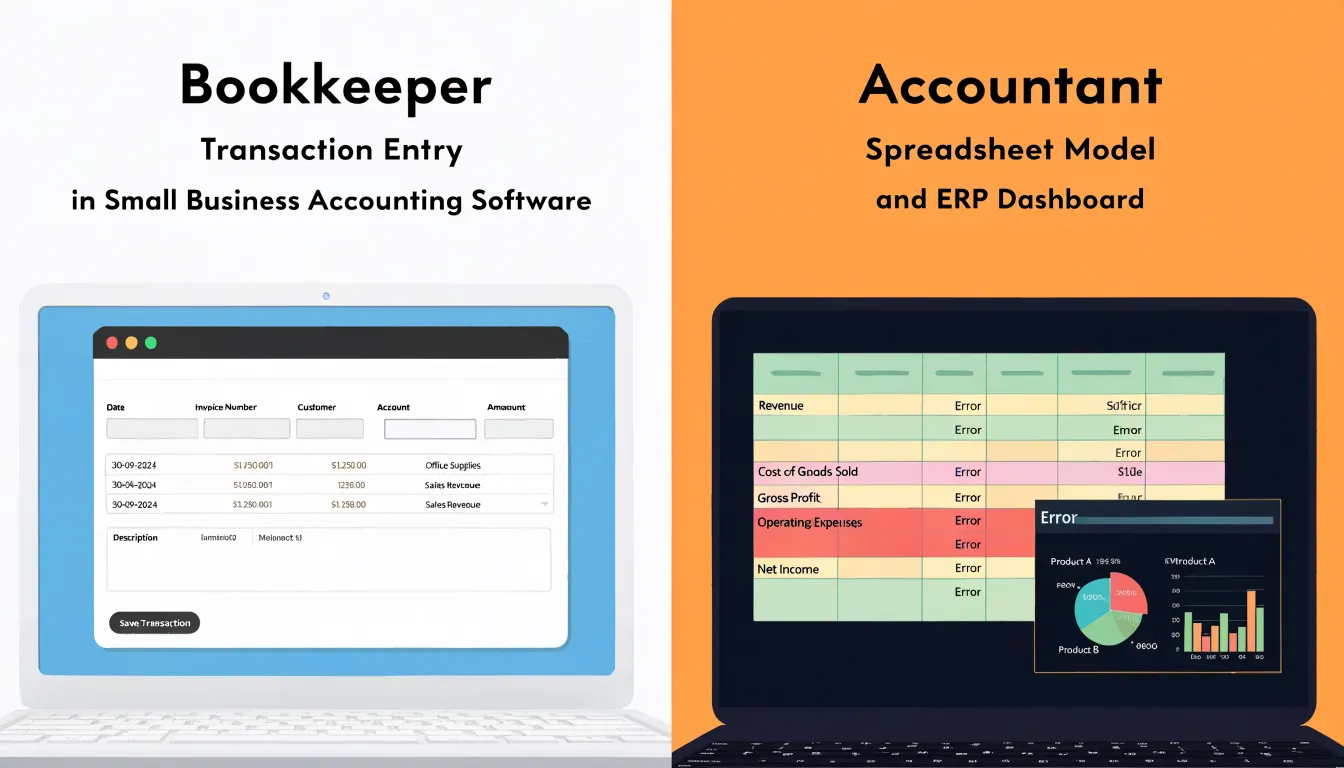
Accountants work at a different layer, and their software reflects that. They frequently rely on advanced spreadsheet work in Excel or Google Sheets to build models, perform variance and ratio analysis, prepare adjusting entries, and support tax planning. For larger organizations, accountants work inside enterprise resource planning systems such as SAP, Oracle NetSuite, or Microsoft Dynamics, which integrate ledgers with inventory, procurement, and reporting across departments. Accountants also use specialized applications for audit sampling, fixed asset management, and financial statement preparation. Many accountants review the same QuickBooks or Xero files their bookkeeping colleagues maintain, treating those records as the raw material for analysis, tax filing, and advisory work.
The technology gap shapes workflows in practical ways. Bookkeepers benefit from tools designed to automate repetitive entry and reconciliation, which frees them to focus on accuracy and completeness. Accountants rely on tools that support interpretation, modeling, and compliance, where judgment matters more than speed of data entry. Cloud platforms have narrowed the distance between the two roles, since both parties can access shared ledgers in real time and hand off work smoothly at month-end or year-end. Still, the day-to-day experience differs: one role lives inside transaction-level software built for consistency, while the other moves between spreadsheets, ERP modules, and reporting suites built for analysis. Understanding these tool preferences helps clarify where bookkeeping tasks end and accounting work begins.
Which financial service does your business need right now
Choosing between bookkeeping and accounting services starts with an honest assessment of where your business currently stands. The right fit depends on three factors: size, stage, and the specific financial questions you need answered.
Start with size. A solo operator or a business with just a handful of transactions each month can usually handle the bookkeeping role with one part-time bookkeeper or a software tool paired with occasional professional review. As headcount and transaction volume grow, the recordkeeping workload expands quickly, and dedicated bookkeeping support becomes essential to keep the books current. Once the business carries inventory, multiple revenue streams, or a payroll of several employees, the complexity typically calls for an accountant’s oversight alongside day-to-day bookkeeping.
Stage matters just as much. In the startup phase, the priority is establishing clean records, a sensible chart of accounts, and a reliable system for capturing income and expenses. A bookkeeper excels here. During growth, the questions shift toward cash flow forecasting, pricing decisions, and tax planning, which fall squarely in the accountant’s domain. Mature businesses with lenders, investors, or auditors often need both roles working together: a bookkeeper maintaining accurate records and an accountant interpreting them.
Finally, consider the questions you find yourself asking. If your needs are transactional, such as reconciling accounts, categorizing expenses, and producing accurate monthly records, a bookkeeper is the right call. If your needs are analytical, such as understanding profitability by product line, preparing for tax filing, or planning for a major purchase, you need an accountant. Many small businesses land in both categories and benefit from hiring a bookkeeper for recordkeeping while engaging an accountant periodically for review, tax preparation, and advisory work.
A practical way to decide is to list your ten most pressing financial questions. Sort them into recordkeeping and analysis. The balance of that list points directly to the service your business needs right now, and the mix will shift as the business evolves.
Cost Comparisons
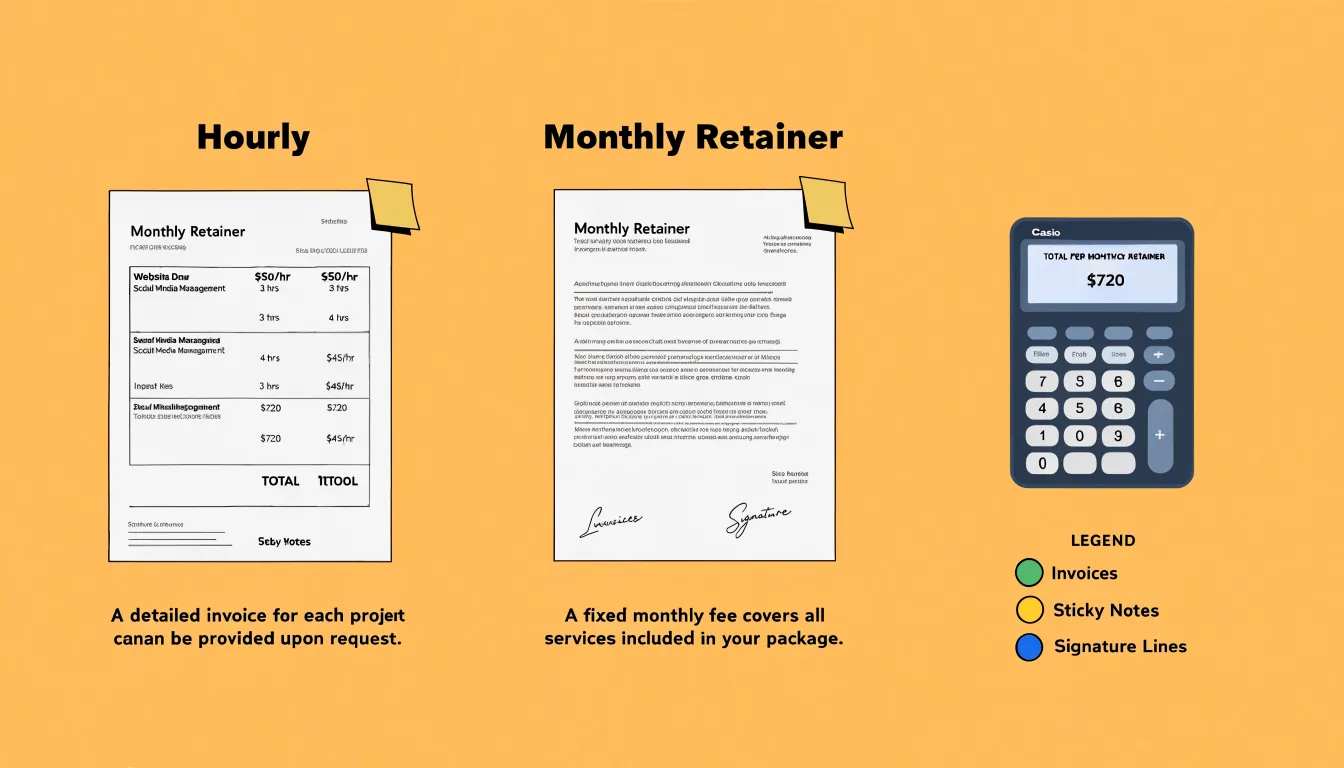
Cost is often the first question a business owner asks when deciding who should handle their financial records, and the answer depends heavily on how each professional structures their fees. Bookkeepers typically charge either an hourly rate or a flat monthly fee. Hourly pricing suits businesses with irregular transaction volumes, where the workload fluctuates from month to month. Monthly packages appeal to owners who want predictable expenses and a defined scope of work, such as transaction entry, bank reconciliations, and accounts payable. Hourly rates for bookkeeping generally range from modest entry-level figures to higher amounts for specialists with industry expertise, while monthly packages scale with transaction counts, the number of accounts, and the frequency of reporting.
Accountants tend to offer more varied pricing structures because their work spans compliance, planning, and advisory services. Hourly billing remains common for one-off engagements such as tax preparation or a specific consultation. Project-based fees apply to defined deliverables like preparing a year-end financial statement package or setting up a new accounting system. Retainer arrangements, meanwhile, provide ongoing access to an accountant for a fixed monthly sum, often including periodic reviews, tax planning, and financial guidance. Retainers usually cost more than bookkeeping packages because they bundle higher-level expertise and strategic input.
Several factors influence what either professional charges. Location matters, since rates in major metropolitan areas run higher than in rural regions. Complexity plays a role as well: a business with multiple revenue streams, inventory, or international transactions requires more time and specialized knowledge. The frequency and depth of reporting also affect price, as does the level of software integration in place. Clean, well-organized records reduce hours billed, while messy books increase them. Turnaround expectations can add a premium, particularly during tax season when demand surges.
Comparing costs fairly means looking beyond the headline rate. A bookkeeper charging a lower hourly rate but requiring many hours may cost more overall than a monthly package. Likewise, an accountant’s retainer may deliver savings if it prevents costly errors or identifies tax deductions. Business owners benefit from requesting a clear scope of services alongside any quote, so they can weigh the total value of each arrangement rather than focusing on a single number.
Clear signs your business is ready to transition to an accountant
Recognizing the moment when your business has outgrown basic bookkeeping is a skill in itself. Several reliable indicators can help you decide when to bring a professional accountant on board. Revenue growth is often the first signal. As your income climbs and transaction volume multiplies, the time required to record each sale, expense, and payment expands accordingly. A bookkeeper can keep the ledgers current, yet rising revenue also brings questions that reach beyond record-keeping: how to structure cash flow, where to reinvest profits, and which expenses deserve priority. An accountant interprets the numbers behind that growth and turns them into forward-looking guidance.
The need for tax planning tends to arrive alongside growth. Beyond filing annual returns, an accountant can map out strategies across the year, such as timing major purchases, choosing the right business structure, and anticipating liabilities before they come due. For many owners, the first large or unexpected tax bill is the moment this gap becomes clear.
Investor requirements represent another strong prompt. When you seek outside funding, lenders and investors expect financial statements that follow recognized standards. An accountant can prepare documentation that withstands scrutiny, which builds credibility during due diligence and negotiations. Even informal partnerships or family investments often benefit from professionally prepared figures.
Complex financial decisions also point toward professional support. Expanding into a new market, hiring a team, acquiring equipment, or weighing a merger each carry financial consequences that ripple through the business for years. An accountant models scenarios, assesses risk, and helps you compare options with confidence.
Beyond these specific triggers, watch for subtler cues: spending entire evenings on spreadsheets, feeling uncertain about the accuracy of your reports, or facing compliance deadlines you barely understand. Each of these moments is a reasonable signal to consult an accountant. Hiring one earlier than strictly necessary often pays for itself through better decisions, cleaner records, and fewer surprises at tax time.
Frequently Asked Questions
What is the difference between bookkeeping and accounting?
Bookkeeping is the recording function that captures every transaction accurately and consistently into ledgers, journals, and a trial balance. Accounting takes that organized data and interprets it by preparing financial statements, analyzing trends, and drawing conclusions about the business’s financial health.
What does a bookkeeper do day to day?
A day-to-day bookkeeper records sales, purchases, payments, and expenses accurately and promptly, assigns each entry to the correct account, and works from source documents such as receipts, invoices, bank feeds, and sales records. The role also includes bank reconciliation, managing invoices, payroll tasks, and maintaining the general ledger.
What does an accountant do that a bookkeeper doesn’t?
An accountant analyzes financial data to assess financial health, identify trends, and support strategic decision-making, and prepares and interprets statements such as the balance sheet, income statement, and cash flow statement. Accountants also handle compliance with standards like GAAP or IFRS, prepare tax returns, and provide tax planning and strategic advice.
Do bookkeepers and accountants have different education and credentials?
Bookkeepers typically enter with a high school diploma or associate degree, though many pursue certificate programs or the Certified Bookkeeper designation. Accountants usually need a bachelor’s degree in accounting, often a master’s degree, and CPA licensure requires 150 semester hours, passing the four-part Uniform CPA Examination, and relevant work experience.
How are bookkeeping and accounting services priced?
Bookkeepers typically charge an hourly rate or a flat monthly fee, with hourly pricing suiting irregular transaction volumes and monthly packages appealing to owners who want predictable expenses. Accountants often use hourly billing for one-off engagements, project-based fees for defined deliverables, and retainer arrangements for ongoing access to an accountant.
How do I know whether my business needs a bookkeeper or an accountant?
If your needs are transactional, such as reconciling accounts, categorizing expenses, and producing accurate monthly records, a bookkeeper is the right call. If your needs are analytical, such as understanding profitability by product line, preparing for tax filing, or planning for a major purchase, you need an accountant, and many small businesses benefit from using both.