CapEx vs OpEx
Capital expenditures (CapEx) are upfront purchases of long-term assets—like machinery, buildings, or equipment—capitalized on the balance sheet and depreciated over their useful life, so cash leaves immediately but tax relief arrives gradually. Operating expenses (OpEx) are day-to-day costs—rent, utilities, salaries—deducted in full in the current year, delivering immediate tax savings and predictable cash outflows.
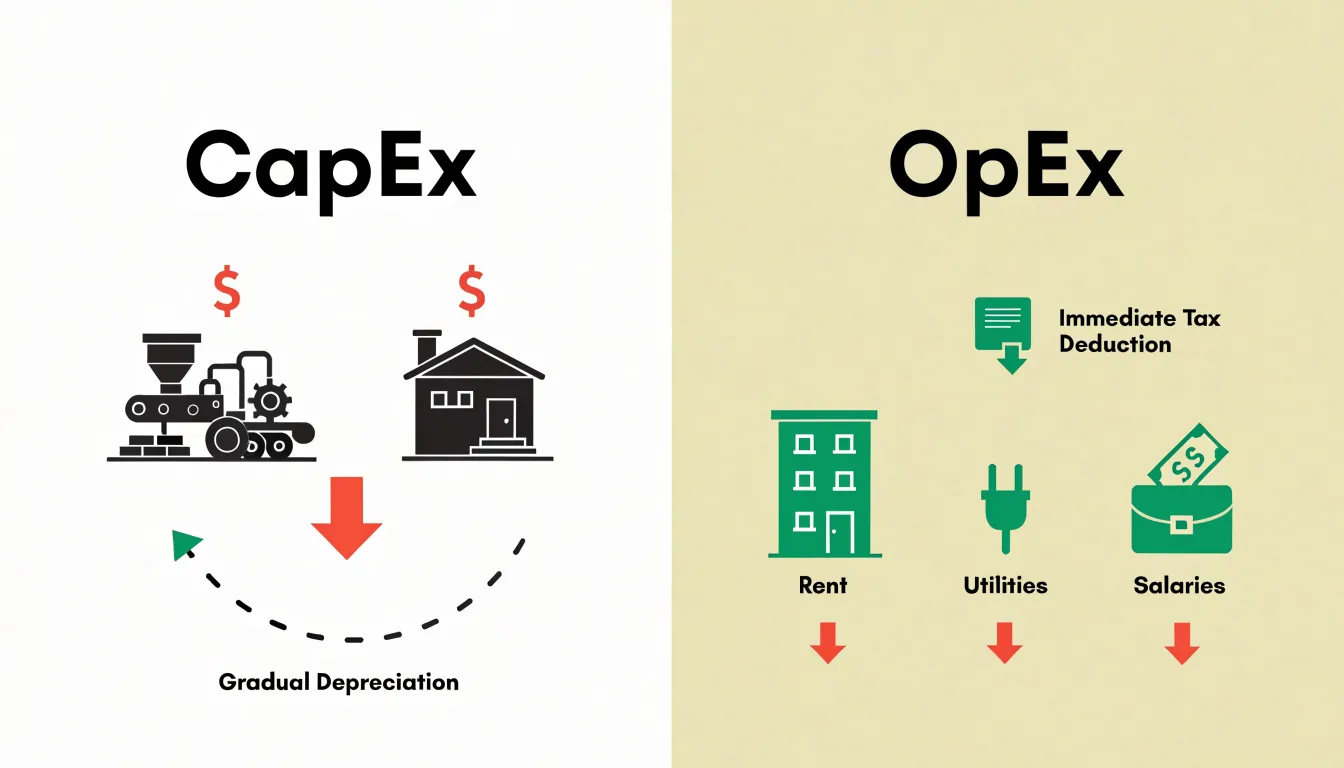
Table of Contents
- What capital expenditures and operating expenses mean for cash flow
- CapEx vs OpEx
- How capital expenditures are capitalized and depreciated over time
- Why operating expenses offer immediate tax deductions in the current year
- Which expense type benefits your short term cash flow more
- Tax treatment rules
- Common accounting mistakes when classifying business expenses
- How shifting from CapEx to OpEx impacts financial statements and profitability
- Can a small business deduct capital purchases immediately using special tax rules
- How to choose the right spending strategy for your growth phase
What capital expenditures and operating expenses mean for cash flow
Cash flow sits at the center of how capital expenditures and operating expenses shape a business’s financial life. When a company makes a capital expenditure, it commits a substantial sum of money upfront to acquire, build, or substantially improve a long-term asset such as machinery, a building, software infrastructure, or a fleet of vehicles. That cash leaves the business immediately, yet the benefits arrive gradually, spread across the asset’s useful life. Because of this mismatch between the timing of the payment and the timing of the payoff, CapEx places real pressure on liquidity in the short term. A manufacturer that spends several million dollars on a new production line must fund that outlay from reserves, financing, or investor capital, and it will not see the full return until the line has run productively for years. The accounting treatment mirrors this reality, since the cost is depreciated over time rather than charged against a single year’s income, which smooths reported earnings even as it locks up cash.
Operating expenses work in a very different rhythm. These are the ongoing costs of running the business day to day, including rent, utilities, salaries, insurance, maintenance, and routine supplies. Each payment is generally deductible in the year it is incurred, which reduces taxable income right away and produces a tax benefit that partially offsets the cash outflow. The trade-off is that OpEx generates a steady, recurring stream of payments. A company leasing its equipment or office space faces predictable monthly outflows that must be met from operating cash flow as they come due. There is no large upfront commitment, but there is also no multi-year asset building up on the balance sheet.
For day-to-day liquidity, the distinction matters enormously. Heavy CapEx can strain working capital and leave a business vulnerable if revenues dip before the investment pays off, while a lean CapEx profile frees cash for flexibility. Conversely, an OpEx-heavy structure keeps cash needs predictable but creates persistent claims on incoming revenue. Finance teams weigh these patterns when deciding whether to buy or lease, build or subscribe, and how much cash buffer to hold. Understanding the cash timing of each category helps a business plan for both the lumpy demands of investment and the steady drain of routine costs, keeping liquidity intact through the year.
CapEx vs OpEx
Capital expenditures and operating expenditures touch different parts of the financial statements, and a side-by-side comparison makes those differences concrete. On the CapEx side, typical examples include purchasing production machinery, vehicles, buildings, major software licenses, and significant facility upgrades. These purchases carry a useful life extending beyond a single accounting period, often spanning several years, and their cost is recorded as an asset on the balance sheet. Rather than hitting the income statement all at once, the cost is allocated over time through depreciation or amortization, so each period absorbs a portion of the original outlay. OpEx, by contrast, covers items such as rent, utilities, payroll, routine maintenance, office supplies, and subscription services. These costs are consumed within the current period, appear directly on the income statement as expenses, and reduce taxable income in the year they are incurred.
The decision criteria businesses apply when classifying a purchase usually revolve around a few practical tests. The first is useful life: if the asset delivers benefit across multiple accounting periods, it leans toward CapEx; if it is consumed within the current cycle, it belongs in OpEx. The second is materiality. Companies set capitalization thresholds, and a purchase below that threshold is typically expensed immediately regardless of its lifespan, simply because tracking and depreciating trivial amounts costs more than it saves. The third is whether the spending creates a new asset or extends an existing one’s capacity, which supports capitalization, versus keeping an asset in its current working condition, which is generally treated as an operating expense. Fourth, businesses weigh the nature of ownership and control: buying an asset outright points to CapEx, while leasing or subscribing to a service points to OpEx. Tax treatment and cash flow timing also enter the picture, since capitalizing a purchase spreads the financial impact while expensing it concentrates the hit in one period. In practice, finance teams document these criteria in a capitalization policy so that similar purchases are treated consistently across departments and reporting periods, which keeps the financial statements comparable and supports cleaner budgeting and forecasting.
How capital expenditures are capitalized and depreciated over time
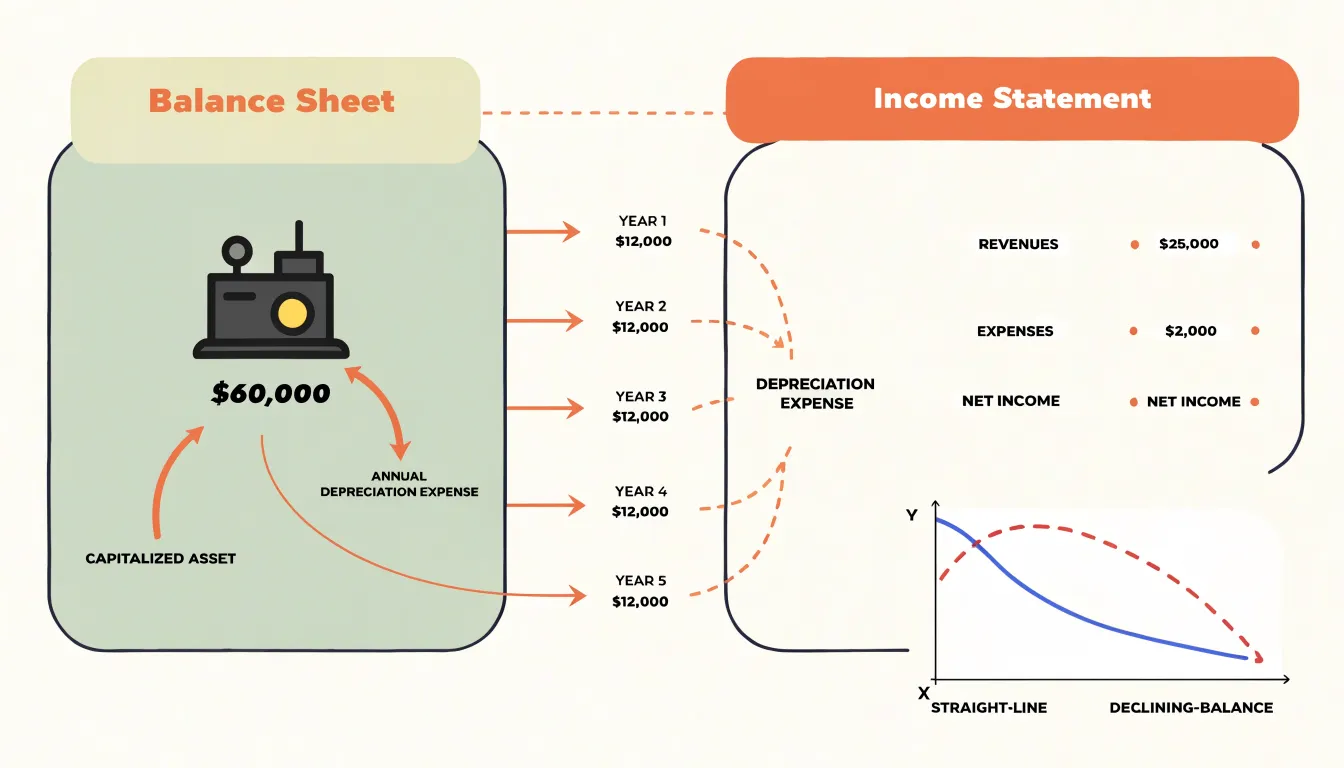
When a company makes a capital purchase, the accounting treatment begins with the balance sheet rather than the income statement. The full cost of the asset is recorded as a long-term asset, such as property, plant, and equipment, rather than being deducted as an expense in the period the cash leaves the business. From that point forward, the cost is allocated across the years the asset is expected to generate benefit. This allocation is depreciation, and it reflects the gradual consumption of the asset’s economic value over its useful life.
The choice of depreciation method determines the pattern of that allocation. Straight-line depreciation spreads the depreciable cost evenly across each year of the useful life, producing a constant annual charge that is simple to calculate and easy to compare across periods. Declining balance methods apply a fixed percentage to the asset’s remaining book value, generating larger charges in the early years and smaller charges later, which suits assets that lose value quickly or become less efficient with age. Units of production ties the annual charge to actual usage, such as machine hours or units manufactured, so depreciation rises and falls with output and matches cost to activity more closely.
Whichever method is selected, the annual depreciation expense flows through the income statement as a non-cash operating expense. It reduces reported operating profit and, in turn, taxable income, even though no cash changes hands during the period. On the balance sheet, the same amount is added to accumulated depreciation, a contra-asset account that reduces the asset’s gross cost to arrive at net book value. The cash outflow itself appeared earlier, at the time of purchase, which is why depreciation is often described as the accounting echo of a past cash payment.
These mechanics have practical consequences. The depreciation method and useful life estimates shape reported earnings, return on assets, and effective tax timing, and they require judgment that auditors and analysts scrutinize closely. Over the life of the asset, total depreciation equals the capitalized cost less any residual value, regardless of the method chosen; the method only changes when the expense appears. Understanding this flow, from capitalized asset to periodic expense, is essential for reading financial statements and for planning how major purchases will affect future profitability.
Why operating expenses offer immediate tax deductions in the current year
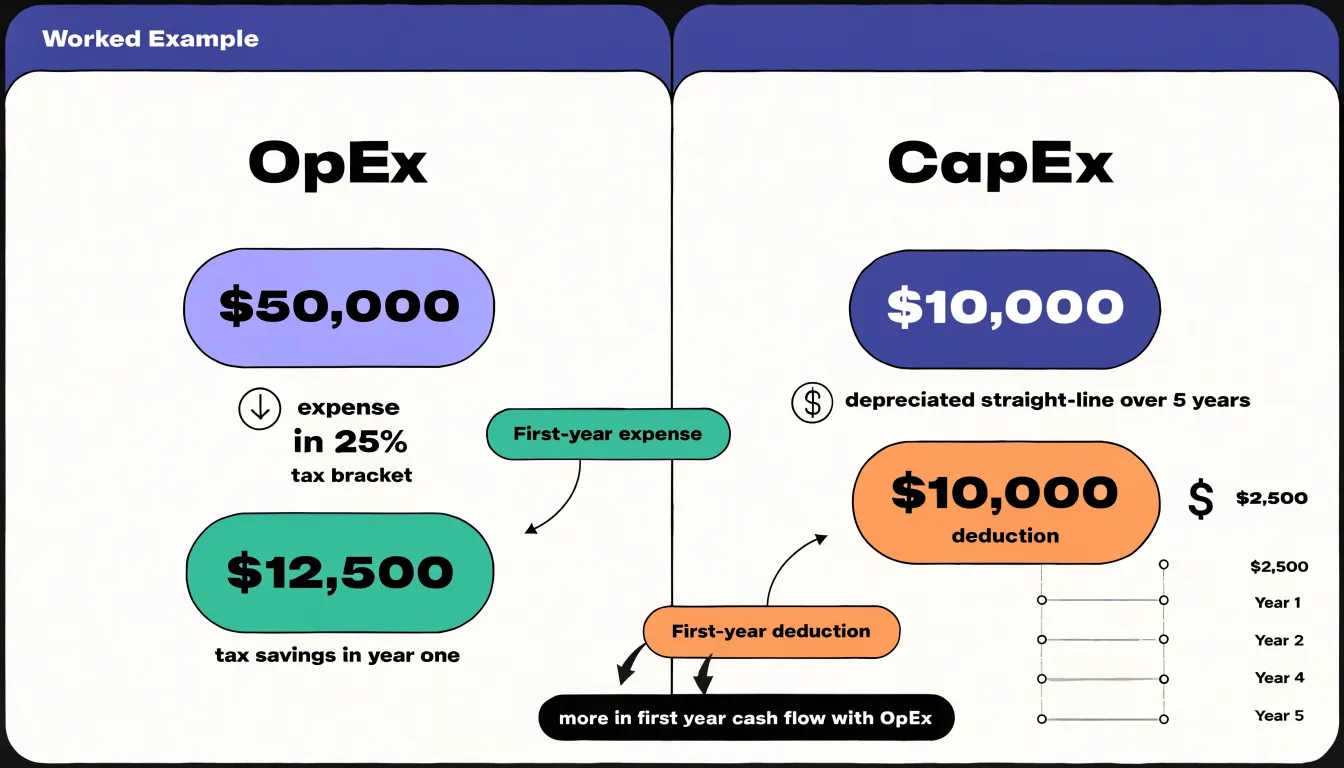
Operating expenses are the ordinary and necessary costs of running a business day to day, such as rent, utilities, salaries, supplies, and maintenance. Because these costs are consumed within the current period and do not create a lasting asset, tax rules generally allow them to be deducted in full on the tax return for the year they are paid or incurred. This treatment aligns with the matching principle in accounting: expenses are recognized in the same period as the revenues they help generate. For tax purposes, the rationale is straightforward. The expense has been used up, so it reduces the taxpayer’s ability to pay tax for that year. Deducting OpEx immediately lowers taxable income right away. For example, if a business earns $500,000 in revenue and incurs $200,000 in operating expenses, it reports $300,000 of taxable income. The full $200,000 deduction is taken in the current year, directly reducing the tax bill for that year. This immediate deduction stands in contrast to capital expenditures, which are capitalized and recovered over time through depreciation or amortization. Depreciation spreads the cost of an asset over its useful life, generating smaller deductions in each year. The cash-flow advantage of immediate OpEx deductions is significant. Tax savings from OpEx occur sooner, freeing up cash that can be reinvested in the business, used to pay down debt, or distributed to owners. Consider a business in the 25% tax bracket that spends $50,000 on operating expenses. The immediate deduction saves $12,500 in taxes for the current year. If that same $50,000 were a capital expenditure depreciated over five years using straight-line, the first-year deduction would be only $10,000, yielding a tax savings of just $2,500. The $10,000 difference in cash flow in year one can be substantial for a growing company. The time value of money amplifies this benefit: a dollar saved today is worth more than a dollar saved in future years. Moreover, immediate deductions simplify tax planning and provide certainty, as businesses can predict their tax liability more accurately. This front-loaded cash-flow advantage is a key reason why businesses often prefer to classify costs as operating expenses when the tax code permits, and it underscores the importance of understanding the distinction between CapEx and OpEx for effective tax and cash management.
Which expense type benefits your short term cash flow more
When a business evaluates whether OpEx or CapEx serves its short-term cash flow better, the decisive factor is timing: how much cash leaves the bank account, and when any tax relief arrives. Operating expenses are generally deductible in full in the year they are incurred. A company that pays 12,000 for software subscriptions, rent, or marketing during the year reduces its taxable income by that full amount in the same period, lowering the tax bill within the current reporting cycle. The cash benefit is immediate and matches the outflow, so the net drain on working capital is reduced right away.
Capital expenditures follow a different rhythm. Buying equipment, vehicles, or major technology infrastructure typically requires a large upfront cash payment, yet the tax relief arrives gradually through depreciation, spread across the asset’s useful life. A 60,000 machine depreciated over five years might generate 12,000 of deductions annually, so the tax saving in year one is a fraction of the outlay. The gap between when cash leaves and when relief lands can strain liquidity, particularly for smaller firms or seasonal businesses whose reserves are thin.
That said, depreciation schedules and available incentives can tilt near-term outcomes. Accelerated depreciation rules, bonus depreciation provisions, and Section 179-style expensing let companies deduct a substantial share of a capital purchase in the first year. In those cases, CapEx can deliver a first-year tax shield close to that of OpEx while still creating a durable asset on the balance sheet. Businesses expecting strong profits in the current year may find this especially attractive.
Scenario matters just as much as mechanism. A startup burning cash and prioritizing runway will usually favor OpEx because it avoids lump-sum outlays, keeps obligations flexible, and delivers deductions immediately. A profitable, established company with stable reserves may prefer CapEx, since it can absorb the upfront payment, capture accelerated deductions, and own an appreciating or revenue-generating asset. Leasing arrangements and subscription models offer a middle path, converting what would be a capital purchase into deductible operating payments.
The practical conclusion is to model both paths against the cash flow forecast. Compare the upfront outflow, the timing of tax savings, and the effect on the working capital buffer, then choose the structure that keeps the balance sheet liquid through the periods that matter most.
Tax treatment rules
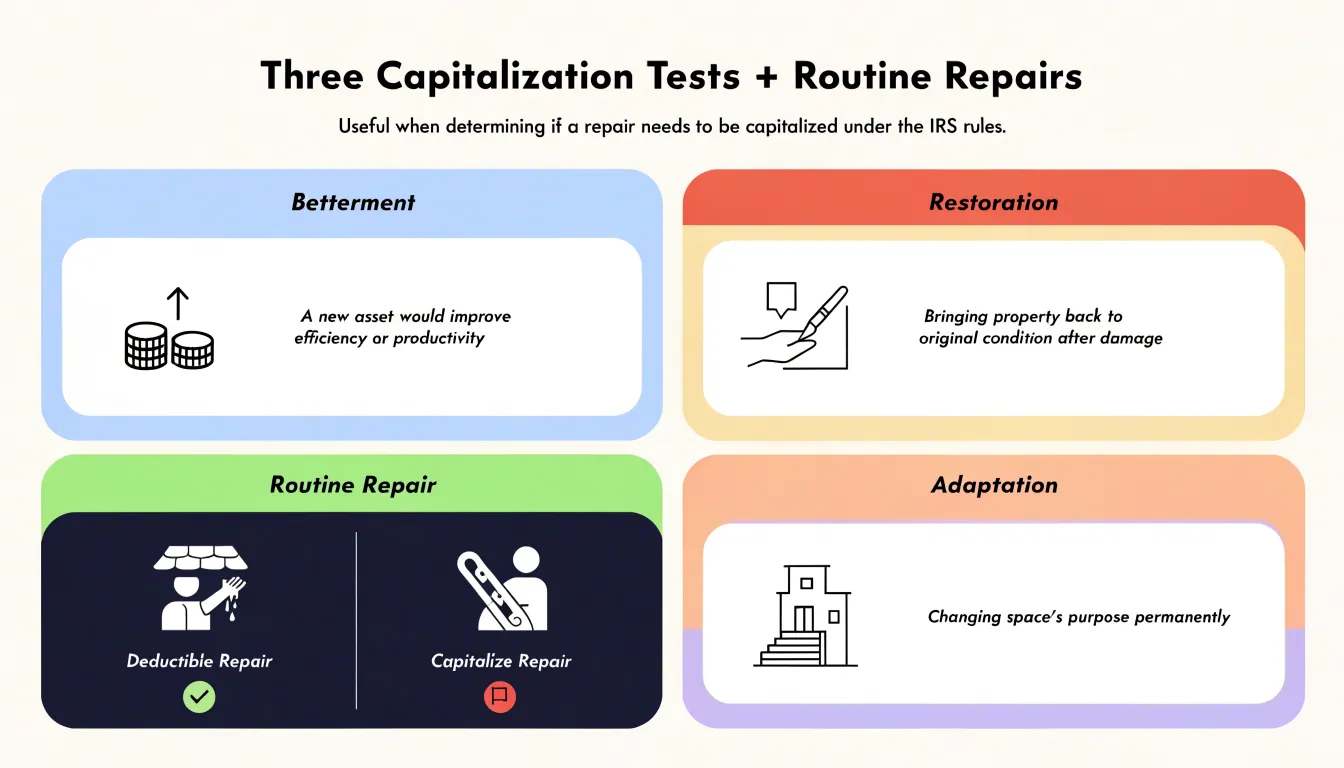
Tax authorities draw a firm line between costs that must be capitalized and those that can be deducted immediately, and understanding that line is essential for accurate financial reporting and tax planning. The IRS-style framework evaluates whether an expenditure results in a capital improvement by applying three primary tests: betterment, restoration, and adaptation. A cost is considered a betterment if it enhances the property’s value, increases its productivity or efficiency, or extends its useful life beyond its original estimate. Restoration occurs when the expenditure returns a component to its original condition after it has deteriorated, such as replacing a major structural element that had worn out. Adaptation applies when the cost modifies the property to a new or different use, such as converting a warehouse into a retail space. Routine repairs, by contrast, keep the property in its ordinary operating condition without adding value or extending life, and these are typically deductible as ordinary and necessary business expenses.
Gray areas frequently arise with partial replacements and ongoing maintenance. For instance, replacing a roof might seem like a repair, but if it restores a significant component that had fully deteriorated, the IRS may treat it as a restoration and require capitalization. Similarly, replacing a broken window is usually a repair, but replacing all windows as part of a major renovation could be a betterment. Maintenance activities like painting, cleaning, and minor part replacements are generally deductible, yet if they are performed as part of a larger improvement project, they may need to be capitalized as part of that project. The key is to examine the context and the nature of the work: isolated fixes that maintain normal operation are repairs, while expenditures that improve, restore, or adapt the property are capital improvements. Documenting the purpose and effect of each expense helps navigate these gray areas and withstand scrutiny from tax authorities. Proper classification ensures that businesses claim the correct deductions and avoid penalties for mischaracterization.
Common accounting mistakes when classifying business expenses
Expense classification errors are among the most persistent problems in small and mid-sized business accounting, and they tend to surface at the worst possible time, usually during an audit or a lender’s review of the financial statements. One of the most frequent mistakes is expensing a large purchase outright rather than capitalizing it. When a business buys equipment, vehicles, or significant software systems and records the entire cost as a current-period expense, reported profit for that period drops sharply while future periods appear artificially strong. The purchase delivers value across multiple years, so spreading its cost through depreciation or amortization gives a far more accurate picture of profitability. Lenders and investors who spot this pattern often discount the reliability of the financial statements as a whole.
A second common error involves repairs versus improvements. Routine maintenance that merely keeps an asset in working order, such as replacing a worn belt on a machine or patching a roof, belongs in expenses. Work that extends an asset’s useful life, increases its capacity, or adapts it to a new use counts as an improvement and must be capitalized. Businesses often lump both categories together as repairs to simplify bookkeeping, which understates asset values and distorts expense timing. Documenting the nature of each project at the time it occurs makes the distinction defensible later.
The de minimis safe harbor rules are another frequent blind spot. Tax regulations allow businesses to expense items below a specified per-item or per-invoice threshold, but that election must be made properly on the tax return and applied consistently through a written accounting procedure. Businesses that expense small items without adopting the election, or that apply inconsistent thresholds from year to year, create exposure if the treatment is ever challenged.
Finally, poor documentation of business purpose weakens every classification decision. Records should capture what was purchased, why it serves the business, and who uses it. Without that context, even correctly classified expenses can be disallowed, and the burden of proof falls on the taxpayer. Building documentation into the purchasing workflow, rather than reconstructing it after the fact, is the most reliable safeguard.
How shifting from CapEx to OpEx impacts financial statements and profitability
When a business shifts spending from capital expenditures to operating expenditures, the change flows through every major financial statement, and the effects show up quickly. Under the CapEx model, a company buys physical assets such as servers, networking gear, and data center equipment. Those purchases appear on the balance sheet as property, plant, and equipment, and the cost is spread across the asset’s useful life through depreciation. Under an OpEx-heavy model, the same capability is purchased as a subscription, and the payments appear as operating expenses on the income statement in the period they are incurred.
The balance sheet is affected first. Moving to cloud subscriptions removes large equipment purchases from the capital budget, so gross asset balances shrink and the depreciation base declines over time. Cash that would have been tied up in hardware stays available for other uses, which can improve liquidity measures such as the current ratio. At the same time, the company loses the collateral value and residual worth of owned assets, and the balance sheet becomes lighter and more flexible.
The income statement changes as well. Subscription costs land in operating expenses each period, which can reduce reported net income in the near term compared with a CapEx approach where depreciation charges are spread out. This timing difference matters for profitability comparisons across periods and between companies that structure their infrastructure spending differently. Because operating expenses are deducted before EBITDA is calculated, an OpEx-heavy model typically lowers reported EBITDA relative to a CapEx model, even when total cash outlays are similar. Analysts who rely on EBITDA as a proxy for cash generation need to account for this effect when comparing firms with different spending structures.
Key ratios shift accordingly. Asset turnover often rises because the denominator, total assets, is smaller. Return on assets can improve for the same reason. Debt-related ratios may strengthen if the company no longer borrows to fund equipment purchases, while operating margin may compress as subscription costs accumulate. The overall picture is one of lower asset intensity, changed profitability timing, and different ratio profiles, all of which require careful interpretation when evaluating financial performance.
Can a small business deduct capital purchases immediately using special tax rules
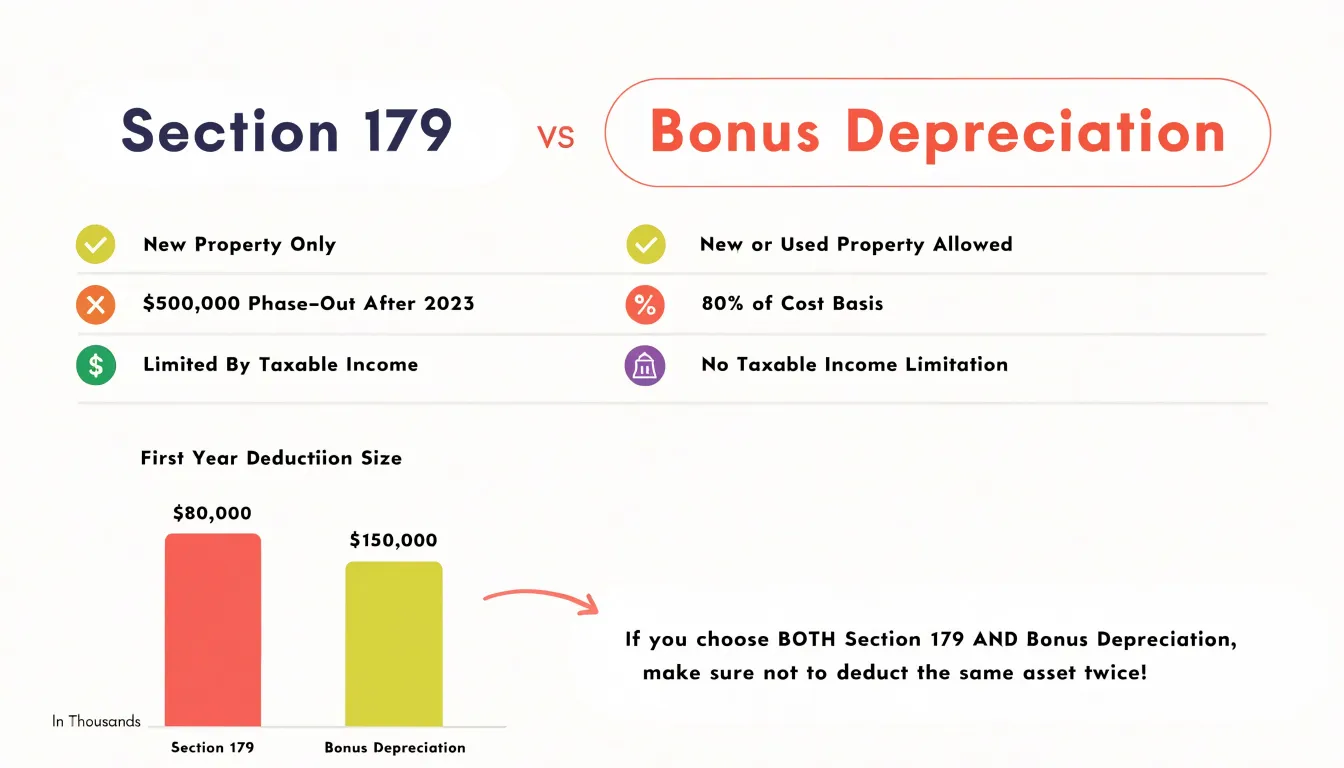
Small businesses that purchase qualifying equipment and property can often deduct a substantial portion of those costs immediately rather than spreading the deduction across many years through regular depreciation. Two provisions of the tax code make this possible: Section 179 expensing and bonus depreciation. Section 179 allows eligible businesses to elect to deduct the full purchase price of qualifying equipment and software purchased or financed during the tax year, up to an annual dollar limit that is adjusted periodically for inflation. The deduction is available for both new and used property, which makes it useful for businesses buying vehicles, machinery, office equipment, and off-the-shelf software. Eligibility depends on the business’s total amount of qualifying property placed in service during the year; once spending exceeds a phase-out threshold, the available deduction is reduced dollar for dollar, and it disappears entirely at the upper end of that range. The deduction also cannot exceed the business’s taxable income from active conduct of a trade or business, though any amount disallowed by that limit can be carried forward to future years.
Bonus depreciation works differently and can be used alongside Section 179. It allows businesses to deduct a set percentage of the cost of qualifying property in the first year it is placed in service, with the remaining cost recovered through regular depreciation. Historically the bonus percentage has varied, reaching 100 percent under changes made by the Tax Cuts and Jobs Act before phasing down in later years. Bonus depreciation generally applies to new property, though certain used property has qualified under more recent rules, and it is not subject to the same taxable income limitation as Section 179.
For a small business, these provisions provide meaningful cash-flow benefits. Instead of waiting years to recover the cost of a delivery van, manufacturing equipment, or computer systems, the business can reduce its current-year taxable income and retain more cash for operations. Planning matters: the business must place the property in service before year-end, keep accurate records substantiating the purchase and its business use, and coordinate the two provisions so that the same cost is not deducted twice. Consulting a tax professional helps confirm which assets qualify and how the elections interact with the business’s overall tax position.
How to choose the right spending strategy for your growth phase
Choosing between capital expenditures (CapEx) and operating expenditures (OpEx) is a strategic decision that should align with your company’s growth phase. For startups, cash preservation is critical. OpEx-heavy models—such as cloud subscriptions, leased equipment, and outsourced services—minimize upfront costs and provide flexibility to pivot as the business model evolves. Startups often lack the cash reserves or credit history for large CapEx investments, and they may not yet have the taxable income to benefit from depreciation deductions. Instead, they can expense OpEx immediately, reducing taxable income and preserving cash. However, if a startup has access to venture funding or favorable financing, targeted CapEx in core assets that drive long-term value (e.g., proprietary technology) may be justified, but only after rigorous validation.
In the growth phase, the calculus shifts. With proven demand and scaling operations, investing in CapEx can lower unit costs and improve margins. For example, purchasing manufacturing equipment or building data centers may offer economies of scale that OpEx cannot match. Growth-stage companies often have better access to financing—loans, leases, or equipment financing—making CapEx more feasible. Tax considerations also evolve: as profitability increases, depreciation shields become more valuable. Yet flexibility remains important; hybrid approaches, such as leasing with an option to buy, can balance commitment and adaptability. The key is to match asset investments to sustainable demand, avoiding overcapitalization that strains cash flow.
Mature companies typically have stable cash flows, established credit, and long-term asset needs. Here, CapEx is often the default for major infrastructure, property, and equipment, as owning assets can be more cost-effective over the long run and provides control over operations. Tax planning plays a significant role: depreciation and interest deductions can reduce the effective cost of CapEx, while OpEx may be less advantageous if the company is highly profitable. However, mature firms must also consider obsolescence risk and the opportunity cost of tying up capital. A balanced approach might involve owning core assets while using OpEx for peripheral or rapidly changing technologies.
Ultimately, the right strategy depends on a careful assessment of cash reserves, financing options, tax position, and long-term asset needs. Regularly revisiting these factors as your company evolves ensures that spending decisions support sustainable growth.
Frequently Asked Questions
What is the difference between CapEx and OpEx for cash flow?
CapEx requires a substantial upfront cash payment for a long-term asset, while the benefits are spread across the asset’s useful life, which can pressure short-term liquidity. OpEx covers ongoing day-to-day costs and creates a steady, recurring stream of payments that must be met from operating cash flow.
How do companies decide whether a purchase is CapEx or OpEx?
Businesses typically look at useful life, materiality and capitalization thresholds, whether the spending creates or extends an asset versus maintaining its current condition, and whether the company is buying an asset outright versus leasing or subscribing. Tax treatment and cash flow timing also factor into the classification.
How is a capital expenditure depreciated over time?
A capital purchase is recorded as a long-term asset, and its cost is allocated across the years it is expected to generate benefit through depreciation. Common methods include straight-line depreciation, declining balance, and units of production; the annual depreciation expense reduces reported operating profit and taxable income even though no cash changes hands that period.
Why do operating expenses offer immediate tax deductions in the current year?
Operating expenses are consumed within the current period and do not create a lasting asset, so tax rules generally allow them to be deducted in full for the year they are paid or incurred. This lowers taxable income right away, unlike capital expenditures, which are capitalized and recovered over time through depreciation or amortization.
Which expense type benefits short-term cash flow more?
Operating expenses generally benefit short-term cash flow because they are deductible in full in the year incurred, lowering the tax bill within the current reporting cycle. Capital expenditures require a large upfront cash payment and tax relief usually arrives gradually through depreciation, though accelerated depreciation, bonus depreciation, and Section 179-style expensing can provide a larger first-year tax shield.
Can a small business deduct capital purchases immediately using special tax rules?
Yes, Section 179 expensing allows eligible businesses to elect to deduct the full purchase price of qualifying equipment and software up to an annual dollar limit, subject to phase-out rules and a limit based on taxable income from active conduct of a trade or business. Bonus depreciation allows businesses to deduct a set percentage of qualifying property in the first year it is placed in service and can be used alongside Section 179; businesses must place the property in service before year-end, keep accurate records, coordinate the provisions so the same cost is not deducted twice, and consult a tax professional to confirm qualification.