
Capital Structure
Capital structure is the mix of debt and equity a company uses to fund operations and growth. Debt carries fixed repayment obligations and interest, preserving ownership but adding financial risk. Equity shares ownership and profits with no repayment requirement, offering flexibility at the cost of dilution. The optimal mix balances tax benefits, distress risk, cost of capital, and control.
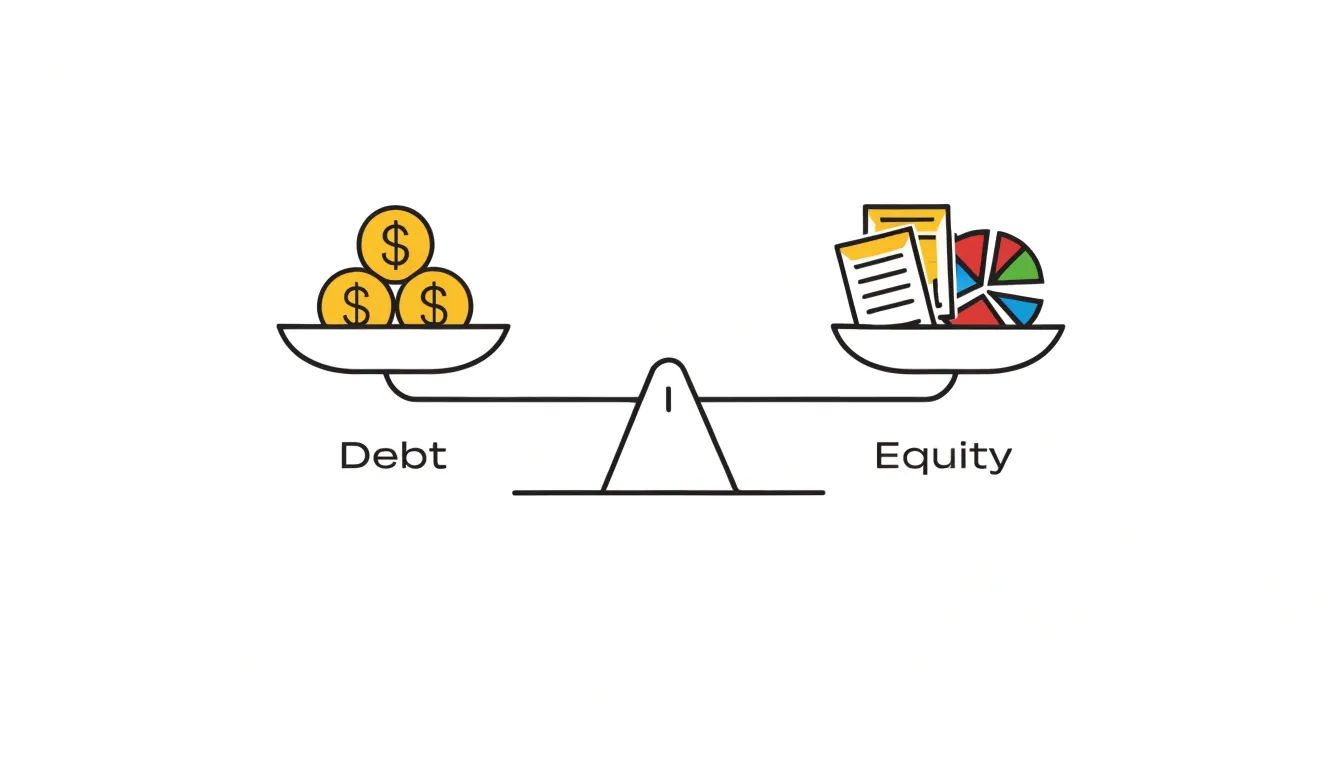
Table of Contents
- Understanding the Core Difference Between Business Debt and Ownership Equity
- Why Your Capital Structure Matters for Long Term Business Survival
- Debt vs Equity
- Key Financial Metrics That Reveal Your Ideal Debt Ratio
- When Should You Choose Borrowed Capital Over Giving Up Shares
- The Tradeoff Theory
- How Weighted Average Cost of Capital Influences Real World Funding Decisions
- Step by Step
- Common Financing Mistakes That Lead to Dilution or Insolvency
Understanding the Core Difference Between Business Debt and Ownership Equity
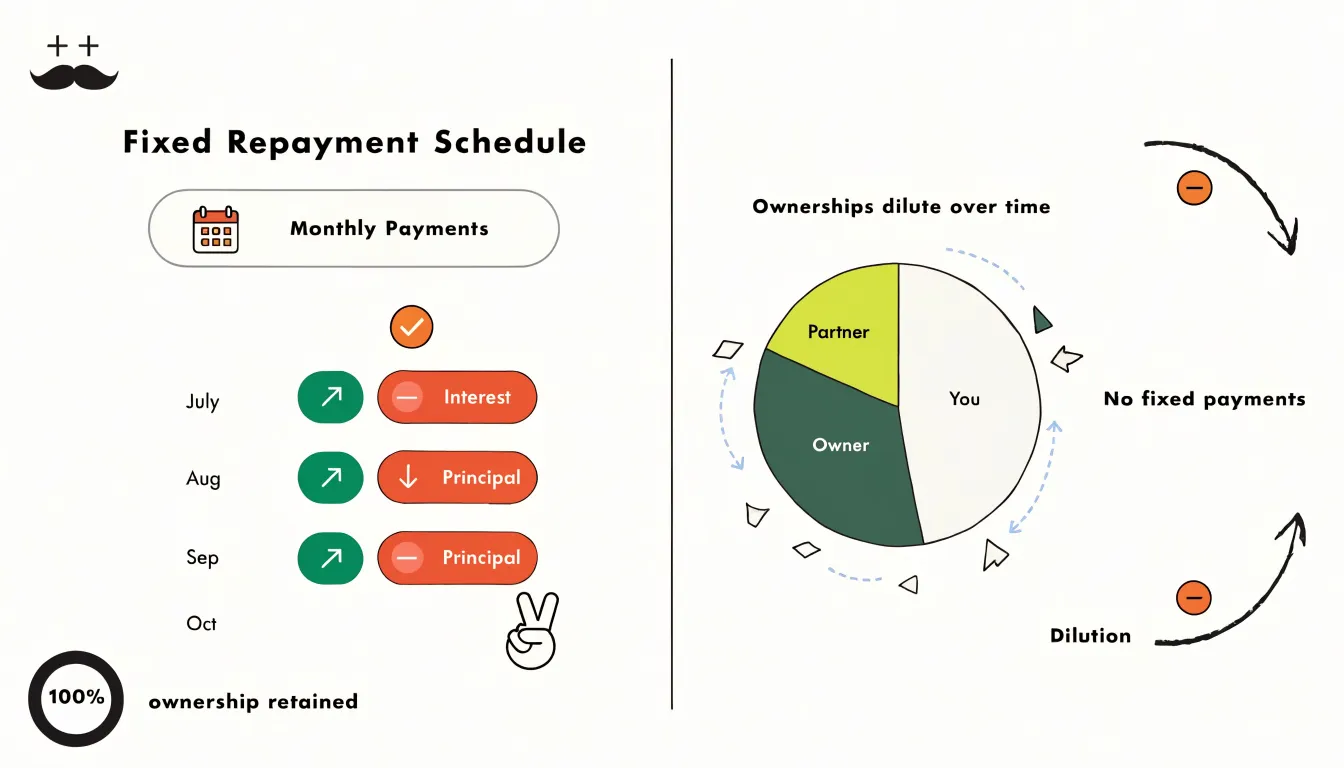
The distinction between debt and equity is the foundational building block of any capital structure decision. When a business raises debt, it enters into a contractual obligation to repay the principal amount borrowed along with interest over a defined schedule. The lender’s claim is fixed and limited to those contractual payments, which means the existing owners retain full ownership and control of the enterprise. Interest payments are typically tax-deductible, lowering the effective cost of borrowing, and the obligation is finite: once the loan is repaid, the relationship ends. The trade-off is that repayment is mandatory regardless of business performance, and failure to meet scheduled payments can trigger default and, in severe cases, insolvency. Debt therefore suits businesses with predictable cash flows that can comfortably service fixed obligations.
Equity works along an entirely different mechanism. When a company issues shares, it sells a permanent stake in the business. Investors contributing equity become part-owners with residual claims on profits and assets, meaning they are paid only after all creditors have been satisfied. In exchange for accepting that subordinate position and the risk of losing their investment, shareholders gain a share of future upside: dividends, capital appreciation, and potentially a voice in governance through voting rights. The capital raised through equity never has to be repaid, which gives the firm greater financial flexibility and resilience during downturns, since dividend payments are discretionary rather than contractual. The cost of that flexibility is dilution, as existing owners see their percentage ownership, control, and claim on future profits reduced.
These structural differences shape how each instrument fits a company’s circumstances. Debt preserves ownership but imposes fixed cash obligations and covenant restrictions. Equity shares both risk and reward, imposes no repayment burden, but permanently divides control and future value among a wider group. A well-designed capital structure balances the two, weighing the tax advantages and discipline of debt against the flexibility and risk-sharing that equity provides, and aligning the mix with the firm’s growth stage, cash flow stability, and the owners’ appetite for dilution.
Why Your Capital Structure Matters for Long Term Business Survival
Capital structure determines how a company funds its operations and growth, and the composition of that funding shapes what the business can survive and what it can pursue. Every organization draws on some combination of debt and equity: borrowed money that carries fixed repayment obligations, and invested capital that shares in ownership and returns. The proportions between these sources influence cost of capital, cash flow demands, ownership control, and the cushion available when conditions turn unfavorable. Over years and decades, these effects compound. A structure chosen for short-term convenience can quietly constrain a company’s options long after the immediate need has passed.
Resilience begins with the obligations a company must meet regardless of circumstance. Debt requires scheduled payments of interest and principal, and those payments continue through slow seasons, lost contracts, or sudden drops in demand. A company carrying heavy fixed obligations must devote cash to lenders before it can address anything else, which reduces its margin for error. Firms with more moderate leverage retain room to absorb shocks: they can miss a forecast without defaulting, postpone a project without penalty, and keep operating through a quarter that underperforms. Equity capital, which imposes no mandatory payments, provides a similar buffer. A structure weighted toward equity can be more expensive in good times, yet it buys a company the ability to endure bad ones without a crisis.
Flexibility during downturns follows from the same foundation. When revenue falls, management needs options: renegotiating terms, delaying expansion, cutting costs, or drawing on reserves. Each of these options is easier when the balance sheet is not already committed. A company with ample liquidity and manageable debt can respond deliberately. A company stretched thin may be forced into reactive measures, such as selling assets at unfavorable prices or accepting emergency financing on harsh terms. The difference between these positions often determines whether a downturn becomes a temporary setback or a permanent decline.
Capital structure also shapes the capacity to seize growth opportunities. Acquisitions, new facilities, product launches, and market entry all require funding, and the timing of opportunity rarely aligns with convenience. A company with a well-managed structure can raise additional capital, secure credit, or invest retained earnings when a promising opening appears. A company burdened by existing obligations may have to pass on opportunities or take on risk that threatens solvency. Striking that balance supports both resilience and growth.
Debt vs Equity
When a company needs to raise capital, the choice between debt and equity hinges on a careful evaluation of risk, cost, and control. Debt financing involves borrowing funds that must be repaid with interest, creating fixed obligations. These obligations are legally binding and must be met regardless of the company’s performance, which introduces financial risk. If earnings fall short, the company may struggle to service its debt, potentially leading to default or bankruptcy. Equity financing, by contrast, involves selling ownership stakes in the company. Equity investors become shareholders and share in the profits and losses, but they also dilute the ownership and control of existing shareholders. The risk with equity is not a fixed obligation but rather the potential loss of control and the possibility of conflicts between management and new shareholders.
Cost is another critical factor. Debt carries an explicit cost in the form of interest payments, which are often tax-deductible, reducing the effective cost. However, debt also increases financial leverage, which can magnify returns to shareholders but also amplifies risk. Equity financing does not require interest payments, but it dilutes earnings per share and gives away a portion of future profits. The cost of equity is often perceived as higher because equity investors demand a higher return to compensate for their risk, and there are issuance costs associated with selling new shares. Additionally, equity does not provide a tax shield, making it relatively more expensive on an after-tax basis.
Control implications are profound. Debt holders typically have no voting rights and do not participate in management, so control remains with existing owners. However, debt covenants can restrict managerial discretion, limiting decisions on dividends, additional borrowing, or asset sales. Equity investors, on the other hand, may gain voting rights and influence over corporate decisions, potentially leading to a shift in control. For founders and existing shareholders, this dilution can be a significant concern, especially if it reduces their ability to steer the company’s direction.
In weighing these factors, companies must consider their risk tolerance, cash flow stability, growth stage, and strategic goals. A mature company with steady cash flows might favor debt for its tax advantages and control preservation, while a high-growth startup might prefer equity to avoid fixed obligations and preserve cash for investment. Ultimately, the optimal capital structure balances the trade-offs between risk, cost, and control to maximize firm value.
Key Financial Metrics That Reveal Your Ideal Debt Ratio
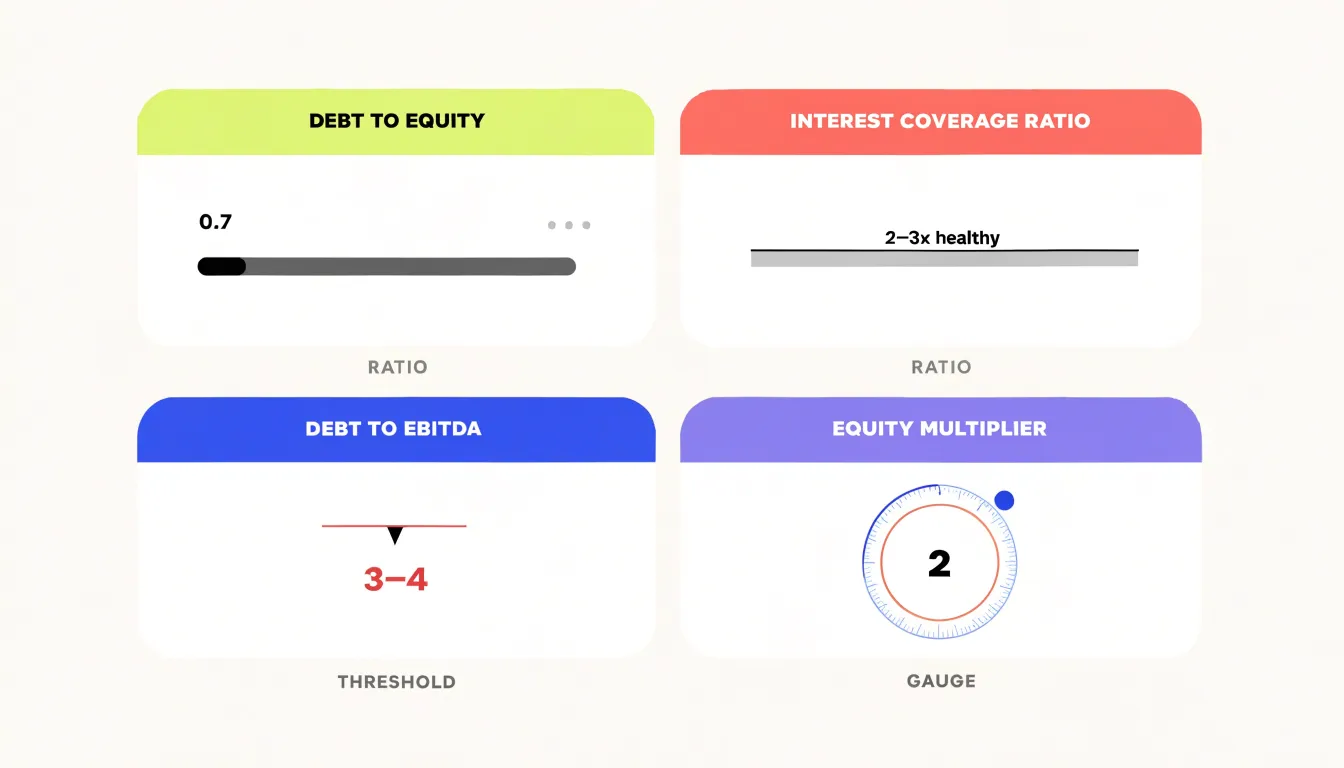
Several financial metrics help pinpoint an appropriate debt ratio by revealing how much leverage a company can comfortably carry. The debt-to-equity ratio, calculated as total liabilities divided by shareholders’ equity, shows the proportion of debt and equity used to finance assets. A higher ratio indicates greater reliance on debt, which can amplify returns but also increases financial risk. Interpreting this metric requires context: industries with stable cash flows, such as utilities, often support higher debt-to-equity ratios, while cyclical or volatile industries warrant lower ratios. Comparing a company’s ratio to its industry peers and its own historical trend provides a benchmark for what is typical and sustainable. Another critical metric is the interest coverage ratio, which measures how many times a company’s earnings before interest and taxes (EBIT) can cover its interest expenses. A ratio below 1.5 suggests that the company may struggle to meet interest obligations, signaling an excessive debt load. Lenders and investors typically look for an interest coverage ratio of at least 2 to 3, with higher ratios indicating a stronger cushion. This metric directly ties debt capacity to profitability, helping determine whether the company generates enough operating income to service its debt. Leverage ratios, such as the debt-to-EBITDA ratio, compare total debt to earnings before interest, taxes, depreciation, and amortization. This ratio is widely used by creditors to assess how many years of earnings would be needed to repay all debt. A lower ratio implies less risk; for many industries, a debt-to-EBITDA ratio above 3 to 4 may be considered high, though norms vary. Finally, the equity multiplier, defined as total assets divided by shareholders’ equity, reflects the degree to which assets are financed by debt. A higher multiplier indicates more leverage. Together, these metrics provide a comprehensive view of financial risk. By analyzing them alongside industry benchmarks, historical performance, and cash flow stability, a company can gauge an appropriate debt level that balances the tax benefits of debt against the risk of financial distress.
When Should You Choose Borrowed Capital Over Giving Up Shares
The decision between borrowed capital and equity financing hinges on a careful reading of a company’s cash flow profile, the prevailing interest rate environment, and the strategic value the founders place on ownership. Debt becomes the more attractive route when a business generates predictable, steady cash inflows that can comfortably service scheduled interest and principal payments. A firm with recurring revenue, long-term customer contracts, or stable demand can map out its future obligations with confidence, which makes fixed debt payments manageable rather than risky. In such conditions, borrowing lets the company retain the full upside of its growth instead of sharing future profits with outside investors.
Interest rates play an equally decisive role. When rates are low, the cost of debt is comparatively cheap, and locking in financing at favorable terms can be far less expensive over time than issuing new shares. Low-rate environments also make refinancing easier and reduce the drag that debt service places on operating cash flow. Companies with strong credit profiles can capture these benefits and use leverage to amplify returns for existing owners.
Ownership considerations often tip the scales as well. Founders who want to preserve control, avoid board seats for outsiders, or keep decision-making concentrated will favor debt when the numbers allow it. Equity dilution is permanent, while debt is finite and its claim ends once repaid. For businesses nearing an exit or those protecting a concentrated ownership structure, this permanence matters enormously.
Equity financing tends to make more sense in the opposite circumstances. Early-stage ventures with unpredictable revenue, heavy upfront investment needs, or negative cash flow may struggle to meet fixed debt obligations and are better served by investors who share the risk. Companies in rapid growth phases that need large capital infusions before profits materialize often find equity more flexible, since repayments are not forced during lean periods. Similarly, businesses with high uncertainty or volatile earnings benefit from the cushion equity provides. In these cases, giving up a share of ownership buys stability and runway that debt could not safely deliver, and the trade-off is worthwhile.
The Tradeoff Theory
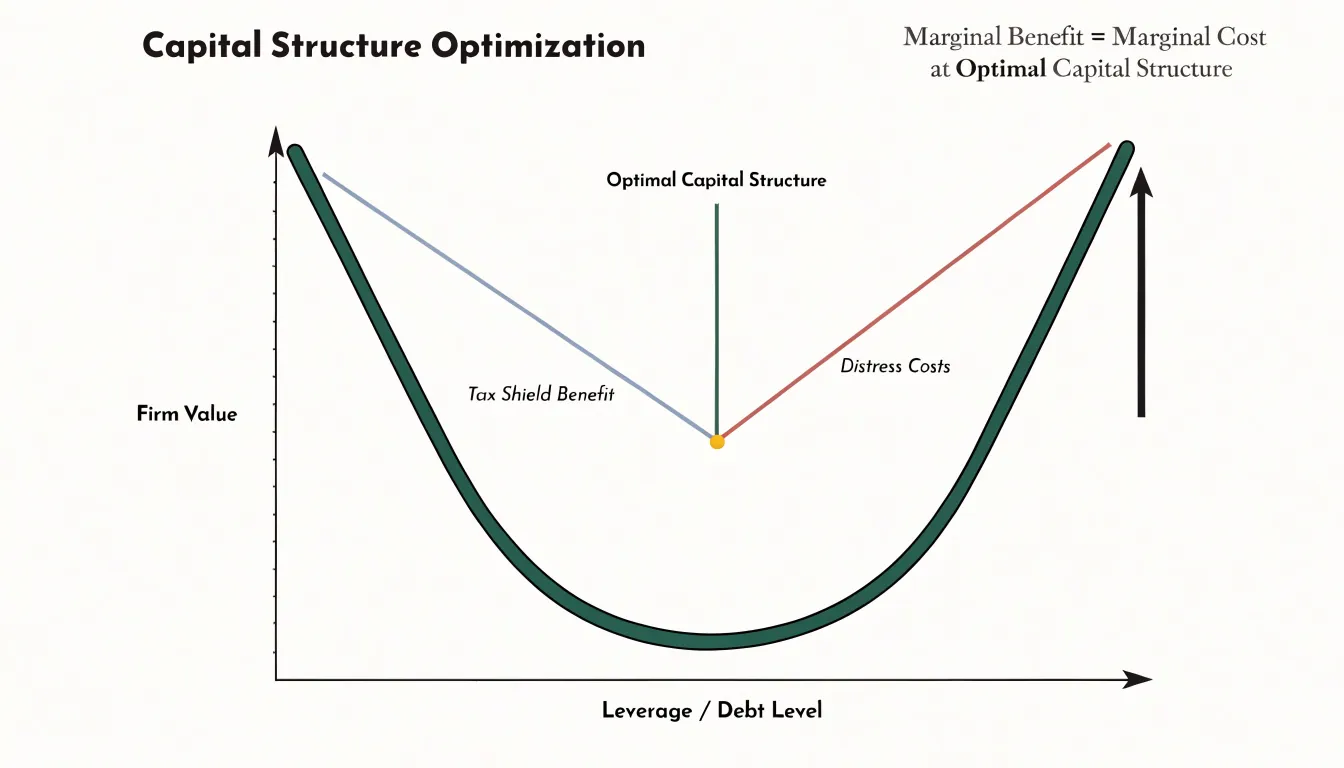
The tradeoff theory of capital structure starts from a simple observation: debt carries real benefits, and it also carries real costs. The goal of the theory is to find the point where the two are balanced most advantageously. On the benefit side, interest payments on debt are typically tax-deductible, which creates a tax shield. Every dollar of interest reduces taxable income, so substituting debt for equity lowers the firm’s tax bill and leaves more cash for investors. All else equal, this pushes a company toward using more leverage. On the cost side, higher debt levels raise the probability that the firm will struggle to meet its obligations. As leverage climbs, lenders demand higher interest rates, suppliers and customers grow cautious, and key employees may look for safer ground. In extreme cases the firm faces financial distress, which can include costly restructuring, asset fire sales, or bankruptcy proceedings. These distress costs can be direct, such as legal and advisory fees, or indirect, such as lost sales and damaged relationships that erode value long before any formal bankruptcy filing.
The theory says managers should weigh these forces against each other. At low levels of debt, the tax shield dominates and adding leverage creates value. At high levels, the expected costs of distress begin to outweigh the tax benefit, and each additional unit of debt destroys value. Somewhere in between sits an optimal capital structure, a financial sweet spot where the marginal tax benefit of one more dollar of debt equals the marginal expected cost of distress. In practice, finding this point is not a precise calculation. Managers estimate it by examining industry norms, their own cash flow volatility, the tangibility of their assets, and their access to credit markets. Firms with stable, predictable cash flows and substantial physical assets can typically carry more debt before distress costs bite, while volatile or asset-light businesses reach their limit sooner. The tradeoff framework also explains why observed capital structures cluster by industry and why firms tend to drift back toward target leverage ratios over time. It treats the search for the right mix as an ongoing balancing act rather than a one-time decision, with managers adjusting as tax rules, market conditions, and business risk evolve.
How Weighted Average Cost of Capital Influences Real World Funding Decisions
The weighted average cost of capital, commonly abbreviated as WACC, represents the blended rate of return a company must earn on its existing asset base to satisfy its owners, creditors, and other capital providers. It is calculated by weighting the cost of each source of capital—debt and equity—by its proportional share of the firm’s total capital structure. The cost of debt is relatively straightforward, reflecting the interest rate a company pays on borrowed funds, adjusted for the tax deductibility of interest. The cost of equity is more subtle, capturing the return shareholders expect given the risk they bear. By combining these components into a single percentage figure, WACC distills the firm’s overall financing costs into one practical benchmark that managers can apply across a wide range of decisions.
In real-world funding decisions, WACC functions as a hurdle rate. When a company evaluates a potential project, the expected return on that project is compared against the WACC. A project expected to generate returns above the WACC is generally value-creating, because it earns more than the capital tied up in it costs. A project expected to fall below the WACC destroys value, since the firm would be paying more for capital than the investment returns. This simple comparison gives managers a consistent, quantifiable threshold for screening capital proposals, from building a new factory to acquiring a competitor or launching a product line.
WACC also guides how a firm chooses to finance its activities. Because the weighted average depends on the mix of debt and equity, changing the capital structure changes the hurdle rate. Debt tends to be cheaper than equity due to tax shields and lower perceived risk, so adding debt can lower WACC up to a point. Beyond that point, rising financial risk pushes up both the cost of debt and the cost of equity, and WACC begins to climb again. Managers therefore use WACC analysis to test whether a proposed financing mix improves or worsens the firm’s overall cost of capital, informing decisions about issuing bonds, taking on loans, or raising equity.
Finally, WACC connects project-level decisions to firm-level value. By applying a single, consistently derived rate across divisions and investment opportunities, companies ensure that capital flows toward the activities that best compensate their investors for the risk taken, which is the central aim of sound capital structure management.
Step by Step
Adjusting your capital mix over time works best as a deliberate sequence of stages, each matching the risks and cash flow profile your company has at that moment. At the startup stage, equity is the natural backbone of the capital structure. Early cash flows are unpredictable, collateral is scarce, and lenders have little to evaluate, so founders, angel investors, and venture funds supply the capital. The practical step here is to raise enough equity to fund eighteen to twenty-four months of operations, keeping the cap table organized and documenting every round clearly. Founders should also begin building the habits that later make debt possible: clean bookkeeping, reliable monthly reporting, and a clear view of unit economics.
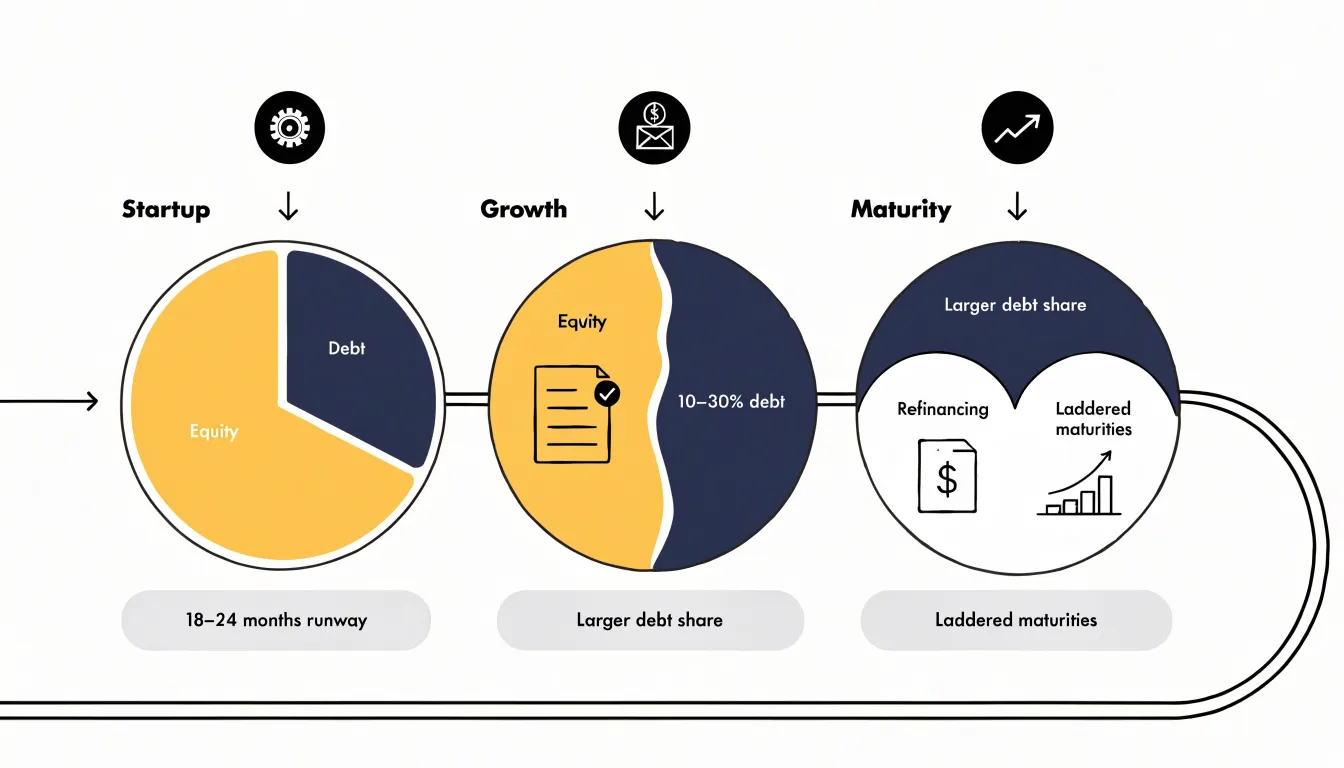
As the company enters the growth stage, revenue becomes more predictable and the business accumulates assets, customer contracts, and a track record. This is the moment to introduce a first layer of debt. Practical steps include applying for a working capital line of credit to smooth seasonal swings, exploring equipment financing for machinery or technology purchases, and, once recurring revenue is stable, investigating revenue-based financing or venture debt to extend runway without diluting ownership. A useful discipline is to set a target mix, for example moving from nearly all equity toward a blend where debt funds ten to thirty percent of the asset base, and to revisit that target annually.
At maturity, cash flows are steady enough to service meaningful leverage. Companies at this stage can refinance expensive early debt, term out short obligations into longer maturities, and use debt to fund expansions or acquisitions at a lower cost than issuing new equity. Practical rebalancing steps include maintaining a debt service coverage cushion, laddering maturities so no single year carries a wall of repayments, and periodically reviewing whether retained earnings can replace external funding. Throughout every stage, the discipline is the same: match the instrument to the risk, monitor leverage ratios against industry norms, and rebalance on a schedule rather than only in a crisis.
Common Financing Mistakes That Lead to Dilution or Insolvency
Capital structure mistakes tend to fall into recognizable patterns, and each one carries a distinct set of consequences for founders and lenders alike. Over-reliance on equity is among the most common. Companies that fund every stage of growth through successive equity rounds avoid the discipline of debt, yet they give away ownership with each raise. Founders who sell 20 to 30 percent of the business in every round can find themselves with a minority stake by the third or fourth financing, and later investors may demand protective provisions that further erode control. The remedy is to model the ownership consequences of each raise before signing a term sheet and to consider alternative instruments, such as convertible notes or revenue-based financing, for short-term needs.
Excessive debt represents the opposite error. Leverage magnifies returns when cash flows are stable, and it magnifies losses when they are not. Companies that borrow against optimistic projections rather than conservative ones often discover that a single missed quarter leaves them unable to service interest. A useful discipline is to stress-test the repayment schedule against a downside scenario, asking whether the business could meet its obligations if revenue fell by 20 or 30 percent.
Ignoring covenants is a subtler failure. Loan agreements frequently include maintenance covenants tied to leverage ratios, minimum liquidity, or EBITDA thresholds. Management teams that treat these as boilerplate may breach them without warning, triggering technical defaults that allow lenders to demand immediate repayment or reprice the facility. The practical safeguard is to track covenant headroom monthly and to open a conversation with the lender at the first sign of pressure, since most institutions prefer a negotiated amendment to enforcement.
Failing to plan for repayment is perhaps the most avoidable mistake. Bullet maturities arrive on a fixed date regardless of business conditions, and refinancing markets can close quickly. Companies should begin arranging replacement capital twelve to eighteen months before a maturity, maintain relationships with multiple lenders, and hold a cash buffer sufficient to cover at least two quarters of debt service. Together, these habits keep dilution predictable and solvency intact.
Frequently Asked Questions
What’s the difference between debt and equity financing?
Debt financing is borrowed money that must be repaid with interest on a defined schedule, and lenders generally have no ownership or voting rights, though covenants can restrict managerial discretion. Equity financing sells a permanent ownership stake, with shareholders paid after creditors and taking on dilution and potential loss of control in exchange for sharing future upside.
Why is capital structure important for long-term business survival?
Capital structure affects cost of capital, cash flow demands, ownership control, and the cushion available when conditions turn unfavorable, and those effects compound over time. Heavy fixed debt obligations reduce the margin for error, while equity capital imposes no mandatory payments and can provide a buffer.
How can I tell what debt ratio is right for my company?
Metrics such as debt-to-equity, interest coverage, debt-to-EBITDA, and the equity multiplier help reveal how much leverage a company can comfortably carry, and they should be analyzed alongside industry benchmarks, historical performance, and cash flow stability. An interest coverage ratio below 1.5 suggests the company may struggle to meet interest obligations, while lenders and investors typically look for at least 2 to 3.
When should a business use debt instead of equity?
Debt can be more attractive when a business has predictable, steady cash inflows to service scheduled interest and principal, when interest rates are low, and when owners want to preserve control and avoid dilution. Borrowing lets the company retain the full upside of growth instead of sharing future profits with outside investors.
What does the tradeoff theory say about capital structure?
The tradeoff theory says debt carries benefits such as the tax shield from deductible interest, but higher leverage raises the probability of financial distress and related costs. The optimal capital structure balances the marginal tax benefit of debt against the marginal expected cost of distress, and firms with stable cash flows and substantial physical assets can typically carry more debt.
What financing mistakes can cause dilution or insolvency?
Over-reliance on equity can lead founders to sell 20 to 30 percent of the business each round and become minority holders by the third or fourth financing, while excessive debt borrowed against optimistic projections can leave a company unable to service interest after one missed quarter. Ignoring loan covenants and failing to plan for repayment can trigger technical defaults or refinancing problems.