Cash Basis Accounting
Cash basis accounting records revenue when cash is received and expenses when cash is paid, regardless of when work is performed or bills are incurred. This method mirrors bank account activity, simplifies bookkeeping by eliminating receivables and payables tracking, and defers taxes on unpaid invoices, but it can distort profitability during periods with significant timing differences.
Table of Contents
- How cash basis accounting tracks money when it changes hands
- Cash versus accrual
- Primary financial benefits of using the cash method
- Simple bookkeeping
- Hidden downsides of tracking cash only when received
- Tax timing
- Types of small businesses that thrive on cash accounting
- When growing businesses must switch to accrual accounting
How cash basis accounting tracks money when it changes hands
Cash basis accounting tracks money at the moment it changes hands. Revenue is recorded when cash is received, and expenses are recorded when cash is paid. This simple mechanic means the timing of transactions in the accounting records follows the timing of actual cash flows, rather than the timing of economic activity. For a small business owner, this often aligns closely with what they see in their bank account, making the books easier to interpret.
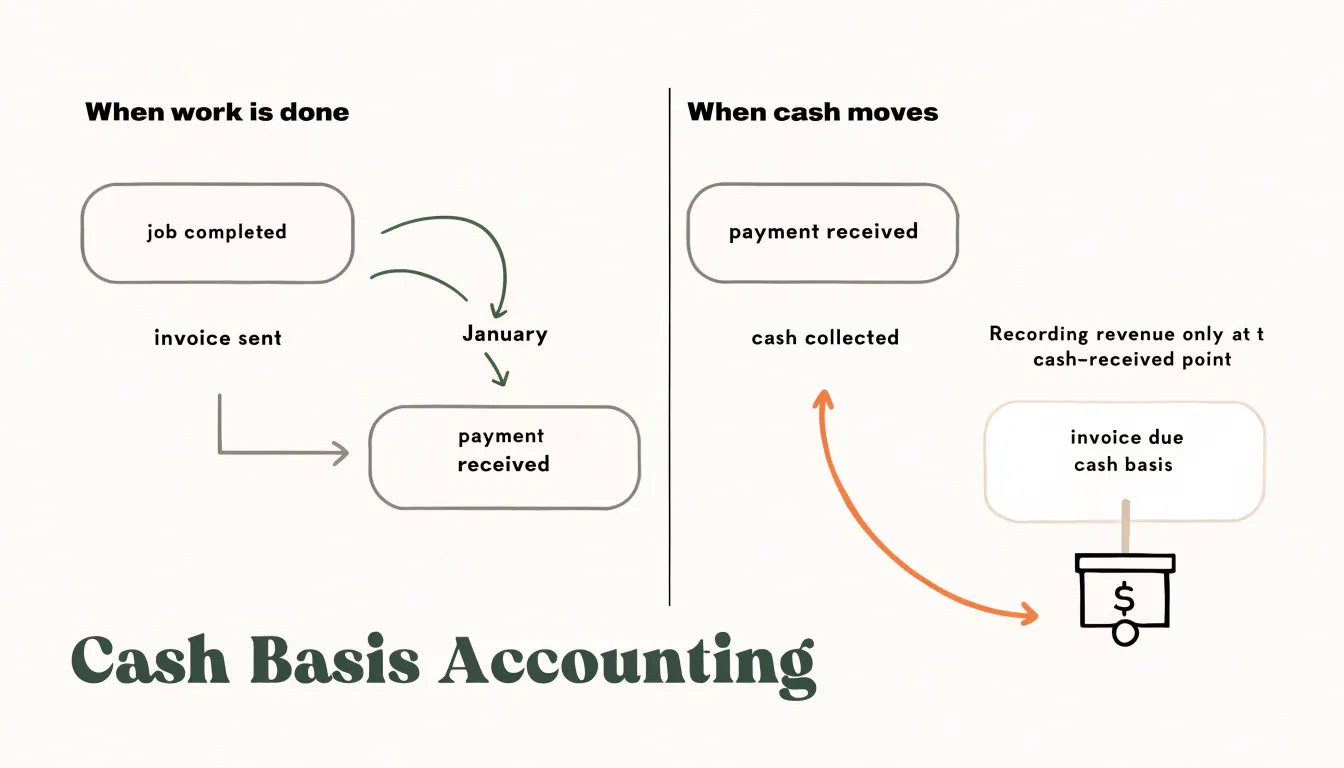
Consider a concrete example. A landscaping company completes a $5,000 job in December but the client does not pay until January. Under cash basis accounting, the company records no revenue in December. The $5,000 is recorded as revenue in January, when the cash arrives. Similarly, if the company pays $1,200 in December for a one-year insurance policy that covers the following year, the entire $1,200 is recorded as an expense in December, even though the coverage extends into future months. The expense is recognized when paid, not when the benefit is consumed.
These two examples illustrate how cash basis accounting handles delayed invoices and prepaid expenses differently from accrual accounting. Under accrual accounting, the $5,000 job would be recorded as revenue in December, when the service was performed, with a corresponding receivable. The $1,200 insurance premium would be recorded as a prepaid asset in December and then expensed over the coverage period. Cash basis accounting skips these timing adjustments and simply waits for cash to move.
The core mechanic is straightforward: every cash receipt is recorded as revenue, and every cash payment is recorded as an expense. This approach provides a clear picture of cash on hand and is often preferred by sole proprietors and very small businesses because it requires less bookkeeping and no need to track accounts receivable or payable. However, it can obscure the underlying economics of a business, especially when there are significant timing differences between when work is done and when cash is exchanged. For instance, a business that has a profitable month on an accrual basis might show a loss on a cash basis if customers haven’t paid yet. Understanding this mechanic is essential for interpreting financial statements prepared on a cash basis and for recognizing when accrual accounting might offer a more complete view.
Cash versus accrual
Cash basis and accrual basis accounting differ most visibly in the moment a transaction enters the books. Under the cash method, revenue is recorded when payment actually arrives, and expenses are recorded when they are actually paid. A consulting firm that invoices a client in December but receives the check in January counts that income in January. Under the accrual method, the same firm records the revenue in December, when the work was completed and the right to payment was established, regardless of when the cash changes hands. Expenses follow the same logic: a supplier bill is booked when the obligation is incurred, whether or not the check has gone out yet.
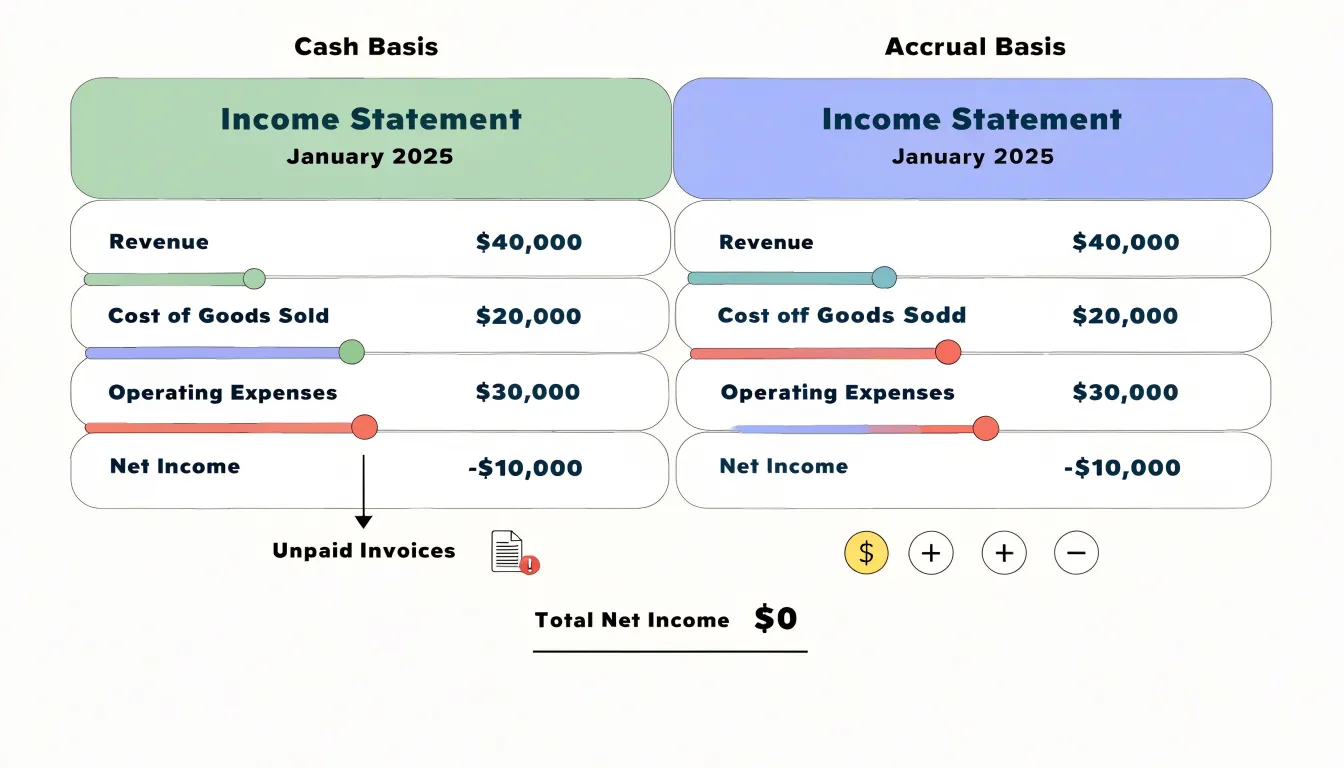
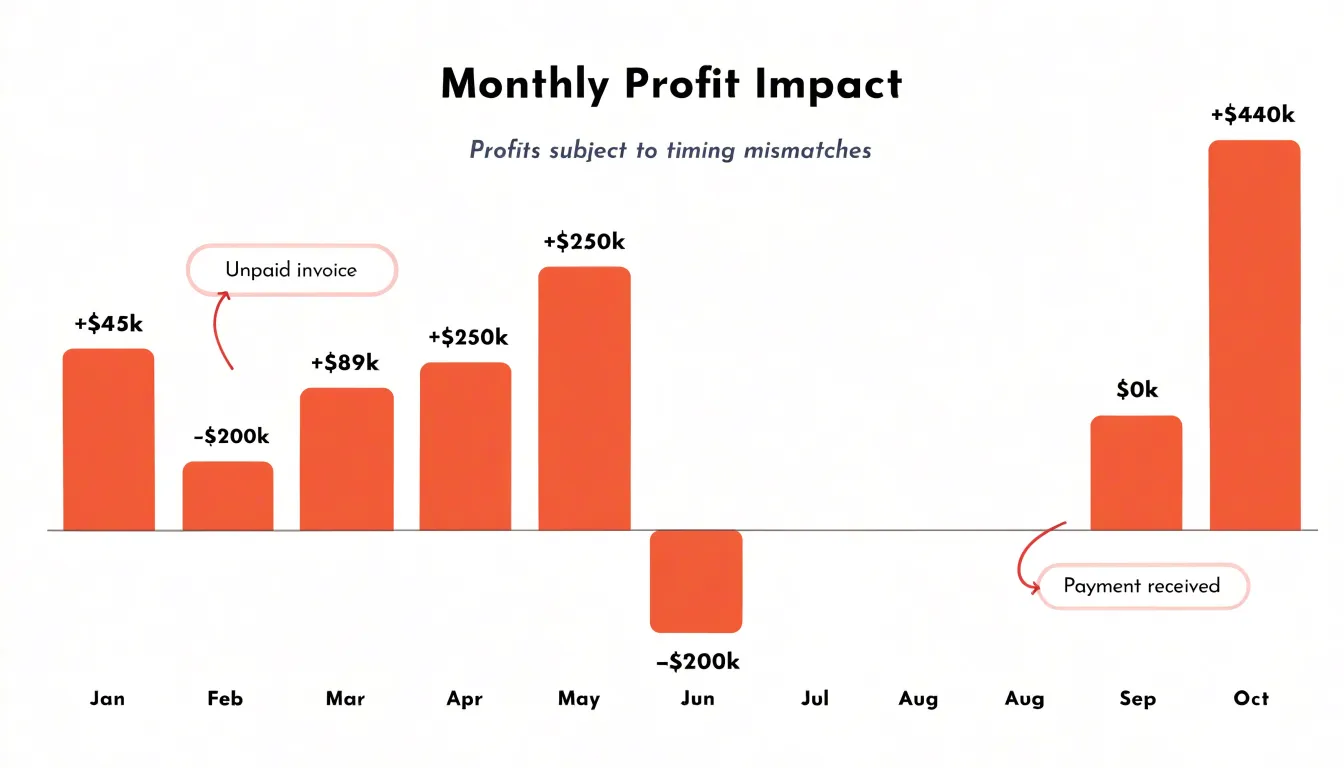
That timing difference flows directly into reported profit. In a month where a business completes substantial work but collects little cash, cash basis books can show a loss or a modest figure while accrual books show the revenue and the matching costs together, producing a profit that reflects the actual economic activity of the period. The reverse can happen when a strong collections month follows a slow sales month: cash basis profit spikes while accrual profit stays flat, because the revenue was already recognized earlier. Over the full life of a business, total profit under both methods converges, yet the month-to-month and year-to-year numbers can look strikingly different.
The choice also changes how a reader interprets financial health. Cash basis statements answer a practical question: is there money in the bank to pay bills and meet payroll? They are simple to maintain and closely track liquidity. Accrual statements answer a broader question: is the business generating value from its operations, independent of collection timing? They capture receivables, payables, and obligations that cash statements leave invisible until money moves. A company can look flush on a cash basis while carrying large unpaid bills, or look strained on a cash basis while holding substantial receivables that will soon convert to cash.
Because of these differences, the method shapes lending decisions, tax planning, and performance comparisons across periods. A side-by-side view helps owners and advisors see both the cash position and the underlying economics, and it explains why two sets of books for the same business can tell two different stories about the same stretch of time.
Primary financial benefits of using the cash method
The cash method of accounting offers several primary financial benefits that can be particularly advantageous for small businesses and sole proprietors. First, it provides improved cash flow visibility. Because transactions are recorded only when cash changes hands, the books directly reflect the actual cash position at any given moment. This real-time clarity helps business owners make informed decisions about spending, investing, and managing obligations, as they can see exactly how much money is available without adjusting for accruals or outstanding invoices.
Second, the cash method typically results in lower accounting costs. The recording process is straightforward: income is logged when received, and expenses are logged when paid. This simplicity reduces the need for complex accrual adjustments, such as tracking accounts receivable and payable, prepaid expenses, and accrued liabilities. Consequently, businesses can save on bookkeeping and accounting fees, and owners can often manage their own books with minimal training, further cutting costs.
Third, tax preparation becomes easier under the cash method. Since the IRS generally accepts cash-basis accounting for small businesses, taxpayers can report income and deductions based on actual cash flows. This alignment simplifies the reconciliation of book income to taxable income, reducing the time and effort required to prepare tax returns. It also minimizes the need for intricate tax adjustments that are common under the accrual method, such as those related to bad debts or inventory.
Finally, the cash method allows businesses to defer taxes on receivables until the money actually arrives. Under accrual accounting, income is recognized when earned, even if payment is not yet received, which can create a tax liability before the cash is in hand. With the cash method, taxes on sales are deferred until payment is collected, providing a significant cash flow advantage, especially for businesses that extend credit terms to customers. This deferral can improve liquidity and give business owners more flexibility in managing their finances. Collectively, these benefits make the cash method an attractive option for many small enterprises seeking simplicity and financial agility.
Simple bookkeeping
Cash basis accounting keeps daily bookkeeping within reach for owners who handle their own finances. Every transaction is recorded at the moment money actually moves, which means the bookkeeping process mirrors what happens in the bank account. When a customer pays an invoice, revenue appears in the books that day. When a bill is paid, the expense is recorded then. There is no separate ledger of amounts owed to the business or amounts the business owes, because those obligations only enter the books when cash changes hands. This single rule removes entire categories of recordkeeping that would otherwise require constant attention.
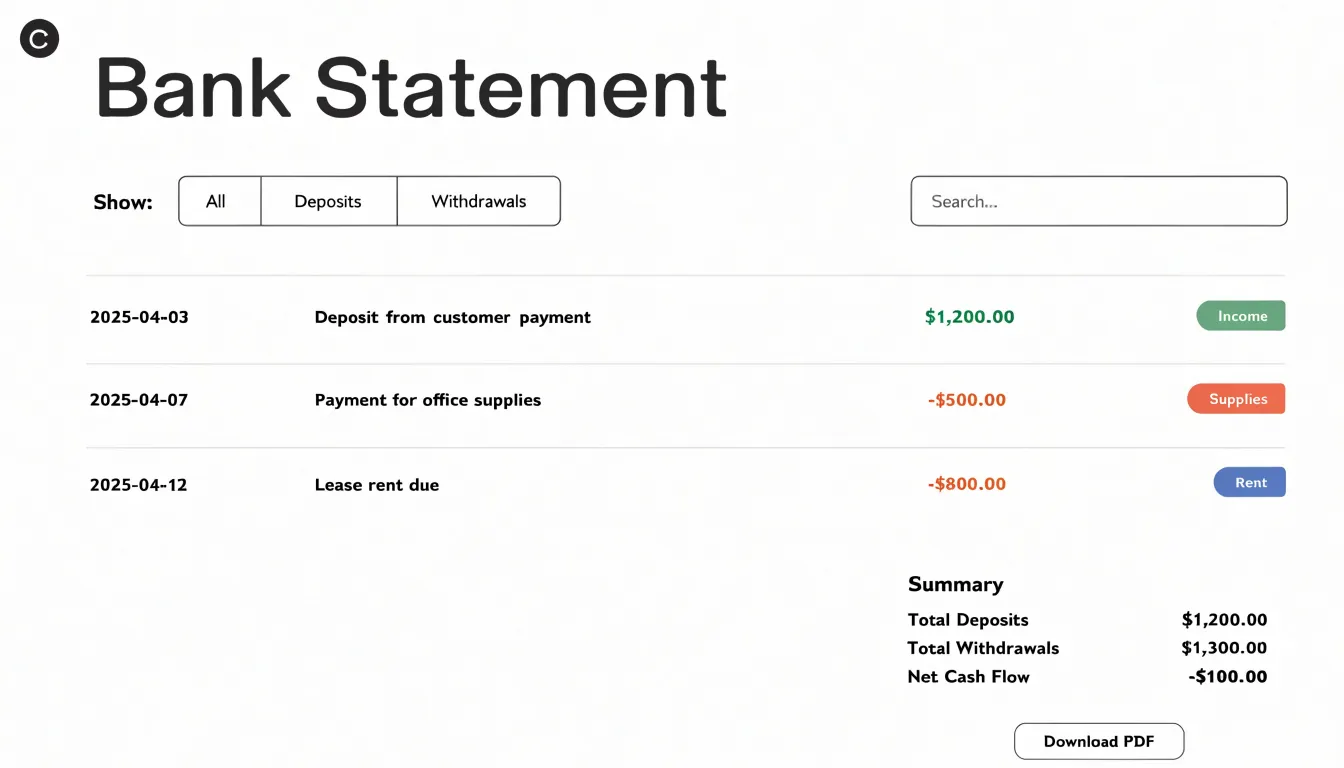
A large share of the simplification comes from eliminating accounts receivable and payable tracking. Under accrual accounting, every unpaid invoice creates a receivable that must be monitored, aged, and reconciled, and every unpaid bill creates a payable that must be scheduled and matched to a future payment. Cash basis accounting sidesteps this paperwork entirely. The owner does not need to maintain customer ledgers, follow up on aging reports, or track vendor balances in the books. The bank statement becomes the primary record, and the bookkeeping task reduces to categorizing deposits and withdrawals as they appear.
The method also reduces the need for adjusting journal entries. Accrual books require month-end adjustments to record revenue earned but not yet billed, expenses incurred but not yet paid, prepaid items, and accrued liabilities. Each adjustment is an extra step that must be calculated, entered, and later reversed. With cash basis accounting, those entries largely disappear because the books already reflect actual cash movement. Month-end close becomes a matter of reviewing transactions rather than constructing them, which shortens the process considerably for a small operation.
Because the recordkeeping is lighter, basic tools are usually sufficient. Many owners can manage their books with entry-level accounting software or even a well-structured spreadsheet that mirrors the bank account. Deposits are logged as income, withdrawals as expenses, and categories are assigned as the work is done. This keeps the cost of bookkeeping low and makes the numbers easy to understand at a glance. An owner can open the books on any given day and see exactly what cash came in and what went out, with no need to interpret accruals or reconcile subsidiary ledgers.
Hidden downsides of tracking cash only when received
One of the most significant hidden downsides of tracking cash only when it is received is that profitability can appear distorted during periods when large invoices remain unpaid. A business may complete substantial work, deliver goods, or finish a major project, and yet its books show little or no revenue for that month because the client has not yet paid. The expenses tied to that work, however, such as materials, labor, and subcontractor costs, have already been recorded. The result is a misleading picture: the income statement may show a loss or a sharply reduced profit even though the underlying operations were healthy and the money is contractually owed. When the payment finally arrives weeks or months later, the books swing in the opposite direction, showing a surge of revenue in a period that may have been relatively quiet. This timing mismatch makes it difficult to compare one month or quarter against another, and it can lead owners to draw false conclusions about which products, services, or seasons are actually profitable.
The same cash-only lens creates practical obstacles when a business seeks external financing or investment. Lenders and investors typically evaluate a company through its financial statements, and they look for evidence of consistent revenue, collectible receivables, and predictable cash flows. A cash-basis ledger that shows erratic income, or that omits earned but uncollected revenue entirely, can make a viable business look unstable or underperforming. Bankers may question whether the company can service a loan, and investors may hesitate to commit capital when the reported numbers do not reflect the true scale of activity. Preparing supplementary schedules and explanations adds work and uncertainty to every financing conversation.
Finally, relying solely on cash timing carries the risk of misjudging overall financial health when receipts lag behind real activity. Owners may postpone hiring, cut spending, or turn down new work because the bank balance looks thin, even though a wave of receivables is on its way. Conversely, a temporary influx of cash from an unusually fast-paying client can create a false sense of security. Without visibility into outstanding invoices and accrued obligations, decisions about growth, pricing, and spending rest on incomplete information, and small misjudgments can compound into larger financial problems.
Tax timing
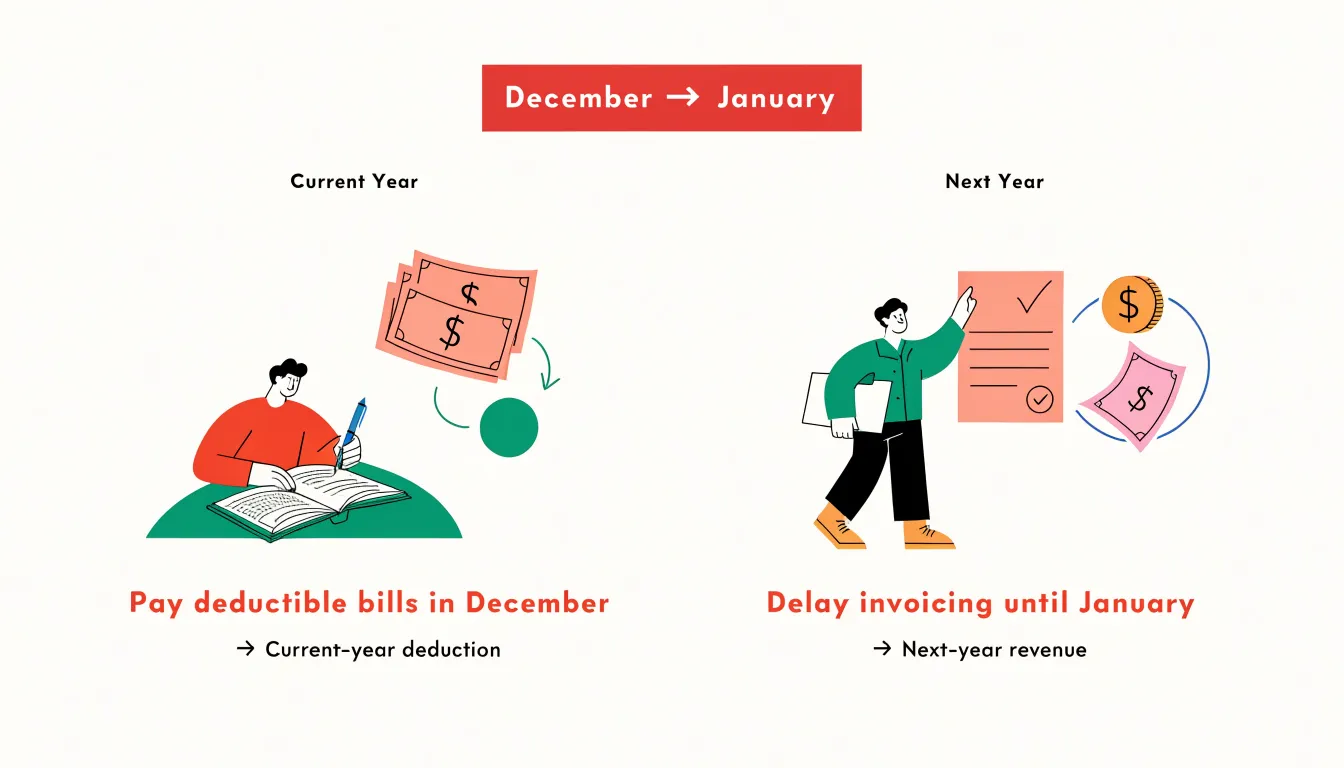
Cash basis accounting affects your tax return because the timing of when money moves determines when income and expenses appear on your books. Under this method, income is recorded when you actually receive payment, and expenses are recorded when you actually pay them. A sale made in December but paid in January becomes income for the following tax year. A bill received in December but paid in January becomes a deduction in the following year. This shift creates a natural lever for managing taxable income: accelerating expenses into the current year lowers this year’s profit, while deferring customer payments into the next year pushes revenue forward. Many small business owners deliberately pay deductible bills in late December and hold off invoicing until early January to smooth their tax burden. Those choices must reflect real business activity, since the IRS expects the method to clearly reflect income.
The IRS governs eligibility for cash accounting through revenue thresholds. For tax years beginning after 2017, the Tax Cuts and Jobs Act raised the gross receipts test to $25 million, adjusted annually for inflation, allowing more small businesses to use the cash method without maintaining inventory accounting or matching rules. Businesses that exceed the threshold generally must use the accrual method. Certain entity types, such as tax shelters, remain excluded. When a business crosses the threshold, it may need to file a change in accounting method using Form 3115, which requests automatic consent from the IRS. Staying aware of the threshold matters because crossing it can force a transition and alter the timing of income recognition.
Strategies for timing payments follow from the mechanics. Sending invoices early in December can pull revenue into the current year, which helps in a low-income year when a business wants to use up lower tax brackets or offset credits. Delaying invoices moves income into the next year during a high-income year. On the expense side, prepaying rent, insurance, or supplies before year-end can increase current deductions, provided the payments are legitimate business costs and not artificial arrangements. Businesses should also watch the constructive receipt doctrine: a check received but not deposited, or funds made available without restriction, can count as income even if not yet in the bank. Coordinating these timing moves with an accountant helps ensure they comply with IRS rules and support an accurate, defensible return.
Types of small businesses that thrive on cash accounting
Cash basis accounting tends to suit small businesses whose money moves in and out quickly, where the gap between delivering a service and getting paid is measured in days rather than months. Service providers such as plumbers, electricians, landscapers, and cleaning companies are classic examples. They typically collect payment at the end of a job or shortly after, so their bank balance closely reflects what they have actually earned. Freelancers and independent consultants fall into the same category. A graphic designer or copywriter who invoices a client and receives payment within two weeks has little need for the accrual adjustments that track unbilled work and outstanding invoices. For these owners, recording income when the check clears keeps the books simple and matches the way they already think about their finances.
Retailers and other businesses with immediate payment cycles also fit comfortably into cash accounting. A shop, cafe, or online store selling directly to consumers usually receives payment at the point of sale, whether through cash, card, or a payment processor that settles within a day or two. Inventory purchases, rent, and wages are likewise paid on a regular schedule, so the timing differences between cash and accrual methods stay small. The same logic applies to businesses with low receivables, meaning the bulk of their sales convert to cash almost instantly and few customers carry balances on credit.
Eligibility for cash basis accounting depends on size and structure as well. In the United States, the Internal Revenue Service generally allows sole proprietors, partnerships, and S corporations to use the cash method without restriction, while C corporations and partnerships with corporate partners must meet revenue thresholds. Under current rules, businesses with average annual gross receipts of roughly 25 million dollars or less over the prior three years can generally use the cash method, a threshold that covers the vast majority of small enterprises. Farming businesses have historically enjoyed even broader access to cash accounting.
For owners within these bounds, the appeal is practical. Cash accounting mirrors the checking account, simplifies tax preparation, and avoids the need to estimate revenue that has been earned but not yet collected. A business that fits the profile of fast payment cycles, minimal receivables, and modest revenue can adopt cash accounting with confidence and keep its bookkeeping straightforward.
When growing businesses must switch to accrual accounting
For many small businesses, cash basis accounting offers simplicity: you record revenue when cash arrives and expenses when you pay them. As a company grows, however, this method can obscure financial reality and create compliance hurdles. The IRS imposes a gross receipts threshold that forces a change to accrual accounting for certain entities. Under current rules, businesses with average annual gross receipts exceeding $29 million for the three prior tax years (adjusted for inflation) generally must use an accrual method, though exceptions exist for certain small business taxpayers. Falling under this rule means a mandatory switch, which brings both operational and tax consequences.
Operationally, transitioning to accrual accounting requires adjusting your books to reflect accounts receivable and payable. You’ll need to record revenue when earned and expenses when incurred, regardless of cash flow. This can be a significant undertaking, requiring updated accounting systems, staff training, and potentially the help of a CPA. Tax consequences also arise: the year you switch, you may need to recognize income that was previously deferred, or deduct expenses that were previously capitalized, leading to a one-time tax impact. Proper planning can mitigate surprises, such as spreading adjustments over multiple years under IRS procedures.
Beyond the IRS threshold, certain signs indicate it’s time to voluntarily adopt accrual accounting. Investor scrutiny is a major signal. If you’re seeking outside funding, investors will expect accrual-based financial statements that provide a clearer picture of profitability and growth. Accrual accounting matches revenue with the expenses incurred to generate it, offering a more accurate view of performance. Inventory complexity is another trigger. Businesses with significant inventory or complex production processes benefit from accrual because it better captures the timing of costs and revenues, aiding in pricing and profitability analysis. If your operations involve multiple revenue streams, long-term contracts, or credit sales, accrual provides a more sophisticated framework for decision-making.
Ultimately, the switch to accrual accounting is a milestone that reflects growing complexity. Whether mandated by the IRS or chosen strategically, it demands careful preparation and a clear understanding of the implications for your financial reporting and tax obligations.
Frequently Asked Questions
What is cash basis accounting?
Cash basis accounting records revenue when cash is received and expenses when cash is paid. The books follow actual cash flows rather than when work is performed or bills are incurred.
How does cash basis accounting differ from accrual accounting?
Cash basis records transactions when money changes hands, while accrual records revenue when it is earned and expenses when they are incurred, regardless of cash timing. For example, a job completed in December but paid in January is revenue in January under cash basis but December under accrual.
What are the main benefits of cash basis accounting for small businesses?
The article lists improved cash flow visibility, lower accounting costs, easier tax preparation, and the ability to defer taxes on receivables until payment is collected. It also says the method can let owners handle their own books with minimal training.
What are the downsides of using cash basis accounting?
Cash basis accounting can distort profitability when large invoices remain unpaid, making a healthy month look like a loss. It can also complicate financing and cause owners to misjudge financial health because outstanding invoices and accrued obligations are not visible until cash moves.
How does cash basis accounting affect taxes?
Income is recorded when payment is received, and expenses are recorded when paid, so a sale paid in January becomes income for the following tax year. The method can defer taxes on receivables until money arrives, but timing choices must reflect real business activity because the IRS expects the method to clearly reflect income. IRS gross receipts thresholds govern eligibility, and certain entities such as tax shelters remain excluded.
When should a business use cash basis accounting, and when might it need to switch to accrual?
Cash basis tends to suit small service providers, freelancers, and retailers with fast payment cycles and low receivables. Growing businesses may need to switch when they exceed the IRS gross receipts threshold, seek outside funding, or face inventory complexity, long-term contracts, or credit sales. The article notes that switching requires adjusting books for receivables and payables and can have a one-time tax impact.