
Cash Flow Management
Cash flow management is the process of tracking, forecasting, and controlling the money actually moving in and out of a business, separate from accounting profit. Profit records revenue when earned and expenses when incurred, while cash flow tracks when money truly hits or leaves the bank, so profitable companies can still run short.
Table of Contents
- Understanding the difference between profit and actual cash in the bank
- Invoice timing
- Setting up emergency cash reserves for unexpected operational slow periods
- How to negotiate extended payment windows with key vendors
- Monitoring cash flow
- Using early payment discounts to encourage faster client settlements
- Managing inventory levels to prevent tied up working capital
- What should you do when customers fall behind on payments
- Separating personal and business accounts to maintain clear record keeping
- When is the right time to secure a business line of credit
Understanding the difference between profit and actual cash in the bank
Profit and cash are two different measures of business health, and confusing them is one of the most common reasons otherwise healthy companies find themselves unable to pay their bills. Profit is an accounting figure. It represents what remains after revenues are matched against the expenses incurred to generate them during a given period. Cash is the money actually sitting in the bank at a specific moment. Under accrual accounting, revenue is recorded when it is earned, meaning when goods or services are delivered, regardless of whether the customer has paid yet. Expenses are recorded when they are incurred, even if the supplier will not be paid until later. This matching principle produces an accurate picture of profitability over time, but it deliberately ignores the timing of money moving in and out of the bank account.
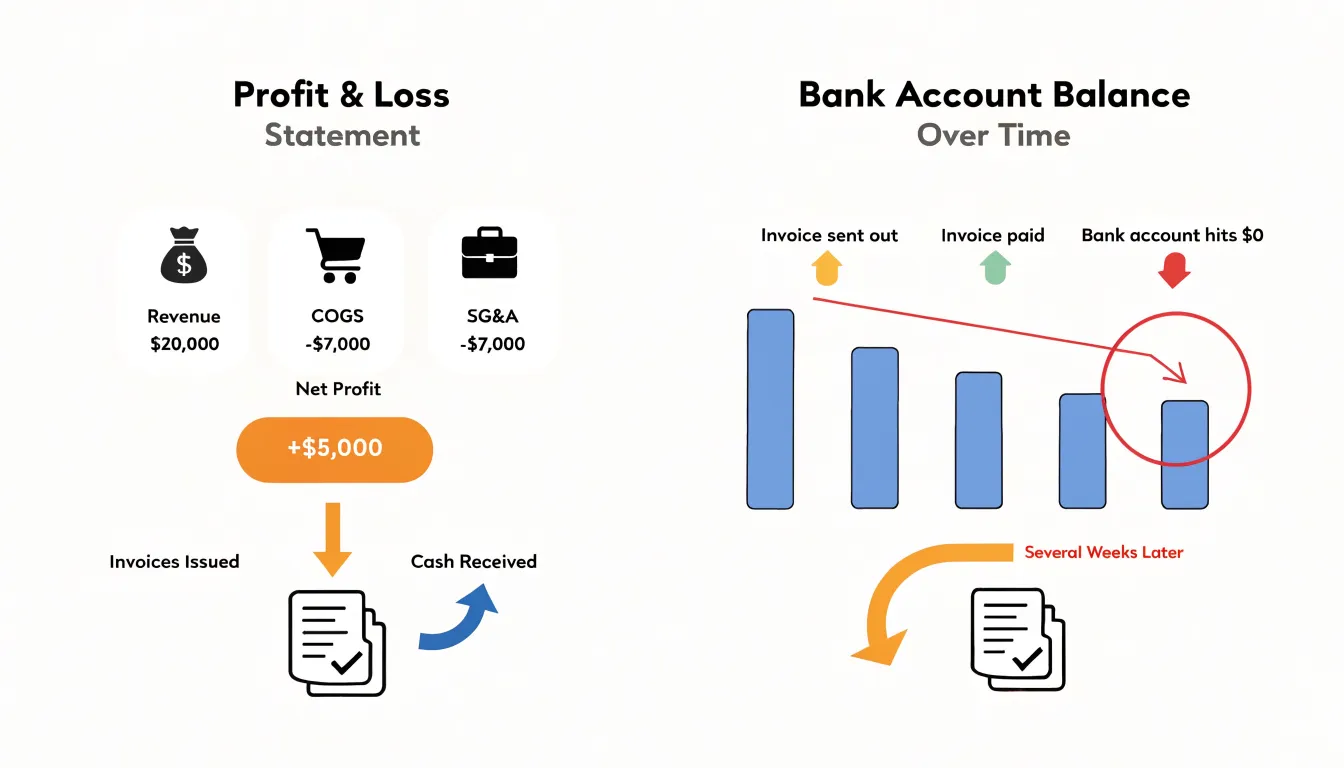
The gap between recording a sale and collecting the cash is where trouble often begins. A company can invoice a large client in January, book the revenue, and show a healthy profit on its January income statement, yet wait sixty or ninety days for the payment to arrive. In the meantime, payroll, rent, supplier invoices, and loan payments still come due on their usual schedule. Every dollar of profit tied up in unpaid receivables is a dollar unavailable to meet those obligations. The faster a business grows, the more pronounced this effect becomes, because growth typically requires upfront spending on inventory, wages, and marketing before the corresponding customer payments arrive. A profitable, expanding company can therefore exhaust its cash reserves precisely when its sales figures look strongest.
Timing gaps also appear on the expense side. Large purchases, quarterly insurance premiums, tax payments, and seasonal inventory build-ups create outflows that do not line up neatly with the months in which the related revenue is recognized. Depreciation is a further wrinkle: it reduces reported profit without consuming any cash at all, while loan principal repayments consume cash without reducing profit. These differences mean a profit and loss statement alone cannot tell an owner whether there will be enough money to cover next month’s commitments. Cash flow management requires looking directly at the movement of funds, tracking when invoices are issued and when they are actually paid, and forecasting the balance in the bank account week by week. Profit tells you whether the business model works over time; cash tells you whether the business survives long enough to prove it.
Invoice timing
Invoice timing is one of the most direct levers a business can pull to keep cash moving. When you extend net-30 or net-60 terms to customers, you are effectively offering them an interest-free loan, and your own cash sits tied up in accounts receivable for weeks or months. Shortening those terms to net-15 or due-on-receipt compresses the gap between delivering goods or services and getting paid. The immediate benefit is a faster inflow of cash that can be used to cover operating expenses, invest in inventory, or reduce reliance on short-term borrowing. For many small and mid-sized businesses, the difference between net-30 and net-15 can mean the difference between meeting payroll comfortably and scrambling for a line of credit.
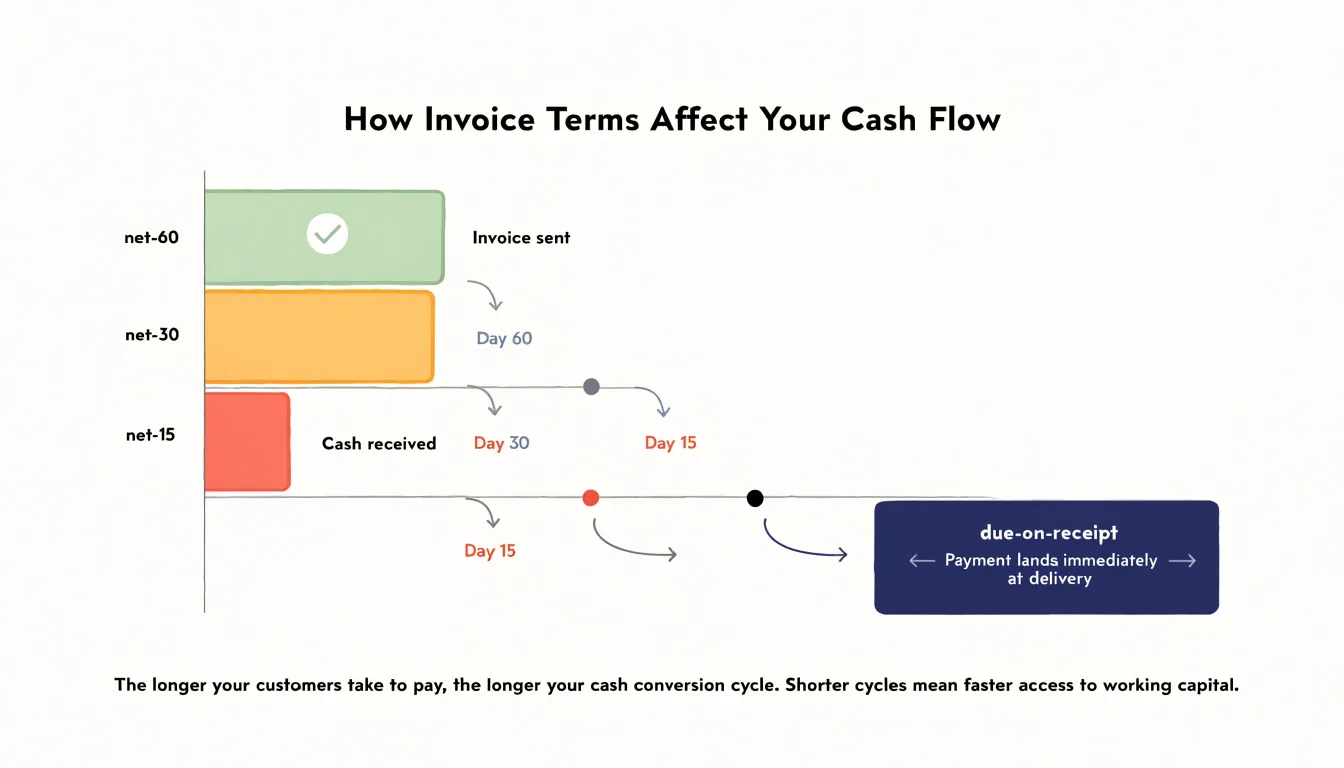
Faster invoicing cycles amplify this effect. Sending invoices immediately upon delivery, rather than waiting until the end of the month, shaves days off the collection period. Combined with shorter terms, this accelerates the cash conversion cycle—the time it takes from spending money on inputs to receiving cash from customers. A shorter cycle means less working capital is needed to sustain operations, freeing up resources for growth. It also reduces the risk of bad debt, since customers are more likely to pay promptly when the due date is close and the transaction is fresh in their minds.
To implement shorter terms effectively, businesses should communicate the change clearly to customers, offering incentives such as small discounts for early payment, and use automated invoicing and payment reminders to reduce administrative friction. While some customers may resist, the long-term benefit of improved cash flow and financial resilience typically outweighs the short-term pushback. By tightening invoice timing, businesses gain greater control over their cash position and are better equipped to handle unexpected expenses or seize new opportunities.
Setting up emergency cash reserves for unexpected operational slow periods
An emergency cash reserve is the financial cushion that keeps a business operating when revenue dips unexpectedly or during predictable seasonal lulls. The first step in setting one up is calculating a target amount. A common starting point is three to six months of fixed operating costs, including rent, utilities, insurance premiums, loan payments, and core salaries. Businesses with highly seasonal revenue patterns may need to aim toward the higher end of that range, while those with diversified, steady income streams can often begin with three months and build from there. The calculation should be based on committed fixed costs rather than total expenses, since variable costs can usually be scaled back during a slowdown.
Where the reserve is held matters as much as how much is set aside. The funds should sit in a separate account, ideally one that is quickly accessible without penalty, such as a dedicated business savings or money market account. Keeping reserves apart from the operating account reduces the temptation to spend them on routine expenses and makes the balance easy to monitor. Liquidity is the priority: certificates of deposit or longer-term instruments may offer slightly better returns, but they can lock up cash precisely when it is needed most. Many businesses ladder a portion of the reserve into short-term instruments while keeping the remainder fully liquid.
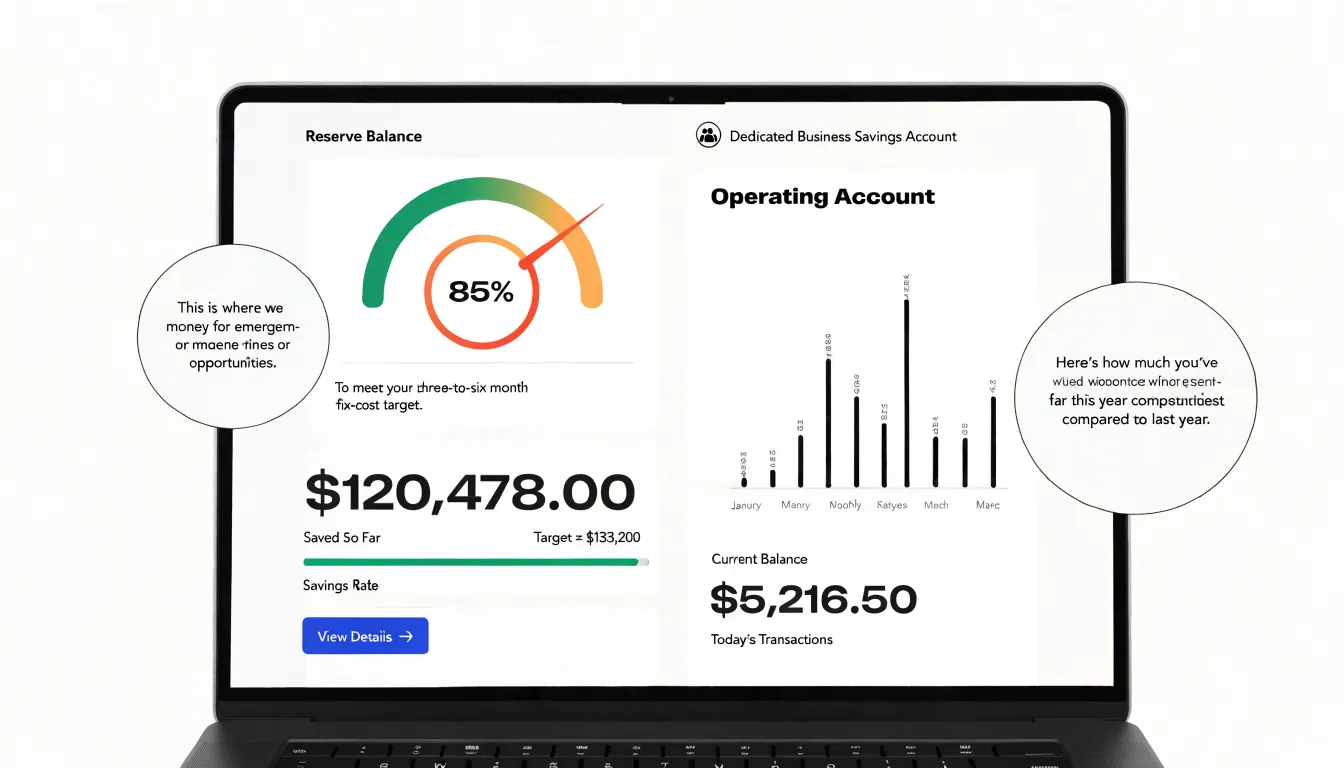
Building the buffer takes time and should be approached methodically. A practical approach is to transfer a fixed percentage of monthly revenue or a set dollar amount into the reserve account automatically, treating it like any other recurring obligation. Windfalls such as a strong quarter, a tax refund, or a large one-time payment can be used to accelerate progress. During the build-up phase, the business should track its reserve balance against the target on a regular basis, perhaps monthly, so progress stays visible. Once the target is reached, the reserve can be left in place and reviewed periodically, adjusting the target as fixed costs change. Regular review ensures the cushion keeps pace with the business as rent rises, new staff join, or loan obligations shift.
How to negotiate extended payment windows with key vendors
Negotiating extended payment windows with key vendors works best when you approach the conversation as a planning exercise rather than a plea for help. The vendors who matter most to your operation are also the ones most likely to value a stable, long-term relationship, so the goal is to frame the request around mutual benefit and predictability. Start by reviewing your current payment history. A vendor who has seen you pay on time for a year or more has a strong reason to work with you. Bring concrete numbers to the discussion: your average monthly spend, the seasonality of your orders, and the specific terms you are proposing. Asking to move from net 30 to net 45 or net 60 is a reasonable and common request, particularly when you can pair it with a commitment to volume or a longer contract.

Timing matters as much as the ask itself. The best moment to raise extended terms is during contract renewal, at the start of a new budget cycle, or when you are about to place a larger order. Vendors are more flexible when they are competing for your business or when a bigger commitment is on the table. Avoid asking in the middle of a dispute or immediately after a late payment, since those moments invite resistance. If your business is seasonal, explain the cash flow cycle plainly so the vendor understands why a longer window helps you both keep orders steady through the slow months.
Tactics that preserve the relationship include offering something in return, such as a slightly higher unit price, faster payment on a portion of the invoice, or a scheduled autopay arrangement. Some vendors will agree to a split schedule, where a percentage is due at 30 days and the remainder at 60. Put any agreed change in writing and confirm it with the accounts receivable contact, since verbal understandings often get lost between sales and finance teams. Finally, treat extended terms as a privilege to protect. Paying consistently within the new window builds the credibility you will need the next time you ask, and it keeps the door open for further flexibility down the road.
Monitoring cash flow
Effective cash flow management hinges on a monitoring rhythm that matches the business’s operating reality. Daily cash tracking provides a real-time view of inflows and outflows, enabling immediate decisions about payments, collections, and short-term borrowing. This granular approach suits small businesses with tight margins, seasonal volatility, or unpredictable receivables, where a single missed payment can trigger a liquidity crunch. Daily tracking also helps identify patterns, such as weekly sales dips or recurring expenses, that monthly forecasts might overlook. However, it demands discipline and time, and can lead to reactive management if not balanced with a forward-looking perspective.
Monthly forecasting, by contrast, projects cash positions over a longer horizon, typically 30 to 90 days. It supports strategic planning, such as timing major purchases, scheduling loan repayments, or anticipating funding needs. This approach works well for larger, stable businesses with predictable revenue streams and diversified customer bases. Monthly forecasts are less granular and may miss short-term fluctuations, but they provide a buffer against overreacting to daily noise. They also align with standard financial reporting cycles, making them easier to integrate with budgeting and performance reviews.
The choice between daily and monthly monitoring often depends on business size and volatility. Startups and micro-enterprises with limited cash reserves benefit from daily tracking to avoid surprises. As companies grow and establish steadier cash cycles, they can shift to weekly or monthly forecasts, supplementing with daily checks during peak periods. High-volatility industries, such as construction or retail, may require a hybrid approach: daily monitoring for operational decisions and monthly forecasts for strategic planning. Ultimately, the right rhythm balances accuracy with efficiency, ensuring that cash flow visibility supports both day-to-day survival and long-term growth.
Using early payment discounts to encourage faster client settlements
Early payment discounts give clients a financial incentive to settle invoices ahead of the due date, usually in exchange for a small percentage reduction on the amount owed. A common structure is 2/10 net 30, meaning the client receives a 2% discount if they pay within ten days, or pays the full amount within thirty days. For the business extending the offer, the appeal is straightforward: cash arrives sooner, the receivables cycle shortens, and the funds can be redeployed into operations, inventory, or debt reduction rather than sitting locked in outstanding invoices. Clients benefit too, since many treat the discount as a low-risk return on cash they already hold, which makes the offer easy to accept when their own cash position allows.
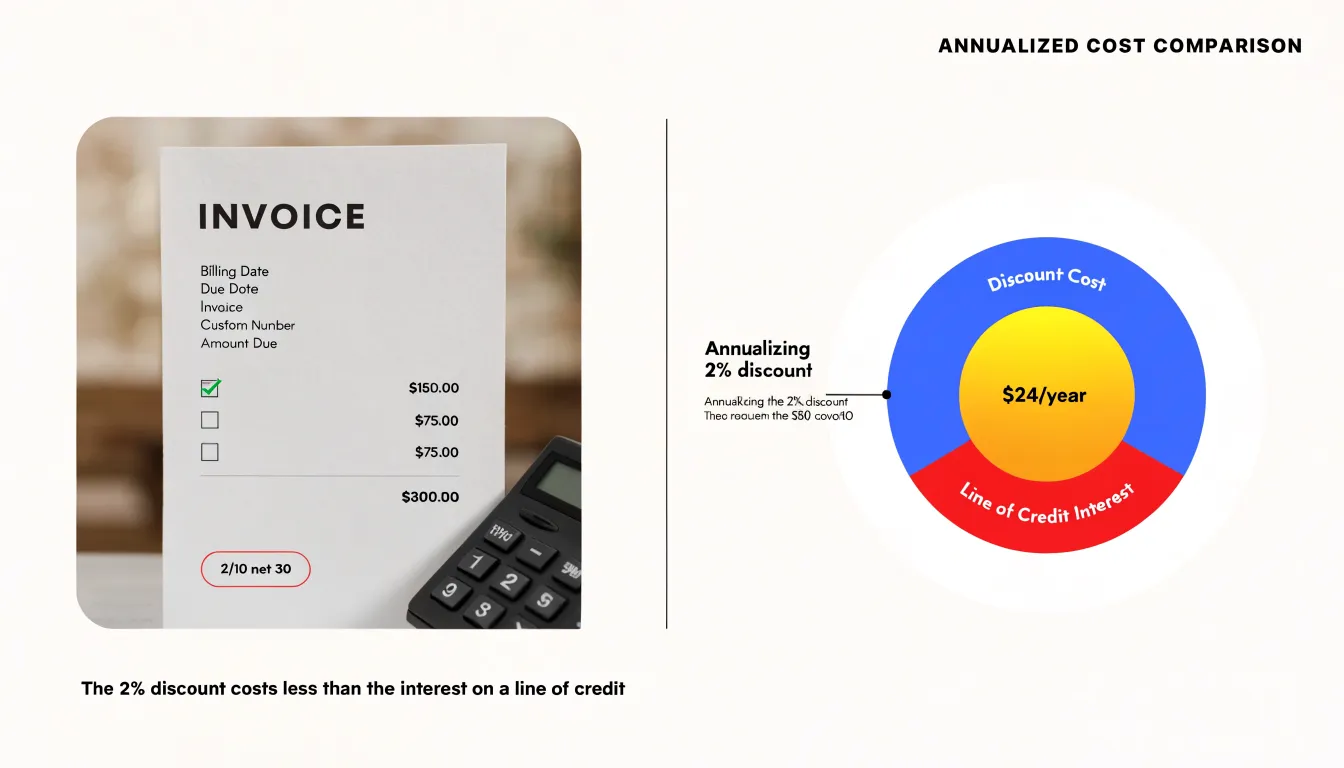
The central question is how to set the discount rate so it accelerates collections without cutting into margins. Start by calculating the cost of the discount as an annualized rate, because a seemingly small percentage over a short window can represent an expensive form of financing. For a 2/10 net 30 term, the client effectively pays 2% to keep the money for an additional twenty days; annualized, that cost is substantial. Compare this figure against the cost of your alternative funding sources, such as a line of credit or an overdraft. If the discount costs less than borrowing would, it is a rational trade. If it costs more, the offer is eroding margin for little gain.
Next, model the discount against your gross margin on the specific invoice. A discount reduces revenue dollar for dollar, so a 2% cut on a job with a 10% margin removes a fifth of the profit on that sale. Run the numbers at the client level and the portfolio level, weighting for clients who are most likely to take the offer. Many businesses find that a smaller discount, such as 1% for payment within ten days, still motivates reliable payers while protecting margin on slower or larger accounts.
Finally, set clear eligibility rules. Offer discounts only on invoices where faster cash genuinely helps, communicate the terms explicitly on the invoice, and review take-up rates after a quarter to see whether the acceleration justifies the cost. Adjust the rate, the window, or the client list based on what the data shows.
Managing inventory levels to prevent tied up working capital
Inventory is one of the largest current assets for many businesses, and it directly consumes cash. Every unit of raw material, work-in-progress, or finished goods represents money that has been spent but not yet recovered through sales. When inventory levels exceed what is needed to meet customer demand, that excess locks up working capital that could otherwise be used for operations, debt reduction, or growth initiatives. The cash conversion cycle lengthens as inventory sits on shelves or in warehouses, delaying the inflow of cash from sales. This can create a vicious cycle: cash is tied up in inventory, leaving less available for other needs, which may force the business to rely on expensive short-term financing.
Excess inventory also brings hidden costs. Storage, insurance, obsolescence, and spoilage all erode profitability. Moreover, holding too much stock can mask underlying issues such as inefficient processes or poor demand planning. To free up working capital, businesses must actively manage inventory levels. One effective strategy is just-in-time (JIT) ordering, where inventory is ordered and received only as needed for production or sales. JIT minimizes holding costs and reduces the risk of obsolescence, but it requires reliable suppliers and accurate demand signals. Another key strategy is demand forecasting, which uses historical data, market trends, and customer insights to predict future sales. Better forecasts enable businesses to align inventory purchases with actual demand, avoiding both stockouts and overstock situations. Combining JIT with robust forecasting creates a lean inventory system that releases cash for other uses.
Regular inventory reviews, such as ABC analysis, help identify slow-moving or obsolete items that can be liquidated or written off. Implementing inventory management software provides real-time visibility and automates reorder points. By systematically reducing excess inventory, companies can convert tied-up cash into available working capital, improving liquidity and financial flexibility. The goal is to maintain sufficient inventory to meet customer needs while minimizing the cash invested in stock. This balance requires ongoing monitoring and adjustment, but the payoff in freed-up working capital can be substantial.
What should you do when customers fall behind on payments
When a customer falls behind on payments, a structured escalation process helps you recover cash without damaging the relationship. Start with a friendly reminder sent shortly after the due date. A brief email or phone call that assumes an oversight—“We noticed invoice #123 is past due; could you confirm it’s scheduled?”—often resolves the issue. Keep the tone helpful and include the invoice details and payment link for easy action.
If payment doesn’t arrive within a week, escalate to a firmer follow-up. Reference the original due date, restate the amount, and ask for a specific payment date. This is also the moment to ask if there’s a problem—perhaps a missing PO or a cash flow issue on their end. Offering a short payment plan can preserve the relationship while securing a commitment. Document the conversation and send a confirmation email summarizing the agreed date.
When the account becomes significantly past due (e.g., 30–45 days), move to a formal demand letter. This letter should be professional and factual: state the amount owed, the original terms, and a final deadline (e.g., 10 business days) before further action. Mention that you value the relationship and prefer to resolve this directly. At this stage, consider pausing new orders or requiring prepayment to limit further risk.
If the customer still doesn’t pay, you have options: engage a collections agency, file a small claims lawsuit, or write off the debt. Before taking legal action, attempt one last direct call from a manager or owner to negotiate a settlement. Throughout the process, keep communication respectful and avoid public shaming. Preserving the relationship matters because the customer may pay eventually and continue doing business with you.
Protect your cash flow by setting clear credit terms upfront, sending invoices promptly, and monitoring receivables weekly. A consistent escalation process ensures you don’t let small delays become large losses, while giving customers a fair chance to make things right.
Separating personal and business accounts to maintain clear record keeping
One of the foundational practices in cash flow management is keeping personal and business finances in separate accounts. When a business owner runs transactions through a personal checking account, or deposits revenue into a savings account shared with household spending, the records quickly lose their clarity. Every expense becomes ambiguous: a grocery store charge might include supplies for the office, a fuel purchase might cover both a family trip and a client visit. Reconstructing which portion belongs to the business requires guesswork, and bookkeeping turns into an exercise in archaeology rather than routine recording. A dedicated business account eliminates that ambiguity at the source, because every transaction in it can be assumed to relate to the business unless proven otherwise.
The accounting confusion from commingled funds compounds over time. At year end, an accountant or bookkeeper must sort through statements to identify deductible expenses and reportable income. Mixed accounts increase the hours spent on that work, raise the likelihood of errors, and make it harder to reconcile the books against bank statements. Clear records depend on a clean paper trail, and a separate account produces exactly that: a single ledger of business activity that can be matched line by line.
Tax risk is a related and often more serious concern. Tax authorities expect business income and expenses to be traceable. When funds are commingled, legitimate deductions may be missed because receipts cannot be tied to a business purpose, while personal spending may be mistakenly claimed, creating exposure during an audit. In some business structures, commingling can also blur the legal separation between the owner and the entity, which carries consequences beyond tax season. Dedicated accounts keep the business’s financial identity intact.
Separate accounts also make cash flow visible. With one account devoted to the business, the owner can see the current balance, track incoming payments, and monitor outgoing expenses without filtering out personal transactions. This visibility supports forecasting, helps identify slow-paying customers early, and shows whether the business is generating enough cash to cover its obligations. A quick glance at the account provides an accurate picture, which is the starting point for every sound cash flow decision.
When is the right time to secure a business line of credit
Securing a business line of credit works best when it is treated as a planning decision rather than an emergency measure. The right time to apply is typically when a business is stable, generating consistent revenue, and able to show a clean financial record. That is the moment when lenders are most receptive and when the terms on offer tend to be strongest. Waiting until cash is already tight inverts this dynamic, because lenders assess risk on the evidence available at the time of application, and a stressed balance sheet signals exactly the kind of risk that leads to higher rates, lower limits, or outright rejection.
Several signals indicate that a line of credit deserves consideration. One is seasonal fluctuation, where revenue dips predictably at certain times of year while fixed costs continue. Another is a growing gap between when customers pay and when suppliers and payroll must be covered. Rapid growth itself is a signal, since expanding orders or inventory often require working capital ahead of the cash those orders generate. Businesses that regularly dip into savings or rely on owner funds to smooth month-to-month timing are also strong candidates. Even a comfortable business can benefit from establishing a line before it is needed, since the facility then serves as a buffer against unexpected events such as a major customer paying late or equipment failing.
The core reason to apply early is that credit access depends on the lender’s confidence in repayment capacity, and that confidence is easiest to establish when the business is not under pressure. Applying during a crunch narrows options precisely when flexibility matters most, and it can force acceptance of unfavourable terms. An established line also provides a track record of responsible use, which supports future borrowing.
Lenders evaluate eligibility through several lenses. They review time in business, typically looking for at least one to two years of operations. They examine revenue consistency and profitability through financial statements and tax returns. They check credit history, including both business and personal scores for owners of smaller companies. Bank statements reveal cash flow patterns and existing debt obligations, which feed into debt service calculations. Collateral and personal guarantees may also factor in. Understanding these criteria in advance lets a business prepare documentation and address weaknesses before submitting an application.
Frequently Asked Questions
What is the difference between profit and cash in the bank?
Profit is an accounting figure that matches revenues against expenses for a period, while cash is the money actually sitting in the bank at a specific moment. A profitable company can still run out of cash because sales may be recorded before customers pay.
How can shortening invoice terms help my business cash flow?
Shortening terms from net-30 or net-60 to net-15 or due-on-receipt compresses the gap between delivery and payment and brings cash in faster. Sending invoices immediately and using automated reminders can further accelerate the cash conversion cycle.
How much should a business keep in an emergency cash reserve?
A common starting point is three to six months of fixed operating costs, including rent, utilities, insurance premiums, loan payments, and core salaries. Seasonal businesses may aim toward the higher end, while businesses with diversified, steady income can begin with three months and build from there.
When is the best time to ask vendors for extended payment terms?
The article says the best time is during contract renewal, at the start of a new budget cycle, or when you are about to place a larger order. Approach it as a planning exercise, bring concrete numbers, and put any agreed change in writing.
Should I monitor cash flow daily or monthly?
It depends on business size and volatility: startups and micro-enterprises with limited reserves benefit from daily tracking, while larger, stable businesses can shift to weekly or monthly forecasts. High-volatility industries may use a hybrid of daily monitoring for operations and monthly forecasts for strategy.
What should I do when a customer falls behind on payments?
Start with a friendly reminder shortly after the due date, then escalate to a firmer follow-up if payment does not arrive within a week. If the account becomes significantly past due, the article recommends a formal demand letter and, if needed, options such as a collections agency, small claims lawsuit, or writing off the debt.