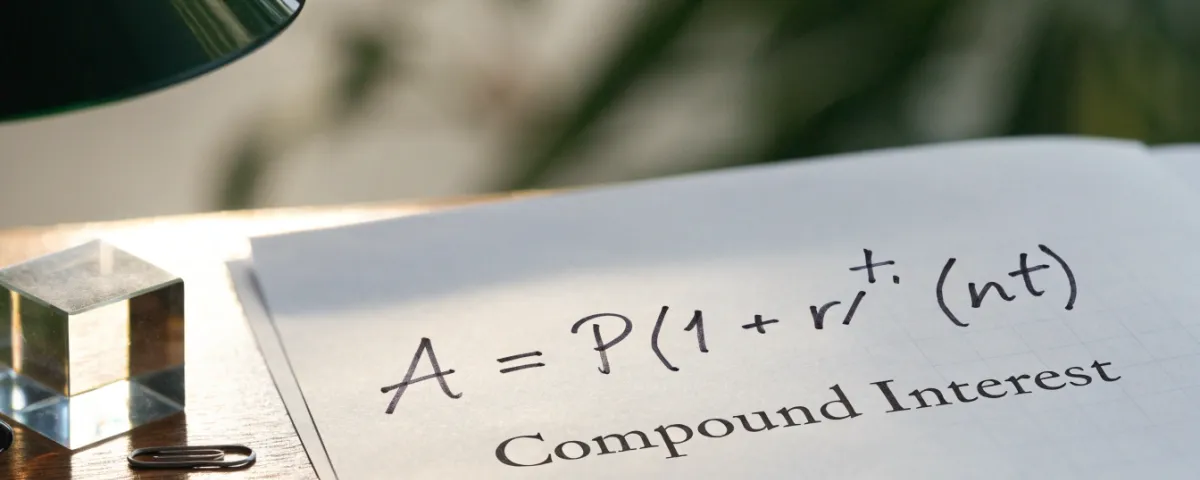
Compound Interest Formula
The compound interest formula is A = P(1 + r/n)^(nt), where P is the principal, r is the annual interest rate as a decimal, n is the number of compounding periods per year, and t is the time in years. It calculates growth in which earned interest is added back to the balance, so future interest is earned on a larger sum.
Table of Contents
- Understanding how compound interest builds wealth over time
- The compound interest formula
- How to calculate annual compound interest step by step
- How does compounding frequency impact your final balance
- How to handle exponents on a standard calculator
- Step by step walkthrough
- Using the rule of seventy two for quick estimates
- Simple math errors that ruin your interest calculations
Understanding how compound interest builds wealth over time
Compound interest is the process by which earned interest is added back to the principal, so that future interest is calculated on a larger balance. Each period, the interest you earn begins earning interest of its own, and this cycle repeats for as long as the money remains invested. The result is a snowball effect: growth feeds on prior growth, and the balance accelerates rather than rising in a straight line. This is the core concept of compounding, and it explains why a modest starting sum can become a substantial amount when given enough time.
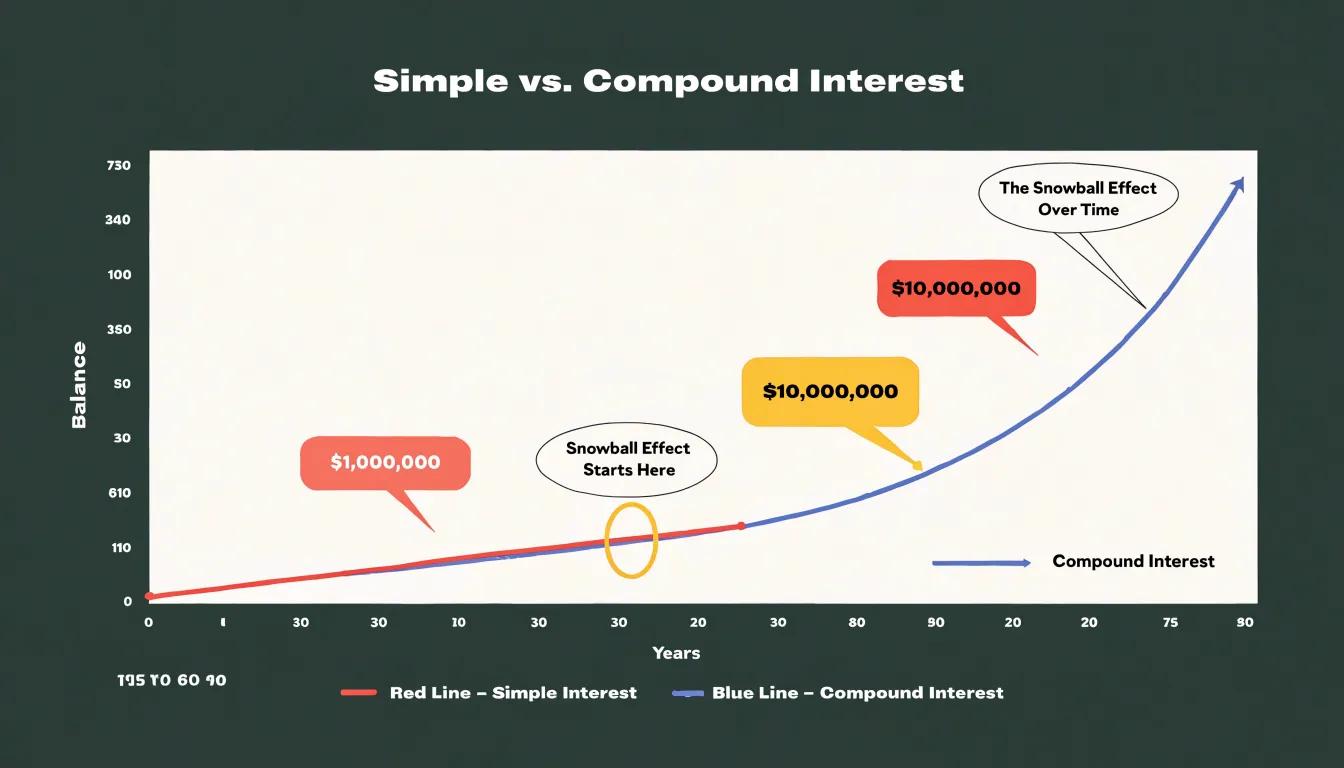
Consider a simple illustration. Suppose you invest $1,000 at an annual rate of 8 percent, compounded yearly. After one year you have $1,080. After ten years the balance is roughly $2,159, more than double the original amount. After twenty years it reaches about $4,661, and after thirty years it grows to approximately $10,063. Notice the pattern: the first decade adds about $1,159, the second adds roughly $2,502, and the third adds around $5,402. The same rate produces larger and larger gains each decade because the base on which interest is calculated keeps expanding. That is exponential growth in action, and it is the mechanism behind long-term wealth building.
Time in the market matters more than the rate for most investors. A higher rate certainly helps, but the number of compounding periods is the variable that does the heaviest lifting. Doubling the rate roughly doubles the final result, while extending the time horizon can multiply it many times over, because compounding works on the entire accumulated balance. Starting early, even with small contributions, gives the process more cycles to run and lets the later, larger gains dominate the outcome. Regular contributions amplify this further, since each deposit begins its own compounding journey.
Patience is therefore central to the strategy. The most dramatic growth typically arrives in the later years, after the balance has grown large enough for interest on interest to matter. Staying invested through that period allows compounding to deliver its full effect.
The compound interest formula
The compound interest formula A = P(1 + r/n)^(nt) contains four variables, and understanding each one in practical terms is the key to using the formula with confidence. Start with P, the principal. This is the amount of money you begin with—the initial deposit in a savings account, the starting balance of an investment, or the original sum of a loan before any interest is added. Everything else in the formula builds on this foundation, so P is best understood as the base amount that will grow over time.
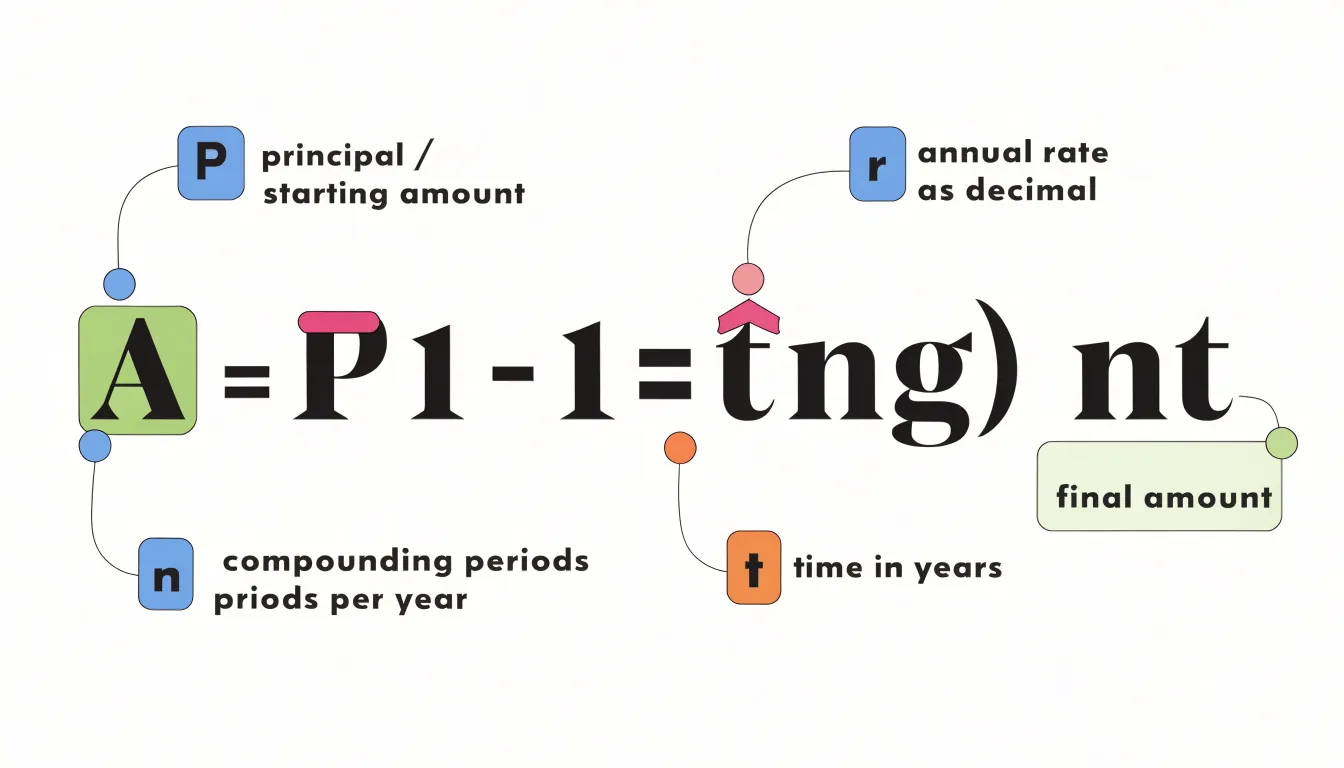
The variable r represents the annual interest rate, expressed as a decimal. A rate of 5% is written as 0.05. This figure describes the rate applied over the course of a full year, before any adjustment for how often compounding occurs. In practical terms, r is the headline rate you see advertised on a savings product or quoted on a loan agreement, and it tells you how quickly the principal would grow if interest were calculated just once per year.
The variable n is the compounding frequency—the number of times per year that interest is calculated and added to the balance. Common values are 12 for monthly compounding, 4 for quarterly, 2 for semiannual, and 1 for annual. Dividing r by n gives the rate applied in each individual period, so a 6% annual rate compounded monthly produces a 0.5% rate each month. As n increases, interest is added more often, and the balance grows slightly faster because each addition begins earning interest sooner.
Finally, t is the time in years that the money remains invested or borrowed. Because the exponent is nt, time works together with compounding frequency: the total number of compounding periods is simply the number of periods per year multiplied by the number of years. Leaving money in place for ten years with monthly compounding means 120 separate applications of interest, each one building on the last. Together, these four variables determine the final amount A, and adjusting any one of them—a larger principal, a higher rate, more frequent compounding, or a longer horizon—changes the outcome in a predictable way.
How to calculate annual compound interest step by step
To see how the compound interest formula works in practice, walk through a concrete example using annual compounding, where interest is calculated and added to the balance once per year. In formula terms, this means the compounding frequency n equals 1, which simplifies the calculation considerably. Suppose you deposit $1,000 into an account with a 5% annual interest rate and leave it untouched for three years.
The formula is A = P(1 + r/n)^(nt). Here P is the principal, $1,000; r is the annual rate expressed as a decimal, so 5% becomes 0.05; n is 1; and t is 3 years. Substituting these values gives A = 1000(1 + 0.05/1)^(1 × 3), which simplifies to A = 1000(1.05)^3.
Work through the arithmetic one year at a time to see where the compounding comes from. In year one, the interest is 5% of $1,000, or $50. The balance at the end of year one is $1,050. In year two, interest is calculated on the new balance of $1,050 rather than the original deposit. Five percent of $1,050 is $52.50, bringing the balance to $1,102.50. In year three, 5% of $1,102.50 is $55.13, so the final balance is $1,157.63. Evaluating (1.05)^3 directly gives 1.157625, and multiplying by $1,000 produces the same result.
Each step follows the same pattern: convert the rate to a decimal, divide by the compounding frequency, add 1, raise the result to the power of n times t, then multiply by the principal. With n = 1, the division and exponent are straightforward, which makes annual compounding a useful starting point before moving on to monthly or daily compounding.
Compare the final balance of $1,157.63 with the $150 you would earn from simple interest over the same period. The extra $7.63 comes entirely from earning interest on previously earned interest. That small difference grows larger as the time horizon lengthens or the rate increases, which is the central insight behind compound interest.
How does compounding frequency impact your final balance
Compounding frequency determines how often interest is calculated and added to the principal balance. Each time interest is compounded, the accumulated interest begins earning interest in subsequent periods. As a result, the more frequently compounding occurs, the greater the effective yield on the same nominal annual rate. Consider a nominal annual rate of 5% applied to a $10,000 investment over one year. With annual compounding, the balance at year-end is $10,500. With semi-annual compounding, interest is added twice, at 2.5% each time, resulting in $10,506.25. Quarterly compounding produces $10,509.45. Monthly compounding yields $10,511.62. Weekly compounding gives $10,512.67, and daily compounding results in $10,512.67 (rounded to the nearest cent, though slightly higher at $10,512.67 versus $10,512.67—actually daily compounding yields $10,512.67, while weekly is $10,512.67; the differences become smaller at higher frequencies). For clarity, here is a comparison table for a $10,000 principal at a 5% nominal annual rate over one year:
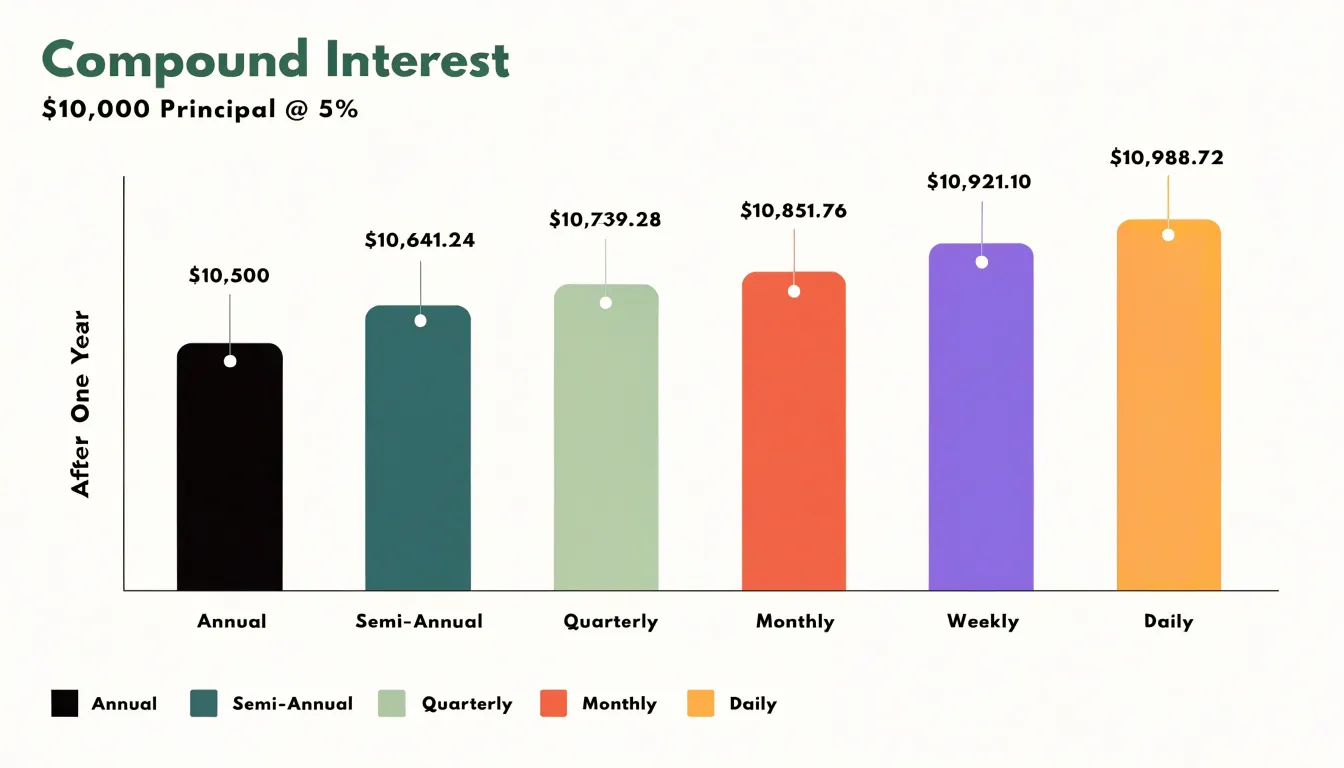
Compounding Frequency | Balance at Year-End | Effective Annual Yield Annual | $10,500.00 | 5.000% Semi-annual | $10,506.25 | 5.0625% Quarterly | $10,509.45 | 5.0945% Monthly | $10,511.62 | 5.1162% Weekly | $10,512.67 | 5.1267% Daily | $10,512.67 | 5.1267%
The table illustrates that moving from annual to monthly compounding increases the final balance by $11.62, while the incremental gain from monthly to daily is only $1.05. This diminishing return occurs because each additional compounding period adds interest on an increasingly smaller base of newly accumulated interest. The effective annual yield (EAR) captures this difference and is calculated as (1 + r/n)^n – 1, where r is the nominal rate and n is the number of compounding periods per year. As n approaches infinity, the EAR approaches e^r – 1, the limit for continuous compounding. In practice, daily or continuous compounding offers the highest effective yield for a given nominal rate. Understanding this relationship helps investors compare financial products accurately, as a slightly lower nominal rate compounded more frequently can outperform a higher nominal rate compounded less often. For example, a 4.9% rate compounded daily yields an EAR of about 5.02%, surpassing a 5% rate compounded annually. Thus, compounding frequency is a critical factor in evaluating the true growth of an investment or the true cost of a loan.
How to handle exponents on a standard calculator
Working with the compound interest formula, the exponent term nt represents the number of compounding periods, and calculating it on a standard calculator requires a few practical habits. The first step is to identify the exponent key on your specific device. On most scientific calculators this appears as a y^x button, while many basic and graphing models use a caret symbol (^). Some simpler calculators lack a dedicated exponent key entirely, in which case you can compute the power by repeated multiplication when nt is a small whole number, though this quickly becomes impractical for larger values.
Once you have located the key, the entry order matters. On most calculators you enter the base first, press y^x or ^, then type the exponent, then press equals. For example, to compute 1.05 raised to the 12th power, you type 1.05, press the exponent key, enter 12, and press equals. A common mistake is reversing the order, entering the exponent before the base, which produces a completely different result. Another frequent error involves parentheses: when the base is a fraction or a negative number, wrap it in parentheses before applying the exponent so the calculator groups the terms correctly.

Pay attention to how your calculator handles the exponent as a single unit. If nt is itself a product, such as 4 multiplied by 3, either compute that product first and write it down, or enclose the multiplication in parentheses so the calculator treats the entire quantity as the exponent. Entering 1.05 ^ 4 x 3 will often yield the base raised to the fourth power, then multiplied by three, which is not what the formula intends.
Rounding is another subtle trap. Storing intermediate values by hand introduces small errors that compound over many periods, so use the calculator’s memory function or keep the full display value rather than retyping a rounded figure. Finally, double-check that your calculator is in standard mode rather than a statistical or programming mode, and confirm the display matches your expected magnitude before using the result in the rest of the formula.
Step by step walkthrough
Working through a complete example makes the mechanics of the compound interest formula concrete. Suppose you deposit $5,000 into an account that pays an annual interest rate of 6%, compounded monthly, and you plan to leave the money untouched for five years. The first step is to identify each variable in the formula A = P(1 + r/n)^(nt). The principal P is 5,000. The annual rate r is 0.06, expressed as a decimal. The number of compounding periods per year n is 12, and the total number of years t is 5.
The next step is to compute the periodic rate by dividing the annual rate by the number of periods: 0.06 divided by 12 equals 0.005. This is the interest rate applied in each monthly cycle. Then calculate the total number of compounding periods by multiplying n by t: 12 times 5 equals 60 months. These two intermediate values reduce the formula to A = 5,000(1 + 0.005)^60, or 5,000(1.005)^60.
Evaluating the exponent comes next. Raise 1.005 to the 60th power, which yields approximately 1.34885. Multiplying that growth factor by the principal of 5,000 gives a final amount of roughly $6,744.25. Subtracting the original $5,000 leaves about $1,744.25 in earned interest over the five-year horizon.
Interpreting the result involves a few observations. The effective annual growth is a little above 6% because interest is credited monthly and itself begins earning interest in subsequent months. The order of operations matters: convert the rate to a decimal, divide by the compounding frequency, add one, raise to the total period count, and only then multiply by the principal. Rounding too early at the exponent stage can shift the final figure by a few dollars, so carry several decimal places until the last step. Comparing this outcome with simple interest on the same deposit, which would earn 5,000 × 0.06 × 5 = $1,500, shows the extra $244.25 that compounding contributes. This gap widens noticeably with longer horizons and higher rates, which is why the timing of deposits and the compounding frequency deserve attention when projecting multi-year returns.
Using the rule of seventy two for quick estimates
The rule of seventy-two offers a fast way to estimate how long an investment takes to double when it grows at compound interest. The procedure is simple: take the number 72 and divide it by the annual interest rate expressed as a percentage. The result is an approximate number of years required for the principal to double. At 8% per year, for example, 72 divided by 8 gives nine years. At 6%, the estimate is twelve years; at 9%, eight years; at 12%, six years. This makes the rule a handy mental tool for comparing rates at a glance, since the relationship between rate and doubling time is close to inverse within the range of rates people commonly encounter.
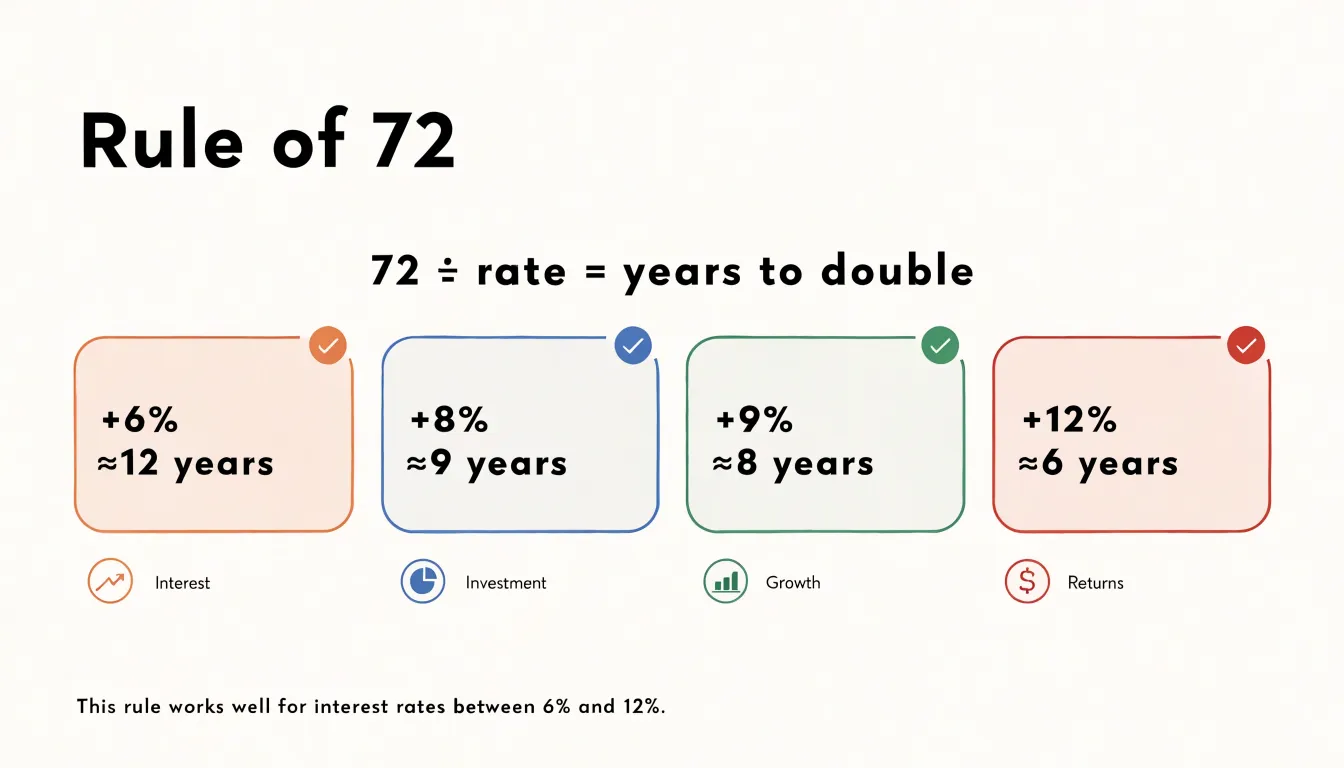
The rule works because the logarithm of 2 is roughly 0.693, and the natural log of (1 + r) is close to r for small values of r. Converting the decimal rate to a percentage introduces a factor of 100, which turns 0.693 into about 69.3. The number 72 is used instead because it divides evenly by many common rates, including 2, 3, 4, 6, 8, 9, and 12, and because it compensates slightly for the fact that compounding at higher rates is more powerful than the first-order approximation suggests. For rates between about 5% and 10%, the estimate typically lands within a few months of the exact answer.
Accuracy does shift at the extremes. At very low rates, such as 1% or 2%, the rule of seventy-two overstates the doubling time somewhat; the figure of 69 or 70 tends to be closer. At high rates, such as 20% or more, the rule understates the doubling time, because compounding accelerates and the approximation drifts. For continuous compounding, the coefficient is exactly 69.3. The rule also assumes a constant rate that never changes, which is rarely true of real investments, whose returns fluctuate year to year.
Even with these caveats, the rule of seventy-two remains a useful first pass. It gives savers and borrowers an intuitive sense of how powerfully a rate compounds over time, and it turns an exponential calculation into simple division that anyone can do without a calculator.
Simple math errors that ruin your interest calculations
Simple math errors can quietly ruin an otherwise correct compound interest calculation, and most of them come from small slips rather than misunderstandings of the formula itself. The most common mistake involves the interest rate. A rate written as 5 percent must be entered as 0.05 in the formula, and a rate already given as a decimal should never be divided by 100 a second time. Entering 5 instead of 0.05 produces results that are wildly inflated, sometimes by a factor of a hundred, and the error is easy to miss because the calculation still runs smoothly. A good habit is to write the rate as a decimal on a separate line before substituting it, which makes the conversion visible and easy to check.
Mixing up compounding periods is another frequent source of trouble. The formula divides the annual rate by the number of compounding periods per year and multiplies the exponent by the same number. If interest compounds monthly, the rate must be split into twelve pieces and the exponent multiplied by twelve; if it compounds quarterly, both numbers become four. A common slip is dividing the rate by twelve while leaving the exponent in years, or the reverse, which halves or doubles the effective growth without any warning. Keeping the two adjustments tied together, always using the same period count for both, prevents this mismatch.
Forgetting to convert time is the third quiet culprit. When periods are measured in months or days, the time value must be expressed in years before it goes into the exponent, so eighteen months becomes 1.5 years. Entering 18 as the time with a monthly compounding setup inflates the result enormously. Writing the time in years first and then converting it to match the compounding frequency keeps the numbers consistent.
These errors share a simple defense: label every value with its units, write each step on its own line, and sanity-check the final figure against a rough estimate. If the answer looks far larger or smaller than expected, one of these three conversions is usually the reason.
Frequently Asked Questions
What is compound interest and why does it grow faster over time?
Compound interest is the process by which earned interest is added back to the principal, so future interest is calculated on a larger balance. Each period, the interest you earn begins earning interest of its own, creating a snowball effect that accelerates growth rather than rising in a straight line.
What do P, r, n, and t mean in the compound interest formula?
In A = P(1 + r/n)^(nt), P is the principal or starting amount, r is the annual interest rate expressed as a decimal, n is the number of times interest is compounded per year, and t is the time in years.
How does compounding frequency affect the final balance?
More frequent compounding generally produces a greater effective yield on the same nominal annual rate because interest is added and begins earning interest sooner. For a $10,000 investment at 5% over one year, moving from annual to monthly compounding increases the final balance by $11.62, while the gain from monthly to daily is only $1.05.
How do I calculate exponents for the compound interest formula on a standard calculator?
Find the exponent key, usually y^x or ^, then enter the base first, press the exponent key, type the exponent, and press equals. If the exponent is a product such as 4 × 3, compute that product first or enclose the multiplication in parentheses so the calculator treats the entire quantity as the exponent.
How can I estimate how long it takes an investment to double?
Use the rule of seventy-two: divide 72 by the annual interest rate expressed as a percentage to estimate the number of years required to double. At 8% per year, for example, 72 divided by 8 gives nine years.
What common math errors can ruin compound interest calculations?
Common errors include entering a percentage rate as 5 instead of 0.05, mixing up the compounding-period adjustments so the rate and exponent are not tied to the same period count, and forgetting to express time in years before putting it into the exponent. Labeling every value with its units and checking the final figure against a rough estimate helps catch these mistakes.