
Cost Accounting
Cost accounting is an internal management tool used to capture, measure, and analyze the costs of producing goods or delivering services, supporting cost control, pricing, budgeting, and profitability analysis. Unlike financial accounting, which follows standardized rules for external reporting, cost accounting is flexible, examines both historical and estimated future costs, and lets managers choose the methods that best suit decision-making.
Table of Contents
- What cost accounting is and how it differs from financial accounting
- Core types of costs every business needs to track
- Direct vs indirect costs and why the distinction matters
- Standard costing
- Activity based costing for tracing expenses to specific production steps
- Job order costing
- How process costing manages expenses in continuous mass production
- Marginal costing
- How to select the right cost accounting method for your business model
What cost accounting is and how it differs from financial accounting
Cost accounting is an internal management tool that organizations use to capture, measure, and analyze the costs associated with producing goods or delivering services. Its central purpose is cost control and profitability analysis: managers rely on cost accounting information to determine what products or services actually cost to produce, where inefficiencies exist, and how pricing and resource allocation decisions should be made. Cost accounting examines both historical costs and estimated future costs, and it often incorporates non-financial information such as production volumes, machine hours, and waste rates. The information it generates supports budgeting, variance analysis, performance evaluation, and continuous improvement efforts within the organization.
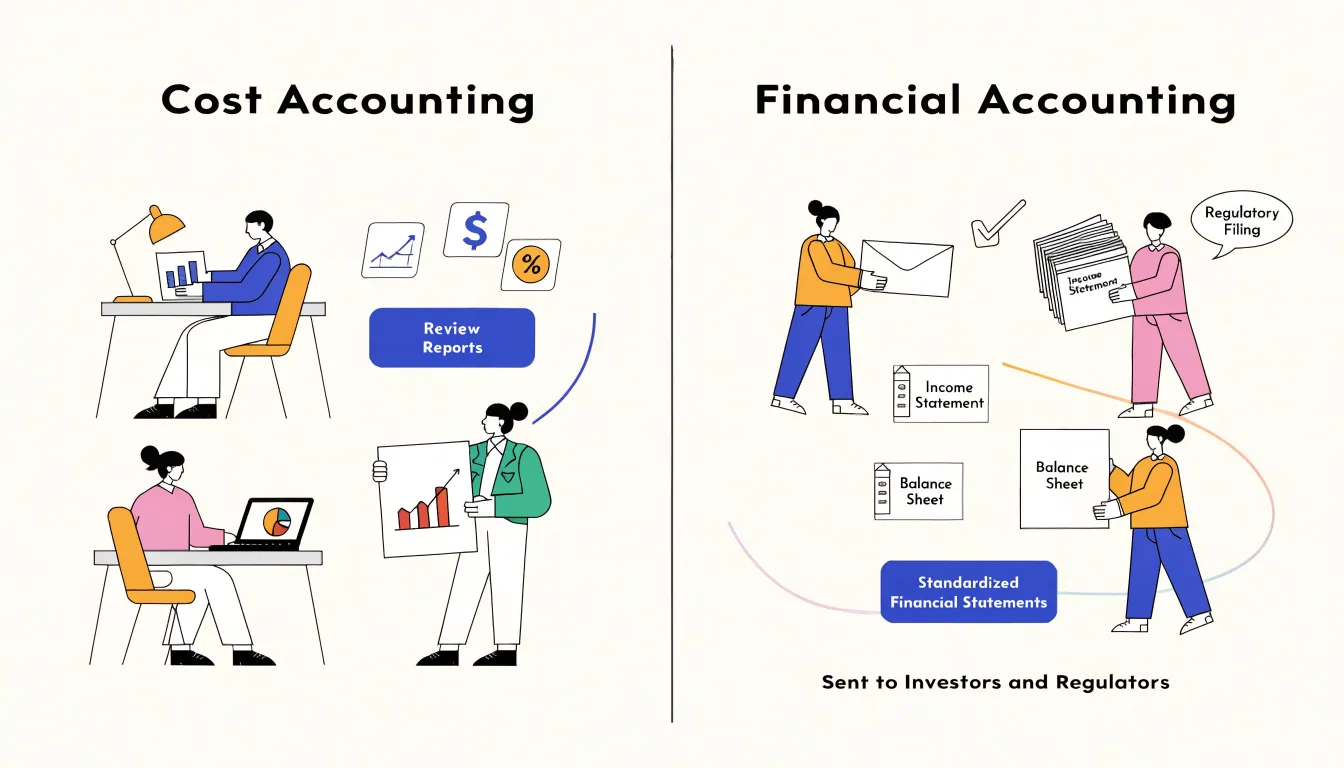
Financial accounting serves a different audience and purpose. It focuses on preparing general-purpose financial statements, such as the income statement, balance sheet, and cash flow statement, that are distributed to external parties, including investors, creditors, regulators, and tax authorities. Because these statements inform decisions by people outside the organization, financial accounting must follow prescribed standards and conventions, such as generally accepted accounting principles or international financial reporting standards. Consistency and comparability across organizations are essential, so the format and content of external reports are largely standardized.
Cost accounting operates with far more flexibility in how information is gathered and presented. There are no mandatory external standards governing cost accounting methods; instead, management selects the techniques, allocation bases, and reporting formats that best suit its decision-making needs. The time orientation also separates the two disciplines. Financial accounting is predominantly historical, reporting on transactions and events that have already occurred, typically on a quarterly or annual basis. Cost accounting looks backward to analyze actual costs and forward to estimate future costs, supporting planning and forecasting throughout the year.
The two systems are complementary rather than independent. Cost accounting data frequently feeds into the inventory and cost-of-goods-sold figures that appear in external financial statements, while the discipline as a whole remains an internal function designed to help managers understand cost behavior, control spending, and improve profitability.
Core types of costs every business needs to track
Fixed costs remain constant regardless of output volume, at least within a relevant range. Rent, insurance premiums, salaried managers, and depreciation on machinery are classic examples. A bakery pays the same monthly lease whether it sells one hundred or one thousand loaves. Because fixed costs do not change with production, they create operating leverage: once covered, every additional sale contributes more heavily to profit. Tracking fixed costs is essential for pricing because each unit must carry a share of these unavoidable expenses. Underpricing can leave a business unable to cover its base overhead even when sales are strong.
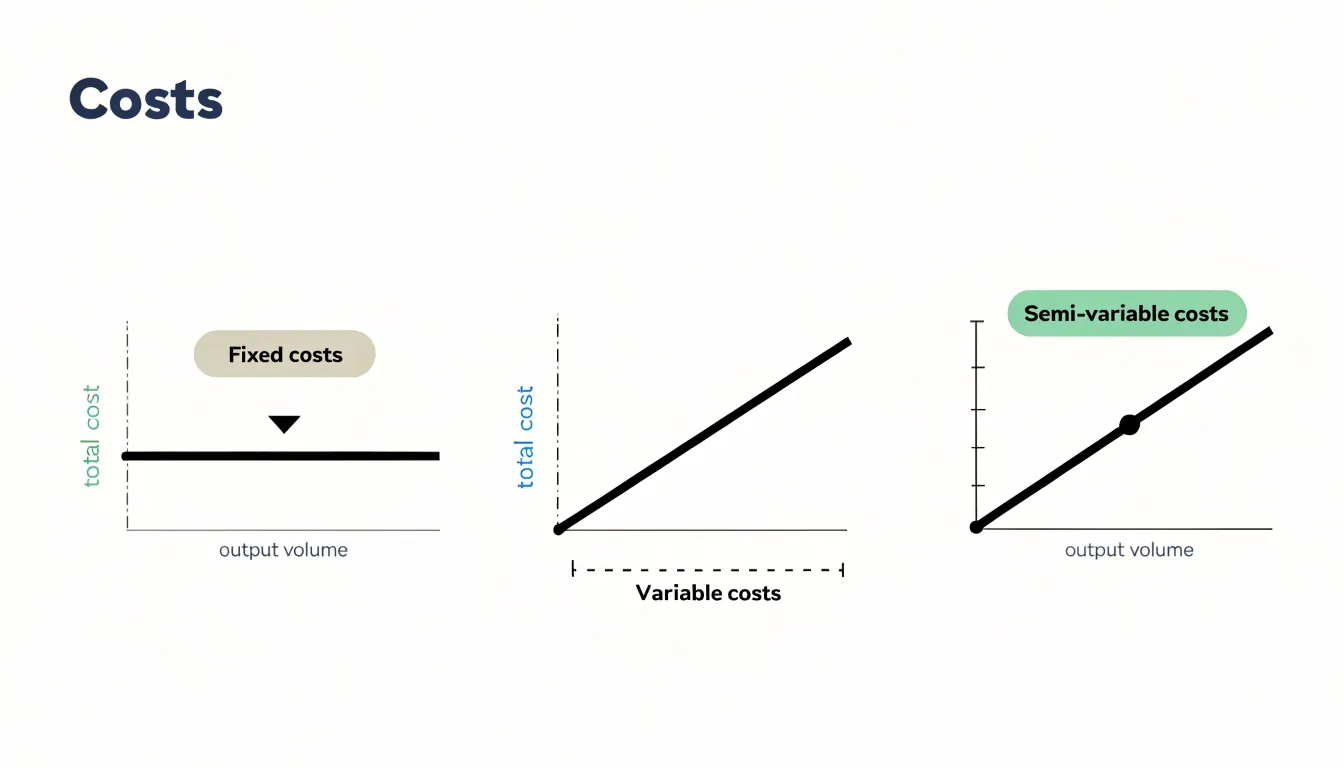
Variable costs rise and fall directly with output. Raw materials, direct labor paid per unit, packaging, and sales commissions behave this way. A furniture maker’s lumber expense grows with each table built. Variable costs set the floor for pricing decisions: a price below variable cost per unit means every sale deepens the loss. Tracking them allows managers to calculate contribution margin, the amount each sale contributes toward fixed costs and profit, which is central to break-even analysis and budgeting.
Semi-variable costs contain both fixed and variable components. A utility bill often includes a fixed connection charge plus usage-based charges. A salesperson’s salary plus commission is another example. These costs are trickier to forecast because they step up as activity increases. Separating their fixed and variable portions, often using the high-low method or regression analysis, gives managers a clearer picture of how total costs will behave at different volumes.
Opportunity costs represent the value of the next best alternative forgone when a resource is committed to one use. If a business owns a building and uses it for operations, the opportunity cost is the rent it could have earned by leasing it out. Opportunity costs do not appear in accounting records, yet they matter for decisions such as whether to accept a special order, make or buy a component, or continue a product line. Ignoring them can lead to choices that look profitable on paper but destroy value compared with alternatives.
Together, these cost types give managers the vocabulary to price products sensibly, set budgets that reflect real behavior, and evaluate trade-offs. A business that tracks only total spending misses the structure beneath it and risks pricing below cost or misallocating scarce resources.
Direct vs indirect costs and why the distinction matters
Direct costs are those that can be traced to a specific product, service, or job in an economically feasible way. Raw materials, components, and the wages of workers who build or assemble a product are the classic examples. If a company manufactures wooden chairs, the lumber and the pay of the carpenters on the line are direct costs of those chairs. The defining test is traceability: the cost can be identified with a particular cost object without arbitrary allocation. Indirect costs, by contrast, cannot be traced to any single product in a practical way. Factory rent, utilities, machine maintenance, supervisory salaries, quality control, depreciation of shared equipment, and the wages of material handlers all fall into this category. These costs are collected as overhead and later spread across products using an allocation base such as direct labor hours, machine hours, or units produced. The distinction matters because it determines how costs flow into product cost calculations and, ultimately, into the prices a business sets and the products it chooses to keep or drop. When a cost is classified incorrectly, the distortion is rarely obvious. A factory’s electricity bill, for example, often looks like overhead, yet in an energy-intensive process it behaves like a direct cost that rises with output. When such a cost is lumped into general overhead, product profitability can be misstated: high-volume products may absorb more of the misallocated cost, making them appear unprofitable, while low-volume specialty items may appear stronger than they are. Decisions follow the numbers. Managers may prune a product line that is in fact profitable, raise prices on the wrong items, or accept orders that quietly lose money. The misclassification also clouds make-or-buy analyses and capacity decisions, since overhead rates built on flawed cost pools lead to misleading incremental cost estimates. Accurate classification keeps the cost model honest by ensuring that costs that vary directly with production are assigned directly whenever traceability is practical, and that only genuinely shared costs are pooled and allocated. The discipline of asking whether a cost can be traced to a product protects the reliability of every downstream decision built on product cost data.
Standard costing
Standard costing begins with the establishment of benchmarks that represent what each unit of output should reasonably cost under normal operating conditions. For direct materials, these benchmarks combine two elements: a standard quantity, reflecting the amount of material required per unit after accounting for normal waste and spoilage, and a standard price, derived from historical purchase data, supplier contracts, and anticipated market conditions. Together these produce a standard material cost per unit that serves as the reference point for later comparison.
Direct labor standards follow a similar structure. Managers determine the standard time required to complete each operation, often through time-and-motion studies or historical records, and pair it with a standard wage rate that reflects prevailing pay scales and expected skill levels. Overhead standards require a different approach, since overhead costs are indirect and cannot be traced to individual units. Instead, a predetermined overhead rate is calculated by dividing estimated total overhead costs by an expected activity base such as direct labor hours or machine hours, and this rate is then applied to production.
Once these benchmarks are in place, variance analysis provides the mechanism for spotting spending red flags. Actual costs incurred during a period are compared against the standard costs allowed for the output actually produced, and the resulting differences are broken down into their component causes. A materials price variance isolates the effect of paying more or less than the standard price per unit, while a materials quantity variance captures excessive usage or waste. Labor rate and efficiency variances perform the same function for wages and hours worked. Overhead variances reveal whether spending exceeded budgeted amounts or whether production volumes diverged from the activity level used to set the predetermined rate.
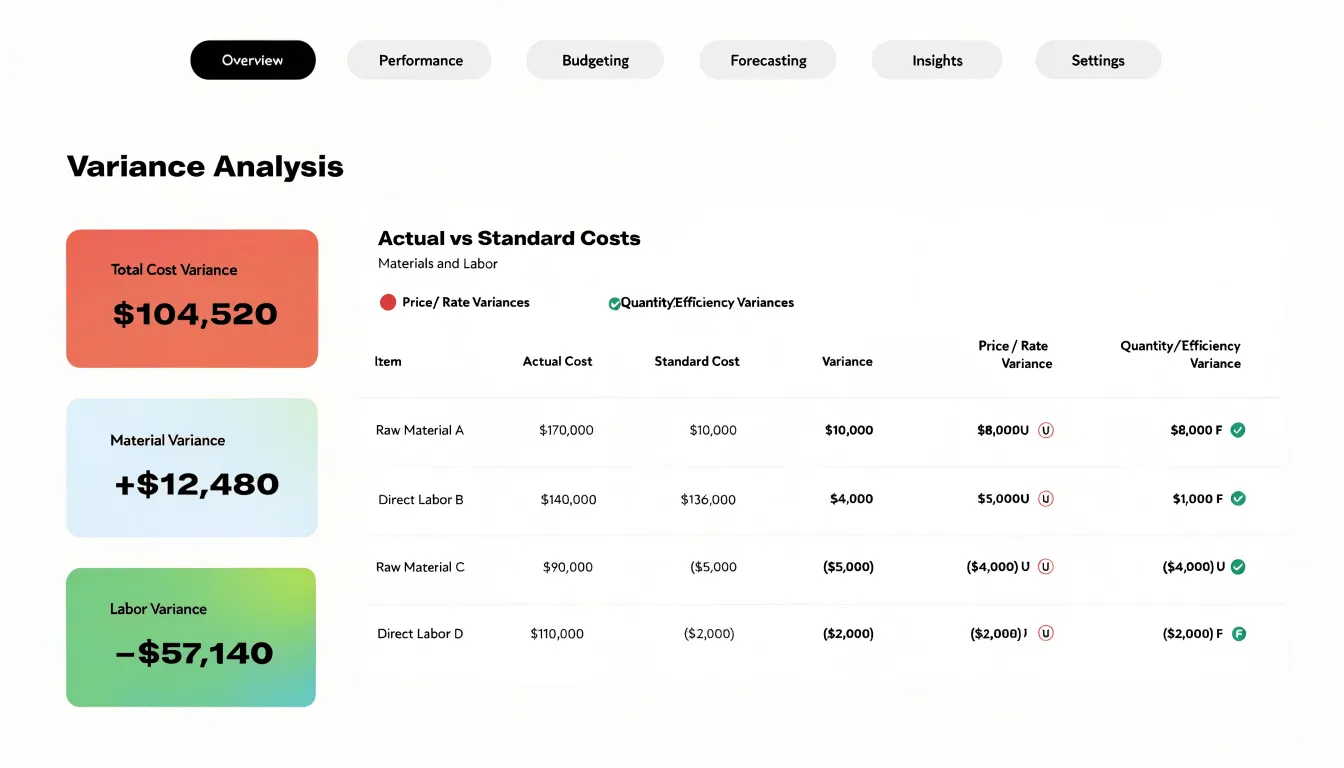
Each variance tells a story about where money is leaking. An unfavorable materials quantity variance may point to poor quality inputs, machine malfunctions, or inadequate worker training. A labor efficiency variance can signal scheduling problems, bottlenecks, or outdated methods. By flagging these deviations as they occur, standard costing allows managers to investigate root causes promptly and take corrective action before inefficiencies become entrenched, turning routine cost comparisons into an early warning system for the business.
Activity based costing for tracing expenses to specific production steps
Activity based costing offers a structured method for tracing expenses to the specific production steps that consume resources. The approach begins by identifying the individual activities that make up the production process, such as machine setup, material handling, quality inspection, and order processing. Each of these activities generates costs, and those costs are collected into activity cost pools rather than being lumped into a single broad overhead account. Once the pools are established, cost drivers are selected for each activity. A cost driver is the measurable factor that reflects how much of an activity’s resources a product or job actually uses, such as the number of setups, the number of inspection hours, or the quantity of material moves.
With cost pools and drivers in place, overhead is assigned to activities first and then to products according to their actual consumption of each activity. A product that requires frequent machine setups and extensive inspection will carry a larger share of those activity costs than a product that runs in long, uninterrupted batches with minimal oversight. This two-stage assignment process gives managers a clearer picture of where overhead is really being generated and which products or production steps are responsible.
The accuracy gains become most pronounced in complex or diverse product lines. When a company produces a wide range of items with differing volumes, batch sizes, and processing requirements, a single plant-wide overhead rate can distort product costs. High-volume, simple products may end up absorbing overhead that actually belongs to low-volume, complex products, or the reverse. Activity based costing corrects this by linking each cost pool to the activities that drive it, so products are charged in proportion to the demands they place on the production system. The result is more reliable product cost information that supports better decisions about pricing, product mix, process improvement, and resource allocation across the manufacturing operation.
Job order costing
Job order costing is a system for tracking expenses when each unit of output is distinct and produced to a customer’s specifications. Under this approach, costs are accumulated for each individual job or batch rather than averaged across a continuous production run. Direct materials, direct labor, and manufacturing overhead are assigned to the specific job as it moves through production, allowing managers to see the true cost of each customized order. This level of detail supports accurate pricing, profitability analysis, and client billing, and it gives management a way to compare estimated costs against actual results on a job-by-job basis.
The central record in this system is the job cost sheet, a document that accompanies each job and collects its costs in one place. Material requisitions identify the raw materials drawn from inventory for that job, and their costs are posted to the sheet. Labor time tickets capture the hours and wage rates of employees who work on the job, and those amounts are also recorded. Overhead is applied using a predetermined rate, often tied to direct labor hours or machine hours, since actual overhead is difficult to trace directly to individual jobs. The completed job cost sheet provides a running total of the job’s cost and, once the job is finished, serves as the basis for valuing finished goods and calculating the cost of goods sold.
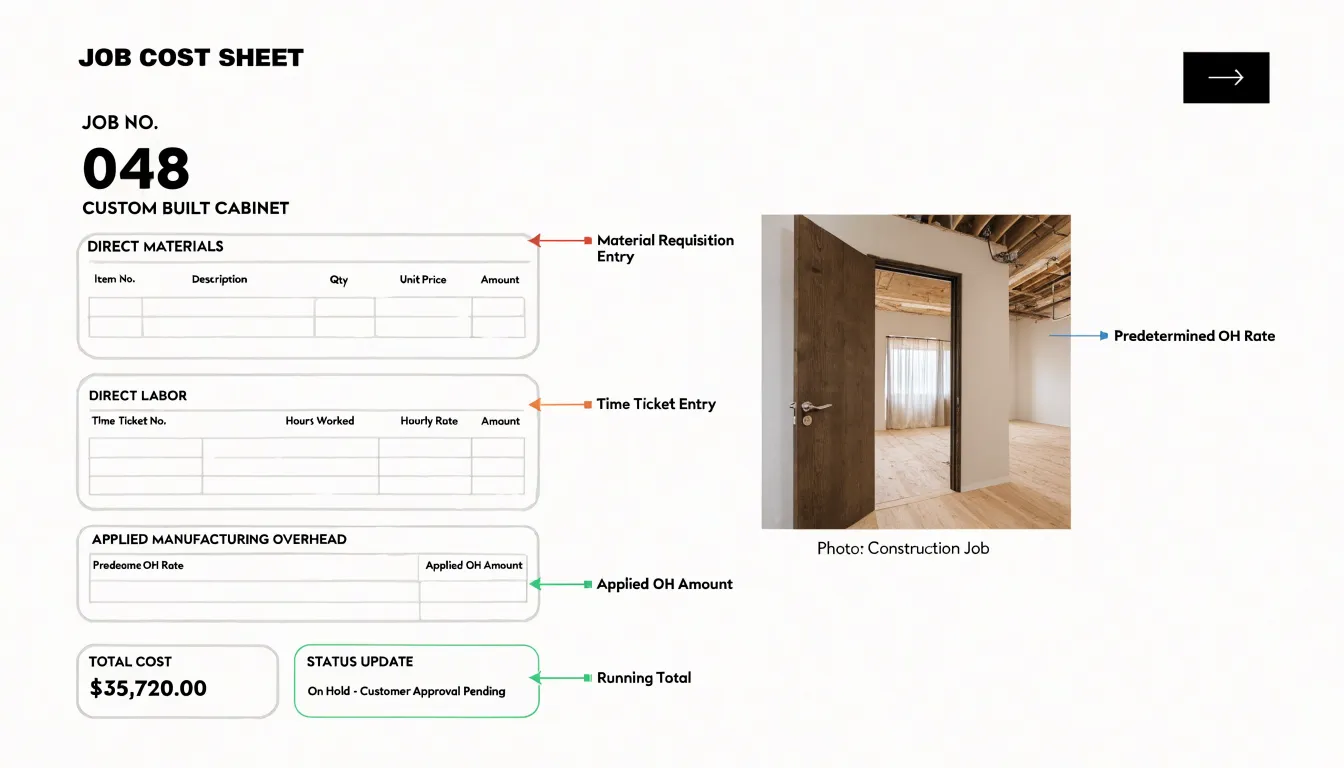
Job order costing is a natural fit for construction, where every project has unique specifications, materials, and site conditions. General contractors track costs for each building or renovation separately, which helps them manage change orders, progress billings, and contract profitability. Printing companies also rely on job costing because each print run differs in paper stock, ink, setup time, and quantity, and the shop needs to quote prices that cover its costs. Professional services firms, including accounting practices, law offices, and consulting groups, use job costing to tally the direct labor and expenses attributable to each client engagement. In each setting, the job cost sheet provides the detailed record that ties day-to-day spending to individual projects and makes reliable cost control possible.
How process costing manages expenses in continuous mass production
Process costing is designed for continuous mass production, where identical or homogeneous products are produced in a steady stream. Industries such as chemicals, food processing, oil refining, and textiles rely on this method because individual units cannot be easily distinguished or traced. Instead of assigning costs to specific jobs, process costing accumulates costs for a period and then averages them across all units produced. This averaging is achieved through the concept of equivalent units, which accounts for partially completed units in work-in-progress (WIP). Equivalent units express the amount of work done during a period in terms of fully completed units. For example, if 1,000 units are 50% complete, they represent 500 equivalent units. Costs are then divided by equivalent units to determine a cost per equivalent unit, which is used to value completed units and ending WIP. WIP is handled by separating costs into direct materials, direct labor, and manufacturing overhead, and then allocating these costs between units transferred out and units still in process. The weighted-average or FIFO method is used to assign costs, with the weighted-average method combining beginning WIP costs with current period costs, while FIFO keeps them separate. This approach ensures that expenses are systematically matched with production output, providing accurate product costing and inventory valuation in continuous production environments.
Marginal costing
Marginal costing centers on the cost of producing one additional unit of output. The marginal cost represents the change in total cost that results when production volume increases by a single unit. In practical terms, this figure isolates the variable elements of cost, such as raw materials, direct labor, and variable overhead, that rise and fall with output, while fixed costs remain constant across the relevant range of activity. Because fixed costs do not change in the short term, the marginal cost of the next unit is driven almost entirely by variable expenses, giving managers a clear view of what each extra unit truly adds to the cost base.
This information supports short-term pricing decisions. When a business receives a special order or faces a competitive bid situation, knowing the marginal cost allows managers to set a floor price that covers the incremental cost of production. Any price above marginal cost contributes something toward fixed costs and profit, which can make otherwise unattractive orders worthwhile when spare capacity exists. Marginal costing also underpins break-even analysis. By comparing the marginal cost per unit with the selling price, managers derive the contribution margin, which shows how much each sale contributes to covering fixed costs. Dividing total fixed costs by the contribution per unit yields the break-even quantity, a benchmark that clarifies the volume needed before the organization begins to generate profit.
Output decisions benefit from the same logic. Marginal cost helps managers judge whether increasing or decreasing production is worthwhile, since comparing marginal cost with marginal revenue indicates whether an additional unit adds to or subtracts from overall profitability. In the short term, a firm may rationally continue producing at a price below total average cost as long as the price exceeds marginal cost and some contribution is made toward fixed expenses. Marginal costing thus provides a flexible, decision-oriented view of costs that complements full absorption costing, and it remains a core tool for pricing, planning, and operational control.
How to select the right cost accounting method for your business model
Selecting the right cost accounting method begins with an honest assessment of how your business actually produces and delivers value. Production type is the first practical filter. Businesses that manufacture distinct, customised units, such as a bespoke furniture workshop or a construction contractor, are naturally suited to job order costing, which accumulates costs against each individual job. Businesses that produce uniform output continuously, such as a beverage bottler or a chemical processor, fit process costing, where costs are averaged across departments or production stages. Where output is repetitive and reasonably predictable, standard costing becomes attractive because it sets predetermined costs and highlights variances, giving managers a regular signal about efficiency and spending.
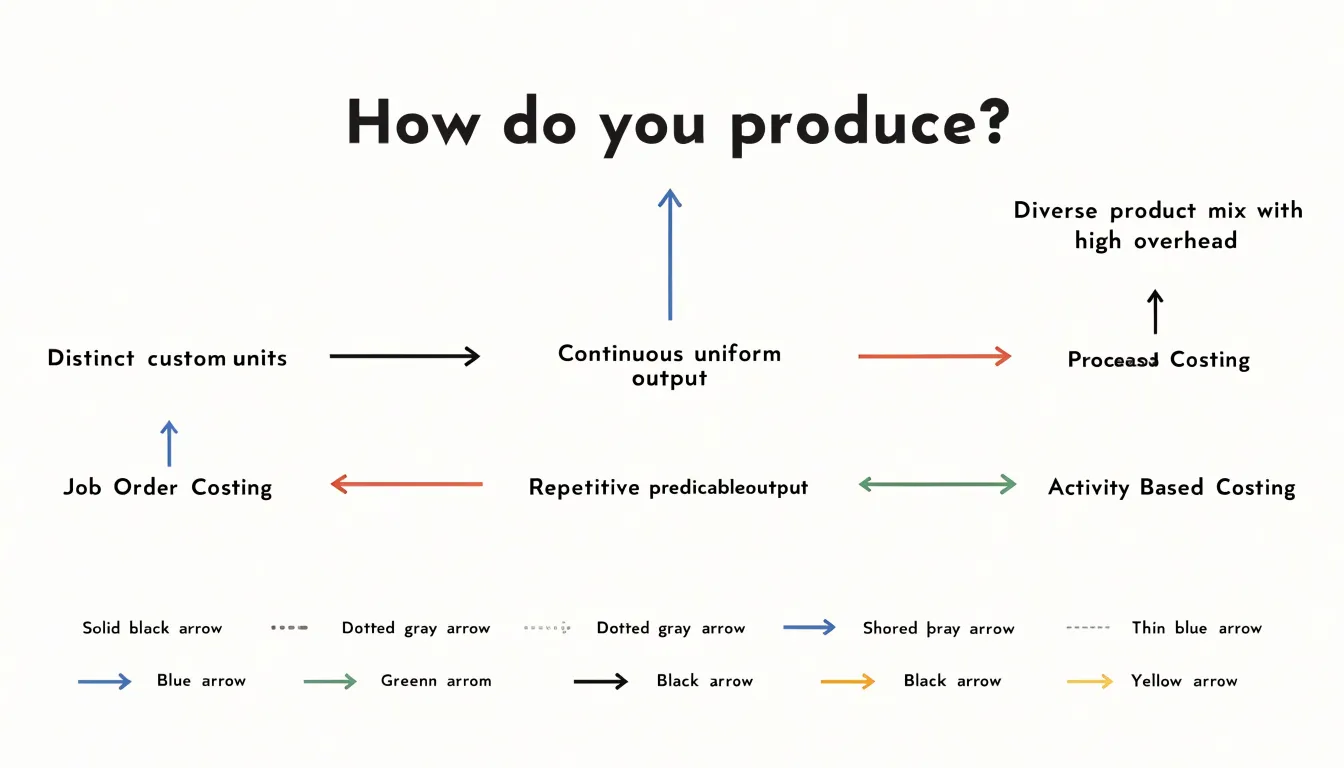
Product diversity shapes the decision just as strongly. A company with a narrow range of similar products can allocate overhead using simple bases such as direct labour hours or machine hours without much distortion. As the product mix widens and different items consume overhead resources in very different proportions, activity-based costing becomes more valuable because it traces costs to the activities that actually drive them, improving accuracy for pricing and profitability analysis.
Cost structure matters next. Organisations with high fixed overhead relative to direct costs need a method that allocates those overheads sensibly; ABC or a well-designed absorption approach helps prevent cross-subsidisation between products. Where variable costs dominate and managers need quick insight into contribution and break-even points, marginal costing offers a clean, decision-focused view by separating fixed and variable elements.
Reporting needs complete the picture. External financial reporting and inventory valuation typically require absorption-based methods that capture the full cost of production, while internal decision-making often benefits from marginal or activity-based perspectives. Consider the granularity your managers require, the frequency of reporting, the availability of reliable activity data, and the administrative cost of maintaining the chosen system. Many businesses sensibly combine approaches, using standard or process costing for routine valuation and ABC or marginal analysis for specific decisions. The right method is the one that matches your operations, delivers accuracy where it matters, and remains practical to run.
Frequently Asked Questions
What is cost accounting and how is it different from financial accounting?
Cost accounting is an internal management tool used to capture, measure, and analyze the costs of producing goods or delivering services. Financial accounting focuses on preparing general-purpose financial statements for external parties and must follow prescribed standards such as GAAP or IFRS.
What are fixed costs and variable costs?
Fixed costs remain constant regardless of output volume within a relevant range, such as rent, insurance, and salaried managers. Variable costs rise and fall directly with output, such as raw materials, direct labor paid per unit, and packaging.
What is the difference between direct and indirect costs?
Direct costs can be traced to a specific product, service, or job in an economically feasible way, such as raw materials and assembly wages. Indirect costs cannot be traced to a single product practically and are collected as overhead and allocated using a base such as direct labor hours, machine hours, or units produced.
How does standard costing use variances?
Standard costing compares actual costs incurred against standard costs allowed for the output actually produced. The differences are broken into variances, such as materials price and quantity variances or labor rate and efficiency variances, to help managers spot spending red flags and investigate causes.
What is activity based costing?
Activity based costing traces expenses to specific production steps by identifying activities, collecting costs into activity cost pools, and using cost drivers to assign overhead to products based on their actual consumption of each activity. This can improve product cost accuracy, especially in complex or diverse product lines.
Should a business use job order costing or process costing?
Job order costing fits when each unit of output is distinct and produced to a customer’s specifications, while process costing is designed for continuous mass production of identical or homogeneous products. The choice depends on how the business actually produces and delivers value.