
Days Sales Outstanding (DSO)
Days sales outstanding (DSO) is the average number of days a business waits to collect payment after a credit sale. It is calculated as accounts receivable divided by total credit sales, multiplied by the number of days in the period. A low or falling DSO signals faster cash conversion; a rising DSO ties up working capital.
Table of Contents
- What days sales outstanding measures in your business cash flow
- The standard DSO formula
- Step-by-step walkthrough for calculating your company DSO
- What counts as a healthy DSO score across different industries?
- Why a rising DSO threatens your everyday working capital
- Invoicing fixes that immediately shorten your payment cycle
- Automating receivables
- How to handle persistent late payers without ruining client relationships
What days sales outstanding measures in your business cash flow
Days sales outstanding measures the average number of days your business waits to collect payment after a sale has been made. The calculation takes your accounts receivable balance over a given period, divides it by total credit sales for that same period, and multiplies the result by the number of days in the period. The output is a single figure expressed in days, and that figure tells you how long, on average, money owed to you remains outstanding before it converts into cash in your bank account. For a business that sells on credit terms, DSO is a direct readout of how quickly revenue becomes usable cash.
The measure reflects the efficiency of your credit and collections process because every stage of that process leaves its mark on the number. When you extend credit to customers, you are effectively lending them money until they pay. A low DSO indicates that customers are paying close to your stated terms and that your invoicing is accurate and timely, your reminders reach the right people, and your collections team follows up without delay. A rising DSO points to friction somewhere in that chain: invoices sent late, disputed line items left unresolved, customers stretching payment beyond agreed terms, or a collections effort that lacks consistency. Because DSO averages across all your receivables, it captures the combined effect of your credit policy, your billing accuracy, and your follow-up discipline in one place.
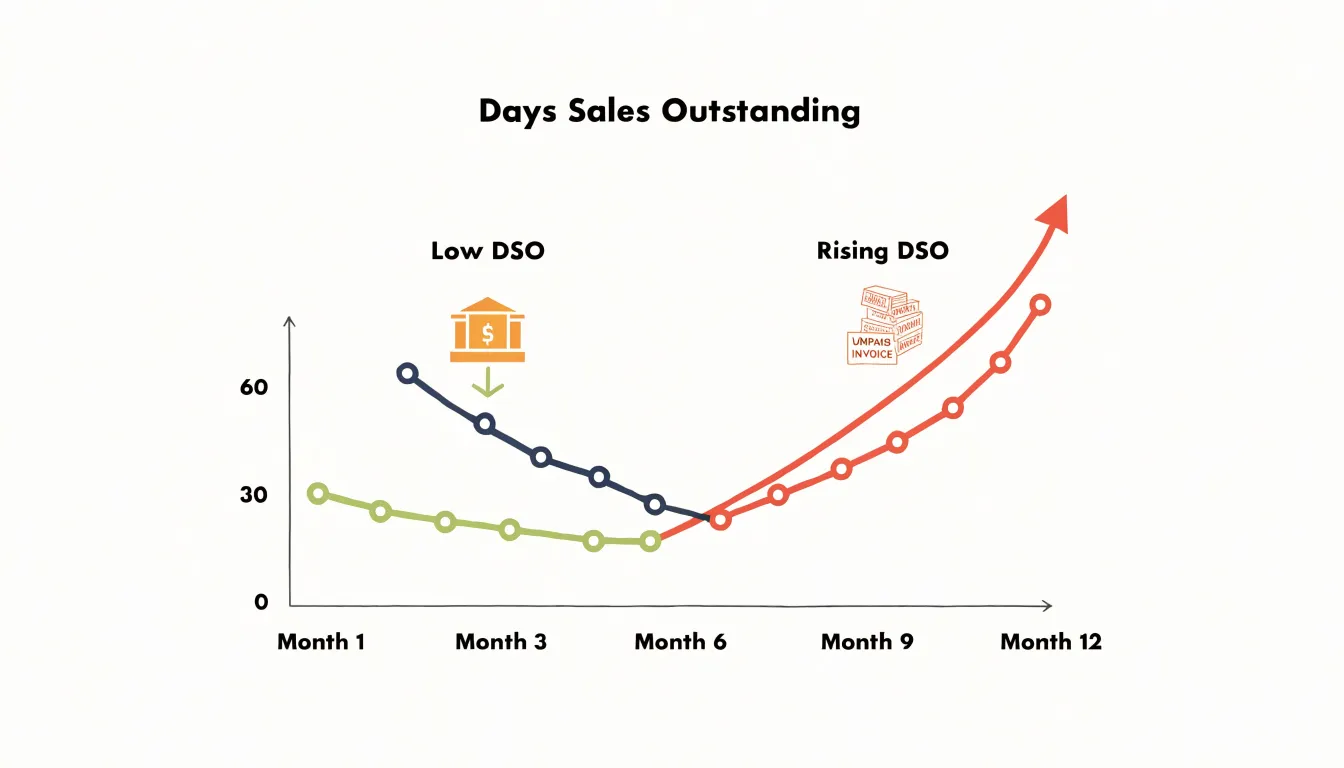
Tracking DSO over time turns it into an early warning system for cash flow. A figure that creeps upward month after month means more of your working capital is tied up in unpaid invoices, which can force you to draw on credit lines or delay your own payments to suppliers. Comparing DSO against your standard payment terms shows whether customers are honoring those terms in practice. Comparing it across customer segments or sales channels reveals where collection problems concentrate, so you can target credit limits, deposit requirements, or follow-up resources where they will do the most good. Used consistently, DSO gives you a practical gauge of how well your business turns sales into collected cash.
The standard DSO formula
The standard DSO formula is simple: Days Sales Outstanding equals Accounts Receivable divided by Total Credit Sales, multiplied by the Number of Days in the period. Each component carries its own meaning. Accounts Receivable is the ending balance of money customers owe at the close of the measurement window, typically pulled from the balance sheet. Total Credit Sales is the revenue booked on credit during that same window, excluding cash sales, since only credit transactions generate receivables. The Number of Days sets the scale — 30 for a month, 90 for a quarter, 365 for a year — and converts the ratio into a day count that is easy to interpret.
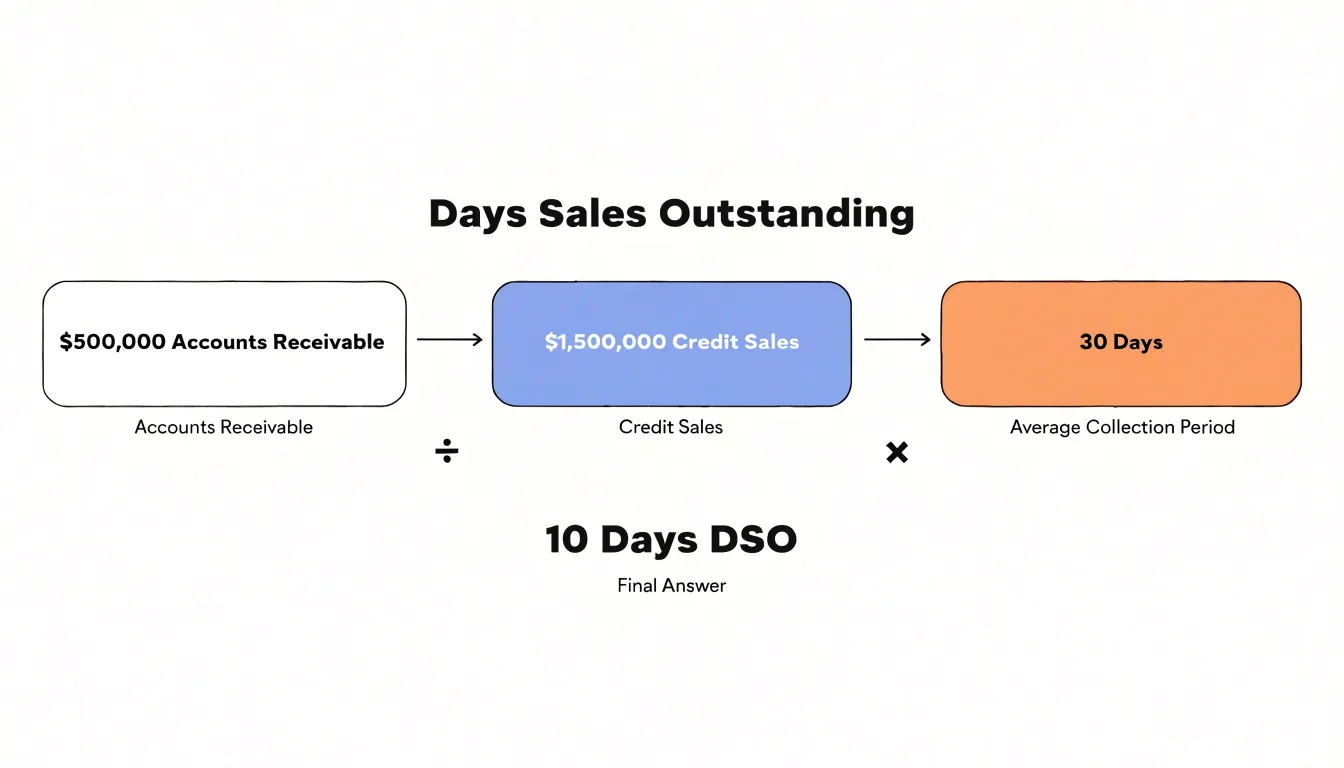
A worked example clarifies the mechanics. Suppose a company closes the month with $500,000 in accounts receivable and recorded $1,500,000 in credit sales over 30 days. Dividing 500,000 by 1,500,000 gives 0.333; multiplying by 30 produces a DSO of 10 days. On average, customers pay in ten days, which suggests an efficient collections process or generous early-payment incentives.
Several variations of the formula address its limitations. The countback method, also called the days-sales-outstanding countback, is the most common alternative. It works backward from the most recent month, applying each month’s sales to the outstanding receivable balance until the balance is exhausted, then counting the days consumed. This approach avoids distortions caused by sales fluctuations and seasonal swings, and it is often considered more accurate than the simple average. Other variations include using average receivables over the period rather than the ending balance, which smooths out sudden jumps at month-end, and using a 365-day annual denominator to standardize comparisons across reporting periods. Some analysts prefer to measure only collectible receivables, excluding doubtful accounts, to reflect realistic collection performance.
Together, the classic formula and its variations give finance teams a flexible toolkit. The basic calculation is quick and useful for trend spotting, while methods like countback offer precision when the stakes are higher. Choosing the right version depends on the reporting context, industry norms, and the degree of accuracy the analysis requires.
Step-by-step walkthrough for calculating your company DSO
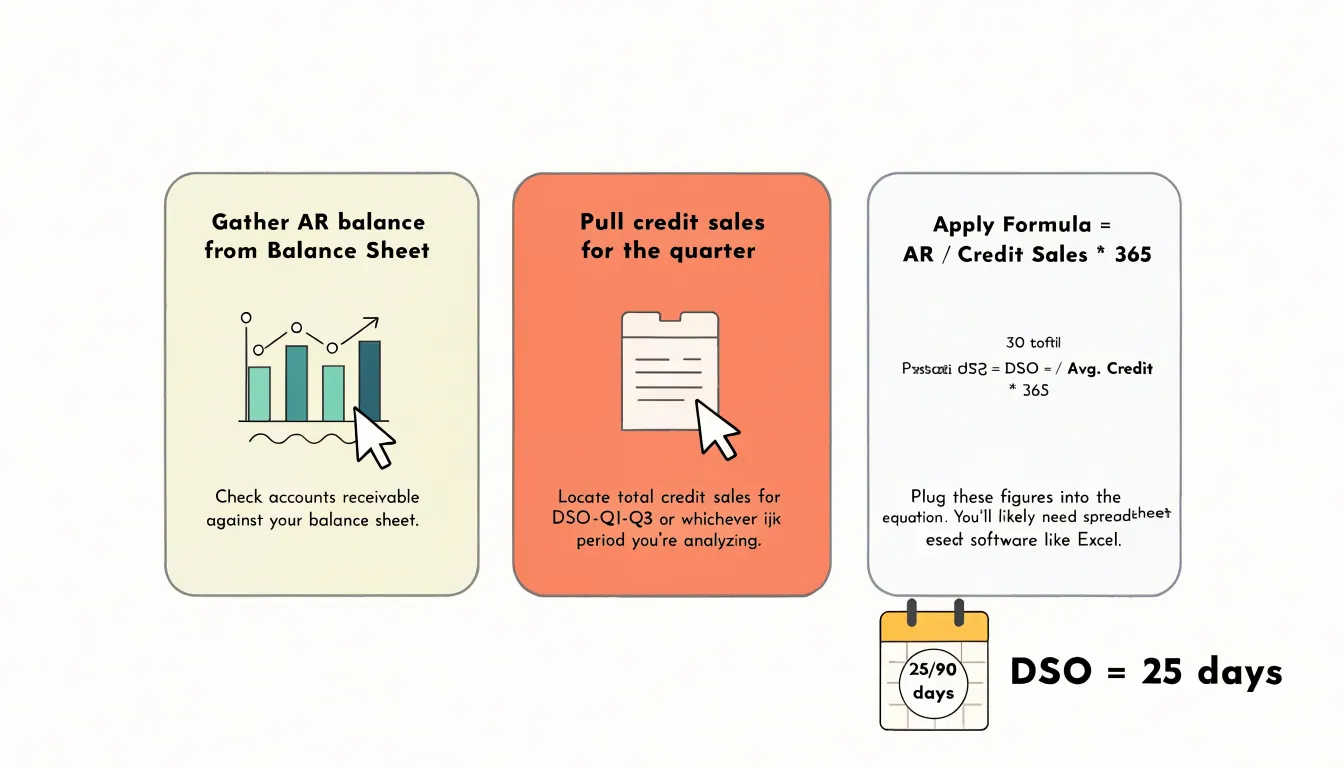
Calculating DSO begins with gathering two figures from your financial statements: the accounts receivable balance and the total credit sales for the period. Accounts receivable appears as a line item on the balance sheet, while credit sales come from the income statement. If your income statement reports only total revenue, you can approximate credit sales by subtracting cash sales, which typically requires a look at your sales ledger or point-of-sale records. For this walkthrough, suppose a company reports $500,000 in accounts receivable at the end of the quarter and $1,800,000 in credit sales for those three months.
Choosing the right period matters because DSO measures how many days, on average, customers take to pay. Match the receivable balance to the sales period it corresponds to. Using a single quarter’s sales against a quarter-end receivable balance gives a clean calculation. If you use annual sales, divide by 365; for a quarter, divide by 90; for a month, divide by 30. Mixing periods, such as annual sales with a month-end receivable balance, distorts the result and makes comparisons across time unreliable.
With the figures in hand, apply the formula: DSO equals accounts receivable divided by credit sales, multiplied by the number of days in the period. Plugging in the sample numbers gives $500,000 divided by $1,800,000, which equals 0.2778, multiplied by 90 days, producing a DSO of 25 days. That means, on average, customers pay their invoices about 25 days after a sale.
Interpreting the result requires context. Compare the 25-day figure against your stated payment terms. If you offer net 30, a DSO of 25 days suggests collections are running efficiently, with customers paying slightly ahead of the deadline. A DSO of 45 days under the same terms would flag slower payments and prompt a review of credit policies or collection follow-up. Track DSO over several consecutive periods to spot trends rather than reacting to a single quarter. A rising DSO consumes working capital and can signal loosening credit standards or customer financial stress. A falling DSO frees up cash for operations. Running this calculation each period builds a reliable benchmark for your business.
What counts as a healthy DSO score across different industries?
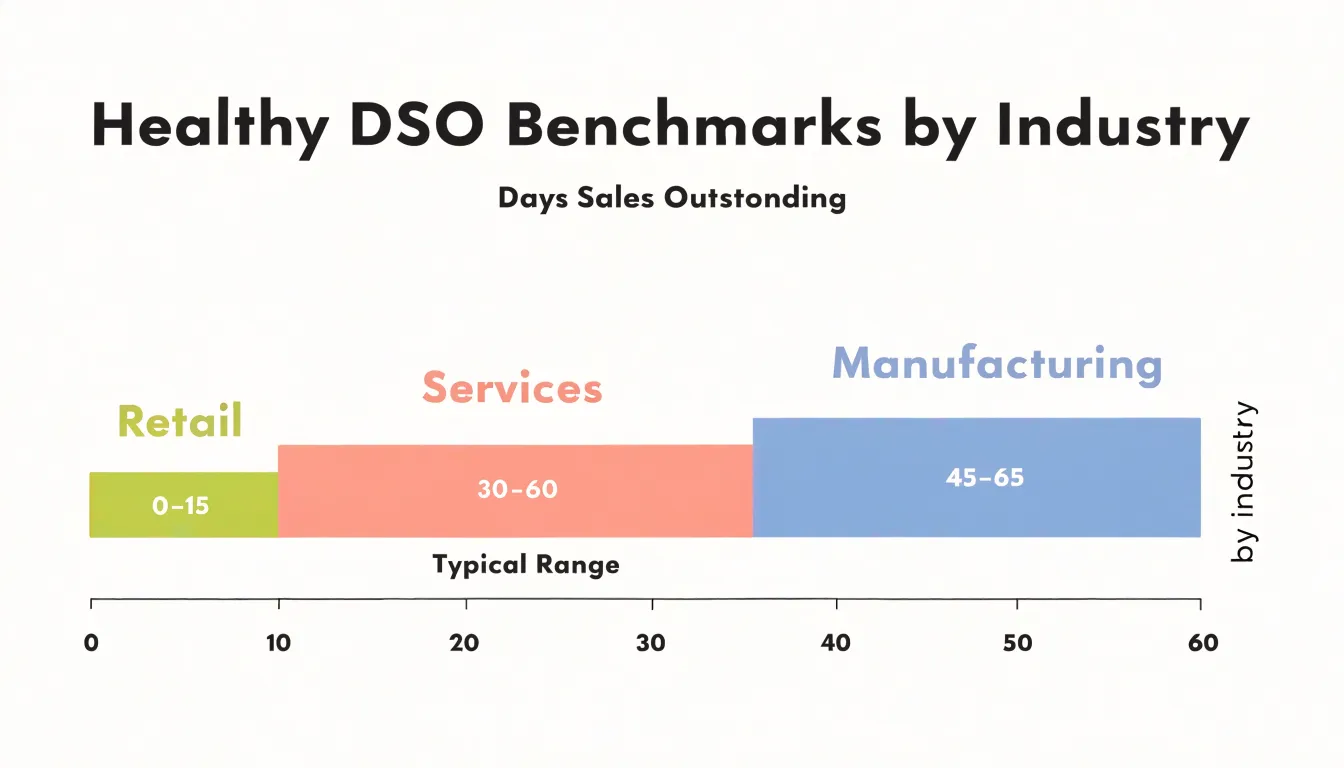
A healthy DSO score is best understood as a range rather than a single number, and that range shifts considerably from one industry to the next. In retail, where most transactions are settled at the point of sale and card payments clear within days, a DSO in the single digits to low teens is typical, and anything approaching 30 days may signal problems with receivables from wholesale or business-to-business channels. Manufacturing operates on longer cycles: invoices often follow shipment and acceptance milestones, and a DSO somewhere between 45 and 65 days is commonly regarded as sound, with heavy equipment or project-based manufacturers sometimes running higher. Service businesses sit in a middle band, frequently landing between 30 and 60 days depending on whether they bill in advance, on completion, or on a monthly retainer basis. Professional services firms with large corporate clients often accept longer cycles because their customers’ procurement and accounts payable processes are slow by design.
Contractual payment terms are the single largest driver of what counts as healthy. A company offering net 60 terms cannot reasonably benchmark itself against a net 30 peer without adjusting for the difference; the useful measure is how close actual collections come to the stated terms. Analysts often compare DSO to the average terms extended, and a gap of ten days or fewer is generally viewed as good discipline. Seasonality also distorts headline figures. Retailers see DSO swell after holiday inventory builds if they sell on credit, while agricultural suppliers and construction firms experience strong seasonal swings tied to planting and building calendars. A healthy annual average can therefore hide months of poor collection performance.
Other factors shape expectations as well: customer concentration, with a few large buyers able to dictate terms; the creditworthiness of the customer base; and the presence of early-payment discounts that accelerate cash. Best practice is to benchmark against direct competitors of similar size and terms rather than against broad industry averages, and to track DSO as a rolling trend so that seasonal noise does not mask a genuine deterioration in collections.
Why a rising DSO threatens your everyday working capital
Days Sales Outstanding (DSO) measures the average time it takes to collect payment after a sale. When DSO rises, cash that should be flowing into your business remains stuck in accounts receivable. This directly reduces the cash available for daily operations—paying salaries, covering rent, purchasing inventory, and managing other routine expenses. Even profitable companies can face a liquidity crunch if their cash is tied up in unpaid invoices.
To bridge the gap, businesses often turn to credit lines or loans, which introduce interest costs and fees. This reliance on external financing can strain relationships with lenders, especially if the pattern persists. Over time, rising DSO may erode your creditworthiness, making it harder or more expensive to borrow when you truly need it. Moreover, the interest expense eats into margins, reducing the funds available for growth initiatives or emergency reserves.
Delayed collections also ripple through your supply chain. When cash is tight, you may need to stretch payments to suppliers, potentially damaging relationships or incurring late fees. Suppliers might respond by tightening their own credit terms, demanding cash on delivery, or reducing discounts. This can disrupt your operations if inventory runs low or if you lose favorable pricing. In some cases, suppliers may prioritize other customers, leaving you at a disadvantage.
A rising DSO can also be a red flag. It may indicate that customers are facing financial distress and are slower to pay, which could lead to bad debt. Alternatively, it might reflect lax credit policies—such as extending terms too generously or failing to screen customers properly. Without corrective action, these issues can compound, leading to a vicious cycle of worsening cash flow and strained customer relationships.
In essence, DSO is more than a metric; it’s a barometer of your cash conversion efficiency. Ignoring a rising trend puts your working capital at risk, forcing you to make difficult choices that can hinder day-to-day operations and long-term stability. Monitoring DSO closely and addressing its root causes is essential for maintaining healthy cash flow and operational resilience.
Invoicing fixes that immediately shorten your payment cycle
Prompt invoicing is one of the most direct ways to shorten your payment cycle. Send invoices the moment a product ships or a service is delivered, while the details are fresh and the client’s sense of obligation is strongest. Delays in invoicing create delays in payment, so establish a routine that eliminates lag: automate invoice generation from your accounting or ERP system, set a fixed daily or weekly send schedule, and confirm that the invoice reaches the right person. Include the purchase order number, a clear description of the work, and the exact amount due so the client has no reason to request clarification.
Offering multiple payment methods removes friction from the payer’s side. Provide options such as ACH transfers, credit cards, digital wallets, and online payment portals. Each additional method accommodates different client preferences and internal processes, making it easier for them to pay quickly. A secure self-service portal can also let clients view and settle invoices at any time, reducing back-and-forth and accelerating cash inflow.
Clear terms and late fees set expectations from the start. Spell out the due date, accepted payment methods, and any early-payment discounts or penalties for late payment. When terms are unambiguous, clients know exactly what is required and when. A reasonable late fee further encourages on-time payment by attaching a cost to delay, while early-payment incentives can motivate clients to pay ahead of schedule.
Systematic follow-up ensures that invoices do not slip through the cracks. Implement a schedule of reminders: a friendly notice a few days before the due date, a follow-up on the due date, and escalating reminders afterward. Use automated emails or calls to maintain consistency, and track responses to identify chronic late payers. Personal outreach for overdue accounts can resolve disputes quickly and preserve the relationship. Together, these tactics create a predictable, professional billing process that reduces payment delays and improves cash flow.
Automating receivables
Accounts receivable automation replaces manual, spreadsheet-driven collections work with software that handles repetitive tasks and surfaces information as it happens. These platforms connect directly to accounting and ERP systems, pulling invoice data the moment it is issued and tracking every open item against its due date. From that foundation, the software runs a set of coordinated functions that together shorten the time between invoice and cash.
Reminder workflows sit at the center of most receivables tools. Rather than relying on a collections clerk to remember which customers owe what, the system triggers dunning messages automatically at intervals the finance team defines. Reminders can be sequenced by customer segment or invoice age, personalized with the correct invoice references, and delivered by email or through a customer portal. Because every reminder goes out on schedule, fewer invoices drift past due unnoticed, and the collections team spends its time on exceptions rather than routine follow-up.
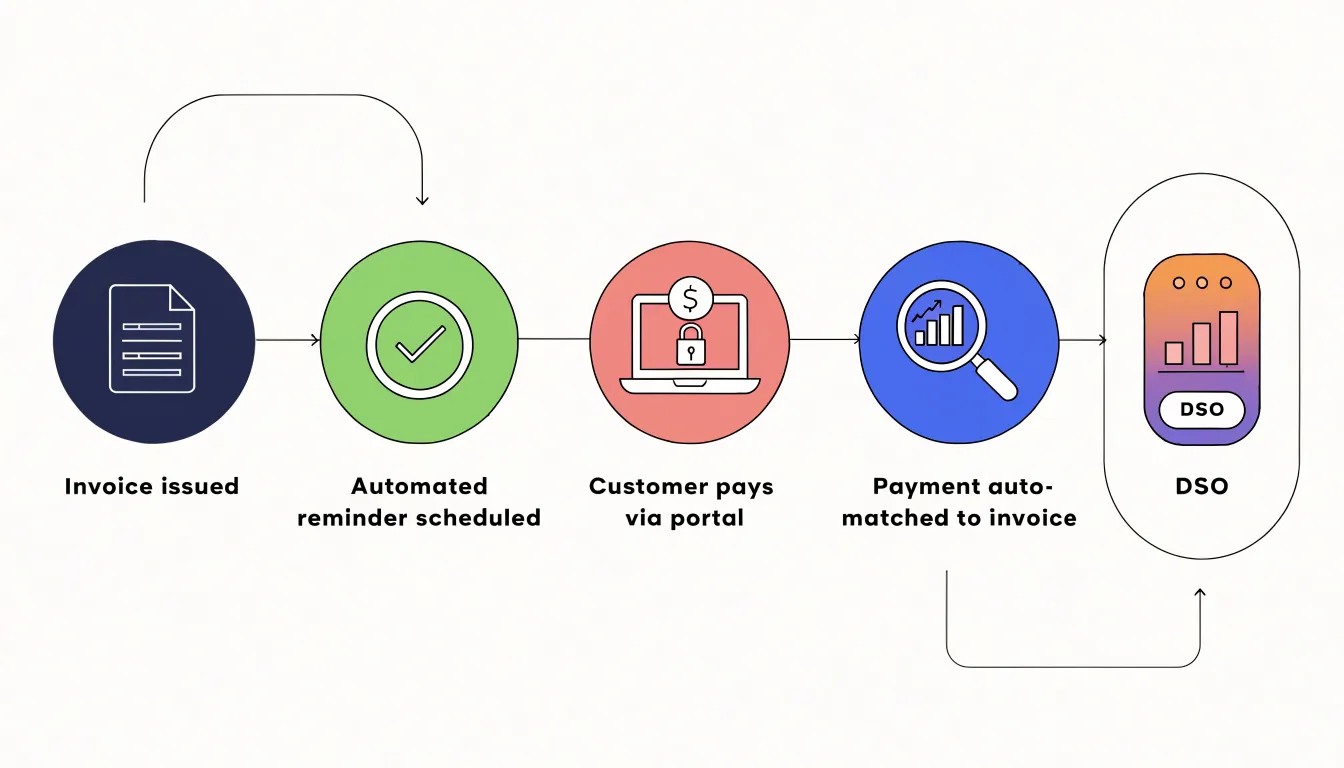
Payment processing is the second pillar. Automated tools present customers with convenient ways to pay, typically including card, ACH, and links embedded in invoices and reminders. When a payment arrives, the system applies it to the matching invoice, posts the cash entry, and notifies the customer of receipt. This removes the delays that come from manual remittance matching and eliminates much of the friction that causes customers to postpone payment.
Real-time dashboards complete the picture by giving finance leaders continuous visibility into receivables health. Aging buckets, days sales outstanding trends, promise-to-pay tracking, and customer-level collection histories update as transactions occur, so problems are visible while there is still time to act. Managers can see which accounts are slipping, which reminders are working, and where cash is stuck.
The combined effect on DSO is direct. Faster invoicing, consistent follow-up, easier payment, and prompt cash application each shave days off the collection cycle, and the analytics layer helps teams keep improving the process over time. Organizations that adopt these tools typically see measurable reductions in DSO within a few billing cycles.
How to handle persistent late payers without ruining client relationships
Persistent late payers require a balanced approach that protects your cash flow while preserving the client relationship. Start with proactive communication: before an invoice becomes overdue, confirm receipt and remind the client of the due date. A brief, friendly email a week before payment is due can prevent delays. If payment is missed, follow up promptly with a polite but firm message that references the agreed terms and asks for a specific payment date. This early intervention signals that you track payments closely without being confrontational.
When late payment becomes a pattern, negotiate a payment plan. A client facing temporary cash-flow issues may respond well to a structured schedule, such as splitting the balance over several weeks. Document the plan in writing, including new due dates and any applicable fees, and confirm both parties’ agreement. This approach shows flexibility and a commitment to the relationship while establishing clear expectations.
For clients who repeatedly miss deadlines, implement escalation tiers. Begin with gentle reminders from your accounts receivable team, then escalate to a phone call from a manager, and finally involve senior leadership. Each tier should be defined in advance and applied consistently. The goal is to increase pressure gradually without jumping straight to harsh measures. Keep the tone professional and solution-oriented at every stage.
Setting clear consequences is essential. Your contract should specify late fees, interest charges, or suspension of services after a certain number of days. When enforcing these consequences, do so matter-of-factly, not punitively. For example, a note that “as per our agreement, a 1.5% monthly late fee will apply” is factual and avoids personal criticism. If non-payment persists, you may need to pause work or escalate to collections, but communicate this decision in advance and in writing, explaining the rationale and offering a path to resolve the issue.
Throughout, maintain professionalism by keeping emotions out of communications, focusing on the facts, and documenting every interaction. Preserve the relationship by acknowledging the client’s value and expressing a desire to continue working together. By combining empathy with firm boundaries, you can recover overdue payments without damaging long-term partnerships.
Frequently Asked Questions
What does days sales outstanding measure?
Days sales outstanding measures the average number of days your business waits to collect payment after a sale has been made. It reflects how quickly revenue from credit sales becomes usable cash.
How do you calculate DSO?
The standard DSO formula is Accounts Receivable divided by Total Credit Sales, multiplied by the Number of Days in the period. Use 30 days for a month, 90 for a quarter, or 365 for a year, and match the receivable balance to the same sales period.
What is a healthy DSO?
A healthy DSO is best understood as a range that shifts by industry: retail may be single digits to low teens, manufacturing commonly 45 to 65 days, and service businesses often 30 to 60 days. The useful measure is how close actual collections come to your stated payment terms, with a gap of ten days or fewer generally viewed as good discipline.
Why is a rising DSO bad for cash flow?
When DSO rises, cash that should be flowing into the business remains stuck in accounts receivable, reducing cash available for daily operations such as salaries, rent, and inventory. Businesses may then turn to credit lines or loans, which introduce interest costs and fees, and may need to stretch payments to suppliers.
How can invoicing changes shorten the payment cycle?
Send invoices the moment a product ships or a service is delivered, and automate invoice generation to eliminate lag. Also include clear details, offer multiple payment methods, spell out terms and late fees, and use a systematic schedule of reminders.
How can automating receivables reduce DSO?
Receivables automation connects to accounting and ERP systems, tracks open invoices, triggers reminder workflows, offers convenient payment options, applies payments to matching invoices, and provides real-time dashboards. Faster invoicing, consistent follow-up, easier payment, and prompt cash application each shave days off the collection cycle.