
Debit vs Credit in Accounting
A debit is a ledger entry recorded on the left side, and a credit is an entry on the right. Debits increase assets, expenses, and dividends; credits increase liabilities, equity, and revenue. Every transaction keeps total debits equal to total credits, so the accounting equation (Assets = Liabilities + Equity) stays balanced.
Table of Contents
- Why Bank Statements Confuse People About Debits and Credits
- What Does Debit Actually Mean in Double Entry Accounting
- What Does Credit Mean in Double Entry Accounting
- Assets vs Liabilities
- How Revenue and Expense Accounts Behave
- Real World Scenarios
- Simple Tricks to Remember Which Account to Debit or Credit
- How to Audit Your Ledger to Ensure Debits Equal Credits
Why Bank Statements Confuse People About Debits and Credits
Bank statements present a persistent challenge for anyone learning accounting because they use the words debit and credit in a way that feels inverted compared with the textbook definitions. On a typical personal or business bank statement, a debit entry describes money leaving the account, while a credit entry describes money arriving. This reflects the bank’s own ledger, where your deposited funds are recorded as a liability the bank owes back to you. From the bank’s point of view, when you deposit money, the bank owes you more, so it credits that liability account; when you withdraw or spend money, the bank owes you less, so it debits the liability. The terminology is internally consistent for the bank, yet it appears backwards to a customer who naturally thinks of their own account balance increasing or decreasing.
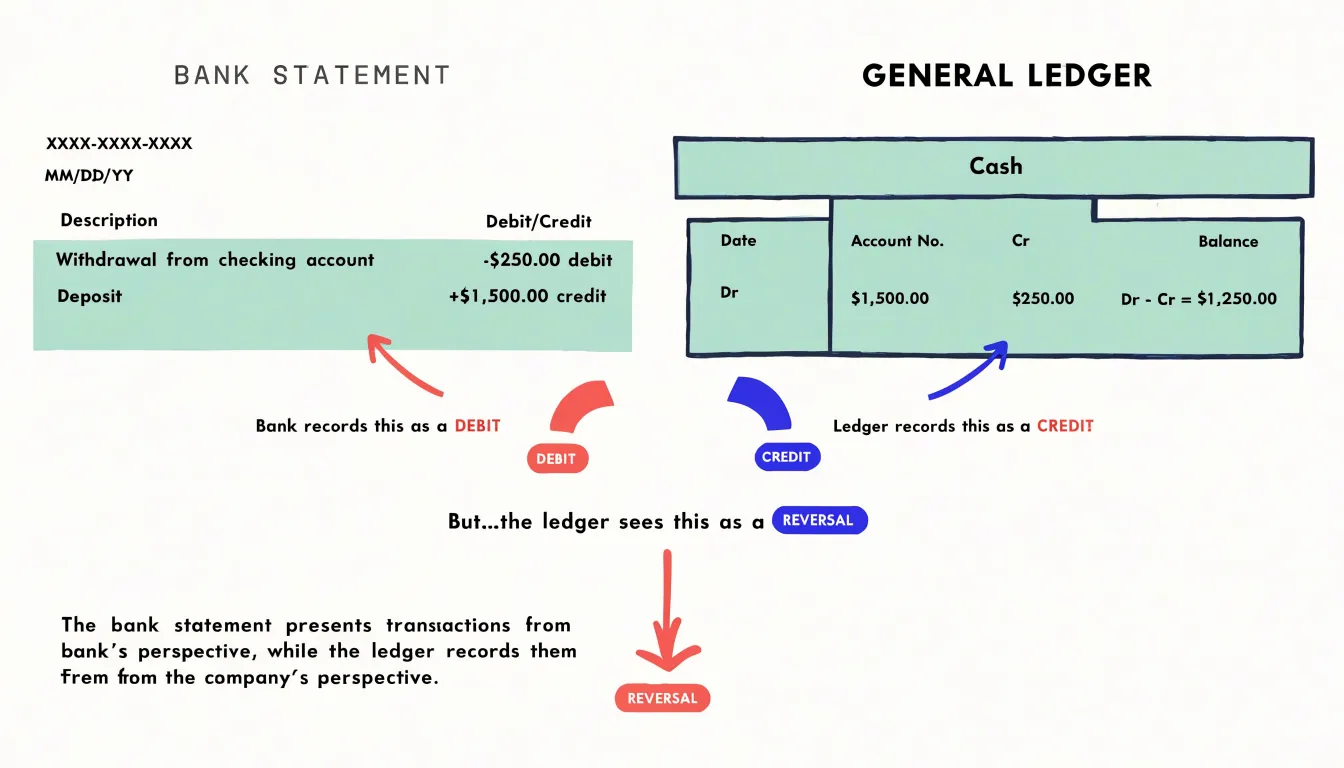
The confusion deepens because the same words carry different meanings depending on whose books are being examined. In standard double-entry accounting from the perspective of a business, a debit increases asset accounts such as cash, and a credit decreases them. A business that receives a payment debits its cash account and credits the revenue or receivable account. That same payment, viewed on the bank statement, appears as a credit because the bank is recording its liability to the customer, not the customer’s asset. Learners who move between a company’s general ledger and a bank statement encounter two valid but opposing frames applied to identical transactions.
This perspective mismatch trips people up in practical ways. Someone reconciling a checking account may instinctively record a statement debit as a debit in their own books, which reverses the intended effect and distorts the balance. Students memorizing rules such as debits increase assets then struggle when a bank statement shows a credit increasing their cash balance. The underlying issue is not an error in either system but a difference in viewpoint: one set of records belongs to the bank, the other to the account holder. Recognizing whose books are in front of you resolves the apparent contradiction, and keeping that perspective in mind makes bank statements read as straightforward records rather than sources of confusion.
What Does Debit Actually Mean in Double Entry Accounting
In double entry accounting, a debit is formally defined as an entry recorded on the left side of a ledger account. Every account in the bookkeeping system has two sides, and the left column is always reserved for debits, while the right column is reserved for credits. This structural convention gives the term its precise technical meaning, regardless of how the word is used in everyday banking language. When an accountant says an account is debited, the statement describes a physical placement of the figure on the left-hand side of the relevant T-account or ledger page.
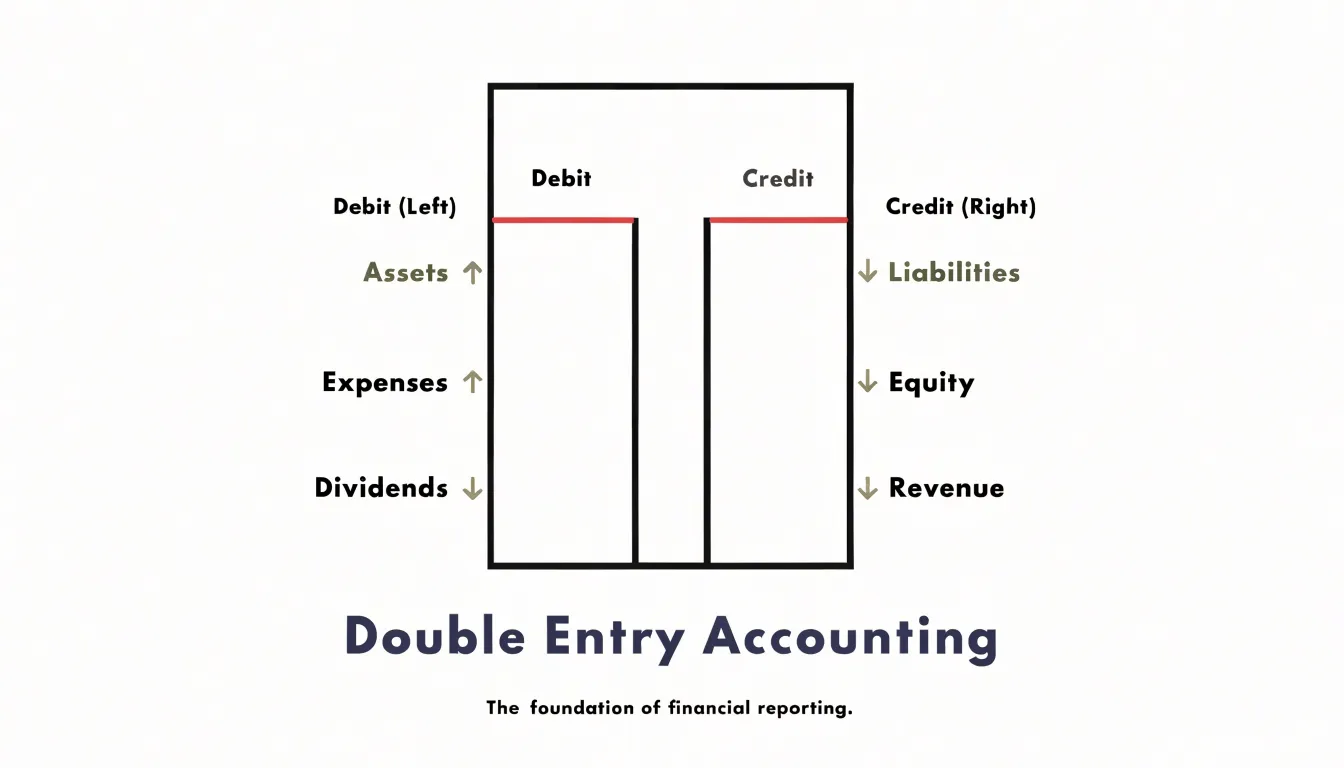
The effect a debit has on an account balance depends on the type of account involved. Asset accounts, which include cash, inventory, equipment, and accounts receivable, increase when they are debited. Spending cash to purchase supplies, for example, is recorded as a debit to the supplies asset account, raising its balance. Expense accounts follow the same pattern: expenses increase through debits, which is why the cost of rent, wages, or utilities appears on the left side when those costs are recorded. This shared behavior reflects the underlying relationship between assets and expenses, since both consume resources in the ordinary course of business.
On the other side of the ledger, debits reduce the balances of liability, equity, and revenue accounts. A liability such as accounts payable decreases when the business makes a payment toward what it owes, and that reduction is captured as a debit. Equity accounts behave similarly, so a distribution to owners reduces equity through a debit entry. Revenue accounts also fall when debited, a situation that occurs during closing entries at the end of an accounting period or when a customer refund reverses previously recorded income.
These rules form the foundation of the double entry system, where each transaction produces debits equal in total to credits. Understanding that a debit simply means an entry on the left, and that its effect depends on the account category it touches, allows anyone to trace how a single transaction ripples through the financial statements.
What Does Credit Mean in Double Entry Accounting
In double entry accounting, a credit is formally defined as an entry recorded on the right side of a ledger account. Every account has two sides: the left side, known as the debit side, and the right side, known as the credit side. When accountants speak of crediting an account, they mean recording a monetary amount in the right-hand column of that account. This definition is positional and mechanical, grounded in the structure of the ledger rather than in any judgment about whether a transaction is favorable or unfavorable. The term credit carries no inherent connotation of good or bad; it simply identifies where the entry is placed. Understanding this positional definition is the foundation for understanding how credits affect the various types of accounts.
The effect of a credit depends entirely on the category of account being credited. For liability accounts, a credit increases the balance. When a business borrows money from a lender, it credits the loan payable account, raising the amount the business owes. Similarly, crediting an equity account increases the owner’s stake in the business, as happens when an owner contributes capital or when revenues are closed into retained earnings. Revenue accounts also increase with credits, which is why recording a sale typically involves a credit to a revenue account such as sales revenue or service revenue. These three categories, liabilities, equity, and revenue, share the same credit behavior and together form the right side of the accounting equation as it is conventionally presented.
On the other side of the ledger structure, asset and expense accounts behave in the opposite manner. Crediting an asset account decreases its balance. When a company pays cash, it credits the cash account, reducing the asset. When inventory is sold, the inventory asset account is credited to reflect the outflow of goods. Expense accounts likewise decrease when credited, although in practice expenses are most often debited when incurred and credited when they are closed out at the end of a reporting period. This consistent pattern, where credits raise liabilities, equity, and revenue while lowering assets and expenses, allows the double entry system to keep the accounting equation in balance across every transaction.
Assets vs Liabilities
Every account in a double-entry bookkeeping system falls into one of five main categories: assets, liabilities, equity, revenue, and expenses. Learning which category an account belongs to is the key that unlocks the entire debit and credit system, because the rules for increasing or decreasing an account flow directly from its type. Assets are the resources a business owns or controls, such as cash, inventory, equipment, and accounts receivable. Liabilities represent obligations owed to others, including loans, accounts payable, and accrued expenses. Equity is the owner’s residual interest in the business after liabilities are subtracted from assets. Revenue captures the inflows earned from selling goods or services, and expenses record the costs incurred to generate that revenue.
The debit and credit rules follow a simple pattern built on the accounting equation, Assets = Liabilities + Equity. Accounts on the left side of the equation, assets, are increased by debits and decreased by credits. Accounts on the right side, liabilities and equity, behave in the opposite way: they increase with credits and decrease with debits. Revenue and expenses extend this logic because they ultimately affect equity. Revenue increases equity, so revenue accounts increase with credits and decrease with debits. Expenses reduce equity, so expense accounts increase with debits and decrease with credits.
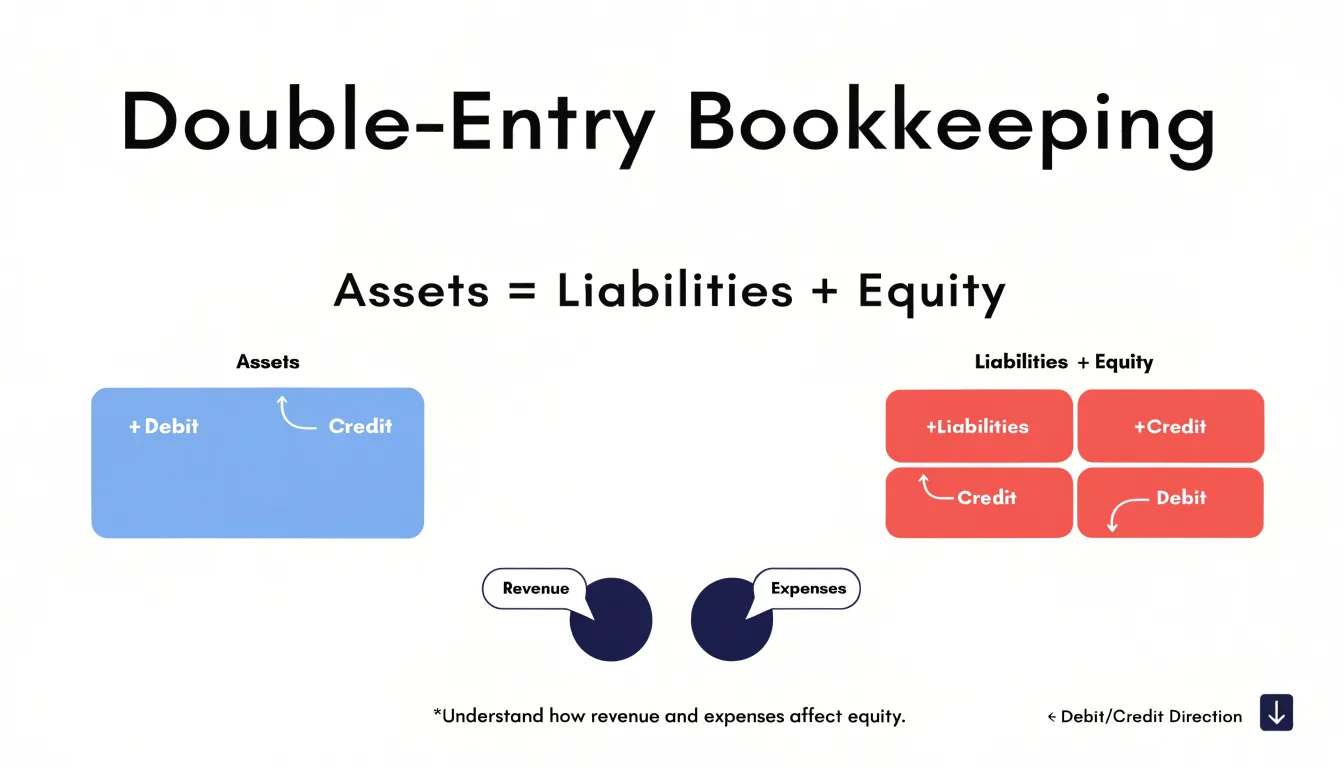
A common mnemonic for recalling these groupings is DEALER, which stands for Dividends, Expenses, Assets, Liabilities, Equity, and Revenue. The first three items, Dividends, Expenses, and Assets, are the accounts that increase with a debit. The last three, Liabilities, Equity, and Revenue, increase with a credit. A related memory aid is DEAD CLIC: Debits increase Expenses, Assets, and Dividends, while Credits increase Liabilities, Income, and Capital. Either mnemonic gives a quick reference when recording a transaction and helps prevent the most common beginner error of reversing the normal balance of an account.
A short reference table reinforces the same rules. For asset accounts, the normal balance sits on the debit side. For liability, equity, and revenue accounts, the normal balance sits on the credit side. Expense accounts carry a normal debit balance. When a transaction is recorded, the accountant identifies the two or more accounts involved, classifies each by type, and then applies the matching rule to decide whether each account should be debited or credited. Once the five account types and their normal balances are committed to memory, the mechanics of journal entries become a straightforward application of these patterns rather than a matter of rote memorization.
How Revenue and Expense Accounts Behave
Revenue and expense accounts drive the change in equity from a company’s core operations, and their debit and credit behavior follows directly from their relationship to equity. Equity increases when a company earns revenue and decreases when it incurs expenses. Because equity accounts normally carry a credit balance, any increase to equity is recorded as a credit. Revenue, which increases equity, therefore increases with a credit. Expenses do the opposite: they reduce equity, so they increase with a debit. This is why revenue accounts have a normal credit balance and expense accounts have a normal debit balance, placing them on opposite sides of the ledger from the asset accounts that dominate the debit side.
The effect on equity is visible in the accounting equation, Assets = Liabilities + Equity. When a company earns revenue, assets such as cash or accounts receivable increase, and equity increases by the same amount. The revenue account serves as a temporary record of that equity increase. When a company pays an expense, assets decrease or liabilities increase, and equity decreases. The expense account records that reduction. At the end of the accounting period, revenue and expense balances are closed into equity, leaving these temporary accounts at zero for the next period. Throughout the period, their balances reflect the cumulative effect of operating decisions on equity.
Revenue accounts increase with credits because they represent inflows that enrich the owners’ stake. A credit entry to a revenue account is matched by a debit to an asset account or a credit to a liability account, depending on whether cash is received immediately or later. Expense accounts increase with debits because they represent outflows that diminish the owners’ stake. A debit entry to an expense account is matched by a credit to an asset account, such as cash, or to a liability account, such as accounts payable. The normal balance of each account type simply reflects the side on which increases are recorded.
The contrast with asset accounts is straightforward. Assets are resources the business owns, and they normally increase with debits. Revenue and expense accounts are not resources; they are flow accounts that measure changes in equity over a period. Revenue increases equity, so it follows the credit direction of equity. Expenses decrease equity, so they follow the debit direction, opposite to equity’s normal balance. This symmetry keeps the double-entry system in balance: every transaction affects at least two accounts, and the total of debits always equals the total of credits.
Real World Scenarios
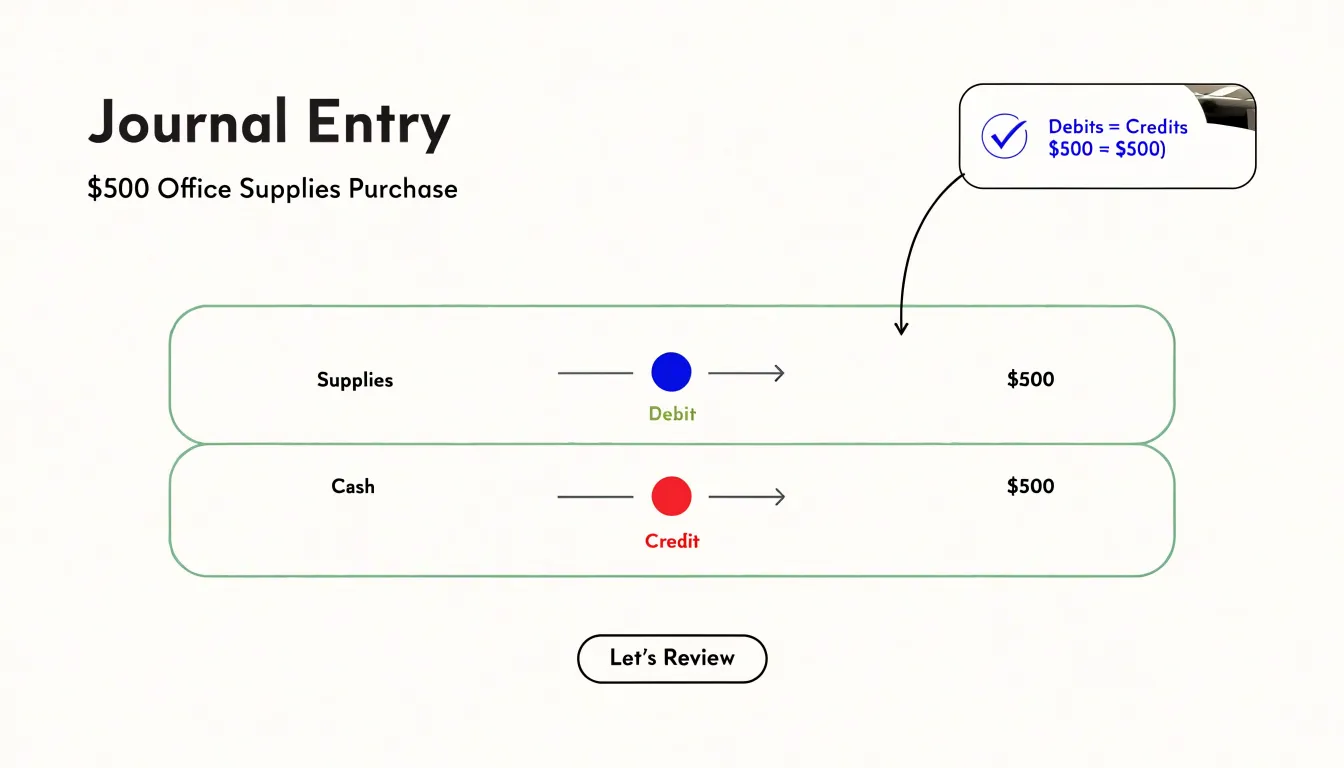
Recording everyday business transactions becomes clearer when you walk through common scenarios and see exactly which accounts are debited and credited. Consider a company that buys $500 of office supplies with cash. The supplies are an asset that increases, so the Supplies account is debited for $500. Cash, another asset, decreases, so the Cash account is credited for $500. The logic holds because debits increase assets and credits decrease them. Next, imagine the same company pays $2,000 in monthly rent. Rent is an expense that increases, and expenses are increased by debits. So the Rent Expense account is debited for $2,000, while Cash is credited for $2,000 to reflect the outflow. This transaction reduces both cash and net income, correctly captured by the debit to an expense and the credit to an asset.
Now consider a sale. A business sells $1,200 of goods to a customer on credit. Revenue increases, and revenue accounts are increased by credits. Therefore, the Sales Revenue account is credited for $1,200. The corresponding debit goes to Accounts Receivable, an asset that increases because the customer owes the business money. If the customer pays later, the company debits Cash and credits Accounts Receivable, converting one asset into another. If the sale had been for cash instead, the debit would go directly to Cash. In both cases, the credit to revenue records the earning of income, while the debit records the increase in an asset.
Finally, suppose the company takes out a $10,000 bank loan. Cash increases, so Cash is debited for $10,000. The liability to repay the loan also increases, and liabilities are increased by credits. Thus, the Loan Payable account is credited for $10,000. When the company later repays part of the loan, it debits Loan Payable to reduce the liability and credits Cash to reduce the asset. Each of these walkthroughs follows the same underlying rules: debits increase assets and expenses, credits increase liabilities, equity, and revenue, and every transaction keeps the accounting equation in balance. By practicing these common entries, anyone can build confidence in recording everyday business activity accurately.
Simple Tricks to Remember Which Account to Debit or Credit
One of the most practical ways to build speed with double-entry bookkeeping is to lean on a handful of memory devices that turn the debit and credit rules into something you can recall instantly. The best known of these is DEAD CLIC, an acronym that pairs each account type with its normal balance. DEAD stands for Debits increase Expenses, Assets, and Drawings, while CLIC stands for Credits increase Liabilities, Income, and Capital. Once you can recite the phrase, you have a compact map of the entire ledger: put an expense, an asset purchase, or an owner withdrawal on the debit side, and put a liability, a sale, or a capital contribution on the credit side. The reverse automatically applies when those accounts decrease.
A second trick grounds the same rules in the accounting equation: Assets = Liabilities + Equity. Because the two sides of the equation must stay balanced, any increase on the left side is matched by an increase on the right, or by a decrease elsewhere on the left. Thinking in these terms helps you see why buying equipment with cash debits one asset and credits another, leaving the equation untouched, while borrowing from a bank debits the cash asset and credits the loan liability, growing both sides together. The equation acts as a built-in check on whatever entry you propose.
A third approach shifts attention from account names to the direction of value. Ask yourself where the benefit is going and where it is coming from. The account receiving value is debited; the account giving up value is credited. When a customer pays you, cash flows into the business, so cash is debited and the corresponding revenue or receivable is credited. When you pay a supplier, value leaves the cash account, so cash is credited and the expense or payable is debited. Framing each transaction as a flow of value keeps the mechanics intuitive and works well for visual thinkers.
These three devices reinforce one another, and experienced bookkeepers often cycle between them without noticing. With regular practice, the mnemonics fade into background knowledge, and identifying the correct debit and credit becomes almost automatic.
How to Audit Your Ledger to Ensure Debits Equal Credits
Auditing your ledger starts with a full review of the entries recorded during the period. Begin by confirming that every transaction has a source document behind it, such as an invoice, receipt, or bank statement, and that the amount and date on the document match the entry in the ledger. Work through the ledger account by account, paying attention to entries that look unusual in size, timing, or direction. Once each entry has been verified against its documentation, total the debit column and the credit column separately for the entire ledger. In a double-entry system these two totals must match exactly; any difference is a signal that at least one entry has been recorded incorrectly or left incomplete.
When the totals do not agree, look for the most common causes first. A transposition error occurs when digits within a number are reversed, such as writing 540 instead of 450, and it often produces a difference divisible by nine. An omission error happens when one side of a transaction is never recorded, leaving a debit without its matching credit. Other frequent problems include recording the same entry twice, posting an amount to the wrong account, or entering the correct figure on the wrong side of an account. Comparing each ledger account against its source documents usually narrows the search to a small number of suspect entries.
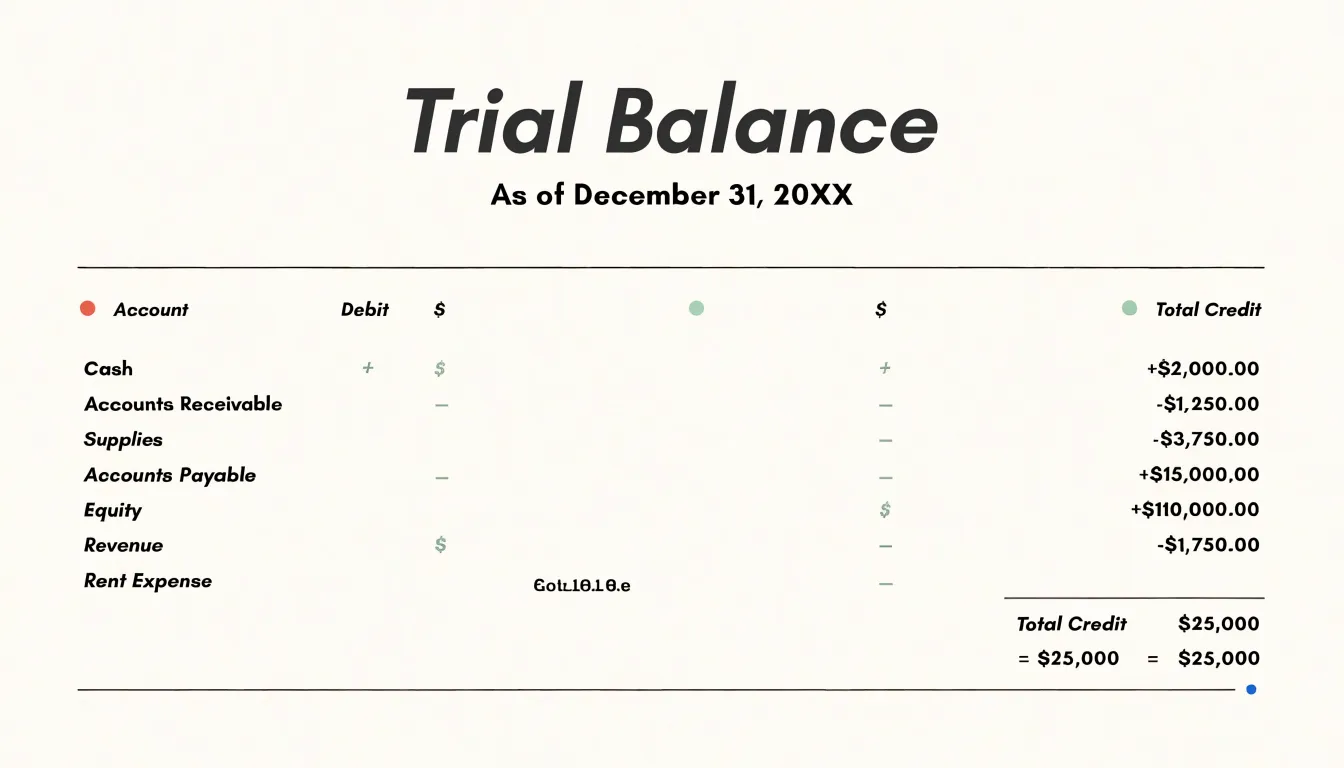
A trial balance is the standard tool for confirming that the ledger is internally consistent. List every account with its closing debit or credit balance, then total both columns. If the two totals agree, the ledger is mathematically balanced, although this alone does not prove every entry is correct, since offsetting errors can cancel each other out. If the totals differ, the amount of the difference offers a useful clue: check for a missing entry of that exact amount, for a balance entered in the wrong column, or for a transposition whose difference is divisible by nine. Repeat the trial balance after each correction until the columns match, and keep a record of adjustments made so the audit trail stays clear.
Frequently Asked Questions
Why does my bank statement show a debit when money leaves my account?
Bank statements use debit and credit from the bank’s perspective, where your deposited funds are recorded as a liability the bank owes back to you. When you withdraw or spend money, the bank owes you less, so it debits that liability account.
What does a debit mean in double-entry accounting?
In double-entry accounting, a debit is formally defined as an entry recorded on the left side of a ledger account. Its effect depends on the type of account being debited.
How do debits and credits affect asset and liability accounts?
Assets are increased by debits and decreased by credits. Liabilities behave in the opposite way: they increase with credits and decrease with debits.
Do revenue accounts increase with debits or credits?
Revenue accounts increase with credits because revenue increases equity, and equity accounts normally carry a credit balance. Expense accounts, by contrast, increase with debits because expenses reduce equity.
What does the DEAD CLIC mnemonic mean?
DEAD CLIC is a memory aid where Debits increase Expenses, Assets, and Drawings, while Credits increase Liabilities, Income, and Capital. It gives a quick reference for recording transactions and helps prevent reversing an account’s normal balance.
How can I check whether my ledger’s debits equal its credits?
Use a trial balance by listing every account with its closing debit or credit balance and totaling both columns. If the totals agree, the ledger is mathematically balanced, although offsetting errors can still exist.