
Debits and Credits
Debits and credits are directional bookkeeping entries: a debit records value on the left side of an account, a credit records value on the right. Debits increase assets and expenses, while credits increase liabilities, equity, and revenue. Every transaction records equal debits and credits, keeping the accounting equation (Assets = Liabilities + Equity) balanced and self-checking.
Table of Contents
- Why Accounting Uses Left and Right Instead of Plus and Minus
- The Five Main Accounts
- Assets and Expenses
- Understanding Liabilities Equity and Revenue Increasing with Credits
- The Core Balancing Rule That Keeps Every Accounting Ledger Accurate
- Using T-Accounts to Sketch Out Complex Transactions Before Journaling
- Walking Through Everyday Examples of Real World Journal Entries
- Common Misconceptions About What Debit and Credit Cards Actually Mean
Why Accounting Uses Left and Right Instead of Plus and Minus
Accounting uses the terms debit and credit rather than plus and minus for reasons that reach back to the merchant ledgers of medieval and Renaissance Italy. The words themselves come from Latin: debitum, meaning “that which is owed,” and creditum, meaning “that which is entrusted or believed.” Early Italian bankers and merchants recorded transactions in ruled books, entering amounts on one side of a page for goods and obligations owed and on the other side for value received. The vocabulary grew out of the physical layout of those ledgers, where each account occupied two facing columns. Over centuries this bookkeeping practice spread across Europe, and the terms became standard professional language long before modern accounting theory formalized them. By the time double-entry bookkeeping was codified in works such as Luca Pacioli’s 1494 treatise, debit and credit were already embedded in commercial practice.

The practical reason for keeping this terminology becomes clear when you consider how many different kinds of accounts exist. A single business tracks assets, liabilities, equity, revenue, and expenses, and each category behaves differently when its balance increases. Adding money to a cash account increases an asset, while adding money to a loan account increases a liability. If accountants used plus and minus, the meaning of a “plus” entry would shift depending on which account it touched, and readers would have to remember a separate rule for every account type. The words debit and credit avoid this confusion because they carry no built-in direction of increase or decrease. A debit simply means an entry on the left side of an account; a credit means an entry on the right. This rule holds true whether the account is an asset, a liability, or a revenue account.
Left and right therefore provide a consistent directional framework across the entire ledger. Every account has a left side and a right side, and every transaction fits into that structure without ambiguity. The debits and credits of each entry must balance, which gives the system its self-checking property. Accountants can inspect any ledger and know exactly where an amount was recorded and what side it fell on, regardless of the account’s nature. This uniformity is what makes double-entry bookkeeping reliable and auditable across businesses of every size and industry.

The Five Main Accounts
Every dollar that moves through a business lands somewhere in the accounting system, and that somewhere is always one of five account categories: assets, liabilities, equity, revenue, and expenses. Understanding these five buckets gives you a framework for organizing transactions consistently and reading financial statements with confidence.
Assets are the resources a business owns or controls that carry future value. Cash in the bank, accounts receivable owed by customers, inventory waiting to be sold, equipment, vehicles, and buildings all belong here. An asset represents something the business can use to generate revenue or settle obligations. When a customer pays an invoice, cash increases and accounts receivable decreases, with both accounts sitting inside the asset category.
Liabilities are the obligations a business owes to outside parties. Loans from a bank, unpaid supplier invoices recorded as accounts payable, credit card balances, wages owed to employees, and taxes due to a government authority all fall under this heading. Liabilities represent claims against the business that must be settled through future payment or service.
Equity, sometimes called owner’s equity or capital, represents the residual interest in the business after liabilities are subtracted from assets. For a sole proprietor, this includes the owner’s initial investment and retained profits. For a corporation, it includes stock issued to shareholders plus retained earnings. Equity grows when the business earns profits and shrinks when the owner withdraws funds or the business sustains losses.
Revenue captures the inflows earned from the core operations of the business. Sales of products, fees for services rendered, rental income, and interest earned on investments are common examples. Revenue is recorded when it is earned, which means the business has delivered goods or completed a service, regardless of when cash actually arrives.
Expenses are the costs incurred to generate revenue. Rent, utilities, payroll, advertising, supplies, insurance, and depreciation on equipment all reduce the profitability of operations. Like revenue, expenses are recorded when they are incurred rather than only when paid.
These five categories form the backbone of the chart of accounts. Assigning each transaction to the correct category keeps the books accurate and makes the balance sheet and income statement meaningful.
Assets and Expenses
In double-entry accounting, debits and credits are directional entries that increase or decrease different types of accounts. Two account categories are increased by debits: assets and expenses. Understanding why these two share this behavior is key to mastering the mechanics of accounting.
Asset accounts represent resources owned by a business, such as cash, inventory, equipment, and accounts receivable. When a business acquires an asset, it records a debit. For example, if a company purchases equipment for $5,000 in cash, it debits the Equipment account (increasing the asset) and credits the Cash account (decreasing the asset). Similarly, when a business earns revenue and receives cash, it debits Cash (increasing the asset) and credits Revenue (increasing equity). The debit directly reflects the inflow or acquisition of value.
Expense accounts represent the costs incurred to generate revenue, such as rent, salaries, and utilities. Expenses are essentially the consumption of assets or incurrence of liabilities. When a business pays rent, it debits Rent Expense (increasing the expense) and credits Cash (decreasing the asset). The debit increases the expense account, which in turn reduces equity on the income statement. This parallels the asset side because expenses are viewed as costs that have been used up in the pursuit of revenue, much like assets are resources that provide future benefit.
To remember this pairing, consider the accounting equation: Assets = Liabilities + Equity. Equity is increased by revenues and decreased by expenses. Debits increase assets, and since expenses reduce equity, they also increase with debits. A common mnemonic is DEAD: Debits increase Expenses, Assets, and Dividends (dividends also reduce equity). This simple acronym helps recall that debits are associated with these accounts. Another way is to think of debits as the destination of value: when you spend cash (an asset) to pay rent (an expense), the debit goes to the expense account, increasing it, while the credit reduces the asset. Thus, debits naturally increase both assets and expenses, reflecting the flow of economic resources.
Understanding Liabilities Equity and Revenue Increasing with Credits
Credits increase liabilities, equity, and revenue accounts because these accounts sit on the opposite side of the accounting equation from assets. The equation states that assets equal liabilities plus equity, and every transaction must keep that equation in balance. When a credit entry increases a liability or an equity account, the accounting system records a corresponding debit somewhere on the asset side or as a reduction elsewhere, preserving the fundamental equality of the ledger. Grasping why credits raise these particular accounts begins with recognizing that liabilities and equity represent claims against the business, sources of value that fund the assets the company controls. Revenue, in turn, increases equity through profit, so it follows the same credit-favoring pattern.
A borrowing transaction illustrates the mechanism clearly. When a company takes out a bank loan of fifty thousand dollars, it debits cash, increasing the asset account, and credits the loan payable account, increasing the liability. Both sides of the equation grow by the same amount, and the credit serves as the natural way to record an increase in what the business owes. Owner investments work the same way. If an owner contributes capital, the business debits cash and credits the owner’s capital account, lifting equity while recording the incoming asset. The credit reflects the increase in the owners’ claim on the business.
Sales revenue follows the same logic. When a company sells goods for cash, it debits cash and credits the sales revenue account. Revenue ultimately flows into retained earnings, which is part of equity, so crediting revenue increases the equity portion of the equation. When a sale is made on credit, the debit lands in accounts receivable instead, and the revenue credit still balances the entry. In each case, the credit records the source of the economic benefit, whether that source is a lender, an owner, or a customer, and the matching debit records the asset received or the claim created.
This pattern explains why the credit side functions as the record of where value comes from. Liabilities, equity, and revenue all describe inflows or obligations that fund the assets a business holds, and the accounting system captures these increases with credits so that the debits and credits of every transaction stay in equilibrium.
The Core Balancing Rule That Keeps Every Accounting Ledger Accurate
The fundamental accounting equation states that a company’s total assets always equal the sum of its liabilities and its equity: Assets = Liabilities + Equity. Assets are the resources the business controls, such as cash, inventory, equipment, and receivables. Liabilities are the obligations owed to outside parties, such as loans, accounts payable, and accrued expenses. Equity represents the owners’ residual interest in the business after liabilities are subtracted from assets. The equation holds because every asset a business acquires must have been financed in one of two ways: through borrowing (a liability) or through owner contributions and retained profits (equity). This relationship is the structural backbone of the ledger, and it must remain true after every single transaction, no matter how large or small.
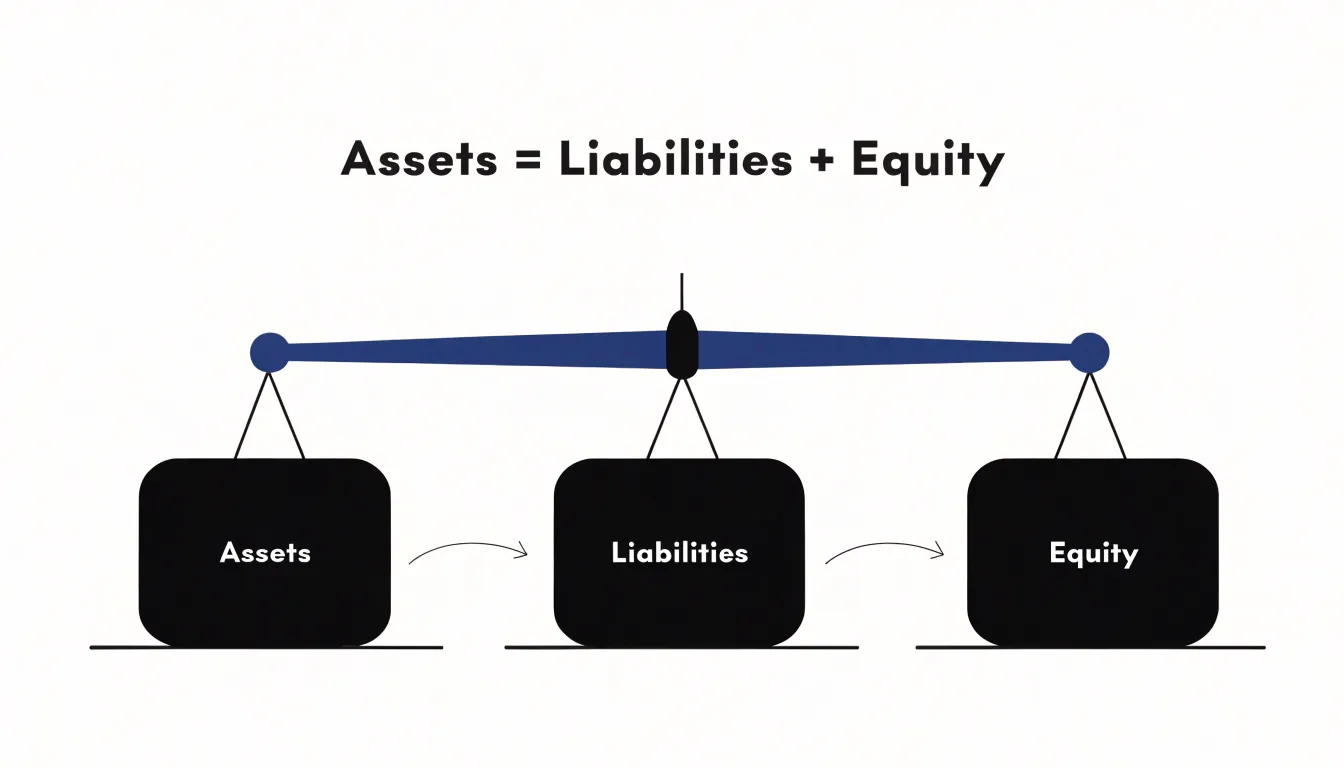
The double-entry rule operationalizes this equation. Every transaction is recorded in at least two accounts, with total debits equal to total credits. When a business purchases equipment for cash, the equipment asset account is debited and the cash asset account is credited for the same amount, so total assets stay unchanged while the composition of assets shifts. When a business takes out a bank loan, cash is debited and the loan liability is credited, increasing both sides of the equation by an identical amount. When the owner invests capital, cash is debited and the equity account is credited. In each case, the equality between debits and credits mirrors the equality between assets, liabilities, and equity.
This design produces a self-checking system. Because every debit has a matching credit, the sum of all debit balances in the ledger must equal the sum of all credit balances. If the two totals disagree, an error has occurred somewhere in the recording process, whether a transposition, a missed entry, or a posting to the wrong side. Accountants detect such problems through a trial balance, which lists every account and its balance and confirms that the debit and credit columns agree. A balanced trial balance does not guarantee that every entry was correct in substance, yet it confirms that the mechanical integrity of the ledger has been preserved. The equation and the double-entry rule work together to keep the books internally consistent and to provide a reliable foundation for financial statements.
Using T-Accounts to Sketch Out Complex Transactions Before Journaling
A T-account is a simple sketch of a single ledger account: a horizontal line across the top for the account name, a vertical line down the middle, debits on the left and credits on the right. Because it strips away dates, descriptions, and reference numbers, the T-account lets you focus purely on the movement of value between accounts. For anyone learning double-entry bookkeeping, this makes it an ideal planning tool. Before committing anything to a journal, you can draft the transaction on scratch paper and see at a glance whether your debits and credits balance.

Start by reading the transaction carefully and listing every account it touches. A sale on credit, for example, involves Accounts Receivable and Sales Revenue; a purchase of equipment paid partly in cash and partly on account involves Equipment, Cash, and Accounts Payable. Draw a T for each account and label it. Next, decide the nature of each account, since that determines which side increases it: assets and expenses increase on the left, while liabilities, equity, and revenue increase on the right. Then walk through the transaction event by event. If cash leaves the business, credit Cash on the right side of its T. If equipment arrives, debit Equipment on the left. Enter the amount beside each side you use, and keep a running check that total debits equal total credits before moving on.
Multi-account entries reward this visual approach most. Compound transactions, such as paying off a supplier bill with a discount, can touch three or four accounts at once, and it is easy to lose track of which side an amount belongs on. Sketching each account side by side shows the full picture: the cash outflow, the reduction of the payable, and the discount received all appear together, and any imbalance stands out immediately. A useful tip is to record each amount with a short note explaining why that account is affected, which forces you to justify every debit and credit. Another is to keep the T-accounts in the same order as they will appear in the journal entry, so the sketch converts directly into the final record. Once the sketch balances, transferring it to the journal and then to the ledger becomes a mechanical step, and errors are caught at the planning stage rather than during posting.
Walking Through Everyday Examples of Real World Journal Entries
Everyday business transactions provide the clearest way to see how debits and credits work in practice. Consider a cash sale. A customer buys a product for $500 and pays immediately. The business records this by debiting the Cash account for $500, reflecting the increase in the asset held in the bank or till drawer. At the same time, the Sales Revenue account is credited for $500, recording the income earned from the transaction. The two entries balance, and the accounting equation stays intact: assets rise, and equity rises through revenue.

Paying a bill follows the same double-entry logic. Suppose the business receives an electricity bill for $200 and pays it from the bank account. The bookkeeper debits the Utilities Expense account for $200, recognizing the cost consumed in running the business, and credits Cash for $200, showing the money leaving the account. The expense reduces equity, and the cash reduction reduces assets by the same amount, so the equation remains in balance.
Buying equipment on credit adds a step involving liabilities. A company purchases a $5,000 machine on 30-day terms. The Equipment asset account is debited for $5,000, capturing the new resource that will support operations for years. The Accounts Payable account is credited for $5,000, recording the obligation owed to the supplier. When the invoice is later paid, the entry reverses: Accounts Payable is debited to clear the debt, and Cash is credited to reflect the payment. This sequence shows how a single purchase generates two distinct journal entries across time.
A fourth example clarifies the treatment of customer prepayments. When a client pays a $1,000 deposit before work begins, the business debits Cash and credits a liability account such as Unearned Revenue. The money has arrived, but the service has not yet been delivered, so it represents an obligation. Once the work is complete, the bookkeeper debits Unearned Revenue and credits Service Revenue, moving the amount from liability to income.
These walkthroughs share a common rhythm: identify the accounts affected, decide which increase and which decrease, then record equal debits and credits. Repeated exposure to ordinary transactions builds the intuition needed to handle unfamiliar ones with confidence.
Common Misconceptions About What Debit and Credit Cards Actually Mean
The words debit and credit carry specific technical meanings in bookkeeping, and those meanings differ sharply from what the same words describe in everyday personal finance. In accounting, a debit is simply an entry on the left side of a ledger account and a credit is an entry on the right side. Whether a debit increases or decreases a given account depends entirely on the type of account involved. A debit raises an asset account such as cash and lowers a liability account such as a loan payable; a credit does the reverse. These are neutral directional labels, not judgments about whether a transaction is good or bad. A debit card and a credit card, by contrast, are named for the way they settle transactions with a bank, and neither name refers to a bookkeeping entry. When a shopper pays with a debit card, funds move almost immediately out of a checking account that the customer already owns. When a shopper pays with a credit card, the bank advances the money and the customer owes it back later, typically on a monthly statement. The card names describe the timing and source of payment, while the accounting terms describe which side of a ledger an entry lands on. The overlap in vocabulary is historical rather than logical, which is why the confusion persists. A debit card withdrawal does reduce the cash asset on a bank’s or a customer’s books, so there is a loose connection, but the everyday phrase debit card does not mean the card creates a debit entry in accounting. Likewise, a credit card purchase does not mean the transaction is recorded as a credit in the accounting sense. A further source of confusion is the word credit itself, which in personal finance often signals borrowing capacity or a positive balance, as in a credit to an account or a good credit score. In accounting, a credit can just as easily reduce an asset or increase a liability. None of this affects how consumers should use the cards, but understanding the distinction helps people read financial statements and bank documents without misreading the labels as evaluations of their spending.
Frequently Asked Questions
Why does accounting use debits and credits instead of plus and minus?
Accounting uses debits and credits because plus and minus would change meaning depending on which account type is affected. A debit simply means an entry on the left side of an account, and a credit means an entry on the right side.
What are the five main account categories in accounting?
The five main account categories are assets, liabilities, equity, revenue, and expenses. These categories form the backbone of the chart of accounts and help organize transactions consistently.
Do debits increase assets and expenses?
Yes. Debits increase assets and expenses, and the article notes the mnemonic DEAD: Debits increase Expenses, Assets, and Dividends. For example, purchasing equipment for cash debits Equipment and credits Cash.
Why do credits increase liabilities, equity, and revenue?
Credits increase liabilities, equity, and revenue because these accounts sit on the opposite side of the accounting equation from assets. Liabilities and equity represent claims against the business, and revenue increases equity through profit.
How does double-entry bookkeeping help keep the ledger accurate?
Double-entry bookkeeping records every transaction in at least two accounts, with total debits equal to total credits. This creates a self-checking system, and a trial balance confirms whether the debit and credit columns agree, though a balanced trial balance does not guarantee every entry was correct in substance.
Is a debit card the same as a debit in accounting?
No. In accounting, a debit is simply an entry on the left side of a ledger account, while a debit card is named for how it settles transactions with a bank, with funds moving almost immediately out of a checking account. A debit card payment does not mean the transaction is recorded as a debit in the accounting sense.