
Deferred Revenue
Deferred revenue is money a company receives from a customer before delivering the promised goods or services. Because the obligation is still outstanding, it is recorded as a liability on the balance sheet, not as income, and is recognized as revenue only as the company fulfills its performance obligation.
Table of Contents
- Understanding the core concept of deferred revenue
- Why cash in the bank does not equal earned income
- The balance sheet breakdown
- How the accrual accounting framework shapes revenue timing
- Real world examples of prepaid customer cash
- Debits and credits
- Transferring liability to income as services are delivered
- What happens to financial statements if deferred revenue is misclassified
- Tracking unearned balances to maintain accurate cash flow forecasting
Understanding the core concept of deferred revenue
Deferred revenue is an accounting term for money a company has already received from a customer for goods or services it has not yet provided. When a customer pays in advance, the business owes that customer a future delivery, and the payment represents an obligation rather than earned income. Because the work is still outstanding, the money cannot be recorded as revenue on the income statement at the moment it arrives. Instead, it sits on the balance sheet as a liability, often labeled deferred revenue, unearned revenue, or customer prepayments, until the company fulfills its side of the agreement.
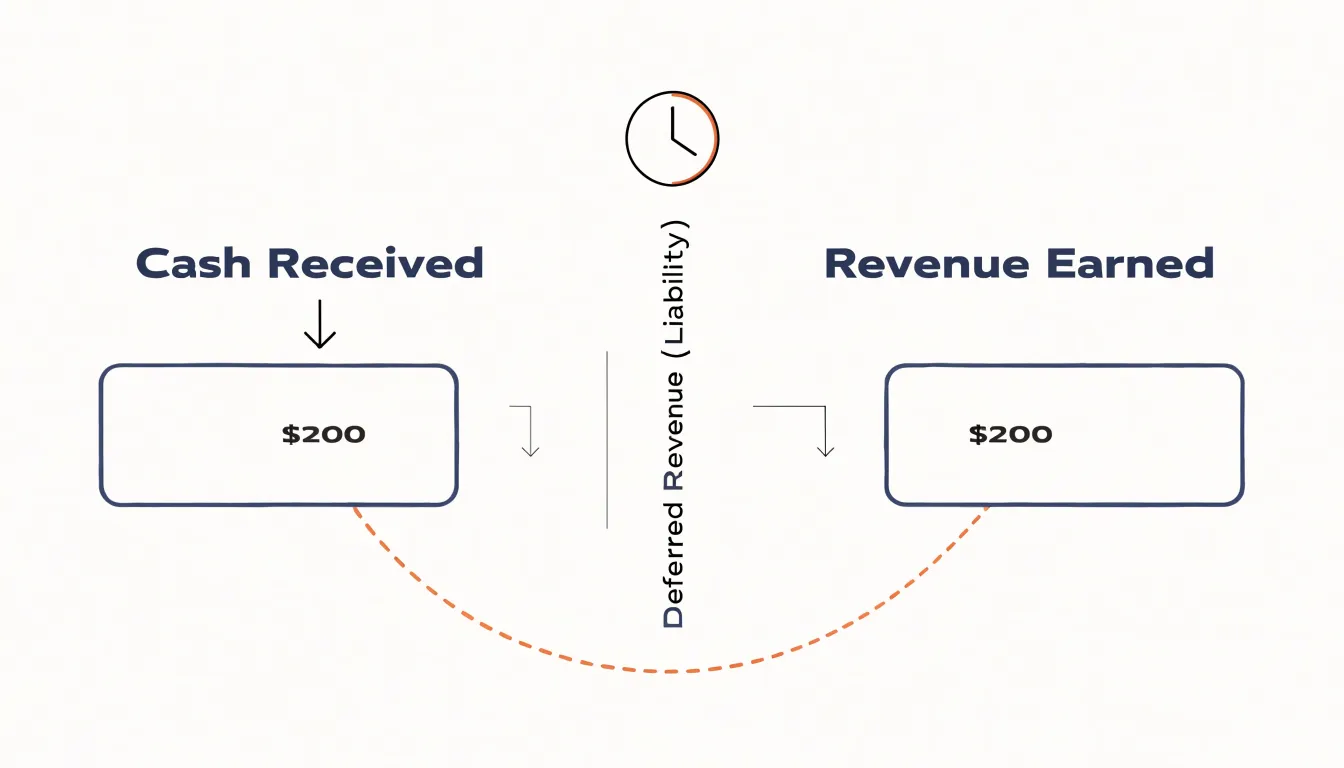
The obligation at the heart of deferred revenue is straightforward. A customer who pays upfront has purchased a promise: a subscription that will run for twelve months, a service contract that begins next quarter, a product that ships in six weeks, or a ticket to an event held later in the year. Until the business delivers those goods or services, it holds funds that belong, in an economic sense, to the customer. If the company failed to deliver, it would typically owe a refund or another remedy. That continuing responsibility is precisely why accounting standards treat the amount as a liability and why the label deferred revenue captures the idea that recognition of the revenue has been postponed.
Deferred revenue arises most naturally from prepayment arrangements. Businesses that bill customers before delivering value, such as software subscriptions, insurance policies, prepaid service plans, retainer agreements, gift cards, and advance ticket sales, routinely collect cash ahead of performance. The cash receipt and the revenue recognition happen at different times, and accrual accounting requires the two to be separated. The cash shows up in the bank account immediately, while the revenue appears on the income statement only as the company delivers, whether that delivery occurs evenly over a subscription period, at a single point when a product ships, or according to milestones in a long-term contract.
Grasping this core concept matters because deferred revenue reveals the timing gap between getting paid and earning the money. It signals future work the company has committed to perform and gives readers of financial statements a window into obligations still outstanding. As delivery occurs, the liability is gradually reduced and an equal amount flows into revenue, completing the cycle that began with the customer’s advance payment.
Why cash in the bank does not equal earned income
When a business receives cash, it is tempting to treat that money as income right away. However, accounting principles draw a clear line between the cash receipt and revenue recognition. Cash in the bank represents funds available, but it does not necessarily mean the business has earned that money. Revenue is considered earned only when the company has fulfilled its obligations to the customer—typically by delivering goods or providing services. Until then, the cash received is a liability, often recorded as deferred revenue.
Consider gift cards. A customer pays $100 for a gift card. The business now has $100 in cash, but it has not yet provided any product or service. The sale is incomplete because the customer could redeem the card at a later date or never at all. Accounting rules require the business to record the $100 as deferred revenue, a liability, until the card is used or expires. Only when the customer redeems the card for goods does the business recognize revenue. At that point, the obligation is satisfied, and the deferred revenue is converted to earned income.
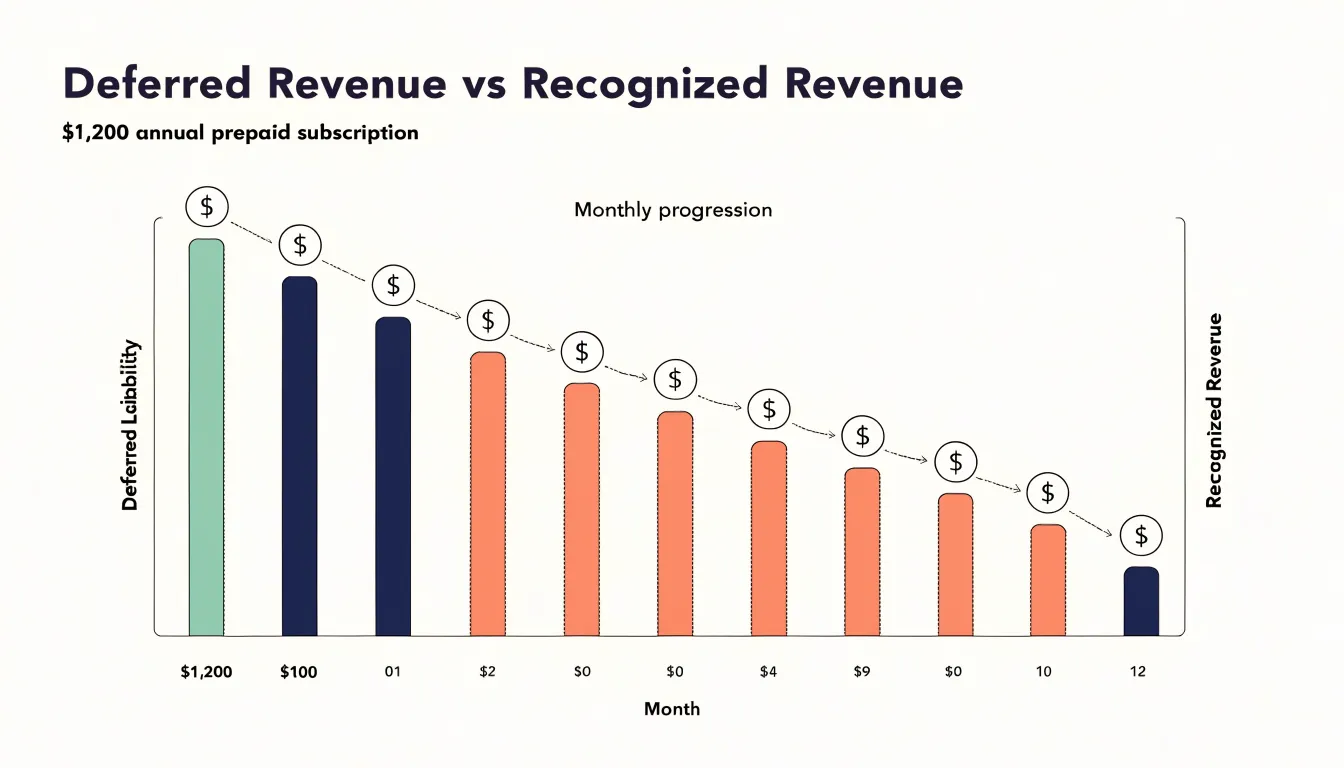
Annual subscriptions offer another clear example. A customer pays $1,200 upfront for a one-year subscription to a software service. The business receives the cash immediately, but it has not earned the entire amount on day one. Instead, it must provide the service over twelve months. Each month, as the service is delivered, the business recognizes $100 of revenue. The remaining balance stays in deferred revenue. This matching of revenue to the period in which the service is provided ensures that financial statements reflect the actual economic activity. If the business recognized the full $1,200 immediately, it would overstate income in the first month and understate it in subsequent months, misleading stakeholders.
These examples illustrate why cash receipt and revenue recognition are distinct concepts. Cash flow measures liquidity, while revenue measures earned income. A business can have strong cash flow but weak revenue recognition if it collects money for future obligations. Conversely, it can recognize revenue without immediate cash receipt if it extends credit to customers. Understanding this distinction is essential for accurate financial reporting and for assessing a company’s true performance. Deferred revenue acts as a bridge, holding cash until the earnings process is complete.
The balance sheet breakdown
Deferred revenue occupies a specific position on the balance sheet: it is recorded as a liability, typically grouped among current liabilities because the obligation attached to it is generally expected to be settled within the ordinary operating cycle, usually the coming twelve months. When a customer pays in advance for goods or services, the company has received cash but has not yet earned the right to keep it. Accounting standards require that the cash inflow be matched with a corresponding liability that captures the company’s outstanding obligation, and that liability is deferred revenue. It appears on the balance sheet under names such as unearned revenue, customer prepayments, or contract liabilities, and it remains there until the performance obligation is fulfilled, at which point it is released to the income statement as recognized revenue.
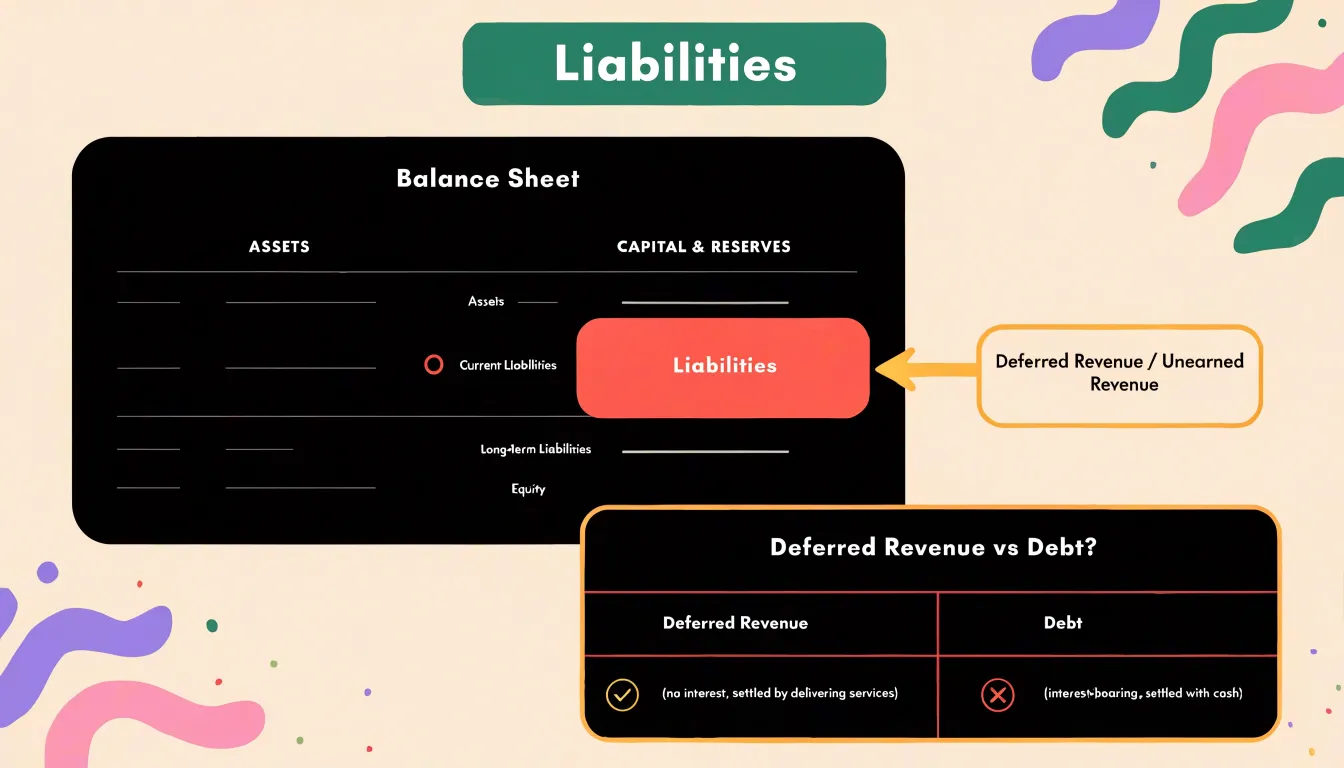
The reason deferred revenue is classified as a liability is that it represents a claim on future performance. The customer holds an enforceable right to receive the promised goods or services, or to a refund if the company fails to deliver. Until delivery occurs, the company owes something of value. This makes deferred revenue a genuine obligation rather than merely a bookkeeping placeholder, and its size offers a signal about how much work the company has committed to complete before it can recognize the associated earnings.
Deferred revenue differs from debt in important respects, even though both sit on the liability side of the balance sheet. Debt involves a borrowing arrangement with a lender, typically carries explicit interest, and is settled with cash. Deferred revenue arises from customer transactions, generally bears no interest, and is discharged primarily by delivering goods or services rather than by paying money back. A software company that bills annually in advance satisfies its deferred revenue balance by providing twelve months of access, not by writing a check. For this reason, analysts often treat deferred revenue as a favorable liability, since it reflects prepaid demand and reduces the company’s reliance on external financing. Understanding this classification helps readers interpret the balance sheet correctly and see how the timing of cash collection and revenue recognition shapes a company’s reported financial position.
How the accrual accounting framework shapes revenue timing
The timing of revenue recognition is governed by the accrual accounting framework, which anchors the reporting of income to the completion of performance rather than the movement of cash. Under the accrual principle, revenue is recorded when a company has substantially fulfilled its obligations to a customer, regardless of when payment actually arrives. This matching concept ties revenue directly to the delivery of goods or services, so that the income statement reflects economic activity in the period it occurs. When a customer pays in advance, the company has cash in hand but has not yet earned it; the amount sits on the balance sheet as deferred revenue, a liability representing an obligation still to be satisfied. Only as the work is performed does that liability unwind and the corresponding amount migrate to the income statement as recognized revenue.
Generally accepted accounting principles and international financial reporting standards provide the detailed rules that operationalize this principle. Both frameworks, through standards such as ASC 606 and IFRS 15, establish a five-step model for recognizing revenue: identifying the contract, separating performance obligations, determining the transaction price, allocating that price across obligations, and recognizing revenue as each obligation is satisfied. These standards give preparers a consistent structure for judging when control of a good or service passes to the customer, which in turn determines whether revenue is booked immediately or deferred across future periods. Compliance with these frameworks is what makes financial statements comparable across companies and jurisdictions, and it is the reason deferred revenue appears as a distinct line item rather than being folded into current income.
Cash-basis accounting approaches timing from an entirely different direction. Under the cash basis, revenue is recorded at the moment payment is received and expenses when they are paid, with no regard for when the underlying work was completed. For a business that collects subscriptions or retainers upfront, cash-basis records would show income immediately, even though the service has yet to be delivered. Accrual accounting instead spreads that income across the periods in which the service is provided, producing a smoother and more faithful picture of operating performance. This difference matters greatly for stakeholders: accrual-based statements reveal the obligations a company carries and the revenue it has genuinely earned, while cash-basis statements can obscure the timing mismatch between money received and value delivered. Understanding this distinction clarifies why deferred revenue exists and how it functions as a bridge between cash collection and earned income.
Real world examples of prepaid customer cash
Software subscriptions offer one of the clearest illustrations of prepaid customer cash creating deferred revenue. When a business customer signs an annual contract for a cloud-based platform and pays the full year upfront, the vendor receives cash immediately but has delivered only the first month of service. Accounting rules require the vendor to record the unearned portion as a liability, then recognize revenue month by month as access is provided. This pattern appears across SaaS products, from project management tools to cybersecurity platforms, and it explains why growing subscription companies can show large cash balances alongside substantial deferred revenue on their balance sheets. The same logic applies to prepaid multi-year support contracts and maintenance agreements attached to hardware sales.
Airlines provide a familiar consumer-facing example. When a passenger books a flight months in advance, the carrier collects payment at the time of purchase but has not yet transported anyone. The ticket price sits as a liability, often called air traffic liability, until the flight operates or the ticket is refunded or forfeited. The scale of this liability at major carriers can run into billions of dollars, and it became a closely watched figure during periods of widespread cancellations. Similar mechanics apply to rail tickets, cruise bookings, and prepaid hotel reservations.
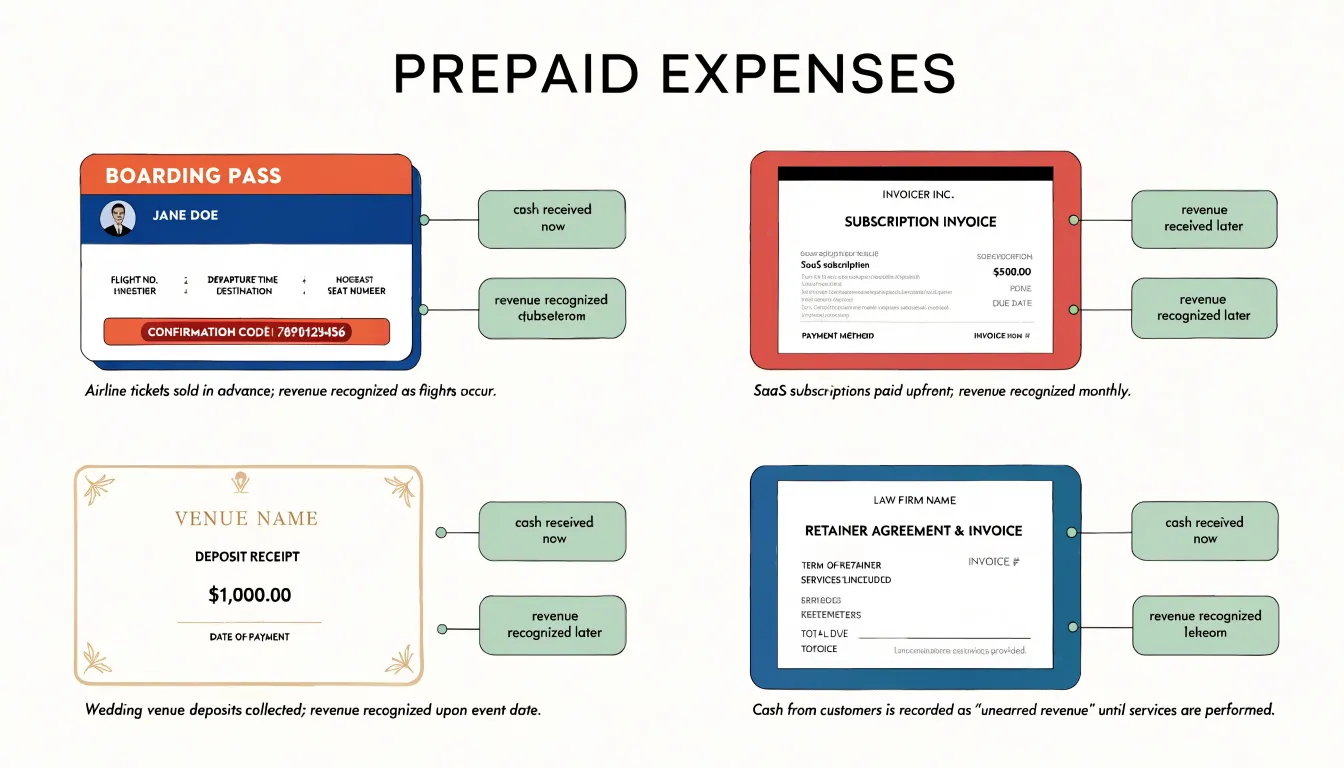
Event deposits follow the same pattern. Wedding venues, conference organizers, and concert promoters routinely collect deposits or full ticket payments long before the event date. A venue that receives a deposit a year ahead of a wedding holds customer cash while the obligation to host the event remains outstanding. Only after the event takes place does the deposit convert into recognized revenue. If the event is cancelled under terms that allow the customer to reschedule, the liability stays on the books.
Retainer fees round out the picture. Law firms, agencies, and consultants frequently bill clients a retainer up front for work to be performed over the coming months. The firm holds the client’s money as an obligation to provide services, drawing it down as hours are logged or milestones are met. Until that work occurs, the retainer remains deferred revenue, a direct record of the promise still owed to the customer.
Debits and credits
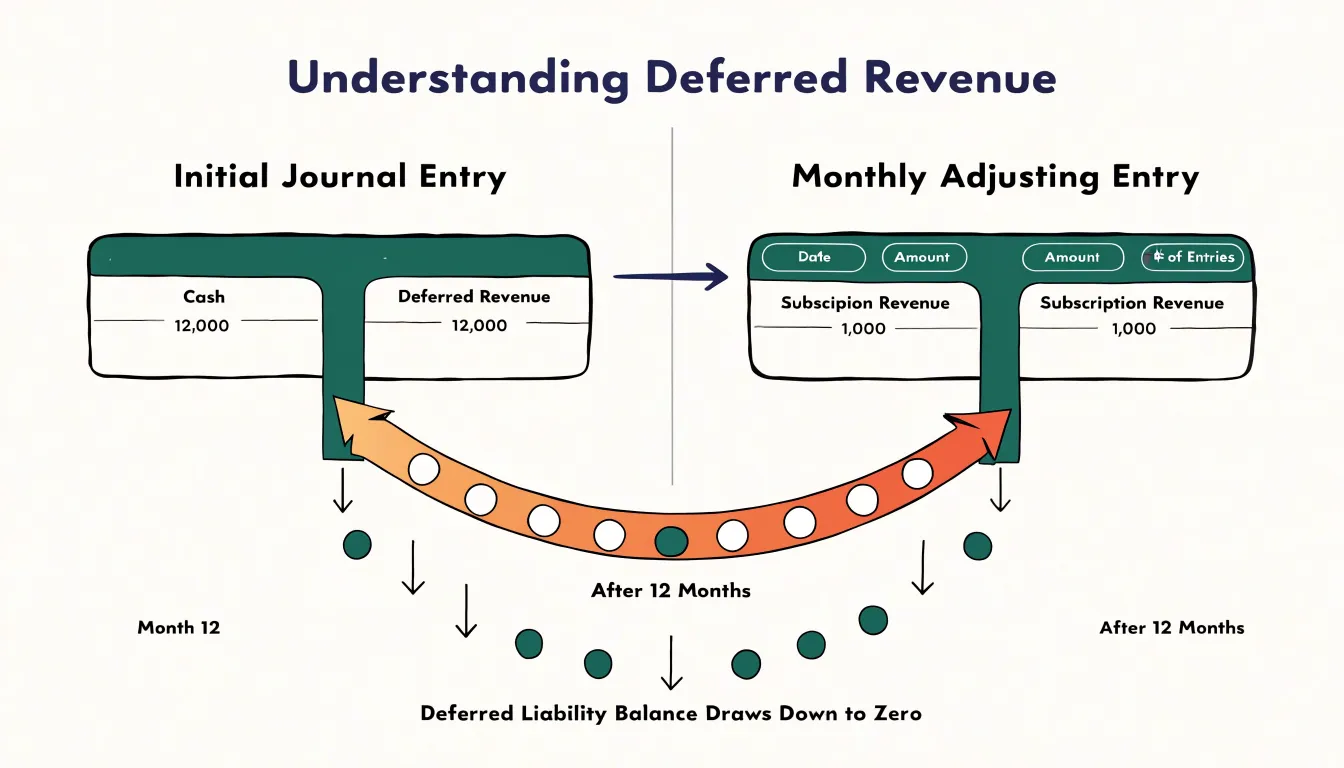
Recording unearned funds begins the moment cash or another form of payment arrives before the related work has been performed. The first journal entry captures this receipt at the transaction level: debit the Cash account and credit the Deferred Revenue liability account for the full amount received. Debiting Cash increases the asset balance, reflecting the funds now available to the business. Crediting Deferred Revenue increases a liability, because the company now owes its customer a product, service, or performance obligation in the future. This entry preserves the timing match between cash collection and revenue recognition, keeping the income statement free of revenue the company has not yet earned.
As the obligation is fulfilled, the entry reverses in stages aligned with progress. When a portion of the service is delivered, the company debits Deferred Revenue for the earned amount and credits a revenue account, such as Service Revenue or Sales Revenue. Debiting the liability reduces the balance the company owes, while crediting revenue records the amount now earned and reportable on the income statement. If the contract spans multiple periods, the company repeats this entry at each recognition point, gradually drawing down the liability until the obligation is fully satisfied and the deferred balance reaches zero.
Consider a simple example: on the first of the month, a customer pays 12,000 in advance for an annual subscription. The initial entry debits Cash for 12,000 and credits Deferred Revenue for 12,000. At the end of each month, the company delivers one-twelfth of the service, so it debits Deferred Revenue for 1,000 and credits Subscription Revenue for 1,000. After twelve months, the deferred liability has fallen to zero and the full 12,000 sits in revenue, matching the periods in which the service was provided.
Several practical points matter when applying these entries. The company should maintain a subsidiary ledger tracking each deferred contract separately, so the aggregate liability account reconciles to individual customer balances. It should also review the recognition schedule at each reporting date, since cancellations, refunds, or changes in the performance obligation may require adjusting entries. Consistent journal entry documentation, tied to contract terms, supports audit readiness and ensures the balance sheet presents the liability accurately at every period end.
Transferring liability to income as services are delivered
The core mechanism of deferred revenue accounting is the gradual transfer of liability to income as services are delivered. When a customer pays in advance, the company records a liability, typically in a deferred revenue account, because it owes a service or product in the future. As the company fulfills its obligation, it reduces the deferred revenue balance and recognizes an equivalent amount as revenue on the income statement. This process ensures that revenue is reported in the period in which the service is performed, aligning with the matching principle of accrual accounting.
Recognition occurs over time, often in proportion to the progress of the service. For example, a software-as-a-service (SaaS) company might receive an annual subscription payment of $1,200 upfront. Initially, the entire amount is recorded as deferred revenue. Each month, as the service is provided, the company recognizes $100 as revenue and reduces the deferred revenue liability by the same amount. After twelve months, the deferred revenue balance is zero, and the full $1,200 has been recognized as revenue. This proportional recognition method reflects the continuous delivery of the service.
Other examples include service contracts, such as maintenance agreements, where revenue is recognized evenly over the contract period, or tuition fees recognized over the academic term. In each case, the deferred revenue balance is adjusted downward as the obligation is satisfied, and revenue is increased correspondingly. The adjusting entry typically debits deferred revenue and credits revenue. This entry is made at regular intervals, such as monthly or quarterly, to keep the financial statements current.
The proportional recognition approach requires a reliable measure of progress. For services delivered evenly over time, straight-line recognition is common. For services with varying levels of activity, a proportional method based on usage or milestones may be more appropriate. The key is to systematically reduce the deferred revenue liability and recognize revenue in a manner that faithfully represents the delivery of the service. This ongoing adjustment ensures that the balance sheet accurately reflects the remaining obligation and that the income statement reports revenue earned during the period.
What happens to financial statements if deferred revenue is misclassified
When a company receives payment for goods or services to be delivered in the future, accounting principles require that the cash be recorded as deferred revenue, a liability on the balance sheet, until the obligation is fulfilled. If that amount is instead recorded as income immediately, the financial statements become misleading in several ways. First, revenue and net income are overstated in the period the payment is received, because the company has not yet earned the revenue. This overstatement inflates profitability metrics and can create a false impression of the company’s operating performance. Second, liabilities are understated, since deferred revenue is removed from the balance sheet. The company appears less leveraged and more financially stable than it truly is, which can mislead creditors and investors about its risk profile.
Misclassification also distorts key ratios used to assess performance. Gross margin, for example, is calculated as gross profit divided by revenue. If deferred revenue is improperly recognized as income, both gross profit and revenue increase, but the effect on the ratio depends on the associated costs. Typically, the costs of fulfilling the obligation have not yet been incurred, so gross profit rises disproportionately, leading to an artificially high gross margin. This can make the company’s core operations appear more efficient and profitable than they are. Similarly, the current ratio and debt-to-equity ratio are affected: current liabilities are reduced, improving liquidity ratios, while equity is increased through higher retained earnings, lowering leverage ratios. These distorted metrics can influence investment decisions, loan covenants, and management compensation.
The consequences extend beyond the reporting period. When the obligation is eventually fulfilled, the company must recognize the revenue, but it has already done so. This can lead to a subsequent decline in reported revenue and profits, creating volatility in earnings and eroding investor confidence. In some cases, the misclassification may be intentional, constituting accounting fraud, which can result in regulatory penalties and legal liability. Even if unintentional, it reflects weak internal controls and can damage the company’s reputation. Overall, treating deferred revenue as income undermines the transparency and reliability of financial statements, leading stakeholders to make decisions based on inaccurate information.
Tracking unearned balances to maintain accurate cash flow forecasting
Tracking unearned balances gives a business a forward-looking view of money it already holds but has not yet earned. Each time a customer pays in advance, the liability account grows, and each time an obligation is fulfilled, that balance is drawn down and recognized as revenue. Monitoring this schedule means maintaining a running record of every contract or invoice that contributes to the deferred balance, along with the period in which each portion will be earned. A well-kept schedule shows the opening balance, additions from new prepayments, reductions from revenue recognition, and any adjustments such as refunds or contract modifications. Reviewing it on a regular cadence, whether monthly or weekly for high-volume businesses, keeps the liability account reconciled against the underlying contracts and flags discrepancies before they distort reporting. The schedule also serves as the source document for the adjusting entries that move amounts out of deferred revenue and into earned revenue, so accuracy here directly affects the reliability of the income statement.
Reconciling deferred revenue with cash flow requires attention to timing. Cash collected upfront appears in operating cash flow in the period of receipt, while the corresponding revenue appears later. Comparing the movement in the deferred revenue balance against bank deposits from customers helps confirm that every prepayment has been recorded and that no cash sits unaccounted for. A rising deferred balance typically signals healthy advance collections and points to revenue that will be recognized in future periods, which supports forecasting of both earnings and the cash needed to deliver on those obligations. Declining balances can indicate that the company is working through its backlog faster than it is signing new prepaid contracts, a pattern worth investigating early.
The balance itself becomes a forecasting tool. By mapping the schedule across future periods, a finance team can project recognized revenue with reasonable confidence and estimate the costs required to fulfill those commitments. That projection informs liquidity planning, showing whether incoming cash will cover payroll, vendor payments, and other obligations as earned revenue is delivered. Regular review of the deferred revenue schedule, tied back to cash receipts and forward cost estimates, turns a passive liability into an active planning instrument.
Frequently Asked Questions
What is deferred revenue in accounting?
Deferred revenue is money a company has already received from a customer for goods or services it has not yet provided. It is recorded as a liability until the company fulfills its obligation.
Does cash in the bank mean the business has earned income?
No. Cash in the bank does not necessarily mean the business has earned that money; revenue is considered earned only when the company has fulfilled its obligations to the customer. Until then, the cash received is a liability, often recorded as deferred revenue.
Where does deferred revenue appear on the balance sheet?
Deferred revenue is recorded as a liability, typically grouped among current liabilities because the obligation is generally expected to be settled within the ordinary operating cycle, usually the coming twelve months. It may appear under names such as unearned revenue, customer prepayments, or contract liabilities.
How does accrual accounting affect when revenue is recognized?
Under accrual accounting, revenue is recorded when a company has substantially fulfilled its obligations to a customer, regardless of when payment arrives. For example, with a $1,200 annual subscription paid upfront, the article explains that $100 is recognized monthly as the service is delivered.
What journal entry records deferred revenue?
When payment arrives before the related work is performed, the company debits Cash and credits Deferred Revenue for the full amount received. As the service is delivered, it debits Deferred Revenue and credits a revenue account for the earned amount.
What happens if deferred revenue is misclassified as income?
If deferred revenue is recorded as income immediately, revenue and net income are overstated in the period the payment is received, and liabilities are understated. This distorts key metrics and ratios, can mislead stakeholders, and may lead to a subsequent decline in reported revenue and profits when the obligation is eventually fulfilled.