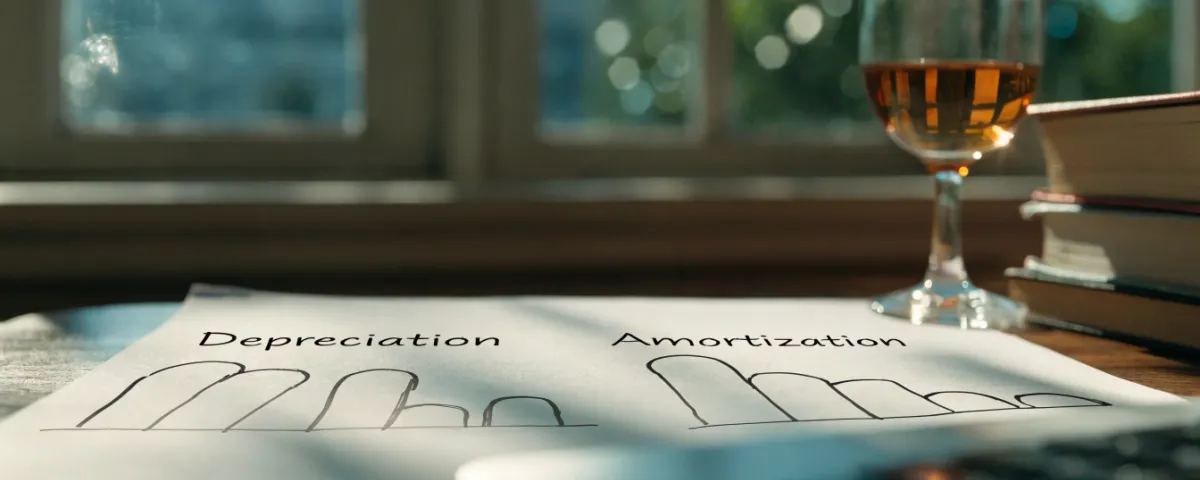
Depreciation vs Amortization
Depreciation allocates the cost of tangible assets—buildings, machinery, vehicles, equipment—over their useful lives, while amortization allocates the cost of intangible assets such as patents, copyrights, trademarks, software, and goodwill. Depreciation may subtract salvage value and offers methods like straight-line or accelerated; amortization typically uses straight-line over legal or useful life, often with zero residual value.
Table of Contents
- What Main Feature Separates Depreciation From Amortization?
- How Depreciation Tracks the Declining Value of Physical Property
- Physical Assets in Action
- How Amortization Measures the Expiration of Non-Physical Assets
- Non-Physical Assets
- Why Salvage Value Matters for Physical Goods but Not Intangibles
- Comparing Straight Line Calculation Methods Across Both Types
- How These Non-Cash Expenses Lower Your Business Taxes
What Main Feature Separates Depreciation From Amortization?
The primary feature that separates depreciation from amortization is the nature of the asset being expensed. Depreciation applies to tangible physical assets—items that have physical substance and can be touched, such as buildings, machinery, vehicles, and office equipment. Amortization, by contrast, applies to intangible assets, which lack physical form but still hold value for the business, such as patents, copyrights, trademarks, software, and goodwill. This fundamental difference in asset type drives distinct accounting treatments and considerations.
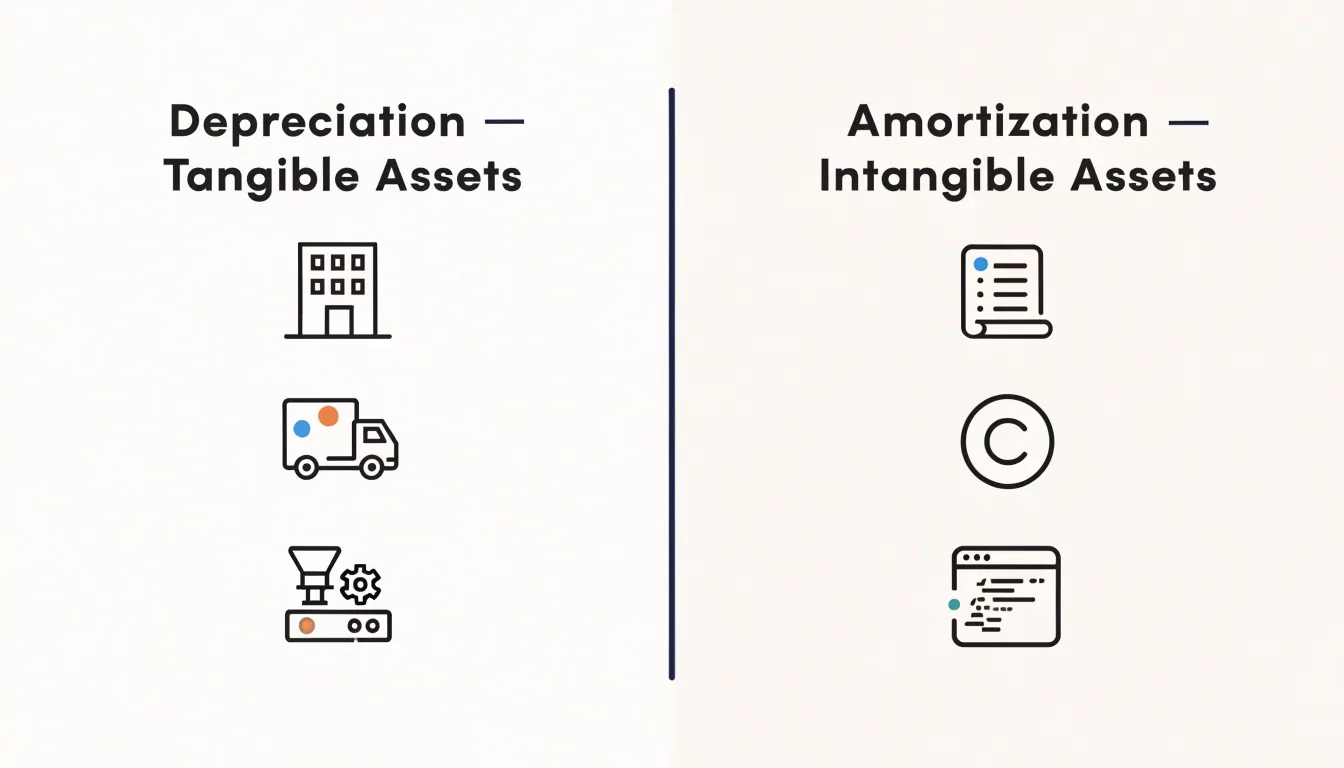
For tangible assets, depreciation accounts for the wear and tear, obsolescence, or deterioration that occurs over time. Because these assets are physical, their useful lives are often limited by factors like mechanical failure, technological advancements, or legal regulations. Accountants calculate depreciation using methods such as straight-line, declining balance, or units of production, which allocate the asset’s cost over its estimated useful life. The chosen method reflects the pattern in which the asset’s economic benefits are consumed. Additionally, tangible assets may have residual value—an estimated salvage value at the end of their useful life—which reduces the depreciable base. Depreciation also ties into maintenance and replacement decisions, as physical assets require ongoing upkeep.
Intangible assets, on the other hand, are amortized to reflect the consumption of their economic benefits, which often arise from legal rights or competitive advantages. Their useful lives can be influenced by legal or contractual terms; for example, a patent lasts 20 years, while a trademark may be renewed indefinitely. Amortization is typically calculated using the straight-line method unless another pattern better reflects the consumption of benefits, and intangible assets usually have no residual value. The accounting for intangibles also involves considerations of impairment, as their value can fluctuate with market conditions or technological changes. Furthermore, internally developed intangibles may have specific capitalization rules, while purchased intangibles are recorded at cost.
These differences in asset characteristics lead to divergent accounting treatments: depreciation often involves more complex calculations due to varying methods and residual values, while amortization tends to be simpler, with straight-line allocation being the norm. Understanding this core distinction is essential for proper financial reporting and asset management.
How Depreciation Tracks the Declining Value of Physical Property
Depreciation is the accounting process of allocating the cost of a tangible asset across the span of years it is expected to serve the business. When a company purchases equipment, vehicles, machinery, or buildings, the full expense is not recorded in a single period. Instead, the cost is spread systematically over the asset’s useful life, matching the expense to the revenue the asset helps generate. This allocation converts a large upfront outlay into a series of smaller periodic charges on the income statement, giving a more accurate picture of profitability in each accounting period.
Physical assets lose value through ordinary use. Machinery wears down as it runs through production cycles, vehicles accumulate mileage, and buildings experience structural fatigue. Each hour of operation consumes a portion of the asset’s capacity to generate economic benefit. Accountants capture this consumption by recording periodic depreciation expense, which simultaneously reduces the asset’s carrying value on the balance sheet through accumulated depreciation. Over time, the gap between original cost and net book value widens, reflecting the gradual exhaustion of the asset’s service potential.
Obsolescence exerts a parallel force. An asset can remain physically sound while losing economic relevance because newer technology, shifting market demand, or improved production methods render it less efficient or less valuable. A machine that still runs smoothly may become uneconomic when a faster model enters the market. Depreciation methods such as straight-line, declining balance, and units of production provide different patterns for recognizing this decline, and management selects the method that best reflects how the asset’s benefits are consumed. Straight-line spreads cost evenly, while accelerated methods front-load expense to reflect rapid early loss of value.
Useful life estimates and residual values anchor the entire calculation. Accountants assess how many years the asset will contribute to operations and what salvage value it may retain at disposal. These estimates require judgment and are periodically reviewed. When circumstances change, the depreciation schedule adjusts prospectively. The result is a running record of declining book value that informs financial statements, tax calculations, and capital planning decisions, giving stakeholders a transparent view of how physical resources diminish in worth as they fulfill their productive role.
Physical Assets in Action
Depreciable tangible assets show up across nearly every industry, and walking through concrete examples makes the concept easier to apply. Vehicles are one of the most familiar categories. A delivery company’s fleet of vans, a sales team’s company cars, and a landscaping firm’s trucks all lose value as they accumulate mileage and wear. Because a vehicle has a determinable useful life, typically measured in years or miles driven, its cost is spread across the periods in which it helps generate revenue. Machinery follows the same logic. Manufacturing equipment such as lathes, presses, conveyor systems, and packaging lines represents a substantial capital outlay that delivers benefit over many production cycles. As the machine runs, it wears down, and its resale value declines, which is precisely why its cost is allocated over its service life rather than charged entirely to the year of purchase.
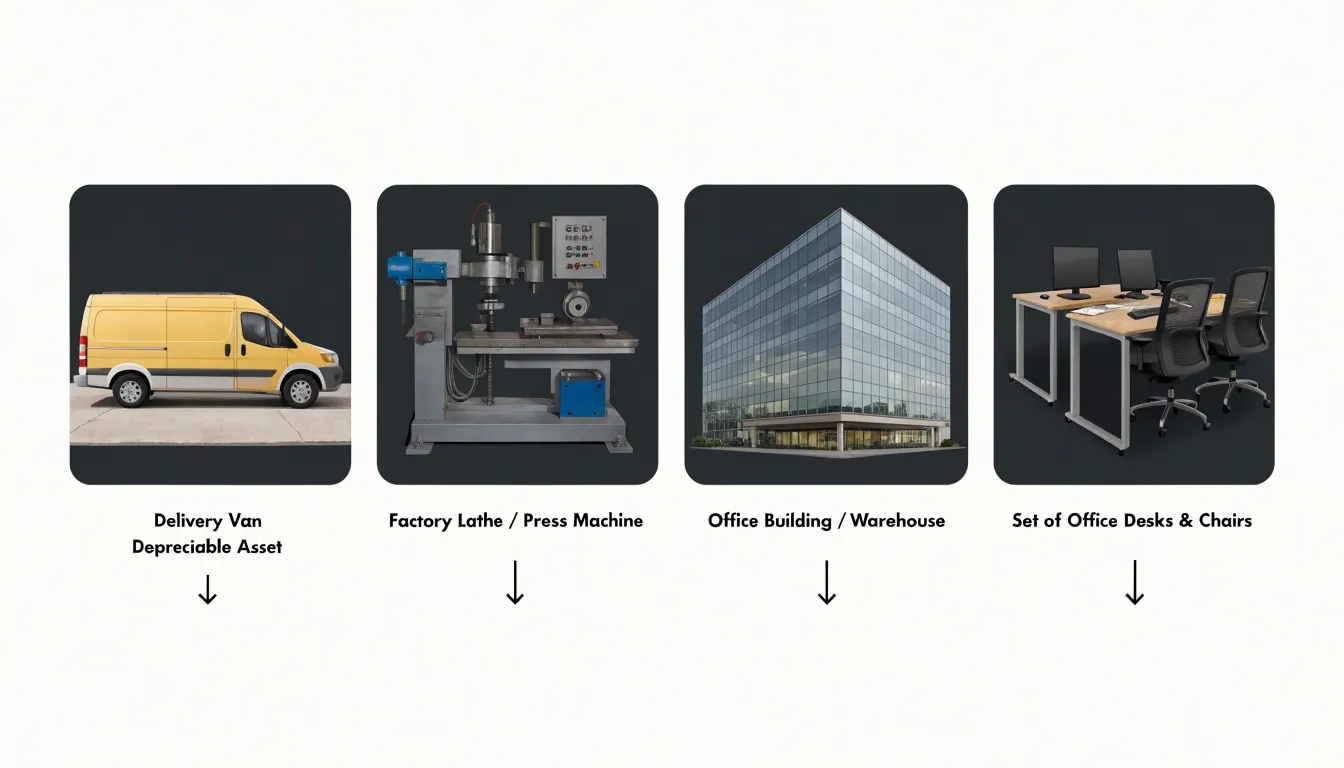
Buildings form another major category. Office buildings, warehouses, retail storefronts, and factory facilities are long-lived tangible assets whose value erodes through use, weathering, and obsolescence. A company that purchases a warehouse expects to benefit from it for decades, so the structure’s cost is systematically allocated across those years. Office furniture rounds out the picture at a smaller scale. Desks, chairs, filing cabinets, conference tables, and shelving units are used daily and gradually deteriorate, and they are commonly replaced when styles or needs change. Their relatively modest cost and shorter lifespan make them a straightforward illustration of depreciation principles in practice.
Equipment covers a broad range of items, from computers and servers to restaurant kitchen appliances, medical imaging devices, and heavy construction tools. Each of these items shares the defining traits of a depreciable tangible asset: it has physical substance, it is used in business operations, it has a useful life longer than one year, and its value diminishes over time. None of these assets is held for sale in the ordinary course of business; instead, each is employed to produce goods or services. Recognizing these common examples helps businesses identify which purchases belong on the depreciation schedule and ensures that costs are matched to the revenue they help generate.
How Amortization Measures the Expiration of Non-Physical Assets
Amortization provides the mechanism for allocating the cost of an intangible asset across the periods in which that asset is expected to deliver economic benefit. Intangible assets such as patents, copyrights, trademarks, franchise agreements, licenses, and purchased goodwill lack physical substance, yet they carry acquisition costs that must be matched against the revenue they help generate. Amortization accomplishes this matching by spreading the capitalized cost of the intangible asset over its legal life or its useful life, whichever is shorter, and recording a portion of that cost as an expense on the income statement in each reporting period. The cumulative effect reduces the carrying value of the asset on the balance sheet until it reaches its residual value, typically zero for most intangibles.
Contract terms frequently determine the amortization period. A patent, for example, may carry a legal term of twenty years from filing, but if the entity expects the underlying technology to generate revenue for only eight years before obsolescence, the useful life of eight years governs the amortization schedule. Similarly, a leasehold improvement or a license agreement tied to a specific contractual term is amortized over that stated term, since the legal right to the benefit expires when the contract ends. Where a contract includes renewal options that the entity is reasonably certain to exercise, the amortization period may extend to cover the renewal term as well. Analysts and accountants therefore review the underlying agreements carefully to identify the enforceable duration of the right being amortized.
Estimated benefit periods introduce judgment into the process. Management must assess how long an intangible asset will contribute to cash flows, considering factors such as technological change, customer demand, competitive pressure, and the stability of the market in which the asset operates. A customer list acquired in a business combination might be amortized over five to ten years depending on anticipated attrition, while a brand name with an indefinite expected life may escape amortization altogether and instead be tested annually for impairment. When circumstances change and the estimated useful life shortens, the remaining carrying amount is amortized over the revised period, which can materially affect periodic earnings. This requirement to reassess benefit periods reflects the broader principle that amortization should track the actual consumption of economic utility, giving stakeholders a clearer picture of how intangible investments translate into reported performance over time.
Non-Physical Assets
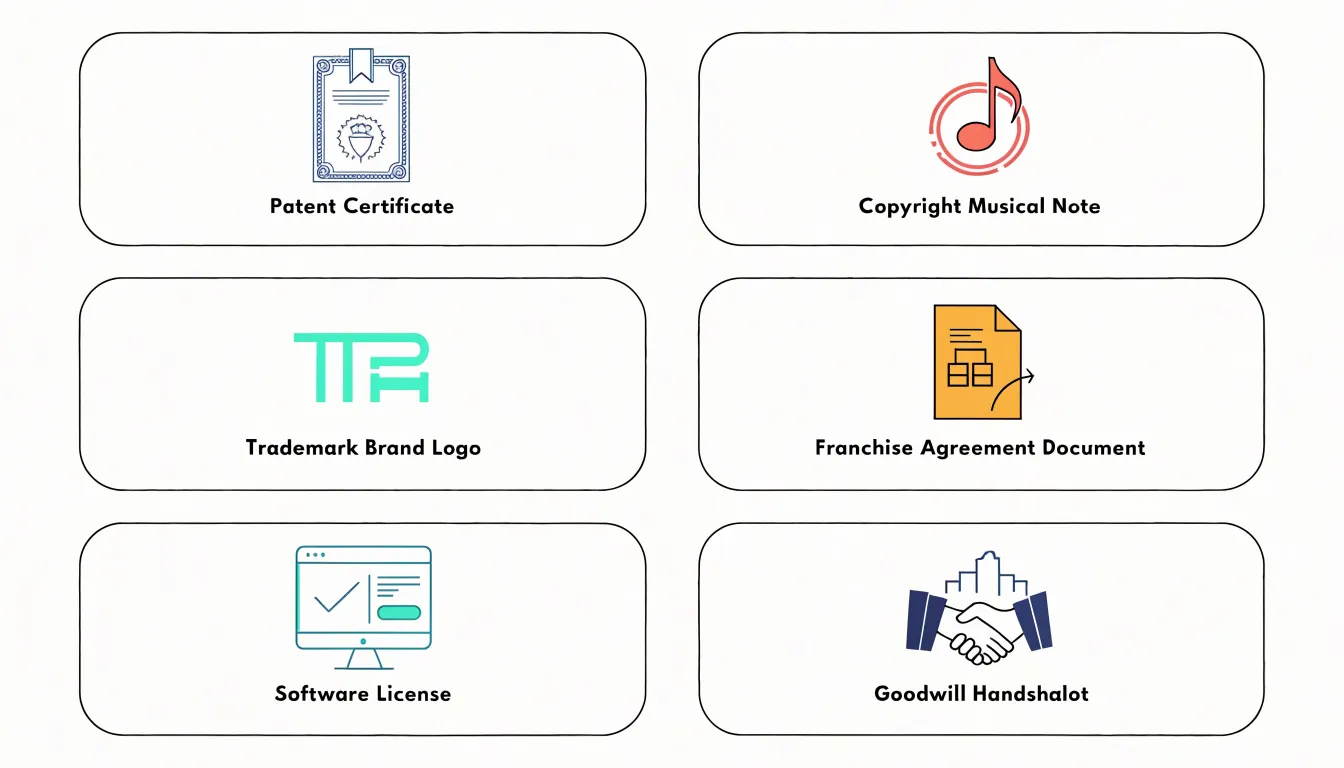
Amortization applies to intangible assets, which are non-physical resources that carry value for a business over multiple accounting periods. Several categories appear most often in practice.
Patents grant an inventor exclusive rights to a design or process for a set number of years. A company that acquires or develops a patent typically amortizes its cost over its legal or useful life, whichever is shorter, often using the straight-line method. Copyrights, which protect creative works such as books, music, or software code, follow a similar pattern: the capitalized cost is spread across the period the work is expected to generate revenue.
Trademarks and brand names can be amortized when they are purchased rather than internally developed. A company that buys a trademark records it at cost and amortizes it over its estimated useful life, though trademarks with indefinite legal lives may instead be tested annually for impairment rather than amortized. Software is one of the most common amortized intangibles. Purchased or internally developed software is typically amortized over its expected service life, commonly three to five years, using straight-line amortization.
Licenses, such as operating licenses, spectrum rights, or franchise agreements, are amortized over the term of the agreement. Because these assets have defined expiration dates, the amortization schedule usually matches the license period precisely. Goodwill arises when a company acquires another business for more than the fair value of its net identifiable assets. Goodwill is not amortized under current US GAAP but is tested for impairment; under IFRS, it is likewise subject to impairment testing rather than systematic amortization, though private companies may elect to amortize it over a period not exceeding ten years. This makes goodwill an important exception worth noting alongside the standard examples.
For each of these assets, the amortization entry debits an expense account and credits the intangible asset or a related accumulated amortization account, gradually reducing the carrying value on the balance sheet while reflecting the consumption of the asset’s economic benefit on the income statement.
Why Salvage Value Matters for Physical Goods but Not Intangibles
When a business capitalizes the cost of a physical asset such as a vehicle, machine, or building, the accounting question is how much of that cost should be spread across its useful life. Salvage value, also called residual value, provides the answer to where the spreading stops. It represents the estimated amount the company could recover by selling, scrapping, or trading in the asset at the end of its service life. Because that portion of the cost is expected to come back through a disposal transaction, it is excluded from the depreciable base. A delivery van purchased for $40,000 with an estimated $5,000 trade-in value after six years produces $35,000 of depreciation expense over that period rather than $40,000. The estimate matters because it directly changes annual expense, reported profit, and the carrying amount shown on the balance sheet. It also reflects economic reality, since secondhand markets, scrap metal prices, and parts resale give most tangible goods a floor value that does not disappear simply because the asset is old.
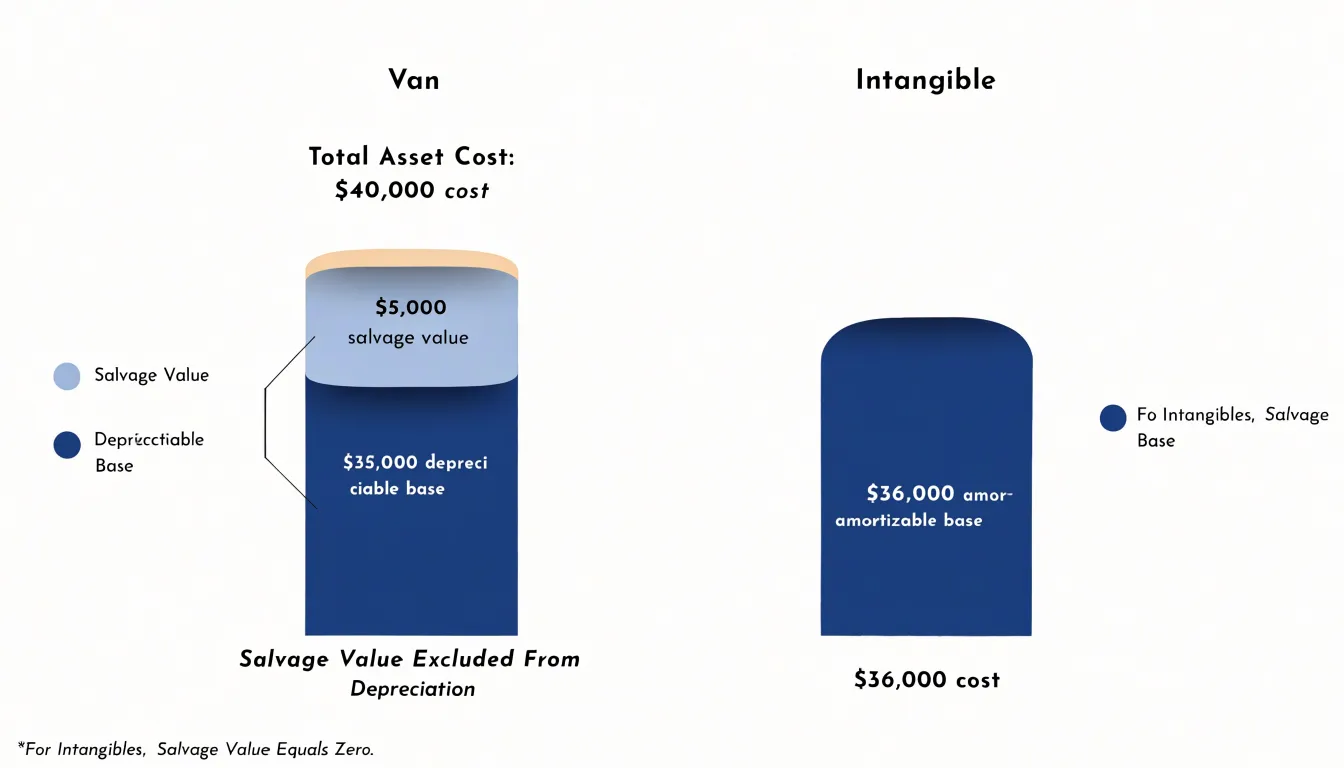
Intangible assets follow a different logic. A patent, trademark, customer list, or capitalized software license typically has no established resale market and no scrap material to recover. When its legal or economic life ends, the remaining book value generally cannot be converted into cash through a sale or disposal transaction. For this reason, amortization usually writes the intangible asset down to zero over its useful life, treating the full capitalized cost as the amount to be expensed. Companies normally assume a residual value of zero for intangibles unless a third party has already committed to purchase the asset at the end of its term or an active market clearly demonstrates a disposal price. That exception is rare in practice.
The distinction rests on the nature of the asset rather than on accounting preference. Physical goods wear out but retain material substance that others may value, while intangibles expire or become obsolete and leave nothing behind to sell. Recognizing this difference keeps the depreciation and amortization schedules aligned with what each type of asset can realistically return to the business.
Comparing Straight Line Calculation Methods Across Both Types
The straight-line method provides a common framework for spreading the cost of an asset across the periods that benefit from its use, and it applies to both tangible and intangible assets with only minor differences in the formula. A side-by-side walkthrough makes the shared structure clear and shows where the two calculations diverge. For depreciation, the formula is: annual expense equals the asset’s cost minus its salvage value, divided by its useful life. Salvage value, sometimes called residual value, represents the estimated amount the company expects to recover when the asset is retired or sold at the end of its service. Subtracting it from cost gives the depreciable base, which is the total amount allocated over time. For amortization, the formula is: annual expense equals the asset’s cost divided by its useful life. Intangible assets such as patents, copyrights, and capitalized software generally have no salvage value because they cannot be sold or scrapped for meaningful residual proceeds, so the full cost becomes the amortizable base. To illustrate, consider a delivery van purchased for $40,000 with an estimated salvage value of $4,000 and a useful life of six years. The depreciable base is $36,000, producing an annual depreciation expense of $6,000. Now consider a patent acquired for $36,000 with a legal life of six years and no residual value. The amortizable base is $36,000, producing an annual amortization expense of $6,000. Both assets generate an identical $6,000 annual charge even though one formula subtracted salvage value and the other did not. The mechanics line up period by period: each year records the same expense, the carrying amount declines by that amount, and the asset reaches its ending value at the close of the final period. The only structural difference is the salvage subtraction, which appears in the depreciation formula because tangible assets retain some residual worth and disappears from the amortization formula because intangibles typically do not. Readers can therefore treat the two methods as variations on one calculation: identify the base, divide by useful life, and recognize the result consistently each period.
How These Non-Cash Expenses Lower Your Business Taxes
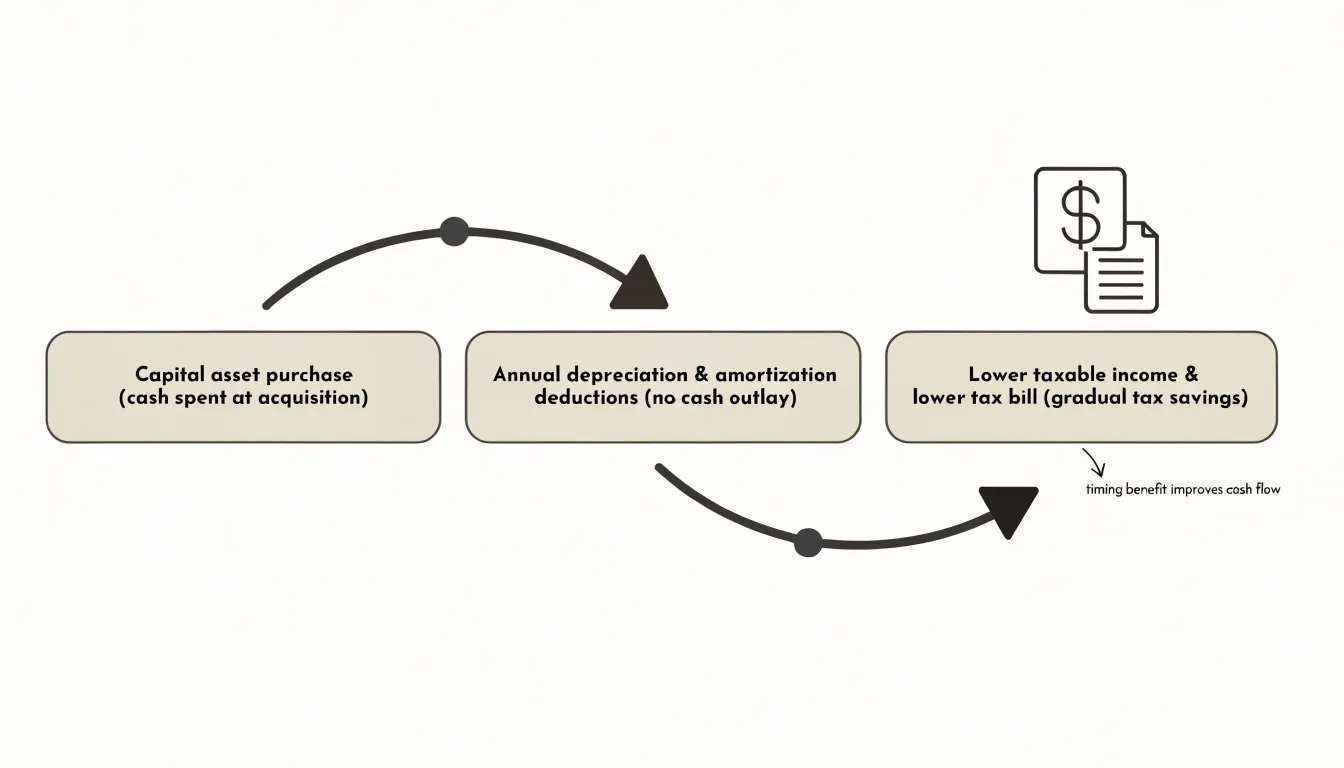
Depreciation and amortization are non-cash expenses that reduce your business’s taxable income, thereby lowering your tax bill. When you purchase a capital asset, such as equipment or a vehicle, you generally cannot deduct the full cost in the year of purchase. Instead, you spread the cost over the asset’s useful life through depreciation. Similarly, amortization spreads the cost of intangible assets like patents or goodwill over time. These annual deductions represent the portion of the asset’s cost allocated to that year, and they directly reduce your reported profit on the income statement. Because taxable income is calculated after deducting these expenses, a lower taxable income means a lower tax liability. The key advantage is that these deductions do not require any cash outlay in the year they are claimed. The cash was spent when the asset was acquired, but the tax benefit is realized gradually over multiple years. This creates a timing benefit: you get to deduct expenses without spending additional cash, which can improve your cash flow. For small businesses, this can be particularly valuable. By carefully planning asset purchases and understanding the depreciation and amortization rules, you can maximize your deductions and manage your tax burden more effectively. For instance, timing the purchase of equipment near year-end might allow you to claim a partial-year deduction, or you might take advantage of accelerated depreciation methods to front-load deductions. Additionally, certain assets may qualify for bonus depreciation or Section 179 expensing, which can further accelerate tax savings. These strategies require careful planning and a solid understanding of the tax code, but they can yield significant benefits. Ultimately, depreciation and amortization are powerful tools for reducing taxable income without affecting cash flow, making them essential considerations in any small business tax strategy.
Frequently Asked Questions
What is the main difference between depreciation and amortization?
Depreciation applies to tangible physical assets that can be touched, such as buildings, machinery, vehicles, and office equipment. Amortization applies to intangible assets that lack physical form but still hold value, such as patents, copyrights, trademarks, software, and goodwill.
What kinds of assets are depreciated?
Depreciation is used for tangible physical assets used in business operations, including vehicles, machinery, buildings, office furniture, computers, servers, restaurant appliances, medical imaging devices, and construction tools. These assets have physical substance, a useful life longer than one year, and value that diminishes over time.
What are examples of intangible assets that are amortized?
Common intangible assets include patents, copyrights, trademarks, franchise agreements, licenses, purchased goodwill, customer lists, and software. Goodwill is an exception: it is not amortized under current US GAAP and is tested for impairment, though private companies may elect to amortize it over a period not exceeding ten years.
How do you calculate straight-line depreciation and amortization?
For straight-line depreciation, annual expense equals the asset’s cost minus its salvage value, divided by its useful life. For straight-line amortization, annual expense equals the asset’s cost divided by its useful life, because intangibles generally have no salvage value.
Why do tangible assets usually have salvage value while intangible assets don’t?
Tangible assets such as vehicles, machines, and buildings can often be sold, scrapped, or traded in at the end of their service life, giving them an estimated residual value. Intangible assets typically have no established resale market or scrap material, so amortization usually writes them down to zero; residual value is assumed only if a third party has committed to purchase the asset or an active market clearly shows a disposal price.
How do depreciation and amortization lower business taxes?
Depreciation and amortization are non-cash expenses that reduce taxable income, which lowers the business’s tax bill. The deductions do not require cash outlay in the year claimed, and planning asset purchases or using accelerated methods, bonus depreciation, or Section 179 expensing can affect the timing of tax savings.