
Depreciation
Depreciation is an accounting method that spreads the cost of a fixed asset over its useful life, recording a non-cash expense that reduces reported profit and book value without any cash outflow. Common methods include straight-line, units of production, double declining balance, and sum of the years’ digits, each shifting deduction timing.
Table of Contents
- Understanding asset depreciation in practical small business accounting
- Why tracking declining asset value matters for your business taxes
- Straight line depreciation for steady year over year write offs
- Units of production method
- Double declining balance for maximizing early tax deductions
- Sum of the years digits method
- How do you choose the right depreciation strategy for your business
- Real world impact of depreciation on cash flow and tax reporting
Understanding asset depreciation in practical small business accounting
In the daily bookkeeping of a small business, depreciation appears as a routine journal entry that quietly touches two financial statements at once. Each accounting period, the bookkeeper records an amount of depreciation expense on the income statement while simultaneously reducing the asset’s accumulated depreciation on the balance sheet, which lowers its book value. For a piece of equipment purchased for $12,000 and depreciated over five years, that might mean a $200 monthly entry: a debit to depreciation expense and a credit to accumulated depreciation. The mechanics are straightforward, and once the schedule is set up, the entry repeats with little friction.
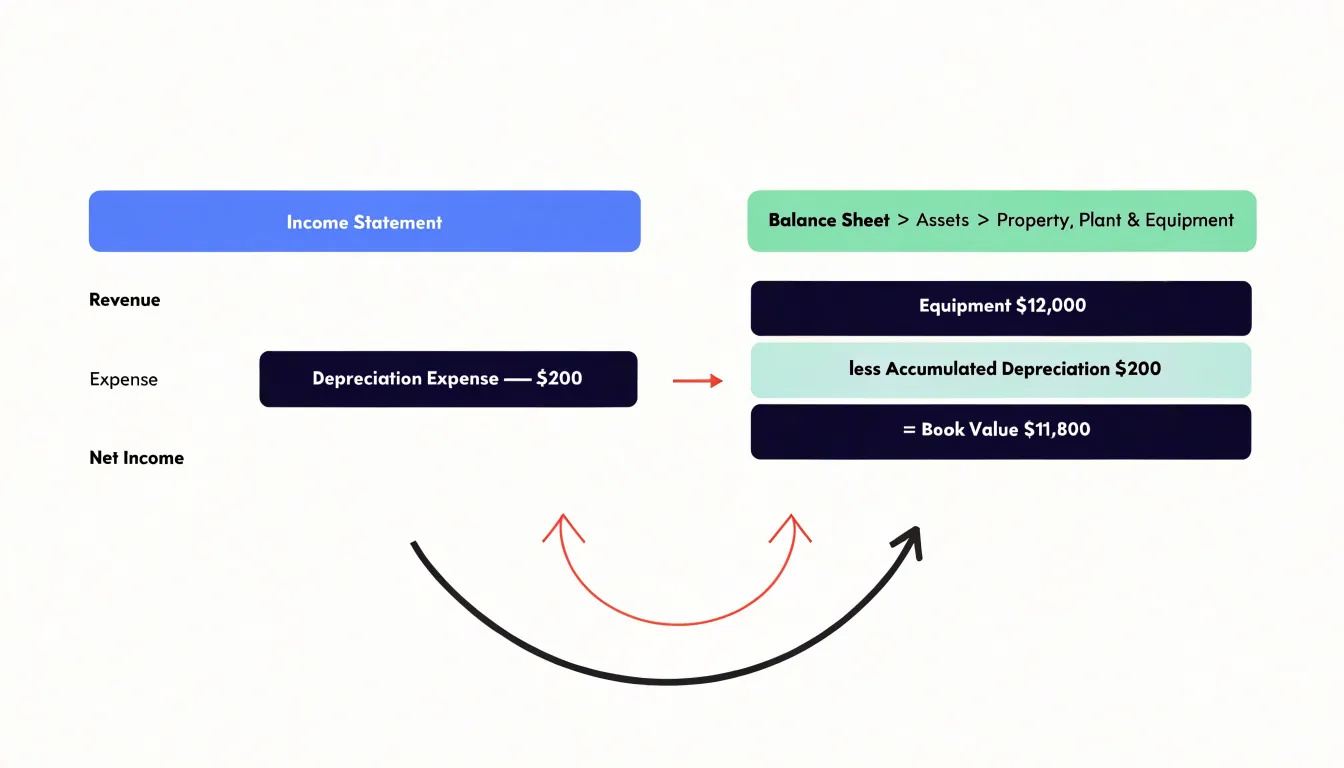
The distinctive feature of this entry is that it records an expense without any corresponding cash outflow. No cheque is written and no bank balance changes when depreciation is booked. This is why depreciation is described as a non-cash expense, and why it is added back to net income when preparing a cash flow statement. The cash movement happened earlier, at the moment of purchase, when the asset was capitalized rather than expensed. Depreciation simply spreads the recognition of that cost across the periods in which the asset helps generate revenue, matching expense to benefit in line with accrual accounting principles.
Even though no money leaves the account during the entry, depreciation carries real weight for a small business owner. It reduces reported profit, which directly affects the tax bill, since depreciation is generally deductible. It lowers the book value of assets on the balance sheet, giving a more honest picture of what the business owns after wear and tear. It also informs decisions about replacement timing and pricing, because the cost of using equipment is captured in the numbers rather than ignored until the asset fails. Lenders and investors reading the statements see both the expense and the declining asset base, which shapes their view of the company’s financial health. Treating depreciation as a genuine cost, recorded consistently and on schedule, keeps the books accurate and the owner’s understanding of profitability grounded in reality.
Why tracking declining asset value matters for your business taxes
Tracking the declining value of assets matters directly to your tax bill because depreciation is one of the largest non-cash deductions most businesses can claim. When you buy equipment, vehicles, machinery, or furniture for business use, you generally cannot deduct the full cost in the year of purchase. Instead, the tax code lets you recover that cost gradually over the asset’s useful life, and each year’s depreciation expense reduces your taxable income. A lower taxable income means a lower tax liability, so every properly recorded deduction keeps real cash in the business rather than sending it to the tax authority. Missing or understating depreciation quietly raises your effective tax rate and leaves money on the table year after year.
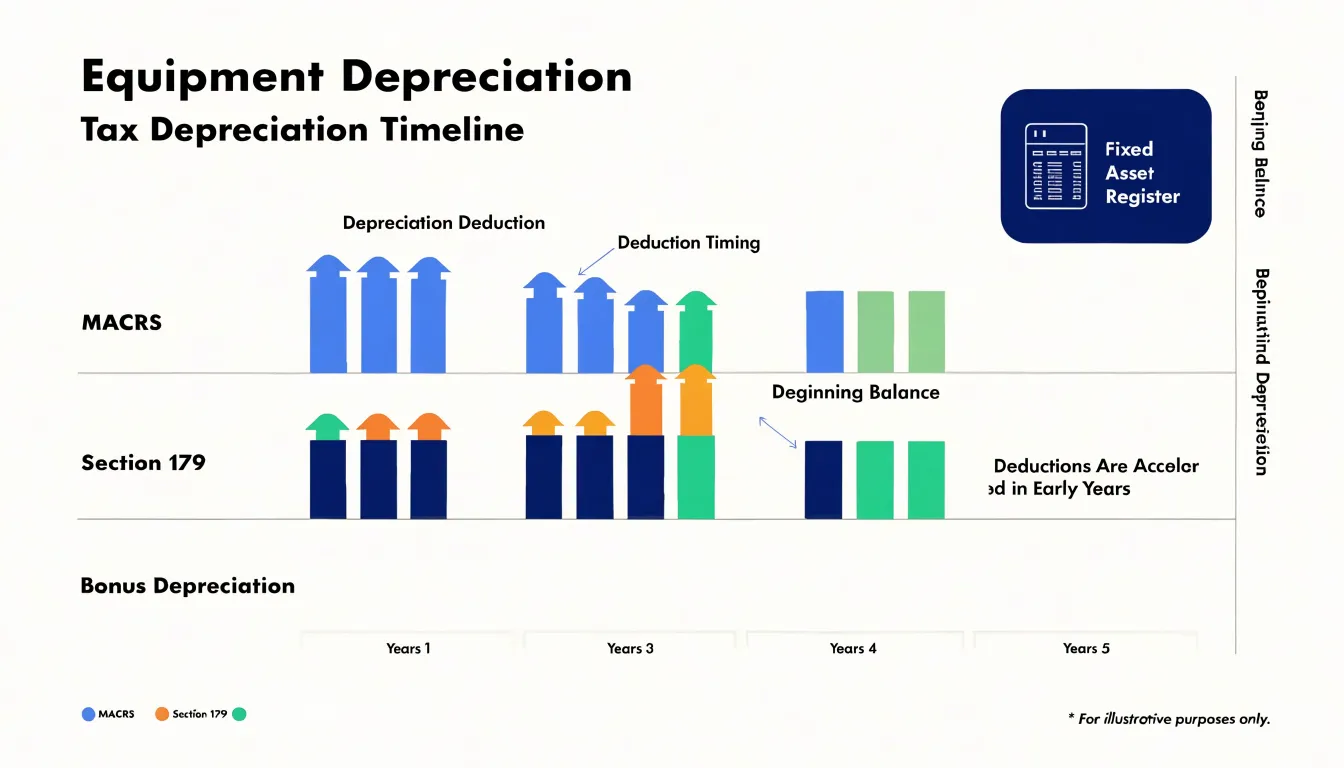
The tax angle gets more complex because book depreciation and tax depreciation follow different rules. Book depreciation is the accounting figure you report on financial statements, chosen to reflect how the asset’s value is consumed in operations. Tax depreciation is governed by the Internal Revenue Code and the Treasury regulations, which prescribe specific recovery periods and methods. Most tangible business assets fall under the Modified Accelerated Cost Recovery System, or MACRS, which assigns assets to property classes and applies accelerated methods such as the double-declining balance, switching to straight-line partway through the asset’s life. MACRS also assumes a mid-year or mid-quarter convention for the year of acquisition and disposal, which can shift the timing of deductions significantly.
Section 179 offers a faster alternative for qualifying property. Instead of spreading the deduction over several years, you can elect to expense a portion of the asset’s cost in the year it is placed in service, subject to annual dollar limits and a phase-out for large purchases. Bonus depreciation provides another accelerated option. Because these elections interact with MACRS and with each other, the choice of method can materially change your taxable income in any given year, and the decision usually needs to be made on a timely filed return.
The practical risk lies in the recordkeeping. Assets that are never added to the depreciation schedule produce no deductions at all. Assets that are misclassified into the wrong recovery period, or recorded with the wrong placed-in-service date or cost basis, produce deductions that are either too small or open to challenge on audit. Disposals that are not recorded can leave you depreciating an asset you no longer own. A disciplined fixed asset register, reconciled to the general ledger and reviewed before each tax filing, protects the deductions you have earned and keeps the tax return defensible.
Straight line depreciation for steady year over year write offs
Straight line depreciation is the simplest and most widely used method for allocating the cost of a fixed asset over its useful life. It produces a steady, even write-off each year, making it easy to budget for and understand. The formula is straightforward: take the asset’s cost, subtract its estimated salvage value (the amount it is expected to be worth at the end of its useful life), and divide the result by the number of years in its useful life. This gives you the annual depreciation expense.
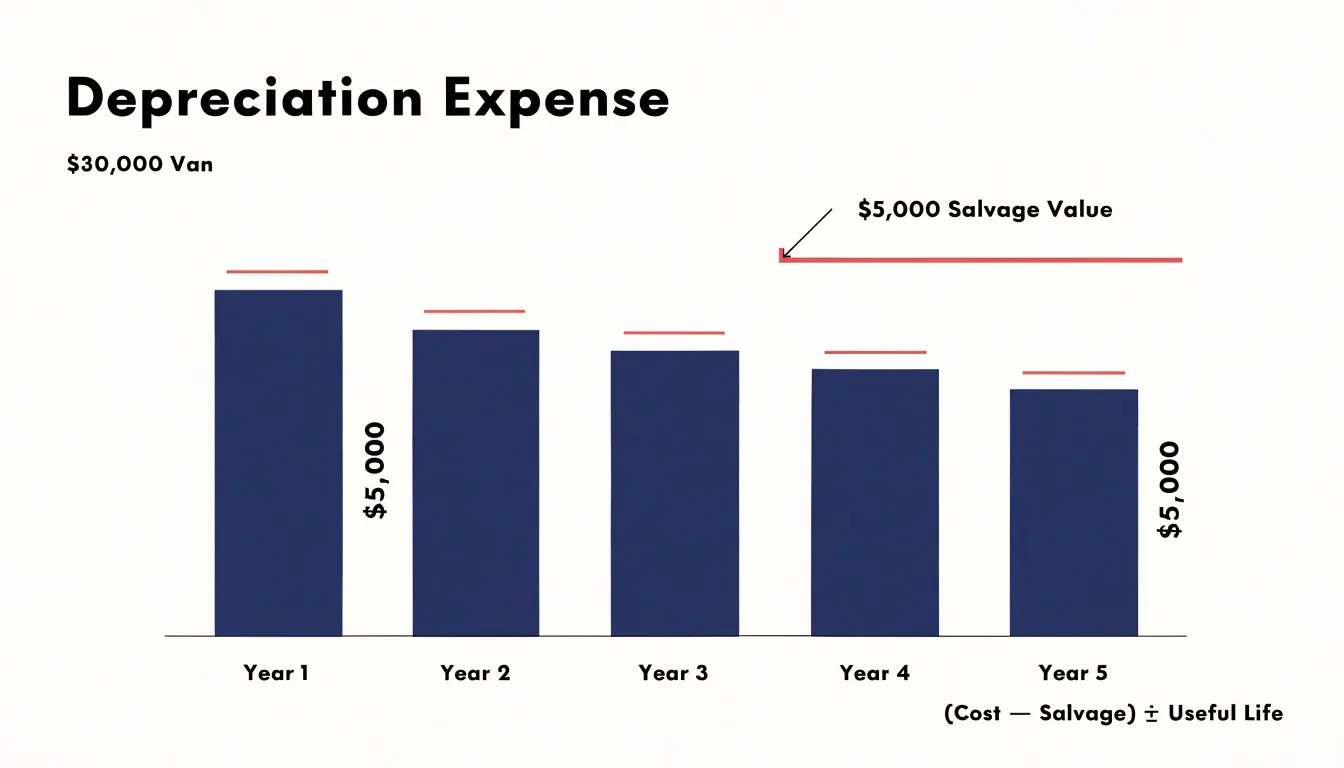
For example, suppose a company buys a delivery van for $30,000. The van is expected to be used for 5 years and then sold for $5,000. Using straight line depreciation, the annual expense is ($30,000 - $5,000) / 5 = $5,000 per year. Each year, the company records $5,000 of depreciation expense, reducing the van’s book value by that amount until it reaches the salvage value of $5,000 after five years.
This method works best for assets that provide consistent benefits over their useful lives and whose value declines in a steady, predictable manner. Buildings, office furniture, and fixtures are classic examples. A building’s utility and value tend to diminish evenly over time due to normal wear and tear, and straight line depreciation mirrors that pattern. Similarly, furniture such as desks and chairs loses value gradually as it is used, with no dramatic drops in utility from year to year. For these assets, the simplicity of straight line depreciation reduces administrative burden and provides a clear, consistent expense pattern that aligns with the asset’s economic benefits.
Straight line depreciation is also preferred when the pattern of an asset’s benefits is uncertain or when the asset is expected to generate roughly equal benefits each year. It avoids the complexity of accelerated methods, which front-load expenses and may not reflect the actual usage pattern. For many small businesses, the method is not only easier to apply but also easier to explain to stakeholders. In summary, straight line depreciation offers a reliable, even approach for assets like buildings and furniture, where steady write-offs match the gradual consumption of economic benefits.
Units of production method
The units of production method ties an asset’s cost directly to its usage, allocating depreciation based on actual output or hours of operation rather than the passage of time. This approach is particularly well suited to equipment such as vehicles or machinery, where wear and tear closely tracks how much the asset is used. Under this method, depreciation is calculated by first determining the depreciable base—the asset’s cost minus its estimated salvage value—and then dividing that base by the total estimated units the asset is expected to produce over its useful life. The result is a per-unit depreciation rate. Each period, the depreciation expense is simply the number of units produced (or hours used) during that period multiplied by this rate.
The formula is straightforward: Depreciation Expense = (Cost − Salvage Value) / Total Estimated Units × Units Produced in the Period. For example, a delivery van costing $40,000 with an estimated salvage value of $5,000 and an expected lifetime mileage of 200,000 miles would have a per-mile depreciation rate of $0.175 (($40,000 − $5,000) / 200,000). If the van is driven 30,000 miles in a year, the depreciation expense for that year would be $5,250 (30,000 × $0.175).
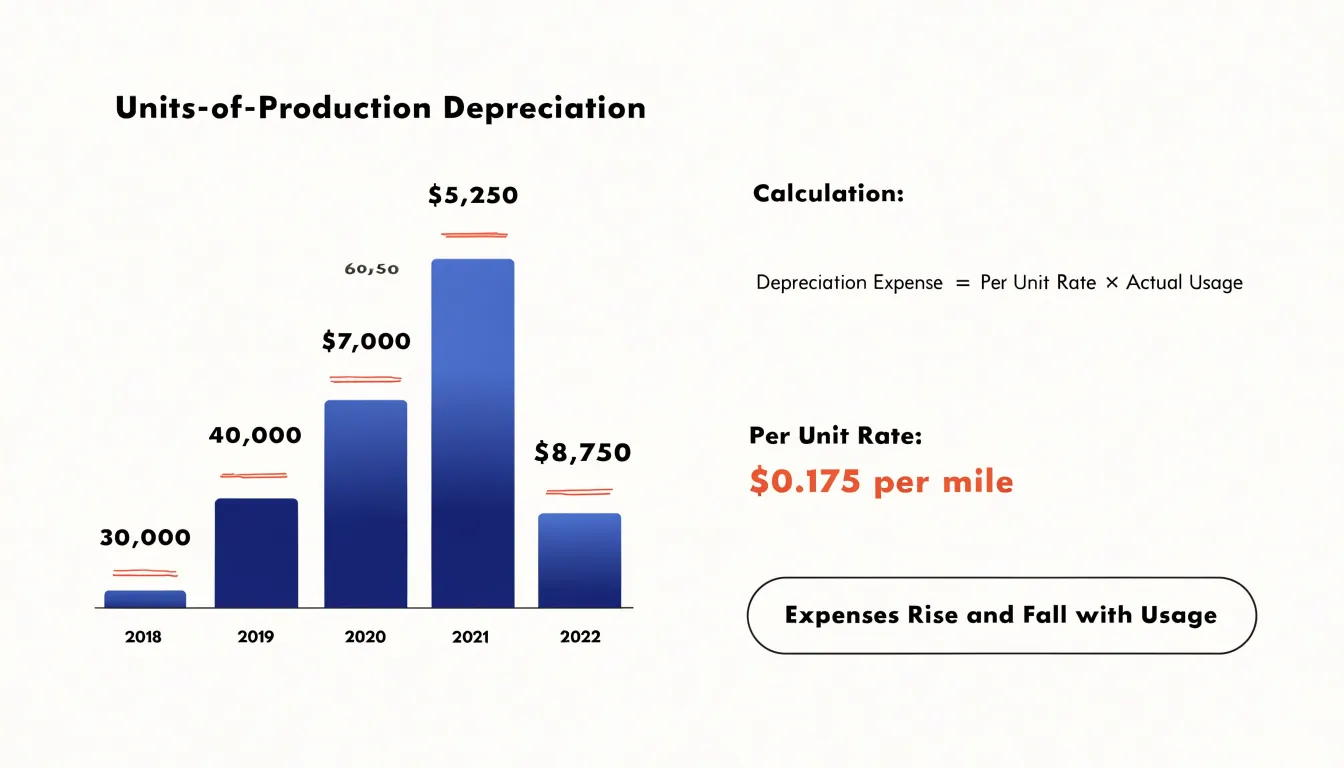
This method suits equipment like vehicles or machinery because their wear and tear is more closely related to usage than to time. A machine that sits idle for months does not depreciate as much as one that runs continuously, and a vehicle’s value declines with each mile driven. By aligning depreciation with actual usage, the units of production method provides a more accurate matching of expenses to the revenue generated by the asset. It also avoids the distortions that can arise with time-based methods, such as straight-line depreciation, which allocate cost evenly regardless of how intensively the asset is used. For businesses with assets whose usage varies significantly from period to period, this method offers a better reflection of economic reality.
Double declining balance for maximizing early tax deductions
The double declining balance method applies a fixed rate of twice the straight-line percentage to the asset’s remaining book value at the start of each year. To see how the mechanics work, consider equipment purchased for $50,000 with a five-year useful life and a $5,000 salvage value. The straight-line rate is 20% per year (100% divided by five years), so the double declining rate is 40%. In year one, 40% of the $50,000 book value produces a $20,000 deduction, leaving a book value of $30,000. In year two, 40% of $30,000 yields $12,000, leaving $18,000. Year three deducts $7,200, leaving $10,800, and year four deducts $4,320, leaving $6,480. Because the method never depreciates below salvage value, the final year’s deduction is limited to the amount that brings book value down to $5,000, giving $1,480 in year five. The total of $45,000 matches the depreciable basis, but the timing of the deductions shifts heavily toward the early years.
That front-loading is the core appeal. A business that places an asset in service mid-year still captures a large first-year deduction relative to straight-line depreciation, which lowers taxable income while the asset is newest and typically most productive. The larger early deductions reduce the present value of the tax bill, effectively deferring cash outflow and freeing capital for reinvestment. For assets that lose value quickly, such as computers, vehicles, and machinery subject to rapid obsolescence, the pattern also tracks economic reality more closely than an even annual charge.
The trade-off is a mirror image in later years. Because early deductions consume the depreciable basis faster, the later years produce smaller deductions than straight-line would deliver. A business whose taxable income is expected to rise substantially in future years may find that the acceleration pushes deductions into periods when they are worth less. The method also requires careful tracking of book value each year and a switch to straight-line in the final periods to fully depreciate the asset to salvage value without overshooting it. Entities electing this approach should confirm it aligns with the applicable tax rules and their broader multi-year tax planning.
Sum of the years digits method
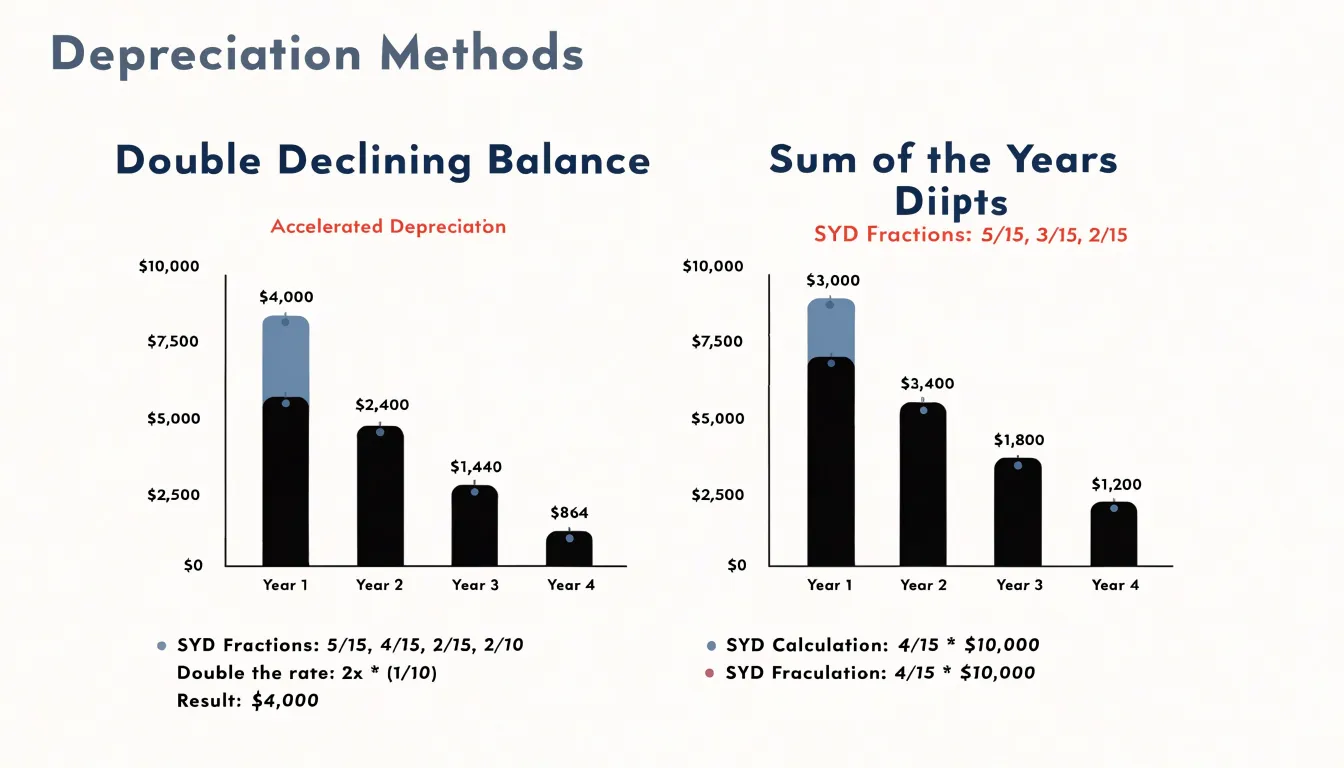
The sum of the years’ digits method offers a balanced approach to accelerated depreciation, front-loading deductions while avoiding the extreme volatility of methods like double declining balance. The formula is fraction-based: each year, you multiply the asset’s depreciable base (cost minus salvage value) by a fraction where the numerator is the remaining useful life at the start of the year and the denominator is the sum of the years’ digits. For an asset with a 5-year life, the sum is 1+2+3+4+5 = 15. In year one, the fraction is 5/15; in year two, 4/15; and so on, until the final year uses 1/15. This yields a smoothly declining depreciation charge each period.
Consider a machine costing $10,000 with a $1,000 salvage value and a 5-year life. The depreciable base is $9,000. Year one depreciation is 5/15 × $9,000 = $3,000, leaving a book value of $7,000. Year two: 4/15 × $9,000 = $2,400, book value $4,600. Year three: 3/15 × $9,000 = $1,800, book value $2,800. Year four: 2/15 × $9,000 = $1,200, book value $1,600. Year five: 1/15 × $9,000 = $600, ending at the $1,000 salvage value. The pattern shows larger expenses early that taper off predictably.
Compared to double declining balance, which applies a fixed rate (twice the straight-line rate) to the declining book value and often switches to straight-line later, SYD front-loads deductions more moderately. For instance, with the same asset, DDB would give year one depreciation of $4,000 (40% of $10,000), year two $2,400 (40% of $6,000), and so on. SYD’s first-year charge of $3,000 is lower, and its later charges are higher, creating a less aggressive acceleration. This makes SYD suitable for assets that lose value quickly but not as sharply as DDB assumes, providing a smoother transition to lower depreciation in later years. The method’s fraction-based structure also makes it easy to calculate and explain, offering a clear rationale for matching higher expenses with the periods when an asset is most productive.
How do you choose the right depreciation strategy for your business
Choosing the right depreciation strategy begins with a clear-eyed assessment of your asset base. Different asset types lend themselves to different methods. Machinery and vehicles that lose value quickly in the early years often benefit from an accelerated method like double-declining balance, which front-loads deductions and better matches the asset’s actual decline in productivity. Buildings and long-term fixtures, by contrast, typically align with straight-line depreciation because their utility and value diminish more evenly over decades. Intangible assets such as patents or software may follow yet another pattern, often tied to legal or contractual life. The expected usage pattern matters just as much: an asset that runs continuously in a three-shift operation will wear out faster than one used intermittently, and the depreciation schedule should reflect that reality.
Cash flow needs also shape the decision. Accelerated methods reduce taxable income more heavily in the early years, freeing up cash that can be reinvested in the business. That can be critical for startups or companies funding expansion. Straight-line depreciation produces a steadier, more predictable tax shield, which suits mature businesses with stable earnings and a preference for smooth financial statements. Tax planning goals enter here as well. If you expect higher tax rates in future years, you might prefer to defer deductions; if rates are likely to rise, accelerating them now can be advantageous. Timing of asset purchases relative to your fiscal year and any available bonus depreciation or Section 179 elections all factor into the calculus.
Consistency is the final pillar. Once you adopt a depreciation method for a class of assets, you generally must apply it consistently to all similar assets and cannot switch freely without IRS consent. This requirement protects the comparability of financial statements and prevents taxpayers from cherry-picking methods to manipulate income. Before changing methods, consult a qualified tax professional who can evaluate the consequences, handle the required Form 3115, and ensure your strategy remains compliant and aligned with your overall business plan.
Real world impact of depreciation on cash flow and tax reporting
Depreciation shapes how a business presents itself to the world in two distinct arenas at once: its financial statements and its tax return. The central fact to grasp is that depreciation is a non-cash expense. When a company records depreciation, it reduces reported profit on the income statement, yet no money leaves the bank account at that moment. The cash for the asset was typically spent when it was acquired. This separation between accounting profit and cash movement explains why a business can report a loss and still generate healthy cash, or report a profit while struggling to pay bills. Because of this gap, depreciation is added back to net income in the operating section of the cash flow statement, reconciling accrual-based profit to actual cash generated. Readers of that statement learn how much cash the business truly produced before accounting allocations. Method choice carries real consequences for tax liability timing. Accelerated methods front-load depreciation deductions, reducing taxable income in early years and deferring tax payments to later periods. Straight-line methods spread the deduction evenly. The total deduction over an asset’s life is usually the same, but the timing shifts. For a growing business, deferring tax can free up cash for reinvestment; for a stable one, the choice may matter less. Different jurisdictions also impose their own rules, so tax depreciation often diverges from book depreciation, creating deferred tax items on the balance sheet. Accurate records tie all of this together. Lenders examine depreciation schedules to assess asset quality and repayment capacity, since add-backs in the cash flow statement depend on reliable figures. Investors use depreciation patterns to judge capital intensity and management’s stewardship of assets. Errors in useful life estimates or asset registers distort profit, tax filings, and cash flow presentation alike, undermining confidence among those who rely on the numbers. Maintaining disciplined records of acquisitions, disposals, and estimated lives supports credible reporting and smoother audits, financing conversations, and tax compliance.
Frequently Asked Questions
Is depreciation a non-cash expense?
Yes. Depreciation records an expense without any corresponding cash outflow, because no cheque is written and no bank balance changes when it is booked. It is added back to net income when preparing a cash flow statement.
What is Section 179 depreciation?
Section 179 is a faster alternative for qualifying property that lets you elect to expense a portion of the asset’s cost in the year it is placed in service, subject to annual dollar limits and a phase-out for large purchases. It interacts with MACRS and bonus depreciation, and the decision usually needs to be made on a timely filed return.
How do you calculate straight line depreciation?
Take the asset’s cost, subtract its estimated salvage value, and divide the result by the number of years in its useful life. This gives you the annual depreciation expense.
What is the units of production depreciation method?
The units of production method allocates depreciation based on actual output or hours of operation rather than the passage of time. The formula is (Cost − Salvage Value) / Total Estimated Units × Units Produced in the Period.
What is the difference between double declining balance and sum of the years’ digits?
Double declining balance applies a fixed rate of twice the straight-line percentage to the asset’s remaining book value each year. Sum of the years’ digits uses a fraction based on remaining useful life and the sum of the years’ digits, front-loading deductions more moderately than double declining balance.
Can you change depreciation methods freely?
No. Once you adopt a depreciation method for a class of assets, you generally must apply it consistently to all similar assets and cannot switch freely without IRS consent. Before changing methods, consult a qualified tax professional who can evaluate the consequences and handle the required Form 3115.