
Double-Entry Bookkeeping
Double-entry bookkeeping records every financial transaction in at least two accounts, with equal debits and credits, so total debits always equal total credits. This self-checking system keeps the accounting equation (Assets = Liabilities + Equity) balanced, catches errors such as transposed digits or one-sided entries, and produces reliable financial statements.

Table of Contents
- Understanding the basic philosophy behind balancing two sides of every financial transaction
- The fundamental accounting equation that keeps your business records accurate
- Debits and credits explained without the confusing traditional definitions
- How to record your first transaction using a simple T chart layout
- Step-by-Step Walkthrough
- What happens when your general ledger does not balance?
- Choosing between manual spreadsheets and automated accounting software for your small business
Understanding the basic philosophy behind balancing two sides of every financial transaction
At the heart of double-entry bookkeeping lies a simple but powerful idea: every financial transaction has two sides. When a business receives cash from a customer, for example, the cash account increases, but so does the revenue account—or, if the payment is for an outstanding invoice, the accounts receivable balance decreases. This dual recording reflects the fundamental reality that money never appears or disappears in isolation; it always flows from somewhere to somewhere else. In accounting terms, every transaction involves a source of funds and a use of funds. The source indicates where the value came from—such as a loan from a bank, a cash sale, or an owner’s investment—while the use shows where the value went, such as purchasing equipment, paying off debt, or covering operating expenses. By capturing both aspects, the accounting system mirrors the actual economic event in its entirety.
This symmetry is more than a bookkeeping formality; it is the foundation of the self-checking mechanism that makes double-entry so reliable. Because each transaction is recorded with equal debits and credits, the total debits in the ledger must always equal the total credits. If an entry is made with only one side, or if the amounts on the two sides do not match, the trial balance will immediately reveal the discrepancy. This built-in error detection catches mistakes such as transposing digits, posting an amount twice, or omitting one half of an entry. While it cannot catch every error—for instance, recording the same wrong amount on both sides—it provides a constant, automatic verification that the books are internally consistent. Over time, this discipline gives business owners and managers confidence that the financial records accurately reflect the underlying transactions, and it lays the groundwork for reliable financial statements. The philosophy of balancing two sides thus transforms bookkeeping from a mere record-keeping chore into a robust system of checks and balances, where every number tells a story of both origin and destination.

The fundamental accounting equation that keeps your business records accurate
At the center of double-entry bookkeeping sits a single relationship that governs every record a business makes: Assets = Liabilities + Equity. Each term describes a distinct kind of economic reality. Assets are the resources the business controls and expects to convert into future benefit — cash in the bank, inventory on the shelf, equipment in the workshop, amounts customers owe you. Liabilities are obligations owed to outside parties, such as supplier invoices, bank loans, and taxes collected but not yet remitted. Equity is the residual claim of the owners: what remains of the assets after all liabilities are settled, including capital contributed and profits retained in the business. Read together, the equation says that everything the business owns was financed either by borrowing or by owners’ stakes, and the two sides must always describe the same total.
In practice, the equation acts as a continuous integrity check on the ledger. Suppose a business buys inventory for 5,000 in cash. One asset, cash, falls by 5,000; another asset, inventory, rises by 5,000. The total on the left is unchanged, so the right side needs no adjustment and the equation still holds. If instead the inventory is bought on credit, the asset side rises by 5,000 and liabilities rise by the same amount, again preserving balance. When the owner injects 10,000 into the bank account, assets increase and equity increases equally. When a customer pays an outstanding invoice, cash rises and receivables fall by matching amounts. In every case, the transaction touches at least two accounts in equal measure, which is precisely why the system is called double-entry.
This mutual dependence is what makes the records trustworthy. Because each transaction is recorded twice, with equal debits and credits, the trial balance should reconcile to zero at all times. Errors of transposition, omission of one side of an entry, or arithmetic slips disturb the equation and surface quickly. The equation also frames how profits flow: revenue increases assets or reduces liabilities, which lifts equity, while expenses do the reverse. A business that keeps the equation in view at every step maintains records that are internally consistent and ready for reliable reporting.
Debits and credits explained without the confusing traditional definitions
In double-entry bookkeeping, the terms debit and credit often cause confusion because they are used in everyday language to mean good and bad, or positive and negative. In accounting, however, they simply refer to the left and right sides of an account. A debit is an entry on the left side of an account, and a credit is an entry on the right side. This mechanical definition removes the emotional baggage and makes the system easier to understand. Every transaction affects at least two accounts, with at least one debit and one credit, and the total debits must equal the total credits. This is the fundamental principle of double-entry bookkeeping.
To use debits and credits correctly, you need to know how different types of accounts behave. The effect of a debit or credit depends on the account category. Here is a quick-reference table showing which side increases each type of account:
Account Type | Increases with | Decreases with Assets | Debit | Credit Liabilities | Credit | Debit Equity | Credit | Debit Revenue | Credit | Debit Expenses | Debit | Credit
For example, when a business receives cash, cash (an asset) increases, so it is debited. The corresponding credit might be to revenue if the cash was earned, or to a liability if it was borrowed. When a business pays an expense, the expense account increases, so it is debited, and cash (an asset) decreases, so it is credited. This pattern holds consistently across all transactions. By focusing on the left/right convention and the account type, you can determine the correct entries without relying on misleading labels. The terms debit and credit are merely directional indicators, and once you internalize the table above, you can analyze any transaction with confidence. Remember that the accounting equation (Assets = Liabilities + Equity) must always stay in balance, and the double-entry system ensures that it does.
How to record your first transaction using a simple T chart layout
To see double-entry bookkeeping in action, start with a T chart, the simplest visual tool for recording a transaction. A T chart takes its name from its shape: a horizontal line with a vertical line dropping from its center, creating a left column and a right column. The account name is written across the top. By convention, the left side is the debit column and the right side is the credit column. Every transaction you record will touch at least two of these charts, and the amounts entered on the left and right must always agree once you total them.
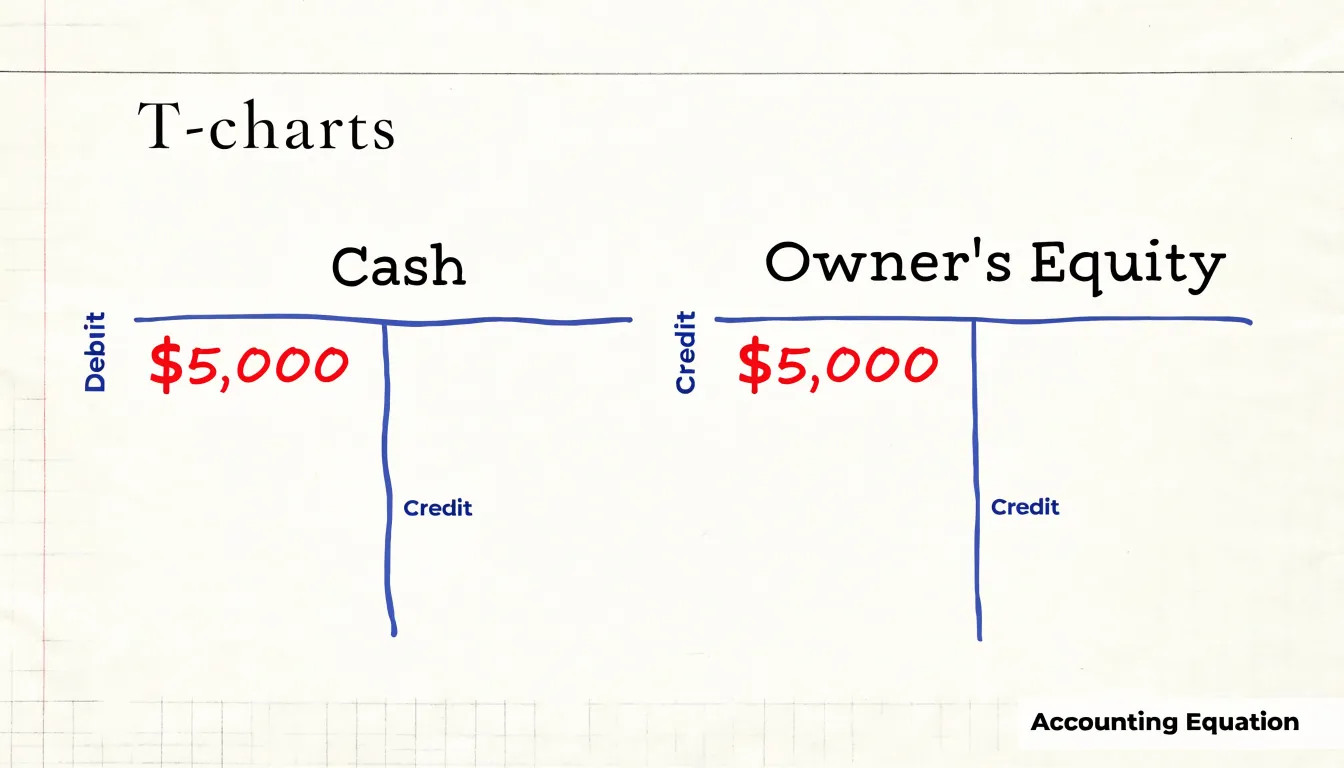
Suppose a new business owner, Maria, opens a business bank account and deposits $5,000 of her own money to get started. She needs two T accounts: one labeled Cash and one labeled Owner’s Equity. Cash is an asset, and assets increase on the debit side, so Maria writes $5,000 in the left column of the Cash account. Owner’s Equity represents the owner’s claim on the business, and equity increases on the credit side, so she writes $5,000 in the right column of the Owner’s Equity account. She has now recorded both halves of the transaction: the business gained cash, and the source of that cash was the owner’s investment.
The next step is the check that keeps the books honest. Maria totals the debit column of the Cash account and gets $5,000. She totals the credit column of the Owner’s Equity account and gets $5,000. The two figures match, which confirms the entry is balanced and complete. If she had written $5,000 on the debit side but only $500 on the credit side, the totals would disagree, and she would know immediately that something was wrong before the error could spread into her other records.
This small example captures the whole logic of double-entry bookkeeping. Each transaction moves value from one place to another, and the T chart makes both sides of that movement visible at a glance. As Maria records more transactions, such as paying rent or making a sale, she will add more T accounts and repeat the same routine: identify the two accounts involved, decide which side of each account increases, enter the amounts, and confirm that total debits equal total credits.
Step-by-Step Walkthrough
To see how double-entry bookkeeping operates in practice, consider a small retail business that buys goods for resale and sells them to customers. The walkthrough begins with the purchase of inventory on credit. Suppose the business buys $5,000 of merchandise from a supplier on terms of net 30. The transaction increases the asset Inventory, so the Inventory account is debited for $5,000. Because payment has not yet been made, a liability is created, so Accounts Payable is credited for the same amount. In the journal, the entry reads: debit Inventory $5,000; credit Accounts Payable $5,000. When this entry is posted to the ledger, the Inventory T-account shows $5,000 on the debit side, and the Accounts Payable T-account shows $5,000 on the credit side. The debits and credits remain equal, and the accounting equation stays balanced: assets rise by $5,000 and liabilities rise by $5,000.
Next, the business sells goods to customers for $3,000 in cash. A sale involves two distinct economic events that require separate entries. First, the business receives cash, so the Cash account is debited for $3,000 and Sales Revenue is credited for $3,000. Second, the inventory that was sold must leave the balance sheet. Assuming the goods sold cost the business $1,800, the Cost of Goods Sold account is debited for $1,800 and Inventory is credited for $1,800. Posting these entries to the ledger updates four T-accounts: Cash increases by $3,000 on the debit side, Sales Revenue increases by $3,000 on the credit side, Cost of Goods Sold increases by $1,800 on the debit side, and Inventory decreases by $1,800 on the credit side.
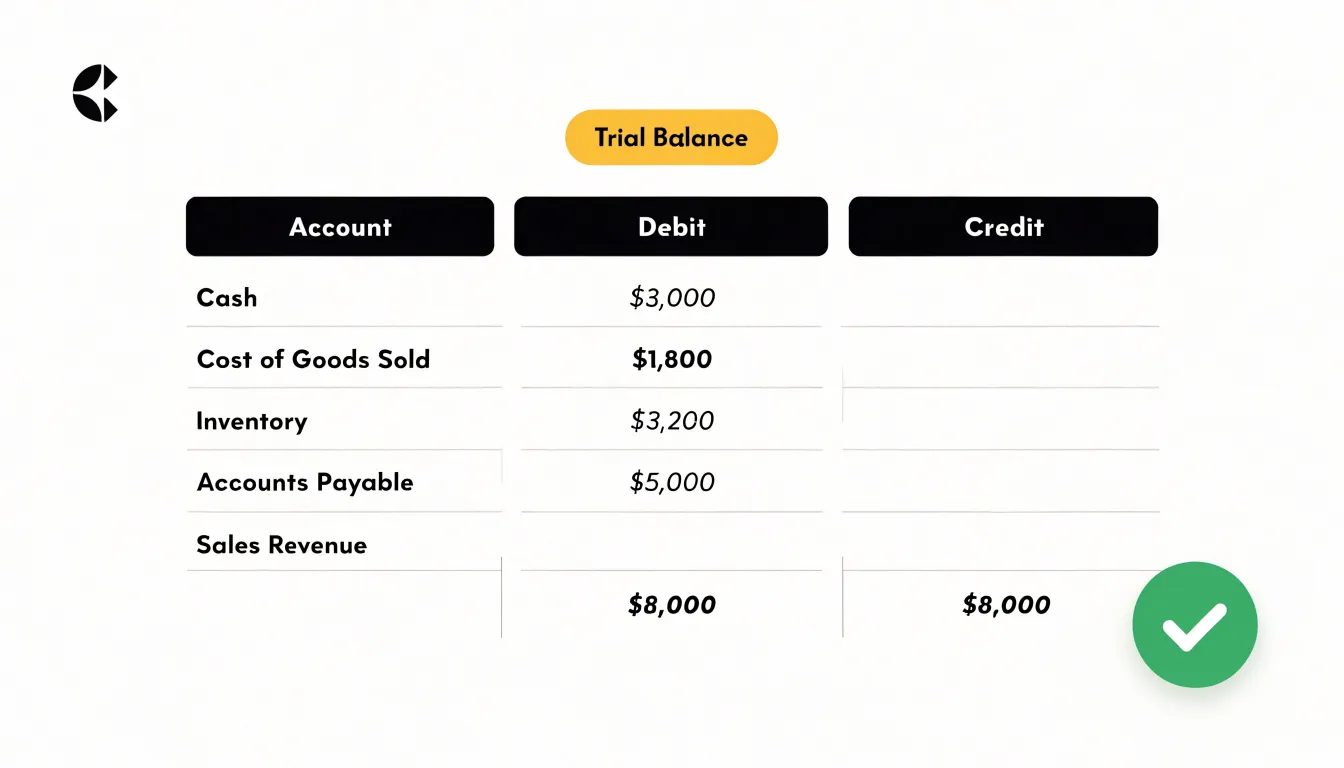
After posting, the Inventory T-account carries a debit balance of $3,200, reflecting the $5,000 purchase less the $1,800 cost of goods sold. Cash holds a $3,000 debit balance, Accounts Payable a $5,000 credit balance, Sales Revenue a $3,000 credit balance, and Cost of Goods Sold a $1,800 debit balance. To confirm accuracy, the bookkeeper prepares a trial balance listing each account and its balance in the appropriate debit or credit column. Total debits equal $3,000 plus $1,800 plus $3,200, or $8,000. Total credits equal $5,000 plus $3,000, or $8,000. The two columns agree, demonstrating that every transaction was recorded with equal debits and credits and that the ledger is internally consistent.
What happens when your general ledger does not balance?
When a general ledger fails to balance, the totals on the trial balance will differ, and the gap between total debits and total credits signals that at least one entry somewhere in the books is incomplete or incorrect. Several common causes account for most imbalances. Transposition errors occur when digits are swapped, such as recording 540 instead of 450; the resulting difference is divisible by nine, which makes these errors easy to spot. Slide errors happen when a decimal point or a zero is misplaced, turning 1,200 into 120. A single-sided entry, where a debit is posted without its matching credit, is another frequent culprit, as is posting an amount twice to one side or omitting an account from the trial balance altogether. Incorrectly carrying a balance forward from one period to the next, or entering a figure in the wrong column, will also throw the ledger out of balance.
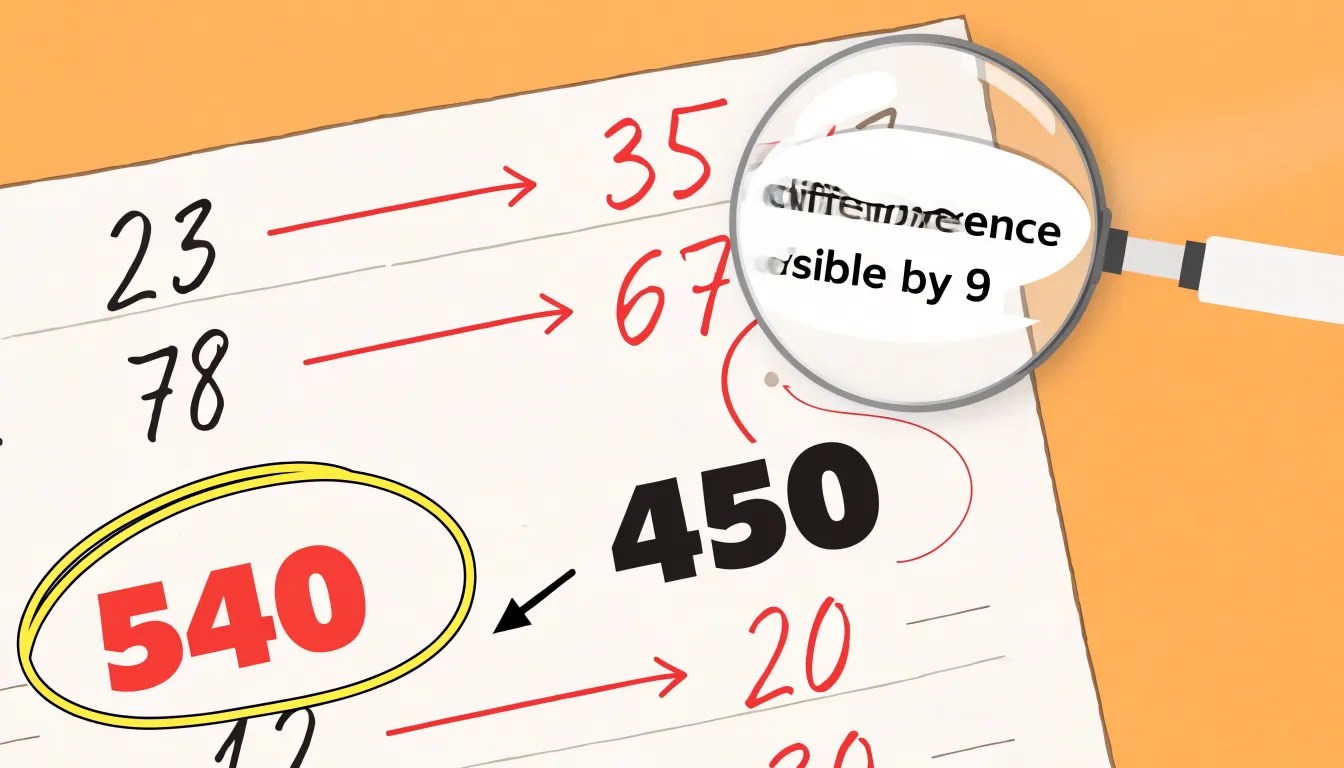
A practical checklist helps isolate the problem systematically. First, confirm the arithmetic by re-adding each column of the trial balance independently, since simple addition mistakes are surprisingly common. Second, compare the size of the discrepancy against the ledger: if it is divisible by nine, look for transposed or slid digits; if it equals an amount that appears in the ledger, look for a one-sided entry of exactly that amount. Third, review recent postings to the affected accounts, working backward from the date the imbalance first appeared. Fourth, check subsidiary ledgers against their control accounts to confirm that individual postings reconcile with the summary figures. Finally, verify opening balances and any adjusting entries made at period end.
If the discrepancy persists after these steps, avoid forcing the ledger to balance by plugging the difference into a suspense account as a permanent fix. A suspense account can hold the amount temporarily while the investigation continues, but it must be cleared before the books are finalized. Document the investigation, escalate to a supervisor if the amount is material, and consider whether a software or data-entry issue is at the root. Persistent imbalances may also indicate fraud, so treat unexplained differences with appropriate caution and keep a clear audit trail of every step taken.
Choosing between manual spreadsheets and automated accounting software for your small business
When a small business sets up its bookkeeping, one of the first practical decisions is whether to track transactions in a manual spreadsheet or to adopt dedicated accounting software. Each route carries distinct trade-offs in cost, time, error risk, and scalability, and understanding these differences helps owners make a choice that fits their current stage of growth.
On cost, spreadsheets have an obvious appeal: a business owner can build a basic ledger in a familiar program at little or no expense, with no subscription fees and no learning curve for new software. Accounting software typically involves a monthly subscription, and the price rises with the number of users and features. For a sole trader with a handful of transactions per month, the spreadsheet’s zero-cost entry point can be entirely reasonable.
The time calculation shifts as transaction volume grows. Manual entry means typing in every sale, purchase, and payment, then reconciling bank statements line by line. Software automates much of this through bank feeds, imported statements, and rules that categorize recurring transactions. What takes hours in a spreadsheet each month may take minutes in software, and that saved time compounds across the year, particularly around tax deadlines.
Error risk is closely tied to manual entry. Spreadsheets rely on the owner to enter figures correctly and to maintain formulas that can break when rows are inserted or copied. A mistyped digit or a deleted formula can distort totals without any warning. Accounting software enforces double-entry rules, flags unbalanced entries, and produces reports directly from the underlying data, which reduces the chance of silent mistakes. Spreadsheets remain viable when they are carefully structured and reviewed, but the discipline required grows with complexity.
Scalability is where the gap widens. A spreadsheet can handle a modest number of transactions, but as the business adds staff, inventory, multiple bank accounts, or VAT registration, the manual workload and the risk of inconsistency rise sharply. Software accommodates growth through multi-user access, audit trails, and integrated reporting. A useful rule of thumb: switch when manual entry consumes more than a few hours a month, when you need accountant-ready reports, or when you begin hiring and delegating financial tasks.
Frequently Asked Questions
What is the main idea behind double-entry bookkeeping?
Every financial transaction has two sides, reflecting a source of funds and a use of funds. Each transaction is recorded with equal debits and credits, so total debits must always equal total credits.
What is the accounting equation and what does it mean?
The accounting equation is Assets = Liabilities + Equity. It means everything the business owns was financed either by borrowing or by owners’ stakes, and the two sides must describe the same total.
What do debit and credit actually mean in accounting?
A debit is an entry on the left side of an account, and a credit is an entry on the right side; they do not mean good or bad. Every transaction affects at least two accounts with at least one debit and one credit, and total debits must equal total credits.
How do you record an owner’s initial cash investment in a T chart?
Debit Cash and credit Owner’s Equity for the same amount. For example, a $5,000 owner deposit is recorded as $5,000 on the debit side of Cash and $5,000 on the credit side of Owner’s Equity, so the totals match.
What happens when the general ledger doesn’t balance?
The trial balance totals will differ, signaling that at least one entry is incomplete or incorrect. Check the arithmetic, look for transposition or slide errors, review recent postings, and if a suspense account is used, clear it before finalizing the books rather than plugging the difference permanently.
Should a small business use spreadsheets or accounting software?
Spreadsheets are low-cost and familiar but rely on manual entry and careful formula maintenance, while accounting software usually involves a subscription but automates bank feeds and enforces double-entry rules. Switch when manual entry takes more than a few hours a month, when you need accountant-ready reports, or when you begin hiring and delegating financial tasks.