
Financial Management Basics for Small Business Owners
Small business financial management means separating personal and business accounts, maintaining clean bookkeeping, and tracking cash flow separately from profit. Owners should build a three-to-six-month emergency reserve, budget for seasonal revenue swings, invoice clients with clear terms and automated reminders, set aside a percentage of each payment for quarterly estimated taxes, and hire a bookkeeper when transaction volume outgrows DIY records.
Table of Contents
- Separating personal and business finances from day one
- How to set up a clean bookkeeping system without an accounting background
- Cash Flow vs Profit
- Creating a realistic operating budget for seasonal revenue swings
- Managing accounts receivable to get paid faster by clients
- How should you handle emergency reserves for your company
- Tax Planning Basics
- When to hire professional bookkeeping help versus managing finances yourself
Separating personal and business finances from day one
Separating personal and business finances from the very first day of operation is one of the most important habits a small business owner can build. When a business is new, it is tempting to use a personal checking account for client payments or to pay for supplies with a personal credit card. This practice, known as commingling funds, quickly creates a tangled financial record that becomes difficult to untangle later. A dedicated business bank account establishes a clean boundary. Every sale, expense, and transfer flows through one place, which means the money going in and out of the business can be traced without sorting through personal grocery runs and utility bills. This clarity pays off at tax time, when owners can hand their accountant a complete, organized record rather than a shoebox of mixed receipts.
The consequences of commingling extend beyond inconvenience. On the tax side, the IRS expects business expenses to be documented and distinguishable from personal spending. When funds are mixed, deductions become harder to substantiate, and an owner may miss legitimate write-offs or, worse, claim expenses that cannot be supported if questioned. On the legal side, many small businesses operate as separate entities such as LLCs or corporations, and that separation is only respected when the owner treats the business as financially distinct. Courts and creditors can look past the liability protection of an entity when personal and business money are blended, leaving personal assets exposed. Commingling also complicates lending, since banks reviewing a loan application want to see business accounts with a clear history of revenue and expenses.
Getting started is straightforward. Open a dedicated business checking account as soon as the business is registered, and use it exclusively for business income and expenses. Pair it with a business credit card so that purchases build a clear, categorized record and can be reconciled monthly. Set up a simple bookkeeping routine, whether through accounting software or a spreadsheet, and record transactions weekly rather than waiting until year end. Pay yourself through a deliberate transfer or salary rather than dipping into the account casually. These steps take an afternoon to arrange and save countless hours of confusion later.
How to set up a clean bookkeeping system without an accounting background
A clean bookkeeping system begins with choosing accounting software that matches the size and complexity of your business. For most small businesses, cloud-based options offer guided setup wizards that ask plain questions about how you earn money and what you spend it on, then configure the basics for you. Look for software that connects directly to your bank and credit card accounts, because automatic transaction imports remove the single biggest source of messy records: manual entry. When you evaluate options, prioritize a clear dashboard, built-in categorization suggestions, and simple report templates such as profit and loss and cash flow statements. Many platforms also include mobile apps, which matter for capturing expenses as they happen.
Once the software is in place, a weekly receipt routine keeps records from piling up. Pick a fixed day and time, perhaps Friday afternoon, and spend twenty to thirty minutes gathering paper receipts, photographing them with your phone, and matching them to bank transactions in the software. Store digital copies in labeled folders by month, and note the business purpose on any receipt that could be questioned later, such as meals or travel. This weekly habit takes far less effort than a quarterly scramble, and it keeps your transaction categories accurate while the details are still fresh in your memory.
A chart of accounts gives your records structure. This is simply the list of categories your business uses to sort money coming in and going out. Software usually provides a default chart tailored to your industry, and you can trim or rename categories to fit how you actually operate. Keep the list short at first, with a handful of income categories and the common expense groups such as supplies, rent, utilities, and professional fees. Add new categories only when a genuine pattern emerges, and review the list once or twice a year to merge duplicates and retire categories you no longer use.
Together, these three elements form a repeatable system. The software captures transactions automatically, the weekly routine keeps supporting documents organized, and the chart of accounts ensures every entry lands in a sensible place. Formal accounting training is not required to maintain this rhythm; consistency and a few simple habits carry most of the weight.
Cash Flow vs Profit
Profit and cash flow are two different financial measures, and understanding their distinction is essential for small business survival. Profit is an accounting concept: it represents revenue minus expenses over a specific period, typically recorded when a sale is made or an expense is incurred, regardless of when cash actually changes hands. Cash flow, by contrast, tracks the actual movement of money in and out of your bank account. A business can be profitable on paper yet still run out of cash, a paradox that sinks many otherwise healthy companies.
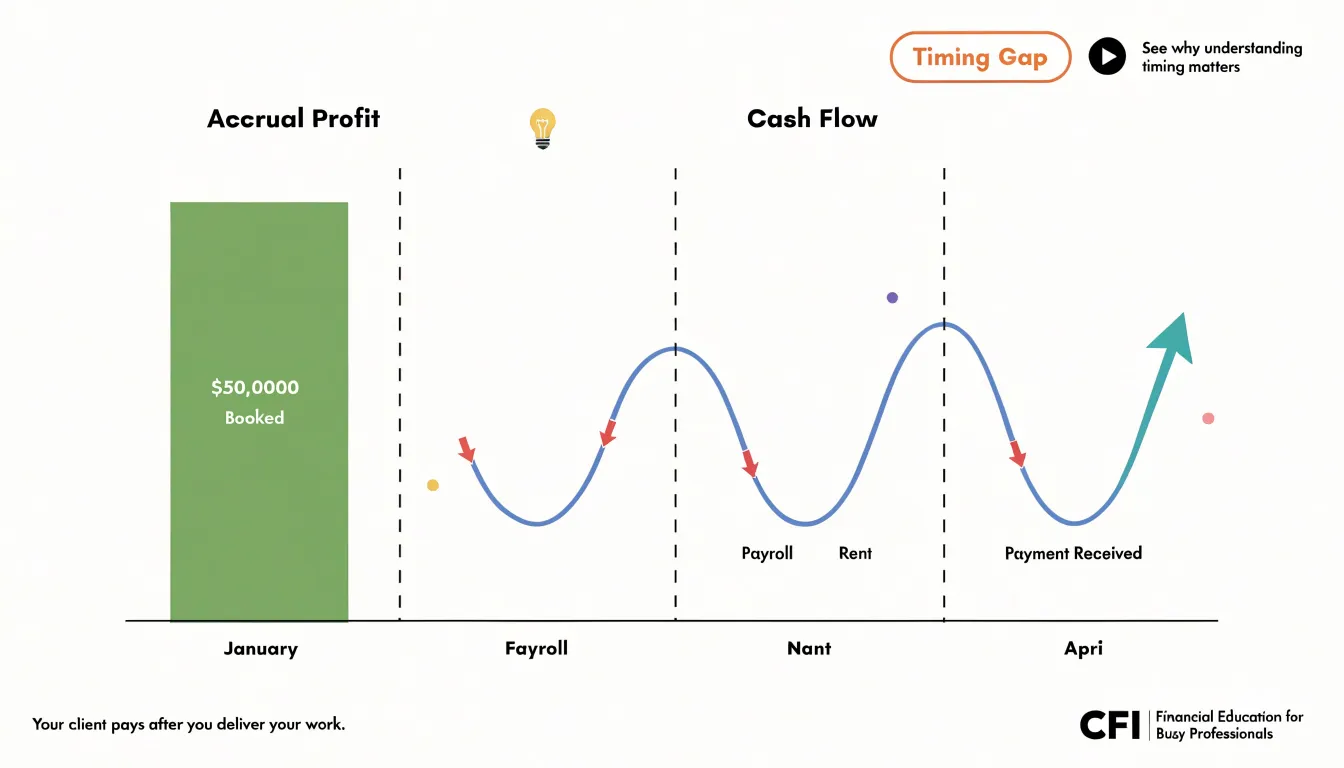
The root cause often lies in timing gaps between receivables and payables. Consider a growing consulting firm that lands a large contract. It completes the work in January and invoices the client for $50,000, recording the revenue immediately. Under accrual accounting, that $50,000 counts as profit in January. However, the client may not pay for 60 or 90 days. Meanwhile, the firm must pay its staff, rent, and other expenses in January and February. Even though the firm is profitable, it may lack the cash to cover payroll before the client pays. If the firm has no cash buffer, it could be forced to borrow at high interest or even miss payments, potentially leading to insolvency.
Similarly, payables can create cash flow strain. Suppose a retailer buys inventory on credit with 30-day terms but sells the goods slowly over 90 days. The retailer must pay the supplier in 30 days, but cash from sales trickles in over three months. The business shows a profit on each sale, but the timing mismatch means cash is going out faster than it comes in. If sales grow, the retailer may need to buy more inventory to meet demand, further straining cash flow. This is why rapidly growing companies often fail: growth consumes cash.
To manage these gaps, business owners should monitor cash flow forecasts, negotiate favorable payment terms, maintain a cash reserve, and consider using tools like invoice factoring or lines of credit. Recognizing that profitability and liquidity are not the same is the first step toward protecting your business from a cash crunch.
Creating a realistic operating budget for seasonal revenue swings
A realistic operating budget begins with an honest look at how money actually moves through your business across a full twelve-month cycle. Start by gathering at least one year of historical income data, ideally two or three, and plot monthly revenue on a simple chart. Seasonal patterns will emerge: months that consistently spike, months that sag, and the shoulder periods in between. Use those figures to build a month-by-month income projection, applying conservative estimates to peak months and remembering that a single strong season does not guarantee a repeat. Where history is thin, industry benchmarks and your own booking or pipeline data can fill the gaps. On the expense side, separate costs into fixed items such as rent, insurance, and loan payments, and variable items such as inventory, hourly labor, and utilities that rise and fall with sales. Assign each variable cost to the months it actually occurs so the budget mirrors real cash flow rather than an annual average.
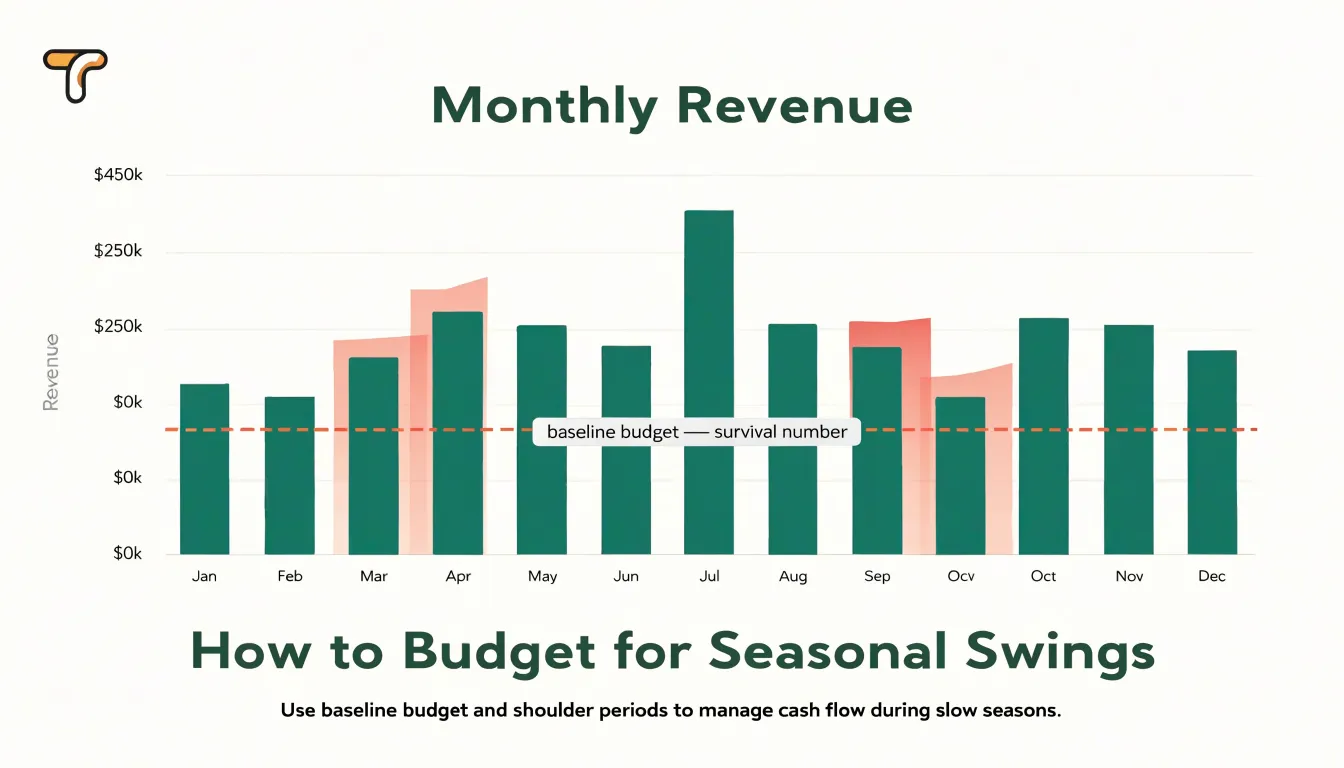
With both sides mapped, calculate a baseline budget: the minimum monthly revenue needed to cover fixed costs plus essential variable expenses. This baseline is your survival number, and every month’s performance should be measured against it. From there, model three scenarios for the year, a lean low-season version, a typical version, and a strong high-season version, and note the surplus generated in peak months. That surplus becomes the reserve that carries the business through slow stretches, so treat a portion of it as untouchable rather than as spending money.
Adjusting spending during slow months works best when the decisions are planned in advance rather than made under pressure. Identify which expenses can flex: defer non-urgent purchases, negotiate seasonal payment terms with suppliers, reduce discretionary marketing to the channels that convert, and schedule owner draws around the calendar instead of evenly. Keep fixed obligations visible at all times so cuts target the right line items. Review the budget monthly against actuals, and update projections as new data arrives, since seasonal patterns shift with weather, holidays, and local demand. A budget built this way turns seasonal volatility into a predictable rhythm the owner can plan around.
Managing accounts receivable to get paid faster by clients
Managing accounts receivable is a critical component of financial management for small business owners. The primary goal is to get paid faster by clients, which directly improves cash flow and reduces the need for external financing. Start by establishing clear invoicing terms. Specify the payment due date, accepted payment methods, and any late fees in your contracts and on every invoice. Ambiguity invites delays, so leave no room for interpretation. For larger projects, require a deposit upfront. This not only secures commitment but also provides immediate cash to cover initial costs. A common practice is to request 50% upfront for new clients or large orders, with the balance due upon completion. Automated reminders are another effective strategy. Use accounting software to send gentle reminders before the due date, on the due date, and after the due date. Automation ensures consistency and saves time, while reducing the awkwardness of manual follow-ups. Develop a follow-up schedule for overdue payments. For example, send a polite email one day after the due date, a phone call one week later, and a formal demand letter after two weeks. Stick to this schedule consistently to signal that you take payments seriously. Consider offering early payment discounts to incentivize prompt payment, such as a 2% discount if paid within 10 days. Conversely, enforce late fees to discourage procrastination. Regularly review your accounts receivable aging report to identify slow-paying clients and take proactive measures. By implementing these strategies, you can reduce late payments, shorten your cash conversion cycle, and maintain a healthier cash flow, which is essential for the stability and growth of your small business.
How should you handle emergency reserves for your company
A financial cushion is essential for any small business, and determining the right size for your emergency reserve starts with your operating expenses. A common guideline is to set aside three to six months’ worth of operating expenses. To calculate this, first identify your fixed monthly costs—rent, utilities, payroll, insurance, and loan payments—and your typical variable costs, such as inventory, supplies, and marketing. Add these together to find your average monthly operating expense. Multiply that figure by three for a baseline reserve, or by six if your industry is seasonal, your revenue is unpredictable, or you have few credit options. This target is a starting point; adjust it as your business grows or your risk profile changes.
Where you keep the reserve matters as much as how much you save. The funds should be readily accessible but separate from your day-to-day operating account to avoid temptation. A dedicated savings or money market account at a bank or credit union works well, offering liquidity and a modest return. Avoid locking the money in long-term certificates of deposit or volatile investments, since emergencies require quick access without penalty. Look for accounts with no monthly fees and low minimum balance requirements, and consider keeping the reserve at a different institution than your primary checking account to reinforce the separation.
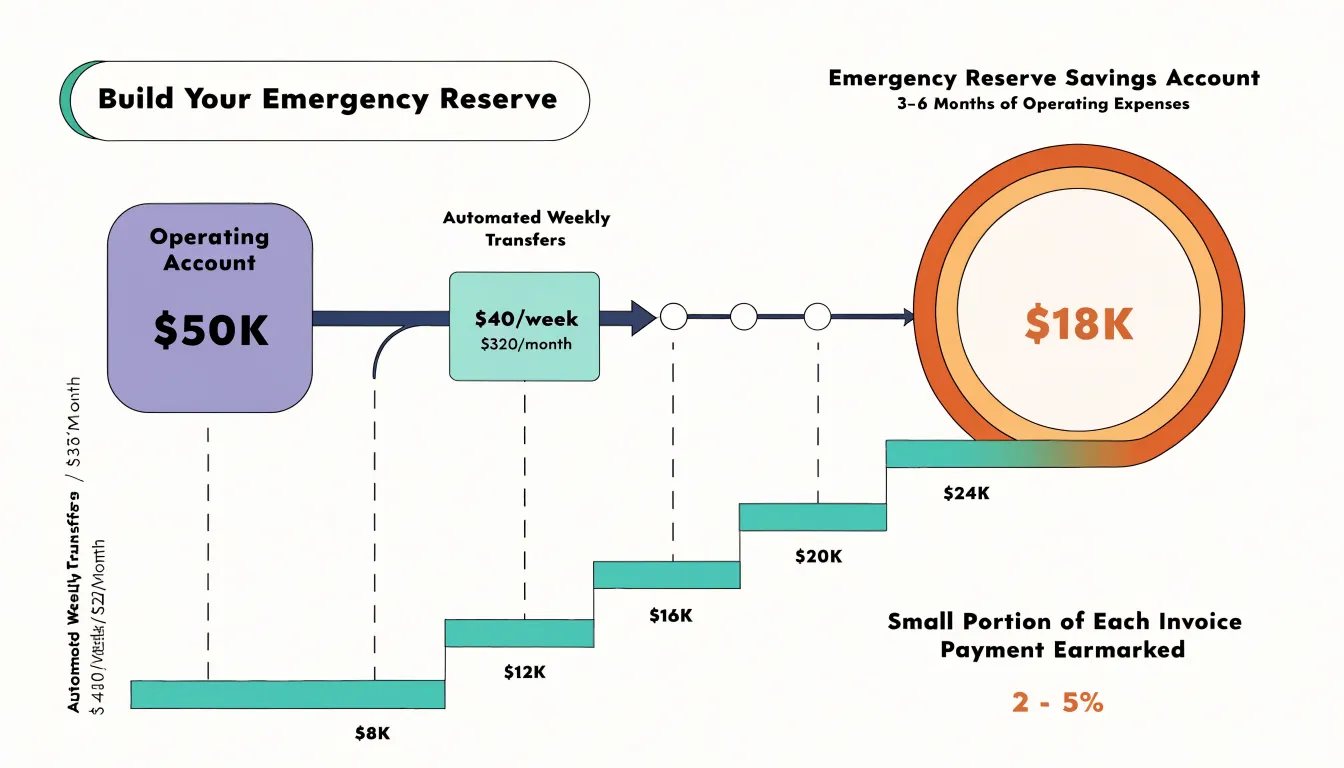
Building the reserve gradually is more realistic than trying to fund it all at once. Start by setting a small, achievable goal—perhaps one week of operating expenses—and automate a transfer from your checking account to your reserve account on a weekly or monthly basis. Treat that transfer like any other fixed bill. Whenever you have a surplus, such as a strong sales month or a tax refund, direct a portion of it to the reserve. You can also earmark a percentage of each invoice payment, say 2–5%, to go into the reserve until you reach your target. Review your progress quarterly and adjust the contribution amount as your cash flow allows. The key is consistency: even small, regular deposits add up over time and create a habit of saving that strengthens your business’s financial resilience.
Tax Planning Basics
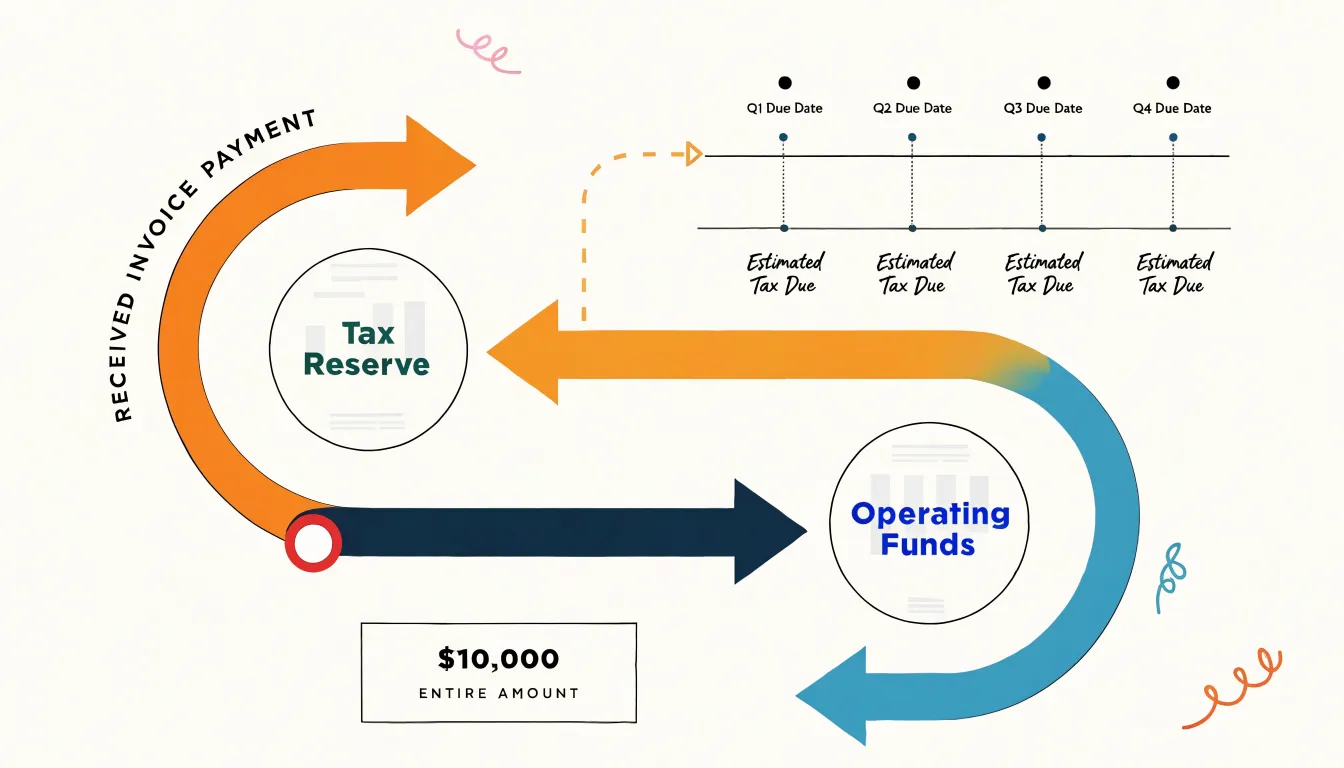
Tax planning for a small business begins with understanding that income tax is generally paid as you earn money throughout the year, rather than in a single lump sum at filing time. Because no employer is withholding on your behalf, the responsibility for sending money to the tax authority falls on you. Estimated tax payments are the mechanism for this. Most jurisdictions divide the year into four payment periods, and each installment covers your expected tax liability for that portion of the year. The amounts are based on your projected income, so the accuracy of your payments depends on how well you forecast revenue and expenses.
A practical starting point is to set aside a fixed percentage of every payment you receive, rather than waiting to see what remains at the end of a quarter. When a client pays an invoice, move a predetermined share into a dedicated tax account the same day. This approach keeps the money separate from operating funds and reduces the temptation to spend it on short-term needs. The exact percentage depends on your tax bracket, local rates, and whether you owe self-employment taxes, so reviewing it with an accountant once a year helps keep the figure realistic. The reserve can then fund each quarterly payment without drawing on working capital.
Safe harbor rules offer a second layer of protection. These provisions generally allow you to avoid underpayment penalties if your payments equal a specified percentage of your prior year’s tax liability, or a high percentage of your current year’s liability, whichever is smaller. Meeting one of these thresholds means that even if your income rises unexpectedly, the penalty for underpayment during the year is limited. Business owners with uneven or seasonal revenue often rely on the prior-year safe harbor because it makes the required installment amount predictable and easy to budget for.
Putting these pieces together creates a routine: track income monthly, transfer the set-aside percentage regularly, and compare cumulative payments against the safe harbor figure before each due date. That rhythm turns tax obligations into a scheduled operating cost and removes the year-end scramble that catches many small businesses off guard.
When to hire professional bookkeeping help versus managing finances yourself
Small business owners often begin by handling their own bookkeeping, and for a while this arrangement can work well. As the business evolves, the demands of financial management shift, and recognizing the moment when outside help becomes worthwhile is an important skill. Growth is one of the clearest signals. When sales volume rises, transactions multiply across bank accounts, payment platforms, and credit cards, and the hours required to record and reconcile them grow accordingly. A business that once needed an hour a week may suddenly demand several hours, and those hours compete directly with sales, customer service, and product development. Complexity offers another signal. Hiring employees brings payroll, tax withholding, and benefits administration. Holding inventory introduces cost-of-goods tracking. Adding a second entity, taking on a partner, or selling across state lines creates filing obligations that are easy to miss. Each new element raises the cost of an error and the difficulty of catching it after the fact. Time constraints complete the picture. Many owners find that evenings and weekends disappear into receipt sorting and account reconciliation, leaving little room for rest or strategic thinking. When bookkeeping consistently crowds out higher-value work, the math has quietly changed.
The cost-benefit tradeoff deserves careful thought. Doing the work yourself saves the direct fee, and that fee can feel significant for a young company. Against that saving, weigh the indirect costs: hours that could generate revenue, the risk of missed deductions, late filings, and penalties, and the difficulty of making decisions without clean, current numbers. A bookkeeper typically charges an hourly rate or a flat monthly fee, and the level of service can scale with the business. Many owners start with a monthly package covering reconciliation and reports, then add services as needs grow. An accountant becomes valuable for tax planning, entity structure questions, and financial analysis. The practical approach is to estimate the hours you spend each month on financial tasks, assign a value to that time, and compare the total to a quote from a local bookkeeper. When the comparison favors outsourcing, or when errors and stress are mounting, hiring help is a sound investment in accuracy, compliance, and peace of mind.
Frequently Asked Questions
Why is it important to keep personal and business finances separate?
A dedicated business bank account creates a clean boundary so every business transaction can be traced and organized for tax time. Commingling funds can make deductions harder to substantiate, and courts or creditors may look past an LLC’s or corporation’s liability protection when personal and business money are blended.
How can I set up bookkeeping if I don’t have an accounting background?
Choose accounting software that matches your business and connects directly to your bank and credit card accounts, then do a weekly receipt routine and keep a short chart of accounts. Formal accounting training is not required; consistency and simple habits carry most of the weight.
What is the difference between profit and cash flow?
Profit is revenue minus expenses over a period, typically recorded when a sale is made or an expense is incurred, while cash flow tracks the actual movement of money in and out of your bank account. A business can be profitable on paper yet run out of cash because of timing gaps between receivables and payables.
How much should a small business keep in an emergency reserve?
A common guideline is three to six months’ worth of operating expenses; use three as a baseline, or six if your industry is seasonal, revenue is unpredictable, or you have few credit options. Keep the funds readily accessible and separate from your day-to-day operating account, such as in a dedicated savings or money market account.
How should I handle small business taxes throughout the year?
Income tax is generally paid as you earn money throughout the year, and estimated tax payments are the mechanism for sending money to the tax authority because no employer is withholding on your behalf. Set aside a fixed percentage of each payment in a dedicated tax account, and review safe harbor rules to limit underpayment penalties.
When should I hire a bookkeeper instead of managing finances myself?
Consider hiring when sales volume and transactions grow, when complexity increases through payroll, inventory, multiple entities, or state filings, or when bookkeeping consistently crowds out higher-value work. Compare the hours you spend on financial tasks and their value to a bookkeeper’s quote; when outsourcing favors that comparison or errors and stress are mounting, hiring help is a sound investment.