
Fixed Costs
A fixed cost is an expense that stays the same regardless of usage or business activity, typically set by contract, such as rent, mortgage payments, insurance premiums, salaried wages, and loan repayments. Fixed costs are known in advance and do not change with production or sales volume, unlike variable costs such as raw materials or hourly labor.
Table of Contents
- What makes an expense fixed instead of variable
- Common personal fixed costs that dominate monthly household budgets
- Business fixed overhead
- How to identify semi-variable expenses hiding as fixed obligations
- Why tracking fixed costs is the foundation of an accurate break-even analysis
- Fixed costs versus variable costs
- Can you actually negotiate or lower your fixed recurring bills
- How inflation impacts fixed expenses over long periods
What makes an expense fixed instead of variable
An expense is classified as fixed when it meets three key criteria: it arises from a contractual obligation, it involves a set amount, and it remains independent of usage. These criteria provide a clear framework for distinguishing fixed costs from variable ones.
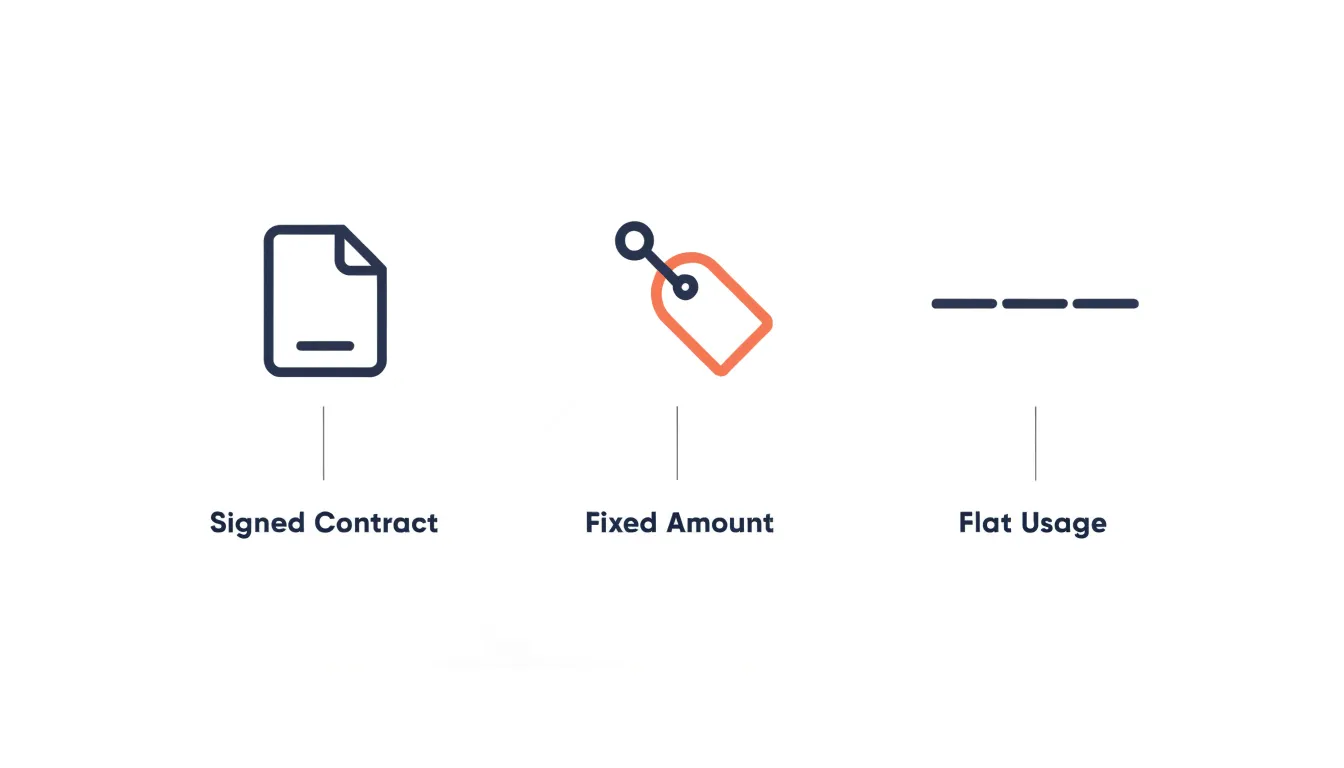
First, a fixed expense typically stems from a contractual obligation. This means the company has entered into an agreement that requires payment regardless of business activity. For example, a lease agreement obligates the tenant to pay rent for the entire term, even if the space is underutilized. Similarly, insurance premiums are paid according to a policy contract, and loan repayments follow a promissory note. The contractual nature ensures the payment is predictable and enforceable.
Second, the amount is set. Fixed costs do not fluctuate with production or sales volume; they are incurred in a consistent amount over a specified period. This set amount can be a flat fee, such as a monthly software subscription, or a predetermined schedule, like annual property taxes. The key is that the amount is known in advance and does not change based on how much the business operates.
Third, fixed costs are independent of usage. Whether the business produces zero units or a thousand units, the expense remains the same. For instance, a factory’s property tax does not increase if the factory runs an extra shift. In contrast, variable costs, such as raw materials or hourly labor, rise and fall with output. The independence from usage means fixed costs provide capacity but do not vary with activity level.
To classify any expense, apply a quick test: Ask, “Does this expense change if the business activity changes?” If the answer is no—the expense stays the same regardless of how much the business produces or sells—then it is fixed. Additionally, check for a contract and a set amount to confirm. If the expense varies with usage, it is variable. Some costs may have both fixed and variable components (mixed costs), but the test helps isolate the fixed portion. By applying these criteria, businesses can accurately categorize expenses for budgeting and decision-making.
Common personal fixed costs that dominate monthly household budgets
For most households, the largest share of the monthly budget is claimed by a small group of recurring obligations that arrive whether or not the month has been good. Housing sits at the top of the list, taking the form of a mortgage payment or a rent cheque. A mortgage bundles principal, interest, property taxes, and often homeowner’s insurance into a single predictable instalment, while rent functions as a fixed charge set by a lease. Either way, the amount is known in advance and falls due on the same date every month, which makes it the anchor around which the rest of the budget is arranged.
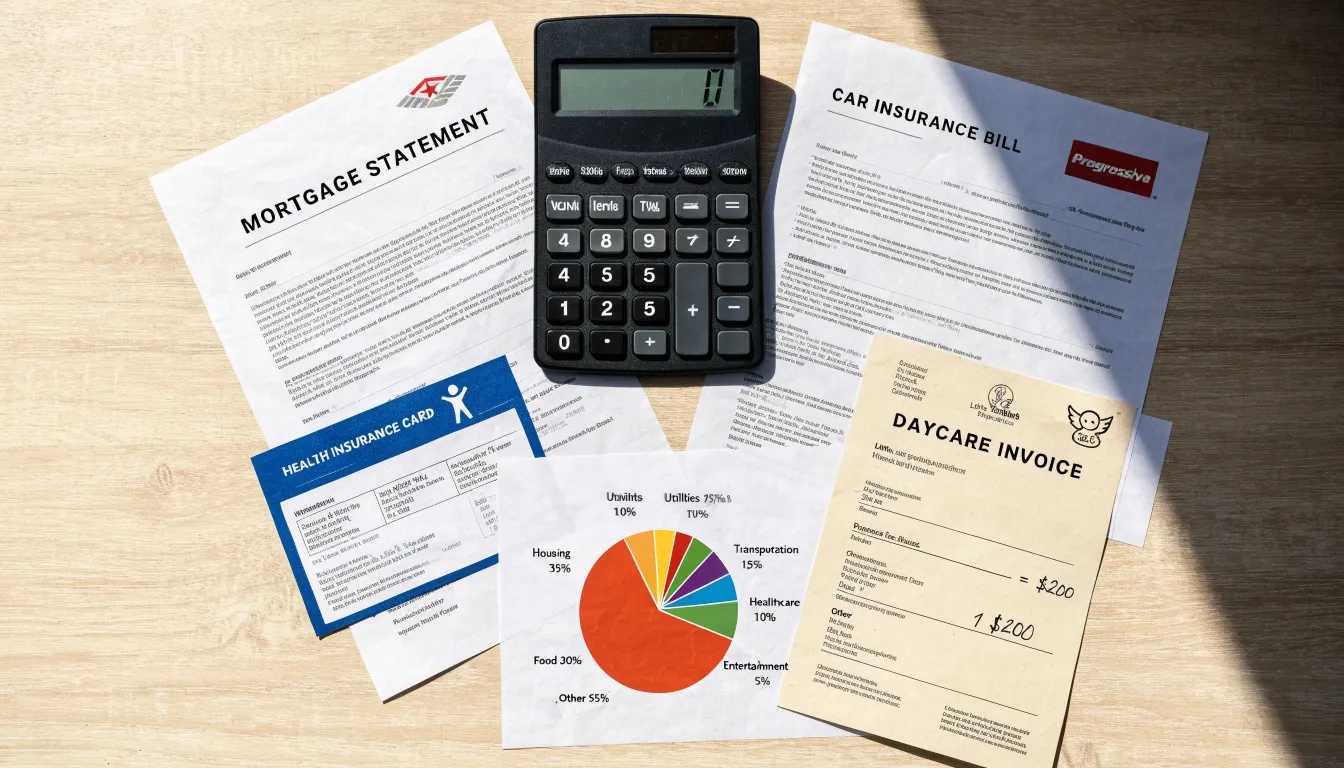
Transportation follows close behind. Car payments on a financed vehicle are a classic fixed cost, set at signing and unchanged for the life of the loan. Alongside the payment sit insurance premiums, which are typically billed monthly or annually and adjust only at renewal. Drivers who commute long distances also carry predictable fuel and maintenance allowances, though the strictest fixed item remains the loan instalment itself.
Insurance of other kinds threads through the household budget as well: health coverage, life insurance, renters or homeowner policies, and sometimes disability coverage. These premiums rarely fluctuate month to month, and many are deducted automatically, which means they leave the account quietly and without a decision being made each time.
Childcare is another substantial fixed commitment for families with young children. Whether a daycare centre, an after-school programme, or a nanny, the weekly or monthly fee is arranged in advance and must be paid to keep a job. Student loan repayments and personal loan or credit instalments round out the picture, each with a scheduled payment that recurs until the balance is cleared.
The reason these items dominate a household budget is straightforward: they are contractual, recurring, and difficult to reduce quickly. A lease, a loan agreement, or an insurance policy locks the amount in place for months or years, and each one must be satisfied before discretionary spending can occur. Because they are paid first and rarely renegotiated, fixed costs tend to absorb the majority of take-home income, leaving a smaller remainder for food, utilities, savings, and everything else.
Business fixed overhead
Business fixed overhead refers to the essential costs a company must pay simply to keep its doors open, regardless of how much it sells in any given period. These are the foundational expenses that underpin daily operations and allow a business to function at even the most basic level. Common examples include rent or mortgage payments on commercial space, salaries for permanent staff, insurance premiums, and equipment leases. Each of these costs appears on the books whether the business enjoys a record-breaking sales month or endures a slow quarter with barely any revenue coming in.
Rent is perhaps the clearest illustration. A retail store, restaurant, or office must secure physical space before it can serve a single customer, and the landlord expects payment on the first of the month no matter what the sales figures look like. Similarly, salaried employees such as managers, administrative staff, and full-time specialists receive their agreed-upon pay regardless of fluctuations in demand. Insurance premiums for property, liability, and workers’ compensation must be maintained continuously to protect the business and satisfy legal requirements. Equipment leases, whether for machinery, vehicles, or office technology, carry contractual payment obligations that persist independently of production levels.

The defining characteristic of these costs is their unavoidability. A business cannot simply decide to skip a rent payment during a slow season or pause insurance coverage when cash flow tightens. These obligations are typically contractual and often legally binding, and failing to meet them can result in eviction, legal action, or the loss of essential coverage. This is why fixed overhead is treated as a permanent structural feature of the business model rather than a variable expense that can be trimmed at will.
Understanding fixed overhead is crucial for financial planning because it establishes the minimum revenue a business must generate just to break even. Before earning any profit, the company must first cover these baseline obligations. Businesses with high fixed costs carry greater risk during downturns, since their expenses remain steady while income may fall sharply. Recognizing and accurately calculating fixed overhead helps owners set appropriate pricing, forecast cash needs, and make informed decisions about expansion or cost restructuring.
How to identify semi-variable expenses hiding as fixed obligations
Semi-variable costs sit in the gray zone between fixed and variable expenses, and that ambiguity makes them some of the most commonly misclassified items in a personal or business budget. A semi-variable cost has two components: a baseline charge you pay regardless of activity, and a usage-driven portion that rises or falls with consumption. Utility bills are the classic example. Your electricity provider may charge a fixed connection or service fee every month no matter how much power you draw, then layer per-kilowatt-hour charges on top. The same structure appears in phone plans with base access fees plus data overages, water bills with meter charges plus volume rates, and even some subscription services that bundle a flat rate with per-use or per-seat pricing. Business owners see it in payroll that combines salaries with commission, or in equipment leases that carry a flat monthly payment plus per-hour usage fees.
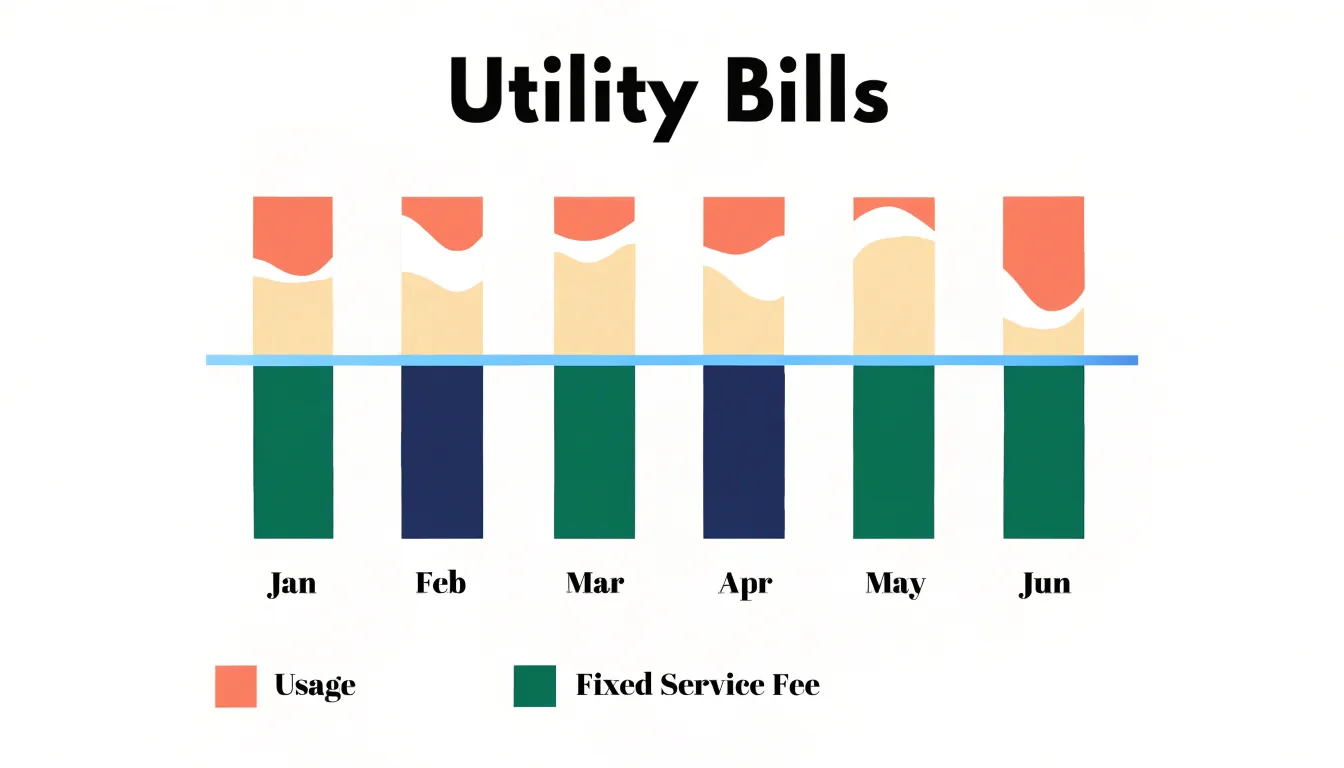
The trouble arises because these expenses often land in a budget looking like a single predictable line item. You glance at six months of utility statements, see figures in a similar range, and file the expense under fixed costs. That classification then distorts your planning: your fixed-cost baseline appears higher than it truly is, your variable spending looks lower, and you lose visibility into the portion of the bill you can actually influence through behavior change.
Spotting semi-variable costs takes a bit of forensic attention. Start by reading the breakdown on your statements rather than the total. Look for language like base fee, service charge, connection fee, or minimum monthly charge. Any bill that itemizes a flat component alongside a metered component is a candidate. Next, compare several months side by side. A truly fixed expense holds nearly constant, while a semi-variable one will show a stable floor with peaks and dips above it. The floor is your fixed portion; the fluctuations are variable. If you can identify the floor, you can split the line item into two budget entries. Finally, ask a simple question of every recurring expense: if I used none of this service this month, what would I still owe? The answer isolates the fixed component and reveals the semi-variable nature hiding beneath a single number. Separating these costs sharpens your fixed-cost picture and gives you a more honest view of what you can control.
Why tracking fixed costs is the foundation of an accurate break-even analysis
Fixed costs form the stable base on which every break-even calculation rests. These are the expenses a business incurs regardless of how much it sells: rent, insurance premiums, salaried wages, software subscriptions, loan interest, and depreciation on equipment. Because they do not fluctuate with output, they can be totaled with confidence and used as a reliable anchor for planning. A break-even analysis asks a simple question: how much revenue must the business generate before it covers everything it spends? That answer depends entirely on knowing the fixed cost total. The formula itself makes the dependency clear. The break-even point equals total fixed costs divided by the contribution margin per unit, which is the selling price minus variable cost per unit. Without an accurate fixed cost figure, the calculation produces a number that looks precise but is built on guesswork. Understate fixed costs and the break-even point appears lower than reality, inviting the business to celebrate profits that have not actually been earned.
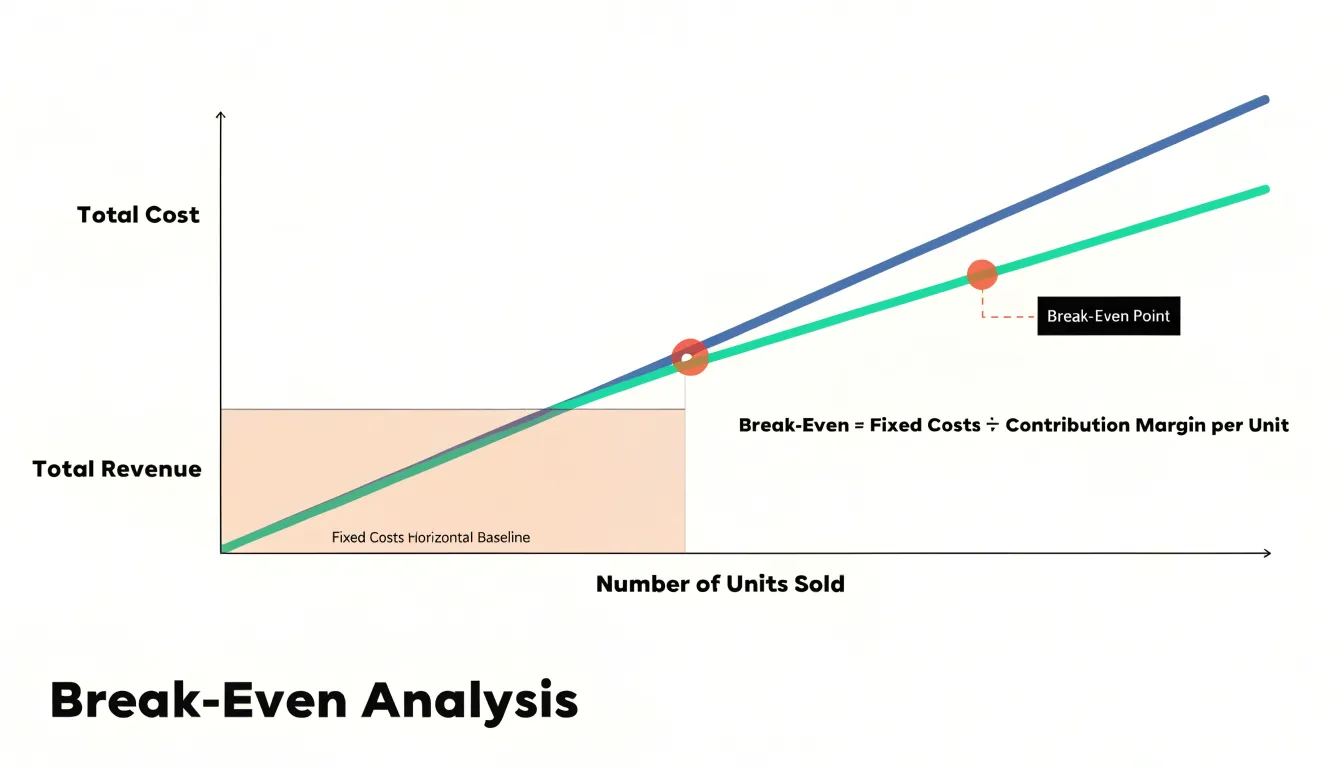
Once the fixed cost total is known, the break-even point becomes a concrete sales target rather than an abstraction. A business can translate it into units sold, revenue generated, or customers served, and then compare those targets against current performance. This turns a static number into a management tool: if the break-even threshold sits at 1,200 units per month and the team consistently sells 900, the gap is visible and actionable. Targets can also be adjusted for seasonality, new hires, or planned expansion, since adding a fixed cost like a second location immediately shifts the threshold.
The same figure supports pricing and cost-cutting decisions. When fixed costs are high, contribution margin per unit must be correspondingly larger to clear the break-even bar, which informs how aggressively a business prices its products. Alternatively, the analysis can reveal that renegotiating rent or consolidating software licenses lowers the fixed cost base and pulls the break-even point down, reducing the sales volume needed to become profitable. Tracking fixed costs consistently also surfaces trends over time, showing whether overhead is creeping upward and outpacing revenue growth. In each case, the fixed cost number is the input that makes the downstream decision meaningful, which is why disciplined tracking of these expenses is the first practical step toward any credible break-even analysis.
Fixed costs versus variable costs
Understanding the distinction between fixed and variable costs gives a budgeter a clearer picture of how money moves through any given month. Fixed costs are those expenses that stay the same regardless of activity level. Rent, mortgage payments, insurance premiums, subscription services, and salaried wages all fall into this category. Because these amounts repeat predictably, a budgeter can plan for them well in advance and know with confidence what portion of income is already committed before the month begins. Variable costs, by contrast, fluctuate with usage or behavior. Groceries, utilities, fuel, entertainment, and discretionary purchases shift from one period to the next depending on choices and circumstances.
Predictability is the most immediate difference. Fixed costs form the stable backbone of a budget, which makes forecasting straightforward. Variable costs require estimation and ongoing tracking, since a spike in heating bills during winter or an unexpected run of social spending can throw off a plan. A budgeter who treats variable costs as fixed is likely to be surprised repeatedly, while one who builds in realistic ranges for them can absorb normal fluctuation without stress.
Control operates differently across the two categories as well. Fixed costs are typically set by contracts and long-term commitments, so changing them takes effort and often negotiation. Variable costs respond directly to daily decisions, giving the budgeter meaningful leverage. Trimming a grocery list, adjusting the thermostat, or pausing a streaming service are quick ways to influence the bottom line. The practical lesson is to focus discretionary energy on the variable side while reviewing fixed commitments periodically for renegotiation or elimination.
Impact on cash flow ties these threads together. Fixed costs create a predictable baseline outflow, which makes them easier to automate and schedule around pay cycles. Variable costs introduce uncertainty, so a cushion in the budget protects against months when they run high. Consider a household with a $1,500 mortgage, a $200 insurance premium, and a $60 phone plan as fixed items, alongside variable expenses like a $400 grocery bill, a $120 utility bill, and $150 in entertainment. The fixed total is knowable in advance; the variable total must be watched. Tracking both separately reveals where money is truly locked in and where flexibility lives, which is the foundation of effective budgeting.
Can you actually negotiate or lower your fixed recurring bills
Fixed costs often feel immovable because they arrive on a schedule and carry the weight of obligation, but a surprising number of them respond to pressure when you apply it deliberately. The first practical strategy is renegotiating existing contracts. Providers of internet, mobile, insurance, and utilities frequently maintain retention departments whose job is to keep customers who signal they might leave. Calling with a specific competitor quote in hand, asking for the retention team directly, and being polite but firm about your willingness to switch can yield meaningful reductions on bills you assumed were set in stone. The key is preparation: know your current rate, know what alternatives cost, and ask for a concrete concession rather than a vague discount.
Switching providers overlaps with renegotiation but applies when a company will not budge. Competitive markets for energy, telecoms, and insurance reward customers who comparison-shop periodically. The effort is front-loaded, and the savings compound month after month.
For debt-heavy fixed costs, refinancing loans deserves attention. Mortgage refinancing, consolidating credit card balances, or renegotiating loan terms during periods of lower interest rates can reduce monthly obligations substantially. Refinancing carries its own costs and paperwork, so run the numbers on the break-even period before committing.
Subscription auditing is the simplest and most overlooked tactic. Recurring charges for streaming services, software, gyms, and memberships accumulate quietly. A monthly review of your bank and card statements, canceling what you no longer use, and negotiating annual rates for what you keep can recover hundreds of dollars a year with minimal effort.
Expectations should stay realistic. Some fixed costs are genuinely rigid, such as regulated utility base rates or lease obligations. Savings from these strategies typically range from modest to substantial rather than transformative, and results depend on your market, credit standing, and willingness to spend time on hold. The payoff is cumulative: shaving even small amounts from several recurring bills each year creates durable breathing room in your budget, and revisiting these costs annually keeps them from creeping back up.
How inflation impacts fixed expenses over long periods
Inflation affects fixed expenses in ways that accumulate quietly over long periods. A rent set at a certain level today will likely be renegotiated at a higher level in five or ten years, and an insurance premium that feels manageable now will drift upward with each renewal cycle as insurers adjust for rising replacement costs, medical costs, and general price levels. Even expenses that seem locked in by contract, such as a multi-year lease with scheduled escalators, carry built-in increases that reflect anticipated inflation. The result is that a budget built on today’s fixed costs will gradually become inaccurate, often without any single dramatic change to point to.
The compounding effect deserves attention. At a modest 3 percent annual inflation rate, a fixed expense of 1,000 grows to roughly 1,340 after ten years and about 1,800 after twenty. These increases arrive in small increments that are easy to absorb one at a time, yet their cumulative weight can strain a long-term budget significantly. Households that plan around nominal figures without accounting for this drift often find their fixed commitments consuming a larger share of income each year, leaving less room for savings and discretionary spending.
Planning for gradual increases begins with treating fixed costs as slow-moving variables rather than constants. One practical approach is to build an annual inflation assumption into long-term projections, then review actual renewal notices and lease terms against that assumption. If actual increases run higher than expected, the budget can be adjusted early rather than after a shortfall appears.
Another strategy is to create a dedicated buffer, sometimes called a cost-escalation fund, that absorbs predictable increases. Setting aside a small percentage of fixed costs each year means renewal bumps can be covered without disrupting other priorities. It also helps to track the renewal dates of insurance policies, leases, and service contracts so that increases never arrive as surprises and can be negotiated or comparison-shopped in advance. When signing long-term agreements, reviewing escalation clauses carefully and favoring predictable, capped increases over open-ended adjustments can protect against sharper rises.
Finally, build periodic reviews into the budgeting routine. Revisiting fixed costs annually to compare current amounts with prior years reveals the pace of increase and allows the long-term plan to stay aligned with reality.
Frequently Asked Questions
What makes an expense fixed instead of variable?
An expense is fixed when it arises from a contractual obligation, involves a set amount, and remains independent of usage. A quick test is to ask whether the expense changes if business activity changes; if it stays the same, it is fixed.
What are common fixed costs in a household budget?
Common household fixed costs include housing payments such as mortgage or rent, car payments, insurance premiums, childcare fees, and student or personal loan repayments. These are contractual, recurring obligations that are difficult to reduce quickly.
What is business fixed overhead?
Business fixed overhead is the essential cost a company must pay to keep its doors open regardless of how much it sells. Common examples include commercial rent or mortgage payments, salaries for permanent staff, insurance premiums, and equipment leases.
How can I tell if an expense is semi-variable?
A semi-variable cost has a baseline charge paid regardless of activity plus a usage-driven portion that rises or falls with consumption. To spot one, read the statement breakdown, compare several months side by side, and ask what you would still owe if you used none of the service.
Why is tracking fixed costs important for break-even analysis?
Fixed costs are the stable base for break-even analysis, which divides total fixed costs by contribution margin per unit. Without an accurate fixed cost figure, the break-even point can look precise but be built on guesswork.
How does inflation affect fixed expenses over time?
Inflation causes fixed expenses such as rent and insurance to drift upward over long periods, even when contracts include scheduled escalators. At a modest 3 percent annual inflation rate, a fixed expense of 1,000 grows to roughly 1,340 after ten years and about 1,800 after twenty.