
GAAP vs IFRS
GAAP is a rules-based US framework with detailed, prescriptive guidance, while IFRS is a principles-based international framework built on broad concepts and professional judgment. GAAP prohibits LIFO inventory and asset revaluations; IFRS bans LIFO but permits revaluation. Revenue and lease standards are largely converged, though application differences persist.
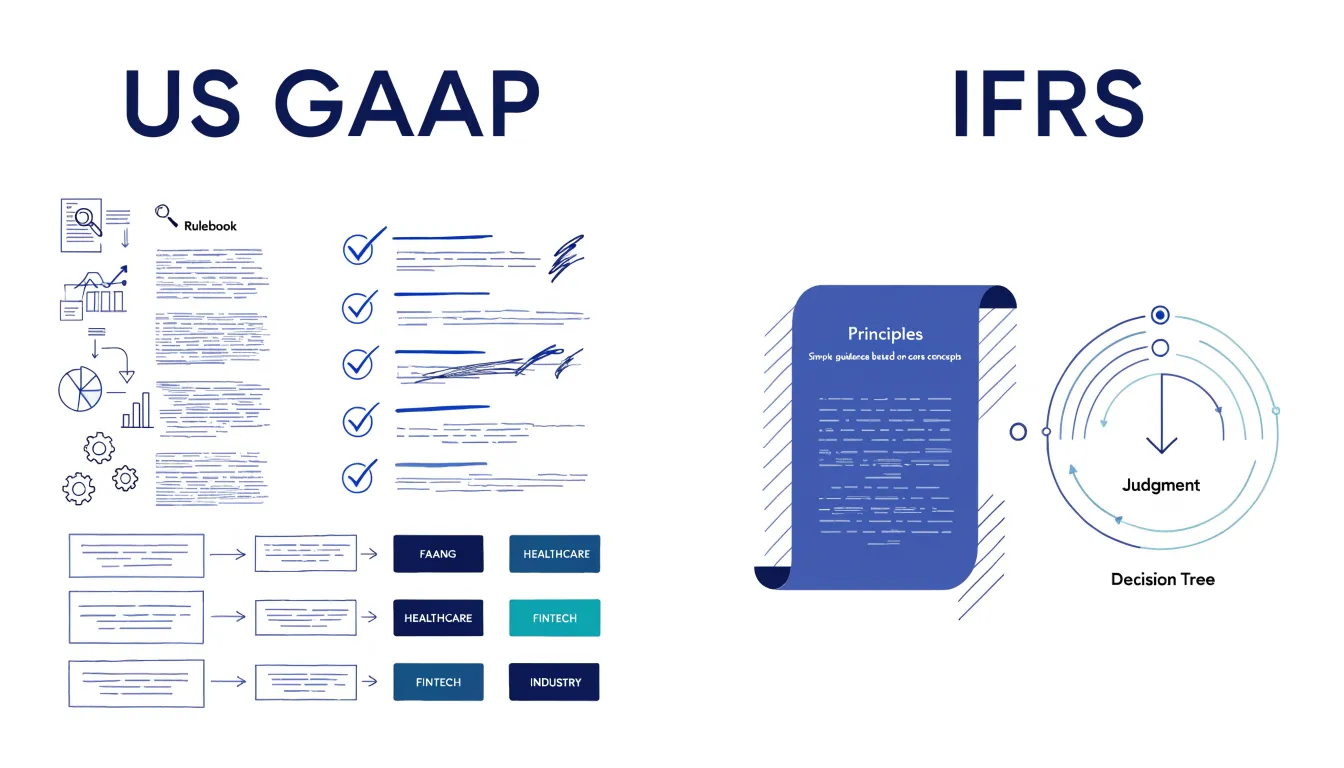
Table of Contents
- Core philosophy behind rules based and principles based frameworks
- Why do the United States and international markets use different standard systems
- Inventory valuation methods
- Treatment of balance sheet items and asset revaluation rules
- How do revenue recognition guidelines differ across global borders
- Lease accounting standards
- Practical challenges for multinational companies consolidating financial reports
- Is a single unified global accounting system actually realistic for investors
Core philosophy behind rules based and principles based frameworks
The core philosophy behind a rules-based framework such as US GAAP centers on providing detailed, prescriptive guidance for nearly every conceivable transaction and circumstance. Under this approach, standard setters anticipate specific situations and issue explicit instructions on how each should be recognized, measured, and disclosed. The result is a vast body of literature, including bright-line thresholds, industry-specific guidance, and step-by-step implementation instructions. The appeal of this structure lies in its consistency: two accountants examining the same transaction should arrive at the same treatment because the rules dictate the answer. This reduces ambiguity and makes outcomes predictable for auditors, regulators, and investors, and it offers a clear reference point when disputes arise. The trade-off is volume and complexity; preparers must navigate extensive guidance, and the sheer specificity can encourage a checkbox mentality in which compliance with the letter of the rules takes precedence over capturing the economic substance of a transaction.
IFRS takes a principles-based approach, built on broad, internally consistent concepts rather than exhaustive instructions. Standards articulate the underlying objective, such as faithfully representing the economic reality of a transaction, and leave the application to professional judgment. Accountants and auditors assess the facts and circumstances of each situation and determine the treatment that best reflects the principles. This approach offers flexibility and adaptability, allowing the framework to accommodate novel transactions and evolving business models without constant amendment. It also keeps the standards more concise and encourages preparers to reason about substance rather than search for a technical loophole. The trade-off is that judgment introduces variability; reasonable professionals may reach different conclusions on similar facts, requiring robust disclosure and strong audit oversight to preserve comparability. In practice, the two philosophies reflect different regulatory cultures and enforcement environments, and each framework blends rules and principles to some degree, with the emphasis determining how much discretion rests with the preparer.
Why do the United States and international markets use different standard systems
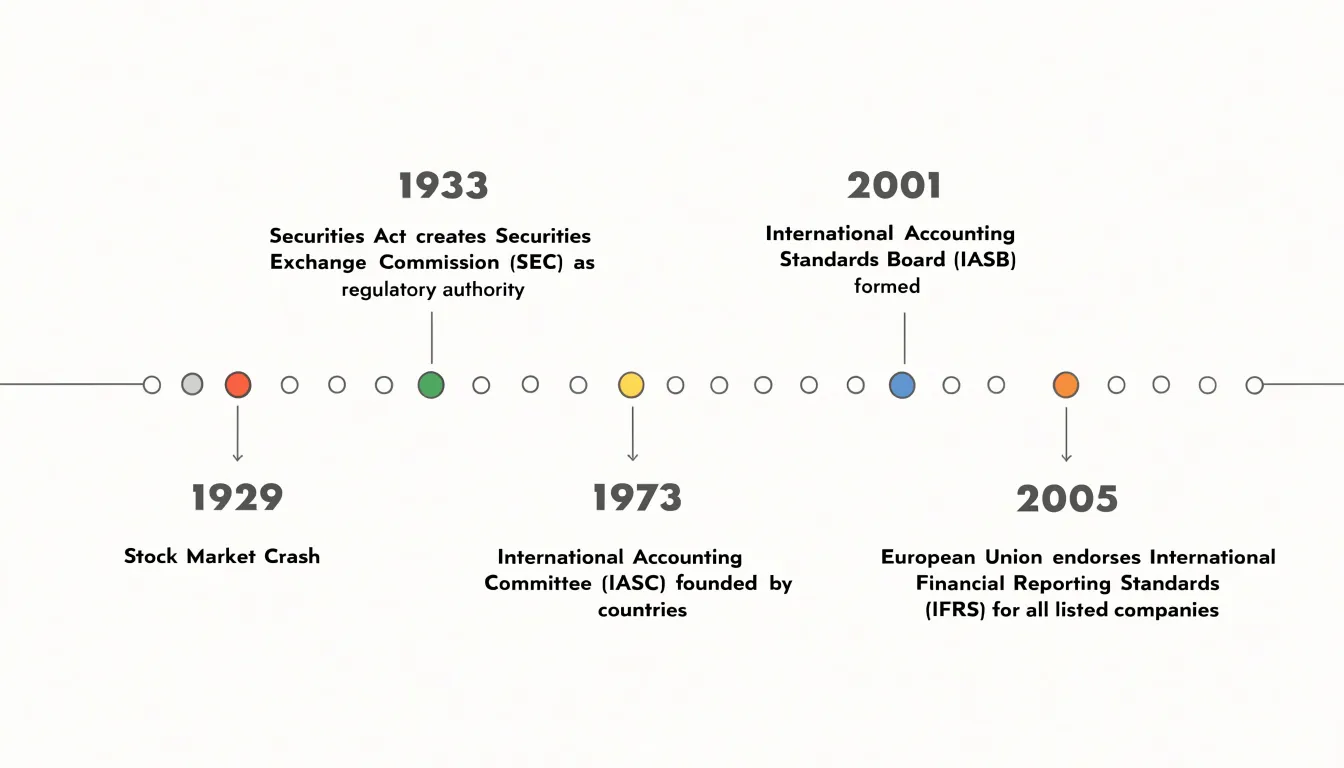
The divergence between GAAP and IFRS traces back to the different paths taken by capital markets after the industrial revolutions of the nineteenth and early twentieth centuries. In the United States, the growth of large public corporations and a dispersed shareholder base created demand for standardized financial reporting early on. Private professional bodies such as the American Institute of Accountants began codifying accepted practice in the 1930s, and these efforts gradually accumulated into what became generally accepted accounting principles. The stock market crash of 1929 and the Securities Act of 1933 gave this process a regulatory anchor, since the newly created Securities and Exchange Commission was granted authority to establish reporting standards for listed companies. The SEC chose to delegate detailed standard setting to the private sector, first to the Committee on Accounting Procedure, later to the Accounting Principles Board, and from 1973 to the Financial Accounting Standards Board. This arrangement produced a rules-based body of guidance built up piece by piece within a single national jurisdiction.
Outside the United States, the picture was more fragmented. European and Asian economies developed their own national standards, often shaped by tax law and banking relationships rather than by public equity markets. As cross-border trade and investment accelerated in the postwar decades, multinational companies faced the burden of preparing multiple sets of accounts. In 1973, accountancy bodies from nine countries formed the International Accounting Standards Committee to harmonize practice, and its work evolved into the International Accounting Standards Board in 2001. The IASB operates as an independent, privately funded standard setter with a global mandate, and its standards, IFRS, were progressively endorsed by national regulators and by the European Union, which required listed companies to apply them from 2005.
A further factor is the difference in oversight structures. GAAP sits within a national regulatory framework where the SEC retains statutory authority and can intervene directly in standard-setting disputes. The IASB answers to a diverse set of national endorsers and trustees rather than to a single government agency, which shapes both its governance and the principles-based character of its standards. The result is two mature but distinct systems, each reflecting the legal, economic, and institutional history of its market.
Inventory valuation methods
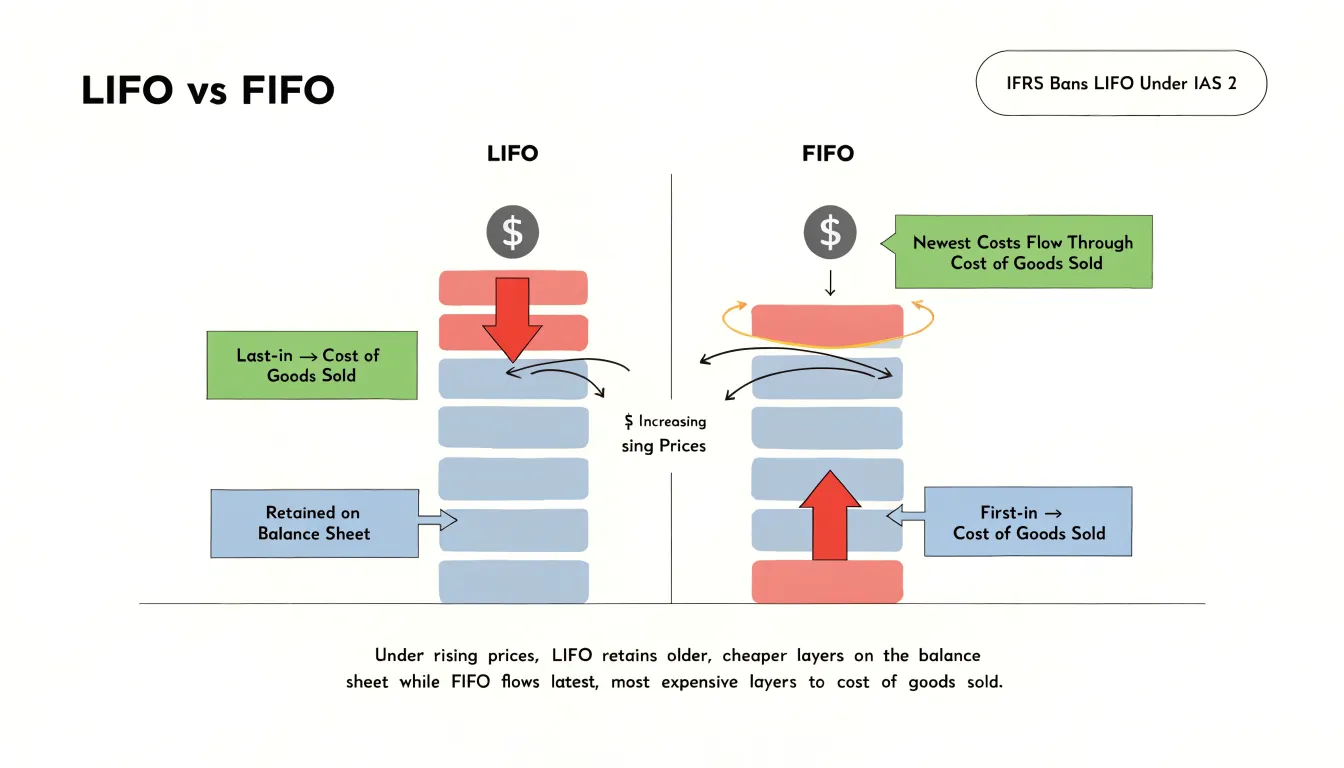
Inventory valuation sits at the center of one of the most consequential differences between GAAP and IFRS, and the divide runs directly through the last-in, first-out method. Under US GAAP, companies may choose among several cost-flow assumptions, including LIFO, FIFO, and weighted average cost. IFRS takes a narrower position: IAS 2 prohibits LIFO entirely, permitting only FIFO and weighted average cost. Understanding why this split exists, and what it means in practice, helps explain why otherwise similar companies can report very different numbers depending on their reporting framework.
The rationale for the prohibition rests largely on the IFRS conceptual framework’s emphasis on faithful representation of financial position. Under LIFO, older, often lower costs remain on the balance sheet as inventory while recently purchased, typically higher costs flow through the income statement. In periods of rising prices, this can leave inventory carrying amounts far below current replacement cost, which IFRS standard-setters view as failing to represent the economic resources the entity actually holds. US GAAP, by contrast, has historically accommodated LIFO because of its long-standing link to tax practice and because it is understood as a systematic allocation of cost rather than a statement of current value.
The tax connection is a major reason LIFO persists in the United States. US tax rules require that companies using LIFO for tax purposes also use it for financial reporting, a conformity requirement that creates a strong incentive to adopt the method. During inflationary periods, LIFO raises cost of goods sold, lowers taxable income, and defers tax payments, producing a real cash-flow benefit. Because IFRS disallows LIFO, companies reporting under IFRS cannot access this deferral mechanism, and the prohibition removes the need for the complex LIFO reserve disclosures that US filers provide.
The statement effects are substantial. LIFO tends to depress reported inventory balances and, during rising prices, reduce net income relative to FIFO, while also producing higher cost of goods sold. When prices fall, the pattern reverses and LIFO can produce liquidation gains as older layers are consumed. Comparability suffers accordingly: two otherwise identical companies, one reporting under GAAP with LIFO and one under IFRS with FIFO, will show different margins, different asset bases, and different return ratios. Analysts often restate LIFO results to a FIFO basis to make cross-border comparisons meaningful, a routine adjustment that underscores how deeply this single methodological choice shapes the financial statements.
Treatment of balance sheet items and asset revaluation rules
The valuation of assets on the balance sheet represents one of the more consequential divergences between US GAAP and IFRS, and the revaluation model sits at the center of that divergence. Under IFRS, entities may elect either the cost model or the revaluation model for classes of property, plant, and equipment as well as intangible assets, provided an active market exists to establish fair value reliably. When the revaluation model is applied, carrying amounts are adjusted to fair value at each reporting date, with upward adjustments recognized in other comprehensive income and accumulated in equity as a revaluation surplus. Downward adjustments generally flow through profit or loss to the extent they exceed any previously recorded surplus for the same asset. The election is made by asset class and must be applied consistently to all items within that class, which prevents companies from cherry-picking individual assets for revaluation.
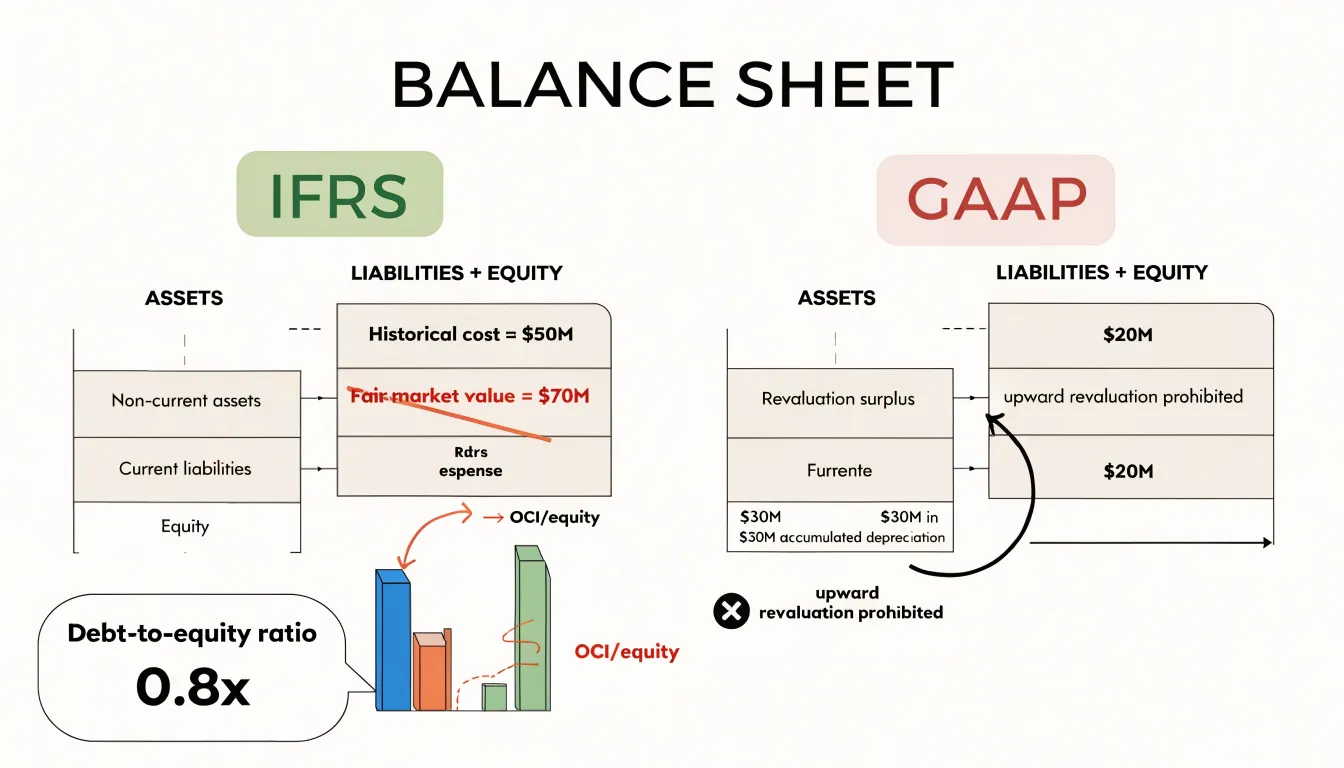
US GAAP takes a narrower position. Property, plant, and equipment are carried at historical cost less accumulated depreciation and impairment, and upward revaluations are prohibited. Once an impairment loss is recognized under GAAP, reversal is not permitted, whereas IFRS allows reversal of impairment losses in certain circumstances, subject to a ceiling equal to the carrying amount that would have been determined had no impairment been recognized. The practical effect is that IFRS balance sheets can reflect current market values for long-lived assets, while GAAP balance sheets generally reflect depreciated historical cost.
These rules carry direct implications for balance sheet metrics. Companies applying the IFRS revaluation model may report higher total assets, higher equity through the revaluation surplus, and consequently lower leverage ratios such as debt-to-equity. Return on assets can shift as well, since a larger asset base dilutes the ratio even as depreciation expense rises on the revalued amount. Book value per share and tangible book value may diverge meaningfully between two otherwise comparable entities reporting under different frameworks. Analysts comparing companies across jurisdictions need to identify which model each entity applies and adjust accordingly, particularly when valuation multiples are anchored to book value. The revaluation surplus also affects equity composition, sitting in reserves rather than retained earnings, and may influence debt covenant calculations that reference balance sheet figures.
How do revenue recognition guidelines differ across global borders
Revenue recognition has become one of the most heavily harmonized areas of financial reporting worldwide. In 2014, the FASB and IASB issued substantially converged standards—ASC 606 in the United States and IFRS 15 internationally—built around a single five-step model: identify the contract with a customer, identify the performance obligations, determine the transaction price, allocate that price to the performance obligations, and recognize revenue as each obligation is satisfied. Because both frameworks share this core logic, a company applying either standard generally reaches the same conclusion about timing and measurement for straightforward sales of goods and services, which reduces the reconciliation burden for multinational groups and dual-listed issuers.
Convergence at the principle level, however, coexists with meaningful divergence in application and disclosure. One notable area is licensing. IFRS 15 distinguishes between a right to access intellectual property over time and a right to use it at a point in time, with specific criteria governing which applies, while ASC 606 historically provided more prescriptive guidance for certain entertainment and media licenses. Arrangements involving variable consideration, such as sales-based royalties, also invite differing judgments about constraint and estimation. Collectibility thresholds present another difference: IFRS 15 requires it to be probable that consideration will be received, whereas ASC 606 frames the criterion around whether collection is probable and ties the assessment more explicitly to credit risk. Practical expedients diverge as well, particularly around significant financing components and the capitalization of incremental costs to obtain a contract.
Disclosure requirements add further variation. Both standards mandate disaggregation of revenue, contract balances, and remaining performance obligations, yet the granularity and format of these disclosures are shaped by regional regulatory expectations, such as SEC comment letter practice in the United States versus national enforcer reviews in Europe. Transition approaches also differed in practice, producing comparability gaps across jurisdictions in the years following adoption.
For analysts comparing companies across borders, these residual differences matter most in complex, long-term, or IP-intensive contracts. Reviewing the accounting policy note and the disaggregated revenue disclosures remains the most reliable way to assess whether apparent performance differences reflect economics or reporting choices.
Lease accounting standards
The overhaul of lease accounting represents one of the most significant recent convergence efforts between US GAAP and IFRS. Under the new standards, ASC 842 and IFRS 16, both boards reached a shared conclusion that operating leases create liabilities and corresponding right-of-use assets that belong on the balance sheet. For lessees, this single principle aligned the fundamental recognition model across the two frameworks, ending the long-standing practice under legacy standards where many operating leases remained off-balance-sheet. Companies reporting under either regime now bring substantially similar populations of leases onto their statements, and the underlying measurement approach for the right-of-use asset and lease liability follows comparable logic in both systems.
The convergence story becomes more layered when examining how each standard treats the income statement and the practical details of application. IFRS 16 applies a single lessee model, recording a depreciation charge on the right-of-use asset alongside interest on the lease liability for essentially all leases. ASC 842 retains a dual classification structure, keeping the distinction between finance and operating leases and allowing operating leases to produce a straight-line expense profile. The result is that identical lease portfolios can generate different expense patterns and different balance sheet trajectories over the lease term depending on which framework applies, which matters for trend analysis, covenant calculations, and ratio comparisons across peer companies.
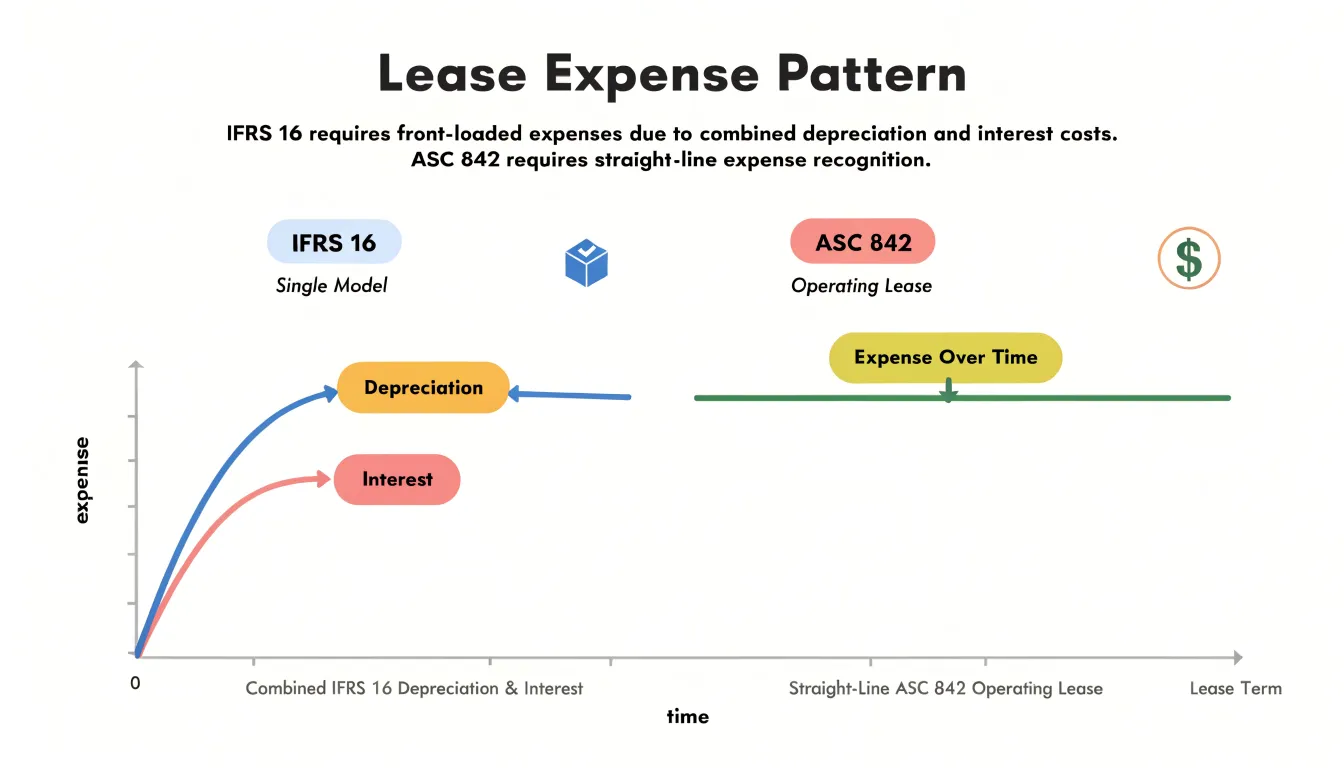
Lessor accounting reflects another area where the two systems diverge. IFRS 16 left lessor guidance largely untouched, preserving the finance and operating lease classification inherited from IAS 17. ASC 842 similarly retained a dual model for lessors but introduced refinements in classification criteria and disclosure requirements. The symmetry that exists on the lessee side therefore does not carry through to lessors, and entities on opposite sides of a transaction may apply different analytical frameworks.
Practical expedients further distinguish the standards. ASC 842 offers a suite of transition elections and ongoing expedients, including options to avoid separating non-lease components and to apply a portfolio approach to certain asset classes. IFRS 16 permits recognition exemptions for short-term and low-value leases, a combination that has no direct ASC 842 counterpart. These differences affect the volume of leases captured, the level of judgment required, and the comparability of reported figures, so analysts should read lease disclosures closely before drawing cross-border conclusions.
Practical challenges for multinational companies consolidating financial reports
Multinational companies that operate across jurisdictions where both GAAP and IFRS are used face substantial operational hurdles when consolidating financial reports. The most immediate challenge is maintaining dual reporting systems. A parent company headquartered in a GAAP jurisdiction may own subsidiaries required to report locally under IFRS, and each subsidiary must produce statements that satisfy local regulators, tax authorities, and auditors. This often means running parallel accounting processes, duplicate transaction records, and separate charts of accounts, all of which demand dedicated staff and robust enterprise resource planning infrastructure configured to handle two sets of rules simultaneously.
Reconciling the differences between the two frameworks adds another layer of complexity. The frameworks diverge on inventory valuation, revenue recognition, lease accounting, and the treatment of development costs, among other areas. When a subsidiary prepares its local statements under IFRS but the group consolidates under GAAP, finance teams must map each divergent item, document the adjustment, and track it through subsequent reporting periods. These reconciliation schedules grow unwieldy as the number of subsidiaries and the volume of intercompany transactions increase, and they introduce the risk of errors that can cascade into restated group accounts.
The consolidation process itself compounds these difficulties across jurisdictions. Intercompany eliminations must account for currency translation under different functional currency rules, and timing differences between local close calendars can delay group reporting. Transfer pricing arrangements, deferred tax calculations, and goodwill measurements each behave differently under the two frameworks, so consolidation software must be configured with jurisdiction-specific logic. Auditors in each country may apply local interpretations, requiring finance leaders to coordinate with multiple audit firms and reconcile their conclusions before the group audit can be signed off.
The costs of this dual burden are considerable. Companies invest in specialized consolidation tools, external advisors, and training programs to keep staff current on both frameworks. Beyond direct expenditure, the administrative workload absorbs management attention that could otherwise focus on strategy. Smaller multinationals in particular may find the overhead disproportionate, yet the alternative of converting statements at year-end introduces its own reconciliation risk and delay.
Is a single unified global accounting system actually realistic for investors
The appeal of a single, unified global accounting system is easy to understand from an investor’s standpoint. A portfolio manager who holds equities in Tokyo, Frankfurt, São Paulo, and New York would be able to compare financial statements across all of them without adjusting for different revenue recognition rules, lease treatments, or impairment methodologies. Research covering cross-border valuation, screening, and peer analysis would become substantially simpler, and the risk of misreading a foreign company’s numbers because of unfamiliar local conventions would fall. For institutional investors running global mandates, the efficiency gains are real and quantifiable.
The question is whether full convergence is achievable, and here the obstacles are considerable. Accounting standards are deeply embedded in national legal and regulatory frameworks. In many jurisdictions, tax rules are tied directly to financial reporting figures, so a change in accounting treatment has immediate fiscal consequences that governments are reluctant to accept. Regulatory bodies and professional accountancy institutes have institutional stakes in their existing standards, and national sovereignty over corporate reporting is a politically sensitive matter. Cultural factors matter as well: different markets have different expectations about conservatism, disclosure granularity, and the role of management judgment, and these expectations shape how standards are written and applied in practice.
Practical obstacles reinforce these political and cultural ones. Even where standards are nominally identical, enforcement varies enormously across jurisdictions, and identical rules can produce different outcomes depending on the quality of auditing and regulatory oversight. Transition costs for companies, particularly smaller ones, are significant. The historical record of convergence efforts shows steady progress on some fronts alongside persistent divergence on others, suggesting that full unification is unlikely in any near-term horizon.
For investors, the realistic implication is to treat convergence as a direction of travel rather than an endpoint. Understanding the remaining differences between major frameworks, and building processes to identify and adjust for them, remains a core analytical skill. A world of partial harmonization still delivers meaningful comparability benefits, while requiring investors to stay attentive to jurisdictional variation in both standards and enforcement.
Frequently Asked Questions
What is the difference between rules-based and principles-based accounting?
A rules-based framework like US GAAP provides detailed, prescriptive guidance for specific transactions, while a principles-based framework like IFRS relies on broad concepts and professional judgment. US GAAP emphasizes consistency through explicit rules, whereas IFRS offers flexibility but allows for more variability in application.
Why do the United States and international markets use different accounting standards?
The divergence reflects different capital market histories and regulatory structures. In the US, standard setting developed through private professional bodies under SEC oversight, while outside the US, fragmented national standards led to the formation of the IASC and later the IASB to harmonize practice globally.
Does IFRS allow LIFO for inventory valuation?
No. IFRS prohibits LIFO entirely under IAS 2, permitting only FIFO and weighted average cost. US GAAP, by contrast, allows companies to choose among LIFO, FIFO, and weighted average cost.
Are upward asset revaluations allowed under US GAAP?
No. US GAAP prohibits upward revaluations and carries property, plant, and equipment at historical cost less accumulated depreciation and impairment. IFRS allows entities to elect the revaluation model for classes of property, plant, and equipment and intangible assets, provided an active market exists to establish fair value reliably.
How do GAAP and IFRS lease accounting differ for lessees?
Both ASC 842 and IFRS 16 require lessees to recognize right-of-use assets and lease liabilities on the balance sheet. However, IFRS 16 applies a single lessee model with depreciation and interest for essentially all leases, while ASC 842 retains a dual classification structure that can produce a straight-line expense profile for operating leases.
Is full convergence to a single global accounting system likely?
Full unification is unlikely in any near-term horizon because accounting standards are embedded in national legal, tax, and regulatory frameworks, and enforcement varies across jurisdictions. The article suggests treating convergence as a direction of travel rather than an endpoint.