
General Ledger
A general ledger is the master record where a small business tracks every transaction, sorted by account. Each account keeps a running total, and together they form the complete financial picture. It serves as the central hub of the accounting system, feeds the income statement and balance sheet, and relies on double-entry bookkeeping so total debits always equal total credits.
Table of Contents
- What a general ledger is in simple small business terms
- How the general ledger acts as your central financial hub
- The core components of a standard general ledger entry
- Understanding the five main account types in your ledger
- Debits and credits
- How sub-ledgers feed daily transactions into your main ledger
- Walkthrough
- How your general ledger powers income statements and balance sheets
- Accounting software versus manual ledgers
- How to spot and fix common ledger entry mistakes
What a general ledger is in simple small business terms
A general ledger is the master record where a small business keeps track of every dollar that moves in and out of the company, sorted by category. Think of the checkbook register most people use at home. Every time a check is written or a deposit lands, it goes into the register with a date, a description, and an amount, and the running balance updates as you go. A general ledger works on the same principle, with one important addition: instead of a single long list, the entries are grouped into separate accounts. Rent payments go into a rent account, equipment purchases into an equipment account, customer payments into a sales account, and so on. Each account keeps its own running total, and together those accounts form the complete financial picture of the business.
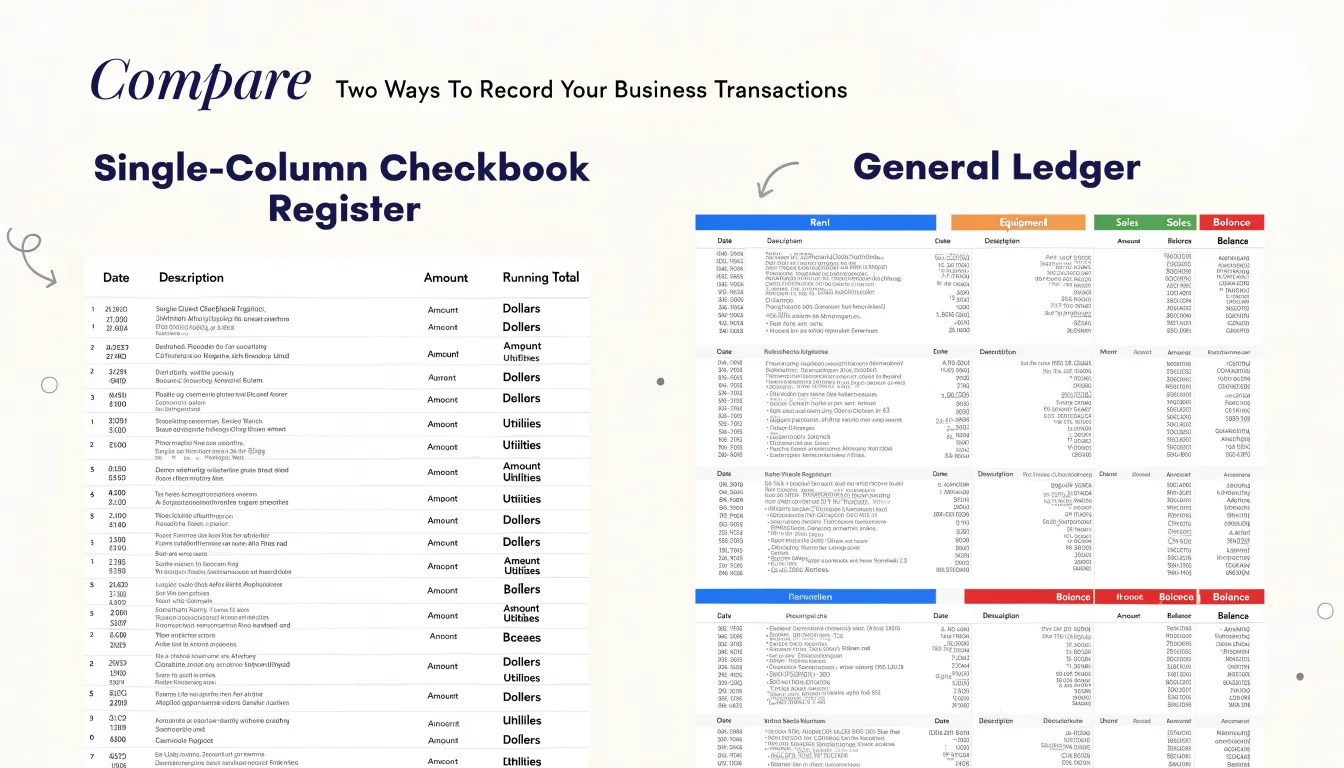
For example, imagine a bakery owner who pays the monthly electricity bill. In a checkbook-style register, that payment would appear as one line among hundreds. In the general ledger, the payment is recorded in the utilities expense account, where it joins all the other utility bills for the year. When the owner wants to know how much the shop spends on power, the answer is sitting in one place rather than scattered across a year of bank statements. The same happens with sales: every counter transaction is logged in the sales account, so the owner can see total revenue without adding up receipts by hand.
This organization is what makes the general ledger useful. At the end of each month or quarter, the owner or bookkeeper can glance at the account totals and immediately understand where money is coming from and where it is going. Those totals feed directly into the financial statements, such as the profit and loss report and the balance sheet. The word ledger may sound formal, but the idea is familiar to anyone who has ever balanced a checkbook. It is simply a careful, categorized record of every transaction, kept in one place, so the business always knows exactly where it stands.
How the general ledger acts as your central financial hub
The general ledger functions as the central financial hub of your accounting system, the one place where every transaction ultimately lands. Each time a sale is recorded, an invoice from a supplier is entered, payroll is processed, or a bank statement is reconciled, the underlying accounting entries flow into the general ledger. Sales generate entries that increase revenue accounts and either cash or accounts receivable. Purchases create entries affecting expense or inventory accounts and either cash or accounts payable. Payroll produces a cluster of entries covering wages, tax withholdings, and employer contributions. Banking activity, from deposits to loan payments and bank fees, is captured in the same ledger through the cash accounts. Because all of these streams converge on a single structure organized by account, the ledger presents the complete financial picture in one place rather than scattered across separate registers or spreadsheets.
This consolidation is what makes the general ledger a single source of truth. When every transaction from every part of the business is recorded in the same system using the same chart of accounts, the balances in that ledger become the authoritative record of what the company owns, owes, earns, and spends. Reconciliation depends on this. Bank reconciliations compare the ledger’s cash balance against the bank statement, and discrepancies point to timing differences, missing entries, or errors that need investigation. Similar checks apply to accounts receivable and payable, where subsidiary records must agree with the corresponding control accounts in the ledger. Without one central record, these comparisons become guesswork spread across disconnected files.
The same centralization supports decision-making. Because the ledger aggregates activity by account and by period, it underpins the financial statements: the income statement, balance sheet, and cash flow statement all draw from ledger balances. Managers can examine trends in specific accounts, compare budgeted figures against actual results, and trace any reported number back to the individual transactions that produced it. Auditors rely on this trail as well, following entries from source documents through to the ledger and out to the statements. In everyday operations, having a single authoritative record reduces duplicate data entry, limits the chance of conflicting versions of the same figure, and gives everyone in the business a common reference point for financial questions.
The core components of a standard general ledger entry
Every general ledger entry is built from a consistent set of fields that together create a complete, auditable record of a financial transaction. The date field establishes when the transaction occurred or was recorded, anchoring it in the correct accounting period. The account name and number identify which specific account is affected, linking the entry to the chart of accounts and ensuring proper classification. A description provides a brief narrative explaining the nature of the transaction, which is essential for later review and audit. The debit and credit amount fields capture the monetary value of the entry, with each line representing either a debit or a credit to the specified account. Finally, the running balance shows the account’s cumulative total after the entry is applied, allowing users to track the account’s current position at a glance.
A sample entry illustrates how these components work together. Consider a $1,000 cash sale on January 15, 2024. The entry would have two lines: the first line shows the date (01/15/2024), account name (Cash), account number (1010), description (Cash sale to customer), debit amount ($1,000), credit amount (blank), and running balance ($5,000, assuming a prior balance of $4,000). The second line shows the same date, account name (Sales Revenue), account number (4010), description (Cash sale to customer), debit amount (blank), credit amount ($1,000), and running balance ($10,000, assuming a prior balance of $9,000). This dual-line structure ensures that total debits equal total credits, maintaining the accounting equation.
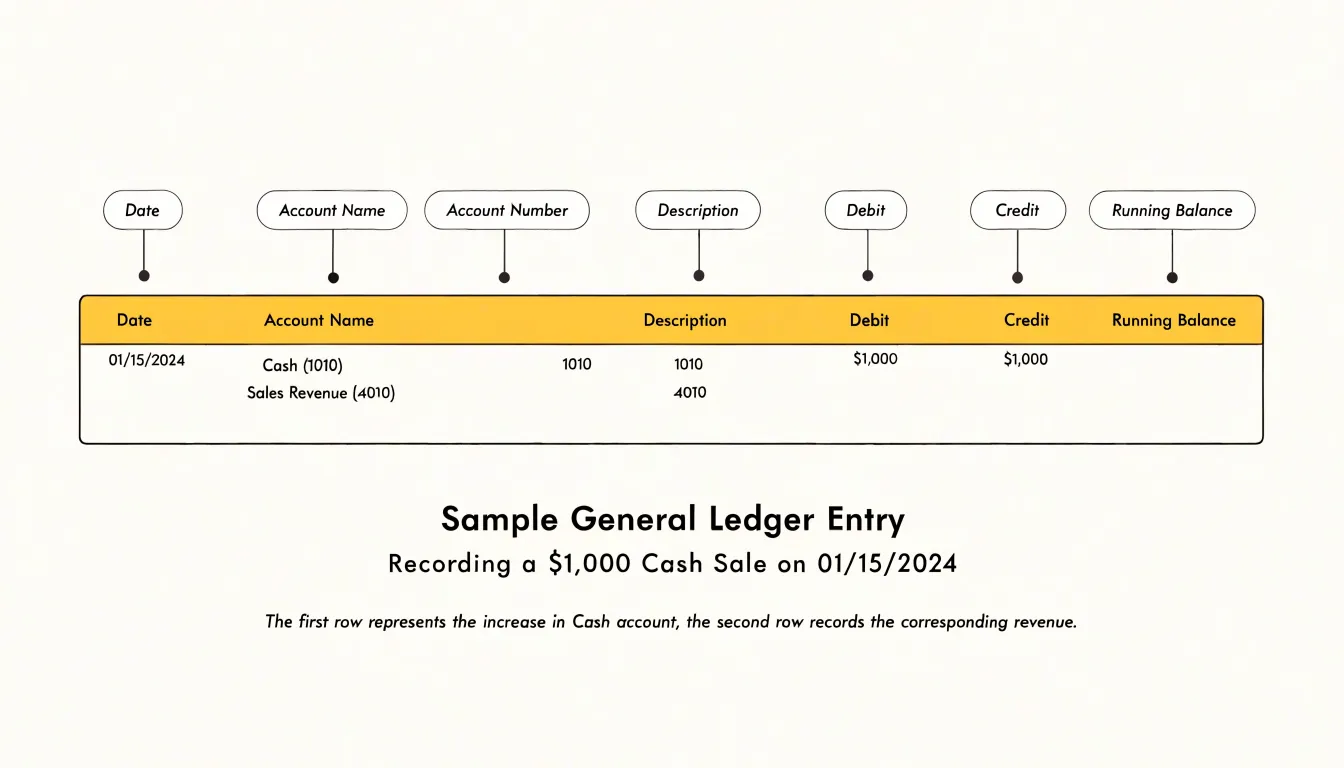
The running balance is particularly useful because it provides immediate visibility into an account’s activity without requiring separate calculations. For accounts with many transactions, the running balance helps identify trends and detect errors quickly. The combination of these fields creates a standardized format that supports efficient data entry, reporting, and analysis across the organization.
Understanding the five main account types in your ledger
Every transaction your business records eventually lands in one of five main account types in the general ledger: assets, liabilities, equity, revenue, and expenses. Each type has a distinct role in the accounting equation and follows its own rules for how balances build up, so learning these categories early makes bookkeeping far more predictable.
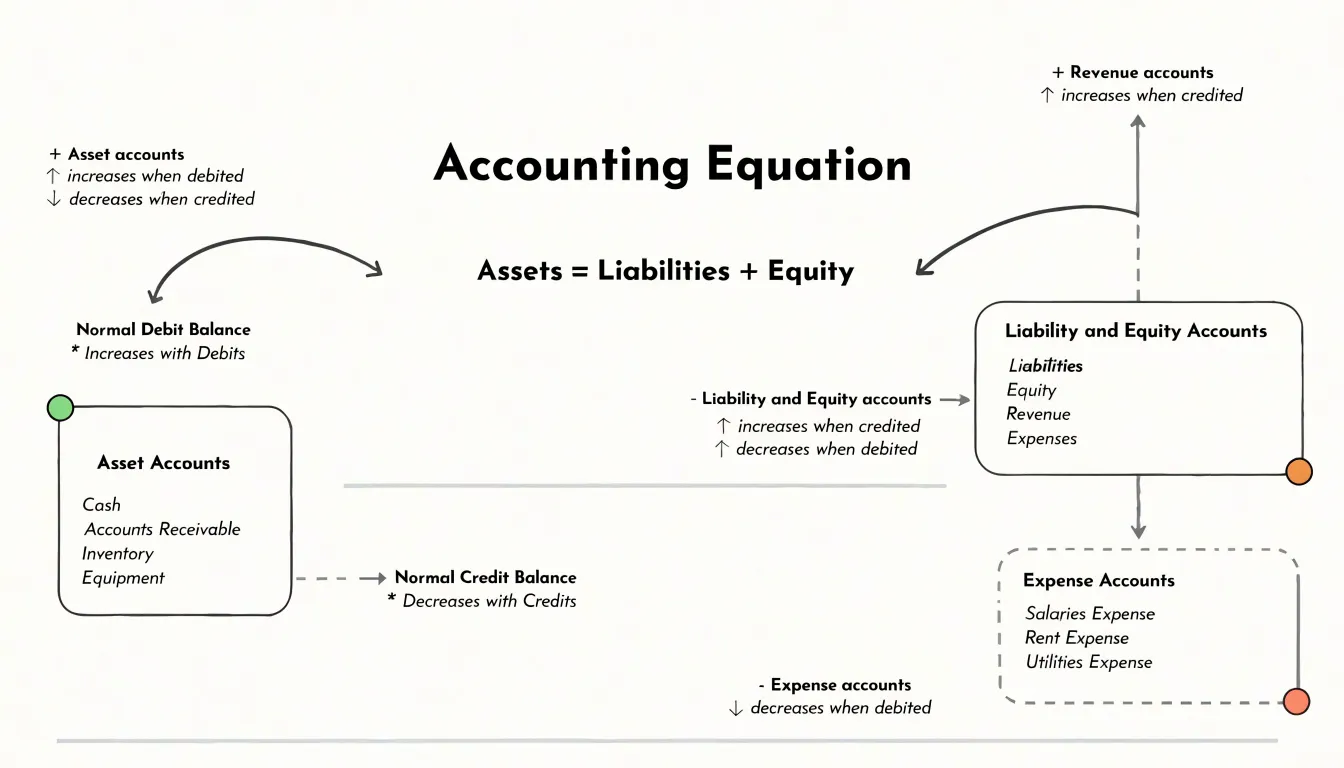
Assets are the resources your business owns or controls and expects to benefit from in the future. Common small business examples include the cash in your checking account, accounts receivable from customers you have invoiced, inventory on hand, equipment, and vehicles. Assets carry a normal debit balance. This means debits increase an asset account and credits decrease it, which is worth memorizing because it sets the pattern for several other categories.
Liabilities are obligations you owe to outside parties. Small businesses typically see accounts payable to suppliers, credit card balances, sales tax payable, accrued wages, and loan balances here. Liabilities carry a normal credit balance, so credits increase the account and debits reduce it. Equity represents the owner’s residual interest in the business, calculated as assets minus liabilities. It includes owner contributions, retained earnings, and draws. Equity accounts also carry a normal credit balance, with owner draws acting as a debit that reduces equity.
Revenue is the inflow from goods sold or services provided in the ordinary course of business. Revenue accounts, such as sales income or service fees, carry a normal credit balance and increase when you record a sale. Expenses are the costs incurred to generate that revenue, including rent, utilities, supplies, advertising, and wages. Expenses carry a normal debit balance; debits increase them and credits reduce them.
A practical way to keep the pattern straight is to notice that assets and expenses share debit balances while liabilities, equity, and revenue share credit balances. When you record a sale, you typically debit cash or accounts receivable and credit revenue. When you pay rent, you debit rent expense and credit cash. Tracing each entry to its account type helps you spot mistakes quickly and keeps your trial balance in line.
Debits and credits
Double-entry bookkeeping rests on a single, elegant rule: every transaction must be recorded with equal debits and equal credits. When a business pays its monthly rent, cash decreases and rent expense increases by the same amount. The two entries travel together as a matched pair, and the accounting equation stays intact. This design is what allows a general ledger to function as a reliable record of financial activity, since each posting carries its own built-in check against error.
Determining which accounts to touch follows from the nature of the transaction and the normal balance of each account type. Assets and expenses increase with a debit and decrease with a credit. Liabilities, equity, and revenue move in the opposite direction, increasing with a credit and decreasing with a debit. A sale on credit, for instance, debits accounts receivable and credits revenue. A customer payment debits cash and credits accounts receivable. Once the account types involved are clear, the correct side of each entry follows naturally.
The proof of all this is the trial balance. At the end of any period, the total of every debit balance across the ledger should exactly equal the total of every credit balance. Because each transaction was posted with matching amounts, the two columns must net to zero. When they do not, the books contain an error: a transposition, a one-sided entry, a duplicated posting, or a similar slip. The trial balance will not catch every mistake, such as a transaction posted to the wrong account on both sides, but it reliably reveals imbalances that would otherwise distort the financial statements.
Keeping this discipline consistently gives the general ledger its credibility. Every figure in the financial statements traces back through balanced entries, and anyone reviewing the books can verify that the debits and credits reconcile. The habit of recording both sides of each event, and of confirming the totals before closing a period, turns bookkeeping from a matter of memory into a matter of arithmetic that checks itself.
How sub-ledgers feed daily transactions into your main ledger
In most accounting systems, daily operational activity flows through specialized sub-ledgers before it reaches the general ledger. Accounts receivable, accounts payable, inventory, and payroll each maintain their own detailed records, tracking individual customer invoices, vendor bills, stock movements, and employee payments. These sub-ledgers function as detailed journals where every transaction is recorded at a granular level. Accounts receivable captures each sale made on credit, the resulting customer balance, and any payments received against outstanding invoices. Accounts payable records every bill received from a supplier, the payment terms attached to it, and the eventual disbursement. The inventory sub-ledger follows the movement of goods, tracking purchases, sales, returns, and adjustments that affect stock quantities and values. Payroll maintains records of hours worked, wage rates, tax withholdings, and benefit deductions for each employee.
While these sub-ledgers capture the day-to-day detail, the general ledger serves as the central record of the company’s financial position. Posting every individual sub-ledger transaction to the general ledger would create an overwhelming volume of entries and make the main ledger difficult to read. Instead, on a regular schedule, usually daily or at the end of each accounting period, the totals from each sub-ledger are summarized and posted as summary entries to the general ledger. A single journal entry might consolidate all credit sales for the day into the accounts receivable and sales revenue accounts, while another entry aggregates all vendor invoices into accounts payable and the relevant expense or asset accounts. Inventory totals are posted to reflect changes in stock value against cost of goods sold, and payroll totals are posted to wages expense, payroll tax liabilities, and cash.
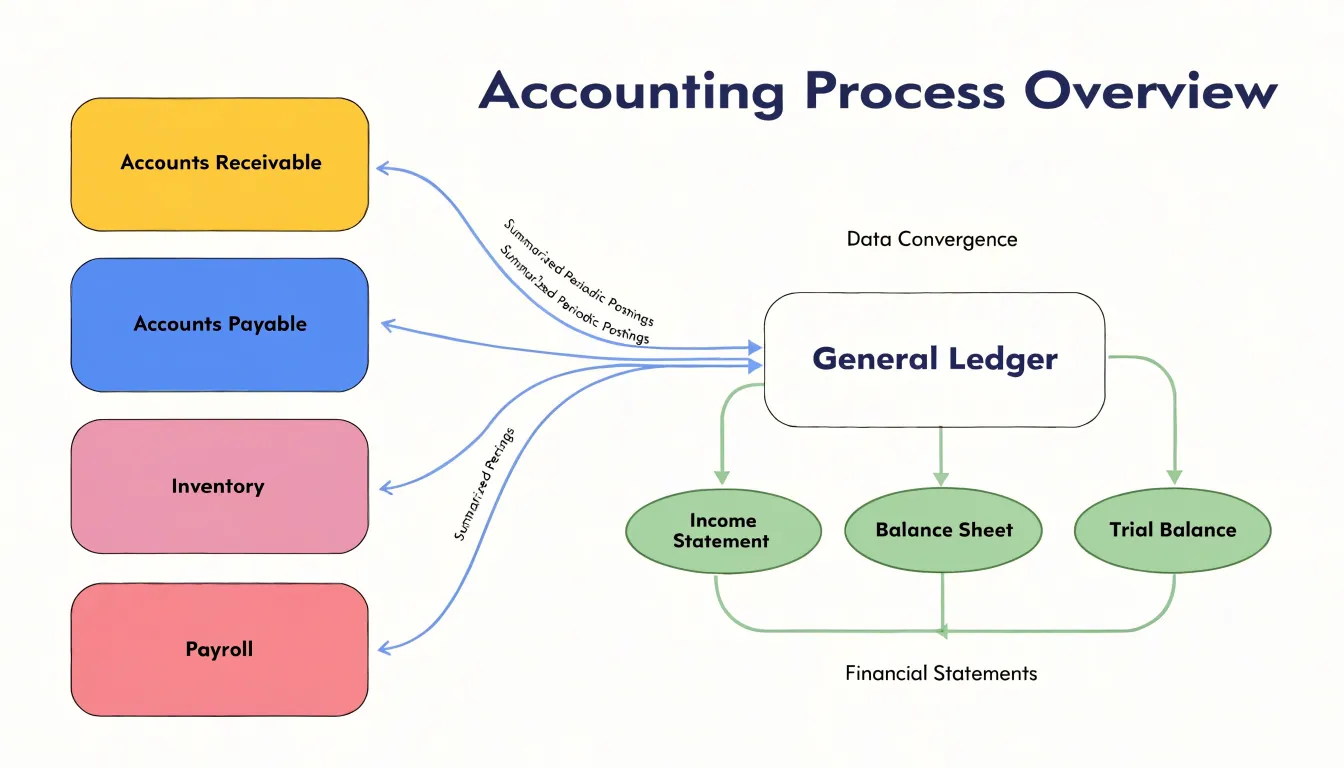
This summary approach keeps the general ledger concise and manageable while preserving the detailed records in the sub-ledgers. Each summary entry must reconcile to the underlying sub-ledger detail. The accounts receivable balance in the general ledger should equal the sum of all individual customer balances in the sub-ledger. When these figures diverge, accountants investigate discrepancies. This control mechanism ensures the integrity of financial reporting. By feeding summarized totals upward, sub-ledgers provide both the fine-grained detail needed for operations and the consolidated view required for financial statements, tax filings, and management analysis.
Walkthrough
Consider a small business that issues an invoice for $1,000 to a customer for consulting services. The moment the invoice is created, the accounting process begins, and following it through to the general ledger shows how the pieces of a bookkeeping system connect.
The invoice first lands in the sales sub-ledger, a detailed record that tracks each individual customer transaction. This sub-ledger holds the invoice date, the customer name, the amount, and payment terms, giving the business an itemized view of who owes what. The sub-ledger is the working record; it keeps the customer-level detail that the general ledger summarizes.
From the sub-ledger, the transaction is translated into journal entries using double-entry bookkeeping. The business debits Accounts Receivable for $1,000, reflecting the amount the customer now owes, and credits Revenue for $1,000, recording that the service has been delivered and earned. Once the customer pays, a second entry debits Cash for $1,000 and credits Accounts Receivable for $1,000, clearing the receivable and reflecting the cash received. Each entry balances, with debits equaling credits.
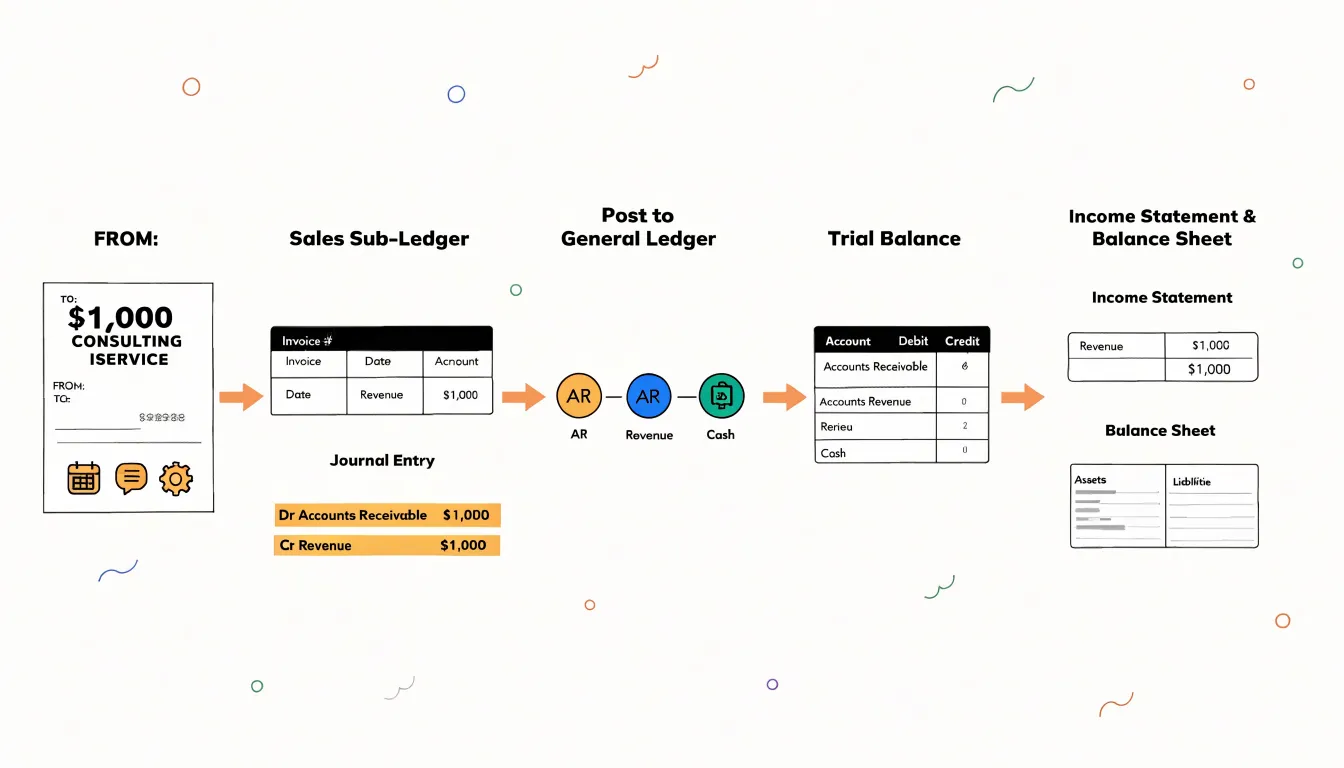
These journal entries are then posted to the general ledger, the master record of all accounts. The Accounts Receivable account shows an increase of $1,000 followed by a decrease when payment arrives. The Revenue account reflects the $1,000 earned. The Cash account shows the $1,000 deposit. The general ledger now holds the summarized balances for each of these accounts, and the sub-ledger totals reconcile to the corresponding general ledger control account.
At period end, the balances in the general ledger feed into the trial balance and, ultimately, the financial statements. Revenue appears on the income statement, while Cash and Accounts Receivable appear on the balance sheet. The walkthrough shows how a single invoice travels through each layer of the system, with the sub-ledger providing detail and the general ledger providing the consolidated view that supports reporting and decision-making.
How your general ledger powers income statements and balance sheets
Every financial statement your business produces traces back to the general ledger, which serves as the central repository where all transactions are recorded and categorized. The ledger organizes each transaction by account, and those account balances become the raw material from which income statements and balance sheets are assembled. Understanding this relationship helps you appreciate why the quality of your ledger directly determines the quality of every report you generate.
The income statement draws its figures from the revenue and expense accounts maintained in the ledger. When you record a sale, the corresponding entry lands in a revenue account; when you pay for supplies or services, the entry flows into an expense account. At the end of a reporting period, these account balances are sorted and arranged into the familiar lines of the income statement, with revenues grouped together at the top, expenses listed below, and the difference between them presented as net income or loss. The sorting process relies entirely on how transactions were classified when they were first entered into the ledger. A sale misclassified as a loan payment, or an expense recorded against the wrong category, will distort the resulting income statement.
The balance sheet follows a similar path, drawing on asset, liability, and equity accounts. Cash, inventory, equipment, accounts payable, loans, and retained earnings all live in the ledger as individual account balances. When the balance sheet is prepared, these balances are grouped into their respective sections: assets at the top, liabilities and equity below. The accounting equation, assets equaling liabilities plus equity, holds true because the ledger itself is built on double-entry principles, where every transaction affects at least two accounts and keeps the books in balance. The balance sheet is essentially a snapshot of these ledger balances at a specific moment in time.
Accurate ledgers are therefore essential for reliable reporting. If transactions are recorded incorrectly, omitted, or posted twice, the errors cascade directly into the financial statements. Reports built on flawed ledger data can mislead owners, investors, lenders, and tax authorities, potentially leading to poor decisions or compliance problems. Regular reconciliation of ledger accounts against bank statements and supporting documents helps catch discrepancies early. A clean, well-maintained ledger ensures that the income statement and balance sheet reflect the true financial position of the business, giving you confidence in the numbers you rely on for planning and decision-making.
Accounting software versus manual ledgers
Choosing between manual ledgers and accounting software is one of the first operational decisions a small business owner faces, and the right answer depends on transaction volume, budget, and how much control the owner wants over the books. Manual approaches, whether a paper ledger or a spreadsheet, carry minimal upfront cost and require no subscription. A paper ledger is simple to start and gives a tactile record, while a spreadsheet template offers basic formulas, sorting, and the ability to share a file electronically. For a very small operation with a handful of transactions each month, such as a sole trader or a side business, a spreadsheet can be entirely adequate and keeps overhead near zero.
The trade-offs appear as activity grows. Manual entry invites transposition errors, duplicated rows, and broken formulas that silently distort totals. Paper ledgers offer no backup, making loss through fire, flood, or simple misplacement a real risk. Spreadsheets scale poorly: reconciliations must be performed by hand, version control becomes confusing when multiple people edit the file, and reporting requires building and maintaining formulas. Time spent on bookkeeping rises roughly in proportion to transaction count, which is a hidden cost that rarely appears in the budget.
Cloud accounting tools address these weaknesses. Bank feeds reduce manual entry, automated reconciliations flag discrepancies, and double-entry logic is enforced in the background, lowering the risk of arithmetic and classification errors. Data is backed up off-site, reports are generated on demand, and the system accommodates growth in transaction volume without a change in method. The price is a recurring subscription, a learning curve during setup, and dependence on internet access and the provider’s continued service. Some owners also find the chart of accounts and workflow constraints less flexible than a blank spreadsheet.
A practical rule of thumb is to begin with a spreadsheet when transactions are few, the owner handles the books personally, and reporting needs are basic. Move to cloud software once bank reconciliation consumes hours each month, multiple people need access, inventory or invoicing complexity increases, or an accountant requests structured data. Many businesses run both briefly during transition, keeping the spreadsheet as a reference while the software becomes the system of record. The decision deserves periodic review, since the point at which manual methods become a burden often arrives quietly.
How to spot and fix common ledger entry mistakes
Ledger entry mistakes are a normal byproduct of manual and semi-automated bookkeeping, and knowing where they tend to cluster makes them easier to catch before they distort financial reports. One of the most frequent errors is digit transposition, where a figure like 1,240 is recorded as 1,420. Transpositions often slip through because the mistake is subtle, but they produce differences divisible by nine, a quick diagnostic when a trial balance refuses to agree. Misclassified accounts form another common category: a payment for equipment repairs posted to the asset account rather than the expense account, or a supplier invoice coded to the wrong cost center. These errors leave the trial balance in agreement while quietly misstating both the balance sheet and the income statement. Duplicate entries occur when an invoice is entered twice, sometimes because a payment run overlaps with a manual posting, and they inflate both sides of the ledger equally. Unbalanced debits and credits, meanwhile, usually stem from a one-sided posting or a keying error in a journal, and they surface immediately when the trial balance is run.
Correcting these mistakes begins with locating them. Reconciliations are the primary detection tool: comparing bank statements, supplier statements, and subledger balances to the general ledger pinpoints discrepancies and their timing. Once an error is identified, the standard remedy is an adjusting journal entry that reverses the incorrect posting and records the correct one, supported by documentation explaining the change. For duplicate entries, a reversing entry clears the extra posting; for misclassifications, a reclassification entry moves the amount to the proper account. Transpositions require careful verification against source documents before the correction is booked, since the original figure must be confirmed. Building a routine of monthly reconciliations, segregation of duties between entry and review, and consistent use of source-document references reduces the frequency of these errors and shortens the time between their occurrence and their correction.
Frequently Asked Questions
What is a general ledger in simple terms?
A general ledger is the master record where a small business tracks every dollar that moves in and out, sorted by category. It works like a checkbook register, but entries are grouped into separate accounts such as rent, equipment, sales, and utilities.
How does a general ledger act as the central financial hub?
Every transaction ultimately lands in the general ledger, including sales, supplier invoices, payroll, and banking activity. This consolidated record becomes the single source of truth for reconciliation, financial statements, and decision-making.
What are the five main account types in a general ledger?
The five main account types are assets, liabilities, equity, revenue, and expenses. Assets and expenses normally carry debit balances, while liabilities, equity, and revenue normally carry credit balances.
What fields are included in a standard general ledger entry?
A standard entry includes the date, account name and number, description, debit and credit amounts, and running balance. These fields create a complete, auditable record of a transaction.
How do debits and credits keep a general ledger balanced?
Double-entry bookkeeping requires every transaction to have equal debits and equal credits. At period end, the trial balance should show total debit balances equal total credit balances; however, the trial balance will not catch every mistake, such as a transaction posted to the wrong account on both sides.
How do sub-ledgers feed transactions into the general ledger?
Accounts receivable, accounts payable, inventory, and payroll keep detailed sub-ledger records, and their totals are summarized and posted to the general ledger on a regular schedule. Each summary entry must reconcile to the underlying sub-ledger detail.