
How to Calculate Net Income
Net income is the amount left after all deductions and expenses are subtracted from gross income. For individuals, it is take-home pay: gross wages minus taxes, retirement contributions, and other payroll deductions. For businesses, it is total revenue minus cost of goods sold, operating expenses, interest, and taxes, reported as the bottom line on an income statement.
Table of Contents
- What Net Income Means for Your Personal Wallet and Business
- Gross Income vs Net Income
- The Basic Formula for Calculating Personal Take Home Pay
- Which Deductions and Taxes Reduce Your Gross Paycheck
- Step-by-Step Example
- How Businesses Calculate Net Income on an Income Statement
- Understanding Business Operating Expenses and Cost of Goods Sold
- Real World Business Example
- Why Net Income Matters for Securing Loans and Building Budgets
- Common Mistakes People Make When Estimating Their Net Earnings
What Net Income Means for Your Personal Wallet and Business
Net income is the figure that tells you what you actually have available to work with, whether you’re managing a household budget or evaluating a company’s performance. For an individual, net income is the amount that lands in your bank account after taxes, retirement contributions, and other payroll deductions have been subtracted from your gross pay. This is the number you can spend, save, or invest. It determines how much rent you can afford, how much you can put toward debt, and how quickly you can build an emergency fund. Budgeting with gross income can lead to overspending because it overstates your available resources. Net income gives you a realistic picture of your financial capacity.

For a business, net income represents the profit remaining after all expenses have been paid. This includes the cost of goods sold, operating expenses, interest, and taxes. It is the bottom line that shows whether the company is generating a profit or operating at a loss. Net income is what can be reinvested in the business, distributed to owners or shareholders, or held as retained earnings for future needs. It is also a key metric for lenders and investors, who use it to assess financial health and growth potential. A business that consistently reports positive net income is more likely to secure financing and attract investment.
The meaning of net income shifts with context, but its core purpose remains the same: it measures what is left over after obligations are met. For individuals, that leftover is the foundation of financial security and goal-setting. For businesses, it is the engine of sustainability and growth. In both cases, focusing on net income rather than gross figures leads to better decisions and more accurate planning. Understanding your net income, whether personal or business, is the first step toward effective money management.
Gross Income vs Net Income
Gross income and net income represent two distinct stages in the flow of money into and out of a person’s or business’s finances, and understanding each one clarifies what actually remains available for spending or saving. Gross income is the starting figure: the total amount earned before any deductions are applied. For an employee, this includes wages, salaries, overtime, bonuses, commissions, and tips. For a business, gross income typically refers to revenue minus the direct cost of goods sold, showing what the operation earns from its core activity before operating expenses, taxes, and other obligations are subtracted. The key characteristic of gross income is that it is inclusive and unadjusted, representing the full amount that changes hands before any claims are made against it.
Net income sits at the other end of the calculation. It is what remains after deductions, taxes, and expenses have been subtracted from gross income. For an employee, net income, often called take-home pay, reflects gross wages minus federal, state, and local taxes, Social Security and Medicare contributions, retirement plan contributions, health insurance premiums, and any other payroll deductions. For a business, net income is gross income minus operating expenses, interest, taxes, depreciation, and amortization, and it represents the profit the business has actually generated. Net income answers the question of what is truly available.
A side-by-side comparison makes the relationship clear. Gross income is the larger, headline figure that appears in a job offer or a sales report. Net income is the smaller, practical figure that shows up in a bank account or on a profit-and-loss statement’s bottom line. The gap between the two consists of mandatory withholdings, voluntary contributions, and operating costs, each of which varies by individual circumstances, jurisdiction, and business structure.
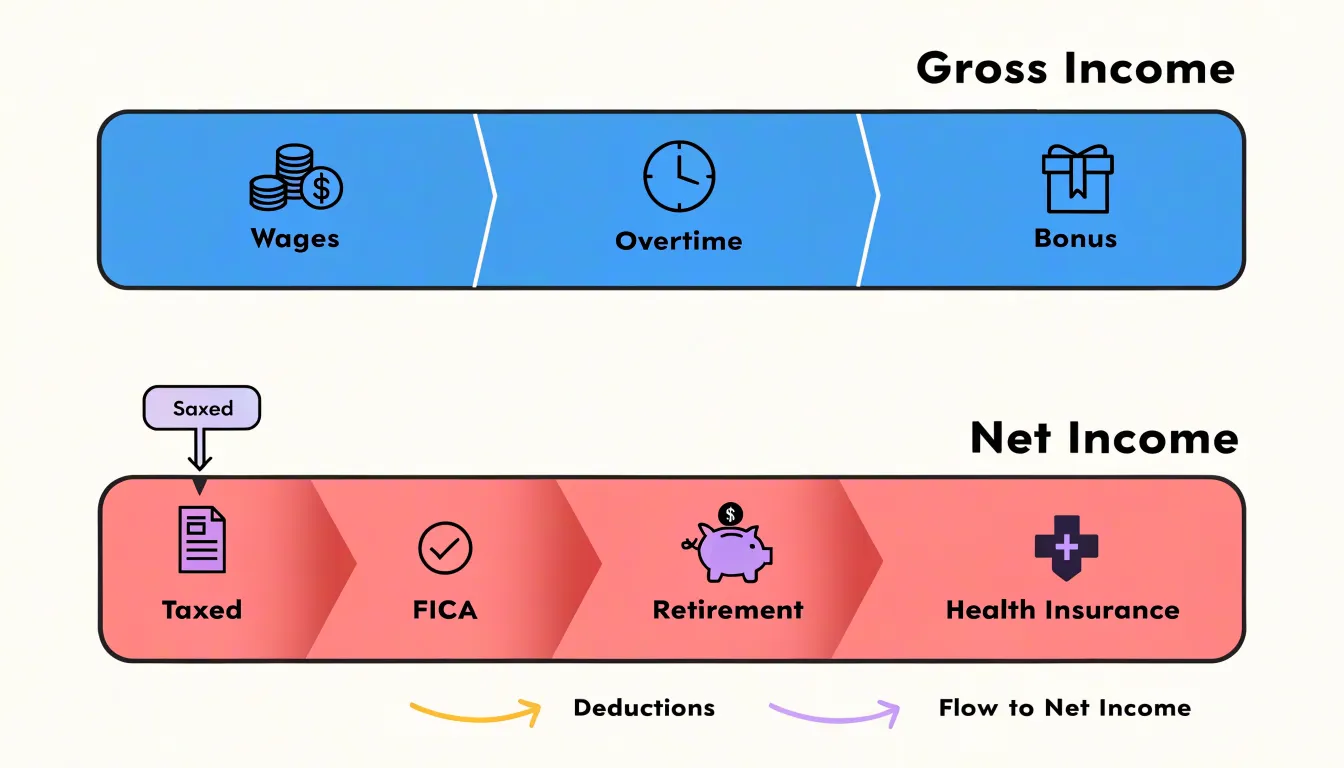
Confusing the two figures is a common source of budgeting errors. A person who plans rent, groceries, and loan payments against gross salary will overestimate available funds, because the deductions between gross and net income can easily consume a quarter or more of earnings. Businesses that treat gross revenue as spendable cash may commit to expenses that net income cannot support. Building a budget on net income grounds every decision in the money that will actually arrive, keeping spending plans aligned with reality.
The Basic Formula for Calculating Personal Take Home Pay
The basic formula for calculating personal take-home pay is straightforward: gross pay minus deductions equals net pay. Gross pay represents the total amount you earn before any withholdings, whether from an hourly wage, salary, or other compensation. Deductions encompass all amounts subtracted from your gross pay, including taxes, benefits, and other withholdings. Net pay, often called take-home pay, is the amount you actually receive in your bank account or paycheck.
Understanding the nature of deductions is crucial because they fall into two categories: pre-tax and post-tax, each affecting your net pay differently. Pre-tax deductions are subtracted from your gross pay before income taxes are calculated. Common examples include contributions to traditional 401(k) plans, health insurance premiums, and flexible spending accounts (FSAs). By reducing your taxable income, pre-tax deductions lower your overall tax burden, which can increase your net pay compared to post-tax deductions of the same amount.
Post-tax deductions, on the other hand, are taken out after income taxes have been applied. Examples include Roth 401(k) contributions, life insurance premiums, and union dues. These deductions do not reduce your taxable income, so they don’t provide an immediate tax advantage. However, they may still be valuable for other reasons, such as saving for retirement with tax-free growth in a Roth account.
When calculating net pay, it’s essential to account for both types of deductions in the correct order. Start with your gross pay, subtract any pre-tax deductions to arrive at your taxable income. Then apply the appropriate tax rates (federal, state, and local) to determine your tax withholdings. Finally, subtract post-tax deductions to get your net pay. This sequence ensures that you accurately reflect how each deduction impacts your take-home amount. Keeping track of these deductions helps you understand where your money goes and allows for better budgeting and financial planning.
Which Deductions and Taxes Reduce Your Gross Paycheck
Once gross pay is established, the next step in calculating net income is understanding every deduction that stands between that figure and the amount actually deposited in your bank account. The first category is income tax withholding, which comes in two layers. Federal income tax withholding is determined by the W-4 form you file with your employer, which tells payroll how to factor in your filing status, dependents, and any additional withholding you request. State income tax withholding works similarly but varies widely: some states levy graduated rates, a handful use a flat rate, and a few states impose no income tax at all. Local income taxes also exist in certain cities and counties. All of these withholdings are estimates of your annual tax liability, spread across pay periods.
The second category is FICA, which funds Social Security and Medicare. Employees pay 6.2 percent of gross pay toward Social Security, up to an annual wage cap that the IRS adjusts periodically, and 1.45 percent toward Medicare with no wage limit. An additional 0.9 percent Medicare surtax applies to wages above a high threshold. Employers match these contributions, though only the employee share reduces your take-home pay. Unlike income tax withholding, FICA is calculated at fixed rates rather than estimated from your W-4.
The third category covers voluntary deductions, which you elect through your employer’s benefits system. Retirement contributions are among the most common, whether to a traditional 401(k), a Roth 401(k), or another plan; traditional contributions typically reduce taxable wages, while Roth contributions are made with after-tax dollars. Health insurance premiums are another frequent deduction, often covering medical, dental, and vision coverage for you and your dependents. Other voluntary items may include health savings account contributions, life and disability insurance premiums, flexible spending account allotments, and union dues.
The distinction between pre-tax and post-tax deductions matters for the calculation. Pre-tax deductions lower your taxable wages before income tax and often FICA are applied, while post-tax deductions come out after taxes are calculated. Reviewing each pay stub line by line lets you verify that every deduction matches your elections and confirm the amount that will ultimately land in your account.
Step-by-Step Example
To illustrate the calculation of net income for an individual, consider a concrete example. Suppose an employee earns an annual salary of $60,000. The first step is to convert this annual figure into gross pay per paycheck. If the employee is paid biweekly, there are 26 pay periods in a year. Dividing $60,000 by 26 gives a gross pay of approximately $2,307.69 per paycheck. This gross amount is the starting point for all subsequent deductions.
Next, subtract each tax and deduction line item. Assume the employee’s federal income tax withholding is 15% of gross pay. That amounts to $346.15. State income tax might be 5%, or $115.38. Social Security tax is 6.2%, which equals $143.08, and Medicare tax is 1.45%, or $33.46. These are mandatory payroll taxes. Then come voluntary deductions: a 401(k) contribution of 5% of gross pay, or $115.38, and a health insurance premium of $150 per paycheck.
Now subtract each from the gross pay. Start with $2,307.69 and subtract federal income tax ($346.15) to get $1,961.54. Subtract state income tax ($115.38) to get $1,846.16. Subtract Social Security ($143.08) to get $1,703.08. Subtract Medicare ($33.46) to get $1,669.62. Subtract the 401(k) contribution ($115.38) to get $1,554.24. Finally, subtract the health insurance premium ($150) to arrive at $1,404.24. This final amount is the employee’s net pay, or take-home pay, for that paycheck.
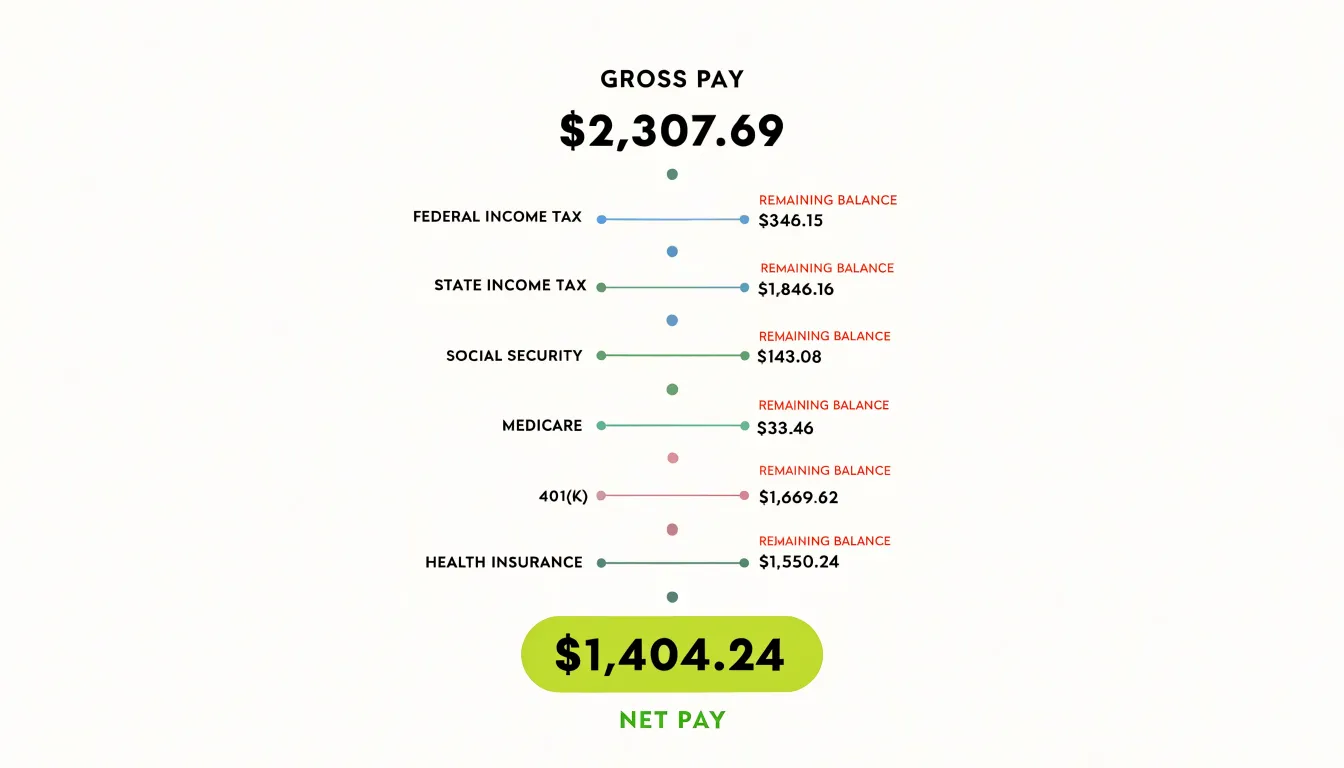
By following this step-by-step process, anyone can calculate their net income from a known gross salary. The key is to account for each deduction individually and subtract them sequentially from the gross pay. This method provides a clear picture of where the money goes and what remains for personal use.
How Businesses Calculate Net Income on an Income Statement
For a business, net income represents the profit that remains after every cost of running the operation has been accounted for. The calculation itself rests on a straightforward formula: total revenue minus total expenses. Total revenue includes all money generated from the sale of goods or services, along with any additional income streams such as interest earned or gains from asset sales. Total expenses encompass everything the business spends to operate, including the cost of goods sold, salaries and wages, rent, utilities, marketing, depreciation, and taxes. Subtracting the second figure from the first produces the net income figure.
The place where this calculation takes shape is the income statement, one of the core financial documents a business prepares each accounting period. A standard income statement moves through several stages. It begins with revenue at the top, then subtracts the cost of goods sold to arrive at gross profit. From gross profit, it deducts operating expenses such as selling, general, and administrative costs to reach operating income. After that come non-operating items like interest expense and interest income, followed by a deduction for income taxes. What remains at the very end of the statement is net income, which is why the figure is commonly called the bottom line. Each line above it feeds into the final result, so the statement reads as a step-by-step narrative of how revenue is consumed by costs before the remaining profit is revealed.
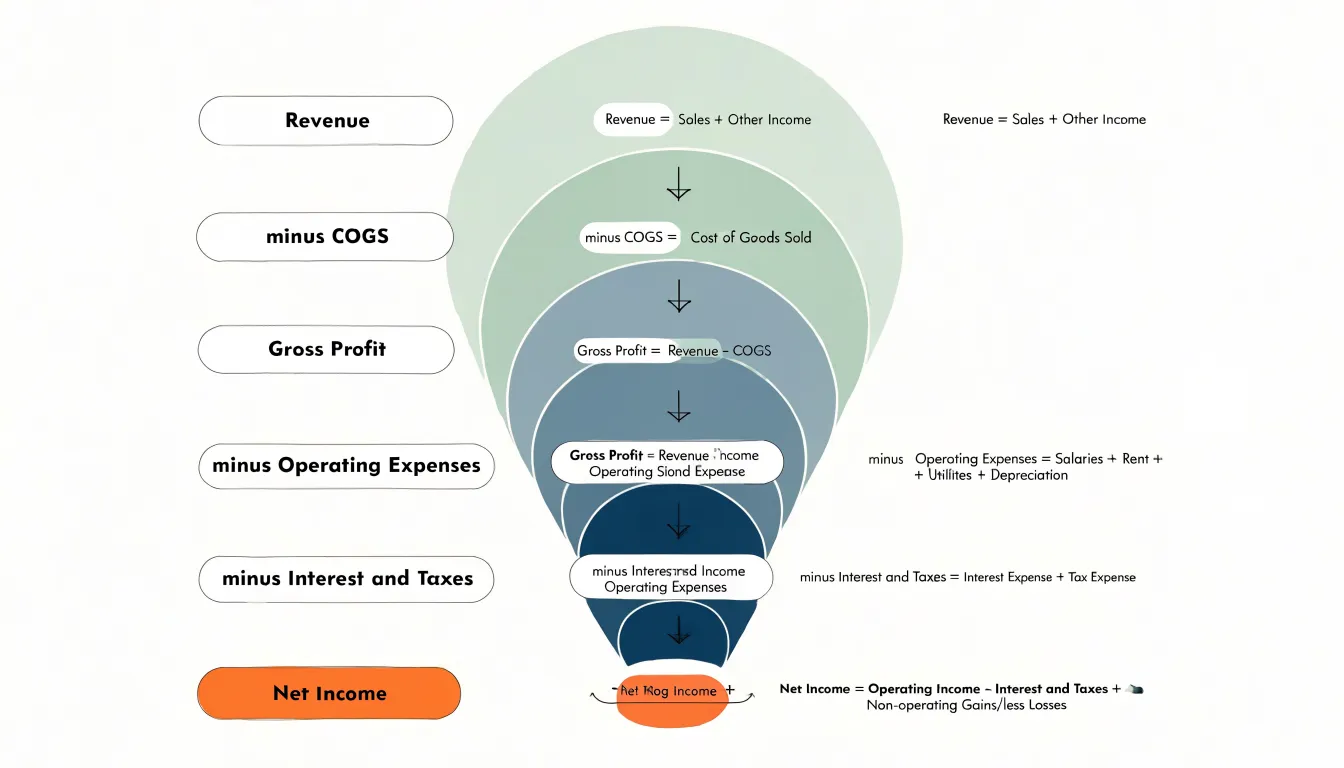
The bottom line carries real significance for anyone reading the statement. Business owners use it to judge whether the company is generating profit or running at a loss, and to compare performance across months, quarters, or years. Lenders and investors review it to assess financial health and the company’s ability to repay debt or fund growth. Because the figure reflects all revenue and all expenses, it gives the most complete single measure of profitability available from the income statement, and it serves as the starting point for other analyses, such as calculating net profit margin or earnings per share.
Understanding Business Operating Expenses and Cost of Goods Sold
When you review an income statement, the costs a business incurs fall into two broad categories: cost of goods sold (COGS) and operating expenses. COGS covers the direct costs tied to producing the goods or services a company sells. For a manufacturer, this includes raw materials, components, and the wages of workers on the production line. For a retailer, it is the wholesale price paid for inventory. For a service business, it may include contractor labor or materials consumed in delivering a client project. COGS rises and falls with sales volume, which is why it is sometimes called a variable cost.
Operating expenses cover the costs of running the business itself, separate from making the product. Rent, utilities, insurance, administrative salaries, marketing and advertising, office supplies, and depreciation on non-production equipment all belong here. These expenses tend to stay fairly stable regardless of how many units are sold in a given month, making them largely fixed costs.
Separating the two categories reveals two different measures of profitability. Subtract COGS from revenue and you get gross profit, which shows how efficiently the business produces or sources what it sells. A shrinking gross profit margin points to problems in production: rising material costs, supplier price increases, or pricing that does not cover direct costs. Subtract operating expenses from gross profit and you arrive at operating income, which shows whether the business can sustain itself after paying for its overhead.
The separation matters because it tells you where to look when profit falls. A company with healthy gross margins but weak operating income likely has an overhead problem, perhaps bloated administrative costs or an expensive office lease. A company with thin gross margins may need to renegotiate supplier contracts or raise prices. Grouping all costs together hides this diagnostic information.
For net income calculation, the sequence is straightforward: revenue minus COGS equals gross profit; gross profit minus operating expenses equals operating income; then subtract interest, taxes, and other non-operating items to reach net income. Keeping COGS and operating expenses distinct at each step gives you a clear trail from top-line revenue to bottom-line profit and shows exactly where money is being made or lost along the way.
Real World Business Example
A small business example helps make the net income calculation concrete. Consider a boutique bakery that operates as a single-location retail shop. Over one fiscal year, the bakery collects $480,000 in total revenue from bread, pastries, cakes, and custom orders. This figure represents gross sales before any costs are subtracted, and it serves as the starting point for the entire calculation.
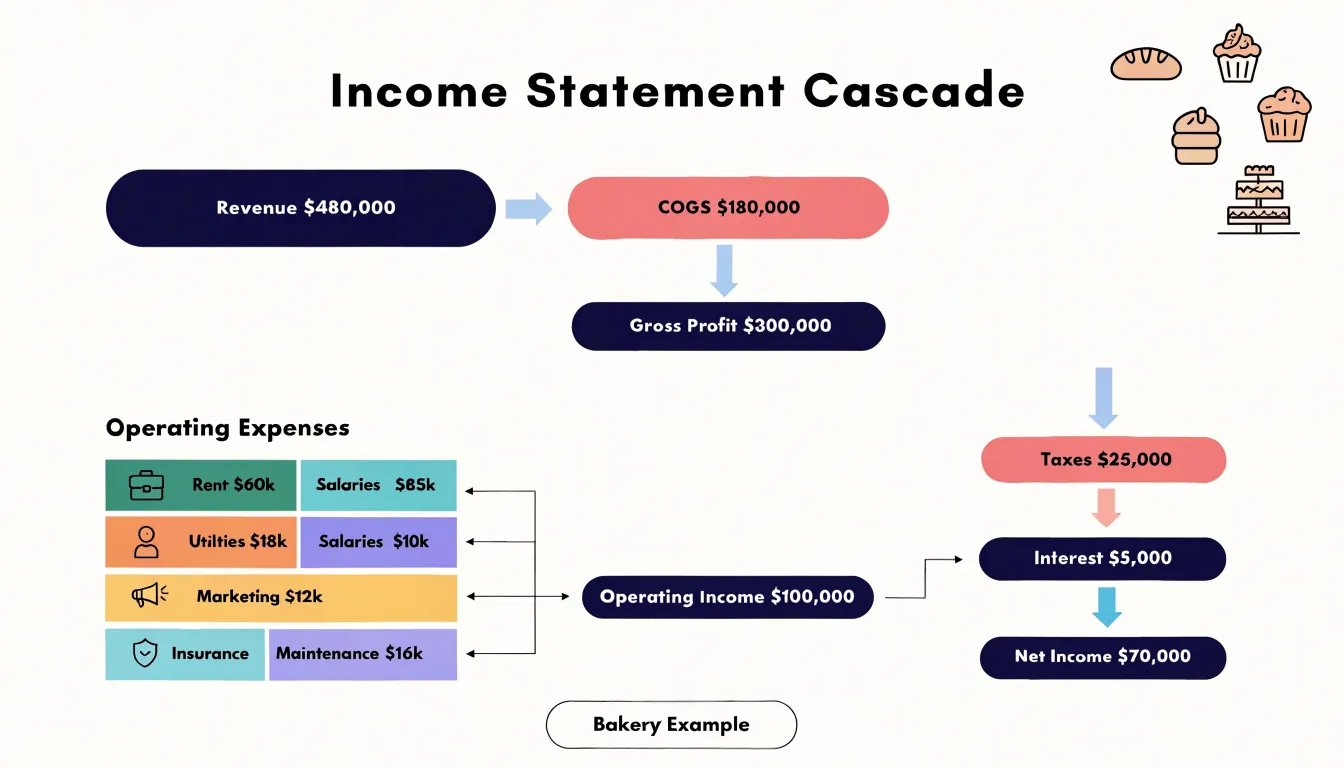
The first deduction is the cost of goods sold, which covers everything directly tied to producing the baked goods: flour, butter, sugar, eggs, packaging, and the wages of the bakers who prepare the products. Suppose these direct costs total $180,000 for the year. Subtracting COGS from total revenue leaves a gross profit of $300,000. This number shows how much the bakery earns from its core products before accounting for the costs of running the business itself, and it gives the owner an early signal about pricing and production efficiency.
Next come operating expenses, the ongoing costs of keeping the shop open. For the bakery, these include rent of $60,000, utilities of $18,000, salaries for front-counter staff and administrative personnel totaling $85,000, marketing and advertising of $12,000, insurance of $9,000, and equipment maintenance and supplies of $16,000. Adding these together yields $200,000 in total operating expenses. Subtracting this from gross profit produces an operating income of $100,000, which reflects the profit generated by normal business operations.
Taxes and other obligations come next. Assuming an effective income tax rate of 25 percent on the operating income, the bakery owes $25,000 in taxes. The owner may also carry interest expense from a small equipment loan, say $5,000 for the year. Subtracting both the taxes and the interest from operating income leaves $70,000.
That final figure is the bakery’s net income, often called the bottom line. Out of $480,000 in revenue, the business retains $70,000 in profit after every cost, expense, and tax obligation has been paid. Tracking each step from revenue through COGS, gross profit, operating expenses, taxes, and interest shows the owner exactly where money is being spent and how much the business truly earns.
Why Net Income Matters for Securing Loans and Building Budgets
Net income serves as a critical metric for lenders when evaluating loan applications. Lenders scrutinize net income to assess a borrower’s capacity to repay debt. For individuals, net income represents the amount of take-home pay available after taxes and deductions, which directly influences monthly cash flow. Lenders typically calculate the debt-to-income ratio (DTI) by comparing monthly debt obligations to gross income, but net income provides a more accurate picture of what the borrower can actually afford. A borrower with a high gross income but significant deductions may have limited net income, affecting their ability to meet loan payments. Similarly, for businesses, lenders examine net income to gauge profitability and the ability to service debt. A consistent net income history demonstrates financial stability and increases the likelihood of loan approval. Lenders may also require personal guarantees or additional collateral if net income is volatile.
Beyond loan applications, net income is the cornerstone of effective budgeting and financial planning. Individuals use net income to create realistic spending plans, allocating funds for necessities, savings, and discretionary expenses. Budgeting based on net income ensures that obligations are covered by actual available funds, preventing overspending and reliance on credit. For instance, a person might set a monthly budget for groceries, rent, and utilities based on their net income, then allocate a portion to savings and investments. This approach fosters financial discipline and helps build an emergency fund. Businesses rely on net income to plan operations, invest in growth, and manage cash flow. A company’s net income guides decisions on hiring, purchasing equipment, and expanding product lines. By understanding net income, businesses can set realistic revenue targets and control costs. Moreover, net income is used to calculate key financial ratios, such as profit margin and return on equity, which inform strategic planning. In essence, net income provides a clear, actionable figure that anchors both personal and business financial decisions, enabling sustainable budgeting and informed borrowing.
Common Mistakes People Make When Estimating Their Net Earnings
When estimating net earnings, several common mistakes can lead to inaccurate take-home pay figures. One frequent error is forgetting variable deductions. Many people account for fixed deductions like federal income tax and Social Security but overlook variable items such as retirement contributions that change with overtime, health insurance premiums that adjust with plan changes, or wage garnishments that continue until a debt is paid. These omissions can overstate net income, especially for those with irregular pay. Another mistake is ignoring self-employment taxes. Freelancers and independent contractors often calculate net income as gross receipts minus business expenses, forgetting the 15.3% self-employment tax that covers both the employee and employer portions of Social Security and Medicare. This tax, along with estimated quarterly payments, significantly reduces take-home pay and must be factored in. Confusing marginal with effective tax rates is also common. People may assume their entire income is taxed at their highest bracket, leading to an overly pessimistic view, or conversely, they might apply only the marginal rate to estimate taxes and miss the progressive nature of the system. The effective tax rate, which is the average rate paid across all income, provides a more accurate picture. Overestimating take-home pay when planning major purchases is a related error. Individuals often use gross income or a simple percentage deduction to estimate net pay, neglecting to account for all deductions and the impact of taxes on bonuses or overtime. This can result in insufficient funds for a down payment or monthly mortgage. To avoid these pitfalls, it is essential to review pay stubs carefully, use accurate tax withholding estimates, and consider setting aside a buffer for variable deductions. Regularly reconciling estimated net income with actual take-home pay helps catch discrepancies early. By being mindful of these common mistakes, individuals can plan more effectively and avoid financial surprises.
Frequently Asked Questions
What is net income for an individual?
For an individual, net income is the amount that lands in your bank account after taxes, retirement contributions, and other payroll deductions are subtracted from your gross pay. It is the number you can spend, save, or invest.
What is the difference between gross income and net income?
Gross income is the total amount earned before any deductions are applied, while net income is what remains after deductions, taxes, and expenses have been subtracted. For an employee, net income is often called take-home pay.
How do pre-tax and post-tax deductions affect take-home pay?
Pre-tax deductions are subtracted from gross pay before income taxes are calculated, which lowers taxable income and can increase net pay compared with post-tax deductions of the same amount. Post-tax deductions are taken out after income taxes have been applied and do not reduce taxable income.
How do you calculate net pay from gross pay?
The basic formula is gross pay minus deductions equals net pay. To calculate it, start with gross pay, subtract pre-tax deductions to arrive at taxable income, apply the appropriate tax rates, and then subtract post-tax deductions.
How does a business calculate net income on an income statement?
A business calculates net income as total revenue minus total expenses. On an income statement, revenue minus cost of goods sold gives gross profit, then operating expenses are subtracted to reach operating income, and interest, taxes, and other non-operating items are subtracted to arrive at net income.
What mistakes can cause people to overestimate their net earnings?
Common mistakes include forgetting variable deductions, ignoring self-employment taxes, confusing marginal with effective tax rates, and using gross income or a simple percentage deduction when planning major purchases. Freelancers and independent contractors may also forget the 15.3% self-employment tax.