
How to Create a Small Business Budget
A small business budget is built by gathering a full year of financial records, separating fixed overhead from variable costs, forecasting revenue with conservative scenarios, and reserving one to three months of supply spending as an emergency fund. Review actual results against the budget monthly, track cash flow with a spreadsheet or accounting software, and adjust spending during seasonal lulls.
Table of Contents
- Gathering essential financial records from your first year of operations
- How do you separate fixed overhead from variable operating costs?
- Revenue forecasting
- Building an emergency fund reserve for unexpected supply chain costs
- Setting up a monthly review schedule to track budget variances
- What tools work best for tracking small business cash flow?
- Adjusting your spending plan during seasonal sales lulls
- Profit planning
Gathering essential financial records from your first year of operations
Your first year of operations generates a paper trail that becomes the foundation for every budget you build afterward. The practical starting point is gathering the records that document where money actually went and where it came from. Begin with your bank statements for every account the business uses, including savings and any credit lines. These statements provide a chronological record of deposits, withdrawals, and recurring payments, and they reveal patterns that are easy to miss when you rely on memory alone. Download monthly statements as PDFs or export them as spreadsheets so the data can be sorted and totaled.

Next, collect receipts and invoices. Receipts capture cash purchases and small expenses that never pass through the bank, while invoices document what you billed customers and what suppliers billed you. Together they close the gaps in the bank record and give you a complete picture of spending categories. Payroll records matter even for a sole proprietor who pays themselves; they show compensation, withheld taxes, and the true cost of any employees. Finally, gather all tax filings from the year, including quarterly estimates and annual returns, since these confirm your official income and deductible expenses.
Organization turns this pile of documents into usable budgeting data. Set up a folder structure that mirrors your budget categories, with separate folders for income, fixed expenses, variable expenses, payroll, and taxes. Name files consistently, such as year-month-vendor-description, so any document can be found in seconds. Where possible, enter the figures into a spreadsheet that totals each category monthly; scanning and storing digital copies protects against loss and makes the records searchable.
Once everything is gathered and sorted, review the totals and compare them against what you believed you were spending. Discrepancies often surface here, and they point to expenses that deserve a closer look in the coming year. A clean, well-organized record set removes guesswork from budgeting and gives you a reliable baseline for projecting costs, setting revenue targets, and spotting seasonal swings.
How do you separate fixed overhead from variable operating costs?
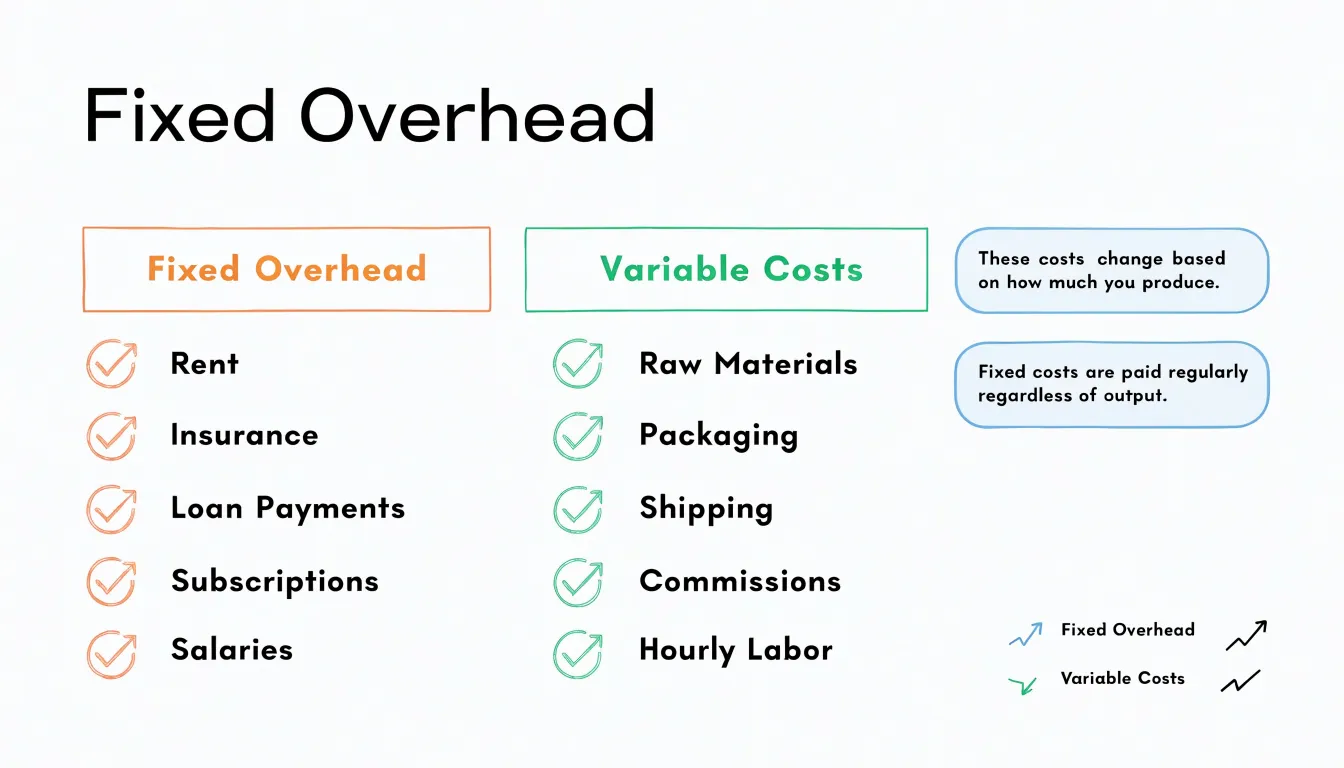
Separating fixed overhead from variable operating costs starts with a clear definition of each category. Fixed costs stay the same regardless of how much your business produces or sells in a given month. Rent, insurance premiums, loan payments, software subscriptions, and salaried administrative staff all fall into this group. You owe these amounts whether you have your best month or your worst, which makes them predictable and relatively easy to plan around. Variable costs, by contrast, rise and fall with your level of activity. Raw materials, packaging, shipping fees, sales commissions, and hourly labor are typical examples. When orders increase, these expenses increase alongside them; when business slows, they shrink.
Many small business expenses resist tidy categorization because they contain both fixed and variable elements. A utility bill is a common example: a base service charge stays constant each month while usage charges fluctuate with production. A delivery vehicle may carry a fixed lease payment plus variable fuel and maintenance costs. Employees paid a base salary plus overtime or commission blend both categories. To handle these mixed expenses, break each bill into its components and assign the fixed portion to overhead and the variable portion to operating costs. Reviewing several months of statements helps you identify the stable baseline and the portion that moves with activity.
Practical methods make this sorting easier. Start by listing every expense your business incurred over the past six to twelve months and ask one question of each: would this charge change if sales doubled or dropped to zero? A yes points to variable; a no points to fixed. For borderline items, calculate the cost per unit of output, such as material cost per product or labor cost per service hour, and treat the remainder as fixed. Accounting software can tag expenses with categories and generate reports that show the split over time. As a final step, revisit the classification each quarter, since a growing business often converts what was once a variable cost, such as outsourced help, into a fixed one through hiring, or vice versa.
Revenue forecasting
Revenue forecasting is a critical component of budgeting for small businesses, especially when sales fluctuate from month to month. To create a reliable budget, you need a realistic estimate of future income. Start by analyzing your historical revenue data. Look at monthly sales over the past year or more to identify patterns and calculate average monthly revenue. This average provides a baseline, but it’s important to recognize that averages can mask significant variations. For a more nuanced view, calculate the median or use a moving average that smooths out short-term fluctuations.
A rolling forecast is another effective technique. Instead of creating a static annual forecast, update your projections regularly—perhaps monthly or quarterly—by adding new data and adjusting future months accordingly. This approach keeps your forecast current and responsive to changing conditions. For example, if you notice a slowdown in one month, you can adjust the next few months’ projections based on that trend. Rolling forecasts help you stay agile and make informed decisions about spending and cash flow.
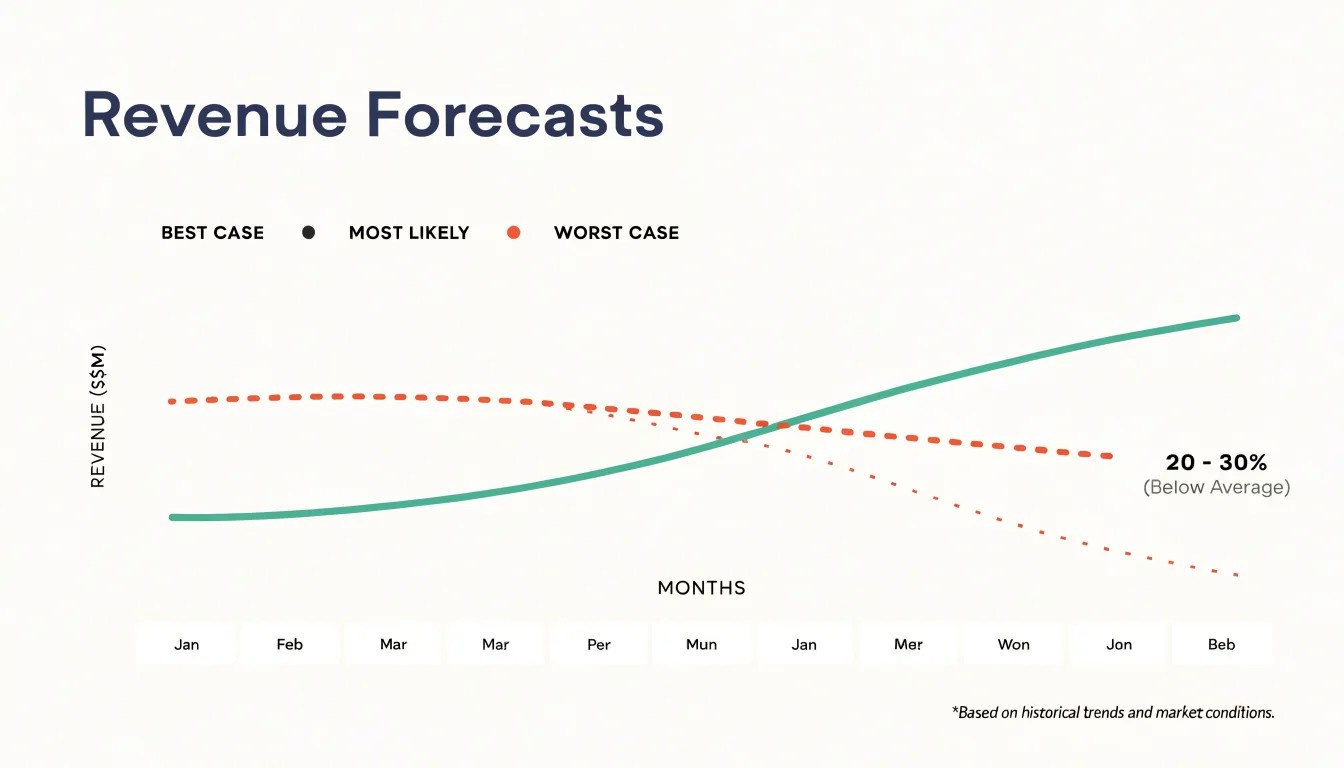
When monthly sales are highly unpredictable, conservative scenarios become essential. Develop a best-case, worst-case, and most-likely scenario for your revenue. The worst-case scenario should reflect a significant downturn, such as a 20-30% drop from your average, so you can prepare for the unexpected. Use the most-likely scenario for your main budget and the worst-case to identify potential cash shortfalls and plan contingency measures. This scenario planning helps you avoid overcommitting to fixed expenses and ensures you have a buffer for lean periods.
Additionally, consider using a percentage of sales method for variable expenses, which automatically adjusts with revenue changes. By combining historical analysis, rolling forecasts, and conservative scenarios, you can create a robust revenue forecast that supports a resilient small business budget.
Building an emergency fund reserve for unexpected supply chain costs
An emergency fund reserve gives a small business a buffer against supply chain shocks that are difficult to predict, such as a sudden price spike from a key supplier, an expedited shipping charge after a delayed delivery, or the cost of sourcing replacement materials from a secondary vendor on short notice. Setting aside a dedicated reserve turns these events from cash flow crises into manageable expenses. A common starting target is one to three months of average supply-related spending, which covers routine purchasing plus freight and any minimum order commitments. Businesses operating in volatile commodity markets or relying on a single supplier may aim toward the higher end of that range. The right figure depends on how quickly input costs can swing and how long a disruption might last. It helps to review the past year of purchasing records to estimate a realistic monthly supply figure, then adjust upward for seasonal peaks or known supplier risks.
Where the reserve is kept matters as much as how much is set aside. The funds should be liquid and separate from the operating account so they are not absorbed into day-to-day spending. A dedicated business savings or money market account works well, offering quick access while earning modest interest. Some owners keep the reserve in a separate sub-account within their existing banking relationship to simplify transfers. The key is that the money remains reachable within a day or two, since supply chain emergencies rarely allow for long notice periods.
Building the reserve gradually keeps it from straining cash flow. A practical approach is to automate a modest transfer, such as a small fixed percentage of monthly revenue or a set dollar amount, into the reserve account on a schedule that matches incoming cash. Treating the contribution like any other recurring operating expense normalizes it and prevents the reserve from being raided for routine purchases. During stronger months, additional contributions can accelerate progress. Clearly labeling the fund and documenting its purpose helps maintain discipline, and replenishing the reserve after any draw keeps the safety net intact over the long term.
Setting up a monthly review schedule to track budget variances
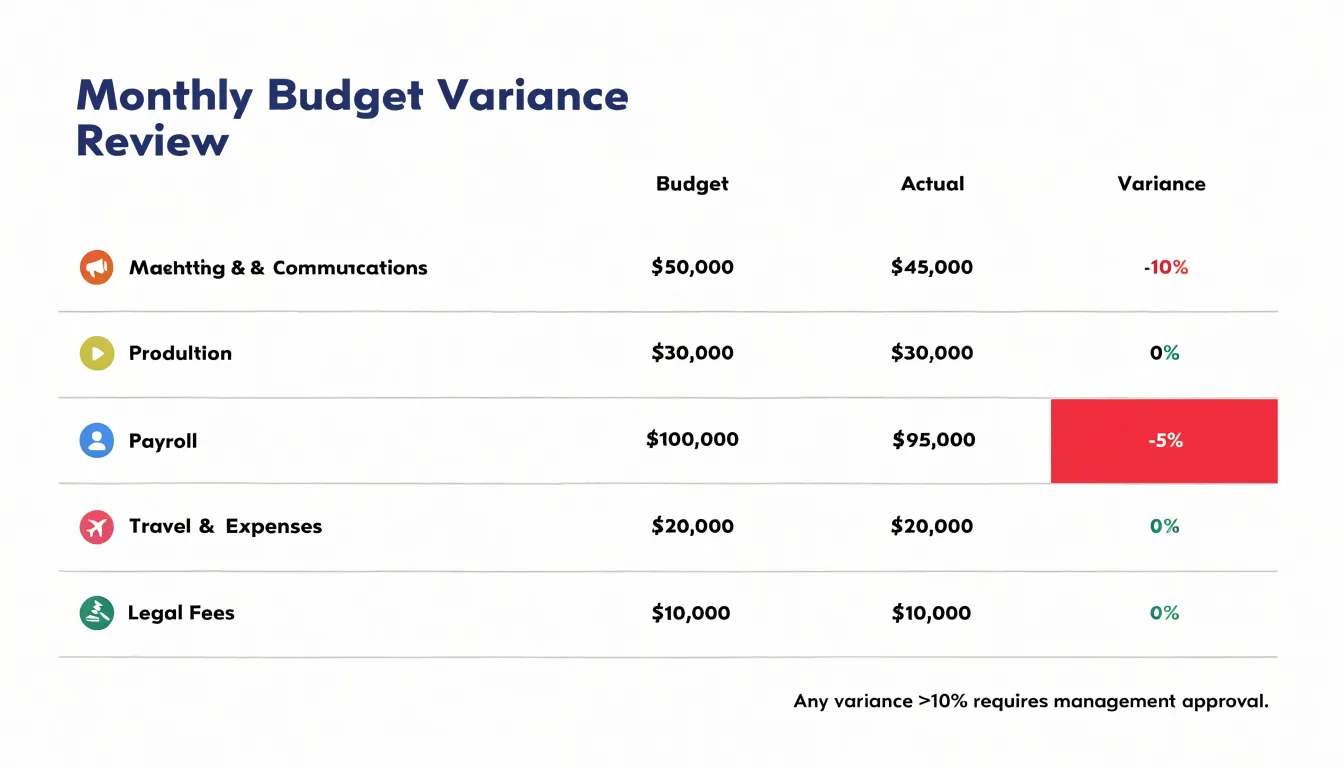
A monthly review schedule transforms your budget from a static document into a living tool for financial control. Set a recurring appointment with yourself, ideally on the same day each month, to compare actual results against your budgeted figures. This routine creates accountability and ensures you catch issues early. During the review, gather your financial statements—profit and loss, cash flow, and balance sheet—and place them side by side with your budget. Calculate the variance for each line item, noting both the dollar amount and percentage difference. Focus on significant variances, typically those exceeding 10% or a predetermined dollar threshold. For each significant variance, ask why it occurred. Was it a one-time expense, a pricing change, or a shift in sales volume? Understanding the cause helps you decide whether to adjust the budget or take corrective action. Not all variances require a budget adjustment; some are seasonal or temporary. However, if a variance persists for two or three consecutive months, it likely signals a fundamental change in your business that warrants a budget revision. The monthly review also provides an opportunity to update your forecast for the remainder of the year based on current trends. Document your findings and decisions in a simple log to track patterns over time. This practice builds financial discipline and helps you anticipate future challenges. By committing to a monthly review, you gain clarity on your business’s financial health and make informed decisions that keep your budget aligned with reality.
What tools work best for tracking small business cash flow?
Selecting the right tool for tracking cash flow depends heavily on how complex your business has become. For very small operations, such as solopreneurs or businesses in their first year, a well-built spreadsheet template often provides everything needed. Spreadsheet templates for cash flow typically include columns for date, description, category, money in, money out, and running balance. They are free or inexpensive, highly customizable, and require no onboarding time. The main limitation is that everything must be entered manually, which increases the risk of typos, missed entries, and stale data if you fall behind on updates. A disciplined weekly routine of entering transactions can keep a spreadsheet accurate, and many small owners find the hands-on process gives them a close feel for their numbers.
As transactions multiply and you begin invoicing clients, managing inventory, or employing staff, accounting software becomes the more practical choice. Programs like QuickBooks, Xero, FreshBooks, and Wave automatically import bank and credit card transactions, reconcile accounts, and generate cash flow statements alongside profit and loss reports. This automation reduces manual entry errors and saves hours each month. Most of these platforms offer tiered pricing, so a business with a handful of clients can start on an entry-level plan and upgrade as volume grows. Look for software that connects directly to your bank, supports the payment methods your customers use, and produces reports your accountant can work with at tax time.
Dedicated cash flow apps sit between spreadsheets and full accounting suites. Tools such as Float, Pulse, and Cash Flow Frog focus specifically on forecasting, pulling data from your accounting software or bank feeds to project balances weeks or months ahead. They shine when your business has irregular income, seasonal swings, or multiple payment obligations that make forward visibility critical. These apps usually integrate with major accounting platforms rather than replacing them.
When choosing, match the tool to your size and complexity. A single-owner service business with predictable monthly expenses can thrive on a spreadsheet. A growing company with employees, inventory, and several income streams should invest in accounting software with strong reporting. A business with lumpy revenue or tight margins benefits from adding a forecasting app. Whatever you choose, the tool should make cash flow visible at a glance and fit the time you can realistically devote to keeping it current.
Adjusting your spending plan during seasonal sales lulls
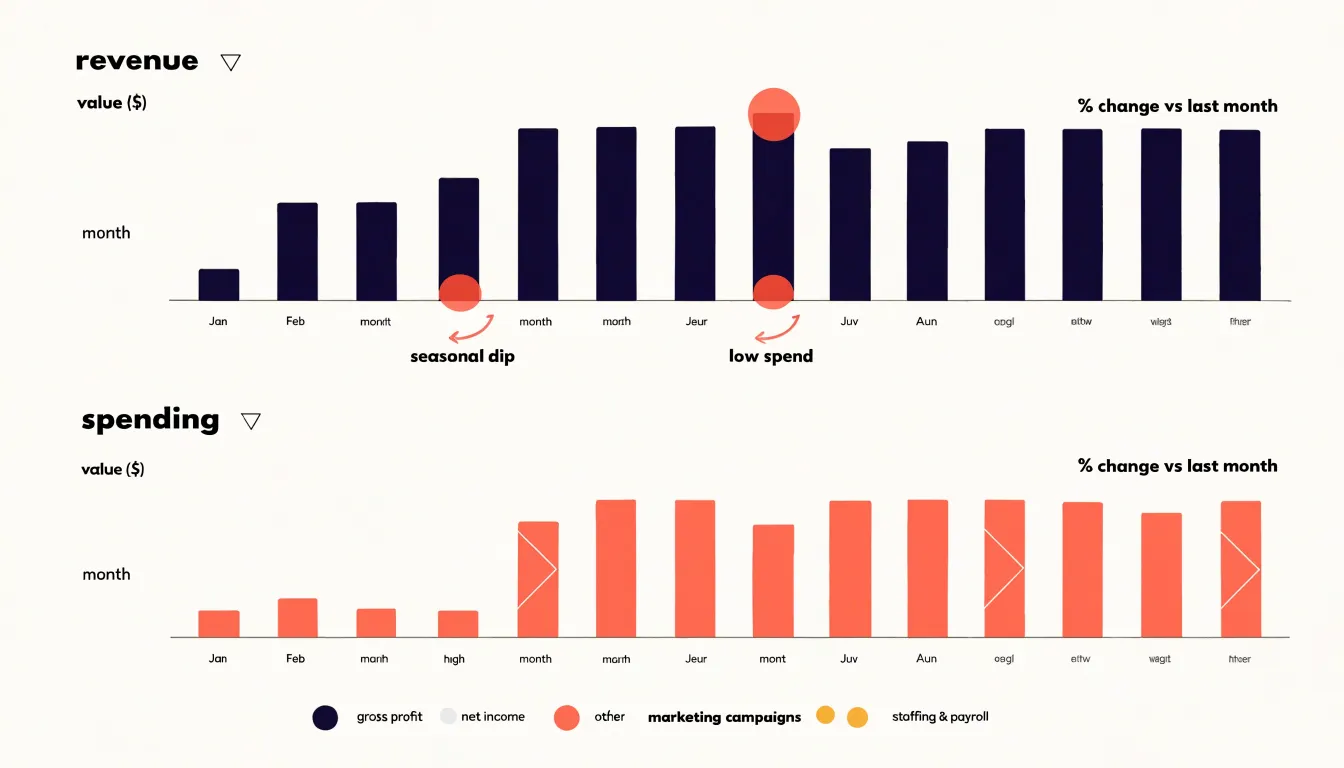
Every small business experiences predictable slow periods, whether they arrive with seasonal shifts, post-holiday slowdowns, or annual cycles specific to your industry. A spending plan becomes far more useful when it accounts for these rhythms in advance. By mapping out the months when revenue typically dips, you can build a flexible budget that contracts during lulls and expands when business picks up, rather than treating every month as though it should look the same.
The first lever involves cutting discretionary spending. During a lull, review line items that are nice to have rather than essential to operations. This might include subscriptions you rarely use, premium software tiers, travel that can wait, or marketing experiments that are not generating measurable returns. Set a temporary cap on categories like dining, entertainment, or office perks, and communicate the change to your team so everyone understands the reasoning. A short-term reduction in these areas protects cash without disrupting the core of the business.
The second lever is deferring non-essential purchases. Large equipment, office upgrades, and one-time projects can often be pushed to a stronger month without harm. Keep a running list of deferred items so nothing falls through the cracks, and revisit the list when revenue recovers. This approach preserves working capital during the weeks when incoming cash is thinnest and gives you more room to cover fixed costs like rent, insurance, and payroll.
The third lever is reallocating funds toward the areas that keep revenue flowing. During a slow period, shift money from lower-priority categories into activities that support cash flow, such as targeted promotions, customer retention efforts, or restocking your best-selling products. Reallocation turns a defensive posture into an active strategy, keeping the business moving while you wait for demand to return.
Finally, treat the lull as a planning opportunity. Use the quieter weeks to review vendor contracts, negotiate better terms, and refine next season’s budget based on what you learn. Documenting each adjustment helps you build a repeatable playbook, so the next slow period feels like a scheduled event rather than a surprise.
Profit planning
Profit planning begins with deciding how much to pay yourself. A realistic owner salary starts with your personal budget: calculate your monthly living expenses, including housing, food, utilities, insurance, and debt payments, then add a buffer for irregular costs. Compare that figure to your business’s projected revenue and cash flow. If the business cannot support a full salary immediately, set a modest starting amount and plan to increase it as revenue grows. Document this salary as a fixed line item in your budget so it is treated as a legitimate business expense. This approach separates your personal finances from the business and prevents ad hoc withdrawals that disrupt cash flow.
Next, estimate your quarterly tax obligations. Most small business owners must pay estimated taxes four times a year. To estimate, project your annual net profit, then apply your effective tax rate, which includes income tax and self-employment tax. A safe starting point is to set aside 25 to 30 percent of net profit for taxes, adjusting based on your bracket and deductions. Review your actual profit each quarter and update the estimate; if profit rises, increase the reserve. Keep these funds in a separate savings account so they are not spent on operations. Mark the quarterly due dates on your calendar and pay on time to avoid penalties.
Finally, reserve a portion of profit for reinvestment or savings. Aim to allocate a percentage of each sale or month’s profit—even 5 percent—to a dedicated reserve. Use this reserve for equipment upgrades, marketing pushes, or a cash cushion for slow periods. Treat this reserve as a non-negotiable line item, just like rent. Over time, consistent profit planning creates stability: you pay yourself predictably, meet tax obligations without stress, and build resources to grow the business.
Frequently Asked Questions
What financial records should I gather to build a small business budget?
Start with bank statements for every business account, including savings and credit lines, then collect receipts, invoices, payroll records, and all tax filings from the year. These documents show where money came from and went, close gaps in the bank record, and confirm official income and deductible expenses.
How do I separate fixed overhead from variable operating costs?
Fixed costs stay the same regardless of production or sales—such as rent, insurance, loan payments, software subscriptions, and salaried administrative staff—while variable costs rise and fall with activity, such as raw materials, packaging, shipping, commissions, and hourly labor. For mixed expenses, break each bill into its components and assign the fixed portion to overhead and the variable portion to operating costs.
How can I forecast revenue when monthly sales are unpredictable?
Analyze historical monthly sales to calculate an average baseline, but also use the median or a moving average to smooth short-term fluctuations. Use rolling forecasts updated regularly, and develop best-case, worst-case, and most-likely scenarios, using the most-likely scenario for the main budget and the worst-case to identify potential cash shortfalls.
How much should I set aside for supply chain emergencies?
A common starting target is one to three months of average supply-related spending, and businesses in volatile commodity markets or relying on a single supplier may aim toward the higher end. Keep the reserve liquid and separate from the operating account so it remains reachable within a day or two.
How often should I review my small business budget variances?
Set a recurring monthly appointment, ideally on the same day each month, to compare actual results against budgeted figures. Focus on significant variances, typically those exceeding 10% or a predetermined dollar threshold, and if a variance persists for two or three consecutive months, it likely warrants a budget revision.
How should a small business owner plan to pay themselves and cover taxes?
Start with your personal monthly living expenses plus a buffer, compare that with projected revenue and cash flow, and document any owner salary as a fixed line item in the budget. For taxes, project annual net profit, set aside 25 to 30 percent of net profit, and keep those funds in a separate savings account.