
How to Value a Small Business
Valuing a small business combines three core methods: the asset approach (adjusted net worth), income methods (discounted cash flow or capitalization of earnings), and market multiples from comparable sales. Most small businesses are priced using seller’s discretionary earnings (SDE), which adds back owner compensation, personal expenses, and one-time costs to show true earnings.
Table of Contents
- Essential Financial Records to Gather Before You Begin
- The Asset Approach and How to Calculate Net Business Worth
- Valuation via Earnings
- Using Market Multiples to Compare Your Business Against Recent Sales
- Seller Discretionary Earnings
- Which Valuation Method Works Best for Your Industry?
- Common Valuation Mistakes That Lower Your Final Sale Price
- Simple Steps to Clean Up Your Financials Before an Evaluation
Essential Financial Records to Gather Before You Begin
A business valuation is only as reliable as the financial information that supports it, so the first practical step is assembling a complete and organized set of records. Profit and loss statements form the backbone of the analysis. Aim to gather at least three years of these statements, ideally on a monthly basis for the most recent twelve months, since monthly detail reveals seasonality and cash flow patterns that annual summaries can hide. Balance sheets for the same period show what the business owns and owes at each point in time, giving the valuator a clear picture of equity, debt load, and working capital.

Business tax returns for the past three to five years serve as a cross-check against the profit and loss statements and often surface discrepancies worth investigating. If the business is a pass-through entity, the owners’ personal returns may also be relevant, particularly where business expenses and income flow through to personal filings. Asset lists round out the picture on the balance sheet side. A detailed schedule of equipment, vehicles, inventory, real estate, and intellectual property, including acquisition dates and current book values, allows the valuator to assess replacement cost and depreciation accurately.
Owner compensation details deserve separate attention. The salary, distributions, perks, and benefits paid to owners often deviate from what a market-rate employee would earn in the same role. Documenting these figures lets the valuator normalize earnings and arrive at a defensible adjusted profit figure, which frequently becomes the basis for the final number. Supporting documents such as bank statements, loan agreements, leases, and key contracts add further context and help verify the figures reported elsewhere.
Gather these records early and in organized form. Clean, complete documentation shortens the valuation process, reduces the need for estimates, and gives both the owner and the valuator confidence that the final figure reflects the true financial position of the business.
The Asset Approach and How to Calculate Net Business Worth
The asset approach to valuing a small business builds a value estimate from the balance sheet up. It starts by listing everything the business owns, then subtracting everything it owes, with one important adjustment: book values recorded at original cost are replaced with fair market value, meaning what each item would realistically bring in the current market. This restatement is what separates a meaningful net worth figure from a simple accounting snapshot.
Begin with tangible assets. These include cash on hand, accounts receivable, inventory, equipment, vehicles, furniture, and leasehold improvements. For each line, ask what a buyer would actually pay today. Inventory might be worth less than book value if some of it is slow-moving or obsolete. Equipment values should reflect its age and condition, drawing on used-market listings or appraisal guidance. Accounts receivable need a realistic allowance for amounts that may never be collected.

Intangible assets add another layer. Customer lists, established supplier relationships, brand recognition, proprietary processes, and a trained workforce all carry value a buyer would be willing to pay for, even though they never appear on a standard balance sheet. Intangibles are harder to price, so support each estimate with evidence such as customer retention rates, contract terms, or comparable transactions where available.
Next, tally the liabilities: outstanding loans, lines of credit, accounts payable, accrued expenses, taxes due, lease obligations, and any contingent liabilities such as pending claims. Subtract total liabilities from total adjusted assets to arrive at net business worth. If the result is positive, the business holds equity value on an asset basis; if negative, liabilities exceed asset value and the figure signals how much capital a buyer would need to inject.
Keep clear documentation for every adjustment made to book value, since buyers and lenders will want to see the reasoning behind each number. The final figure gives a grounded floor for negotiations and a useful benchmark to compare against income- and market-based valuation methods.
Valuation via Earnings
Income-based methods rest on a straightforward idea: a business is worth the profit it will generate for its owner over time, adjusted for the fact that money received later is worth less than money in hand today. Two approaches dominate this category, and both begin with the same raw material, the company’s earnings.
The discounted cash flow method projects the cash the business is expected to produce over a defined forecast period, typically three to five years, then estimates a terminal value representing everything beyond that horizon. Each year’s projected cash flow is then discounted back to the present using a discount rate, and the results are summed to arrive at an indicated value. This method suits businesses with reasonably predictable earnings and a clear growth trajectory, and it rewards careful assumptions about revenue, margins, and capital spending.
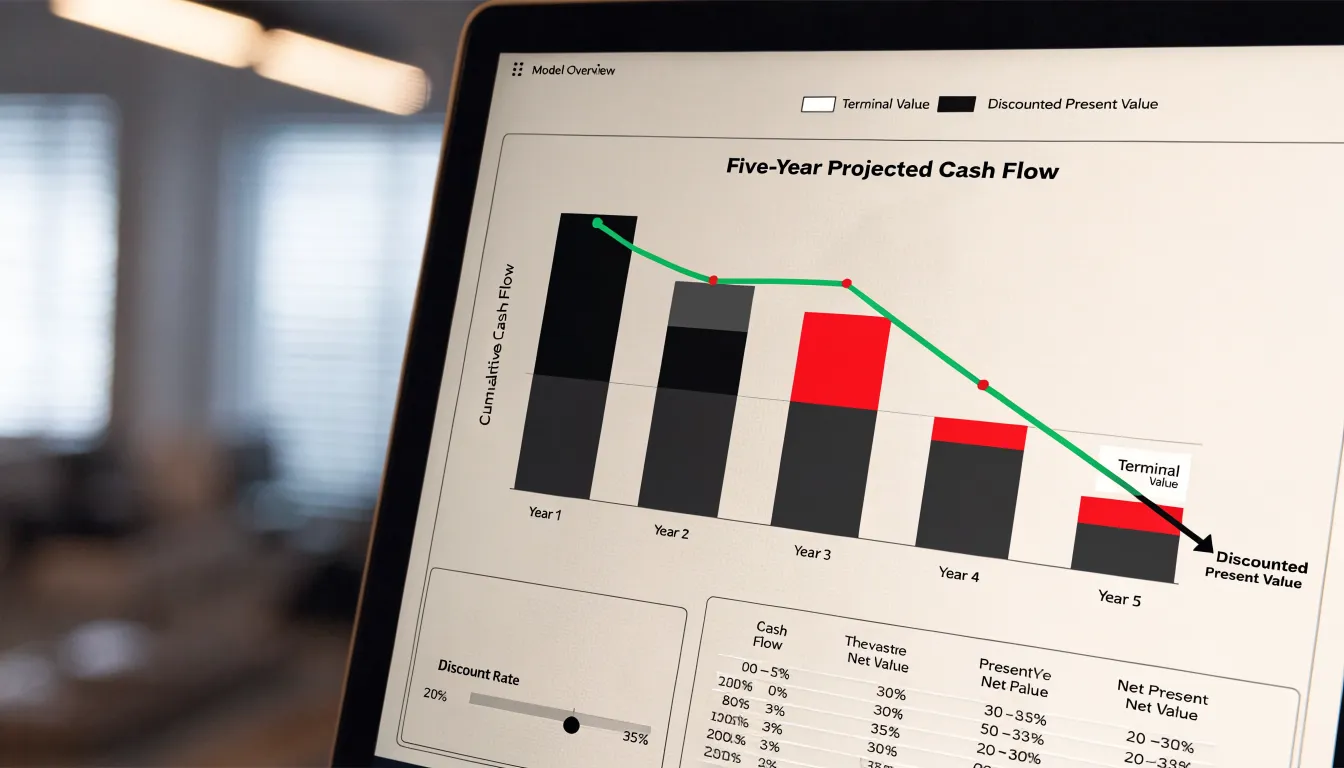
The capitalization of earnings method is a simpler cousin. Rather than projecting year by year, it takes a single representative earnings figure, usually normalized to strip out one-time items and owner-specific compensation, and divides it by a capitalization rate. A cap rate of 25 percent, for example, implies a value of four times earnings. The cap rate bundles together the required return and expected growth, so a business with stable, low-risk earnings might carry a cap rate in the low twenties, while one with volatile results warrants a higher rate and a lower multiple.
Picking the discount rate is where judgment matters most. A common starting point is the build-up approach: begin with a risk-free rate, such as the yield on long-term government bonds, then add premiums for equity risk, small company risk, and industry-specific risk. Many small business appraisers land on discount rates between 20 and 35 percent, reflecting the elevated risk of a company dependent on a small customer base, a narrow management team, or a single market. The rate should reflect what a reasonable buyer would demand as a return given the alternatives available, and it should be documented so that the assumptions behind the number can be defended.
Using Market Multiples to Compare Your Business Against Recent Sales
Market multiples offer one of the most practical ways to value a small business because they ground your estimate in what real buyers have actually paid for similar companies. The process starts with finding comparable sales. Industry associations, business brokers, and specialized databases publish transaction data, and broker market studies often summarize sale prices alongside revenue and earnings figures. Local business brokers can be an especially useful source, since they see deals close in your region and niche and can share general ranges without disclosing confidential details. Aim to gather several transactions from the past few years involving companies in your industry, your size range, and your geographic market.
Once you have a set of comparable sales, apply the multiples that fit your industry. Some sectors are commonly valued on a revenue multiplier, especially where margins are fairly consistent across operators. Others rely on an EBITDA or seller’s discretionary earnings multiplier, which captures profitability and rewards efficient operations. Determine the multiple by dividing each comparable sale price by its revenue or earnings figure, then look at the resulting range. A cluster of transactions producing multiples between 2.0 and 3.0 times earnings, for example, gives you a working benchmark.
Adjustments matter as much as the raw numbers. A comparable business that is larger than yours may command a higher multiple because bigger companies often carry less risk and attract more buyers, so you may need to shade the multiple downward for a smaller operation. Risk differences work the same way: a company with a diversified customer base, documented systems, and a long lease will typically sell at a higher multiple than one dependent on a single client or a founder who handles every sale. Consider growth trends, customer concentration, staff depth, and the transferability of key relationships, and adjust the multiple to reflect how your business compares.
Applying an adjusted multiple to your own revenue or earnings produces an indication of value, one data point to weigh alongside other methods. Review several comparables rather than a single transaction, and document your reasoning so the final figure stands up to scrutiny from buyers, lenders, or advisors.
Seller Discretionary Earnings
Seller discretionary earnings, commonly shortened to SDE, is the central earnings figure used when valuing most small businesses. It begins with the company’s net income and then adds back certain expenses that reflect the owner’s personal choices rather than the underlying economics of the operation. The three broad categories are the owner’s salary and any distributions taken from the business, personal expenses that the owner has run through the company, and one-time or non-recurring costs that are unlikely to repeat under new ownership. Together, these adjustments produce a clearer picture of what the business actually generates for the person running it.

The owner’s compensation is the largest and most important add-back. In many small companies, the owner sets their own pay, and that figure may be well above or well below what a replacement manager would command. Adding salary back to net income lets a buyer compare businesses on a level footing and then decide what they would need to pay someone else to do the same job. Similarly, personal expenses such as a vehicle, travel, meals, or family members on payroll are costs that exist because the owner controls the checkbook. These items are added back because a new owner would not carry them, and they distort net income if left in place.
One-time costs form the third category. Expenses tied to a legal dispute, an equipment failure, a rebranding effort, or an unusual marketing push do not reflect normal operations. Adding them back removes noise from the earnings picture and helps a buyer see the steady-state profitability of the business. Buyers use the resulting SDE figure as the foundation for valuation, often applying a multiple drawn from comparable sales in the same industry and size range. A higher SDE supports a higher valuation and a stronger case for financing. For sellers, understanding which expenses qualify as add-backs and documenting them carefully can meaningfully raise the price the business commands. SDE ultimately answers the question every buyer asks: what will this business realistically put in my pocket each year, once I step into the owner’s shoes?
Which Valuation Method Works Best for Your Industry?
The industry a small business operates in shapes which valuation method produces credible, defensible numbers. Buyers and lenders bring sector-specific expectations to the table, and a valuation that ignores those norms invites skepticism or a lower offer.
Asset-heavy businesses, such as manufacturers, construction firms, and companies with substantial equipment or real estate, are typically valued using an asset-based approach. Buyers in these sectors want to know what the tangible assets are worth on the open market and what it would cost to replace them. A manufacturing company holding $2 million in machinery, vehicles, and inventory will be scrutinized line by line, with adjustments for depreciation and obsolete stock. Lenders in these industries frequently rely on asset values as collateral, so a clean asset appraisal supports both the sale price and any financing the buyer seeks.
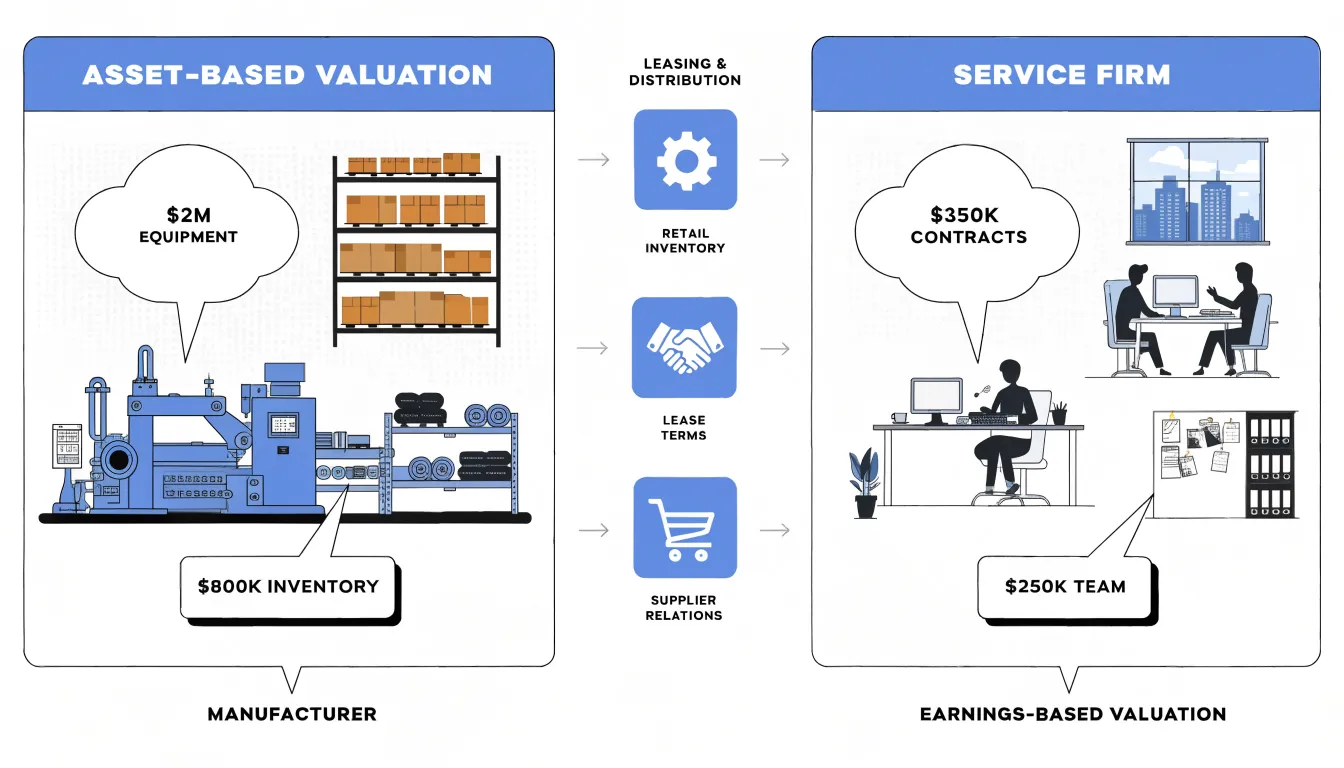
Service businesses, including consultancies, agencies, and professional practices, usually change hands based on earnings-based methods. These companies carry few hard assets, and their value sits in client relationships, recurring revenue, and the owner’s expertise. A marketing agency with steady contracts and strong margins is commonly valued using seller’s discretionary earnings or EBITDA multiples drawn from comparable transactions in the sector. Buyers in service industries pay for cash flow and client retention, and lenders underwriting an acquisition loan will focus on historical earnings and the durability of the customer base rather than on furniture and computers.
Retail businesses sit between these poles and often blend approaches. Inventory levels, lease terms, and location matter, but so do revenue trends and gross margins. A specialty retailer might be valued with a multiple of earnings adjusted for normalized inventory, while a restaurant may lean on a market-based approach comparing recent sales of similar establishments in the region. Lenders in retail tend to be conservative, weighing inventory quality and seasonality alongside profit history.
Matching the method to the sector signals professionalism to buyers and aligns the valuation with what financiers will actually fund. A valuation that fits the industry is easier to defend in negotiation and smoother to carry through due diligence.
Common Valuation Mistakes That Lower Your Final Sale Price
One of the most damaging mistakes sellers make is mixing personal and business finances. When a car payment, family dinner, or personal vacation runs through the business account, the financial statements stop telling a clean story. Buyers and their advisors see the commingling and begin to discount everything they review, since they can no longer trust the numbers at face value. The fix is straightforward: open a dedicated business account, route every business expense through it, and document any owner draws separately. Sellers who clean this up a year or two before listing give buyers a financial record that can be verified line by line.
Ignoring intangible assets is another common pitfall. Many small business owners think of value in terms of equipment, inventory, and real estate, while overlooking the customer relationships, brand reputation, proprietary processes, and trained staff that often drive the majority of earnings. When these assets go unmentioned in the sale materials, buyers assign them little or no value. Sellers should inventory what makes the business distinctive, document recurring revenue and customer retention, and present these strengths in the offering memorandum.
Unrealistic projections erode credibility. A seller who forecasts aggressive growth without supporting evidence invites skepticism, and once buyers doubt one figure, they question the rest. Projections grounded in historical performance, with clear assumptions about costs, pricing, and market conditions, carry far more weight. Conservative forecasts that the business has consistently met or exceeded build trust and often support a higher final price than optimistic numbers that look fabricated.
Failing to normalize financials is perhaps the most technical error. Normalizing means adjusting the statements to reflect what a typical owner would earn and spend, removing one-time costs, above-market owner compensation, and personal expenses. Without this step, buyers must do the work themselves, and they typically apply heavy discounts in the process. Sellers should prepare a normalized statement with each adjustment explained and supported by receipts or records.
Avoiding these mistakes requires early preparation. Sellers who spend twelve to twenty-four months cleaning up their books, documenting intangibles, and building defensible projections enter negotiations from a position of strength and typically command a higher sale price.
Simple Steps to Clean Up Your Financials Before an Evaluation
Preparing a small business for valuation begins with a set of straightforward housekeeping tasks that make the numbers easier for a buyer or appraiser to trust. The first step is separating personal expenses from business accounts. When owners run personal purchases through company cards or pay household bills from the business account, the financial statements understate true profitability and raise questions during due diligence. Moving those transactions to personal accounts and adjusting prior periods accordingly creates a cleaner baseline. Next, gather and organize receipts. Loose receipts stuffed in drawers or scattered across email inboxes slow the review process and invite skepticism. Sorting receipts by month and category, and matching them to bank and credit card statements, allows every reported expense to be traced to source documentation. Where receipts are missing, a reconstructed record with a clear note about the gap is far better than silence.
Account reconciliation is the next practical step. Every bank account, credit card, and loan should be reconciled monthly so that the books tie to actual statements. Unreconciled accounts signal sloppy bookkeeping and can hide errors or even fraud, which makes buyers cautious. Reconciling also surfaces duplicates, missed entries, and uncleared checks before they become a problem. After accounts are reconciled, document add-backs. Many small businesses carry owner-specific or one-time costs that depress reported profit, such as above-market owner compensation, personal vehicle use, or nonrecurring repairs. Each add-back should be listed with a description, amount, and supporting evidence so an appraiser can evaluate its legitimacy. A well-documented add-back schedule lets a buyer see normalized earnings without guessing.
Together these steps produce a financial picture that is transparent and defensible. Clean books shorten the evaluation timeline, reduce disputes over adjustments, and often support a higher valuation because the buyer can verify what the business actually earns.
Frequently Asked Questions
What financial records should I gather before valuing a small business?
Gather at least three years of profit and loss statements, ideally monthly for the most recent twelve months, plus balance sheets for the same period and business tax returns for the past three to five years. Also collect asset lists with acquisition dates and book values, owner compensation details, and supporting documents such as bank statements, loan agreements, leases, and key contracts.
How do you calculate net business worth under the asset approach?
List everything the business owns, replace book values with fair market value, and subtract total liabilities from total adjusted assets. The asset approach includes tangible assets and intangible assets, and a positive result means the business holds equity value on an asset basis.
What is seller discretionary earnings and what is added back?
Seller discretionary earnings starts with net income and adds back the owner’s salary and distributions, personal expenses run through the company, and one-time or non-recurring costs. It is the central earnings figure used when valuing most small businesses.
How do market multiples help value a small business?
Market multiples use comparable sales from industry associations, business brokers, or specialized databases, then divide each sale price by revenue or earnings to find a multiple range. You adjust that multiple for differences such as size and risk, then apply it to your own revenue or earnings as one indication of value.
Which valuation method works best for my industry?
Asset-heavy businesses such as manufacturers and construction firms are typically valued with an asset-based approach, while service businesses are usually valued using earnings-based methods such as SDE or EBITDA multiples. Retail businesses often blend approaches, considering inventory, lease terms, location, revenue trends, and gross margins.
What common mistakes can lower a small business’s final sale price?
Common mistakes include mixing personal and business finances, ignoring intangible assets, using unrealistic projections, and failing to normalize financials. Preparing early by cleaning up books, documenting intangibles, and building defensible projections helps sellers avoid these issues.