
How to Write Journal Entries (With Examples)
Journaling is the regular practice of writing down thoughts, feelings, and observations to build self-awareness, track goals, and process emotions. Common methods include bullet journaling for structure, morning pages for creative unblocking, and gratitude journals for busy schedules. Entries work best when specific, honest, and brief, and the habit sticks when anchored to an existing daily routine.

Table of Contents
- Choosing the Right Journaling Method for Your Routine
- A Simple Daily Reflection Template for Mindful Living
- How to Write a Financial Journal Entry That Tracks Spending Habits
- Prompts to Use When You Feel Stuck or Uninspired
- Gratitude Journaling
- What Should You Write About When Processing Tough Emotions
- Goal Setting
- Simple Strategies to Make Journaling a Lasting Daily Habit
Choosing the Right Journaling Method for Your Routine
Choosing a journaling method starts with an honest look at your daily rhythm and what you hope to gain from the practice. Bullet journaling suits people who like structure and flexibility in equal measure. This method uses a system of rapid logging, symbols, and collections to track tasks, events, and notes in one place. It works well for anyone juggling multiple responsibilities who wants a single notebook to organize both plans and reflections. Because you design the layout yourself, a bullet journal can adapt as your priorities shift, though it does require a small upfront investment in setting up spreads and learning the notation.
Morning pages, popularized by Julia Cameron, involve writing three longhand pages first thing after waking. The practice is deliberately unstructured: no topic, no editing, no goal beyond emptying the mind onto paper. Writers, creatives, and anyone who feels mentally cluttered often gravitate toward morning pages because the exercise clears space for the day ahead. The main requirement is time, roughly twenty to thirty minutes of quiet before the rest of the household stirs, so it fits best for early risers or those willing to set an earlier alarm.
Gratitude journals take the opposite approach in terms of effort. A few lines each day listing things you appreciate can shift attention toward the positive and build a record of small good moments over time. This method suits busy schedules, since it can be completed in five minutes before bed or alongside a morning coffee. It pairs naturally with other practices, so many people keep a gratitude section inside a larger journal.
To match a method to your routine, consider three factors: available time, preferred structure, and your reason for writing. If you have ten minutes and want to reduce stress, a gratitude journal or a simple daily reflection works well. If you have half an hour in the morning and want creative unblocking, try morning pages. If you need to track commitments alongside thoughts, bullet journaling offers the most utility. Many journalers experiment with one method for a few weeks, notice what feels sustainable, and adjust from there. The best method is the one you will actually return to day after day.
A Simple Daily Reflection Template for Mindful Living
A simple daily reflection template gives structure to journaling without making it feel like a chore. The template works best when it is short enough to complete in a few minutes, so it fits naturally into the beginning and end of a day. A practical version has three parts: a morning intention, a mindfulness check-in, and an evening review. Each part contains a handful of fill-in-the-blank prompts that you can answer in a sentence or two.
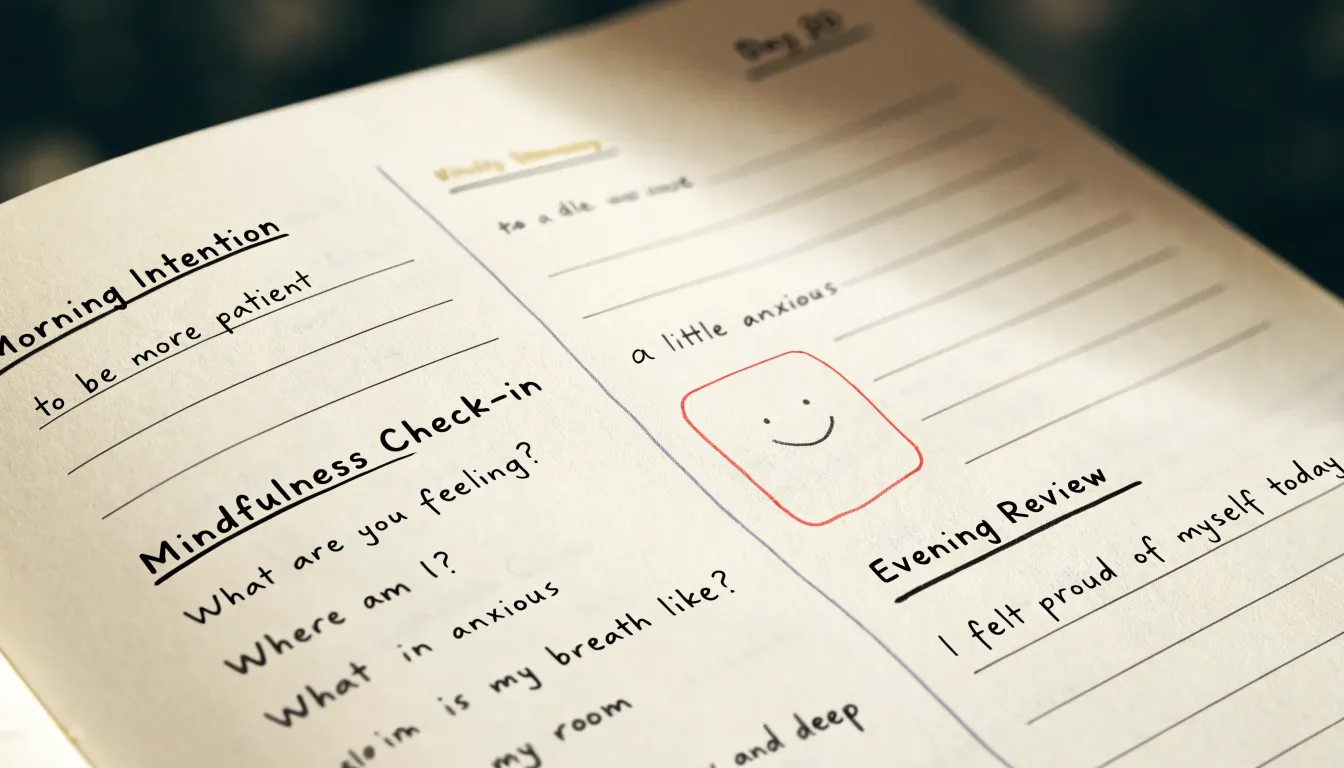
The morning intention section sets the tone before the day gathers speed. Prompts might read: “Today I want to feel ___”, “The one thing that matters most today is ___”, and “A quality I want to bring to my interactions is ___”. Filling these in takes less than two minutes and gives you a touchstone to return to when the day gets busy. The act of naming an intention, even loosely, helps you notice when you have drifted away from what you care about.
The mindfulness check-in is a brief pause you can use at any point, and the template can include a small box for it. Prompts such as “Right now I notice ___”, “My body feels ___”, and “I am grateful for ___” invite you to tune in to the present moment without judgment. You can complete a check-in once at midday, or several times across the day, each time writing only a word or a short phrase. The brevity keeps the practice sustainable.
The evening review closes the loop. Prompts like “One moment that stood out today was ___”, “I handled ___ well”, “I would like to do ___ differently tomorrow”, and “Something I learned about myself today is ___” turn the day’s events into gentle reflection. The emphasis stays on curiosity and learning, so the review feels supportive rather than critical.
To use the template, keep a single page or notebook spread dedicated to it, or copy the prompts into a digital note you can duplicate each day. Write in fragments if full sentences feel like too much. Over time, the filled-in blanks become a record of your intentions, your awareness, and your growth, collected in just a few quiet minutes a day.
How to Write a Financial Journal Entry That Tracks Spending Habits
Tracking spending habits begins with a consistent daily logging practice. Set aside a few minutes each evening to record every expense, no matter how small. Use a dedicated notebook or a digital tool, and include the date, a brief description, the amount, and the payment method. For example, you might write: “October 15 – Coffee at Café Luna – $4.50 – debit card.” This simple act creates awareness of where your money goes. Next, categorize each expense to reveal patterns. Common categories include food, transportation, housing, entertainment, and health. You can create subcategories for finer detail, such as “dining out” versus “groceries.” Consistently assigning categories helps you see which areas consume the most resources. After logging and categorizing, take time to reflect on your money decisions. Ask yourself: Did this purchase align with my values? How did I feel before and after spending? For instance, you might note: “Bought a new book despite having several unread ones at home. Felt excited at the store, but later felt guilty about overspending on entertainment.” This reflection connects purchases to emotions and long-term goals. Consider an example entry that ties these elements together: “October 16 – Lunch with colleagues – $15 – credit card. Category: Dining out. I chose to join the team lunch to build relationships, which supports my career goal. However, I exceeded my weekly dining budget. Next time, I’ll suggest a cheaper option or bring lunch.” Such entries transform a simple expense log into a tool for self-awareness. By consistently logging, categorizing, and reflecting, you gain insight into your spending triggers and can make intentional choices that align with your financial goals. Over time, these journal entries become a valuable record of your journey toward better money management.

Prompts to Use When You Feel Stuck or Uninspired
Every journal keeper eventually meets the blank page, and the pressure to produce something meaningful can make the silence feel louder than the pen. Prompts work as gentle entry points, giving your attention a specific place to land so that writing can begin before motivation arrives. One reliable approach is to write from a different perspective. Describe your day as a curious observer would, or explain a familiar situation to someone encountering it for the first time. This shift in viewpoint loosens the grip of habit and lets you notice details you usually skip over. You might also write a short entry in the voice of a place you love, a season, or an object on your desk, allowing imagination to carry the words forward when memory feels thin.
Another practical prompt is to list small wins. Record three moments from the past day that went better than expected, however modest: a conversation that ended well, a task finished, a moment of calm. Small wins are easy to overlook, and naming them builds a record of progress that visible achievements rarely capture. Alongside this, try listing what you are carrying and what you can set down, or describe the room around you using only sounds. Sensory prompts ground you in the present and generate concrete material when abstract reflection stalls.
Questions also work well as prompts. Ask yourself what you would tell a friend in your situation, or what you are avoiding thinking about and why. Finish-the-sentence prompts can be especially freeing, since an incomplete line invites a response without demanding a polished one. Try completing the thought about what you needed today, or about the smallest thing that made you smile. Give yourself permission to answer briefly; a single honest line is a complete entry.
When inspiration is truly absent, lower the stakes deliberately. Set a timer for five minutes and keep the pen moving, allowing nonsense if necessary. Choose one prompt from a list you keep on hand and write without editing. The goal here is to make starting easy, because momentum usually arrives once the first sentence exists.
Gratitude Journaling
Gratitude journaling works best when entries move past broad statements and capture the particular. A line like “I’m grateful for my family” records a category; a line like “I’m grateful my sister called during lunch to ask how the interview went, and we ended up laughing about the terrible coffee at her office” preserves a moment you can return to. Specificity gives the mind something to hold onto, and that texture is what gradually reshapes how you notice your days.
Consider entries centered on people. Instead of naming a person, describe what they did and why it landed: “Grateful for Marcus, who noticed I was quiet in the meeting and sent a message afterward saying he’d cover my part of the report if I needed the afternoon off.” Writing about people this way trains attention toward the small acts of care that are easy to overlook and easy to forget by evening.
Moments deserve the same treatment. Capture sensory detail and context: “Grateful for the ten minutes on the porch before the rain started, the air cool and smelling of wet pavement, the dog asleep against my foot.” These entries work because they are retrievable. Weeks later, reading them re-creates the calm of that porch and reinforces the habit of noticing similar pockets of quiet as they happen.

Lessons form a third useful category. Writing about something difficult that taught you a skill or clarified a value builds resilience over time: “Grateful that the delayed flight gave me four hours to finish the book I’d been carrying around for a month, and that I finally understood why the ending mattered so much to my friend.” The entry acknowledges friction while drawing out what the experience offered.
A few practical touches help. Write in present or recent tense while the details are fresh. Name at least one concrete element, such as a time, a place, or a quoted phrase. Vary the focus across people, moments, and lessons so the practice does not settle into repetition. Taken together, these habits turn a gratitude list into a record of a life being observed closely, and that record is what gradually builds a more positive mindset.
What Should You Write About When Processing Tough Emotions
When you’re processing tough emotions like anger, grief, or anxiety, journaling can be a powerful tool to help you navigate and make sense of what you’re feeling. Start by finding a quiet space where you won’t be interrupted. Begin with a few deep breaths to center yourself, then write about what’s coming up for you. The goal is to get the emotions out of your head and onto the page, where you can examine them more objectively.
One effective approach is to name your feelings as specifically as possible. Instead of writing “I feel bad,” try to identify the exact emotion: “I feel frustrated because I wasn’t heard,” or “I feel anxious about the upcoming deadline.” Naming emotions accurately can help reduce their intensity and give you a clearer sense of what you’re dealing with. You might use a feelings wheel or a list of emotion words to find the right fit.
Next, separate facts from stories. Our minds often create narratives around events that amplify our distress. Write down what actually happened—the observable facts—and then write down the story you’re telling yourself about it. For example, a fact might be “My friend didn’t reply to my text,” while the story might be “She’s ignoring me because she’s mad at me.” Seeing the two side by side can help you recognize where your mind is jumping to conclusions and give you space to consider alternative explanations.
Here are some prompts to guide you:
- What am I feeling right now, and where do I feel it in my body?
- What happened to trigger this emotion? Stick to the facts.
- What story am I telling myself about this situation? Is there evidence for and against it?
- What do I need right now to feel supported or soothed?
- If I could say anything without fear of judgment, what would I say?
Remember, the goal isn’t to eliminate tough emotions but to understand them and respond to them with compassion. Writing regularly can help you build emotional awareness and resilience over time. If you find yourself feeling overwhelmed, take a break and return to the page when you’re ready.
Goal Setting
Start by translating each career or money milestone into a written SMART goal: specific, measurable, achievable, relevant, and time-bound. Write the goal out in full on the first page of a dedicated journal section so you can return to the exact wording later. For example, a vague wish to ‘earn more’ becomes ‘Increase my annual salary from $58,000 to $65,000 by December 31 through a promotion or a role change.’ A career goal such as ‘become a manager’ becomes ‘Complete two leadership courses and volunteer to lead one cross-functional project by September 30.’ The specificity gives you something concrete to check against, and the deadline tells you when to evaluate.
Once a goal is written, break it into journal check-ins. A weekly check-in can be a short paragraph noting the single action you took toward the goal that week. A monthly check-in works well for reviewing numbers: update your savings balance, your application count, your networking contacts, or whatever measures the goal. A quarterly check-in is the moment to reread the original SMART statement and judge whether the plan still fits. Date every entry and give each one a short heading such as ‘Q2 check-in: salary goal’ so the record stays easy to scan.
Record progress with concrete details and numbers. Note the interview you landed, the raise conversation you scheduled, the amount you moved into savings, or the debt balance you reduced. Numbers turn a journal into a record you can compare across months, and they make later reviews far more useful than general reflections.
Setbacks belong in the journal with equal care. If a promotion falls through or an unexpected expense drains your savings, write down what happened, what was within your control, and what you will adjust. Note the revised next step and a new date for it. Recording setbacks plainly keeps the journal honest, gives you a record of how you responded, and turns a difficult month into material for the next check-in.
Simple Strategies to Make Journaling a Lasting Daily Habit
Building a journaling practice that survives busy weeks comes down to reducing friction and lowering the bar for what counts as a successful session. Habit stacking is one of the most reliable techniques: attach journaling to an existing routine that already happens automatically, such as pouring your morning coffee, finishing dinner, or getting into bed. When the new behavior follows a cue that is already firmly established, the brain begins to associate the two, and the journal page becomes a natural next step rather than a separate task competing for attention. A useful variation is to place the journal at the exact spot where the anchor habit occurs, so the notebook and pen are within arm’s reach when the cue arrives.
Visibility matters just as much as timing. A journal tucked into a drawer is easy to forget, while one resting on the kitchen table, nightstand, or desk serves as a quiet reminder each time you pass it. Keeping a pen clipped to the cover removes the small annoyance of searching for something to write with, and that tiny convenience can make the difference between opening the book and skipping the day. Some people find it helpful to leave the journal open to a blank page, ready to receive the first sentence without any setup.

The two-minute minimum is the final piece of the strategy. Give yourself permission for a session to last only two minutes and to contain only a sentence or two. This approach keeps the habit anchored to consistency rather than volume, which means the practice can continue through exhausting days, travel, and deadlines. Writing one line about the weather or a single word describing the mood still counts, and the streak of showing up builds the identity of someone who journals. Over time, many sessions naturally stretch longer when there is more to say, while short entries preserve the routine on the days when energy is low. Together, these strategies turn journaling from an ambitious project into a small, repeatable ritual that fits inside ordinary life.
Frequently Asked Questions
How do I choose the right journaling method for my routine?
Consider your available time, preferred structure, and reason for writing. For example, a gratitude journal or simple daily reflection can work if you have ten minutes and want to reduce stress, morning pages fit half an hour in the morning for creative unblocking, and bullet journaling offers the most utility for tracking commitments alongside thoughts.
What should a simple daily reflection template include?
It can have three parts: a morning intention, a mindfulness check-in, and an evening review. Each part uses a handful of fill-in-the-blank prompts you can answer in a sentence or two.
How can I use journal entries to track my spending habits?
Set aside a few minutes each evening to record every expense, including the date, a brief description, the amount, and the payment method. Then categorize each expense and reflect on your money decisions to see patterns and spending triggers.
What can I write about when I feel stuck or uninspired?
Try writing from a different perspective, listing small wins, describing what you are carrying and what you can set down, or using sensory prompts. You can also ask yourself questions, use finish-the-sentence prompts, or set a five-minute timer and keep the pen moving without editing.
How do I journal when processing tough emotions?
Find a quiet space, take a few deep breaths, and write about what is coming up. Name your feelings as specifically as possible and separate observable facts from the story you are telling yourself. If you feel overwhelmed, take a break and return to the page when you are ready.
How can I make journaling a lasting daily habit?
Use habit stacking by attaching journaling to an existing routine, keep the journal visible with a pen clipped to the cover, and allow a two-minute minimum with just a sentence or two. This keeps the habit anchored to consistency rather than volume.