LLC vs S Corp
An LLC is a legal business structure with pass-through taxation by default, while an S Corp is a tax election an LLC can make with the IRS. Electing S Corp status splits profit into a reasonable salary subject to payroll tax and distributions exempt from self-employment tax, typically saving money above roughly $60,000 in annual profit.
Table of Contents
- How Default LLC Tax Status Works for Business Owners
- S Corp Status
- How Self-Employment Tax Differs Between LLCs and S Corps
- S Corp Profit Threshold
- The Hidden Expenses of Running an S Corp Payroll
- Qualified Business Income Deduction Rules for Both Structures
- Steps to Formally Transition Your LLC to S Corp Tax Status
- Which Entity Fits Your Long-Term Revenue Goals?
How Default LLC Tax Status Works for Business Owners
When a business registers as a limited liability company, the IRS assigns a default tax classification based on how many owners it has. A single-member LLC is automatically treated as a disregarded entity. The LLC itself does not file a separate tax return or pay income tax; instead, all profits and losses flow directly onto the owner’s personal Form 1040, typically reported on Schedule C. A multi-member LLC is treated as a partnership by default, meaning the company files an informational return (Form 1065) and issues each member a Schedule K-1, with each owner reporting their share of income on their own personal return. In both cases, the central principle is pass-through taxation: the business’s earnings are taxed once, at the owners’ individual rates, rather than at the entity level.
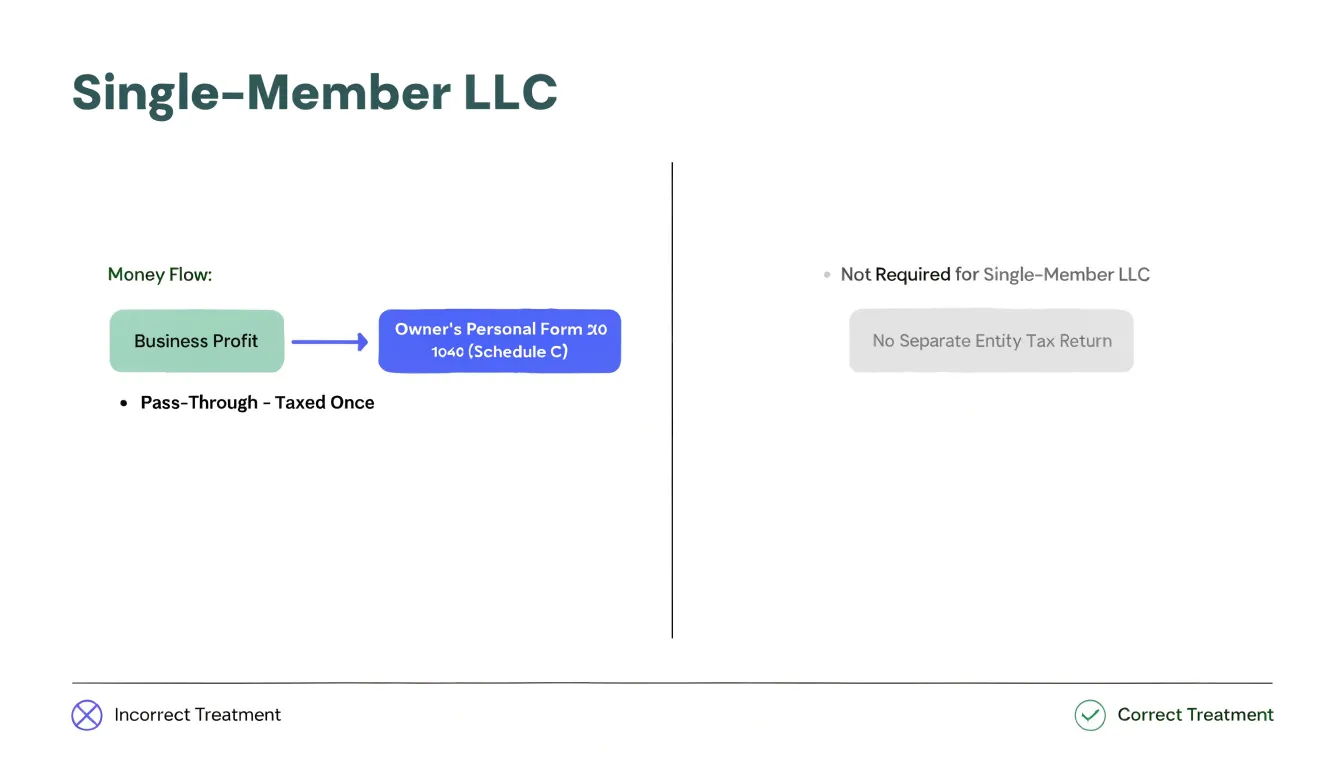
This flow-through structure means owners report business income alongside their other personal income, and the business profits are subject to both income tax and self-employment tax on the owner’s return. Many owners find this arrangement straightforward. There is no separate corporate return to prepare for a single-member LLC, no double taxation of distributed profits, and administrative overhead stays relatively low. Record-keeping centers on tracking revenue and deductions so the owner can complete Schedule C accurately.
For a large share of small business owners, the default setup works well without modification. Sole proprietors, freelancers, consultants, and owners of modestly profitable enterprises often discover that the simplicity of pass-through taxation outweighs any potential benefit from electing corporate treatment. Changing the classification requires filing an election with the IRS, adopting additional formalities such as payroll for a reasonable salary, and maintaining more complex records. Those steps introduce cost and compliance obligations that only make sense when the tax savings clearly exceed the added burden.
Owners who keep the default status retain flexibility. If profits grow substantially or circumstances change, they can revisit the question and elect S corporation status later. Until then, the default classification lets them operate with minimal administrative friction, file straightforward returns, and avoid the payroll and reporting requirements that come with alternative structures. For many owners, this baseline arrangement remains the practical choice throughout the life of the business.
S Corp Status
For an LLC seeking S Corp status, the process begins with filing IRS Form 2553, Election by a Small Business Corporation. This form must be submitted no later than two months and fifteen days after the start of the tax year for which the election is to take effect. The form requires basic information about the LLC, including its EIN, and the consent of all members. Once approved by the IRS, the LLC is treated as an S Corporation for federal tax purposes, though it retains its legal status as an LLC under state law.
Eligibility for S Corp status is governed by several IRS requirements. The LLC must have no more than 100 members, and all members must be eligible shareholders—individuals, certain trusts, and estates are permitted, but partnerships, corporations, and nonresident aliens are not. The LLC must also have only one class of stock, meaning all members must have identical rights to distribution and liquidation proceeds. Additionally, the business must be a domestic entity and must not be an ineligible corporation, such as certain financial institutions or insurance companies.
The core mechanic of S Corp taxation involves splitting the LLC’s income into two components: salary and distributions. The LLC must pay its member-employees a reasonable salary for services rendered, which is subject to payroll taxes such as Social Security and Medicare. The remaining income, after subtracting salary and other expenses, is passed through as distributions to members. These distributions are not subject to payroll taxes, though they are still subject to income tax at the individual level. This split can result in tax savings because only the salary portion is subject to employment taxes, while distributions avoid those taxes entirely. However, the salary must be reasonable and reflect the fair market value of the services provided; the IRS scrutinizes arrangements where salaries are set unreasonably low to maximize distributions. Proper documentation and compliance with payroll tax obligations are essential to maintaining the S Corp election and avoiding penalties.
How Self-Employment Tax Differs Between LLCs and S Corps
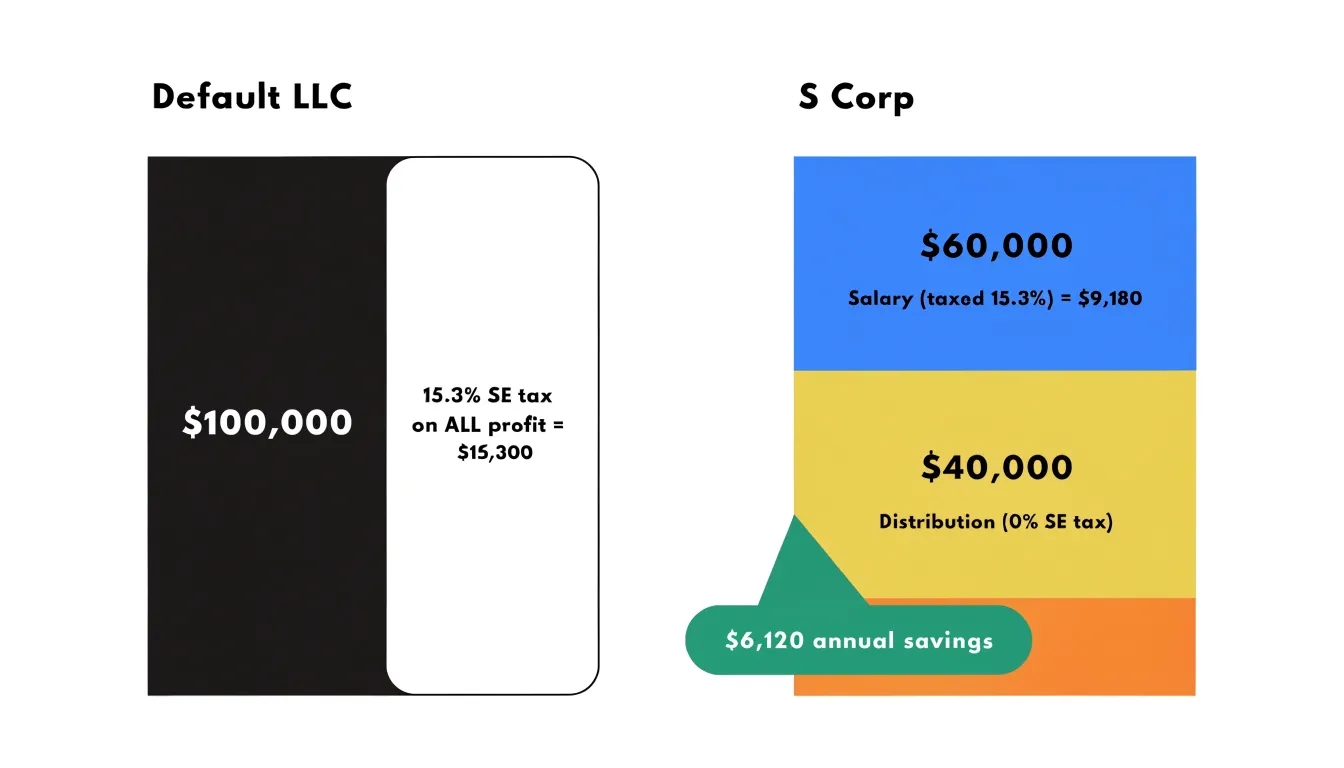
When a single-member LLC is taxed as a disregarded entity, the owner pays self-employment tax on the entire net profit of the business. That tax, currently 15.3%, combines the 12.4% Social Security portion and the 2.9% Medicare portion, and it applies to every dollar of profit the LLC generates, regardless of how that money is used in the business. An LLC owner who nets $100,000 pays self-employment tax on the full $100,000, which comes to $15,300 before any income tax is calculated. There is no mechanism within the default LLC structure to split profits into a wage component and a distribution component, so the full profit figure is the tax base.
An S Corporation changes this calculation because the owner who works in the business must be paid a reasonable salary through payroll. Only that salary is subject to employment taxes. The remaining profit flows through to the owner as a distribution and is not subject to self-employment tax. The key requirement is that the salary must reflect what the owner’s role would command in the open market; the IRS scrutinizes salaries set artificially low to minimize payroll taxes.
A concrete example illustrates the difference. Suppose a business nets $100,000 and the owner’s reasonable salary is $60,000. Under the default LLC treatment, self-employment tax is 15.3% of $100,000, or $15,300. Under S Corp treatment, employment taxes apply only to the $60,000 salary, producing a tax of $9,180. The $40,000 distribution escapes self-employment tax entirely. The difference is $6,120 in annual savings, and that figure scales with profit. At $200,000 of net profit with a $90,000 salary, the savings exceed $16,000.
The S Corp election does carry additional costs that offset part of the savings. The business must run payroll, file payroll tax returns, and often pay for accounting or payroll services. Many states also impose franchise or annual report fees on corporations. For owners with modest profits, these administrative costs can consume most or all of the tax advantage, while owners with substantial profits typically find the savings far outweigh the added compliance burden.
S Corp Profit Threshold
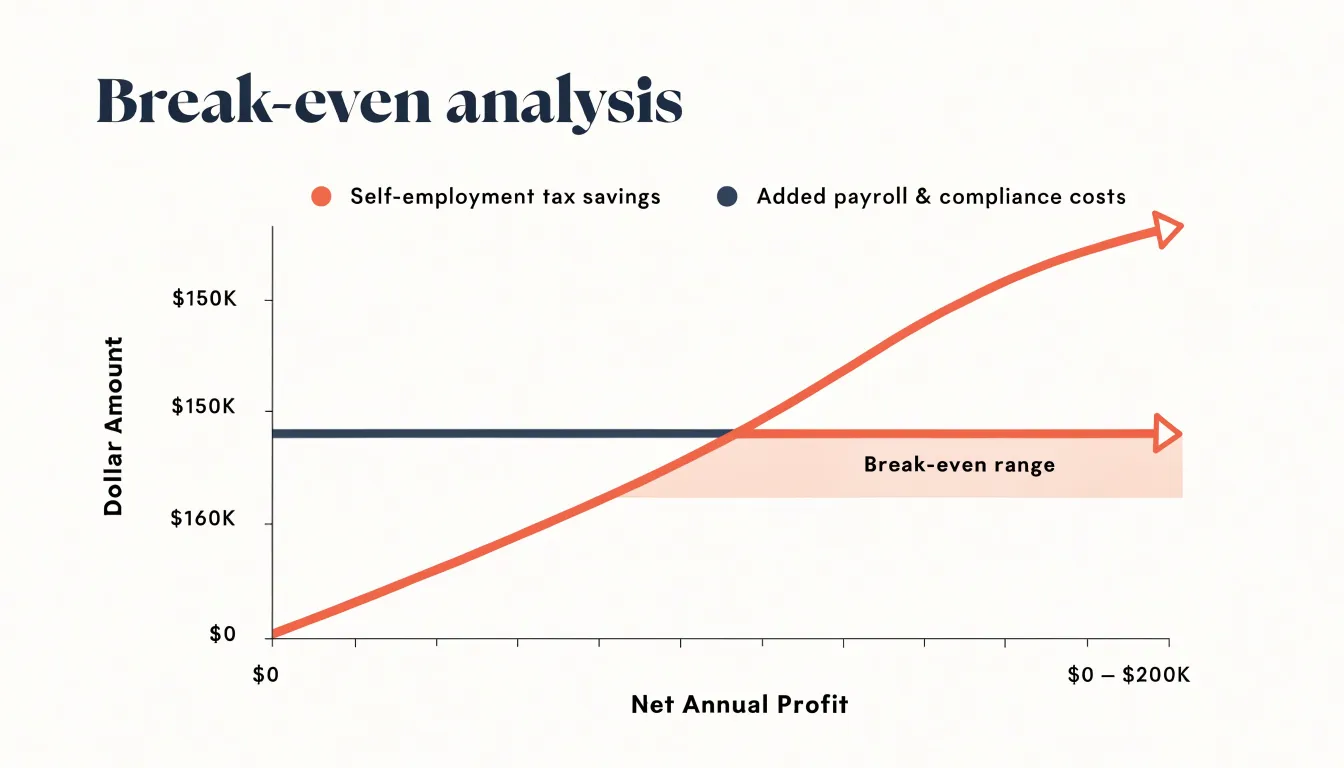
A central factor in deciding whether an S corporation election makes sense is the profit threshold at which the tax savings from reduced self-employment tax outweigh the added costs of payroll and compliance. As a sole proprietor or LLC member taxed as a partnership, your entire net profit is generally subject to self-employment tax, which covers Social Security and Medicare. When you elect S corporation status, only the reasonable salary you pay yourself is subject to employment taxes; the remaining profit can be distributed as shareholder distributions free of self-employment tax. That difference creates the potential savings, but it comes at a price: you must run payroll, file employment tax returns, produce W-2s, and often pay for accounting or payroll services. You may also face state-level fees and additional administrative obligations. The break-even point is where the annual self-employment tax savings equal or exceed these added costs. A common rule of thumb is that the S corporation election starts to make financial sense when your net profit is consistently around $60,000 to $80,000 per year. Below that range, the tax savings are often too small to justify the extra expense and complexity. Above it, the savings tend to grow quickly, making the election more attractive. For example, if your net profit is $100,000 and you pay yourself a reasonable salary of $60,000, the $40,000 distribution avoids self-employment tax, producing savings that can easily exceed $5,000 per year. Against that, payroll and compliance costs might run $1,000 to $3,000 annually, so the net benefit is clear. At $50,000 of profit, the same calculation yields much smaller savings, and after costs the advantage may disappear entirely. Keep in mind that this range is a rough guide, not a hard rule. Your actual break-even depends on your state’s fees, your payroll costs, the reasonable salary required for your role, and your overall tax situation. Use the range as a starting point, then run the numbers for your specific circumstances before making a decision.
The Hidden Expenses of Running an S Corp Payroll
The ongoing costs of maintaining an S Corp payroll can quietly consume a meaningful share of the tax savings the structure is meant to deliver. Once an LLC elects S Corp status, the owner who works in the business must generally be paid a reasonable salary through formal payroll, and payroll is never free to run. Payroll processing services typically charge a monthly base fee plus per-employee and per-payroll charges, with additional fees for year-end W-2 preparation and for handling direct deposits or multi-state filings. For a single-owner business these fees may seem modest on their own, but they recur every month and every year, and they rise as employees are added.
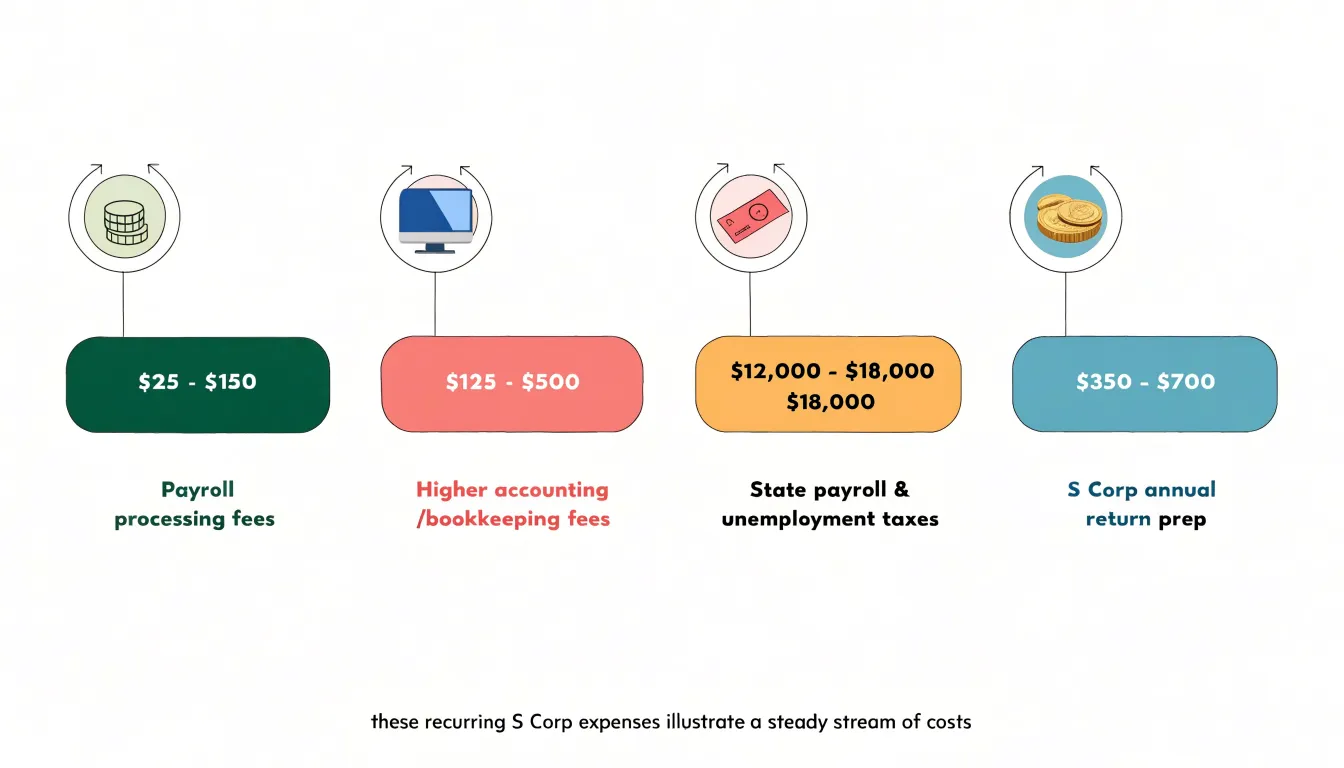
Accounting costs also increase. S Corp bookkeeping generally requires cleaner separation of salary, distributions, and shareholder equity accounts than a simple LLC does, and many owners rely on a bookkeeper or accountant to keep those records straight. Professional fees for this work often run higher than the fees quoted for basic LLC bookkeeping, because the accountant must track basis, reasonable compensation, and the interaction between wages and distributions. Owners who previously handled their own books frequently discover they need paid help to stay compliant.
State payroll taxes add another layer. Even where the S Corp structure reduces self-employment tax at the federal level, employers remain responsible for their share of Social Security, Medicare, and federal and state unemployment taxes on the wages paid. Several states also impose their own payroll taxes, unemployment insurance contributions, or paid leave assessments that apply to W-2 wages. These amounts are calculated on the salary itself, so they scale with the compensation the owner sets, and they arise only because payroll exists.
The extra tax return is a further recurring expense. An S Corp must file its own annual return, and most owners have that return prepared professionally. The preparation fee for the entity return is separate from the personal return and is commonly several hundred to over a thousand dollars per year, depending on complexity and state filings. Taken together, payroll processing, accounting support, employment taxes, and return preparation create a steady stream of costs that should be estimated honestly before electing S Corp status, since savings that look substantial on paper can shrink considerably once these hidden expenses are counted.
Qualified Business Income Deduction Rules for Both Structures
The Qualified Business Income (QBI) deduction, created under Section 199A of the Tax Cuts and Jobs Act, allows eligible owners to deduct up to 20 percent of their qualified business income from pass-through entities. Both LLCs taxed as partnerships or sole proprietorships and S Corporations can potentially benefit from this deduction, making it one of the most valuable tax breaks available to small business owners. The deduction applies to ordinary income from the business, though it excludes reasonable compensation paid to S Corp shareholder-employees, which is handled separately as W-2 wages.
For an LLC taxed as a partnership or disregarded entity, the QBI calculation generally flows directly from the business’s net profit. Each member or sole owner reports their distributive share of income, and the 20 percent deduction is applied at the individual level. This simplicity is one reason LLC owners often find the QBI rules easier to navigate, since there is no separate payroll requirement built into the structure itself.
S Corporation owners face an additional layer of complexity through the wage limitation. Once taxable income exceeds certain threshold amounts, the QBI deduction becomes limited by the greater of 50 percent of the business’s W-2 wages or 25 percent of W-2 wages plus 2.5 percent of the unadjusted basis of qualified property. This means an S Corp must pay reasonable wages to its shareholder-employees to preserve the full deduction. Owners who take little or no salary can see their QBI deduction reduced or eliminated at higher income levels, even when the business is profitable. The wage limitation does not apply below the income thresholds, but owners above those levels must plan carefully around payroll and distributions.
Both structures require attention to specified service trade or business rules, which phase out the deduction entirely for certain professional service businesses at higher incomes. Proper documentation of income, wages, and property basis helps ensure the deduction is calculated correctly, and consulting a tax professional can clarify how these rules apply to a specific business’s circumstances.
Steps to Formally Transition Your LLC to S Corp Tax Status
The practical sequence for moving an LLC into S corporation tax status begins well before any form is filed. Start by confirming eligibility. An LLC must first be treated as a corporation for tax purposes, which usually means filing Form 8832 to elect corporate classification, since a default multi-member LLC is taxed as a partnership. From there, the business must satisfy the S corp requirements: it needs to be a domestic entity, have no more than 100 shareholders, and limit ownership to individuals, certain trusts, and estates. Nonresident alien shareholders are prohibited, and the LLC may only have one class of stock. Checking these boxes early prevents wasted effort and rejected elections.
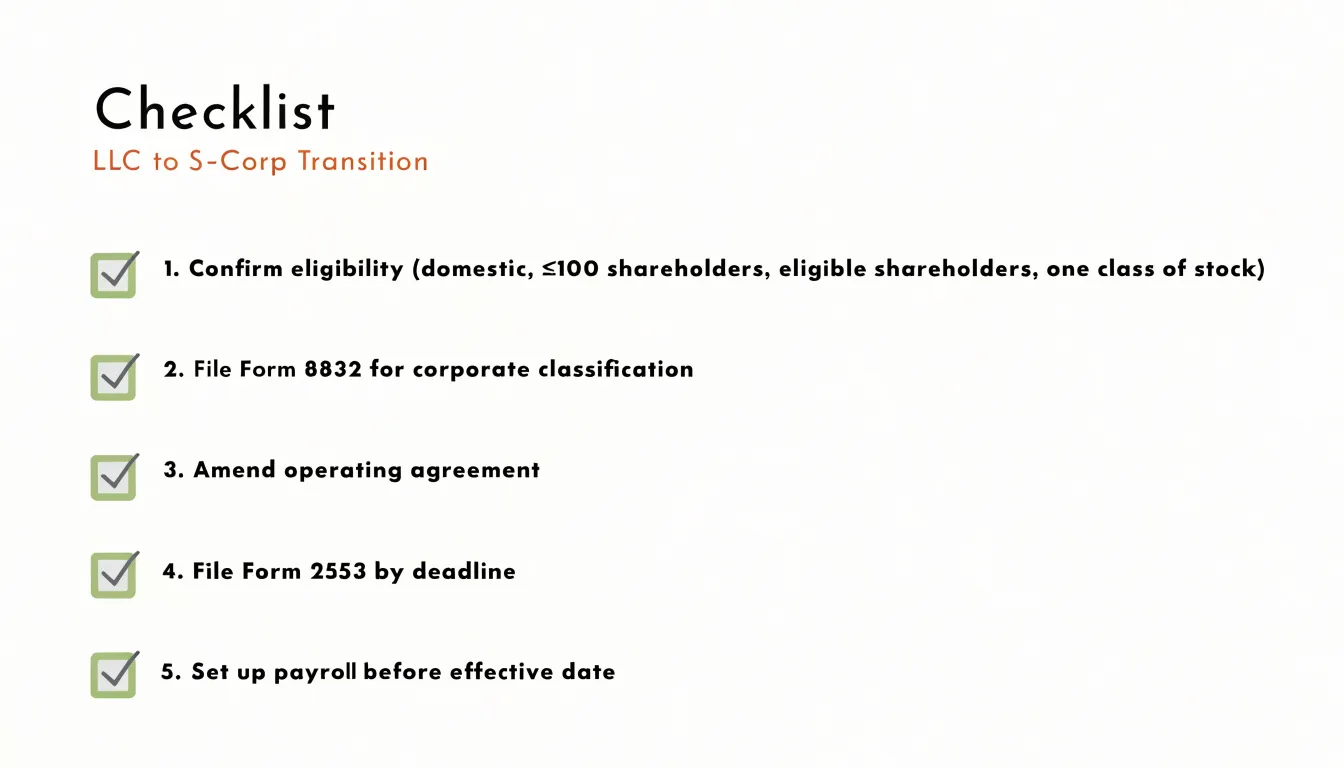
With eligibility confirmed, turn to the operating agreement. Review the document for provisions that conflict with corporate formalities, such as member-managed governance, profit distributions tied strictly to capital contributions, and transfer restrictions meant for partnership-style taxation. Amend the agreement to establish a board of directors or officers, authorize shares, and describe how distributions will work under S corp rules. All members should sign the amended agreement, and the changes should be reflected in any related documents, including the articles of organization if state law requires updates. This step keeps the entity’s internal records consistent with how it will be taxed.
Next, file IRS Form 2553, Election by a Small Business Corporation. Timing matters: the election generally must be submitted no more than two months and 15 days after the start of the tax year in which it should take effect, or at any point during the prior tax year. Missing the deadline pushes the effective date to the following year, so calendar the filing carefully and retain proof of submission. Every shareholder must consent on the form.
Finally, prepare payroll before the election takes effect. Once the S corp status is active, owner-employees who perform services must receive reasonable wages subject to payroll taxes. Set up payroll accounts, withholding, and quarterly filings in advance so the first paycheck after the effective date is processed correctly. This sequence, completed in order and on schedule, produces a clean transition with fewer compliance surprises.
Which Entity Fits Your Long-Term Revenue Goals?
Choosing between an LLC and an S Corporation becomes clearer when you map each structure against your long-term revenue goals. A practical decision framework begins with projected profit. Estimate the net income you expect the business to generate over the next several years, since the self-employment tax savings an S Corp offers through reasonable salary distributions only outweigh the added payroll and filing costs once profits reach a meaningful threshold. Many owners find that below roughly $40,000 to $50,000 in annual net profit, the administrative expenses of running payroll and filing a separate corporate return can consume much of the tax benefit. As projected profits climb, the math increasingly favors the S Corp election. Run the numbers with realistic revenue figures for your first three to five years rather than a single best-case year.
The second dimension is growth plans. If you intend to bring in outside investors, issue multiple classes of stock, or pursue venture funding, an LLC taxed as a partnership may align better with those ambitions, since S Corps face restrictions on shareholder count, eligible shareholder types, and a single class of stock. If you plan to keep ownership concentrated among a few individuals and distribute profits according to ownership percentages, the S Corp structure works comfortably. Consider also whether you expect to sell the business or bring on co-owners down the road, because ownership transitions can be simpler under one structure than the other depending on how your cap table will evolve.
Finally, weigh your tolerance for administrative work. An S Corp requires payroll processing, reasonable compensation analysis, a separate annual tax return, and stricter recordkeeping. An LLC with default taxation involves far less paperwork and offers flexible profit allocation among members. Owners who prefer simplicity and have modest profits may accept the tradeoff of higher self-employment tax in exchange for lower compliance burden, while owners with higher profits and a willingness to invest in professional payroll and accounting support often capture real savings through the S Corp election. Lay out projected profit, growth trajectory, and administrative appetite side by side, and the structure that fits your goals usually becomes evident.
Frequently Asked Questions
How is a single-member LLC taxed by default?
A single-member LLC is automatically treated as a disregarded entity, so the LLC itself does not file a separate tax return or pay income tax. All profits and losses flow directly onto the owner’s personal Form 1040, typically reported on Schedule C, and the owner pays self-employment tax on the entire net profit.
How does an LLC elect S Corp status, and what are the eligibility rules?
An LLC elects S Corp status by filing IRS Form 2553 no later than two months and fifteen days after the start of the tax year for which the election is to take effect, with consent of all members. The LLC must also meet IRS requirements: no more than 100 members, only eligible shareholders such as individuals, certain trusts, and estates (not partnerships, corporations, or nonresident aliens), one class of stock, and it must be a domestic entity that is not an ineligible corporation.
How does self-employment tax work differently for an LLC versus an S Corp?
With a single-member LLC taxed as a disregarded entity, the owner pays self-employment tax on the entire net profit of the business. An S Corp pays the owner-employee a reasonable salary through payroll, and only that salary is subject to employment taxes; the remaining profit can flow through as distributions not subject to self-employment tax, but the salary must reflect fair market value and the IRS scrutinizes artificially low salaries.
At what profit level does electing S Corp status start to make sense?
A common rule of thumb is that the S corporation election starts to make financial sense when net profit is consistently around $60,000 to $80,000 per year. Below that range, the tax savings are often too small to justify the extra expense and complexity, though this is a rough guide and actual break-even depends on state fees, payroll costs, the reasonable salary required, and overall tax situation.
What extra costs come with running an S Corp payroll?
S Corp payroll can involve payroll processing fees, higher accounting costs, state payroll taxes, and the cost of preparing the S Corp’s separate annual tax return. These recurring expenses can offset a meaningful share of the tax savings, so they should be estimated before electing S Corp status.
Can both LLCs and S Corps claim the Qualified Business Income deduction?
Both LLCs taxed as partnerships or sole proprietorships and S Corporations can potentially benefit from the QBI deduction, which allows eligible owners to deduct up to 20 percent of qualified business income from pass-through entities. For S Corps, reasonable compensation paid to shareholder-employees is excluded, and at higher income levels the deduction can be limited by W-2 wages, so the business may need to pay reasonable wages to preserve the full deduction.