
Overhead Costs
An overhead cost is any indirect business expense that cannot be traced to a specific product, service, or project, such as rent, utilities, insurance, and administrative salaries. Overhead is classified as fixed, variable, or semi-variable, and is allocated across outputs using a rate—total indirect costs divided by an allocation base like labor hours.
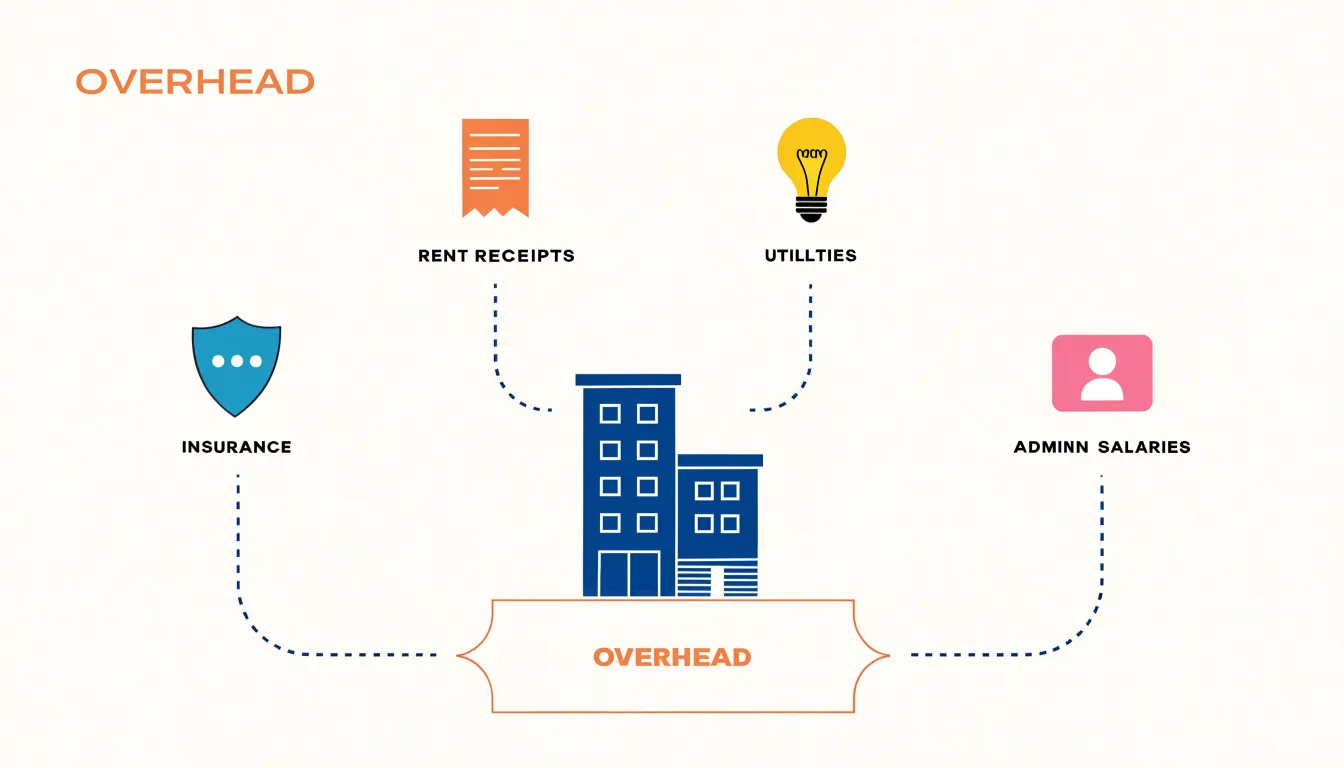
Table of Contents
- What counts as an overhead cost in business accounting
- Fixed vs Variable Overhead
- Common examples of administrative and operational expenses
- Direct Costs vs Overhead Costs
- How to calculate your total overhead rate step by step
- How do overhead expenses directly impact your profit margin
- Simple strategies to track and reduce business overhead
What counts as an overhead cost in business accounting
In business accounting, an overhead cost is defined as any indirect expense incurred in the course of running a business that cannot be attributed to a specific product, service, or project. The defining characteristic is indirectness: the expense supports operations as a whole rather than a single revenue-generating activity. Rent for an office building, salaries for administrative staff, utilities, insurance premiums, and depreciation on shared equipment all fall under this umbrella. None of these costs can be traced with precision to one unit of output, which is precisely what separates them from direct costs such as raw materials or the wages of assembly-line workers.
The accounting definition rests on three criteria that work together to classify an expense as overhead. The first is indirectness, meaning the cost does not vary directly with the volume of a particular product or service. The second is necessity, which captures the idea that overhead expenses are required to keep the business operating, even if they contribute to production only in a supporting role. A factory cannot function without lighting, maintenance, or supervision, yet none of these items appear in the bill of materials for any single item produced. The third criterion is allocation, which concerns how such costs are assigned. Because overhead cannot be traced directly, accountants must distribute it across products, departments, or time periods using a reasonable basis, such as labor hours, machine hours, or square footage.
These criteria help distinguish overhead from other expense categories. Direct costs are traceable to specific outputs, while overhead costs require an allocation formula. Period costs, such as marketing spend, are expensed in the period incurred and are treated separately from the production-related overhead that flows into inventory valuation. The necessity test also excludes discretionary spending that is not essential to operations.
Because overhead is indirect, it must be absorbed into the cost of goods or services through an allocation rate, and any misjudgment in that rate can distort pricing, profitability analysis, and inventory values. Understanding what qualifies as overhead, and why, gives managers and accountants a consistent basis for capturing the true cost of operations and for making informed decisions about pricing, budgeting, and resource allocation across the organization.
Fixed vs Variable Overhead
Fixed overhead consists of expenses that remain unchanged in total regardless of production volume or activity level. Common examples include rent for factory or office space, insurance premiums, property taxes, and salaries for permanent staff. These costs are incurred simply to maintain operational capacity, even if no output is produced. For instance, a manufacturer pays the same monthly rent whether it produces 1,000 or 10,000 units. Because fixed overhead does not vary with output, it is often considered a capacity cost that must be covered by contribution margin from sales.
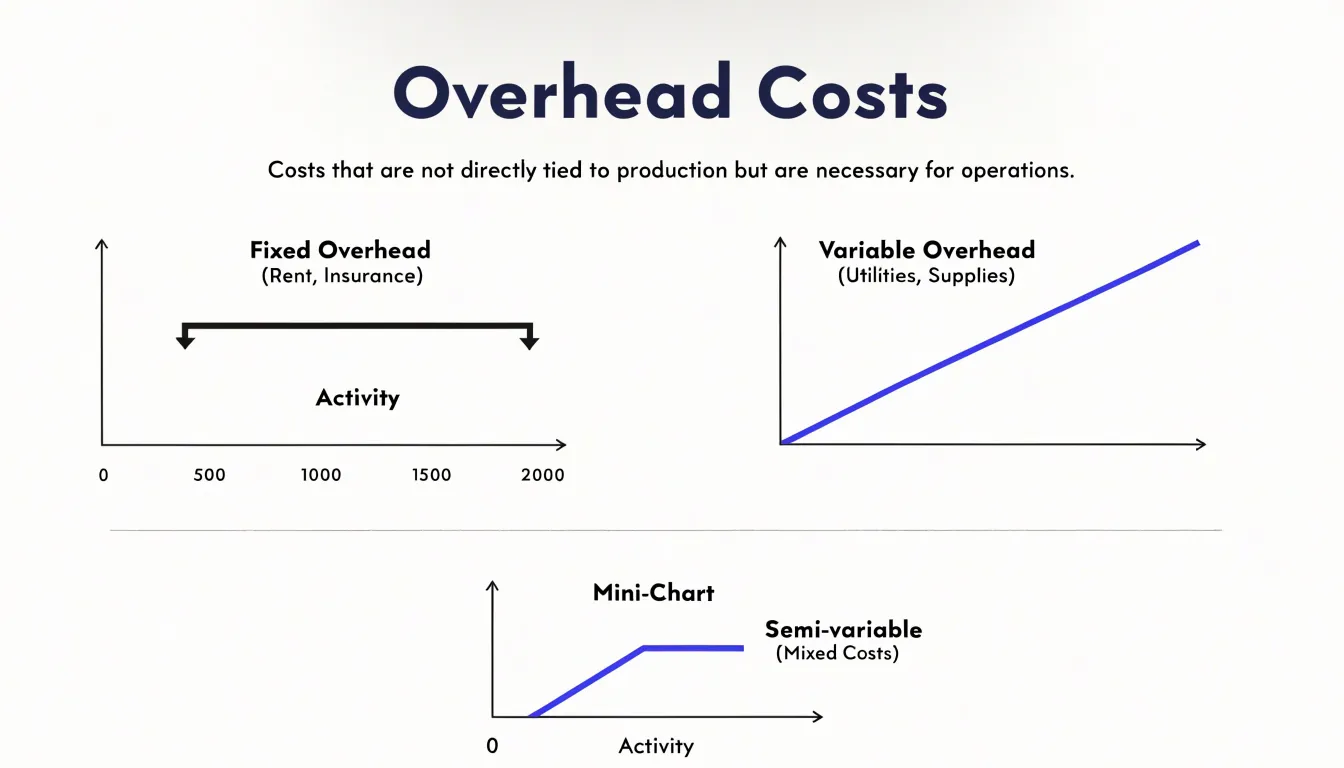
Variable overhead, by contrast, fluctuates in direct proportion to activity. Expenses such as utilities (electricity, gas, water), production supplies, and indirect materials increase as output rises and decrease when production slows. For example, a bakery’s electricity bill climbs when ovens run longer to meet higher demand. Variable overhead is typically budgeted on a per-unit basis, and managers can forecast these costs more precisely by tying them to production forecasts.
Semi-variable costs, sometimes called mixed costs, contain both fixed and variable components. A common example is a utility bill with a fixed base charge plus a per-unit usage rate. Another is a salesperson’s compensation package with a fixed salary and a commission tied to sales volume. These costs remain constant up to a certain activity level and then increase as activity exceeds that threshold. Understanding semi-variable costs is essential for accurate cost behavior analysis, as they must be separated into their fixed and variable portions for planning purposes.
The distinction between fixed, variable, and semi-variable overhead matters greatly for budgeting and decision-making. Fixed costs are predictable in total but can create financial strain during downturns because they must be paid regardless of revenue. Variable costs, while less predictable in total, offer flexibility since they decline when activity falls. Semi-variable costs require careful forecasting to avoid surprises. By classifying overhead correctly, managers can develop more accurate budgets, set appropriate pricing strategies, perform break-even analysis, and make informed decisions about capacity expansion or cost reduction. A clear grasp of these cost behaviors ultimately supports better financial control and strategic planning.
Common examples of administrative and operational expenses
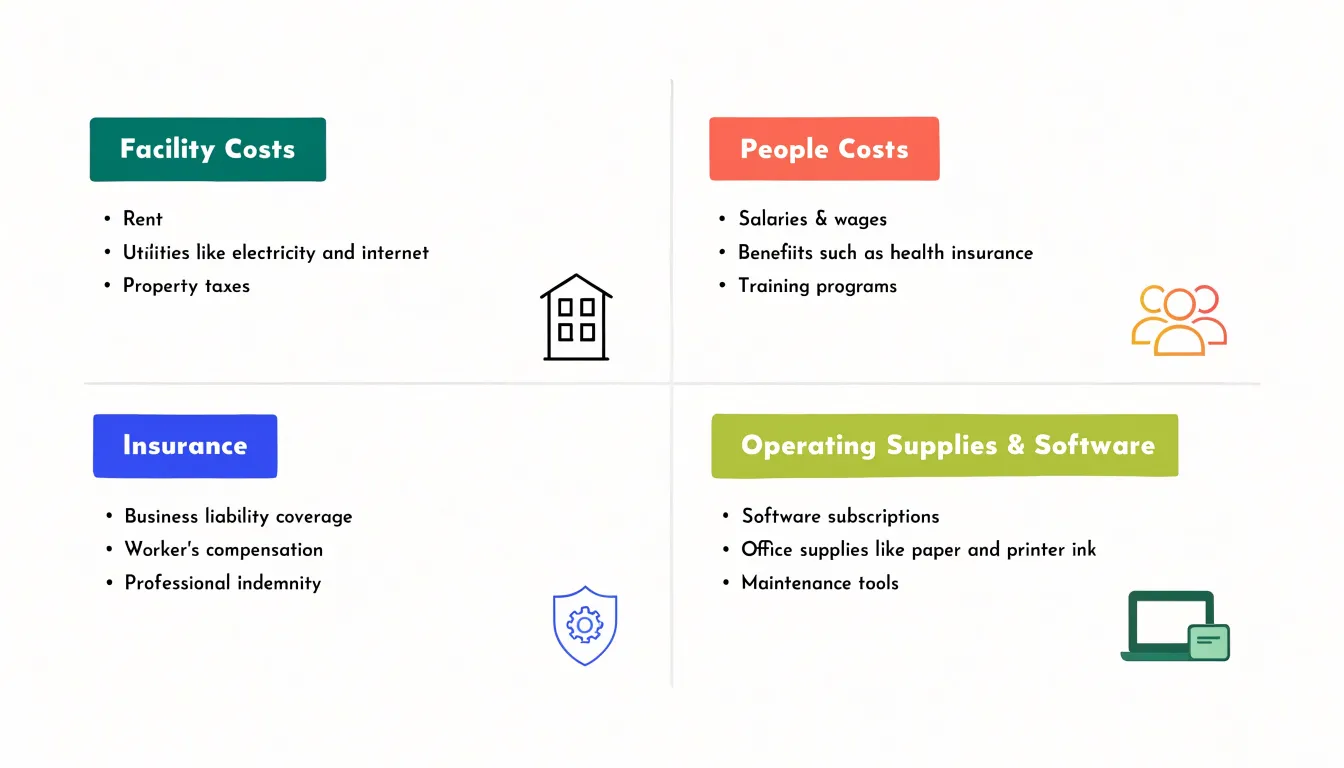
Administrative and operational expenses show up in nearly every business, yet they are easy to overlook because they accumulate quietly in the background. A categorized list of typical overhead items gives readers a practical starting point for identifying their own. Facility costs usually come first: rent or mortgage payments on office space, warehouse space, or retail locations, along with property taxes, maintenance, repairs, and janitorial services. Utilities belong in this category too, including electricity, heating and cooling, water, internet, and telephone service. These facility-related expenses tend to be fixed or semi-fixed, which makes them important to track closely.
People costs form another major category. Salaries and wages for administrative staff, receptionists, bookkeepers, human resources personnel, and managers who support the business rather than produce goods or services directly fall under overhead. Payroll taxes and benefits tied to those positions belong here as well. Insurance is a third category, covering general liability, property insurance, workers’ compensation, and professional liability policies that protect the business from unexpected losses.
Day-to-day operating supplies make up a fourth grouping. Office supplies such as paper, printer ink, and stationery, along with postage, cleaning supplies, and small equipment, are typical examples. In modern workplaces, software subscriptions deserve their own mention: productivity suites, accounting platforms, customer relationship management tools, cloud storage, and communication apps often represent a recurring monthly cost that adds up across an organization. Marketing and advertising expenses, including digital ads, print materials, and promotional events, are frequently classified as overhead when they support the business broadly rather than a single product line. Finally, depreciation of equipment, vehicles, and furniture represents the gradual wear and loss of value on assets the business owns.
Reviewing this categorized list against their own records helps readers spot expenses they may have missed and organize their overhead into clear groupings for budgeting and planning.
Direct Costs vs Overhead Costs
Drawing a clear line between direct costs and overhead begins with a simple test: can the cost be traced to a specific product, project, or service in an economically feasible way? Direct costs pass this test. Raw materials that become part of a finished good, components purchased for a particular assembly, and the wages of workers whose time is logged against a specific job all qualify as direct costs. Overhead covers everything else required to keep the operation running, such as rent, utilities, insurance, administrative salaries, and equipment maintenance, because these costs support the business as a whole rather than any single unit of output.
The difficulty arises with borderline cases that sit between the two categories. A machine operator who spends most of her time on one production line but occasionally fills in for maintenance is a common example. So is a supervisor who oversees several projects at once, or a delivery vehicle used both to ship customer orders and to run errands for the office. A software subscription used mainly by the design team for client work, but also by accounting, raises the same question. In each case, the cost serves identifiable direct purposes and broader indirect ones, so treating it as entirely direct or entirely overhead distorts the picture.
Guidance for these situations starts with materiality. If the indirect portion of a cost is small relative to the total, assigning the whole amount to the direct category is usually acceptable and saves administrative effort. When the mixed use is significant, allocation becomes necessary. A practical approach is to estimate the proportion of the resource consumed by direct activities, using time logs, usage records, or square footage, and split the cost accordingly. The direct share flows into job or product costing, while the remainder stays in the overhead pool. Consistent application matters more than perfect precision, since the goal is comparability across periods and projects.
A useful rule of thumb is to classify a cost as direct when it would disappear if the specific product or project were cancelled, and as overhead when it would persist regardless. Documenting the reasoning behind each borderline decision, and reviewing those decisions periodically, keeps the boundary between direct costs and overhead defensible as the business evolves.
How to calculate your total overhead rate step by step
Calculating your total overhead rate begins with gathering all indirect costs. These are the expenses that support your operations but cannot be traced directly to a specific product or service. Common examples include rent, utilities, insurance, administrative salaries, depreciation on equipment, and maintenance supplies. Review your accounting records for a defined period, such as a month or a year, and list every indirect cost. Be thorough: small recurring expenses can add up quickly. Once you have your list, total these costs to get your total indirect costs.
Next, choose an allocation base that reflects how overhead is consumed. The base should have a logical cause-and-effect relationship with the indirect costs. Common bases include direct labor hours, machine hours, direct labor cost, or units produced. For labor-intensive operations, direct labor hours often work well; for capital-intensive operations, machine hours may be more appropriate. Select a base that is measurable and consistently recorded. To find the total base, sum the units of your chosen base over the same period used for indirect costs. For example, if you choose direct labor hours, add up all hours worked by direct labor employees during that period.
With both figures in hand, apply the overhead rate formula: total indirect costs divided by total allocation base. This gives you a rate that represents the overhead cost per unit of the base. For instance, if your total indirect costs are $100,000 and your total direct labor hours are 20,000, your overhead rate is $5 per direct labor hour.
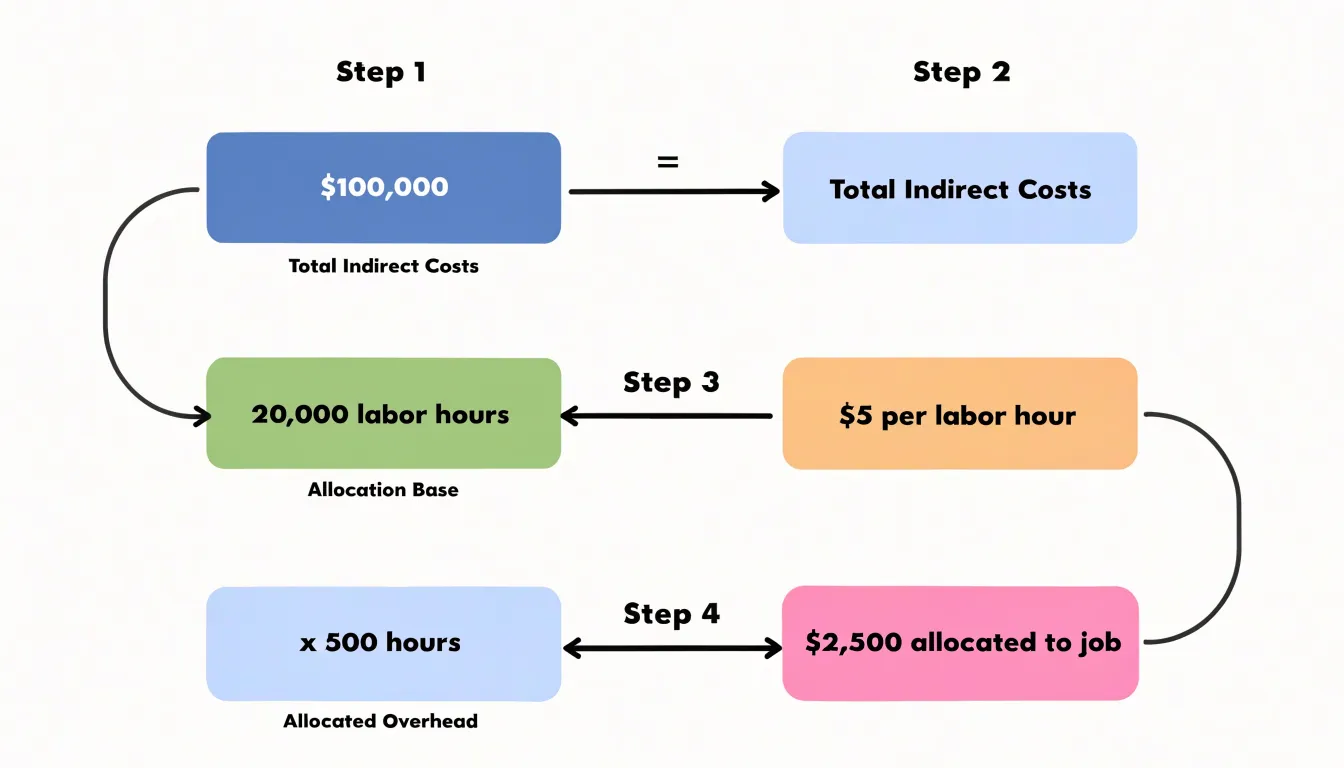
Finally, apply this rate to individual products or jobs. Multiply the overhead rate by the number of base units each product or job consumes. If a job uses 500 direct labor hours, assign $2,500 of overhead to it ($5 × 500). This step-by-step approach ensures overhead is allocated systematically, providing a clearer picture of true costs and supporting better pricing and profitability decisions.
How do overhead expenses directly impact your profit margin
Overhead expenses sit at the center of the relationship between revenue and net profit. Every business generates income through its core activities, yet the money that actually stays with the company is determined by what remains after all fixed and indirect costs are paid. Net profit margin is calculated by dividing net profit by total revenue, and overhead is subtracted before that figure is reached. This means each dollar of overhead reduces the amount available as profit, regardless of how strong sales may be in a given period. A company with healthy gross sales can still post a thin or negative net margin if its overhead load is heavy, which is why overhead deserves the same scrutiny as direct production costs.
High overhead erodes margins in a cumulative way. Rent, insurance, administrative salaries, utilities, equipment depreciation, and software subscriptions accumulate on a monthly basis, independent of sales volume. When revenue dips, these costs remain, compressing margins sharply. Over successive months, persistent overhead pressure can turn a profitable operation into a cash-strapped one, even when demand for the product or service remains steady. Businesses that allow overhead to grow faster than revenue will see net margins shrink steadily, and the effect compounds once financing costs and debt service enter the picture.
The effect becomes clearer when overhead is examined on a per-unit basis. Dividing total overhead by units produced or sold reveals how much of each sale must cover indirect costs before contributing to profit. As volume falls, overhead per unit rises, and pricing decisions must account for that shift. A product that appears profitable at full production may lose money at lower volumes once overhead allocation is factored in. Pricing strategies, therefore, need to build in enough margin to absorb overhead at realistic output levels rather than only at peak capacity.
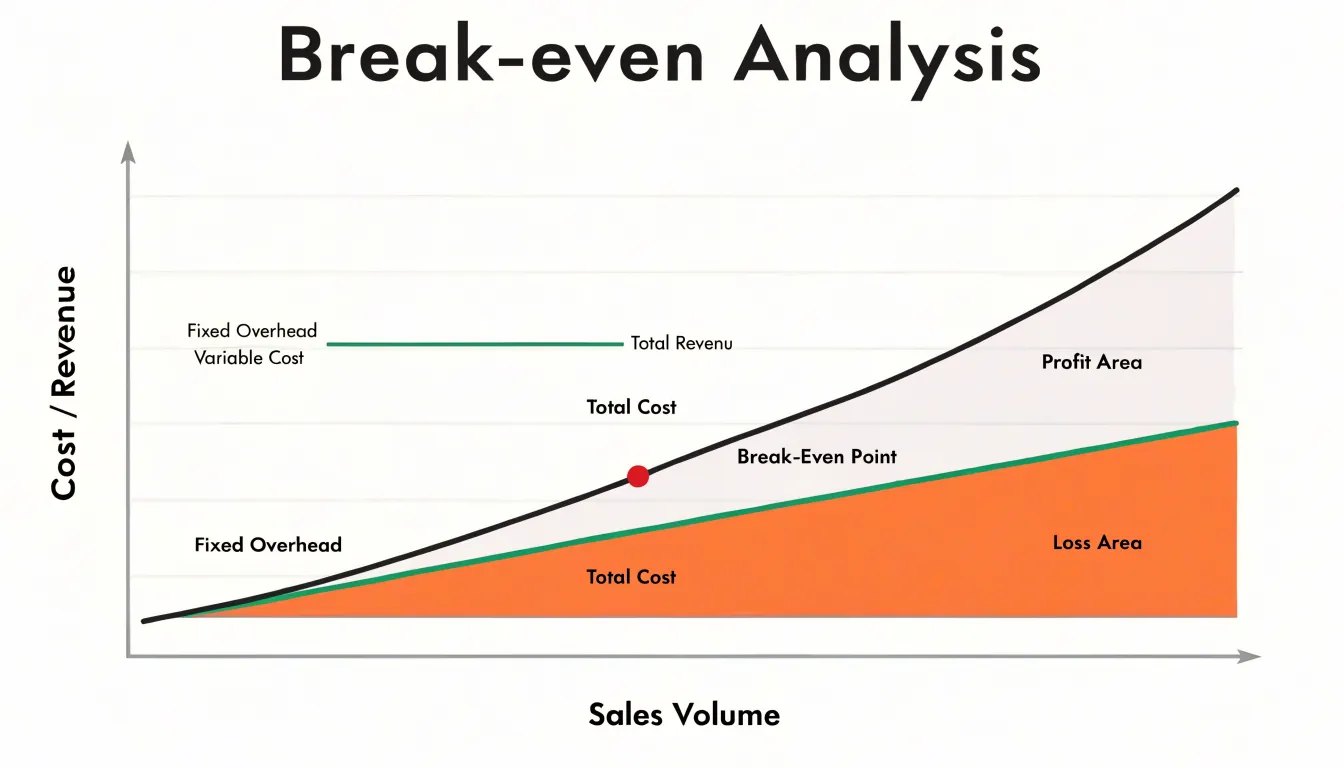
Break-even analysis ties these threads together. It calculates the sales volume or revenue level at which total costs, including overhead, are exactly covered. The break-even point shifts as overhead rises or falls, giving management a concrete threshold to plan against. Understanding this point helps a business decide whether current pricing and overhead structure leave enough cushion for profit, and it supports informed choices about cost reduction, price adjustment, and capacity planning.
Simple strategies to track and reduce business overhead
Tracking overhead begins with knowing exactly where money leaves the business, and a regular expense audit is the foundation of that knowledge. Set a recurring schedule, whether monthly or quarterly, to review every line item across utilities, rent, insurance, subscriptions, and supplies. Compare current spending against prior periods and flag anything that has crept upward without a clear explanation. Small recurring charges are easy to overlook, so scan bank and credit card statements line by line and confirm that each expense still serves a purpose. Cancel dormant subscriptions and consolidate duplicate tools. Once the audit habit is in place, the next lever is contract renegotiation. Vendors often reserve their best pricing for customers who ask, so approach suppliers, landlords, internet providers, and insurance brokers before renewal dates, armed with competitor quotes and a clear picture of your usage. Even modest reductions compound over a year. Process automation offers another practical route: invoicing, payroll, scheduling, and expense reporting can run through software that reduces manual hours and the errors that come with them. Map the tasks your team repeats weekly, then automate the ones with the highest time cost. Energy-efficient equipment and simple facility upgrades, such as LED lighting, programmable thermostats, and motion sensors, lower utility bills steadily and often qualify for rebates or tax incentives that shorten payback periods. Finally, software that monitors overhead ratios over time turns all of these efforts into an ongoing discipline. Dashboard tools can track overhead as a percentage of revenue, alert you when ratios drift outside target ranges, and give you the data to make informed decisions about where to cut and where to invest. Together these tactics form a repeatable cycle: measure, renegotiate, automate, upgrade, and monitor. Businesses that run this cycle consistently keep overhead lean without sacrificing the operations that generate revenue.
Frequently Asked Questions
What counts as an overhead cost in business accounting?
An overhead cost is any indirect expense incurred in running a business that cannot be attributed to a specific product, service, or project. It supports operations as a whole, and examples include rent, administrative salaries, utilities, insurance premiums, and depreciation on shared equipment.
What is the difference between fixed and variable overhead?
Fixed overhead stays the same in total regardless of production volume, such as rent, insurance premiums, property taxes, and salaries for permanent staff. Variable overhead fluctuates in direct proportion to activity, such as utilities, production supplies, and indirect materials.
What are common examples of administrative and operational expenses?
Common examples include facility costs such as rent, property taxes, maintenance, utilities, and janitorial services, along with people costs like administrative salaries, payroll taxes, and benefits. Other typical overhead items include insurance, office supplies, software subscriptions, marketing and advertising, and depreciation of equipment, vehicles, and furniture.
How do you calculate your total overhead rate step by step?
Gather all indirect costs for a defined period and total them, then choose an allocation base such as direct labor hours, machine hours, direct labor cost, or units produced. Divide total indirect costs by the total allocation base to get the overhead rate, then multiply that rate by the base units each product or job consumes.
How do overhead expenses impact profit margin?
Overhead is subtracted before net profit is reached, so each dollar of overhead reduces the amount available as profit, and a company with healthy gross sales can still have a thin or negative net margin if its overhead load is heavy. High overhead also raises overhead per unit as volume falls, which can make a product that appears profitable at full production lose money at lower volumes.
How can a business track and reduce overhead costs?
A business can start with a regular expense audit to review line items, flag unexplained increases, cancel dormant subscriptions, and consolidate duplicate tools. It can also renegotiate contracts before renewal dates, automate repetitive processes, upgrade to energy-efficient equipment and facility improvements, and monitor overhead ratios over time with dashboard tools.