
Prepaid Expenses
A prepaid expense is a payment made in advance for goods or services consumed in a future period, recorded as a current asset on the balance sheet rather than an immediate expense. Each month, an adjusting entry debits the applicable expense account and credits the prepaid asset, recognizing the cost as the benefit is used.
Table of Contents
- What counts as a prepaid expense on your balance sheet
- Initial payment entry
- The monthly adjusting process for converting assets to costs
- Walkthrough
- Why cash basis businesses treat prepaid costs differently
- Creating an amortization schedule to track monthly transfers
- Common bookkeeping errors when expensing prepaid accounts
- Reconciling your prepaid asset balances before closing the books
What counts as a prepaid expense on your balance sheet
A prepaid expense is a payment made in advance for goods or services that will be consumed or used over a future period. At the moment of payment, the economic benefit has not yet been received, so the amount sits on the balance sheet as an asset rather than appearing immediately as an expense on the income statement. As the benefit is gradually used up, the asset is reduced and the cost is recognized as an expense in the period it applies to. This timing difference is what makes prepaid expenses a distinct category of accounting entry.
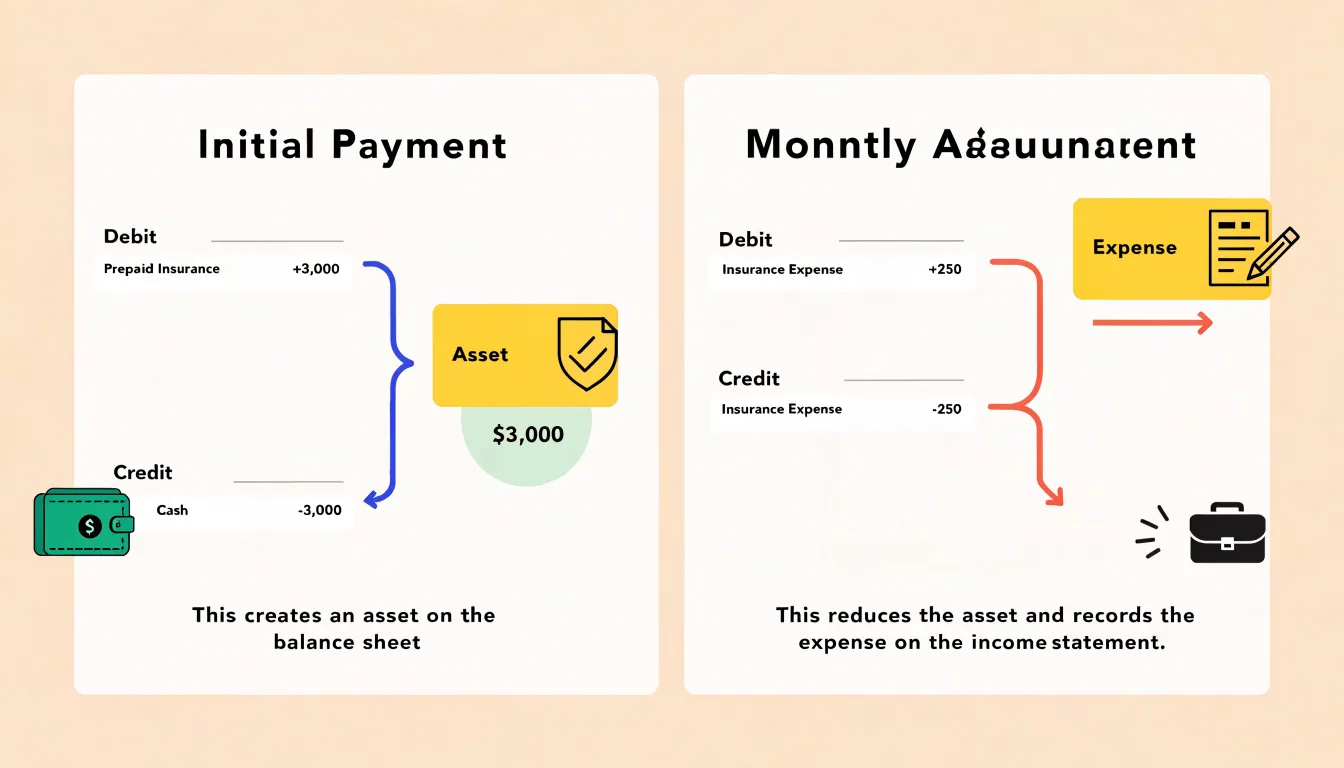
Common examples illustrate how widespread these items are in everyday business operations. Insurance premiums are frequently paid annually or quarterly while coverage extends across many months. Rent is often paid in advance at the start of a lease period, particularly for commercial space. Software subscriptions and annual licenses represent a growing category, especially as businesses shift to cloud-based tools billed on yearly terms. Other familiar instances include prepaid taxes, retainers paid to service providers, and deposits for future events or professional services.
The classification of a prepaid expense as a current asset hinges on the timing of consumption. If the benefit will be fully used within one year, or within the company’s normal operating cycle if that is longer, the prepaid amount is reported as a current asset. This placement signals to readers of the financial statements that the value will convert into operational benefit in the near term. When a prepayment covers a period extending beyond twelve months, the portion attributable to the later period is typically classified as a non-current asset and disclosed separately.
Proper classification requires tracking the consumption schedule for each prepaid item and adjusting the balance accordingly at each reporting date. A prepaid insurance policy spanning twelve months, for instance, begins as a current asset and declines month by month as coverage is used. Maintaining this discipline keeps the balance sheet accurate and ensures that expenses land in the correct accounting periods, which supports reliable reporting and informed decision-making.
Initial payment entry
When a business pays for goods or services in advance of receiving the benefit, the initial transaction is recorded as an asset rather than an expense. The prepaid asset account captures the future economic value that the company has already funded, and it sits on the balance sheet until the corresponding benefit is consumed. Recording this initial payment correctly establishes the foundation for every subsequent adjusting entry that follows.
The mechanics of the entry are straightforward. The company debits a prepaid asset account, often labeled Prepaid Expenses, Prepaid Insurance, Prepaid Rent, or Prepaid Supplies depending on the nature of the item, and credits Cash or the relevant bank account. The debit increases the asset balance, reflecting the right to future services, while the credit reduces cash to show that funds have left the business.
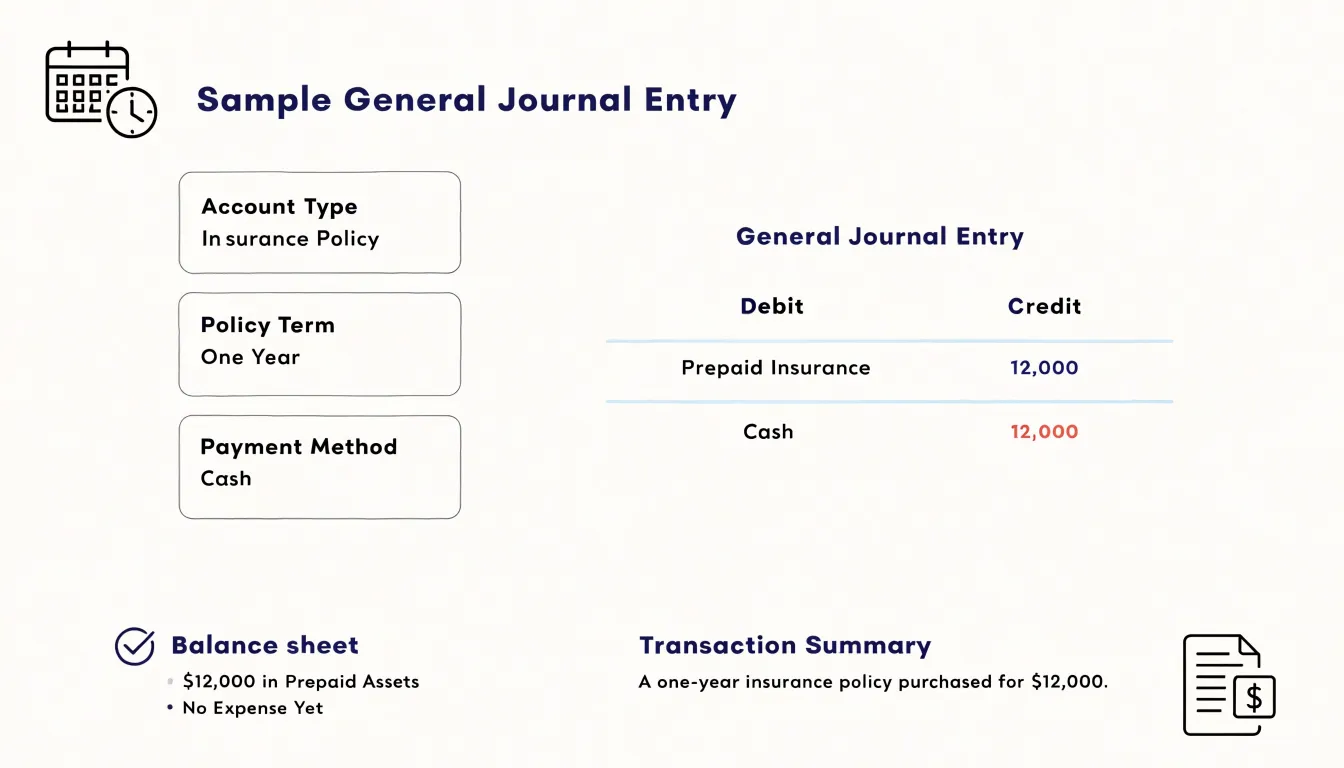
Consider a company that pays 12,000 for a one-year insurance policy on the first day of the month. The journal entry debits Prepaid Insurance for 12,000 and credits Cash for 12,000. The balance sheet now shows 12,000 in prepaid assets, and the income statement reflects no expense yet, which matches the timing of the coverage period.
A second illustration involves office rent paid quarterly. If a tenant pays 9,000 for three months of rent in advance, the entry debits Prepaid Rent for 9,000 and credits Cash for 9,000. Each month thereafter, an adjusting entry moves 3,000 from the prepaid account to Rent Expense, leaving 6,000 in the asset account after the first month.
Supplies purchases follow the same pattern. A business buying 2,500 of office supplies records a debit to Prepaid Supplies and a credit to Cash. As supplies are consumed, the amount is transferred to Supplies Expense.
Several practical details support accurate recording. The prepaid account should be named consistently so that later adjustments and reports are easy to trace. Supporting documentation, such as the invoice or policy schedule, should specify the coverage period so the amortization schedule can be prepared at the time of payment. When payments span fiscal year ends, the prepaid balance signals the portion of benefit still available in the coming period. Establishing the initial entry with clear account mapping and documentation keeps the asset balance meaningful and simplifies the monthly work of releasing the expense in step with the passage of time or consumption of the benefit.
The monthly adjusting process for converting assets to costs
The monthly adjusting process for prepaid expenses is a systematic procedure that ensures expenses are recognized in the periods they benefit. At the end of each month, an adjusting entry is made to record the portion of the prepaid asset that has been consumed or expired. This entry involves a debit to an expense account and a credit to the prepaid asset account. The debit increases the expense on the income statement, reflecting the cost of the benefit used during the month. The credit reduces the asset on the balance sheet, reflecting the remaining unexpired benefit.
For example, suppose a company pays $1,200 for a one-year insurance policy on January 1. Initially, the entire $1,200 is recorded as a prepaid insurance asset. Each month, $100 of the insurance coverage expires. The adjusting entry on January 31 would be a debit to Insurance Expense for $100 and a credit to Prepaid Insurance for $100. After this entry, the Prepaid Insurance account has a balance of $1,100, representing 11 months of remaining coverage, and the Insurance Expense account shows $100 for the month. This process is repeated each month, gradually converting the asset into an expense over the policy period.
The adjusting entry is typically recorded at the end of the accounting period, often monthly, to adhere to the matching principle. The matching principle requires that expenses be recognized in the same period as the revenues they help generate. By expensing a portion of the prepaid asset each month, the company aligns the cost with the benefits received. This ongoing process ensures that the financial statements accurately reflect the company’s financial position and performance. Without these adjustments, assets would be overstated and expenses understated, leading to distorted financial results.
The mechanics of the adjusting entry are straightforward: determine the amount of the prepaid asset that has expired during the month, then record a journal entry with a debit to the appropriate expense account and a credit to the prepaid asset account. The amount is often calculated by dividing the total prepaid amount by the number of months in the coverage period, as in the insurance example. For other prepaid items, such as rent or supplies, the calculation may be based on usage or the passage of time. Regardless of the method, the goal is to systematically reduce the asset and recognize the expense in the correct period. This monthly routine is a key part of the accrual accounting process, ensuring that financial statements remain accurate and reliable throughout the year.
Walkthrough
Consider a company that signs a commercial lease and pays $24,000 upfront to cover twelve months of rent beginning January 1. At the moment of payment, the company has exchanged cash for a future economic benefit: the right to occupy the premises for the coming year. Because that benefit has not yet been consumed, the full amount is recorded as a prepaid asset. The initial journal entry debits Prepaid Rent for $24,000 and credits Cash for $24,000. The balance sheet now shows a current asset reflecting the unused portion of the lease, and no expense appears on the income statement yet.
Each month, the company consumes one-twelfth of that benefit. Dividing $24,000 by twelve gives a monthly rent expense of $2,000. At the end of January, the adjusting entry debits Rent Expense for $2,000 and credits Prepaid Rent for $2,000. This entry recognizes the cost of occupying the space during January while reducing the asset to reflect the eleven months of coverage that remain. The same entry is repeated at the end of February, March, and every subsequent month through December.
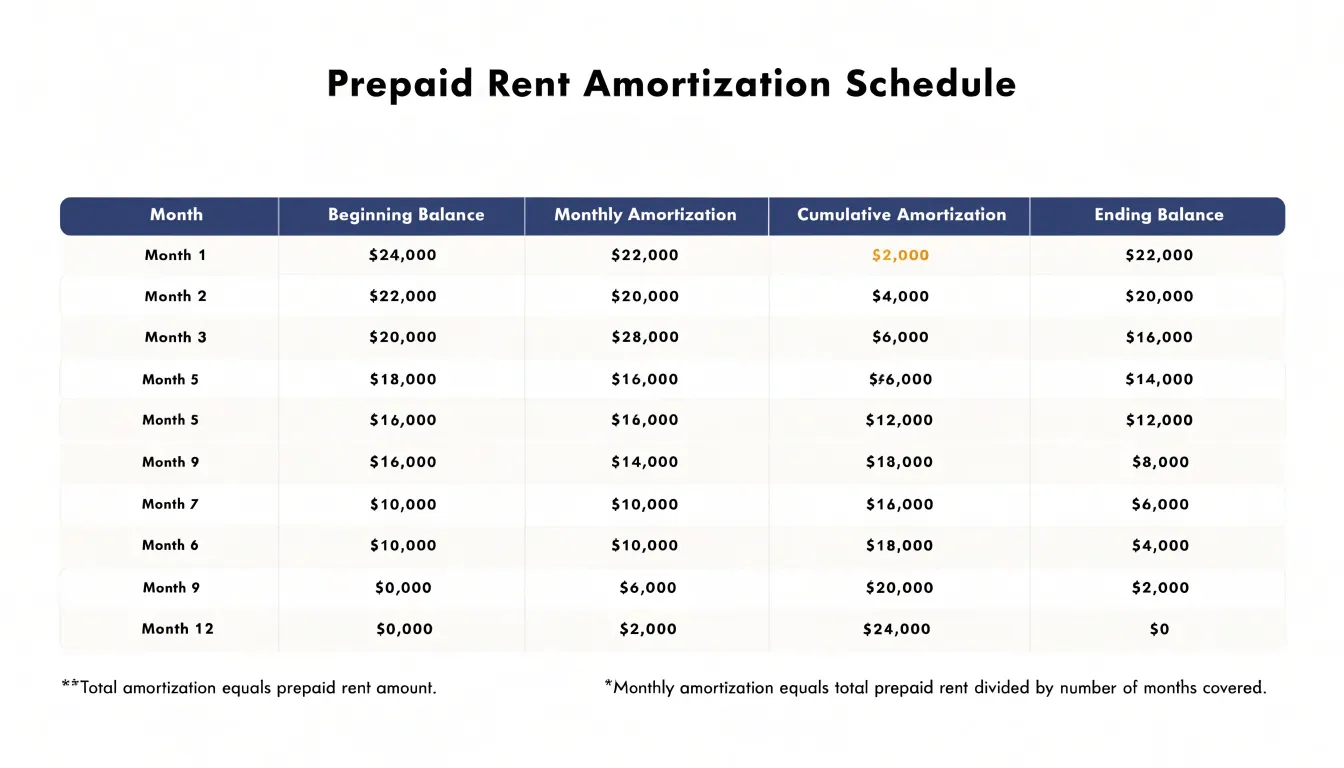
Tracking the balance helps confirm the entries are correct. After the January adjustment, Prepaid Rent stands at $22,000. After February, it is $20,000, and so on, declining by $2,000 each month. By the end of December, the twelfth adjustment brings the prepaid balance to zero, and the income statement shows $24,000 of rent expense for the year, matching the cash paid. The balance sheet no longer carries any prepaid rent for this lease.
If the company prepares monthly financial statements, these adjustments are essential to keep both statements accurate. Skipping them would overstate assets and understate expenses in every month of the lease term. Some companies instead record the initial payment directly to an expense account and then adjust at period end to move the unconsumed portion back into the prepaid asset; either approach reaches the same result as long as the entries are consistent. If the lease renews or the payment covers a different span, the monthly amount is recalculated by dividing the total by the number of months covered, keeping the expense recognition aligned with the period the space is actually used.
Why cash basis businesses treat prepaid costs differently
Cash basis businesses handle prepaid costs in a distinct manner because their accounting revolves around the actual movement of cash. When a cash basis business pays for a prepaid expense—such as a year’s insurance premium, a multi-month rent payment, or a bulk purchase of office supplies—it records the entire amount as an expense at the moment of payment. This approach aligns with the core principle of cash basis accounting: transactions are recognized only when cash changes hands. The expense is logged in full on the date the payment is made, regardless of when the benefit of that payment will be consumed. For example, if a company pays $12,000 for a one-year insurance policy on January 1, the cash basis method records a $12,000 insurance expense immediately, even though the coverage extends through December 31. This simplicity is a hallmark of cash basis accounting, as it eliminates the need for adjusting entries or tracking the portion of the prepaid amount that remains unused at the end of an accounting period.
This treatment contrasts with accrual accounting, where the matching principle dictates that expenses be recognized in the same period as the revenues they help generate. Under accrual accounting, the $12,000 insurance premium would be recorded as a prepaid asset (a current asset on the balance sheet) at the time of payment. Then, as each month of coverage passes, a portion of the prepaid amount—$1,000 per month—would be expensed on the income statement through an adjusting entry. This process ensures that the expense is matched to the periods that benefit from the insurance coverage. The accrual method provides a more accurate picture of profitability over time because it reflects the true cost of operations for each period, rather than lumping the entire cost into the period of payment. Cash basis accounting, by contrast, can cause significant fluctuations in reported expenses and net income, especially for large prepaid items, because the full cost hits the income statement in one period while the benefits extend into future periods. This difference underscores why cash basis is often favored by small businesses for its simplicity, while accrual basis is required for larger entities and provides a more nuanced view of financial performance.
Creating an amortization schedule to track monthly transfers
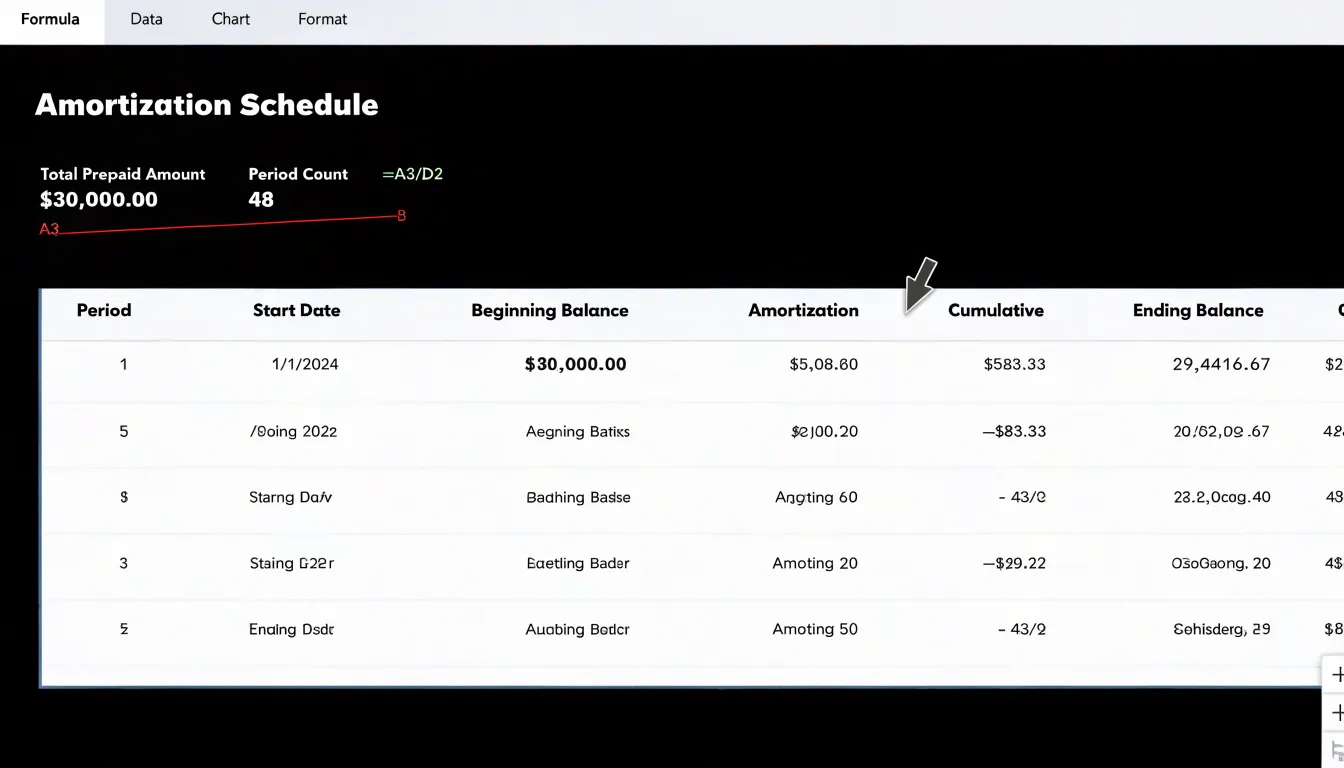
An amortization schedule gives you a reliable record of how a prepaid expense moves from the balance sheet into expense accounts month after month. Start by identifying three inputs: the total prepaid amount, the start date of the benefit period, and the number of months covered. For a twelve-month insurance policy paid upfront at 2,400 dollars, the monthly allocation is simply the total divided by the number of periods, or 200 dollars per month. In a spreadsheet, place the total in one cell, the period count in another, and compute the monthly amount with a formula such as =B2/B3. Set up a table with columns for period number, period start date, beginning balance, monthly amortization, cumulative amortization, and ending balance. The beginning balance for the first row equals the total prepaid amount. The monthly amortization cell references the fixed monthly figure, the cumulative column adds the current period’s amortization to the prior cumulative total, and the ending balance subtracts the monthly amount from the beginning balance. Each subsequent row pulls its beginning balance from the prior row’s ending balance. As a check, the final ending balance should reach zero at the end of the benefit period; a residual balance signals an error in the period count or the monthly figure. If the benefit period does not align with calendar months, prorate the first and last periods by days, using a formula that divides the monthly amount by the days in the month and multiplies by the days of benefit. A sample table might show Period 1 with a beginning balance of 2,400, amortization of 200, cumulative of 200, and ending balance of 2,200; Period 2 begins at 2,200 and ends at 2,000, and so on until Period 12 shows a beginning balance of 200, amortization of 200, cumulative of 2,400, and an ending balance of zero. Keep the schedule alongside the general ledger so each month’s journal entry, a debit to the expense account and a credit to prepaid expenses, can be traced to a specific row, and review the schedule at period close to confirm the remaining prepaid balance matches the account.
Common bookkeeping errors when expensing prepaid accounts
Prepaid expenses are frequently mishandled in bookkeeping, leading to distorted financial statements and inaccurate period reporting. One common error is expensing the full amount immediately when a payment covers future periods. For instance, if a business pays $12,000 for a one-year insurance policy, recording the entire amount as an expense in the current month overstates expenses and understates assets. This violates the matching principle, which requires expenses to be recognized in the periods they benefit. Instead, the payment should be recorded as a prepaid asset and then amortized over the policy term. Another frequent mistake is missing adjusting entries at period end. Even when prepaids are initially recorded correctly, bookkeepers may forget to record the periodic amortization, leaving the prepaid asset overstated and expenses understated. This can lead to an overstatement of net income and equity. For example, if monthly rent of $2,000 is prepaid for six months, failing to record the monthly rent expense results in an inflated asset and understated expenses each month. A third error is misclassifying prepaids as fixed assets. Prepaid expenses are current assets because they will be consumed or expire within a year, whereas fixed assets are long-term tangible assets used in operations. Classifying a prepaid expense as a fixed asset distorts the balance sheet by overstating non-current assets and understating current assets, which can affect liquidity ratios and loan covenants. It also leads to incorrect depreciation calculations if the item is mistakenly depreciated instead of amortized. These errors often stem from a lack of clear policies for identifying and tracking prepaid items, inadequate review of adjusting entries, and insufficient training for bookkeeping staff. To mitigate these risks, businesses should establish a prepaid expense register, reconcile prepaid balances regularly, and implement a period-end checklist that includes adjusting entries for prepaids. Automated accounting systems can also help by scheduling amortization entries and flagging items that require review. By addressing these common pitfalls, organizations can ensure accurate financial reporting and better decision-making.
Reconciling your prepaid asset balances before closing the books
Reconciling your prepaid asset balances before closing the books is a control step that confirms the balance shown in the prepaid asset account on the general ledger matches the detailed records supporting it. The general ledger account provides a single summary figure, while the supporting schedule lists each prepaid item individually — insurance premiums, rent deposits, software subscriptions, annual service contracts — along with its original amount, the portion already expensed, and the remaining unexpired balance. Reconciliation compares these two views and confirms they agree. When they do not, the difference is investigated and corrected before the period is closed, so the balance sheet and income statement reflect accurate figures for the reporting period.
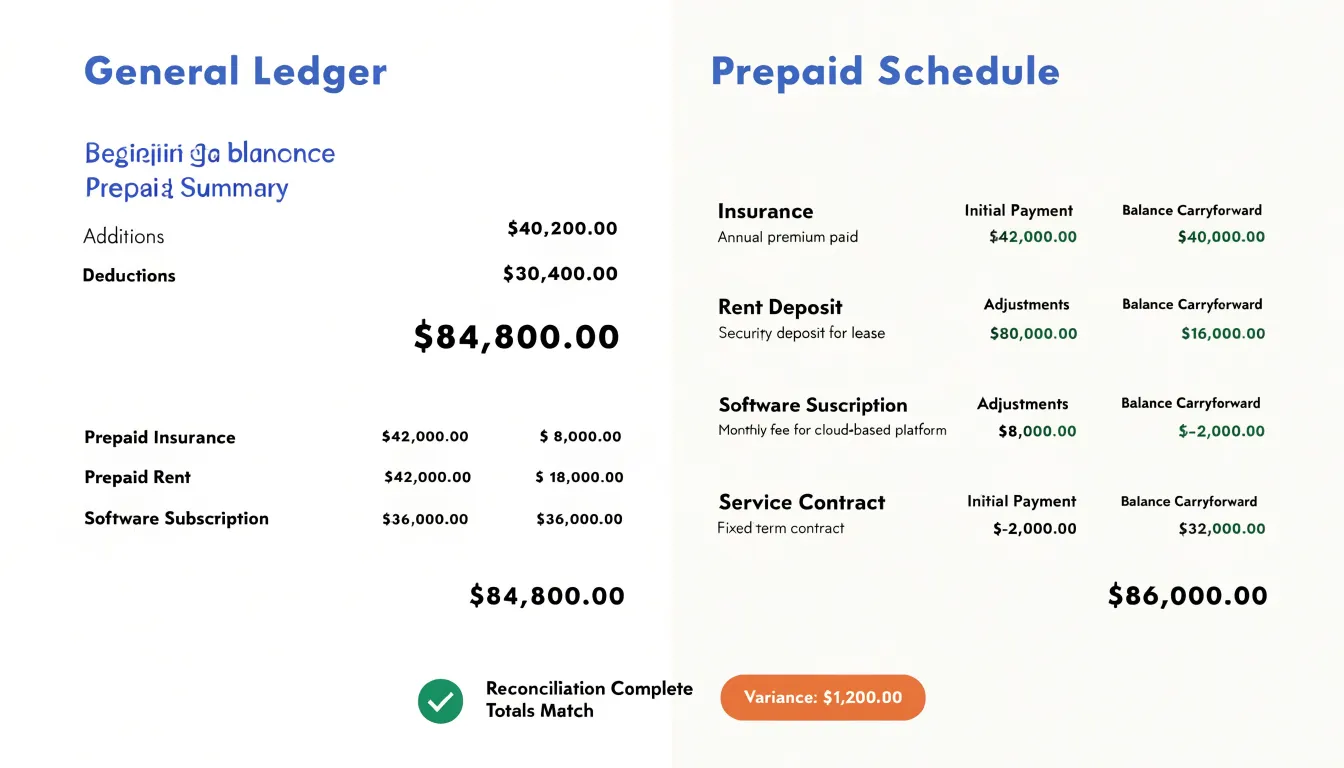
The process begins with gathering the current prepaid schedule and the general ledger balance for the same date. Each item on the schedule is traced to the ledger, and the ledger balance is compared to the schedule total. Any variance is documented and investigated. Common sources include a payment recorded directly to the prepaid account without an entry on the schedule, an amortization entry posted twice or missed entirely, an item fully expensed on the schedule but still carried on the ledger, or a misposting to an adjacent account such as deposits or accrued expenses. Timing differences also arise when a vendor invoice arrives in one period but the payment clears in the next, leaving the schedule and the ledger out of step.
Once the cause is identified, the appropriate correction is made. This may involve recording a missing amortization entry, adjusting the schedule for an item that was expensed in error, reclassifying a misposted amount, or writing off a prepaid balance that no longer has future benefit. Each correction is documented with a reference to the supporting evidence so the adjustment can be reviewed later. Reconciling before close means these corrections flow into the current period’s financial statements rather than surfacing later as unexplained variances.
The reconciliation also provides assurance for management and auditors that prepaid balances are complete and properly supported. A clean reconciliation, with every schedule item traced to the ledger and every variance resolved, supports reliable expense recognition and gives confidence that the prepaid asset reported on the balance sheet represents genuine future economic benefit.
Frequently Asked Questions
What is a prepaid expense?
A prepaid expense is a payment made in advance for goods or services that will be consumed or used over a future period. At payment, it sits on the balance sheet as an asset, and the cost is recognized as an expense as the benefit is used up.
Is a prepaid expense a current asset?
A prepaid expense is reported as a current asset if the benefit will be fully used within one year or the company’s normal operating cycle if longer. If a prepayment covers a period beyond twelve months, the portion for the later period is typically classified as a non-current asset and disclosed separately.
How do you record the initial payment for a prepaid expense?
The company debits a prepaid asset account, such as Prepaid Insurance, Prepaid Rent, or Prepaid Supplies, and credits Cash or the relevant bank account. This records the future economic value on the balance sheet and reduces cash.
How are prepaid expenses adjusted each month?
At the end of each month, an adjusting entry debits the appropriate expense account and credits the prepaid asset account for the portion consumed or expired. This reduces the asset and recognizes the expense in the period the benefit is used.
How do cash basis businesses treat prepaid expenses?
A cash basis business records the entire prepaid amount as an expense at the moment of payment, regardless of when the benefit will be consumed. This approach eliminates the need for adjusting entries or tracking the unused portion at period end.
What are common bookkeeping errors when expensing prepaid accounts?
Common errors include expensing the full amount immediately, missing period-end adjusting entries, and misclassifying prepaid expenses as fixed assets. These mistakes can overstate assets or expenses and distort financial statements.