
Retained Earnings
Retained earnings are the cumulative profits a company keeps in the business rather than paying out as dividends, calculated as beginning retained earnings plus net income minus dividends. Found in shareholders’ equity on the balance sheet, they fund growth, reduce debt, and signal financial stability to lenders and investors.
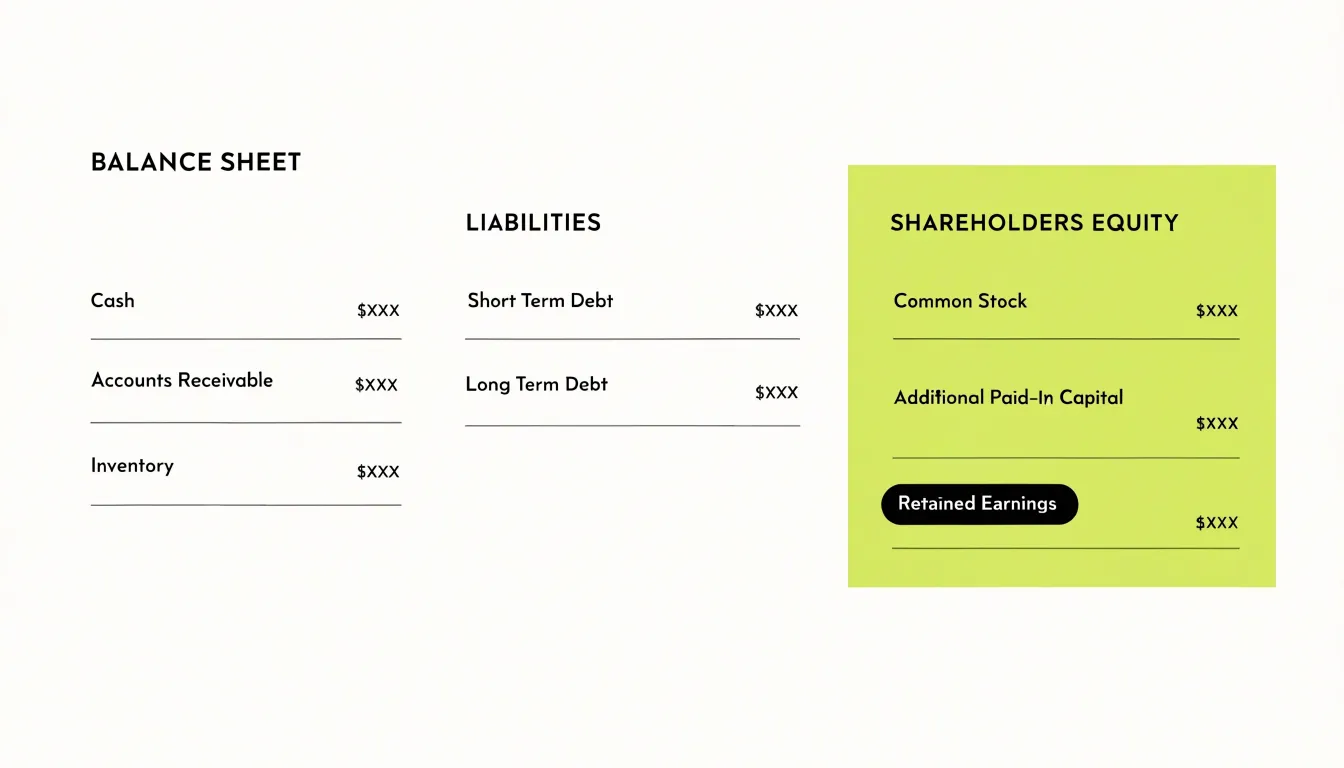
Table of Contents
- What retained earnings mean for your business finances
- The basic retained earnings formula explained
- Step by step guide
- How net income and dividend payments alter your balance
- What happens when your business operates at a net loss
- Where to locate retained earnings on the balance sheet
- Retained earnings versus revenue
- How growing companies reinvest retained profits to expand
What retained earnings mean for your business finances
Retained earnings represent the portion of a company’s net income that is kept within the business rather than distributed to shareholders as dividends. This pool of capital serves as a key indicator of financial health, providing a buffer against economic downturns and enabling strategic investments. A steady growth in retained earnings signals that a company is consistently profitable and has the discipline to reinvest in its operations. This internal funding source allows businesses to pursue growth initiatives—such as expanding operations, developing new products, or acquiring competitors—without incurring debt or diluting ownership through additional equity issuance. By avoiding the costs and obligations of external financing, companies can maintain greater financial flexibility and control over their strategic direction. Moreover, a strong retained earnings balance can enhance a company’s creditworthiness. Lenders often view retained earnings as a sign of stability and repayment capacity, which can lead to more favorable borrowing terms or increased access to credit. Investors also scrutinize retained earnings to assess management’s ability to generate returns. A consistent increase in retained earnings suggests that the company is efficiently allocating capital and has the potential for future growth, making it an attractive option for equity investors. However, it’s important to note that while high retained earnings can indicate strength, they may also prompt questions about whether the company is effectively utilizing its capital or if it should consider returning value to shareholders through dividends. Ultimately, retained earnings are a critical component of a company’s financial foundation, influencing both internal decision-making and external perceptions.
The basic retained earnings formula explained
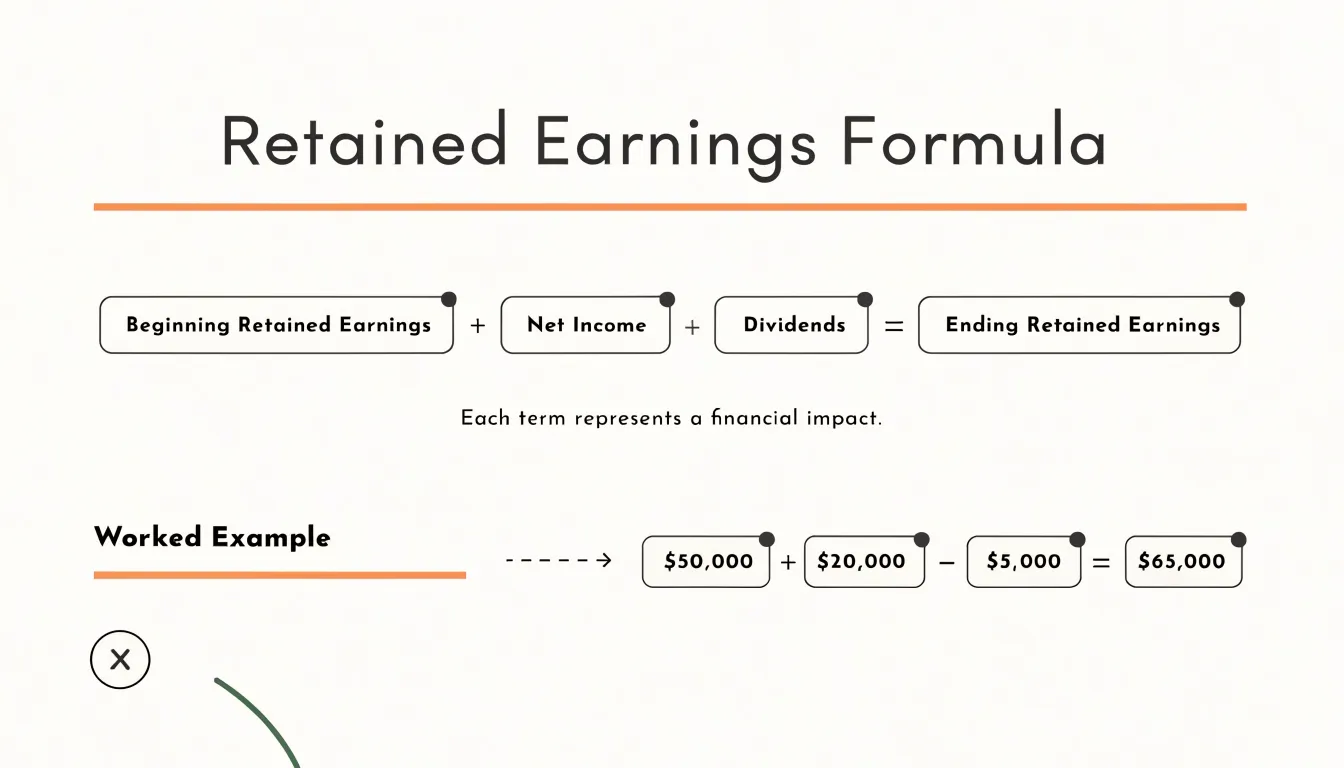
Retained earnings represent the cumulative profits a company has kept in the business since its inception, and the standard formula used to calculate them is straightforward: beginning retained earnings plus net income minus dividends. Each component of this formula captures a distinct part of the company’s financial story, and understanding them individually makes the overall calculation easy to apply.
Beginning retained earnings is the balance carried forward from the end of the previous accounting period. It appears on the prior period’s balance sheet and serves as the starting point for the current calculation. For a company in its first year of operation, this figure is simply zero.
Net income is the profit earned during the current period after all expenses, taxes, and costs have been deducted from revenue. It comes directly from the income statement and represents the pool of earnings available for the company to either retain or distribute. A positive net income increases retained earnings, while a net loss reduces them.
Dividends are the portion of earnings distributed to shareholders, typically in the form of cash payments. Because these funds leave the company, they are subtracted in the formula. Companies that pay no dividends retain the full amount of their net income, which accelerates the growth of their retained earnings balance.
A simple example illustrates how the formula works in practice. Suppose a company ended the prior year with $50,000 in retained earnings. During the current year, it generates net income of $20,000 and pays $5,000 in dividends to shareholders. Applying the formula, the ending retained earnings equal $50,000 plus $20,000 minus $5,000, which comes to $65,000. This figure would then carry forward to the next period as the new beginning retained earnings balance.
The formula highlights a key relationship in corporate finance: retained earnings grow when a company earns profits and shrink when it distributes those profits to shareholders. Managers, investors, and analysts use this calculation to track how much capital the business has accumulated internally over time, and the resulting figure feeds directly into the shareholders’ equity section of the balance sheet.
Step by step guide
Calculating accumulated profits begins with the figure carried over from the prior accounting period. This opening balance represents the retained earnings reported at the close of the previous period, and it serves as the foundation for the current calculation. Locate this number on the prior period’s balance sheet under the shareholders’ equity section, and confirm it matches the closing retained earnings figure recorded in the general ledger. Accuracy at this stage matters, since any error in the opening balance will flow through the entire calculation.
With the opening balance established, the next step is to add the net income generated during the current period. Net income appears on the income statement and reflects total revenues minus total expenses, including taxes. If the business operates at a loss, this figure will be negative, and it reduces the accumulated profits rather than increasing them. Record the net income as a positive addition when profitable, and as a subtraction when the period closes with a net loss.
The third step involves subtracting dividends paid to shareholders. Dividends represent distributions of profit and therefore reduce the amount of earnings the company retains. Identify the total dividends declared during the period, including cash dividends and any stock or property dividends recorded in the equity accounts. Subtract this total from the running figure. If the company paid no dividends during the period, this step results in no change.
After completing these adjustments, the resulting figure is the new retained earnings balance. This amount is added to the shareholders’ equity section of the current balance sheet and carried forward as the opening balance for the next period. A quick verification step helps confirm accuracy: the new balance should equal the prior retained earnings, plus net income, minus dividends. Comparing this computed figure against the retained earnings account in the general ledger provides a final check before the financial statements are finalized.
How net income and dividend payments alter your balance
Net income and dividend payments are the two primary forces that alter a company’s retained earnings balance over time. Net income, the profit remaining after all expenses and taxes are paid, directly increases retained earnings. When a company generates a profit, that amount is added to the cumulative retained earnings figure on the balance sheet, unless it is distributed to shareholders. This accumulation provides a growing pool of internal capital that can be used for reinvestment, debt reduction, or future distributions.
Dividend payments, on the other hand, reduce retained earnings. When a company declares a dividend, it commits to distributing a portion of its profits to shareholders. This distribution is recorded as a reduction in retained earnings because those profits are no longer retained within the business. The timing and size of dividend payments depend on the company’s dividend policy, which can vary widely.
A stable dividend policy, where the company pays a consistent amount each period, provides predictability for shareholders and typically results in steady reductions to retained earnings. A constant payout ratio policy ties dividends to a fixed percentage of net income, so retained earnings fluctuate with profitability. A residual dividend policy prioritizes reinvestment opportunities first and pays dividends only from what remains, leading to more variable and often smaller reductions in retained earnings. Finally, a policy of no dividends means all net income is retained, maximizing the growth of retained earnings.
Over time, the interplay between net income and dividends determines the trajectory of retained earnings. Consistent profitability with modest dividend payments can build a substantial retained earnings balance, while high dividend payouts or periods of losses can deplete it. Understanding these dynamics helps stakeholders assess how management balances returning capital to shareholders with retaining funds for future growth.
What happens when your business operates at a net loss
When a business operates at a net loss, its expenses exceed its revenues for the period, and that shortfall flows directly into retained earnings on the balance sheet. Retained earnings represent the cumulative profits a company has kept in the business rather than distributed to owners as dividends. A net loss reduces this balance dollar for dollar, because the loss is closed out into retained earnings at the end of the accounting period. If the company had built up positive retained earnings, the loss simply shrinks that cushion. A small loss might barely dent the accumulated profits, while a large or repeated loss can erase them entirely.
Once losses push the retained earnings balance below zero, the company has what is called an accumulated deficit. This appears on the balance sheet as a negative retained earnings figure, sometimes labeled “accumulated deficit” or “retained deficit.” It signals that, over the life of the business, cumulative losses have outstripped cumulative profits. An accumulated deficit is common in startups and growth-stage companies that invest heavily before generating consistent revenue, and it is not automatically a sign of failure. Still, it carries real consequences. Lenders and investors often view a persistent deficit as a risk indicator, since it suggests the business has not yet proven it can fund itself through operations. Dividends become off the table until the deficit is cleared, because distributing profits requires positive retained earnings from which to pay them. In many jurisdictions, legal restrictions on dividends are tied to retained earnings, so a deficit can limit how much owners can withdraw.
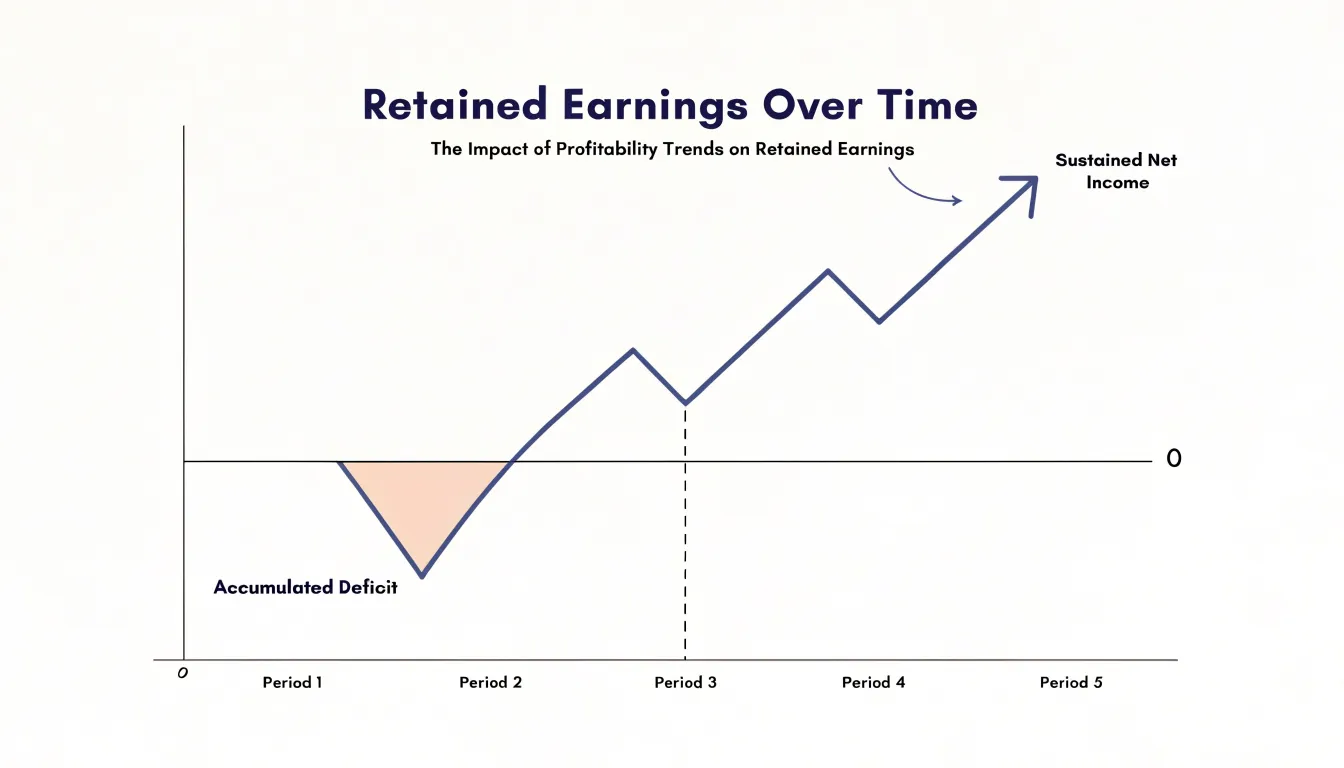
Recovering from an accumulated deficit requires sustained net income. Each profitable period adds to retained earnings until the negative balance is worked off, which can take years for a deeply deficient company. Management should watch the trend rather than any single period, examine which cost structures or revenue shortfalls are driving the losses, and consider whether the business model itself needs adjustment. A declining deficit shows progress; a widening one demands action. Understanding how losses move through retained earnings helps owners see the cumulative effect of their results and make informed decisions about dividends, financing, and turnaround strategy.
Where to locate retained earnings on the balance sheet
Retained earnings occupy a specific and identifiable position within a company’s financial statements: they sit in the shareholders’ equity section of the balance sheet, typically listed alongside common stock, additional paid-in capital, and treasury stock. On a standard balance sheet, equity appears after total liabilities, and retained earnings is usually shown as a single cumulative line item labeled “Retained Earnings” or “Accumulated Deficit” when the balance is negative. This figure represents the cumulative net income a company has earned since inception, minus all dividends paid out to shareholders over that same period. Because it is a cumulative account, the retained earnings balance rolls forward from one reporting period to the next rather than resetting each year.
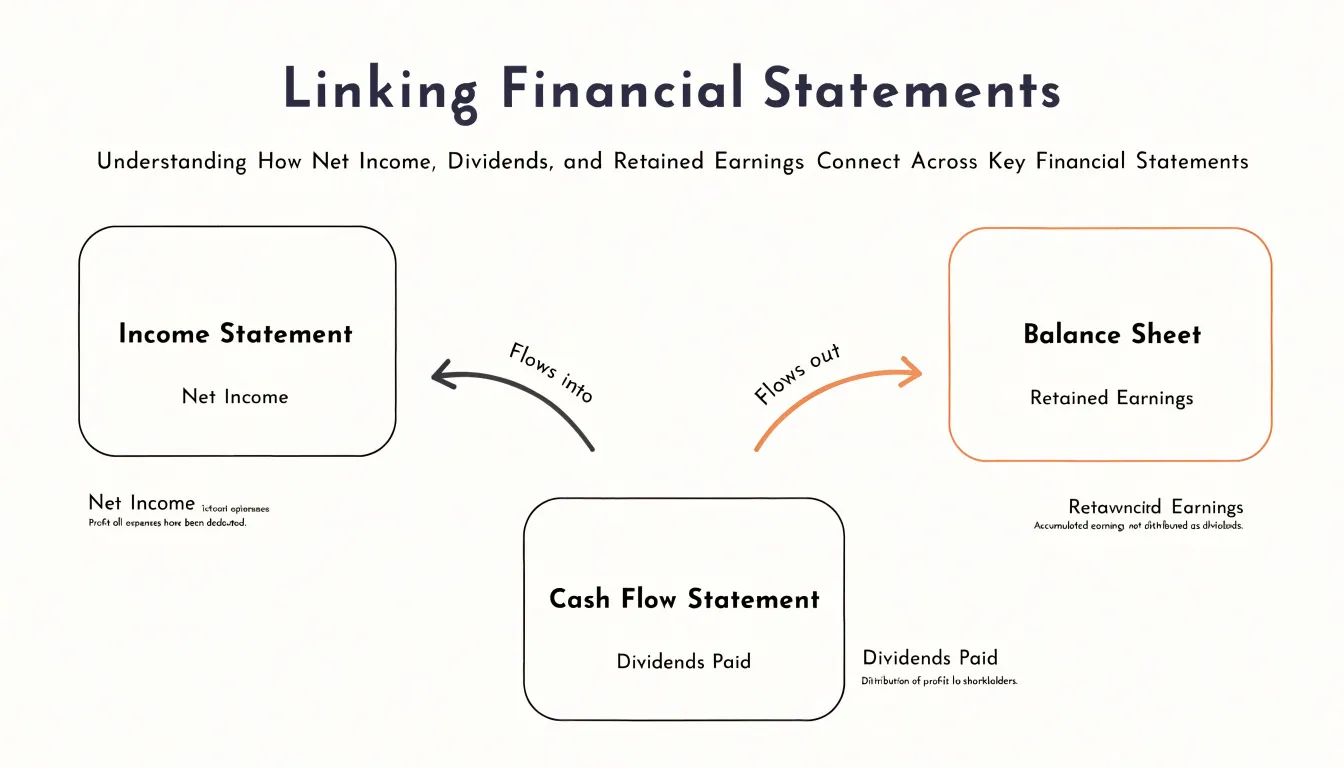
The connection between retained earnings and the income statement runs through net income. At the close of each accounting period, the company’s net income, or net loss, is transferred into retained earnings through closing entries. A profitable quarter increases the retained earnings balance; a loss decreases it. This means the income statement effectively serves as the engine that drives changes in retained earnings, while the balance sheet captures the accumulated result of those changes over time. Investors reviewing the income statement can therefore anticipate how the equity section will shift before the balance sheet is even published.
The cash flow statement adds another layer of connection, particularly through the financing activities section. Dividends paid to shareholders appear as a cash outflow on the cash flow statement, and those same dividend payments reduce retained earnings on the balance sheet. The statement of retained earnings, often presented as a standalone reconciliation or folded into the statement of changes in equity, formally bridges these documents by starting with the opening retained earnings balance, adding net income, subtracting dividends, and arriving at the closing balance reported on the balance sheet.
Understanding these linkages helps readers trace a single dollar of profit from its origin on the income statement through to its resting place in shareholders’ equity. Each financial statement tells part of the same story, and retained earnings serves as the point where profitability, dividend policy, and cumulative corporate history converge into one visible figure on the balance sheet.
Retained earnings versus revenue
Revenue and retained earnings occupy different positions on a company’s financial statements, and confusing the two can lead to faulty conclusions about a business’s health. Revenue, often called the top line, represents the total income generated from sales of goods or services during a specific period, such as a quarter or a year. It captures money coming in before any costs are subtracted. A company reporting $5 million in revenue has sold $5 million worth of products or services, regardless of whether it spent $4.9 million or $1 million to do so.
Retained earnings sit at the bottom of the income statement and on the balance sheet. They represent the cumulative profits a company has kept over its entire history after paying all expenses, taxes, and dividends to shareholders. When a company earns a profit, it can either distribute some of that profit as dividends or keep it in the business. The portion kept accumulates as retained earnings. This figure reflects years of financial decisions, not a single period’s performance.
The distinction matters for several practical reasons. Revenue tells you about scale and market demand, while retained earnings reveal how much profit the company has actually banked and reinvested over time. A fast-growing company can post impressive revenue while carrying negative retained earnings if it has consistently spent more than it earned or paid out large dividends. Conversely, a mature business with modest revenue may hold substantial retained earnings built up over decades.
Investors and analysts use revenue to assess growth trajectories and market position. They look at retained earnings to gauge a company’s ability to fund expansion without external financing, sustain dividend payments, or weather downturns. Lenders often examine retained earnings as a sign of long-term stability, since a healthy balance suggests the business has generated consistent profits.
Understanding both figures together provides a fuller picture. Revenue without profits may signal inefficiency or heavy investment. Large retained earnings with declining revenue may point to past success and present challenges. Reading them in tandem gives stakeholders a clearer view of where a company has been and where it can go.
How growing companies reinvest retained profits to expand
Growing companies often choose to reinvest their retained profits back into the business rather than distributing them as dividends. This strategy allows the company to fund expansion initiatives that can drive future growth and increase shareholder value over the long term. Retained earnings, which represent the cumulative profits not paid out as dividends, serve as a flexible internal source of capital. By retaining these funds, management can pursue opportunities without the need for external financing, which may come with higher costs or dilution of ownership.
One common use of retained profits is the purchase of new equipment. Upgrading machinery or technology can improve efficiency, increase production capacity, or enhance product quality. For example, a manufacturing company might invest in automated systems to reduce labor costs and boost output, thereby capturing a larger market share. Another key reinvestment area is hiring. Growing companies often need to expand their workforce to support increased sales, enter new markets, or develop new products. Retained earnings can fund the recruitment and training of additional staff, which is essential for sustaining growth.
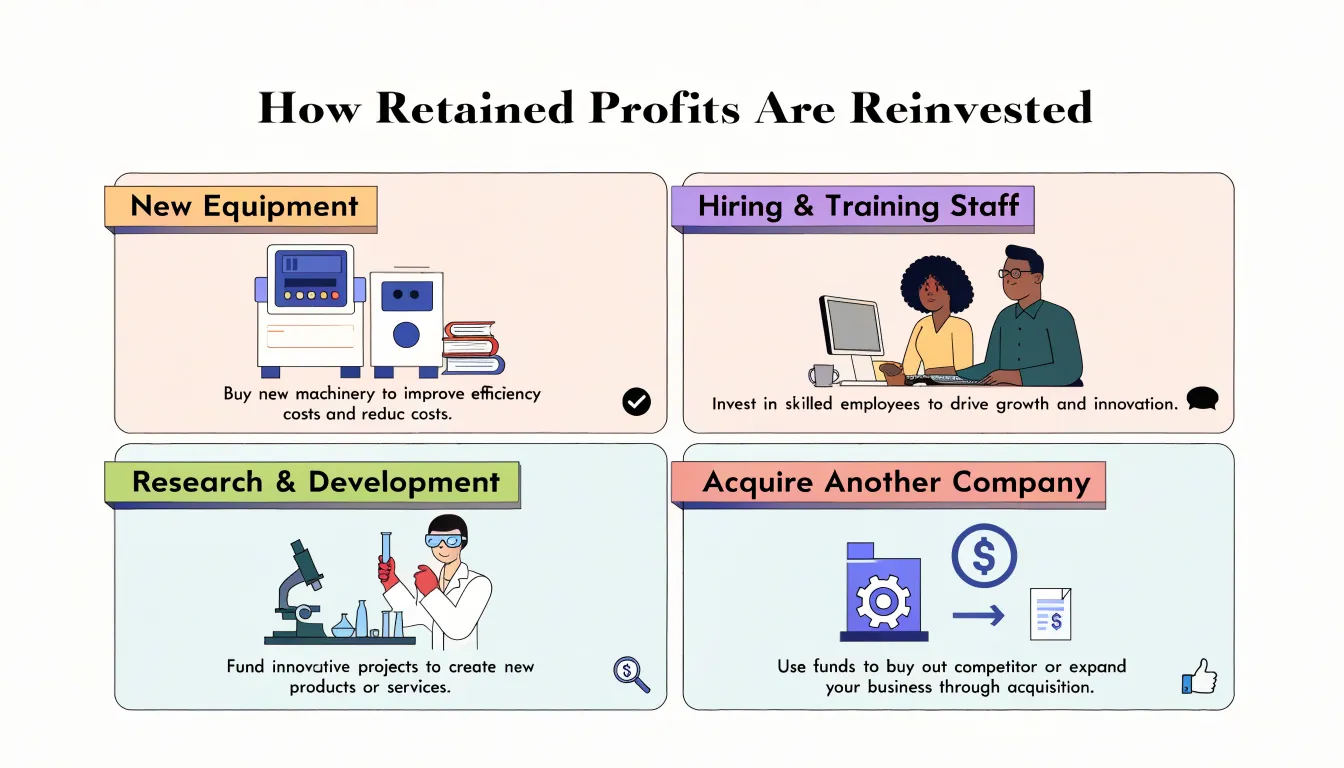
Research and development (R&D) is another critical avenue for reinvestment. Companies in technology, pharmaceuticals, and other innovation-driven industries frequently plow retained profits into R&D to create new products or improve existing ones. This investment can lead to patents, proprietary technologies, and a competitive edge that fuels long-term profitability. Additionally, acquisitions represent a strategic use of retained earnings. By acquiring other companies, a business can quickly expand its customer base, access new technologies, or eliminate competitors. Such moves can accelerate growth and create synergies that benefit shareholders.
The trade-off between growth and shareholder payouts is a central consideration. Paying dividends provides immediate income to shareholders and can signal financial health, but it reduces the capital available for reinvestment. Conversely, retaining profits may lead to higher future earnings and capital appreciation, but shareholders may have to wait longer for returns. Management must balance these priorities, often considering factors such as the company’s growth stage, industry norms, and shareholder expectations. Ultimately, the decision hinges on whether reinvested funds can generate a higher return than shareholders could achieve elsewhere.
Frequently Asked Questions
What are retained earnings and where do they appear on the balance sheet?
Retained earnings are the portion of net income kept in the business rather than paid to shareholders as dividends, representing cumulative profits since inception. They sit in the shareholders’ equity section of the balance sheet, typically shown as “Retained Earnings” or “Accumulated Deficit” when negative.
How do you calculate retained earnings?
The standard formula is beginning retained earnings plus net income minus dividends. For a company in its first year of operation, beginning retained earnings is simply zero.
How do net income and dividend payments change retained earnings?
Net income increases retained earnings, while a net loss reduces them. Dividend payments reduce retained earnings because those profits are distributed to shareholders and no longer retained.
What happens to retained earnings if a business operates at a net loss?
A net loss reduces retained earnings dollar for dollar, and if losses push the balance below zero, the company has an accumulated deficit. Dividends become off the table until the deficit is cleared, and in many jurisdictions legal restrictions on dividends are tied to retained earnings.
What’s the difference between revenue and retained earnings?
Revenue is total income generated from sales during a specific period before any costs are subtracted. Retained earnings are cumulative profits kept over the company’s entire history after paying all expenses, taxes, and dividends.
How do growing companies use retained earnings?
Growing companies often reinvest retained profits into new equipment, hiring, research and development, or acquisitions instead of paying dividends. This lets them fund expansion without external financing, which may come with higher costs or dilution of ownership.