
Statement of Retained Earnings
The statement of retained earnings tracks cumulative profits kept in a business rather than distributed to owners. It starts with the opening retained earnings balance, adds net income (or subtracts net loss), deducts dividends or distributions, and produces the closing balance reported in shareholders’ equity on the balance sheet.
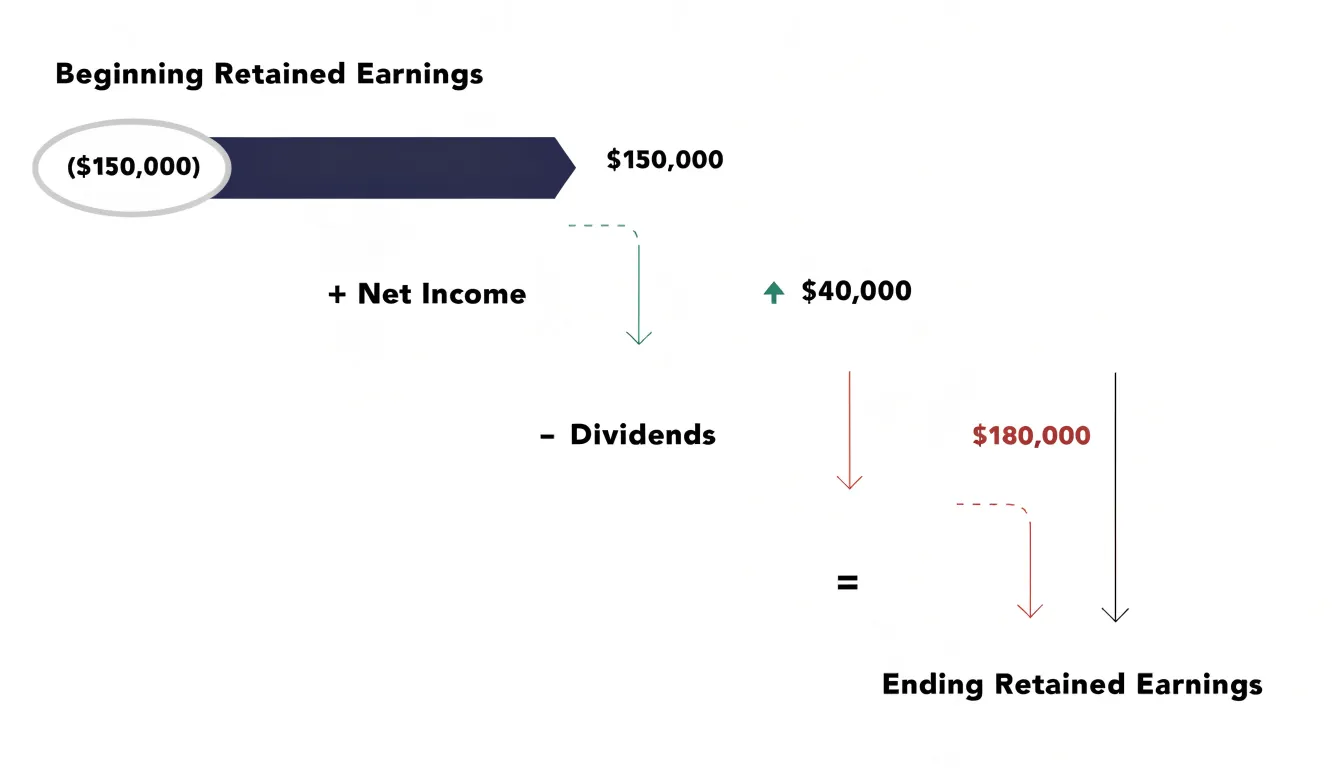
Table of Contents
- What the statement of retained earnings actually tells business owners
- Core components that change your retained earnings balance
- Standard format
- Practical example showing beginning balance to ending totals
- How net income and net losses impact accumulated profits
- Accounting for dividends
- How this report connects directly to the balance sheet and income statement
- Common mistakes that cause errors in your ending retained earnings
What the statement of retained earnings actually tells business owners
The statement of retained earnings tracks the cumulative profits a business has kept rather than distributed to owners. It begins with the opening retained earnings balance, adds net income (or subtracts a net loss), deducts dividends or owner distributions, and arrives at the closing balance. That single figure represents accumulated capital the business has generated and chosen to hold. For an owner, the statement answers a direct question: after paying for operations and rewarding owners, how much profit has stayed inside the company to fund its future? The closing balance is a running total of every dollar the business has kept since it began, adjusted for any prior-period corrections or accounting changes.
The statement also offers a window into financial health. A retained earnings balance that grows steadily over several periods signals consistent profitability and a deliberate choice to build reserves. Those reserves give the company a cushion against downturns, cover unexpected expenses, and reduce reliance on debt. A declining balance can point to losses, heavy distributions, or both, and prompts a closer look at operating performance. Because the figure sits within the equity section of the balance sheet, it connects the income statement to the company’s overall financial position, showing how each period’s profit flows into long-term value.
Reinvestment capacity is where this statement becomes especially practical. Retained earnings are the cheapest source of growth capital available to a business, requiring no interest payments or dilution of ownership. A healthy balance supports equipment purchases, new hires, product development, debt reduction, or expansion into new markets. Lenders and investors often review the trend in retained earnings to gauge whether management funds growth from its own profits or leans on outside financing.
Owners should monitor this statement every accounting period. Watching the balance over time helps them decide how much profit to distribute and how much to keep, compare the pace of reinvestment against growth goals, and spot warning signs early. A consistent review turns the statement into a planning tool rather than a year-end formality.
Core components that change your retained earnings balance
Retained earnings represent the cumulative profit a company has kept in the business since its inception, and that running balance moves up or down over time as specific items are recorded. Understanding which components change the balance is essential to reading the statement of retained earnings accurately. The core components are net income, net losses, dividends, and prior period adjustments.
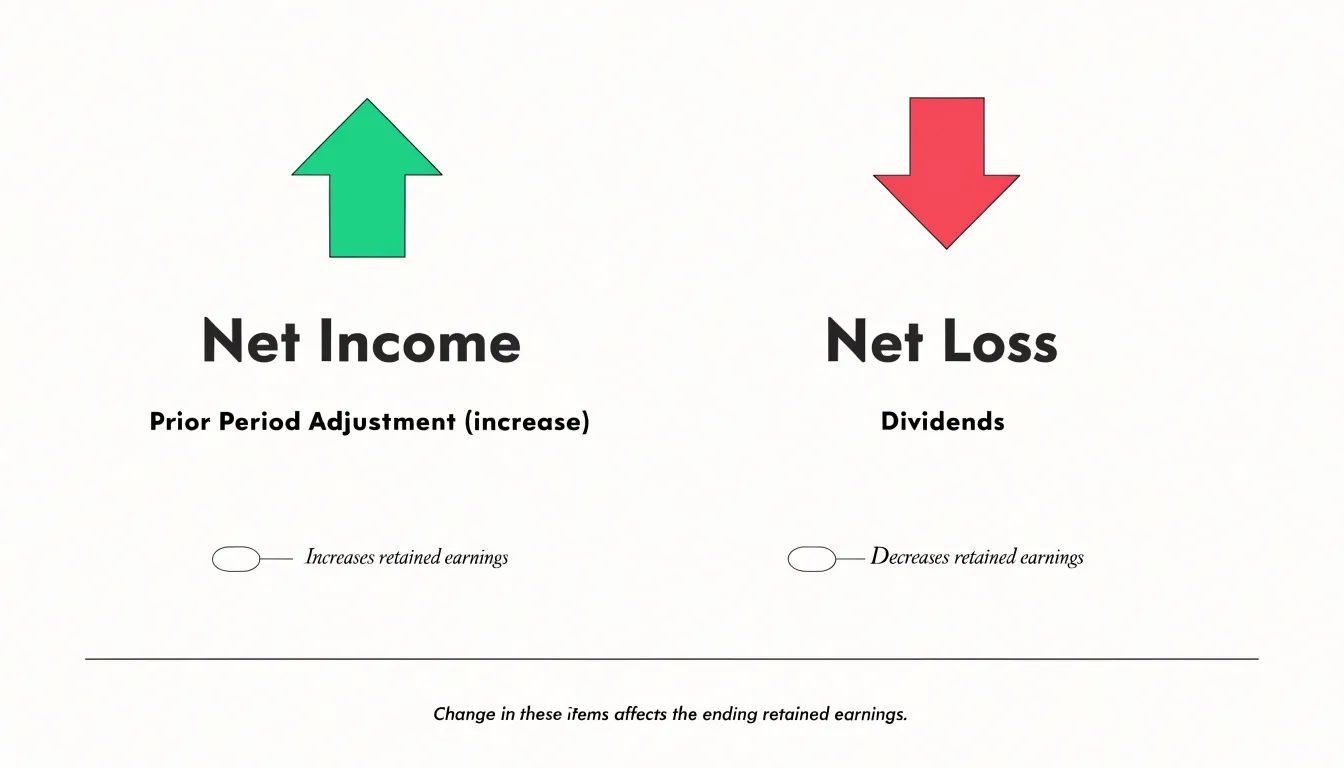
Net income is the primary driver that increases retained earnings. At the end of each accounting period, the company’s net income—revenue minus all expenses, including taxes—is closed into retained earnings, adding to the running total. A profitable period pushes the balance upward, reflecting the value the business has generated and chosen to keep rather than distribute.
Net losses work in the opposite direction. When expenses exceed revenues for a period, the resulting loss reduces retained earnings. A sustained pattern of losses can erode the accumulated balance and, in severe cases, push retained earnings into negative territory, which is reported as an accumulated deficit. This signals that cumulative losses have outpaced cumulative profits.
Dividends are distributions of a portion of retained earnings to shareholders, typically paid in cash. When a company declares a dividend, the amount is subtracted from retained earnings because those profits are leaving the business rather than being reinvested. Dividends reduce the running total directly, and a company cannot pay dividends beyond what its retained earnings (plus certain other equity accounts) can support without impairing capital.
Prior period adjustments are corrections of material errors in previously issued financial statements, such as misstated revenue or improperly recorded expenses. Rather than flowing through the current income statement, these adjustments are applied directly to the opening retained earnings balance, restating it. A correction that increases prior profits raises retained earnings; one that decreases prior profits lowers it. Because these adjustments alter the starting point of the statement, they affect every subsequent figure in the running total.
Together, these four components tell the story of how the retained earnings balance evolved: profits add to it, losses and dividends draw it down, and prior period adjustments restate the beginning balance before the current period’s activity is applied. Tracking each item separately keeps the running total transparent and lets readers see exactly what drove the change from one period to the next.
Standard format
The statement of retained earnings follows a clear line-by-line structure that moves from the opening balance to the closing balance through a defined sequence of additions and subtractions. Preparing the statement in this order supports accuracy and makes the document easy for readers to follow.
The statement begins with the beginning retained earnings balance. This figure is the accumulated retained earnings carried forward from the end of the prior accounting period and appears as the opening line of the current statement. It represents the cumulative profits the company has kept in the business since its inception, less any cumulative losses and dividends, up to the start of the reporting period. Locating this figure on the prior period’s statement of retained earnings, or in the retained earnings account in the general ledger, ensures the report starts from a verified number.
The next line adds net income for the current period. Net income is drawn directly from the income statement and represents the profit remaining after all revenues and expenses have been recognized. Because net income increases retained earnings, it is added to the beginning balance. If the company reports a net loss, that amount is subtracted instead, reducing the accumulated balance.
After net income, the statement subtracts dividends. Dividends are distributions of earnings paid to shareholders and therefore reduce the amount of profit retained in the business. The line typically itemizes dividends paid during the period, including cash dividends and, where applicable, stock dividends, so readers can see the total distribution subtracted from the running balance.
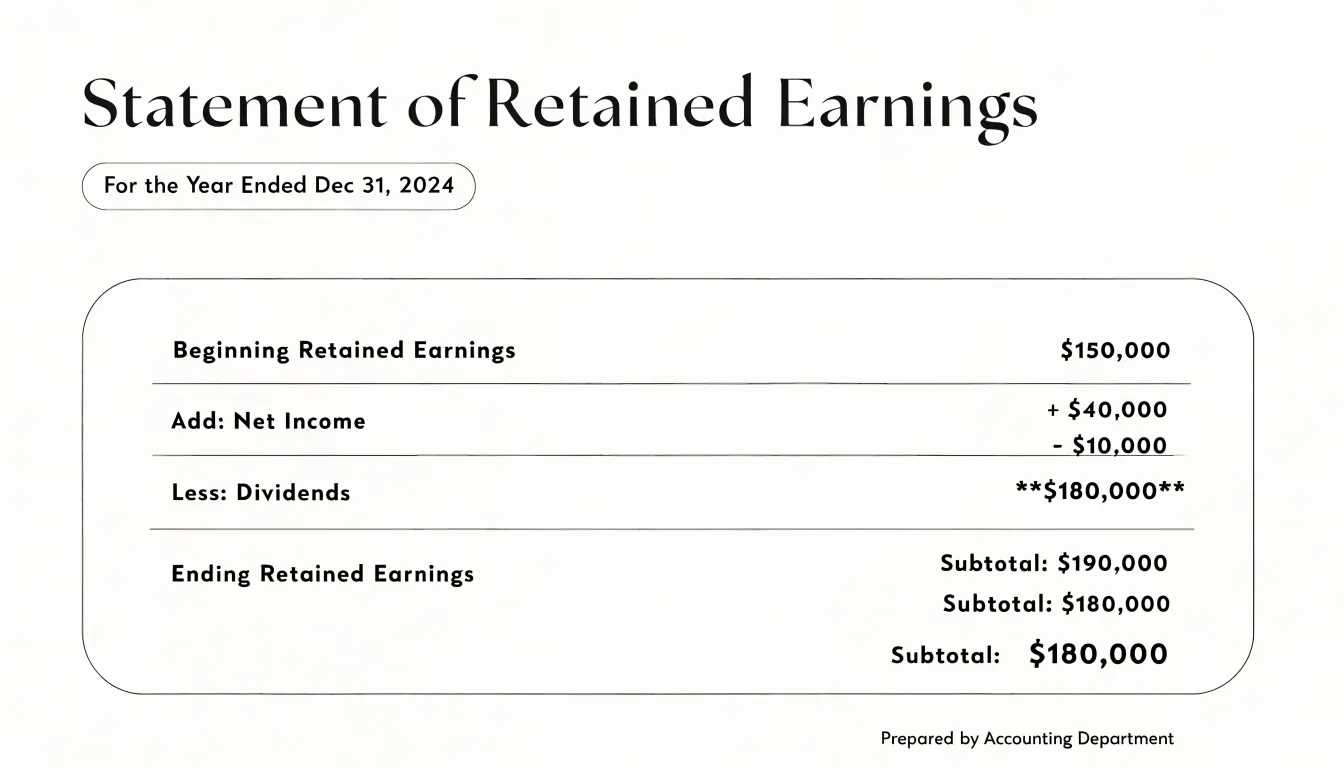
These figures combine to produce the ending retained earnings balance, which appears as the final line of the statement. The ending balance is calculated by taking beginning retained earnings, adding net income, and subtracting dividends. This closing figure also flows to the balance sheet as the retained earnings component of stockholders’ equity, tying the statement into the broader financial reporting framework. Following this step-by-step layout for every reporting period keeps the statement consistent, auditable, and straightforward to interpret.
Practical example showing beginning balance to ending totals
A worked example makes the statement of retained earnings concrete. Suppose a company begins its fiscal year with a retained earnings balance of $150,000. This figure comes from the prior year’s ending balance and serves as the starting point for the current statement. During the year, the company reports net income of $40,000, which increases retained earnings. It also pays dividends of $10,000 to shareholders, which decrease retained earnings. The ending retained earnings is calculated as: Beginning Retained Earnings + Net Income – Dividends = Ending Retained Earnings. Plugging in the numbers: $150,000 + $40,000 – $10,000 = $180,000. The statement would show the beginning balance of $150,000, add net income of $40,000 to get $190,000, then subtract dividends of $10,000 to arrive at the ending balance of $180,000. Each line item is clearly labeled, and the arithmetic is straightforward. This example illustrates how the statement bridges the income statement (net income) and the balance sheet (retained earnings). It also highlights the impact of dividend distributions on the accumulated earnings. By walking through each line item, readers can see how the ending balance is derived and why it matters for financial reporting. The worked example reinforces the concept that retained earnings represent the cumulative profits retained in the business after dividends. It also shows that even a simple set of transactions requires careful tracking to ensure accuracy. In practice, companies may have additional adjustments, such as prior period corrections, but the core structure remains the same. This example provides a clear, numerical foundation for understanding the statement’s purpose and mechanics.
How net income and net losses impact accumulated profits
Net income and net losses sit at the center of the retained earnings calculation, because the profit or loss reported for a period flows directly into the accumulated profits balance reported on the balance sheet. When a company closes its books for an accounting period, the net income figure is transferred from the income statement into the retained earnings account. This means that every profitable period increases the balance available for future use, whether those funds are later distributed to shareholders as dividends, reinvested in operations, or held as a reserve. The direct relationship is straightforward: higher profitability produces larger additions to retained earnings, while weak profitability produces smaller additions. Analysts often track this relationship over several periods to see whether a company is consistently building its equity base or merely holding steady.
Net losses move the balance in the opposite direction. When expenses exceed revenues for a period, the resulting loss is deducted from retained earnings, reducing the accumulated profits built up in prior years. A single loss may simply trim the cushion assembled during earlier profitable periods, but sustained losses erode that cushion quickly. If the accumulated losses exceed the accumulated profits, the retained earnings account turns negative. This negative balance is described as an accumulated deficit, and it appears as a debit within the equity section of the balance sheet, reducing total shareholders’ equity. An accumulated deficit signals that the company has consumed more capital than it has generated over its lifetime, which can raise concerns among lenders, investors, and other stakeholders about the firm’s long-term viability.
The path from a positive retained earnings balance to an accumulated deficit often unfolds gradually. A company may report modest losses for several consecutive periods, with each loss drawing down the reserve accumulated during profitable years. Dividends paid during that same stretch can accelerate the decline, since distributions remove earnings that might otherwise have offset the losses. Management typically monitors trends in retained earnings closely for this reason, treating a shrinking balance as an early warning that operating performance needs correction. Conversely, a business recovering from losses will first need to eliminate its accumulated deficit before retained earnings return to a positive balance, which can delay the resumption of dividend payments and other uses of accumulated profits. In this way, net income and net losses act as the primary drivers of the retained earnings balance across the life of the business.
Accounting for dividends
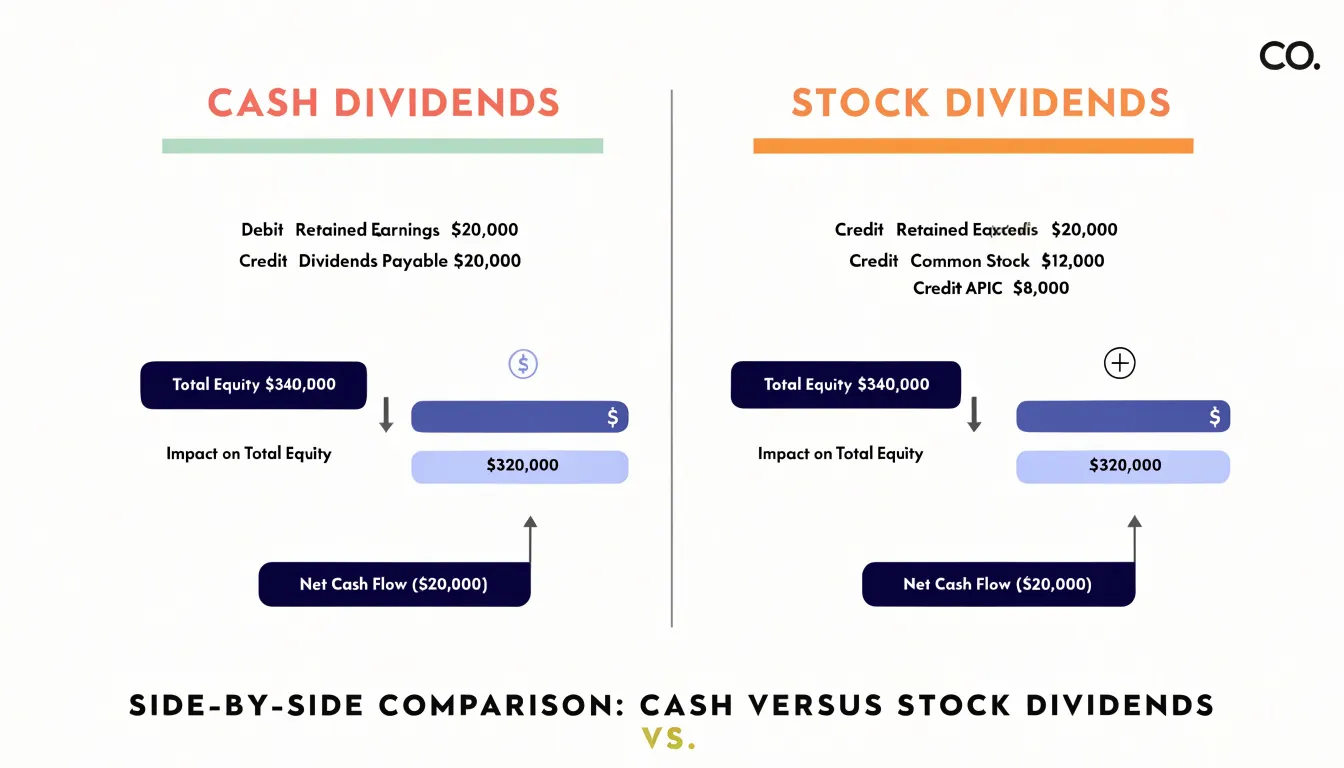
Dividends represent the portion of a company’s earnings distributed to shareholders, and the way each type flows through the financial statements depends on the form the payment takes. When a company declares a cash dividend, the board commits to transferring actual assets out of the business. The accounting treatment is straightforward: on the declaration date, the company debits retained earnings and credits the dividends payable liability. This entry directly reduces retained earnings because the earnings retained in the business are being returned to owners. When the payment date arrives, the company debits dividends payable and credits cash, completing the outflow of resources. The statement of retained earnings captures the reduction at declaration, since that is the point at which the obligation arises. Investors reviewing this statement see the reduction as a direct reflection of capital returned to them.
Stock dividends operate under a different logic. Instead of distributing cash, the company issues additional shares to existing shareholders, converting a portion of retained earnings into contributed capital rather than releasing assets. No cash leaves the company, and total shareholders’ equity remains unchanged. The accounting entry debits retained earnings and credits common stock and additional paid-in capital, reclassifying equity from one category to another. This treatment reflects the economic substance: management has chosen to permanently capitalize a slice of earnings, signaling a decision to keep those funds invested in operations. The absence of a cash outflow means liquidity and solvency are unaffected, which is why companies facing cash constraints sometimes favor this approach.
The reporting implications diverge accordingly. Cash dividends shrink both retained earnings and total equity, and they appear as a financing outflow in the statement of cash flows. Stock dividends reduce retained earnings but leave total equity intact, and they do not appear in the cash flow statement at all. Analysts comparing retained earnings across periods must account for these distinct effects, recognizing that a stock dividend merely reshuffles the equity section while a cash dividend genuinely decreases the company’s accumulated earnings and overall capital base.
How this report connects directly to the balance sheet and income statement
The statement of retained earnings does not exist in isolation; it serves as a vital link between the income statement and the balance sheet, ensuring that the financial statements articulate correctly. Net income, the bottom-line result from the income statement, flows directly into the statement of retained earnings as the primary component of the period’s increase. This figure represents the company’s profit after all expenses, taxes, and costs have been deducted. Once net income is incorporated, it is adjusted for any dividends distributed to shareholders, which reduce retained earnings, and for any prior period adjustments or changes in accounting principles that may affect the opening balance. The resulting ending retained earnings balance is then carried forward to the balance sheet, where it appears within the shareholders’ equity section. This transfer ensures that the balance sheet reflects the cumulative effect of all earnings retained since the company’s inception, net of dividends and other adjustments.
The articulation between these statements is fundamental to the integrity of financial reporting. The income statement measures performance over a period, while the balance sheet provides a snapshot at a point in time. The statement of retained earnings bridges these two by explaining how the retained earnings account changed from the beginning to the end of the period. Without this statement, users of financial statements would be unable to trace how net income and dividend payments affect the equity reported on the balance sheet. For example, if a company reports net income of $100,000 and pays $20,000 in dividends, retained earnings increase by $80,000, assuming no other adjustments. This $80,000 increase is added to the opening retained earnings to arrive at the closing balance, which is then reported on the balance sheet. Any discrepancy in this flow would indicate an error in the financial statements.
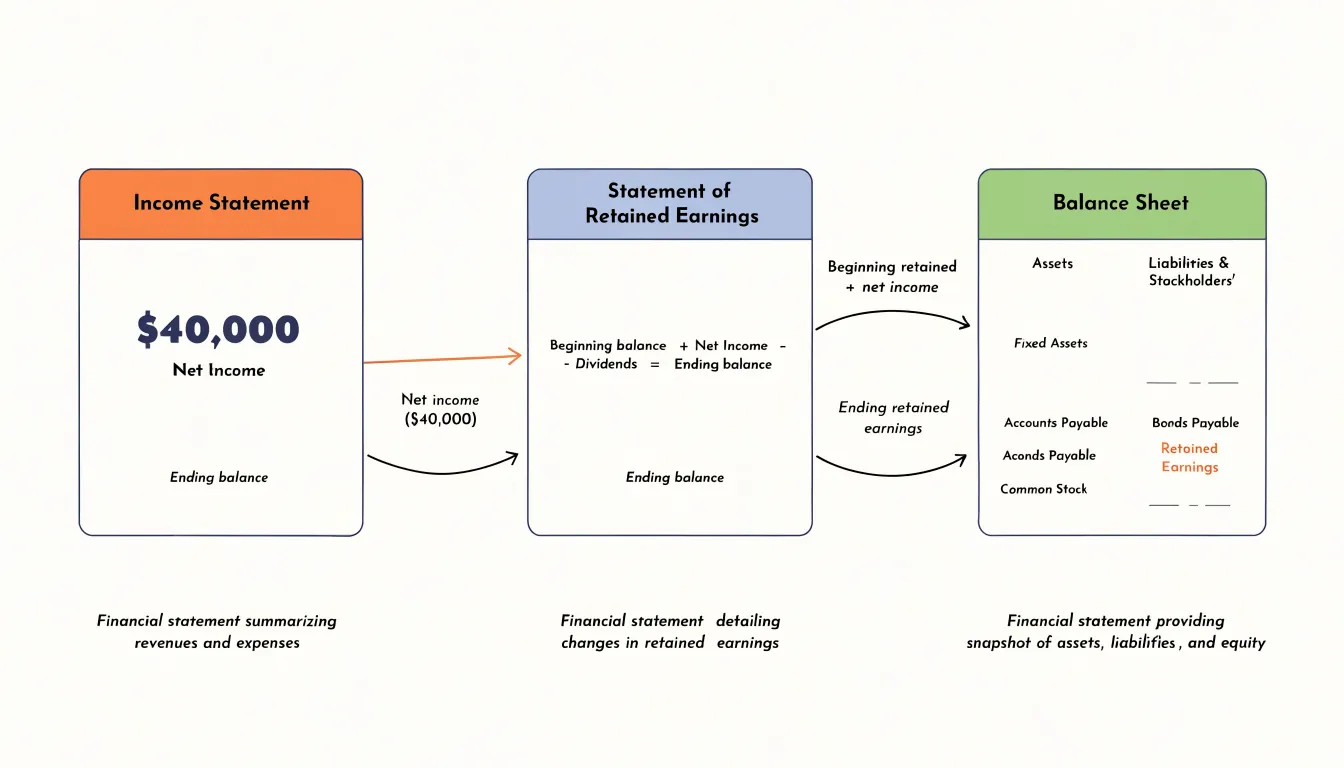
Moreover, the statement of retained earnings highlights the relationship between profitability and dividend policy. It shows how much of the company’s earnings are being reinvested in the business versus distributed to shareholders. This information is crucial for investors and creditors who assess the company’s ability to generate future growth and sustain dividend payments. In summary, the statement of retained earnings is the connective tissue that ties together the income statement and the balance sheet, ensuring that the financial statements present a coherent and accurate picture of the company’s financial position and performance.
Common mistakes that cause errors in your ending retained earnings
Errors in ending retained earnings usually trace back to a handful of recurring pitfalls, and understanding each one makes them far easier to catch before they distort your financial statements. One frequent problem is omitting prior period adjustments. When a company corrects a material error from an earlier period, accounting standards require that correction to be reflected in the opening retained earnings balance rather than buried in current income. Teams that route such corrections through the current period’s net income, or that forget to restate the opening balance at all, end up with a figure that no longer ties to the prior year’s audited statements. The fix is to maintain a clear schedule of prior period adjustments and confirm that each one has been posted to the opening balance with proper documentation.
Misclassifying dividends is another common source of error. Cash dividends and stock dividends affect retained earnings differently, and dividends declared but not yet paid must be recorded as a liability with a corresponding reduction to retained earnings in the correct period. A frequent mistake is recording a dividend only when cash actually leaves the company, which shifts the reduction into the wrong accounting period and overstates retained earnings at the reporting date. Establish a declaration-date routine so that every dividend is captured when the board approves it, and segregate stock dividends so they are handled according to their own accounting treatment.
Failing to reconcile retained earnings with the balance sheet is perhaps the most damaging oversight. The retained earnings figure on the statement must agree exactly with the retained earnings line on the balance sheet; any variance signals a posting error, a missed journal entry, or a roll-forward that was never completed. Build a month-end reconciliation into your close checklist that compares the two figures and investigates any difference before reports are finalized. Running the roll-forward formula, beginning retained earnings plus net income minus dividends, gives you an independent check on the ending balance.
Avoiding these errors comes down to discipline: document every adjustment, track dividends from declaration through payment, and reconcile the statement to the balance sheet every period. A written close checklist and a second reviewer for equity entries add a layer of protection that keeps ending retained earnings accurate and auditable.
Frequently Asked Questions
What does a statement of retained earnings tell a business owner?
It tracks the cumulative profits a business has kept rather than distributed to owners. It starts with opening retained earnings, adds net income or subtracts a net loss, deducts dividends or owner distributions, and arrives at the closing balance.
What increases and decreases retained earnings?
Net income increases retained earnings, while net losses and dividends reduce it. Prior period adjustments are applied directly to the opening retained earnings balance to correct material errors in previously issued financial statements.
How do you calculate ending retained earnings?
Ending retained earnings is calculated as beginning retained earnings plus net income minus dividends. For example, $150,000 beginning retained earnings plus $40,000 net income minus $10,000 dividends equals $180,000 ending retained earnings.
What happens to retained earnings when a company has net losses?
Net losses are deducted from retained earnings and reduce accumulated profits built up in prior years. Sustained losses can push retained earnings into negative territory, reported as an accumulated deficit, which reduces total shareholders’ equity.
How do cash dividends and stock dividends affect retained earnings?
Both reduce retained earnings, but cash dividends also shrink total equity and appear as a financing outflow in the statement of cash flows. Stock dividends reclassify equity, leave total shareholders’ equity unchanged, and do not appear in the cash flow statement. A company cannot pay dividends beyond what its retained earnings plus certain other equity accounts can support without impairing capital.
What common mistakes cause errors in ending retained earnings?
Common mistakes include omitting prior period adjustments, misclassifying dividends, and failing to reconcile retained earnings with the balance sheet. Dividends declared but not yet paid must be recorded as a liability with a corresponding reduction to retained earnings in the correct period.