
Straight-Line Depreciation
Straight-line depreciation is an accounting method that spreads an asset’s cost evenly over its useful life. The formula is (Cost − Salvage Value) ÷ Useful Life, producing an identical depreciation expense each year. It is the most widely used method because it is simple, predictable, and matches cost to the steady revenue an asset generates.
Table of Contents
- What Is Straight-Line Depreciation and How Does It Work
- Key Components
- The Basic Straight Line Depreciation Formula
- Step-by-Step Calculation
- How to Record Depreciation Entries in Your Accounting Journal
- Comparing Straight Line and Accelerated Depreciation Methods
- Tax Implications
- Common Mistakes Small Businesses Make with Asset Depreciation
- When Should You Choose Straight Line Over Other Methods
What Is Straight-Line Depreciation and How Does It Work
Straight-line depreciation is an accounting method that allocates the cost of a fixed asset across the span of years the business expects to use it. Under this approach, the depreciable base of the asset, which is its original cost minus any estimated salvage value, is divided by the number of years in its useful life. The result is a fixed depreciation expense recorded in each accounting period. If a company buys a machine for $50,000, expects it to last ten years, and anticipates a $5,000 residual value, the annual charge is $4,500, applied identically in year one and year ten. The method takes its name from the straight line that appears when cumulative depreciation is plotted over time.
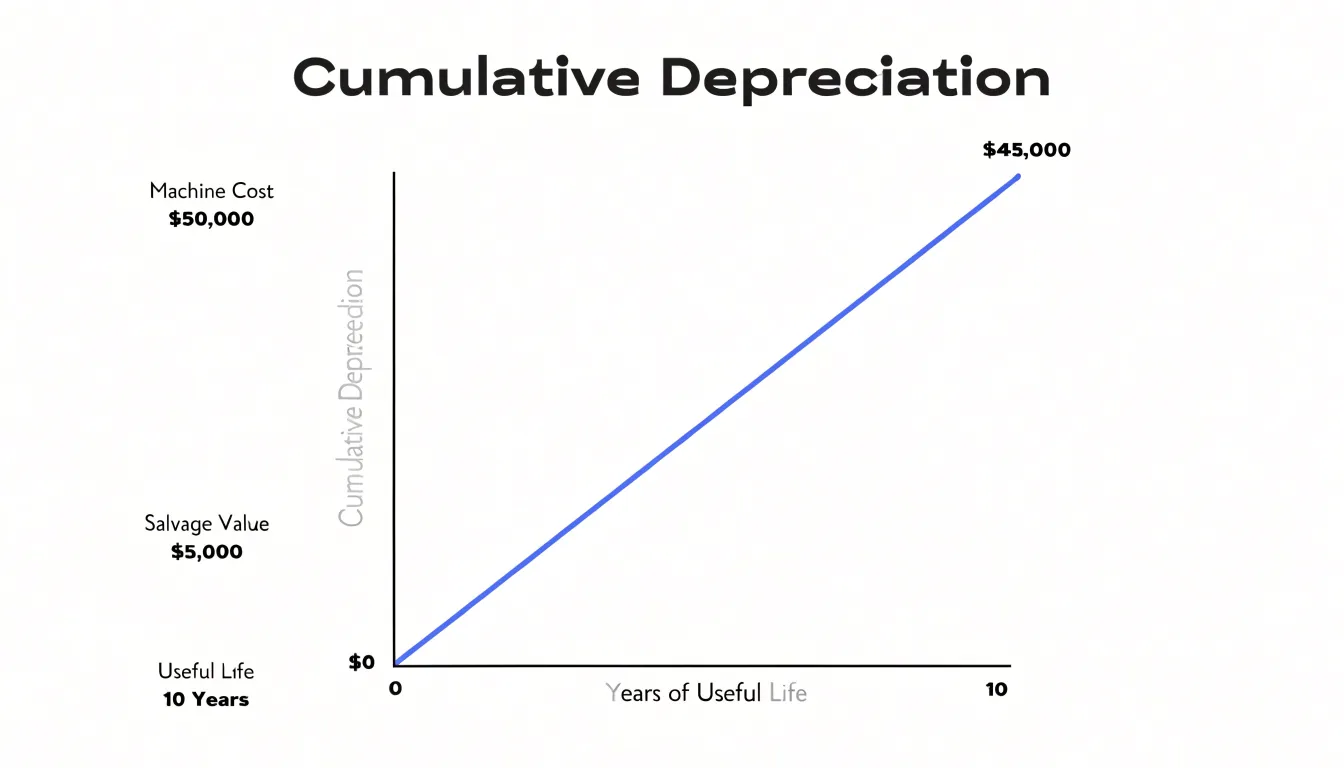
The logic behind spreading the cost evenly rests on the matching principle. An asset contributes revenue across every period of its service, so its cost belongs alongside those revenues rather than being concentrated in the period of purchase. Leveling the expense produces comparable operating results from one year to the next and keeps reported profit from swinging simply because a large purchase happened to fall in a particular period. Because the calculation is simple and the pattern of expense is predictable, straight-line depreciation is the most widely used method in practice, particularly for assets whose economic usefulness declines gradually and steadily, such as furniture, buildings, and many types of equipment.
The contrast with immediate expensing clarifies the purpose of the method. Some purchases, such as office supplies or routine repairs, are consumed in the current period and are recorded as expenses right away. A long-lived asset, by contrast, delivers benefits well into the future, so writing off its entire cost at once would understate profit in the year of purchase and overstate it in later years. Capitalizing the asset and depreciating it over time spreads the recognition of cost in step with the benefits received. The total amount deducted over the asset’s life is the same either way. Straight-line depreciation simply governs the timing, and that timing shapes the financial statements that investors, lenders, and managers rely on.
Key Components
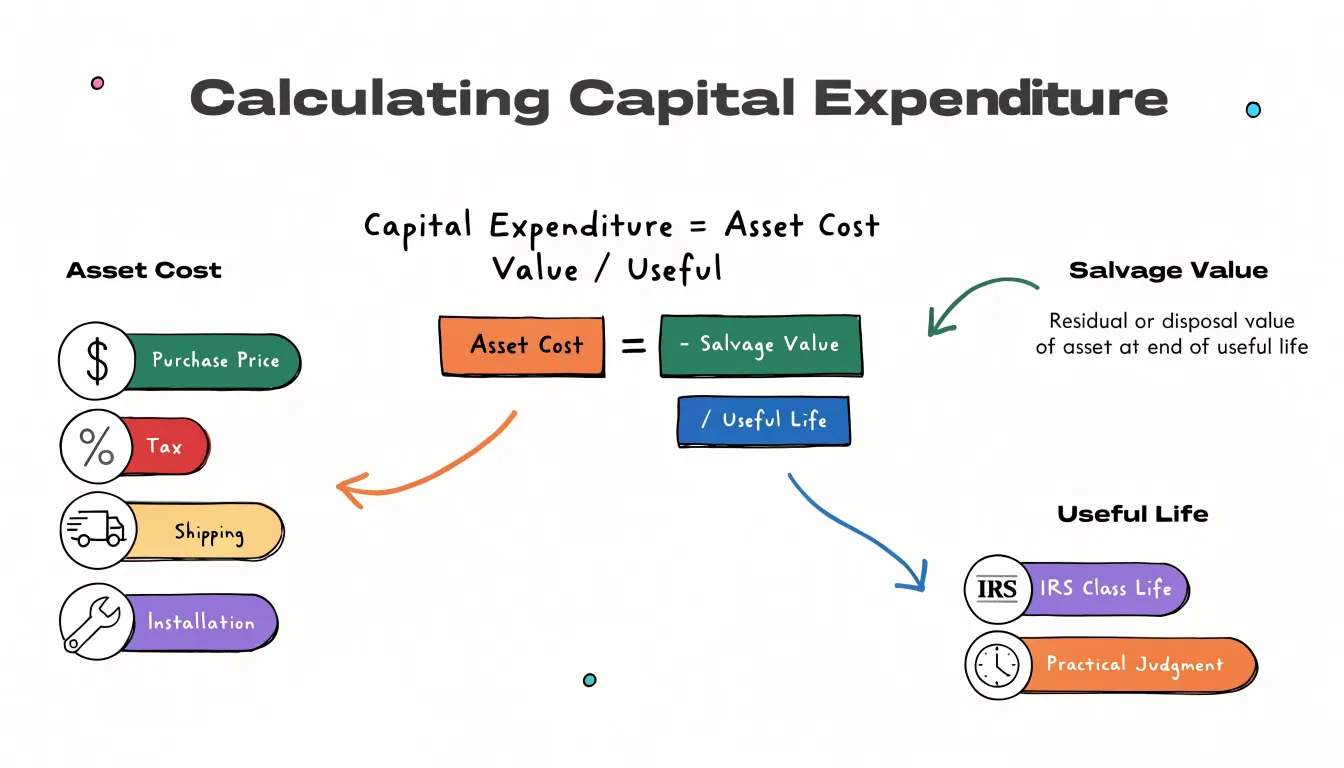
The straight-line depreciation formula rests on three inputs, and each one carries its own meaning and its own estimation challenges. The first is asset cost. This figure includes more than the sticker price. It encompasses everything necessary to bring the asset into service: the purchase price, sales tax, shipping and freight charges, installation fees, and any costs of testing or preparing the asset for its intended use. Costs incurred after the asset is placed in service, such as routine maintenance or repairs, are excluded, since these are treated as operating expenses rather than capitalized amounts. Establishing an accurate cost basis at the outset ensures the depreciation schedule reflects the true capital invested in the asset.
The second component is salvage value, also called residual value. This represents the estimated amount the business could recover by selling or disposing of the asset at the end of its useful life, net of any disposal costs. Determining salvage value requires practical judgment informed by market conditions. A company might review resale prices for similar used equipment, consult dealer trade-in estimates, or examine historical proceeds from prior disposals of comparable assets. A common and conservative convention is to set salvage value at zero, which is permissible under U.S. tax rules and simplifies the calculation while maximizing the depreciable base. Where a meaningful resale market exists, a realistic positive figure avoids overstating annual depreciation.
The third component is useful life, the period over which the asset is expected to provide economic benefit. Two sources of guidance inform this estimate. The first is the IRS, which publishes recovery periods for various asset classes through its Modified Accelerated Cost Recovery System tables and Publication 946. For example, office furniture and computers generally follow five- or seven-year schedules, while certain machinery carries longer periods. The second source is practical judgment about the specific asset and its operating environment. Usage intensity, maintenance practices, technological obsolescence, and industry norms all influence how long an asset remains productive. A delivery truck driven long distances daily will have a shorter realistic life than one used sparingly. Where tax and book treatments diverge, many businesses maintain separate schedules: IRS class lives for tax filings and internally estimated lives for financial reporting. Documenting the reasoning behind each estimate supports consistency and provides a defensible record if the assumptions are later questioned. Together, these three inputs define the depreciable base and the annual expense under the straight-line method.
The Basic Straight Line Depreciation Formula
The basic straight-line depreciation formula is expressed as (Cost − Salvage Value) ÷ Useful Life. Each component carries a specific meaning. Cost refers to the total capitalized amount of the asset, including the purchase price plus any costs necessary to bring the asset to its intended use, such as delivery, installation, and setup fees. Salvage Value, sometimes called residual value, is the estimated amount the company expects to recover at the end of the asset’s service life, either through sale or scrap. Useful Life is the estimated number of years the asset will remain productive for the business. Subtracting salvage value from cost yields the depreciable base, the total amount that will be allocated to expense over the asset’s life. Dividing that base by the useful life spreads the depreciable base evenly across each year of service.
The result of the calculation is the annual depreciation expense, the amount recorded on the income statement each full year of the asset’s life. For example, a machine costing $50,000 with an estimated salvage value of $5,000 and a useful life of nine years produces annual depreciation of ($50,000 − $5,000) ÷ 9 = $5,000. That figure represents the portion of the asset’s cost consumed during a single year of use. Because the charge is identical every year, the pattern of expense is flat, and the asset’s book value declines by the same amount annually until it reaches the salvage value at the end of the useful life.
The same relationship can be expressed as a depreciation rate. Dividing the annual depreciation expense by the depreciable base gives the fraction of the asset’s depreciable cost written off each year. In the example above, $5,000 ÷ $45,000 equals approximately 11.11 percent, which is simply one divided by the nine-year useful life. The rate can therefore be computed directly as 1 ÷ Useful Life, expressed as a percentage. Applying that rate to the depreciable base each year reproduces the same annual expense. Presenting depreciation as a rate is useful for comparing assets with different costs, for building depreciation schedules in spreadsheets, and for communicating the pace at which an asset’s value is being consumed relative to its service life.
Step-by-Step Calculation
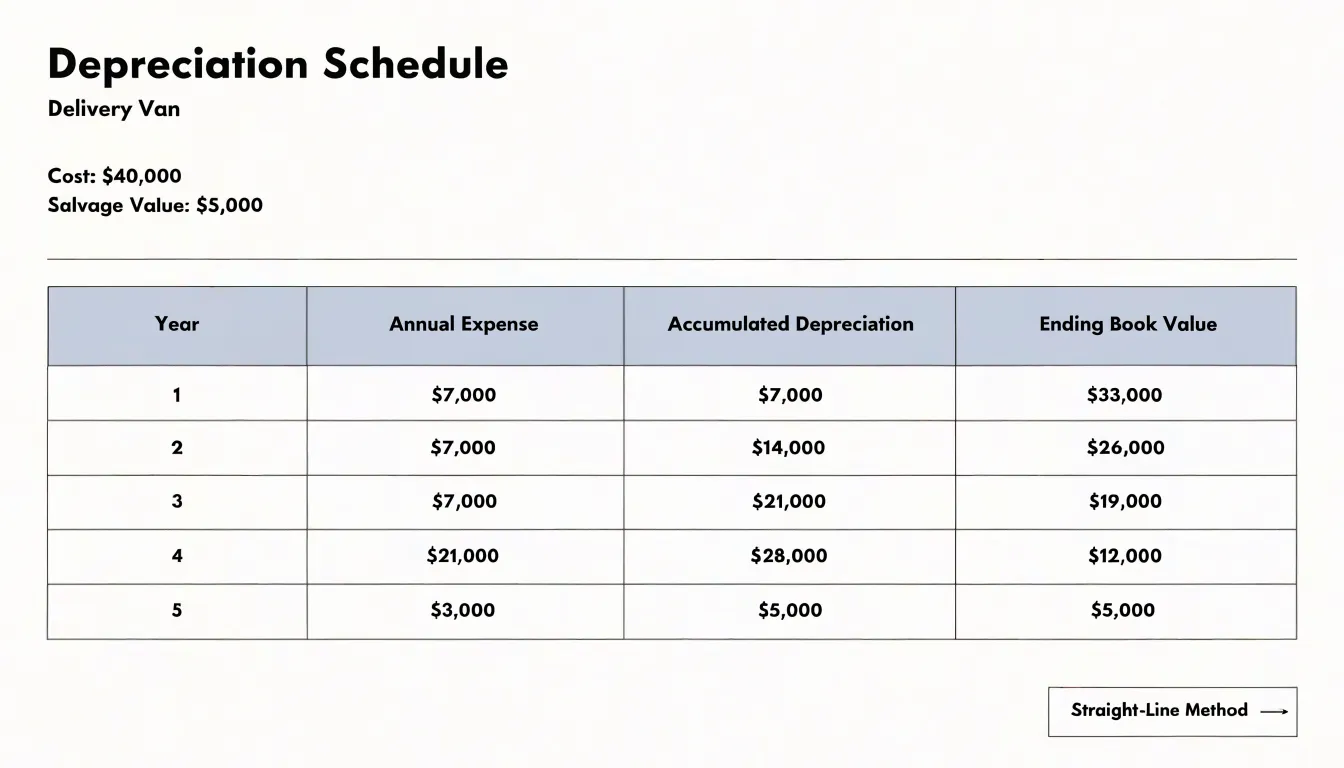
To see how straight-line depreciation works in practice, consider a small distribution company that purchases a delivery van for $40,000. The company expects to use the van for five years, after which it estimates a salvage value of $5,000, the amount it could reasonably recover by selling or trading in the vehicle. The depreciable base is therefore $35,000, calculated as the purchase price minus the salvage value. Dividing that base by the five-year useful life gives an annual depreciation expense of $7,000.
In year one, the company records $7,000 of depreciation expense on its income statement. Accumulated depreciation, the contra-asset account that tracks total depreciation taken to date, rises from zero to $7,000. The van’s book value, meaning its original cost minus accumulated depreciation, falls from $40,000 to $33,000. On the balance sheet, the company still owns an asset with an original cost of $40,000, but the net carrying amount shown is $33,000.
In year two, another $7,000 is expensed. Accumulated depreciation reaches $14,000, and book value drops to $26,000. Year three brings accumulated depreciation to $21,000 and a book value of $19,000. In year four, accumulated depreciation totals $28,000 and book value stands at $12,000. By the end of year five, accumulated depreciation equals the full $35,000 depreciable base, and book value settles at the $5,000 salvage value. The asset has been fully depreciated down to its expected residual worth, and no further depreciation expense is recorded in subsequent years as long as the van remains in use.
Presenting this as a simple table with columns for year, annual expense, accumulated depreciation, and ending book value makes the pattern easy to follow. Each year the expense stays constant, while accumulated depreciation grows and book value shrinks by the same $7,000. This consistency is the defining feature of the straight-line method and makes it straightforward for business owners to forecast depreciation costs across the asset’s life.
How to Record Depreciation Entries in Your Accounting Journal
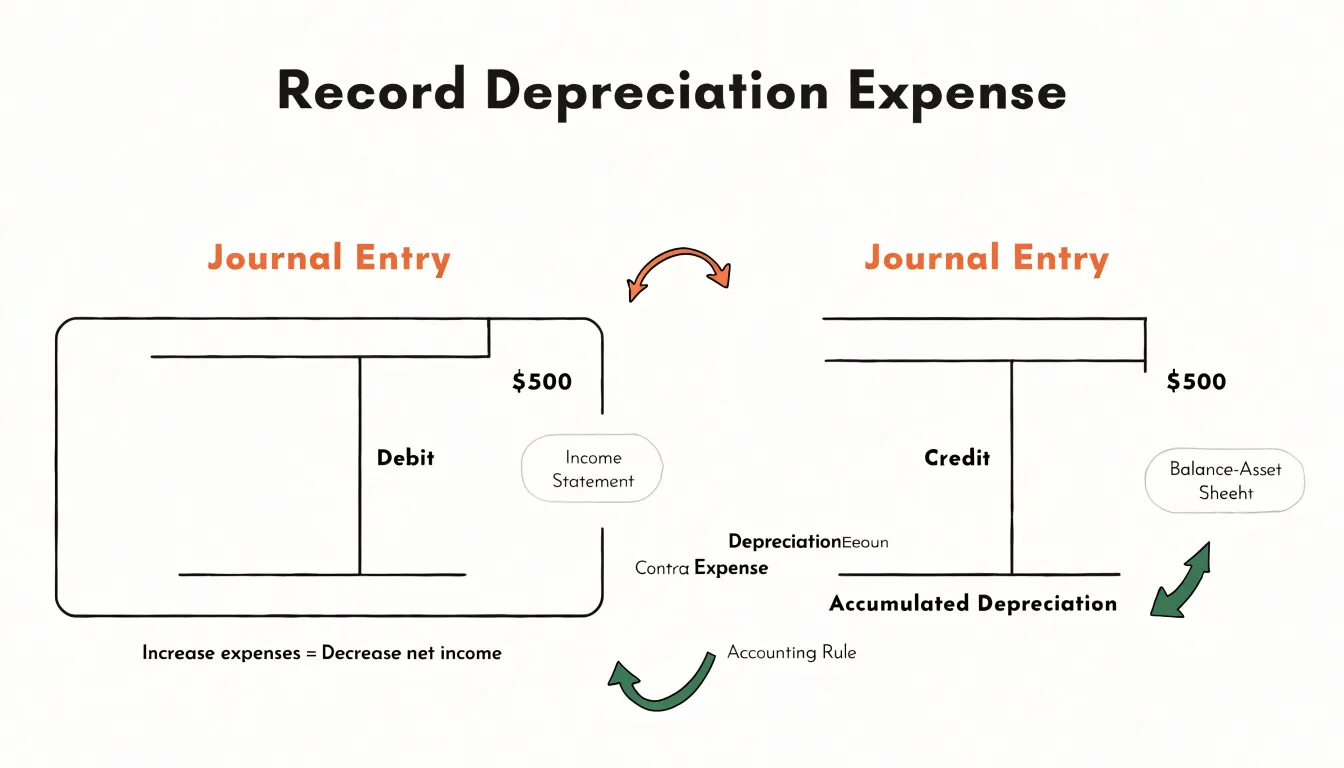
Recording depreciation begins with a journal entry that touches two accounts: a debit to Depreciation Expense and a credit to Accumulated Depreciation. The debit flows into the income statement as an operating expense, reducing net income for the period. The credit lands in a contra-asset account on the balance sheet, where it builds up over the asset’s useful life and is subtracted from the asset’s original cost to arrive at net book value. This split keeps the cost allocation visible on the income statement while preserving the asset’s historical cost on the balance sheet, which is useful for readers who want to see both what was paid for the asset and how much of that cost has been consumed.
The mechanics are straightforward once the accounts are set up. Suppose a company buys equipment for $24,000 with a four-year useful life and no salvage value, producing straight-line depreciation of $500 per month. Each month the entry debits Depreciation Expense for $500 and credits Accumulated Depreciation for $500. After the first year, the income statement shows $6,000 of depreciation expense, and the balance sheet shows the equipment at $24,000 cost less $6,000 accumulated depreciation, for a net book value of $18,000. The cash flow statement is unaffected, since no cash changes hands.
The choice between monthly and annual recording depends on reporting needs. Annual entries are simpler and work well for small businesses that prepare statements once a year. Monthly entries give more timely financial information, keep the general ledger aligned with month-end reporting, and avoid a large year-end adjustment that can distort interim comparisons. Many companies record depreciation monthly through their accounting software, which automates the calculation and posting. Whichever frequency is chosen, the entry should be made consistently and supported by a depreciation schedule that tracks cost, useful life, method, and accumulated depreciation for each asset class, so the figures can be verified at year-end and reconciled during audits.
Comparing Straight Line and Accelerated Depreciation Methods
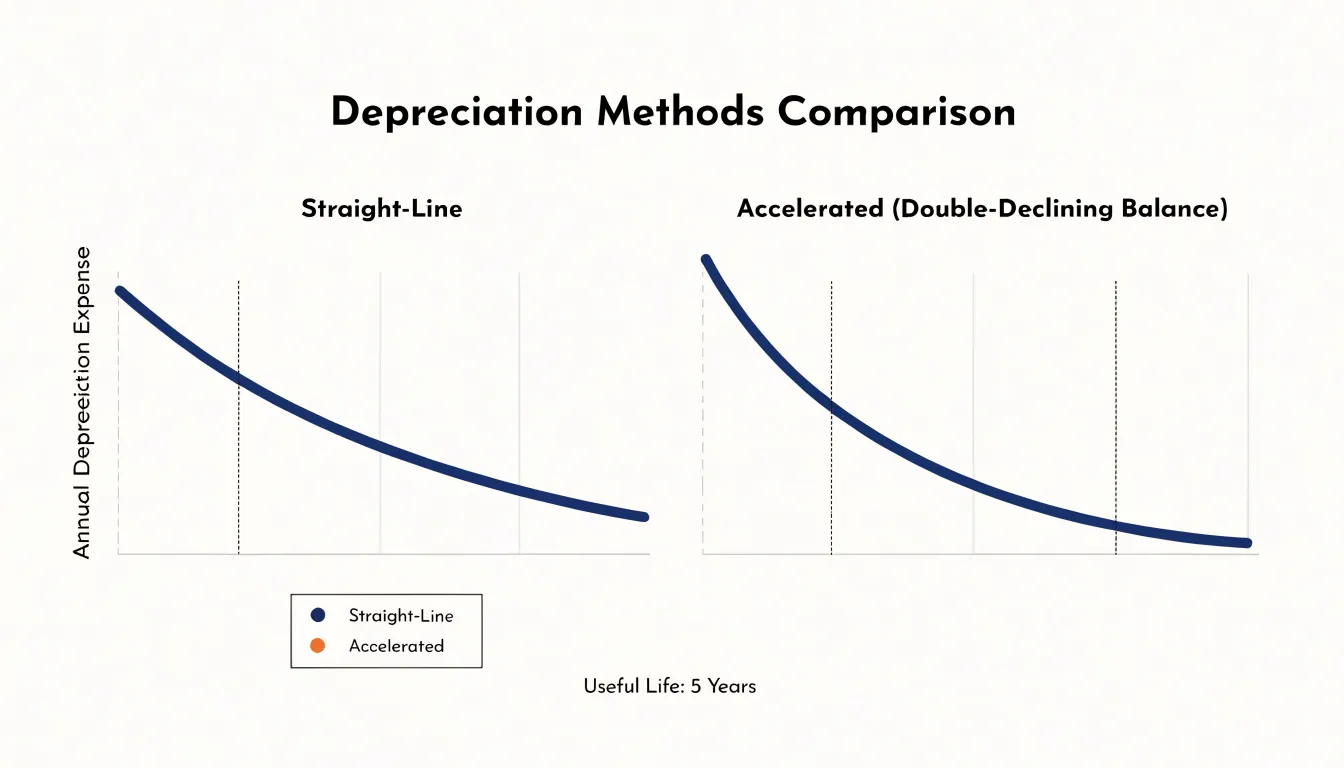
When comparing straight-line depreciation with accelerated methods such as double-declining balance and sum-of-the-years’-digits, the key distinction lies in the timing of expense recognition. Straight-line depreciation allocates the cost of an asset evenly over its useful life, resulting in a constant annual expense. In contrast, accelerated methods front-load depreciation, recognizing larger expenses in the early years and smaller ones later. Double-declining balance applies a constant rate—twice the straight-line rate—to the asset’s declining book value, producing a decreasing expense pattern. Sum-of-the-years’-digits multiplies the depreciable base by a fraction that decreases each year, also yielding higher early expenses. Both accelerated methods reduce reported net income more in the early years, which can lower tax liabilities if the method aligns with tax regulations. The choice between straight-line and accelerated methods often depends on the nature of the asset and financial reporting objectives. Straight-line is preferable for assets that provide relatively consistent benefits over time, such as buildings or office furniture, and it simplifies planning because the expense is predictable. Accelerated methods are better suited for assets that lose value quickly or become obsolete, such as technology equipment or vehicles, as they match higher depreciation with the higher revenue-generating capacity typically seen in early years. Additionally, companies may choose accelerated methods to defer taxes, although this can create a mismatch with financial reporting if different methods are used for book and tax purposes. Ultimately, the decision hinges on how well the chosen method reflects the asset’s actual usage pattern and the company’s strategic financial goals.
Tax Implications
Tax depreciation follows a separate set of rules from the book depreciation reported on financial statements, and understanding this divide is essential for any business that owns depreciable assets. Book depreciation aims to allocate an asset’s cost over its useful life in a way that fairly represents economic reality to investors and creditors. Tax depreciation, by contrast, exists to serve public policy: governments use depreciation schedules to encourage investment, simplify administration, and collect revenue on a predictable timeline. The two systems therefore often produce different expense figures for the same asset in the same year.
The centerpiece of the U.S. tax system for depreciation is the Modified Accelerated Cost Recovery System, or MACRS. Introduced in 1986, MACRS assigns assets to recovery periods and prescribes accelerated methods that generally front-load deductions compared with straight-line book depreciation. A piece of machinery might be written off over seven years for book purposes using straight-line, while MACRS might allow larger deductions in the early years. These prescribed lives and methods are set by statute and regulation rather than by management’s judgment about actual useful life.
Two provisions add further flexibility. Section 179 allows businesses to expense a substantial portion of qualifying asset costs immediately, up to annual limits, rather than depreciating them over time. Bonus depreciation provides an additional first-year deduction, historically at 100 percent and now phasing down, for qualifying property. Both can dramatically reduce taxable income in the year of purchase, creating timing differences relative to book records.
Because of these divergences, most businesses maintain two sets of depreciation records: one for financial reporting and one for tax filing. The book records support accurate financial statements, while the tax records support accurate returns and compliance. The gap between the two is tracked as deferred tax assets or liabilities under accounting rules, reflecting taxes that will be paid or saved in future periods. Maintaining both sets demands disciplined recordkeeping, but it is the standard practice that keeps financial reporting transparent and tax filings defensible.
Common Mistakes Small Businesses Make with Asset Depreciation
Small businesses often handle asset depreciation informally, and that informality produces a recurring set of errors that distort financial statements and create tax complications. One of the most common is ignoring salvage value. Many owners simply divide an asset’s full purchase price by its useful life, treating the asset as though it will be worth nothing at the end. When an asset retains meaningful residual value, such as a vehicle or a piece of heavy equipment, depreciating down to zero overstates annual expense in the early years and understates the book value remaining on the balance sheet. A closely related error involves depreciating land. Land is not a wasting asset and cannot be depreciated under standard accounting rules, yet it frequently gets lumped in with a building purchase as a single line item. A business that buys a property for a combined price should allocate the cost between land and improvements, then depreciate only the improvements. Failing to do so inflates deductions and invites scrutiny from tax authorities. Choosing the wrong useful life is another frequent problem. Owners sometimes default to a round number or copy an estimate from an unrelated industry rather than consulting IRS tables or realistic usage patterns. A useful life that is too short accelerates expense and overstates early profitability, while one that is too long understates it. Both outcomes mislead anyone reading the financials. Finally, businesses often neglect to adjust depreciation when circumstances change. When an asset is sold, scrapped, or traded in, depreciation must stop as of the disposal date, and any gain or loss must be recognized. When a significant improvement extends an asset’s life or capacity, the cost should be capitalized and depreciated over the revised remaining life rather than expensed immediately. Missing these adjustments leaves stale asset values on the books and produces a depreciation schedule that no longer reflects reality. Establishing a simple fixed asset register with clear policies for salvage value, land allocation, useful life, and disposals goes a long way toward preventing these mistakes.
When Should You Choose Straight Line Over Other Methods
Straight-line depreciation is the preferred choice for assets whose economic benefit is spread evenly across their useful life. Office furniture, buildings, and standard machinery tend to generate value in a consistent pattern, and a straight-line method reflects that reality by allocating an equal depreciation expense to each accounting period. When the benefit an asset delivers does not spike in early years or trail off sharply near the end of its life, an even allocation gives readers of the financial statements a clear picture of how the asset contributes to operations over time.
The method also shines when bookkeeping simplicity matters. Small businesses and teams without dedicated accounting staff benefit from a single, predictable calculation: cost minus salvage value, divided by useful life. There are no accelerated tables to consult, no cumulative adjustments to track, and no need to reassess declining balances each year. This simplicity reduces the risk of calculation errors, keeps depreciation schedules easy to audit, and makes it straightforward to train new staff on how the books are maintained. For organizations with limited resources, that operational ease is a genuine advantage.
Straight-line also fits best when it more closely matches the revenue an asset helps generate. If an asset supports a steady stream of income across many periods, charging an equal depreciation amount against that income creates a consistent pattern in the profit and loss statement. This matching supports comparability between periods and gives managers a stable basis for margin analysis and budgeting.
Alternatives deserve consideration in specific circumstances. Assets that lose value quickly or deliver most of their benefit in the early years, such as computers and other technology equipment, may be better served by an accelerated method that front-loads expense. Where tax rules favor faster write-offs, declining balance or sum-of-the-years’-digits approaches can produce a better after-tax result. Assets that are used unevenly, with output varying year to year, may warrant a units-of-production method tied to actual usage. The decision ultimately rests on the pattern of benefit, the reporting goals of the business, and the practical capacity of the accounting function.
Frequently Asked Questions
What is straight-line depreciation and how does it work?
Straight-line depreciation is an accounting method that allocates the cost of a fixed asset across the years the business expects to use it. It divides the depreciable base—original cost minus estimated salvage value—by the asset’s useful life, producing a fixed depreciation expense each accounting period.
What is the straight-line depreciation formula?
The basic formula is (Cost − Salvage Value) ÷ Useful Life. Cost is the total capitalized amount, salvage value is the estimated amount recoverable at the end of the asset’s service life, and useful life is the estimated number of years the asset will remain productive.
How do you record straight-line depreciation in the accounting journal?
Record it with a debit to Depreciation Expense and a credit to Accumulated Depreciation. The debit reduces net income as an operating expense, while the credit builds a contra-asset account that is subtracted from the asset’s original cost on the balance sheet.
What is the difference between straight-line and accelerated depreciation?
Straight-line depreciation allocates an asset’s cost evenly over its useful life, producing a constant annual expense. Accelerated methods such as double-declining balance and sum-of-the-years’-digits front-load depreciation, recognizing larger expenses in the early years and smaller ones later.
How does tax depreciation differ from book depreciation?
Book depreciation aims to allocate an asset’s cost over its useful life for financial reporting, while tax depreciation follows separate rules such as MACRS and may use accelerated methods. Because the two systems often produce different expense figures, most businesses maintain separate book and tax depreciation records.
What common depreciation mistakes do small businesses make?
Common mistakes include ignoring salvage value, depreciating land, choosing the wrong useful life, and failing to adjust depreciation when an asset is sold, scrapped, or significantly improved. Land cannot be depreciated under standard accounting rules, so a combined property purchase should allocate cost between land and improvements and depreciate only the improvements.