
The Accounting Equation Explained (With Examples)
The accounting equation states that Assets = Liabilities + Equity, meaning everything a business owns is funded by either debt or owner claims. Assets are resources with future value, liabilities are outside obligations, and equity is the owner’s residual interest. Every transaction keeps both sides equal through double-entry bookkeeping, where debits must equal credits.
Table of Contents
- What makes the accounting equation the foundation of modern bookkeeping
- Assets, liabilities, and equity
- What counts as an asset on your business balance sheet
- Understanding liabilities and what your business owes to others
- Owner equity
- Why both sides of the accounting equation must always stay equal
- Real world example
- How earning revenue and paying expenses impact owner equity
- The expanded accounting equation for tracking daily business operations
- How the accounting equation connects directly to your balance sheet
- How to spot bookkeeping errors when your equation does not balance
What makes the accounting equation the foundation of modern bookkeeping
The accounting equation, commonly written as Assets = Liabilities + Equity, is the organizing principle that gives modern bookkeeping its structure and internal logic. Every account a business maintains finds a home somewhere within this framework. Assets represent the resources a company controls, from cash and inventory to equipment and receivables. Liabilities capture obligations owed to outside parties, such as loans, supplier invoices, and taxes payable. Equity holds the residual interest of the owners, comprising contributed capital and retained earnings accumulated over time. Because these three categories encompass every possible financial event, the equation functions as a complete map of a company’s financial position at any given moment.
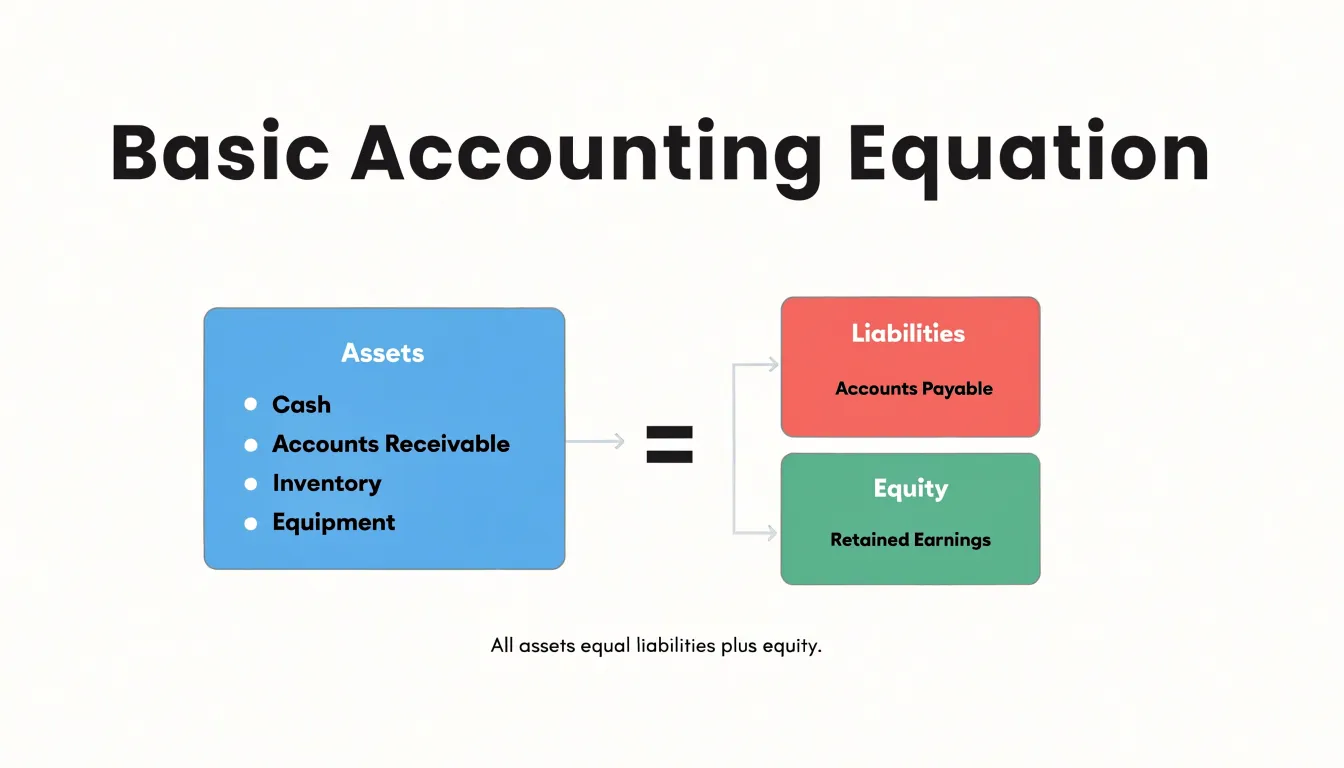
Double-entry bookkeeping rests directly on this relationship. Each transaction is recorded in at least two accounts, and the amounts entered as debits must equal the amounts entered as credits. This rule reflects the equation itself: if one side of the balance sheet grows, the other side must grow equally, or one asset must decrease to offset another. Purchasing equipment with cash, for example, shifts value between two asset accounts without altering the total. Taking out a bank loan increases both cash and liabilities by the same amount. Selling goods on credit raises receivables and equity together. In every case, the equality holds, and that equality is the mechanism that keeps the books internally consistent.
This balancing requirement is what makes reliable records possible. Because every transaction has a corresponding entry, errors tend to surface quickly: a trial balance will reveal any imbalance, prompting investigation before problems compound. The self-checking nature of double-entry bookkeeping gives business owners and auditors confidence that the records reflect reality with reasonable accuracy.
The equation also underpins the financial statements. The balance sheet is a direct presentation of the equation at a point in time. The income statement connects through retained earnings, since profit increases equity, while the cash flow statement explains movements in the cash asset. Together, these statements tell a coherent story anchored in the same underlying logic, which is why the accounting equation is rightly regarded as the foundation of the entire system.
Assets, liabilities, and equity
Every set of financial records rests on three foundational elements: assets, liabilities, and equity. Understanding what each one captures gives you the vocabulary to read any balance sheet with confidence.
Assets are the resources a business owns or controls that carry measurable economic value. They include cash in the bank, accounts receivable owed by customers, inventory waiting to be sold, equipment, vehicles, buildings, and intangible items such as patents or goodwill. The common thread is that an asset is expected to provide future benefit, whether by generating revenue, saving costs, or supporting daily operations.
Liabilities represent what the business owes to outside parties. They include loans and lines of credit, accounts payable to suppliers, wages owed to employees, taxes due, rent obligations, and customer deposits for goods not yet delivered. A liability is a present obligation that will require a future outflow of resources, usually cash, to settle.
Equity, sometimes called owner’s equity or net assets, is the residual interest that remains for the owners after liabilities are subtracted from assets. It grows when the business earns profits or when owners contribute capital, and it shrinks when the business incurs losses or distributes funds to owners. In a company, equity appears as share capital plus retained earnings.
The three elements connect through a simple relationship: assets equal liabilities plus equity. Assets show what the business has; liabilities and equity show who financed those assets. Creditors hold a claim through liabilities, and owners hold a claim through equity. Every transaction affects at least two of the three elements, which keeps the relationship in balance at all times.
Quick reference:
Assets: cash, accounts receivable, inventory, prepaid expenses, property, plant, equipment, investments, intangibles.
Liabilities: accounts payable, short-term and long-term loans, accrued expenses, taxes payable, unearned revenue, bonds payable.
Equity: owner contributions, share capital, retained earnings, drawing or dividend accounts.
Keep this summary nearby as a working checklist. When you encounter an unfamiliar account, ask three questions: does it provide future benefit, does it create a future obligation, or does it represent the owners’ residual stake? The answer places it in the right category.
What counts as an asset on your business balance sheet
An asset is any resource your business owns or controls that has measurable economic value and is expected to provide future benefit. On the balance sheet, assets are typically divided into two categories: current and fixed. Current assets are those you expect to convert into cash, use up, or sell within a normal operating cycle, usually one year. They include cash and cash equivalents, accounts receivable (money owed by customers), inventory (goods held for sale or raw materials), and short-term investments. These are the liquid resources that keep day-to-day operations running.
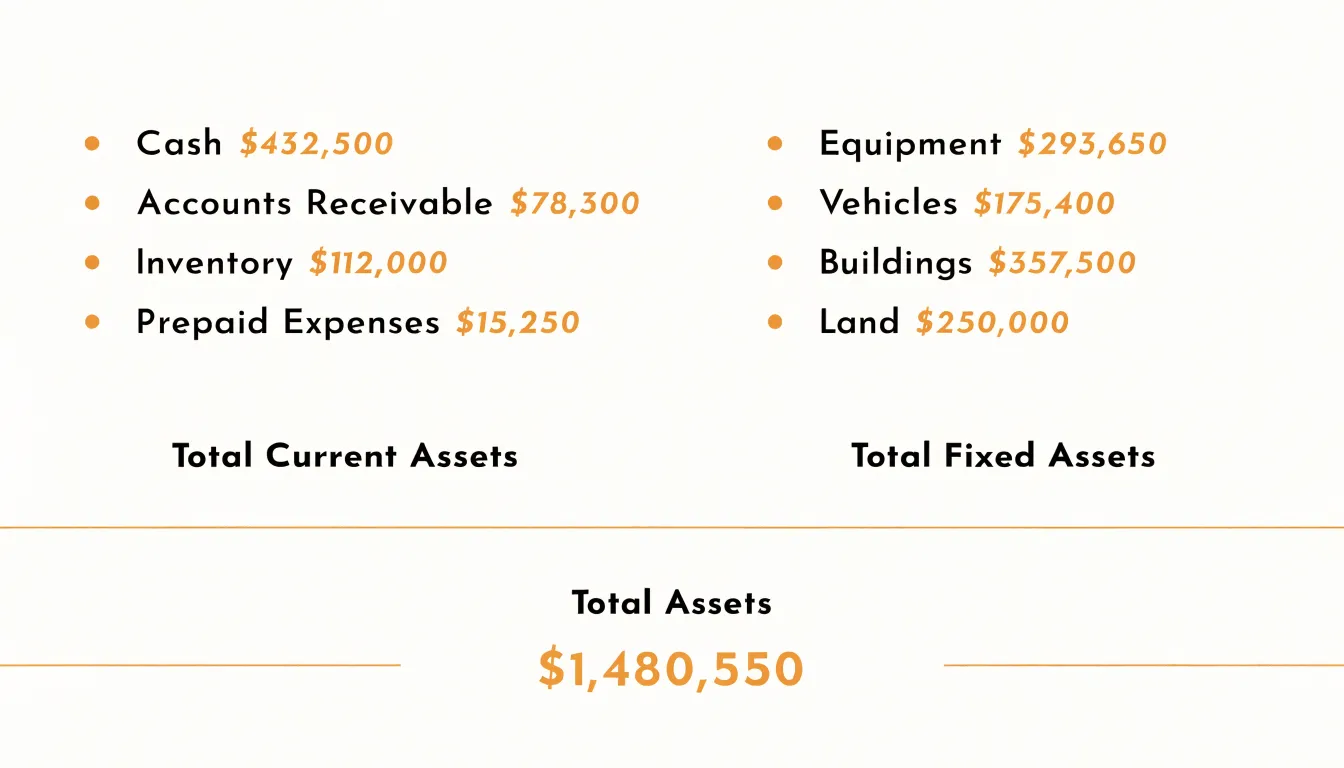
Fixed assets, also called non-current or long-term assets, are resources you intend to use in the business for more than a year. Examples include equipment, machinery, vehicles, buildings, land, and furniture. Unlike current assets, fixed assets are not meant for resale in the ordinary course of business; they support your operations over the long term. Over time, most fixed assets (except land) are depreciated, meaning their cost is gradually expensed on the income statement to reflect wear and tear.
To decide whether something qualifies as an asset, ask three questions. First, does the business own or control it? Control often means legal ownership, but it can also mean the right to use the resource (e.g., a leased asset under certain conditions). Second, does it have measurable value? You must be able to assign a reliable cost or fair value. Third, will it provide future economic benefit? That benefit could be cash inflow, cost savings, or operational support. If all three are true, it’s likely an asset.
Some items are easy to misclassify. For instance, a laptop bought for office use is a fixed asset (if it lasts more than a year), while a laptop bought for resale is inventory (a current asset). Prepaid expenses, like prepaid rent or insurance, are current assets because they represent future benefits already paid for. Conversely, an expense like monthly rent is not an asset because its benefit is consumed immediately.
Properly identifying assets ensures your balance sheet accurately reflects what your business owns and helps you make informed decisions about liquidity, investment, and financing.
Understanding liabilities and what your business owes to others
Liabilities represent everything a business owes to outside parties, and understanding them begins with the distinction between current and long-term obligations. Current liabilities are debts and obligations due within one year, such as accounts payable, short-term loans, accrued expenses, and taxes owed. Long-term liabilities extend beyond that twelve-month window and typically include mortgages, long-term bank loans, and bonds issued to investors. This classification matters because it tells you what cash the business will need to part with in the near future and what obligations can be managed over a longer horizon.
Common examples make the concept concrete. Accounts payable covers money owed to suppliers for goods or services already received, such as inventory purchased on credit. Accrued expenses capture costs that have been incurred but not yet paid, including wages earned by employees, interest on loans, and utilities consumed during the period. Loans, whether a short-term line of credit or a multi-year term loan, represent borrowed funds that must be repaid with interest. Each of these items sits on the balance sheet as a claim against the business and reduces the owner’s equity in the accounting equation.
Tracking liabilities accurately is essential for cash flow management. A business can show a healthy profit on paper while still running into trouble if it fails to anticipate when payments come due. Monitoring accounts payable helps you time supplier payments without straining the bank balance, while keeping an eye on accrued expenses prevents surprises such as payroll or tax obligations arriving unexpectedly. Long-term debt schedules reveal future interest and principal commitments, allowing you to plan for refinancing or reserve cash in advance.
Accurate liability tracking also supports better decision-making. When you know precisely what the business owes and when, you can negotiate payment terms with suppliers, evaluate whether new borrowing is affordable, and maintain a clear picture of liquidity. Lenders and investors review liability figures closely to assess risk, so reliable records build confidence. In short, liabilities shape the financial health of any business, and disciplined tracking keeps cash flowing smoothly while obligations remain under control.
Owner equity
Owner equity represents the residual interest that an owner holds in a business after all obligations to outside parties have been settled. It is calculated as total assets minus total liabilities, and that simple subtraction captures something fundamental: the portion of the business that genuinely belongs to its owners. If a company holds $500,000 in assets and carries $300,000 in liabilities, the owner equity stands at $200,000. This figure acts as a running scoreboard of the owner’s financial stake, and it shifts whenever the business engages in transactions that affect assets, liabilities, or the owner’s relationship with the enterprise.
Several forces push equity upward. Owner contributions, such as injecting cash or transferring personal property into the business, directly increase the stake. Profits earned through operations also raise equity, because revenue left after expenses adds to the assets the business controls without creating new obligations. Conversely, owner draws or distributions reduce equity by pulling value out of the business for personal use. Losses accomplish the same reduction, since expenses exceeding revenue deplete the asset base while liabilities remain. Each of these movements feeds directly into the accounting equation and keeps the balance between assets, liabilities, and equity intact.
Reading owner equity as a health indicator requires attention to context. A steadily rising equity balance suggests the business is generating profit or receiving capital infusions faster than it distributes value, which points toward long-term stability and the capacity to absorb shocks. A declining balance can signal recurring losses, heavy owner withdrawals, or mounting debt relative to assets. Lenders and investors often examine equity in proportion to total assets, since a thicker equity cushion means the business relies less on borrowed money and carries lower financial risk. Equity also reveals how much of the enterprise is truly self-funded. For a small business owner, tracking this figure over time provides a clear view of whether the venture is building lasting worth or quietly eroding the owner’s position, making it one of the most practical measures available for judging financial direction.
Why both sides of the accounting equation must always stay equal
The accounting equation — Assets = Liabilities + Equity — works as a self-checking system because of the double-entry principle. Every business transaction touches at least two accounts, and the amounts recorded on each side are designed to offset each other exactly. This is why the two sides of the equation remain in balance after every single entry, no matter how many transactions a business records.
The mechanic behind this is the debit and credit system. A debit is simply an entry on the left side of an account, and a credit is an entry on the right side. Whether a debit increases or decreases a given account depends on the type of account: assets and expenses rise with debits, while liabilities, equity, and revenue rise with credits. The one rule that never changes is that total debits must equal total credits for every transaction.
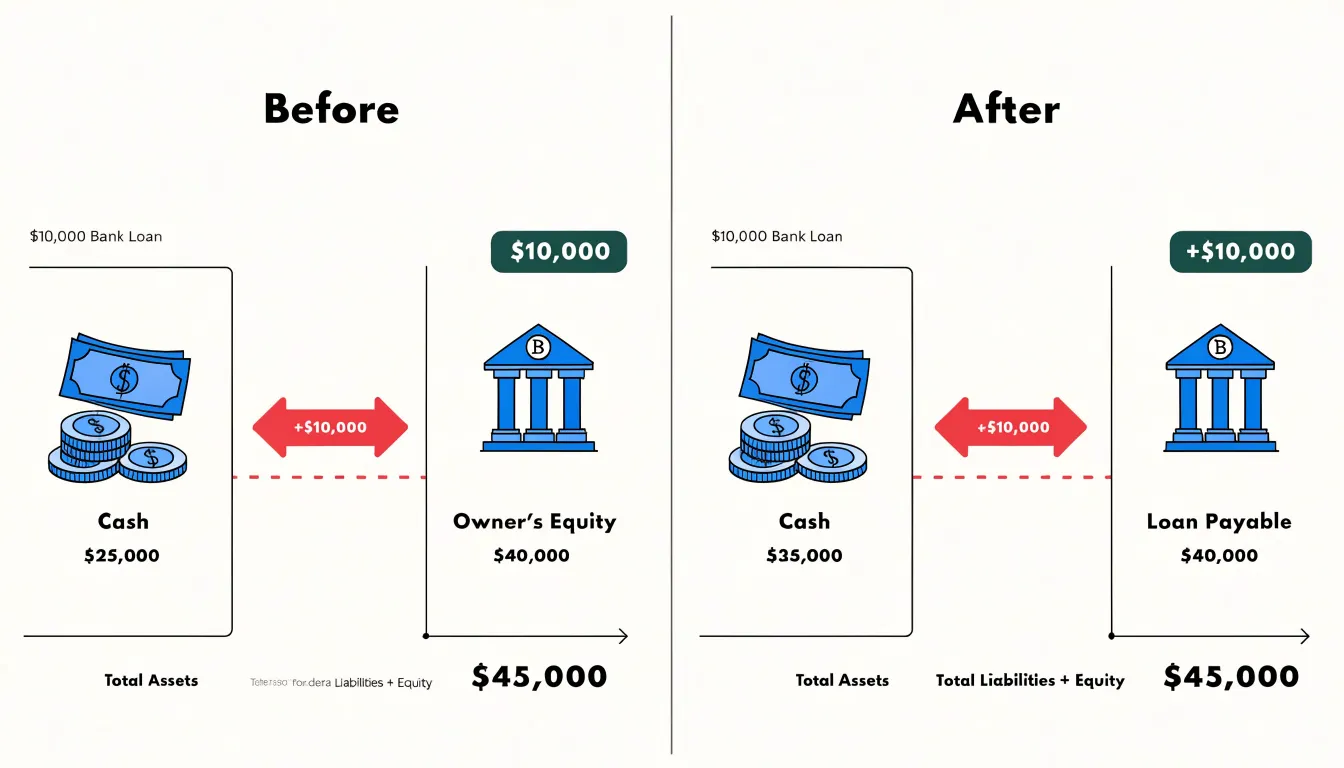
Consider a simple illustration. A business takes out a $10,000 bank loan. The cash account, an asset, increases by $10,000, which is recorded as a debit. The loan payable account, a liability, also increases by $10,000, recorded as a credit. On the equation, assets go up by $10,000 and liabilities go up by the same $10,000, so both sides grow equally and the balance holds.
Now suppose the business buys $2,000 of equipment with cash. Equipment, an asset, increases by $2,000, a debit, while cash, also an asset, decreases by $2,000, a credit. Total assets are unchanged because one asset rose while another fell by the same amount. The equation stays in balance without touching liabilities or equity at all.
Each transaction follows this pattern: the changes are recorded in at least two places, and the debit total equals the credit total. Because the equation is a mathematical identity, any entry that keeps debits and credits equal automatically keeps both sides of the equation equal. This built-in equality is what makes the equation a reliable tool for catching errors — if the two sides ever fail to match, an entry has been recorded incorrectly, and the books must be reviewed before reliable reports can be produced.
Real world example
To see how the accounting equation holds up in practice, consider a small business that needs a new piece of equipment costing $10,000. The way that purchase is financed changes which accounts move, even though the equation stays in balance either way.
Suppose the business pays cash. Before the purchase, it holds $50,000 in cash and $40,000 in equipment, giving total assets of $90,000 against $30,000 in liabilities and $60,000 in equity. Paying $10,000 in cash reduces the cash account to $40,000, and the new equipment raises the equipment account to $50,000. Total assets remain $90,000. The cash simply moved from one asset account into another, so liabilities and equity are untouched, and the equation reads $90,000 equals $30,000 plus $60,000 exactly as before.
Now suppose the business buys the same equipment on credit, agreeing to pay the supplier within 60 days. Cash stays at $50,000, but equipment rises to $50,000, pushing total assets to $100,000. On the other side, the unpaid supplier bill creates a new liability, accounts payable, which grows from whatever balance it carried to include the $10,000. If liabilities were $30,000 before, they are now $40,000. Equity is unchanged at $60,000, and the equation reads $100,000 equals $40,000 plus $60,000. Both sides of the equation grew by the same amount, so the balance is preserved.
The two scenarios illustrate a useful habit: whenever a transaction is recorded, identify which accounts it touches and confirm that the total change on the asset side matches the total change on the liabilities-and-equity side. A cash purchase swaps one asset for another; a credit purchase adds an asset and a matching obligation. In both cases, the accounting equation remains a reliable check that the books are internally consistent.
How earning revenue and paying expenses impact owner equity
Owner equity represents the residual interest in a business’s assets after liabilities are deducted, and it moves constantly as the business trades. Revenue and expenses are the two everyday forces that drive those movements. When a business earns revenue, it receives value from customers in exchange for goods or services, and that value flows straight into equity because it belongs to the owners. When a business pays expenses, it consumes value in the ordinary course of operations — rent, wages, utilities, supplies — and that consumption reduces equity because resources that would otherwise belong to the owners have been used up. Profit is simply the net of the two: revenue minus expenses. The accounting equation captures this directly, since any increase in assets from revenue, or any decrease in assets from expenses, must be matched by a corresponding change in equity whenever liabilities are unaffected.
Consider a small consulting business. It begins the day with assets of $50,000, liabilities of $20,000, and therefore owner equity of $30,000, so the equation reads $50,000 = $20,000 + $30,000. The business completes a project for a client and bills $8,000, which the client pays immediately. Cash rises to $58,000 and equity rises to $38,000. The equation now reads $58,000 = $20,000 + $38,000. Equity grew by the full amount of the revenue because nothing was owed on the transaction and no expense was recorded against it.
Later the business receives and pays a utility bill of $3,000. Cash falls to $55,000, and equity falls to $35,000. The equation reads $55,000 = $20,000 + $35,000. The net effect of both transactions is that assets rose by $5,000 and equity rose by the same $5,000 — the $8,000 of revenue less the $3,000 of expense. Liabilities were untouched. This illustrates why equity is often described as the accumulated result of every profitable or loss-making transaction, and why the equation always stays in balance: each revenue entry adds to both sides of the ownership claim, and each expense entry removes from both.
The expanded accounting equation for tracking daily business operations
The expanded accounting equation takes the basic framework of Assets = Liabilities + Owner’s Equity and adds the activity accounts that change during daily operations: Assets = Liabilities + Owner’s Equity + Revenue − Expenses − Draws. This version gives you a working formula for the day-to-day life of the business. Every sale, purchase, bill payment, and owner withdrawal feeds into one of these components, so the equation stays balanced while showing exactly which accounts moved and why.
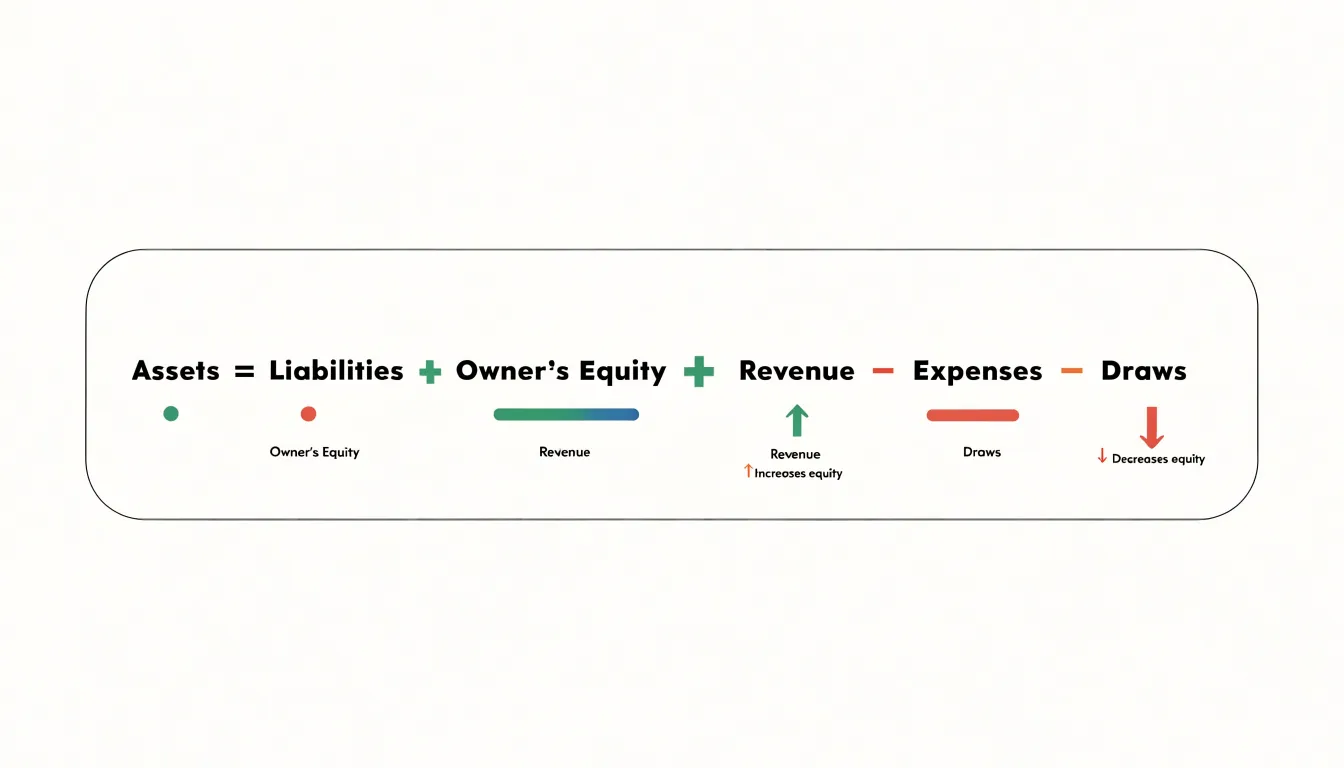
The additional terms capture the flows that build or reduce equity over a period. Revenue increases equity as the business earns income from customers. Expenses decrease equity as costs are consumed to generate that revenue. Draws reduce equity when the owner takes cash or other assets out of the business for personal use. Placing these items directly in the equation lets you see the mechanics of a transaction in one line. When you invoice a client for $2,000, assets rise through accounts receivable and equity rises through revenue. When you pay a $500 utility bill, assets fall through cash and equity falls through expenses. When the owner withdraws $1,000, assets fall and the draws account rises, signaling a reduction in equity.
Tracking operations this way is useful for several practical reasons. It keeps the balance sheet and income statement connected, since profit and owner activity flow straight into equity. It makes the effect of each transaction transparent, which supports accurate bookkeeping and easier review at month-end. It also shows how profitable operations gradually strengthen the financial position, while repeated draws or rising expenses can erode it. By watching the expanded equation over time, you can spot patterns such as revenue growth paired with climbing expenses or steady draws that slow equity accumulation. That visibility supports better decisions about pricing, cost control, and how much the owner can safely take out of the business while still leaving enough capital to operate and grow.
How the accounting equation connects directly to your balance sheet
The balance sheet is the accounting equation written out in full. When you look at the accounting equation, Assets = Liabilities + Equity, you are seeing the underlying logic of the report. The balance sheet takes that same logic and presents it in a structured format with headings, line items, and totals, so the equation becomes a document you can read, share, and analyze. Understanding this connection makes the report far less intimidating, because every number on the page belongs to one of the three parts of the equation.
The assets section occupies one side of the report. It lists everything the business owns or has a right to receive, from cash and inventory to equipment and amounts owed by customers. Each item carries a value, and together they add up to total assets.
The liabilities and equity sections sit on the other side. Liabilities list what the business owes to outside parties, such as supplier invoices, bank loans, and taxes due. Equity shows what remains for the owners after those obligations are accounted for, including invested capital and retained profits. Total liabilities plus total equity must equal total assets, and this equality is the equation at work.
Reading the report at a glance becomes straightforward once you see this structure. Start with total assets to understand the size of the business. Then look at how those assets are funded by comparing liabilities with equity. A company with high liabilities relative to equity is financed largely by outsiders, while one with strong equity relies more on owner capital and accumulated profits. Subtracting total liabilities from total assets gives you equity directly, which is why the equation doubles as a quick analytical tool.
The balance sheet is a snapshot at a single point in time, which makes it a natural fit for the equation. Every transaction shifts amounts between the sections while keeping the two sides in balance, and the finished report captures the cumulative result of all those transactions. Once you recognize the report as a formal presentation of the equation, each section has a clear purpose and the whole document reads as one coherent statement of financial position.
How to spot bookkeeping errors when your equation does not balance
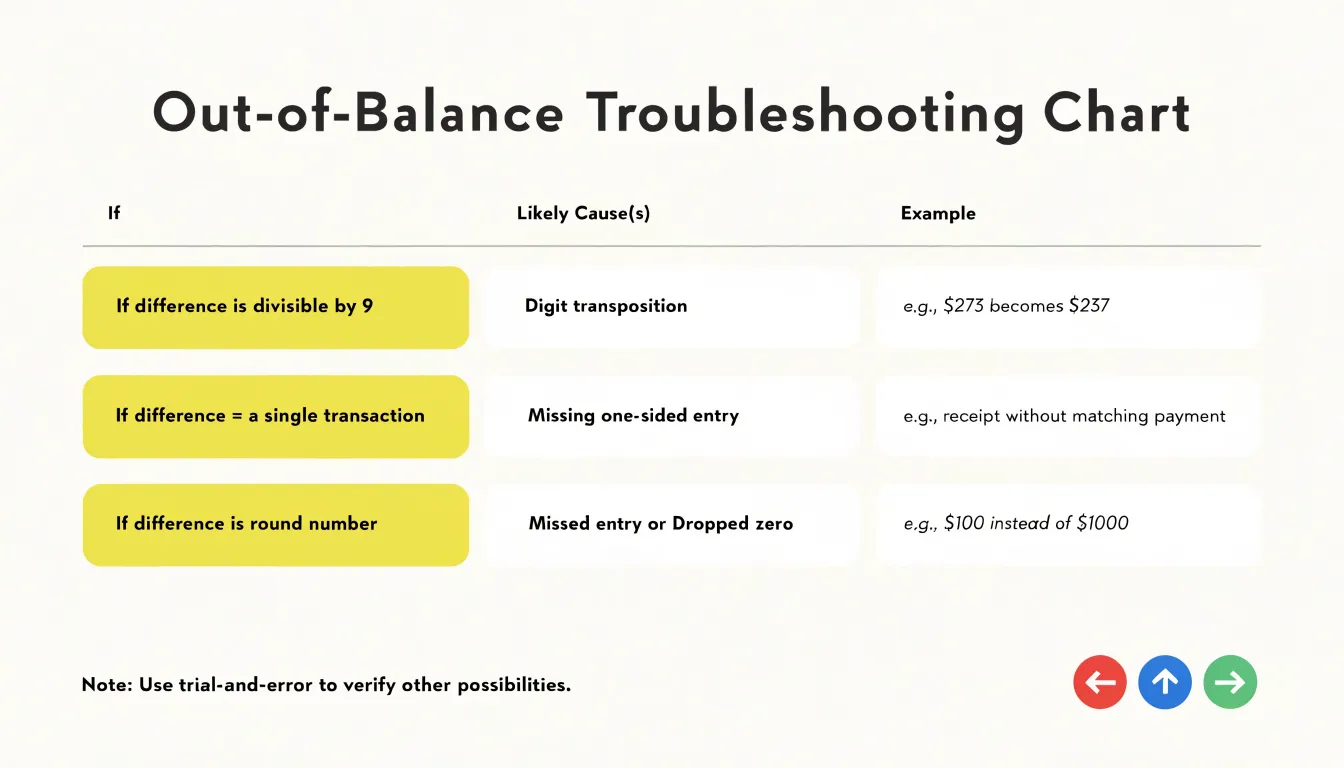
When your accounting equation does not balance, the gap itself is the most useful clue you have. The difference between total assets and the combined total of liabilities and equity tells you the size of the error, and that magnitude often points toward a likely cause. A difference divisible by nine is a classic sign of a transposition, where digits like 45 and 54 were flipped during data entry. A difference that matches a specific transaction amount usually means an entry was recorded on one side but not the other, such as a debit posted without its matching credit. Round-number differences frequently suggest a missed entry or a figure entered with a dropped zero.
Start your troubleshooting with the most recent transactions, since errors tend to cluster near the point where the books last reconciled. Compare each entry against its source document, checking the date, amount, and accounts selected. Look for transactions recorded in the wrong period, payments posted twice, or entries made in a liability account when they belonged in an expense account. Misclassified accounts are common culprits: a cash purchase recorded as a credit sale, or an owner withdrawal coded to an expense, will throw off the equation even though the total money movement is correct.
Work methodically rather than scanning everything at once. Recompute the totals in your trial balance, verify each subsidiary ledger against its control account, and trace the bank balance back to the last statement you reconciled. If the gap persists, try halving the difference, which can reveal an item entered on the wrong side. Keep a written log of what you have checked so you do not repeat steps.
Bring in a professional when the difference is large, when you cannot locate it after a thorough search of a full period, or when the books have gone unreconciled for several months. A bookkeeper or accountant can rebuild the trial balance, identify patterns across periods, and confirm whether the issue is a simple data entry slip or a deeper problem in how transactions are recorded. Early professional help often costs less than weeks of unresolved uncertainty.
Frequently Asked Questions
What is the accounting equation?
The accounting equation is commonly written as Assets = Liabilities + Equity, where assets are resources the business controls, liabilities are obligations to outside parties, and equity is the owners’ residual interest. It functions as a complete map of a company’s financial position at any given moment.
What is the difference between current and fixed assets?
Current assets are expected to be converted into cash, used up, or sold within a normal operating cycle, usually one year, while fixed assets are intended for use in the business for more than a year. Examples of fixed assets include equipment, machinery, vehicles, buildings, land, and furniture.
What are current liabilities versus long-term liabilities?
Current liabilities are debts and obligations due within one year, such as accounts payable, short-term loans, accrued expenses, and taxes owed. Long-term liabilities extend beyond that twelve-month window and typically include mortgages, long-term bank loans, and bonds issued to investors.
How do revenue and expenses affect owner equity?
Revenue increases equity because value received from customers belongs to the owners, while expenses reduce equity because resources are consumed in operations. Profit is revenue minus expenses, and the accounting equation stays in balance as these changes are recorded.
Why does the accounting equation have to stay balanced?
The equation is a self-checking system based on double-entry bookkeeping, where every transaction touches at least two accounts and total debits must equal total credits. Because the equation is a mathematical identity, any entry that keeps debits and credits equal automatically keeps both sides equal.
How does the accounting equation relate to the balance sheet?
The balance sheet is the accounting equation written out in full: it lists assets on one side and liabilities plus equity on the other, and total liabilities plus total equity must equal total assets. Reading it this way helps show how assets are funded by liabilities and equity.