
Trial Balance
A trial balance is an internal bookkeeping report that lists every general ledger account and its ending debit or credit balance, confirming that total debits equal total credits. It is prepared after posting and before financial statements, acts as an arithmetic checkpoint that catches many mechanical errors, but cannot detect omitted, reversed, or misclassified entries.
Table of Contents
- Understanding the Core Purpose of a Trial Balance in Bookkeeping
- How a Trial Balance Fits Into the Accounting Cycle
- Gathering Your General Ledger Balances Before You Begin
- Step by Step Preparation
- Calculating Total Debits and Credits to Verify Accuracy
- What Should You Do When Debits and Credits Do Not Match
- Common Errors That a Trial Balance Will Not Catch
- Trial Balance vs Balance Sheet
Understanding the Core Purpose of a Trial Balance in Bookkeeping
The trial balance exists because double-entry bookkeeping rests on a simple mechanical rule: every transaction records equal debits and equal credits. Each entry touches at least two accounts, and the amounts on each side of the ledger must match. The trial balance takes the closing balances of every account and arranges them in two columns, debits on one side and credits on the other, to confirm that the column totals agree. That agreement is the whole point of the statement. It is an internal check performed by the bookkeeper before any financial statement is drafted, and it answers one question only: do the recorded debits and credits balance?
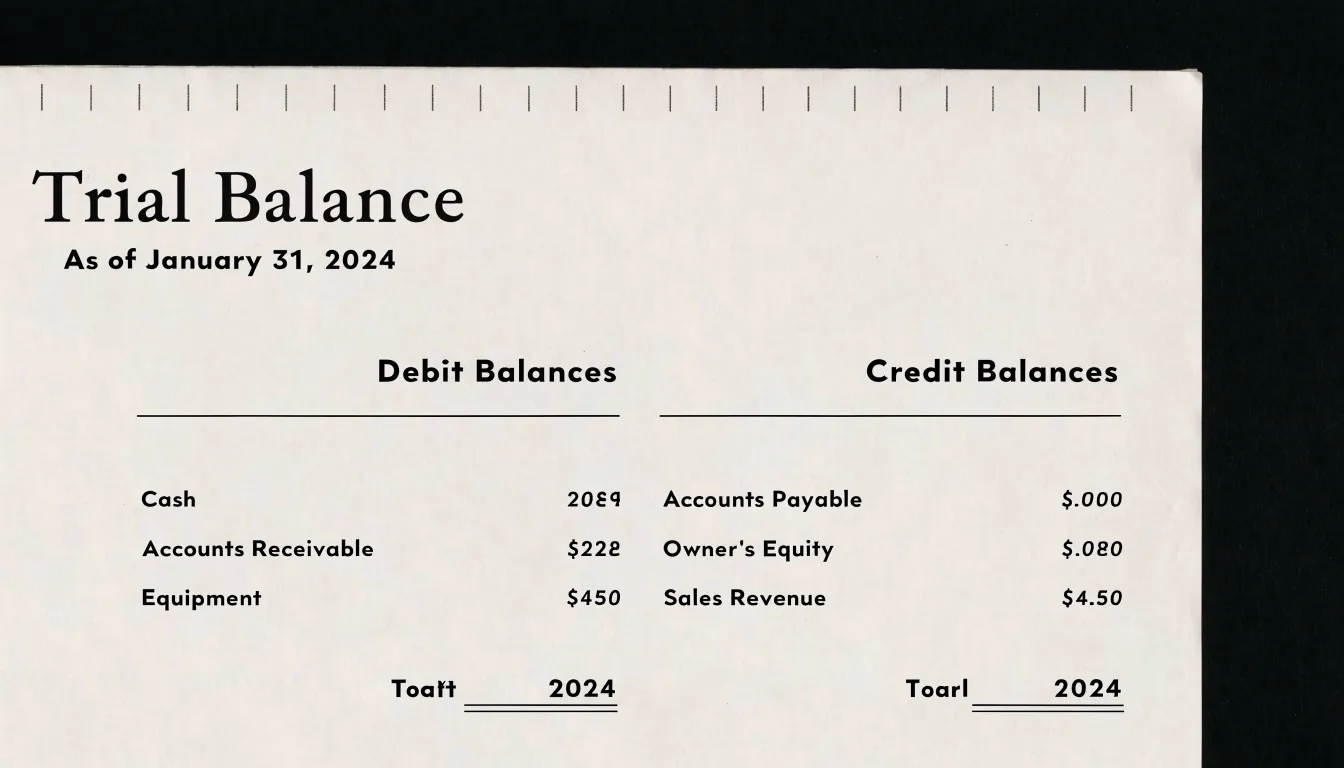
The value of that check lies in how errors accumulate. A transposition while posting an invoice, a figure entered twice, a debit typed into the credit column, or a subtotal carried forward incorrectly will disturb the natural balance of the ledger. When the two columns of the trial balance fail to agree, the bookkeeper knows an error exists somewhere in the recorded entries and can begin tracing it while the records are still fresh. Finding such mistakes at this stage is far simpler than discovering them after the income statement and balance sheet have been prepared and circulated, when a correction means revising figures that others may already have relied upon.
The trial balance also serves as a summarized bridge between the ledger and the financial statements. Its account balances provide the raw figures that flow into the income statement and balance sheet, and its structure confirms those figures are drawn from a complete and internally consistent set of records. Preparing the trial balance forces the bookkeeper to review every account, close out temporary balances, and confirm that nothing has been left unposted.
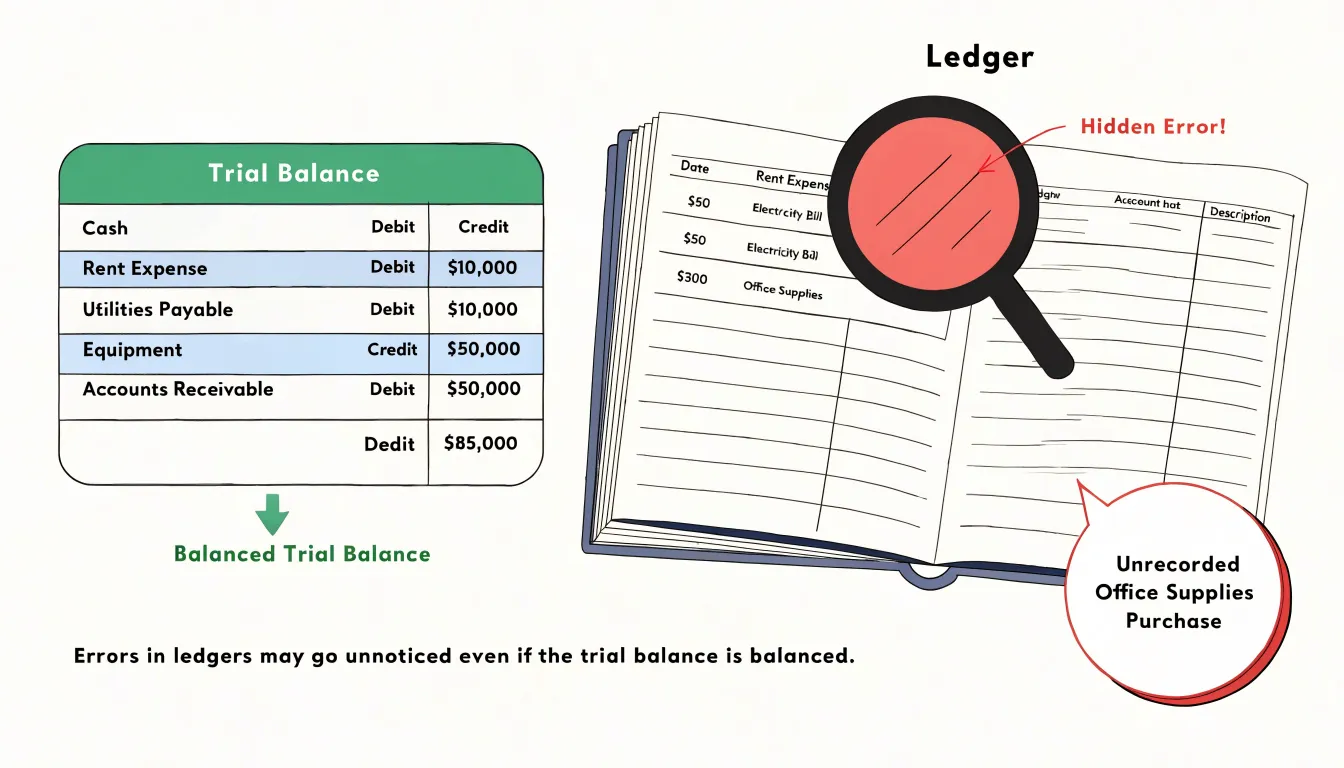
It is important to understand what the check does and does not prove. A balanced trial balance confirms that debits equal credits; it does not confirm that every transaction was recorded correctly. An entry posted to the wrong account, a transaction omitted entirely, or a compensating error of equal size on both sides can leave the columns in agreement while the records remain wrong. The trial balance is therefore a first line of defense, a quick arithmetic safeguard that catches a large share of mechanical mistakes before they travel any further into the reporting process.
How a Trial Balance Fits Into the Accounting Cycle
The accounting cycle is a sequence of steps that moves financial data from raw transactions to finished financial statements, and the trial balance occupies a defined position within that sequence. The cycle begins with the identification of transactions and their recording as journal entries. Each entry is then posted to the general ledger, where every account accumulates a running balance. Once posting for a period is complete, the trial balance is prepared as a summary listing of all ledger accounts along with their debit or credit balances. This listing serves as a checkpoint: because total debits must equal total credits in a double-entry system, the trial balance confirms that the ledger is at least arithmetically consistent before the reporting process moves forward.
The first of the two trial balance stages is the unadjusted trial balance. It is drawn directly from the general ledger as posted, without any period-end adjustments. This unadjusted version gives the accountant a complete picture of account balances and becomes the working document from which adjusting entries are developed. Accruals, deferrals, depreciation, and other adjustments are identified by reviewing the unadjusted balances against supporting records and the requirements of accrual accounting.
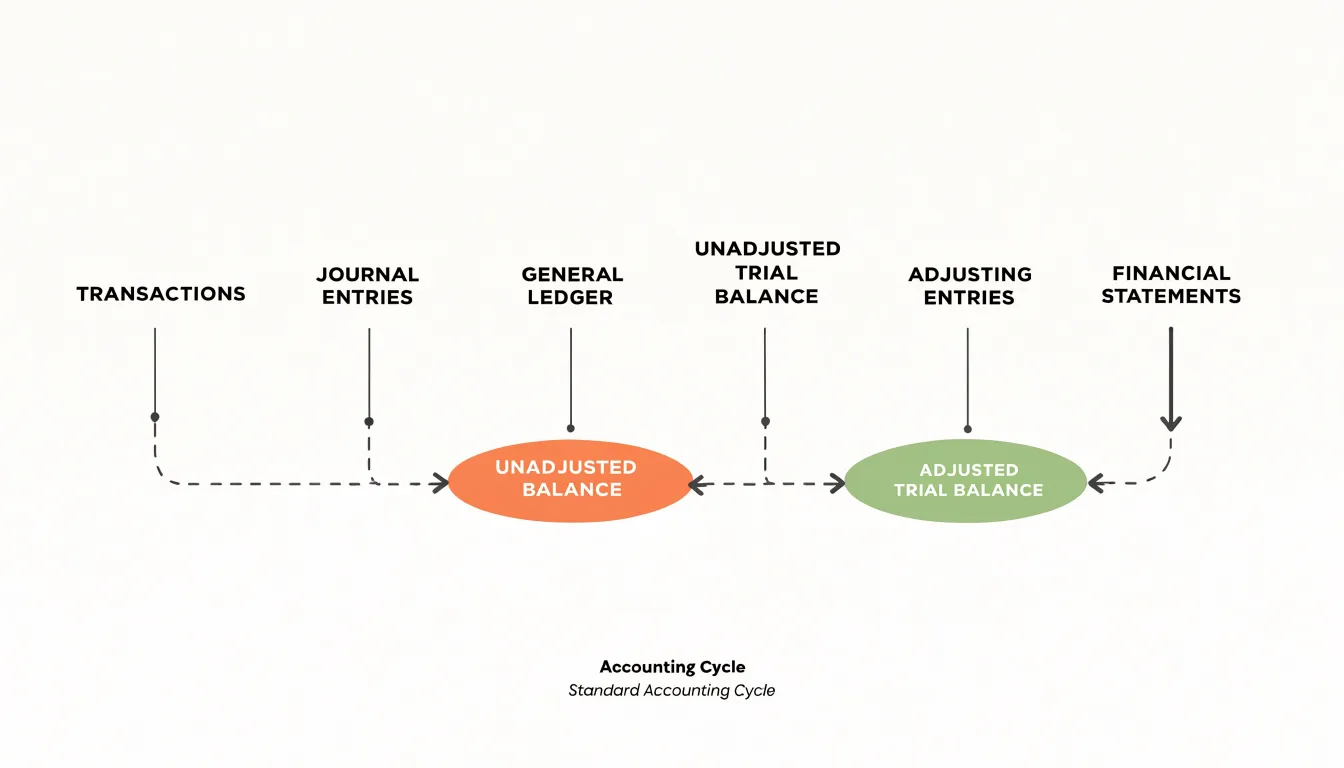
Once those adjusting entries are journalized and posted, a second listing is prepared: the adjusted trial balance. This version reflects every account after period-end adjustments have been incorporated, so revenues are matched to the period in which they were earned and expenses to the period in which they were incurred. The adjusted trial balance is the direct source for the financial statements. The income statement is built from the revenue and expense accounts it contains, while the balance sheet draws on the asset, liability, and equity accounts. The retained earnings figure that appears on the balance sheet is itself derived from the net income shown on the income statement, linking the two reports through figures taken from the adjusted trial balance.
Placing the trial balance between ledger posting and statement preparation gives the cycle a natural control point. Errors caught at the unadjusted stage can be corrected before adjustments complicate the picture, and the adjusted listing provides a final verification that the figures feeding into the income statement and balance sheet are internally balanced.
Gathering Your General Ledger Balances Before You Begin
Before you prepare a trial balance, you need to gather the ending balances from every general ledger account. Start by pulling the closing balance for each account as of the last day of the accounting period you are reporting on. In most accounting systems, you can generate a general ledger detail report or a trial balance preview that lists every account alongside its ending debit or credit balance. Export that listing to a spreadsheet so you can work with the figures directly. If you are working from a manual ledger, total each account’s debit and credit columns and compute the running balance for the period. Take care to include every account in the chart of accounts, even those with zero balances, so the listing is complete and nothing is overlooked.
Next, confirm that the accounting period is closed for new entries. If the period is still open, someone could post a transaction while you are compiling the trial balance, and your figures would no longer match the ledger. Check the period status in your accounting software and verify that all adjusting entries, accruals, and corrections for the period have been recorded and posted. Review the transaction date range on your reports so the balances reflect only activity through the period end. If a late entry does arrive, post it first and regenerate your balances before continuing. Locking the period once you are satisfied prevents accidental changes during the preparation process.
Finally, organize the accounts in a logical order. The conventional arrangement follows the chart of accounts: assets first, then liabilities, equity, revenue, and expenses. Within each category, group accounts by type, such as current and non-current assets, and list them in the same sequence used on your financial statements. Consistent ordering makes the trial balance easier to read, simplifies comparison with prior periods, and helps you trace each figure back to its source. Add columns for account number, account name, debit balance, and credit balance, and total the debit and credit columns at the bottom. With the balances collected, the period closed, and the accounts arranged sensibly, you are ready to begin testing the trial balance for accuracy.
Step by Step Preparation
Preparing a trial balance begins with a clean, ordered listing of every account in the ledger. Working from the chart of accounts or the general ledger, list each account name in a single column, following the standard order: assets first, then liabilities, equity, revenue, and expenses. This ordering mirrors the structure of the financial statements and makes the finished trial balance easier to review. Confirm that no account has been omitted by reconciling the number of listed accounts against the ledger’s account count, and note any accounts with zero balances so their inclusion or exclusion is a deliberate choice.
Next, build the two money columns headed Debit Balances and Credit Balances. For each account, enter the net balance drawn from the ledger as of the trial balance date, placing it in the column that matches its normal balance. Assets carry debit balances and appear in the debit column. Liabilities and equity carry credit balances and appear in the credit column. Revenue accounts normally hold credit balances, reflecting income earned, while expense accounts normally hold debit balances, reflecting costs consumed. Drawing or dividend accounts, where used, take debit balances and reduce equity.
Correct classification rests on understanding what each account represents. An asset is a resource with future economic benefit, such as cash, receivables, inventory, or equipment. A liability is an obligation owed to others, such as payables, accrued expenses, or loans. Equity captures the owners’ residual interest, including capital contributions and retained earnings. Revenue records inflows from delivering goods or services, and expenses record the outflows incurred to generate them. When an account’s balance sits opposite its normal side, such as a debit balance in a liability account, flag it for investigation rather than silently forcing it into the expected column.
Once every account is listed and every balance placed, total both columns. The two totals should agree. A difference signals an error somewhere in the posting or listing process, and the trial balance serves as that checkpoint before any adjusting entries are made.
Calculating Total Debits and Credits to Verify Accuracy
Calculating total debits and credits begins with a careful summation of each column in the trial balance. Working down the debit column, you add every balance listed there, taking care to carry figures correctly and to include all accounts with debit balances, such as assets, drawings, and expenses. The same process applies to the credit column, where you total liabilities, capital, and income accounts. Accuracy at this stage depends on clean transcription from the ledger and on consistent handling of each figure, since a single misplaced digit or omitted line will distort the total. Many bookkeepers re-add each column in the opposite direction as a simple check against addition errors.
Once both totals are calculated, the next step is to compare them side by side. If the debit total equals the credit total, the trial balance is said to balance, and this matched result offers useful evidence that the arithmetic underlying the ledger has been performed consistently. The equality reflects the double-entry principle that every transaction produces equal debit and credit effects, so a balanced trial balance suggests that the mechanical recording of transactions has proceeded without arithmetic slip.
A matched result should be interpreted with care. It signals arithmetic accuracy in the summing and posting process, yet it does not prove that the underlying records are correct. Errors of principle, such as recording a capital expenditure as a revenue expense, leave the totals equal because the wrong accounts still receive equal debits and credits. Compensating errors, where two separate mistakes cancel each other out, and errors of original entry, where an incorrect amount is entered consistently in both accounts, also preserve the balance. Omitting a transaction entirely from the books produces no imbalance either, since neither column is affected.
The matched total therefore functions as a checkpoint rather than a guarantee. It confirms that the columns add up and that debits and credits correspond in amount, which narrows the range of possible mistakes. Interpreting it as proof of correctness overstates what the procedure can deliver, and a sound reading treats the balanced trial balance as one stage in a wider process of verification that includes checking source documents and reviewing account classifications.
What Should You Do When Debits and Credits Do Not Match
When the debit and credit columns of a trial balance refuse to agree, the difference itself becomes a useful diagnostic clue. Begin by recomputing both column totals independently, since a simple addition slip accounts for a surprising share of imbalances. Once the totals are verified, write down the exact amount of the discrepancy and treat it as a fingerprint that points toward specific categories of error.
Dividing the difference by two is a quick and revealing test. If the result matches an entry that appears somewhere in the ledger, the likely culprit is a one-sided posting, where an amount was recorded as a debit without its matching credit, or the reverse. Doubling a single entry inflates one column by exactly that entry’s value, so the gap will equal twice the original figure. Spotting this pattern narrows the search to a single transaction.
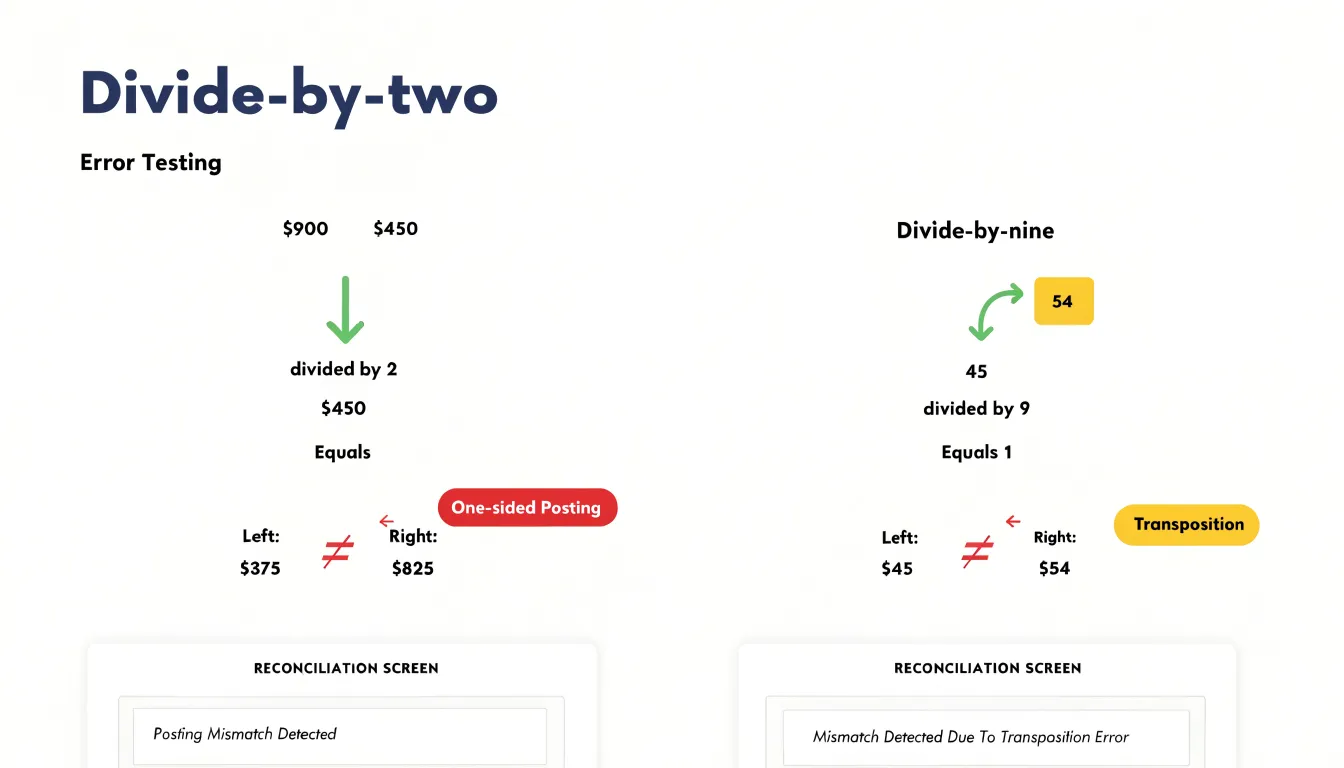
Dividing the difference by nine checks for transposed digits and sliding digits. A misplaced decimal point or a number written with its digits reversed, such as 54 entered as 45, produces a difference that is always divisible by nine. When the division comes out even, scan the ledger for entries whose digits could have been swapped or shifted one place value.
Next, compare the trial balance against the individual account balances to confirm that every balance was carried forward correctly. A figure copied onto the worksheet wrongly will create a discrepancy even when the underlying ledger is sound. Then verify that each transaction was posted to the right side of the right accounts. A debit entered as a credit in a single account throws both columns out of balance by twice the amount, another case where the divide-by-two test helps.
Review the journal for missing entries, particularly around period-end adjustments such as accruals, depreciation, and inventory changes, since unposted adjustments leave one side of a transaction unrecorded. Finally, if the gap remains, halve the search area: check only the transactions above and below the midpoint of the period. Combined with these arithmetic shortcuts, a methodical sweep from totals to ledger to journal will usually isolate the error in far less time than reviewing every entry at random.
Common Errors That a Trial Balance Will Not Catch
A trial balance is a useful checkpoint in the accounting cycle, but its scope is narrower than many people assume. The statement only confirms that total debits equal total credits across the ledger. When the columns agree, the arithmetic is internally consistent, yet a matched pair of columns can still conceal significant bookkeeping mistakes. Several common errors survive the trial balance test precisely because they affect both sides of the entry equally or bypass the ledger entirely.
Recording a transaction in the wrong account is one frequent example. If a business pays a utility bill but the payment is posted to the rent expense account instead of the utilities expense account, the debit and credit still balance. The trial balance totals remain identical, and the error stays invisible until someone reviews the individual expense accounts. Similarly, a sale posted to the wrong customer’s account leaves the accounts receivable control total unchanged while misstating the subsidiary ledger.
Another category involves omitted entries. When a transaction is never recorded at all, there is no debit and no credit to disturb the balance. A purchase of office supplies on credit that is left out of the books entirely will not appear in the trial balance, and the columns will still agree. Duplicate entries behave the same way. If an invoice is entered twice, both the debit and the credit are doubled, so the totals stay equal while the affected accounts are overstated by the same amount.
Errors of reversal can also slip through. If the debit and credit are swapped, or if a transposition such as recording 540 instead of 450 occurs in a single account with an offsetting mistake elsewhere, the totals may still match. Compensating errors, where two separate mistakes cancel each other out, produce the same result.
The underlying reason is that a trial balance tests only one property of the ledger: the equality of debits and credits. It cannot test whether entries are complete, correctly classified, properly timed, or free of duplication. A balanced trial balance is therefore a starting point for verification, not proof of accuracy. Accountants rely on subsidiary ledgers, reconciliations, and detailed review to catch the errors that arithmetic alone will never reveal.
Trial Balance vs Balance Sheet
The trial balance and the balance sheet occupy distinct positions within the accounting cycle, and understanding their differences helps anyone reading financial records interpret them correctly. The trial balance is an internal working document prepared by bookkeepers and accountants to verify that total debits equal total credits across the entire ledger. It lists every account in the chart of accounts, including revenue, expense, asset, liability, and equity accounts, along with each closing balance. Its primary purpose is mechanical: catching arithmetic errors, transposition mistakes, or incomplete journal entries before financial statements are produced. If the columns do not match, something in the recording process needs correction. A trial balance is typically generated at the end of an accounting period, though it can be run at any time for internal checks, and it is rarely shared outside the accounting department.
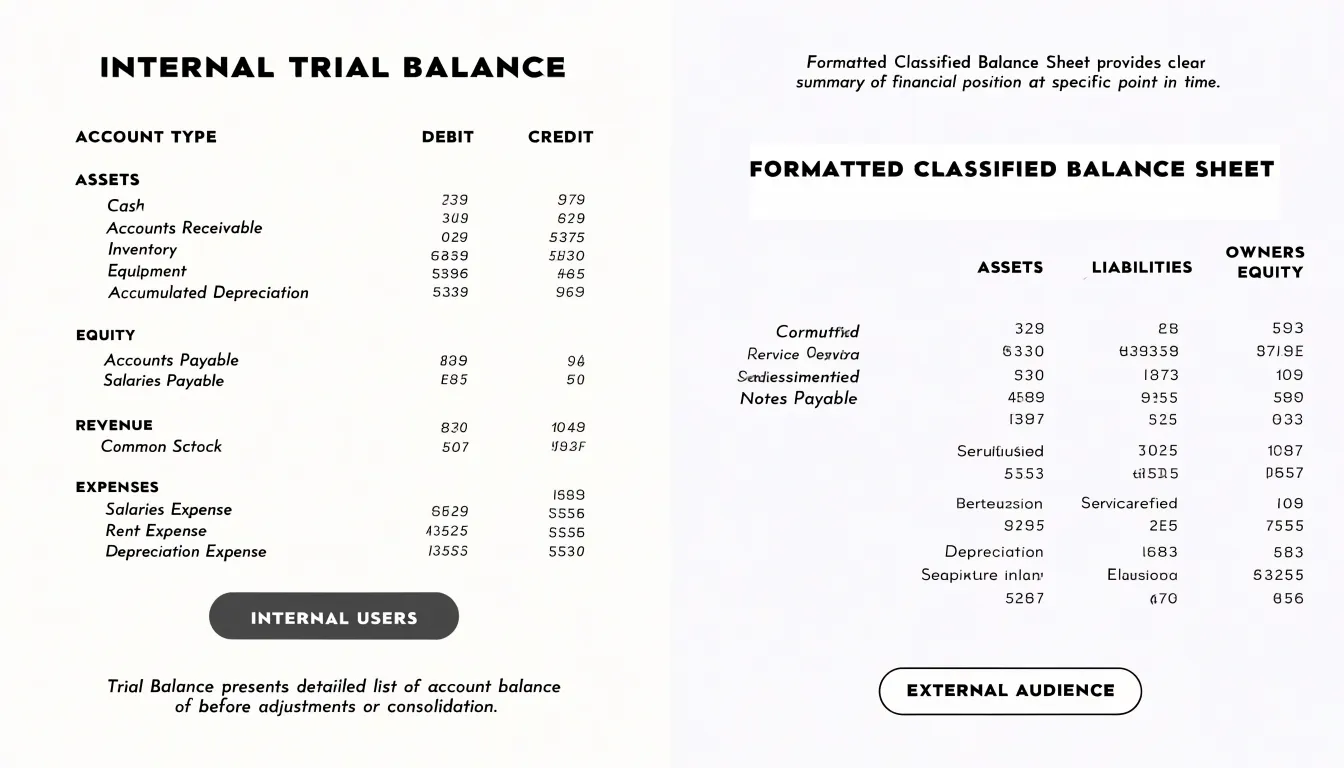
The balance sheet, by contrast, is a formal financial statement intended for external audiences such as investors, lenders, and regulators. It presents only three categories of accounts: assets, liabilities, and owners’ equity, arranged to show the financial position of the business at a single point in time. Revenue and expense accounts do not appear on the balance sheet; their net effect flows into equity through retained earnings. The balance sheet follows standardized presentation conventions and is usually accompanied by notes and comparative figures from prior periods, giving readers a clear picture of what the company owns and owes.
The two documents serve different purposes and audiences. A trial balance is a tool for internal accuracy checks, while a balance sheet is a communication device for stakeholders. The trial balance includes temporary accounts that the balance sheet omits, and it lacks the classified structure and formatting standards of a published statement. One useful way to see the relationship is that a corrected trial balance provides the raw figures from which the balance sheet is constructed. The trial balance confirms the books are in balance; the balance sheet tells the world what that balanced position looks like in financial terms.
Frequently Asked Questions
What is a trial balance used for?
A trial balance is an internal check prepared before financial statements to confirm that total debits equal total credits across the ledger. It lists the closing balances of every account in debit and credit columns and helps catch mechanical errors before reporting moves forward.
What is the difference between an unadjusted and adjusted trial balance?
The unadjusted trial balance is drawn directly from the general ledger without period-end adjustments. The adjusted trial balance reflects all adjusting entries and is the direct source for the income statement and balance sheet.
How do you prepare a trial balance step by step?
List every account in the standard order—assets, liabilities, equity, revenue, and expenses—and confirm that no account has been omitted. Enter each account’s net balance in the debit or credit column based on its normal balance, then total both columns to see whether they agree.
What should I do if my trial balance debits and credits do not match?
Begin by recomputing both column totals and writing down the exact discrepancy. Divide the difference by two to check for one-sided or doubled entries, and by nine to check for transposed or shifted digits, then compare account balances, verify posting sides, and review the journal for missing entries.
Does a balanced trial balance mean the books are error-free?
No. A balanced trial balance only confirms that debits equal credits; it does not confirm that every transaction was recorded correctly. Wrong-account entries, omitted transactions, duplicate entries, compensating errors, and errors of principle can leave the columns in agreement while the records remain wrong.
What is the difference between a trial balance and a balance sheet?
A trial balance is an internal working document that lists every account, including revenue and expense accounts, to verify that total debits equal total credits. A balance sheet is a formal financial statement for external audiences that presents only assets, liabilities, and owners’ equity at a single point in time.