
Types of Business Expenses (and Which Are Deductible)
A deductible business expense must be ordinary (common in your industry) and necessary (helpful and appropriate to your business), incurred in carrying on a trade or business, and supported by records proving amount, date, and business purpose. Everyday costs like rent, utilities, software, and supplies are fully deductible; capital assets are depreciated or expensed under Section 179.
Table of Contents
- Understanding What Makes a Business Expense Legally Deductible
- Ordinary and Necessary Expenses Defined
- Everyday Operating Costs like Rent, Software, and Office Supplies
- Capital Expenses versus Current Expenses
- Vehicle and Mileage Costs
- How to Qualify for and Calculate the Home Office Deduction
- What Travel and Meal Purchases Can You Claim on Your Taxes
- Handling Startup Costs and Pre Opening Business Investments
- Common Personal Purchases You Cannot Write Off
- Keeping Tax Audit Proof Records for Every Category
Understanding What Makes a Business Expense Legally Deductible
The Internal Revenue Code allows businesses to deduct expenses, and the gateway to that deduction is a three-part test that every cost must pass. First, the expense must be ordinary. An ordinary expense is one that is common and accepted in your particular field of business. What counts as ordinary for a construction company may differ entirely from what is ordinary for a software firm, so the standard is industry-specific rather than universal. A cost that a typical business in your line of work would reasonably incur satisfies this prong. Second, the expense must be necessary. Necessary means helpful and appropriate to the development and operation of the business, rather than strictly indispensable. Courts have interpreted this leniently: an expense can be necessary even if it is not absolutely required to keep the doors open, as long as it serves a legitimate business purpose. These two conditions operate together, and an expense that fails either one is generally not deductible.
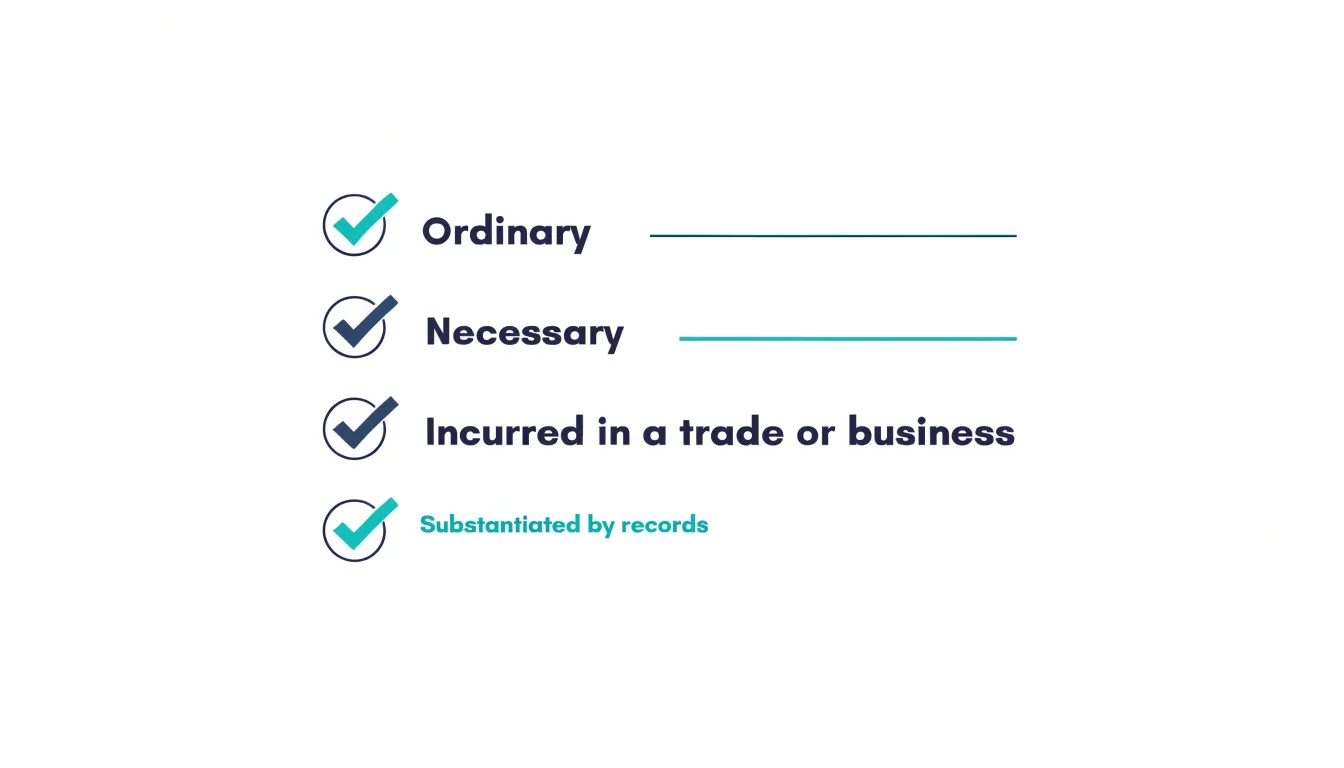
The second layer of the test requires that the expense be incurred in carrying on a trade or business. There must be a genuine business activity, and the cost must connect to that activity. This is where many deductions go wrong. Personal, living, or family expenses are not deductible, and mixed-use costs must be allocated so that only the business portion is claimed. A home office deduction, for example, depends on demonstrating that a specific space is used regularly and exclusively for business rather than doubling as a family room.
The third layer is substantiation. Even a perfectly legitimate, ordinary, and necessary business expense will be disallowed if the taxpayer cannot prove it. The tax code and regulations impose recordkeeping requirements: receipts, invoices, bank statements, calendars, and logbooks that show the amount, the date, and the business purpose. Travel and meals carry especially strict documentation rules. Missing records are one of the most common reasons deductions are reduced on audit. Together, these three layers form the foundation of every deduction decision, which makes them the first thing to check before claiming any business cost.
Ordinary and Necessary Expenses Defined
The phrase “ordinary and necessary” comes straight out of the Internal Revenue Code, and it serves as the basic gatekeeper for every business deduction you will ever claim. Understanding what each word means in practice helps you decide with confidence which expenses belong on your return.
An ordinary expense is one that is common and accepted in your particular trade or industry. The question is whether other businesses in your field typically incur this kind of cost. Advertising, office supplies, professional dues, and liability insurance are ordinary for nearly every business. For a restaurant, replacement kitchen equipment and food inventory are ordinary; for a software consultancy, cloud hosting and developer tools are ordinary. The standard is tied to your industry, so an expense that is routine for a construction company may be unusual for a law firm.
A necessary expense is one that is helpful and appropriate for your business, even if it is not strictly indispensable. Necessary does not mean absolutely required to keep the doors open; it means the cost plays a legitimate role in running or improving your operations. A bookkeeping subscription, a training course that sharpens a needed skill, or a modest client lunch all fit this description.
Expenses that typically pass the test include rent on business premises, utilities, business insurance, supplies consumed in day-to-day operations, wages paid to employees, advertising and marketing costs, and reasonable travel directly connected to business activity. When an expense is both common in your field and helpful to your operation, it generally clears the bar.
The test is equally useful for spotting expenses that fail. Personal costs, such as groceries, family vacations, or everyday clothing that could be worn outside work, are not ordinary and necessary business expenses. Lavish or extravagant outlays, like a luxury weekend treated as a client retreat with no real business purpose, may be disallowed in part. Hobbies presented as businesses, capital improvements written off as repairs, and costs incurred before a business actually begins operating also tend to fail. Political contributions and most fines and penalties are barred outright.
When you can explain why an expense is common in your industry and how it helped your business, you have the documentation mind-set the IRS expects. Keep receipts and a short note on the business purpose, and apply the ordinary and necessary test before you deduct.
Everyday Operating Costs like Rent, Software, and Office Supplies
Everyday operating costs form the backbone of most business budgets, and the good news is that the routine expenses required to keep your doors open are generally fully deductible in the year you pay them. Rent is the clearest example. Whether you lease office space, a retail storefront, or a warehouse, the monthly payment is an ordinary and necessary cost of doing business, and the full amount is deductible when paid or incurred. The same logic applies to utilities such as electricity, water, heating, internet, and phone service, which keep your workspace functional and connected.
Software and subscriptions deserve their own attention because they have become a major line item for modern businesses. Cloud storage, project management tools, accounting platforms, design software, and industry-specific applications are typically deductible in full when the subscription covers a period of a year or less. Annual plans paid upfront are generally deducted in the year of payment under the cash method. Office supplies, from printer paper and toner to postage and small equipment, are similarly straightforward: buy them, use them in the business, and deduct them.

Insurance premiums round out the routine costs. General liability, property, and business owner’s policies are deductible, and premiums are usually written off over the policy period when they cover more than twelve months. Professional fees paid to attorneys, accountants, bookkeepers, and consultants are also fully deductible as ordinary business expenses.
Categorization matters for clean books and an easier tax filing. Rent belongs in its own rent or lease expense account. Utilities should be grouped together so you can spot unusual spikes. Software and subscriptions fit best in a dedicated account that separates recurring digital tools from one-time purchases. Supplies have their own category, distinct from larger equipment purchases that may need to be depreciated. Insurance and professional fees each warrant separate accounts as well. Keeping these costs in consistent, well-labeled categories throughout the year makes it simple to confirm at tax time that each routine expense was captured, and it gives you a clearer picture of where your operating dollars actually go.
Capital Expenses versus Current Expenses
Timing sits at the center of how business expenses interact with your tax bill. Current expenses are the everyday costs of running a business, such as rent, utilities, office supplies, and wages. These items are consumed or used up within the tax year, so the IRS generally allows you to deduct them in full on that year’s return. The deduction reduces your taxable income immediately, which lowers the tax you owe for the current period.
Capital expenses work differently. When you buy an asset with a useful life extending beyond the current year, such as machinery, vehicles, computer equipment, or improvements to a building, the cost is treated as an investment in the business rather than an ordinary operating cost. Instead of taking the full amount as an immediate deduction, you typically recover the cost over time through depreciation, claiming a portion each year based on the asset’s class life and the applicable depreciation method. This spreads the tax benefit across multiple years and matches the deduction to the periods in which the asset helps generate revenue.
The tax code offers ways to accelerate that schedule. Section 179 lets eligible small and mid-sized businesses deduct the full purchase price of qualifying equipment and off-the-shelf software in the year it is placed in service, up to an annual limit that phases out for larger purchases. Bonus depreciation provides a separate mechanism, allowing an additional first-year deduction on qualifying property. Both provisions can turn a multi-year write-off into a substantial current-year deduction, which is especially valuable when you want to reduce taxable income in a strong profit year.
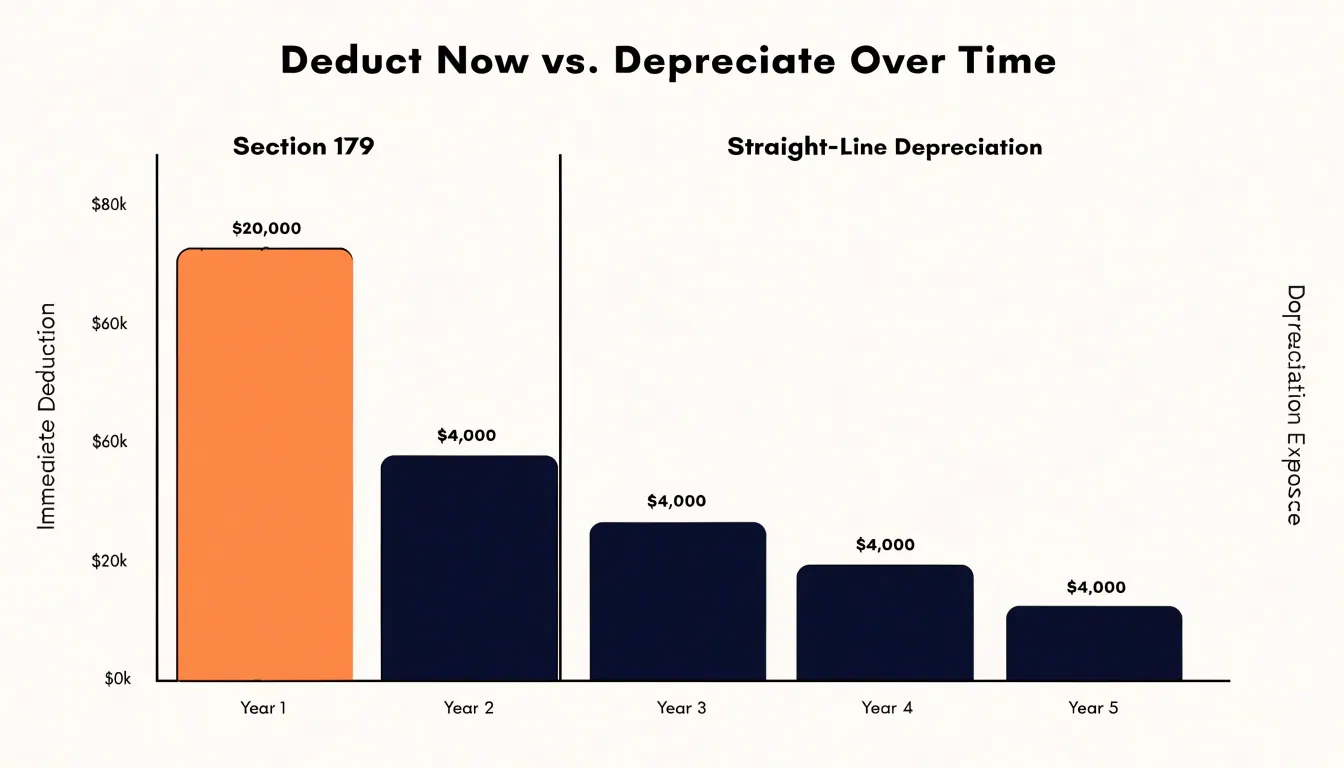
The choice between immediate expensing and depreciation affects cash flow as well as the bottom line. A larger upfront deduction lowers this year’s tax liability, freeing up cash for operations, while depreciation produces smaller, steadier deductions in later years. Because the rules for eligibility, limits, and asset classification are detailed, many business owners review major purchases with a tax professional before year-end to decide which treatment produces the best overall result.
Vehicle and Mileage Costs
Vehicle costs are one of the most frequently claimed business deductions, and the IRS offers two distinct ways to calculate them. Under the standard mileage rate, you multiply your business miles driven during the year by the rate the IRS sets annually, which covers fuel, insurance, repairs, and depreciation in a single figure. The actual expense method requires you to total your real costs for the year, including gas, maintenance, tires, insurance, registration, and depreciation, then multiply that total by the percentage of miles driven for business. Each approach suits different situations. The standard rate demands less paperwork and works well for simpler records, while the actual expense method often produces a larger deduction for a vehicle with high operating costs or heavy business use.
The rules on switching between methods shape how you plan. If you use the standard mileage rate in the first year you place a vehicle in service, you can generally switch to actual expenses in a later year. If you start with actual expenses, you cannot later move to the standard rate for that same vehicle. Once you claim the standard rate, you may also need to use straight-line depreciation if you switch to actual costs, which can reduce the benefit. A vehicle used for both business and personal driving requires you to track the business share closely, since only that portion of actual costs qualifies.
Recordkeeping underpins either method. For the standard rate, keep a contemporaneous log of business trips showing date, destination, purpose, and miles, plus odometer readings at the start and end of the year. For actual expenses, retain receipts for fuel, repairs, insurance, and other costs, along with documentation of total annual miles and business miles. A mileage tracking app or a simple logbook maintained at the time of each trip gives you the strongest support if questions arise. Consistent records throughout the year make either election defensible and help you identify which method delivers the better result for your business.
How to Qualify for and Calculate the Home Office Deduction
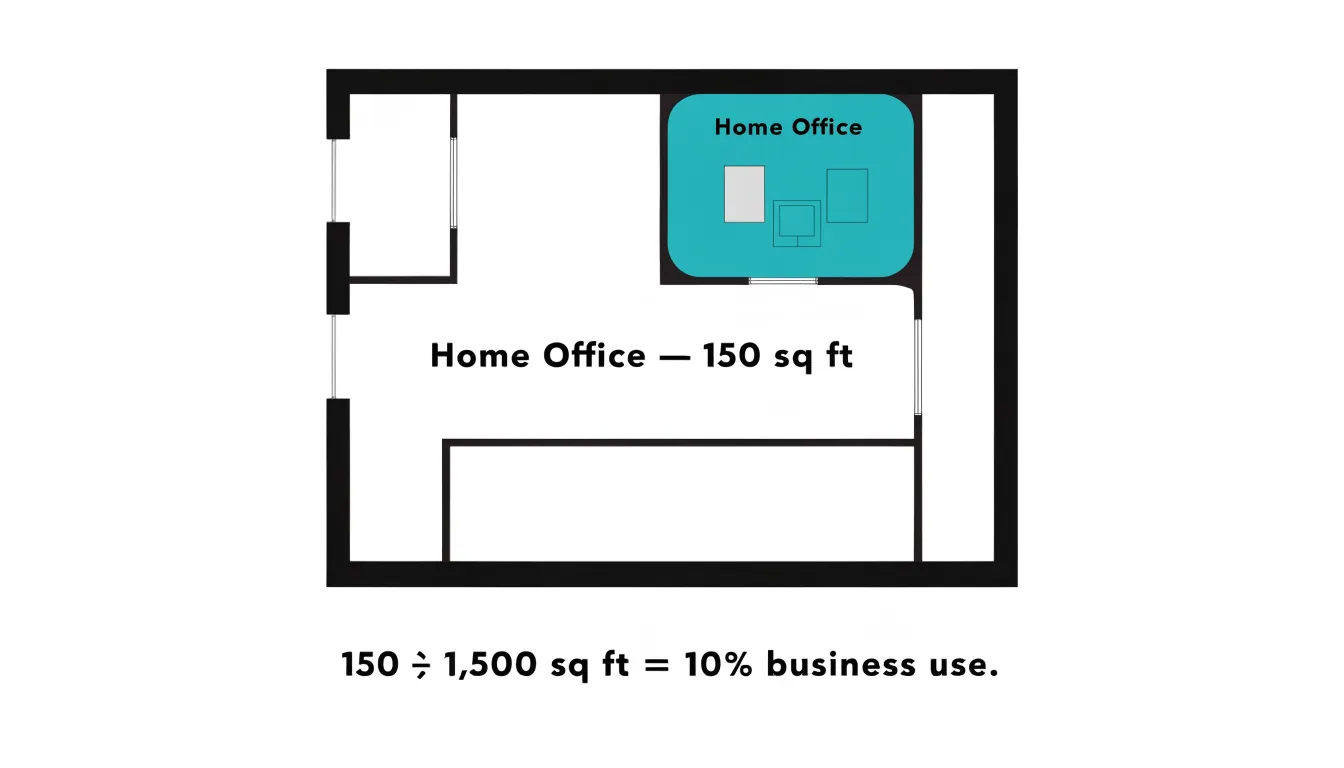
To claim the home office deduction, the space you use must meet two tests set by the IRS: exclusive and regular use. Exclusive use means a specific area of your home is devoted solely to business, so a desk in the corner of a bedroom or a dining table that doubles as your workspace generally will not qualify. Regular use means the space is used consistently for business rather than occasionally. Once those requirements are satisfied, you can calculate the deduction in one of two ways. The simplified method multiplies the square footage of your office, up to 300 square feet, by a set rate of $5 per square foot, giving a maximum deduction of $1,500. This approach requires minimal recordkeeping and no allocation of household expenses, which makes it attractive for smaller offices. The regular method is more involved. You determine the business percentage of your home by dividing the office square footage by the total square footage, then apply that percentage to eligible expenses such as rent, utilities, insurance, and repairs. Depreciation on the home or a portion of your mortgage interest may also factor in. The regular method often produces a larger deduction for substantial dedicated space, particularly in high-cost housing markets, so it is worth running both calculations before choosing. The most common pitfall is overstating the deduction, which draws scrutiny and can result in penalties. Keep the business percentage reasonable and tied to actual measurements. Claim only expenses for the portion of the home used for business, and keep the office area clearly defined so the allocation is defensible. Retain records such as floor plans, photographs, utility bills, and a log of hours spent working in the space. If the business use is less than the full home, avoid deducting costs that relate to personal areas. Also be mindful that the deduction for a home office cannot exceed the gross income from the business, with certain carryover rules applying to the regular method. Consulting a tax professional helps confirm which method suits your situation and ensures the figures you report hold up if questioned.
What Travel and Meal Purchases Can You Claim on Your Taxes
Business travel begins with a clear connection to your trade or business. To claim transportation costs, the trip must be ordinary and necessary, temporary in nature, and primarily for business purposes. Transportation includes airfare, train tickets, rental cars, and mileage driven in your own vehicle, calculated using the standard mileage rate or actual expenses. Lodging qualifies when you are traveling away from your tax home overnight, and the cost must be reasonable for the area. Incidental costs such as baggage fees, parking, tolls, and tips to hotel staff are also deductible when they directly support the business trip. The key dividing line is the ordinary and necessary test: costs must be common in your industry and helpful to your business, so personal sightseeing or extravagant upgrades fall outside the deduction. The business purpose test also governs how much of a trip is deductible. When travel is primarily personal, no transportation costs qualify, while a trip primarily for business allows the full cost of getting there and back. Once you are traveling for business, you can generally deduct the full cost of meals, but the tax code limits that deduction to 50% of the amount otherwise allowable. That 50% limit applies to business meals with clients, customers, or employees where business is discussed, and to meals eaten alone while traveling away from home overnight. The food and beverages must not be lavish or extravagant, and you, or an employee of yours, must be present at the meal. Documentation turns these rules into a defensible deduction. The IRS expects contemporaneous records showing the date and place of the expense, the amount, the business purpose, and the business relationship of the people involved. Keep receipts for anything over the small-dollar threshold and note the attendees and topics discussed on the receipt itself or in a calendar entry. Mileage logs should capture the date, destination, purpose, and odometer readings. A dedicated log, app, or spreadsheet used consistently throughout the year makes it far easier to substantiate travel and meal expenses if questions arise later.
Handling Startup Costs and Pre Opening Business Investments
Before a business opens its doors, owners typically spend money on investigation, setup, and organization. The tax code treats these startup and organizational costs in a specific way, and understanding the rules helps you recover those early outlays sooner rather than later. Startup costs generally include amounts paid to investigate creating or acquiring a business and to prepare it for operation, such as market research, advertising before opening, employee training, and travel connected to finding suppliers or locations. Organizational costs cover the legal and administrative side of forming the entity, including incorporation fees, legal drafting of partnership agreements, and accounting services tied to setting up the structure. These costs fall into a category that the law would otherwise require to be capitalized, spread over the life of the business rather than written off in the year they are paid.
The tax code offers an election that lets you treat a portion of these costs as a current deduction in the year the business begins operations. Under current rules, you can deduct up to $5,000 of startup costs and $5,000 of organizational costs in that first year. Each limit phases out dollar for dollar once total costs in the respective category exceed $50,000, so a business with substantial pre-opening spending may see the immediate deduction shrink to zero. The election is made by attaching a statement to the timely filed return for the year the business begins, listing the costs and confirming the choice.
Costs that are not deducted under the election are amortized ratably over 15 years, beginning with the month the business starts operations. The same 15-year schedule applies to the portion of costs above what the election permits. This treatment spreads the remaining pre-opening investment across a defined period, providing a steady series of deductions that gradually offsets the capitalized amount. Records matter here. Keep receipts, invoices, and a schedule that separates investigation costs, preparation costs, and organizational fees, along with the date the business officially began. Accurate categorization at the outset supports the election, simplifies the amortization schedule, and reduces the risk of challenges on audit.
Common Personal Purchases You Cannot Write Off
Understanding which personal purchases cannot be written off starts with recognizing the ordinary costs of daily living. Groceries for your household, clothing for everyday wear, commuting between home and your regular workplace, and personal entertainment such as streaming subscriptions or concert tickets all fall into the category of nondeductible personal expenses. These costs support your life as an individual, and the tax code treats them as inherently personal regardless of whether you own a business. A home office does not turn your family’s grocery bill into an operating cost, and a long commute does not become a business trip simply because you were thinking about work along the way.
The practical challenge arises when a single purchase serves both personal and business purposes. A cell phone used for client calls and family texts, a vehicle driven to meetings and to the grocery store, or a home internet connection used for invoicing and streaming are all examples of mixed-use costs. The way to separate them is documentation and a reasonable allocation method. Keep receipts and logs that show the business portion of each expense, such as a mileage log for a car or phone bills with business calls highlighted.
Allocate mixed-use costs using a consistent, defensible percentage. If a phone is used 60 percent for business, deduct 60 percent of the monthly bill. For a vehicle, the standard mileage rate applies only to business miles. For home internet, an estimate based on work hours is usually acceptable when records support it.
The boundary line matters because claiming personal expenses as business deductions invites scrutiny and penalties. Keep personal and business bank accounts separate, pay for business items with a dedicated card where possible, and note the business purpose on receipts at the time of purchase. When in doubt, ask whether an ordinary person would incur this cost outside of work. If the answer is yes, treat it as personal unless you can document a clear business portion. This discipline keeps your return accurate and your deductions defensible if questions arise later.
Keeping Tax Audit Proof Records for Every Category
Substantiating every business expense category begins with a consistent recordkeeping habit. For most purchases, a receipt is the primary document; it should show the vendor name, date, amount, and a description of what was purchased. When a receipt is missing, a bank or credit card statement can serve as supporting evidence of the payment, though it typically does not prove the business purpose on its own. Pairing statements with a short note explaining what was bought and why keeps the documentation complete. For vehicle expenses, a mileage log is the standard record, capturing the date, destination, business purpose, and odometer readings for each trip. A log kept in real time, whether in an app or a notebook, carries far more weight than one reconstructed months later. Contemporaneous notes serve the same purpose across categories: jotting down the business reason for a meal, a client gift, or a home office purchase while the details are fresh turns a vague transaction into a defensible one. Photographing paper receipts and storing them in a folder with the related month’s statements makes retrieval simple if questions arise. For retention, the general rule is to keep records supporting a tax return for at least three years from the filing date, which matches the standard audit window. Records tied to property, depreciation, or losses may need to be kept longer, and employment tax records generally carry a four-year expectation. A practical approach is to retain everything for seven years, which covers most scenarios without requiring case-by-case judgment. Organizing records by category and tax year, with a simple index, ensures that any expense can be traced to its supporting documents quickly. The goal is a clear paper trail that shows each deduction was ordinary, necessary, and actually paid.

Frequently Asked Questions
What makes a business expense deductible?
To be deductible, an expense must be ordinary and necessary for your business, incurred in carrying on a trade or business, and substantiated with records showing the amount, date, and business purpose. Personal, living, and family expenses are not deductible, and mixed-use costs must be allocated so only the business portion is claimed.
Are everyday operating costs like rent, software, and office supplies deductible?
Yes. Routine operating costs such as rent, utilities, insurance, professional fees, office supplies, and software subscriptions are generally fully deductible in the year paid when the subscription covers a year or less. Annual plans paid upfront are generally deducted in the year of payment under the cash method.
What is the difference between current expenses and capital expenses?
Current expenses are everyday costs consumed within the tax year, such as rent, utilities, office supplies, and wages, and are generally deducted in full that year. Capital expenses are assets with a useful life beyond the current year, such as machinery, vehicles, computer equipment, or building improvements, and are typically recovered over time through depreciation. Section 179 and bonus depreciation can allow an additional first-year deduction on qualifying property.
How do I qualify for and calculate the home office deduction?
To claim the home office deduction, the space must be used exclusively and regularly for business. You can use the simplified method—up to 300 square feet at $5 per square foot, for a maximum deduction of $1,500—or the regular method, which applies the business percentage of the home to eligible expenses. The deduction cannot exceed the gross income from the business, with certain carryover rules applying to the regular method.
How do I deduct vehicle and mileage costs?
You can calculate vehicle costs using the standard mileage rate, which multiplies business miles by the IRS rate and covers fuel, insurance, repairs, and depreciation, or the actual expense method, which totals real costs and multiplies them by the business-use percentage. If you use the standard mileage rate in the first year the vehicle is placed in service, you can generally switch to actual expenses later, but if you start with actual expenses, you cannot later move to the standard rate for that same vehicle. Keep a contemporaneous log showing date, destination, purpose, and miles, plus odometer readings.
What business travel and meal expenses can I claim?
Business travel costs must be ordinary and necessary, temporary, and primarily for business, and can include transportation, lodging, and incidental costs like baggage fees, parking, tolls, and hotel tips. Meals while traveling away from home overnight or business meals with clients, customers, or employees are generally deductible but limited to 50%, must not be lavish or extravagant, and require documentation showing date, place, amount, business purpose, and business relationship.