
What Is Accounting? A Plain-English Guide for Beginners
Accounting is the process of recording a business’s financial transactions—income, expenses, assets, and liabilities—then summarizing them into financial statements that reveal profitability and solvency. Bookkeepers record daily transactions, while accountants interpret the numbers, prepare reports, handle taxes, and advise on decisions. The double-entry system keeps records accurate by requiring every transaction to balance.
Table of Contents
- How accounting tracks the financial health of a business
- The core difference between bookkeeping and accounting
- Why small business owners and everyday workers need accounting
- Financial versus managerial accounting
- The three essential financial statements explained simply
- How the double entry system prevents costly recording mistakes
- What does an accountant actually do on a daily basis
- Simple steps to start organizing your personal or business finances today
How accounting tracks the financial health of a business
Accounting tracks the financial health of a business by recording its day-to-day activity in a consistent, organized way. Every sale, purchase, bill paid, and loan taken on leaves a trace in the books, and each entry updates four core categories: income, expenses, assets, and liabilities. Income captures the money coming in from customers and clients. Expenses record the costs of running the business, from rent and wages to supplies and utilities. Assets are the things the business owns or is owed, such as cash, inventory, equipment, and unpaid invoices. Liabilities are what the business owes to others, including supplier bills, loans, and taxes due. Because these entries are made regularly rather than once a year, the records stay current and reflect what is actually happening in the business.
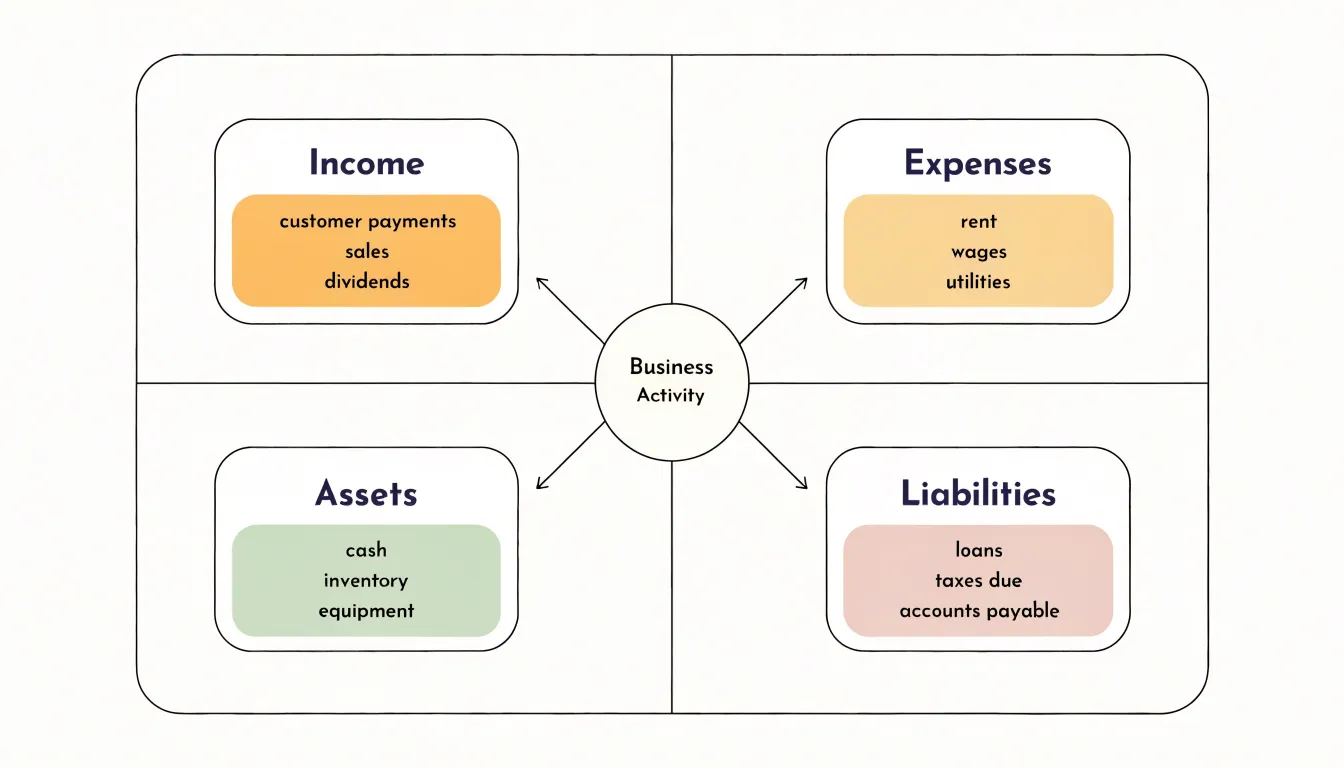
The real value emerges when these categories are brought together. Income minus expenses gives a running view of profitability, showing whether the business is earning more than it spends over any given period. Assets compared with liabilities give a view of solvency, showing whether the business can meet its obligations and stay standing if sales slow down or a large bill arrives. Together, these figures build a picture that updates as the business operates, so the owner can see the movement of money rather than guess at it.
That visibility matters because business decisions depend on knowing where things stand. A business owner who can see steady profits and healthy cash reserves can plan to hire, invest in equipment, or open a new location with confidence. Someone who can see rising expenses or growing debt can act early, adjusting prices, trimming costs, or arranging financing before a problem becomes a crisis. Lenders and investors rely on the same records when deciding whether to extend credit or put money into the business.
Regular bookkeeping turns scattered transactions into a clear, ongoing picture of profitability and solvency. With that picture in hand, owners can make informed choices about spending, growth, and risk instead of operating on intuition alone.
The core difference between bookkeeping and accounting
Bookkeeping is the routine, mechanical side of financial record keeping. Every time a business sells a product, pays a supplier, receives a customer payment, or covers a utility bill, that event needs to be captured somewhere. Bookkeepers record these transactions as they happen, assigning each one to the correct account in the general ledger, keeping receipts and invoices organised, reconciling the bank statement against the books, and making sure the numbers add up. The work is detailed and repetitive, and its value lies in accuracy and consistency. If transactions are missed, duplicated, or filed under the wrong heading, everything built on top of those records becomes unreliable. Bookkeeping is essentially the raw data-collection stage of the financial process, and it happens daily or weekly throughout the year.
Accounting begins where bookkeeping ends. Once the transactions are recorded, an accountant steps back and asks what the numbers mean. That involves preparing financial statements such as the profit and loss account and the balance sheet, analysing trends in revenue and costs, interpreting what the figures say about the health of the business, and reporting those findings to owners, managers, lenders, or tax authorities. Accountants also handle adjusting entries, tax planning, forecasting, and compliance work, all of which require judgement and a working knowledge of accounting standards. The accountant relies on the bookkeeper’s records as the foundation, and the quality of the analysis depends heavily on how clean that foundation is.
In small businesses, the two roles frequently blur together. The owner may do the daily data entry themselves through software like QuickBooks or Xero, then hand the file to an accountant at year end for review and tax filing. A single practitioner might handle both the bookkeeping and the reporting for a client. Understanding where one ends and the other begins helps a new business owner decide what to do in-house, what to automate, and when to bring in professional help.
Why small business owners and everyday workers need accounting
Accounting is often framed as a corporate necessity, yet its practical value extends directly to small business owners and everyday workers. For a small business owner, accounting begins with tax compliance. Every sale, expense, and payroll transaction must be documented accurately to meet legal obligations. Without a clear record, filing taxes becomes a guessing game that can lead to penalties, missed deductions, or audits. Simple bookkeeping habits—tracking receipts, categorizing expenses, and reconciling bank statements—ensure that tax season is manageable and that the business pays what it owes without overpaying.
Beyond taxes, accounting serves as an early warning system for cash-flow problems. A business can be profitable on paper yet still run out of money if cash arrives later than bills. Regular accounting reveals patterns: when receivables are collected, when major expenses fall due, and how much buffer exists. Spotting a shortfall weeks in advance gives an owner time to adjust—by delaying purchases, accelerating collections, or arranging credit—rather than reacting in crisis. This same foresight supports budgeting, turning vague hopes into concrete plans. By comparing actual results to a budget, an owner learns which products, services, or seasons truly drive profit and where costs are creeping up.
For everyday workers, accounting principles translate into informed personal finance choices. Tracking income and expenses creates awareness of where money goes, making it possible to save deliberately rather than sporadically. Understanding concepts like net worth, debt-to-income ratios, and the time value of money helps workers evaluate major decisions: whether to rent or buy, how much to contribute to a retirement account, or which loan terms are truly affordable. A simple budget built on accurate records shows how much can be safely invested and how long an emergency fund will last. Even basic knowledge of financial statements helps workers assess an employer’s stability or make sense of investment options. In short, accounting provides the numbers behind everyday decisions, turning financial goals into measurable steps. The same discipline that keeps a business solvent keeps a household resilient.
Financial versus managerial accounting
Financial accounting focuses on producing reports for people outside the company. Investors, lenders, and regulators rely on these reports to make decisions about the business. Investors want to know whether the company is profitable and how its finances are changing over time. Lenders assess whether the company can repay loans and interest. Regulators, such as government agencies and stock exchanges, require companies to disclose certain information to protect the public and ensure fair markets. Because these external users often have limited access to the company’s internal records, financial accounting follows standardized rules. These rules—such as Generally Accepted Accounting Principles (GAAP) or International Financial Reporting Standards (IFRS)—ensure consistency, comparability, and transparency. They dictate how transactions are recorded, when revenue is recognized, and how assets and liabilities are valued. The result is a set of formal financial statements—the balance sheet, income statement, and cash flow statement—that present a true and fair view of the company’s financial position and performance. These statements are typically prepared on a regular schedule, such as quarterly or annually, and are often audited by independent accountants to add credibility.
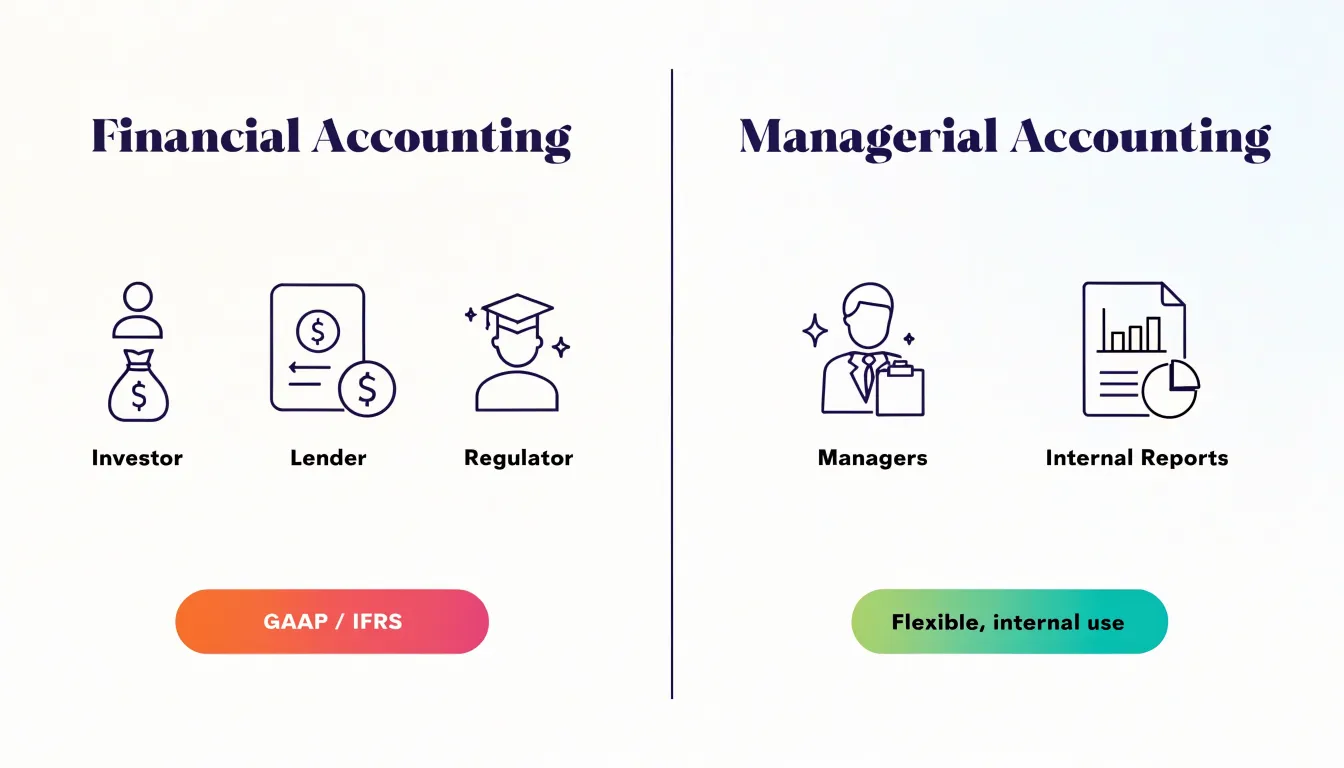
Managerial accounting, in contrast, serves the internal needs of the organization. Managers at all levels use managerial accounting information to plan, control, and make decisions. This includes setting budgets, evaluating performance, pricing products, deciding whether to make or buy components, and choosing among alternative courses of action. Managerial reports are tailored to the specific needs of each manager and are not bound by external standards. They can focus on segments, products, customers, or projects, and they may include non-financial measures such as customer satisfaction, production efficiency, or employee turnover. Managerial accounting is forward-looking, emphasizing forecasts and estimates rather than historical results. It is also flexible in format and timing—reports can be generated daily, weekly, or as needed. Because managerial information is for internal use only, it does not need to follow GAAP or IFRS, and it is not subject to external audit. The primary goal is relevance to decision-making, even if that means sacrificing precision or comparability with other companies. In essence, financial accounting tells the outside world how the company has performed, while managerial accounting gives insiders the tools to steer the company forward.
The three essential financial statements explained simply
Every business, from a corner shop to a multinational corporation, keeps track of its money through three core financial statements. Each one answers a different question, and together they give a complete picture of financial health.
The balance sheet is a snapshot of a business at a single moment in time. It shows what the business owns (assets like cash, equipment, and inventory) and what it owes (liabilities like loans and unpaid bills). The difference between the two is equity, the owner’s stake in the business. Think of it as a photograph: on any given day, it captures the financial position, frozen in place.
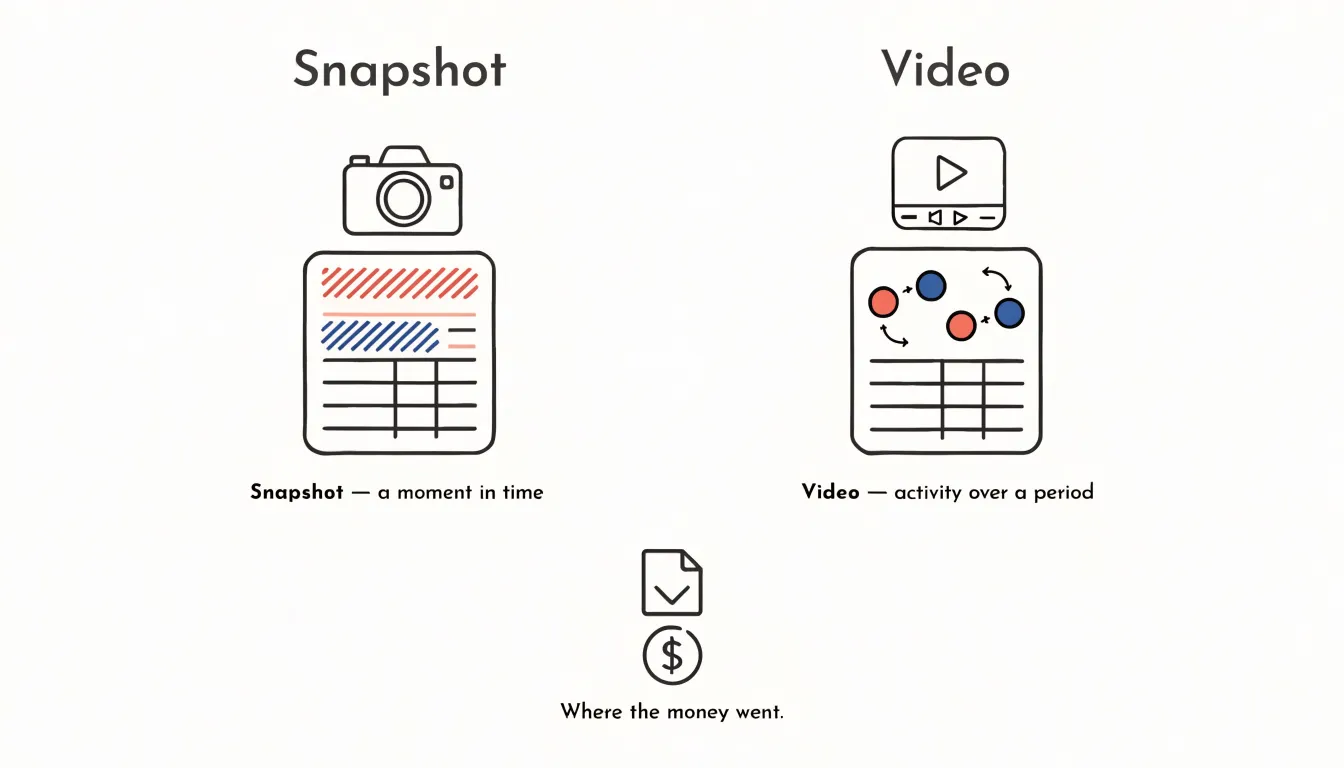
The income statement, sometimes called the profit and loss statement, tells a different story. It covers a period, such as a month or a year, and records what the business earned through sales and what it spent on expenses like rent, wages, and supplies. The result is either a profit or a loss. If the balance sheet is a photograph, the income statement is more like a video, showing activity over time.
The cash flow statement completes the trio by tracking the actual movement of money in and out of the business. It separates cash coming from everyday operations, from investing activities, and from financing such as loans or owner investments. A business can show a profit on its income statement and still run out of cash, which is why this statement matters so much for day-to-day survival.
The three statements are deeply connected. Profit from the income statement feeds into the equity section of the balance sheet. Cash movements recorded on the cash flow statement explain changes in the cash balance shown on the balance sheet. Reading them together gives a richer understanding than reading any one alone. For beginners, the simplest habit is to remember what each statement answers: what you own and owe, what you earned and spent, and where the money actually went.
How the double entry system prevents costly recording mistakes
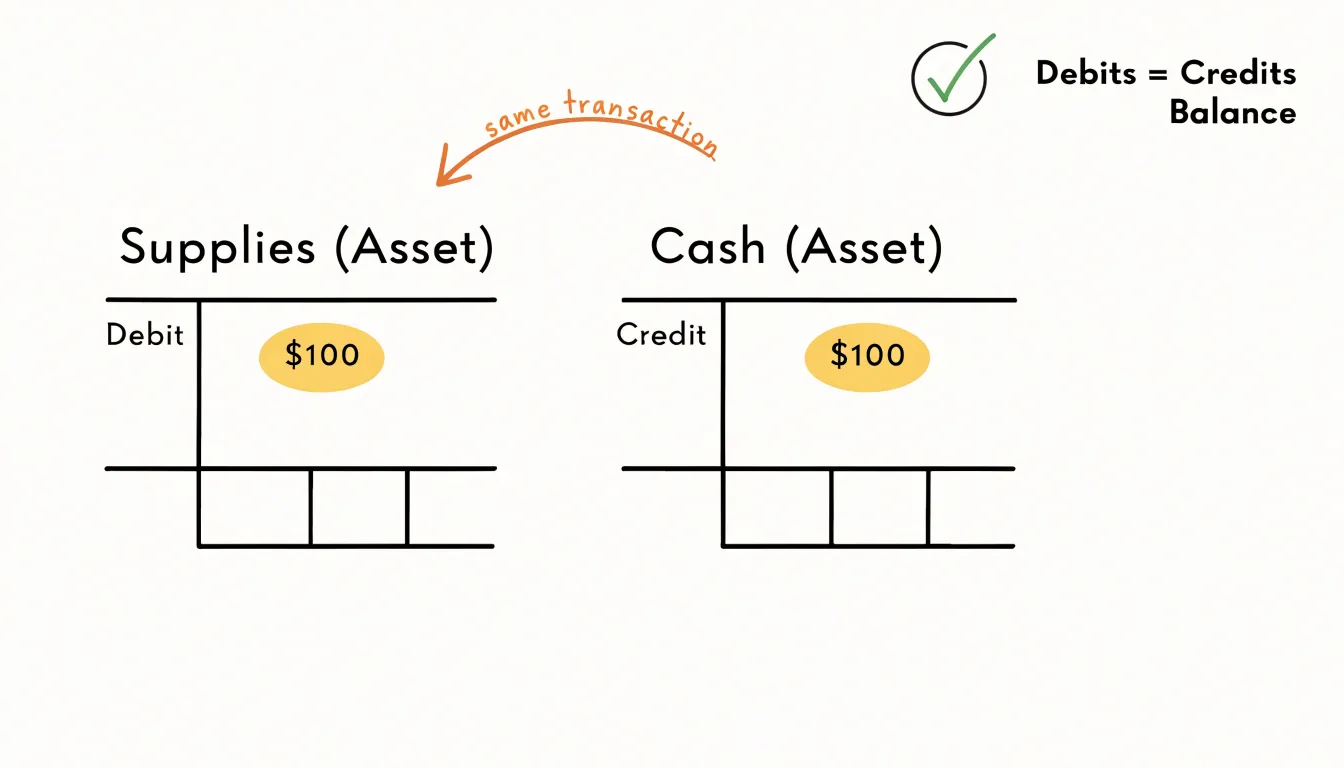
The double entry system is the mechanism accountants use to keep records honest, and it rests on one simple rule: every transaction affects at least two accounts, and the total of the debits must always equal the total of the credits. When you record a transaction, you are not simply noting that money moved. You are describing where it came from and where it went, using two matching entries that keep the books in balance. This built-in equality is what gives the system its self-checking power. Because debits and credits must balance, an entry recorded on only one side of the ledger, or recorded with mismatched amounts, throws the totals out of balance and signals that something needs attention. Bookkeepers routinely run a trial balance, which lists every account and its balance, precisely to confirm that total debits still match total credits. If the two columns disagree, the error is flagged immediately, before it can distort reports or tax filings.
A simple example makes the idea concrete. Imagine a small business buys office supplies and pays for them with cash. Under double entry, the transaction produces two linked entries: the supplies account, an asset, is increased, and the cash account, also an asset, is decreased by the same amount. One side records what the business gained, and the other records what it gave up. The two amounts are identical, so the books remain in balance. If the person recording the purchase accidentally entered the supplies figure slightly differently from the cash figure, the imbalance would surface the next time the totals were checked, pointing the bookkeeper back to the faulty entry.
This self-checking quality matters most in busy operations where hundreds of transactions pass through the books each week. A single transposition, a dropped digit, or a payment posted to the wrong account can quietly corrupt the records and lead to bad decisions about pricing, spending, or cash flow. The double entry system does not rely on the memory or diligence of any one person. The arithmetic itself acts as a watchdog, catching many mistakes at the point of recording and making the remaining ones far easier to trace.
What does an accountant actually do on a daily basis
A typical day for an accountant is built around a handful of recurring tasks. Recording transactions comes first for many: entering sales, purchases, payments, and receipts into accounting software so that the books reflect what actually happened in the business. This includes coding each transaction to the right account, checking invoices against purchase orders, and chasing down missing receipts or paperwork. Bank reconciliation follows close behind. The accountant compares the bank statement with the internal records, identifies differences such as uncleared cheques, bank fees, or timing gaps, and adjusts the books until the two match. Done regularly, reconciliation catches errors early and keeps the records trustworthy.
Preparing reports fills another large part of the week. Accountants compile profit and loss statements, balance sheets, and cash flow summaries, often on a monthly schedule, so owners and managers can see how the business is performing. They also prepare supporting schedules, track ageing of receivables and payables, and answer questions about why a particular figure moved. Tax work has its own rhythm. Depending on the jurisdiction, accountants calculate sales tax or VAT, prepare and file periodic returns, assemble payroll taxes, and gather the documentation needed for annual income tax filings. Deadlines shape the calendar, and much of the daily work involves making sure nothing is missed before those dates arrive.
Advising clients rounds out the role, especially in public practice. An accountant might review a client’s pricing, flag a cash flow squeeze, explain the tax consequences of hiring a first employee, or help plan a major purchase. These conversations often draw directly on the numbers the accountant has just prepared.
The setting shapes how these tasks are weighted. In a small accounting firm, one person may handle bookkeeping, reconciliation, and tax filing for a roster of clients, switching between them through the day. In a large company’s finance department, the work is more specialised: one team handles payables, another handles reporting, and a controller oversees the close of the books each month. Management accountants work inside a single business and focus on budgets and performance reports. Auditors spend their time testing other companies’ records rather than maintaining their own. Tax specialists concentrate on compliance and planning. Whatever the setting, the core of the job remains the same: keeping financial records accurate, timely, and useful to the people who rely on them.
Simple steps to start organizing your personal or business finances today
Getting your finances organized begins with a few practical steps you can take right away, regardless of whether you are managing a household budget or running a small business. The first and often most impactful step is to separate your personal and business money into distinct accounts. Open a dedicated checking account for your business and use it exclusively for business income and expenses. This separation keeps your records clean, makes it far easier to see how the business is performing, and simplifies tax preparation when the time comes. If you operate as a sole proprietor, you can still benefit enormously from this simple boundary.
Next, choose accounting software that matches your level of experience and the size of your operation. Modern tools range from free spreadsheet templates to full-featured platforms that connect directly to your bank accounts and categorize transactions automatically. Look for something with a gentle learning curve, clear reporting, and the ability to attach receipt images to transactions. You do not need every feature available; you need a system you will actually use consistently.
Once your accounts and tools are in place, establish a weekly record-keeping routine. Set aside a fixed block of time, perhaps thirty minutes every Friday afternoon, to review transactions, enter any missing information, and reconcile your records against your bank statements. A weekly rhythm prevents small tasks from piling up into an overwhelming backlog and keeps your financial picture current.
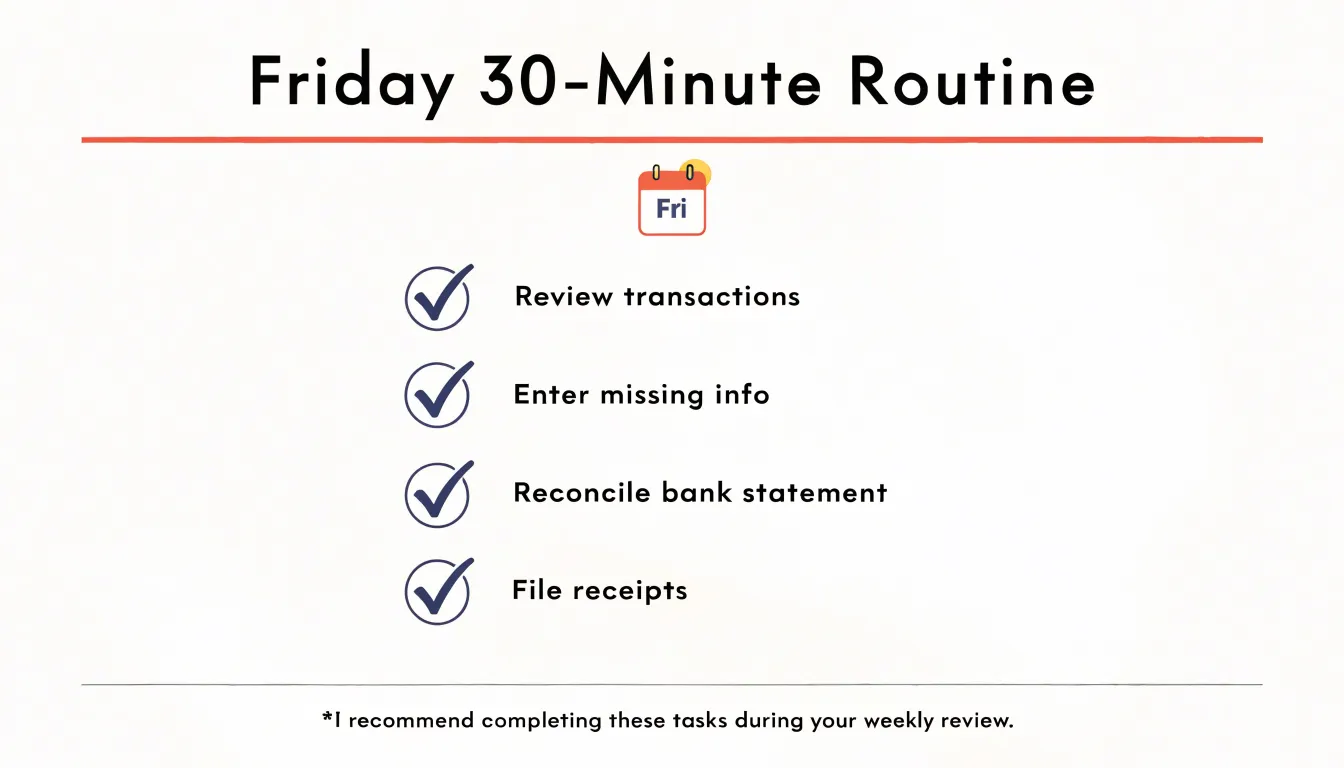
Finally, develop a reliable habit for tracking receipts. Keep a folder or envelope for paper receipts and use your phone to photograph them as soon as you receive them. Many accounting apps let you snap a photo and attach it directly to the matching transaction. For online purchases, forward email receipts to a dedicated folder. Consistent receipt tracking ensures you can substantiate deductions, resolve disputes, and understand exactly where your money goes. Taken together, these four steps create a solid foundation you can build on as your needs grow.
Frequently Asked Questions
What does accounting track in a business?
Accounting tracks the financial health of a business by recording day-to-day activity in a consistent, organized way, with every sale, purchase, bill paid, and loan taken on updating four core categories: income, expenses, assets, and liabilities.
What is the difference between bookkeeping and accounting?
Bookkeeping records transactions as they happen, assigns each one to the correct account, keeps receipts and invoices organized, reconciles bank statements, and makes sure the numbers add up. Accounting begins where bookkeeping ends by preparing financial statements, analyzing trends, interpreting what the figures mean, and reporting findings to owners, managers, lenders, or tax authorities.
Why do small business owners need accounting?
For a small business owner, accounting begins with tax compliance because every sale, expense, and payroll transaction must be documented accurately to meet legal obligations. It also serves as an early warning system for cash-flow problems by revealing patterns and giving an owner time to adjust before a shortfall becomes a crisis.
What is the difference between financial and managerial accounting?
Financial accounting produces reports for people outside the company, such as investors, lenders, and regulators, and follows standardized rules such as GAAP or IFRS. Managerial accounting serves the internal needs of the organization, is tailored to managers, is forward-looking, and is not bound by external standards.
What are the three essential financial statements?
The three essential financial statements are the balance sheet, the income statement, and the cash flow statement. The balance sheet is a snapshot of what a business owns and owes, the income statement records what was earned and spent over a period, and the cash flow statement tracks the actual movement of money in and out of the business.
How does the double entry system prevent recording mistakes?
Every transaction affects at least two accounts, and the total of the debits must always equal the total of the credits. If an entry is recorded on only one side of the ledger or with mismatched amounts, the totals go out of balance and the error is flagged when a trial balance is run.