
What Is GAAP? The 10 Core Principles Explained
Generally Accepted Accounting Principles (GAAP) are standardized accounting rules issued by the FASB that U.S. companies use to prepare consistent, comparable financial statements. GAAP covers ten core principles, including consistency, sincerity, prudence, going concern, periodicity, materiality, and non-compensation, ensuring investors, lenders, and regulators can trust reported financial information.
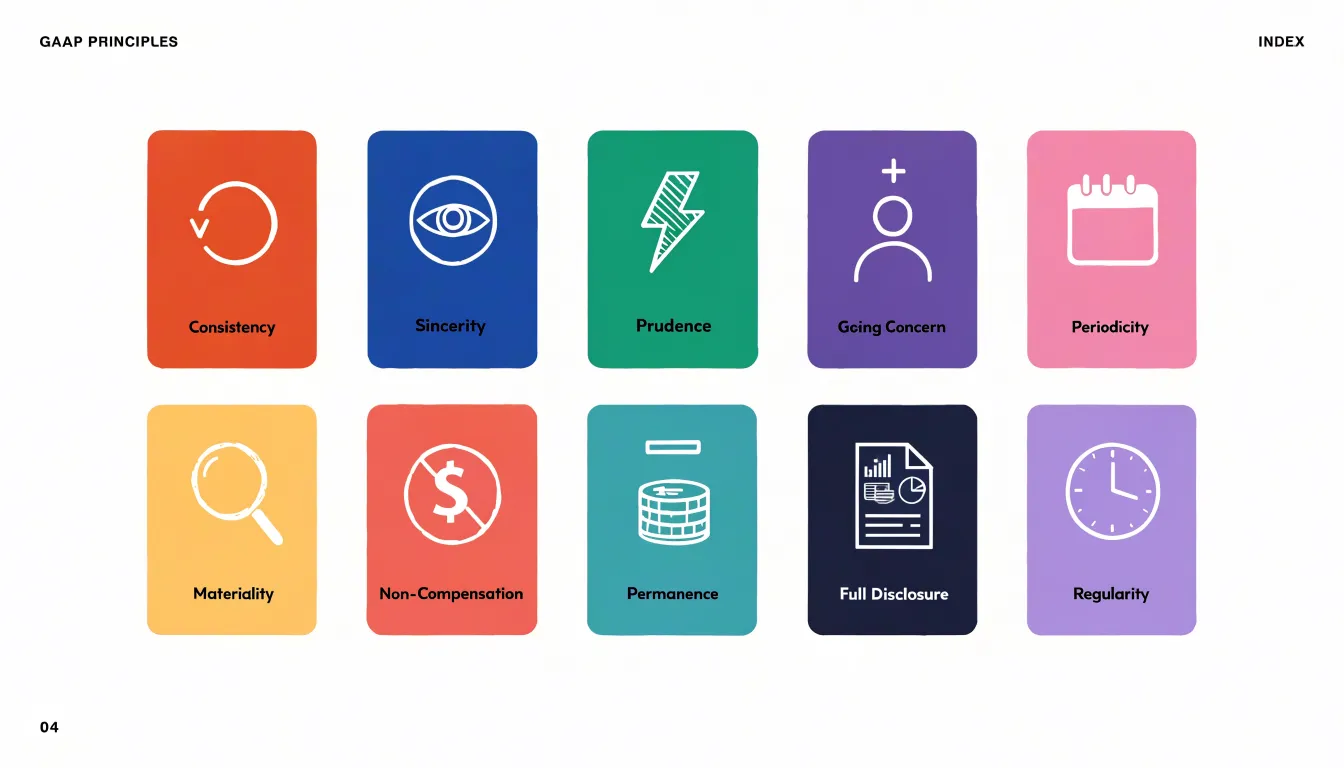
Table of Contents
- What Generally Accepted Accounting Principles Mean for Real World Businesses
- Why Consistency Matters in Financial Reporting
- Principle of Sincerity
- Keeping Methods Permanent Across Accounting Periods
- Why Businesses Cannot Offset Debts Against Assets
- Principle of Prudence
- Assuming Ongoing Operations Through the Going Concern Assumption
- Dividing Business Activity Into Fixed Timeframes
- What Counts as Material Information in Financial Statements
- How GAAP Compares to International Financial Reporting Standards
- Practical Steps for Small Businesses Preparing GAAP Compliant Reports
What Generally Accepted Accounting Principles Mean for Real World Businesses
Generally Accepted Accounting Principles (GAAP) shape the daily operations of businesses by establishing a common financial language. For investors, GAAP-compliant financial statements provide reliability and comparability, which are essential for making informed investment decisions. When a company follows GAAP, investors can trust that the numbers reflect economic reality and can compare performance across different firms. This confidence lowers the cost of capital and enhances a company’s ability to attract investment. Similarly, lenders rely on GAAP financial statements to assess creditworthiness. Banks and other financial institutions often require GAAP-compliant reports as a condition for loan approvals, since these standards reduce the risk of misinterpretation and fraud. For small businesses, however, the cost of compliance can be significant. Implementing GAAP requires investing in accounting software, hiring trained personnel, and possibly engaging external auditors. These costs can be burdensome for startups and small enterprises, which may opt for simpler cash-basis accounting until they seek external financing or face audit requirements. For larger companies, GAAP compliance is more complex and costly, involving rigorous internal controls, audits, and continuous monitoring of new pronouncements. Public companies must also comply with SEC reporting requirements, which are built on GAAP. The auditing requirements under GAAP ensure that financial statements are independently verified, adding credibility but also adding to the expense. Mid-sized companies often face a middle ground, where the need for external credibility grows but resources are still limited. Overall, GAAP affects day-to-day operations by requiring consistent record-keeping, periodic reporting, and adherence to specific measurement and disclosure rules. These practices influence everything from how revenue is recognized to how expenses are matched, impacting managerial decisions and operational workflows. While the cost of compliance can be high, the benefits of investor confidence, easier access to capital, and enhanced credibility often outweigh the drawbacks, making GAAP a cornerstone of financial reporting for businesses of all sizes.
Why Consistency Matters in Financial Reporting
Consistency in financial reporting means that a company applies the same accounting methods, policies, and procedures from one period to the next. When a business chooses a method for valuing inventory, depreciating assets, or recognizing revenue, that choice carries forward into subsequent periods, allowing each new set of financial statements to be read in direct relation to the ones that came before it. This continuity is what gives financial statements their comparative value. An investor reviewing three years of income statements can trace revenue growth, margin trends, and expense patterns with confidence because the underlying measurement rules have remained stable throughout the period.
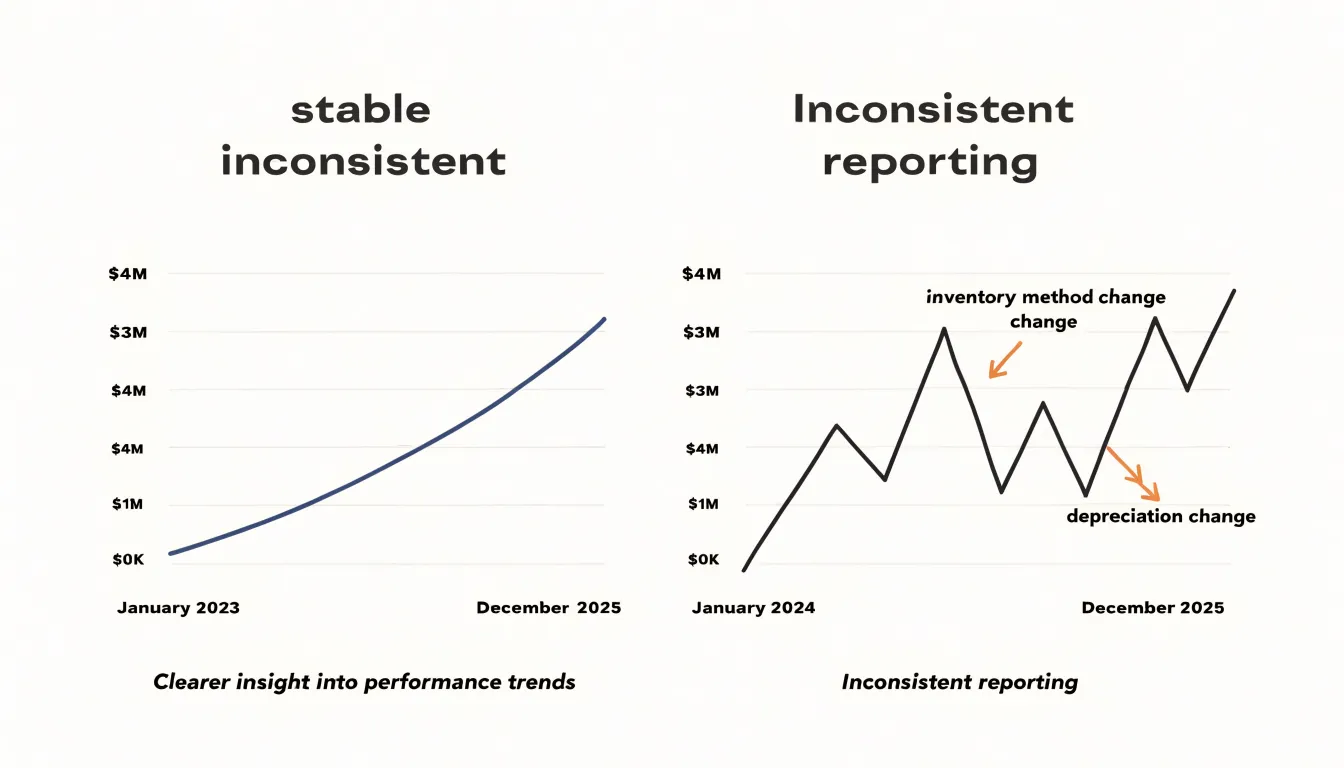
The alternative, frequently changing methods, undermines that comparability. If a company switches inventory valuation approaches or alters its depreciation schedules whenever results look weak, year-over-year figures no longer reflect operating performance. They reflect accounting choices instead. Readers of the statements would struggle to distinguish genuine business improvement from the mechanical effect of a method change, and reported profits could be shifted between periods with little connection to actual economic activity. Consistency closes this door. It constrains management’s ability to select whichever method flatters current results, because the same method must be applied in good years and bad alike.
Consistency also supports the integrity of trend analysis and forecasting. Lenders assessing creditworthiness, analysts building financial models, and auditors testing reported figures all depend on stable measurement conventions. When methods stay the same, variances between periods point to real changes in operations that merit investigation. When methods change frequently, variances become ambiguous and analytical procedures lose their diagnostic power.
GAAP recognizes that circumstances sometimes justify a change, such as a shift in accounting standards or a genuine improvement in how transactions are reported. In those cases, the change must be disclosed along with its nature, justification, and financial impact. This disclosure requirement preserves transparency while acknowledging that consistency is a discipline rather than an absolute prohibition. Applied faithfully, consistency gives stakeholders a reliable basis for comparing performance across time and holds preparers accountable for the numbers they present.
Principle of Sincerity
The principle of sincerity establishes honesty as a foundational obligation in financial reporting. Accountants applying this principle commit to presenting financial information that reflects what actually occurred, without shading figures to produce a more favorable impression of a company’s position. The principle operates alongside the technical rules of GAAP, providing the ethical orientation that guides how those rules are applied in practice. Two organizations can follow identical accounting procedures and still produce very different reports depending on whether sincerity governs their judgment calls.
In day-to-day application, sincerity touches nearly every stage of the reporting cycle. When an accountant records revenue, the principle requires that the transaction genuinely occurred and that the amount recognized matches the economic reality of the arrangement. When management estimates an allowance for doubtful accounts, sincerity calls for a figure grounded in actual collection experience rather than one chosen to smooth earnings. The principle also reaches presentation choices: how transactions are classified, what appears in footnotes, and whether unfavorable developments receive the same visibility as favorable ones. Omitting a material liability or burying a contingent loss in vague language conflicts with the honesty the principle demands.
The principle carries particular weight because GAAP relies heavily on professional judgment. Standards cannot anticipate every transaction, so accountants routinely interpret, estimate, and classify. Sincerity provides the commitment that keeps those judgments anchored to facts. Without it, technically compliant reporting can still mislead readers who depend on the statements to make lending, investing, or contracting decisions.
Sincerity also supports the credibility of the entire financial reporting system. Investors, creditors, and regulators extend trust on the assumption that reported numbers mean what they appear to mean. When that assumption erodes, capital becomes costlier and markets function less efficiently. For individual accountants, the principle reinforces professional integrity and the discipline to resist pressure from managers who might prefer a flattering portrayal over an accurate one. It stands as a reminder that the purpose of financial statements is to inform, and that purpose is served only when the information presented is both complete and truthful.
Keeping Methods Permanent Across Accounting Periods
The permanence principle requires that a company apply its chosen accounting methods consistently from one accounting period to the next. When a business selects a method for valuing inventory, depreciating assets, or recognizing revenue, that method becomes the baseline against which future periods are measured. Consistency gives readers of financial statements a stable frame of reference. An investor comparing this year’s gross margin to last year’s can attribute differences to actual business performance rather than to a shift in how costs were calculated. Without this stability, trends lose meaning and comparisons across periods become unreliable.
This requirement does not lock a company into a method forever. Circumstances arise that justify a change: new accounting standards take effect, a business model evolves, or a previously chosen method no longer reflects the underlying economics accurately. The principle asks that any such change rest on a sound rationale rather than convenience or a desire to flatter results in a given year. A company that switches inventory costing methods simply because the new approach produces a more favorable profit figure in a weak quarter has crossed from legitimate adaptation into manipulation.
When a justified change occurs, disclosure becomes the safeguard. Accounting rules require the company to explain the nature of the change, the reason for it, and its financial effect. Statements typically show the impact on prior periods, either through restatement or a cumulative adjustment, so that readers can see the numbers as if the new method had always been in use. Notes to the financial statements describe the transition in plain terms, including dollar amounts where material. This transparency allows analysts to separate the effect of the accounting change from the effect of genuine operational shifts.
The permanence principle ultimately serves comparability and trust. Financial statements function as a record of performance over time, and that record holds value only when the rules of measurement stay steady. Consistency, paired with full disclosure when methods must change, gives stakeholders confidence that the numbers they review reflect real economic activity and that any variation in reported results has been explained openly.
Why Businesses Cannot Offset Debts Against Assets
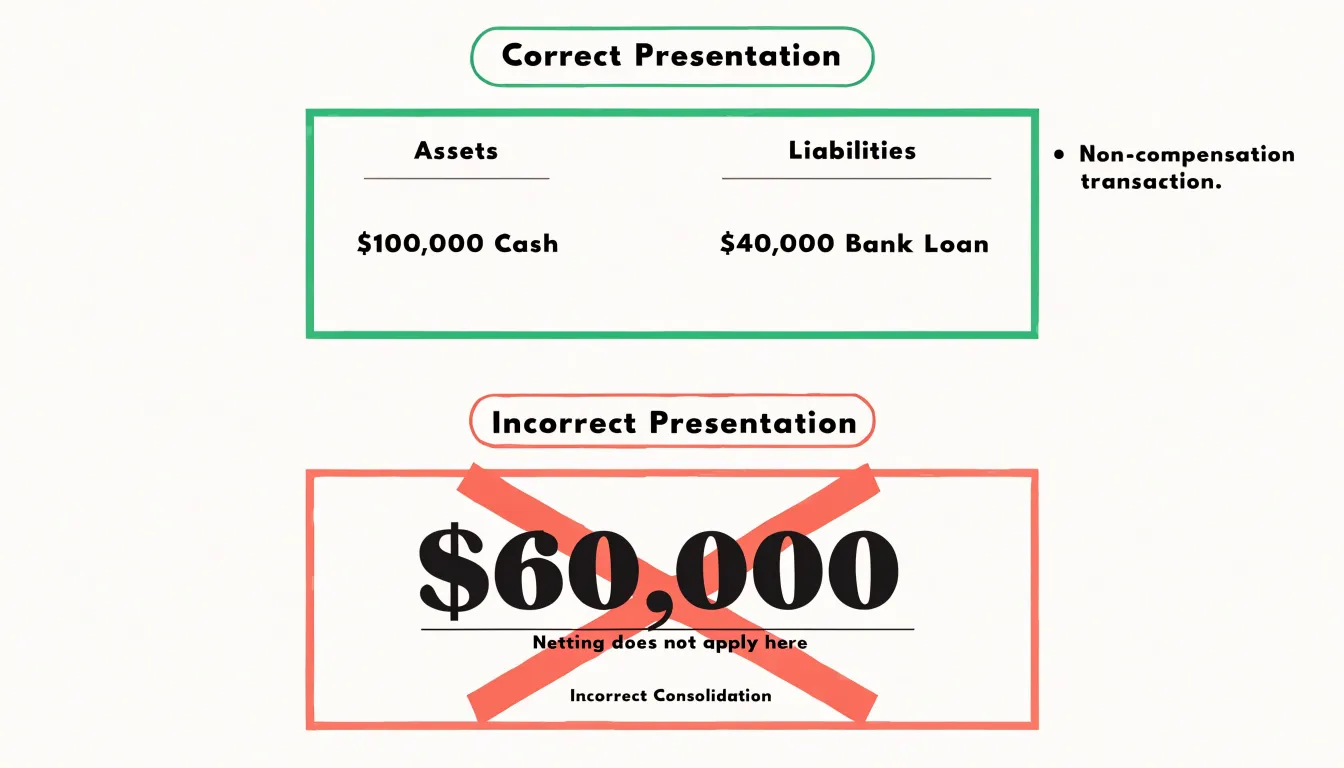
The non-compensation principle, one of the ten core GAAP principles, prohibits businesses from offsetting debts against assets. This means that when preparing financial statements, a company cannot net a liability against an asset to present a single reduced figure. Instead, both the asset and the liability must be reported separately at their full amounts. The rationale behind this rule is to ensure that financial statements provide a complete and transparent view of a company’s financial position, rather than a misleading net figure that obscures the true scale of resources and obligations.
For example, suppose a business holds $100,000 in cash and also has a $40,000 bank loan outstanding. Under the non-compensation principle, the balance sheet must show $100,000 in cash as an asset and $40,000 as a liability. The business cannot simply report $60,000 as a net cash position. While the net figure might seem convenient, it hides the fact that the company has a significant loan obligation and a substantial cash balance. Stakeholders, including investors, creditors, and analysts, need to see both sides to assess liquidity, solvency, and financial flexibility accurately.
The principle applies broadly across all financial statement elements. For instance, accounts receivable should not be reduced by an allowance for doubtful accounts in a way that nets the two together; the gross receivable and the allowance must be presented separately. Similarly, revenue cannot be offset against related expenses to show only net income, and gains cannot be netted against losses unless specifically permitted by GAAP in limited circumstances. The goal is to prevent companies from masking the true nature and magnitude of their transactions.
By requiring separate presentation, the non-compensation principle enhances comparability and reduces the risk of manipulation. A company might be tempted to net items to make its balance sheet appear stronger or its operations more efficient than they really are. GAAP’s prohibition against offsetting debts against assets acts as a safeguard, ensuring that financial statements faithfully represent economic reality. This transparency is essential for informed decision-making by all users of financial statements.
Principle of Prudence
The principle of prudence, often called conservatism, guides accountants to exercise careful judgment when preparing financial statements, particularly when the amounts involved are uncertain. At its core, this principle asks accountants to consider the possible outcomes of uncertain situations and to lean toward the treatment that avoids overstating the financial health of a business. In practice, this means probable losses are recognized as soon as they become reasonably evident, while uncertain gains are treated with far more caution and typically left unrecognized until they are genuinely realized.
Consider a company facing a lawsuit. If legal counsel advises that an unfavorable outcome is probable and the amount can be reasonably estimated, the prudence principle requires the company to record a liability and a corresponding loss right away, even though the case has not yet been settled. Waiting until the verdict arrives would paint an overly rosy picture of the company’s position during the intervening months. The same logic applies to inventory that has declined in value, customer accounts that are unlikely to be collected, or equipment that has become obsolete. In each case, the accountant recognizes the loss or reduction in value promptly so that the financial statements reflect the risks the business actually faces.
The treatment of gains mirrors this caution. Suppose a company expects to win a lawsuit or anticipates a favorable regulatory ruling. Even when the outcome seems likely, the potential gain generally stays off the income statement until it is realized or virtually certain. The reasoning is that hoped-for benefits may never materialize, and recording them early would inflate earnings and mislead readers of the financial statements.
This asymmetric approach produces financial statements that tend to understate rather than overstate a company’s position, giving investors, lenders, and other stakeholders a margin of safety when they assess risk. It also encourages discipline in management reporting, since optimistic projections cannot be booked as results. Because prudence involves judgment, accountants must document the reasoning behind loss provisions and be prepared to revise estimates as new information emerges. Applied consistently, the principle helps ensure that reported figures remain credible and that stakeholders can rely on the statements when making decisions.
Assuming Ongoing Operations Through the Going Concern Assumption
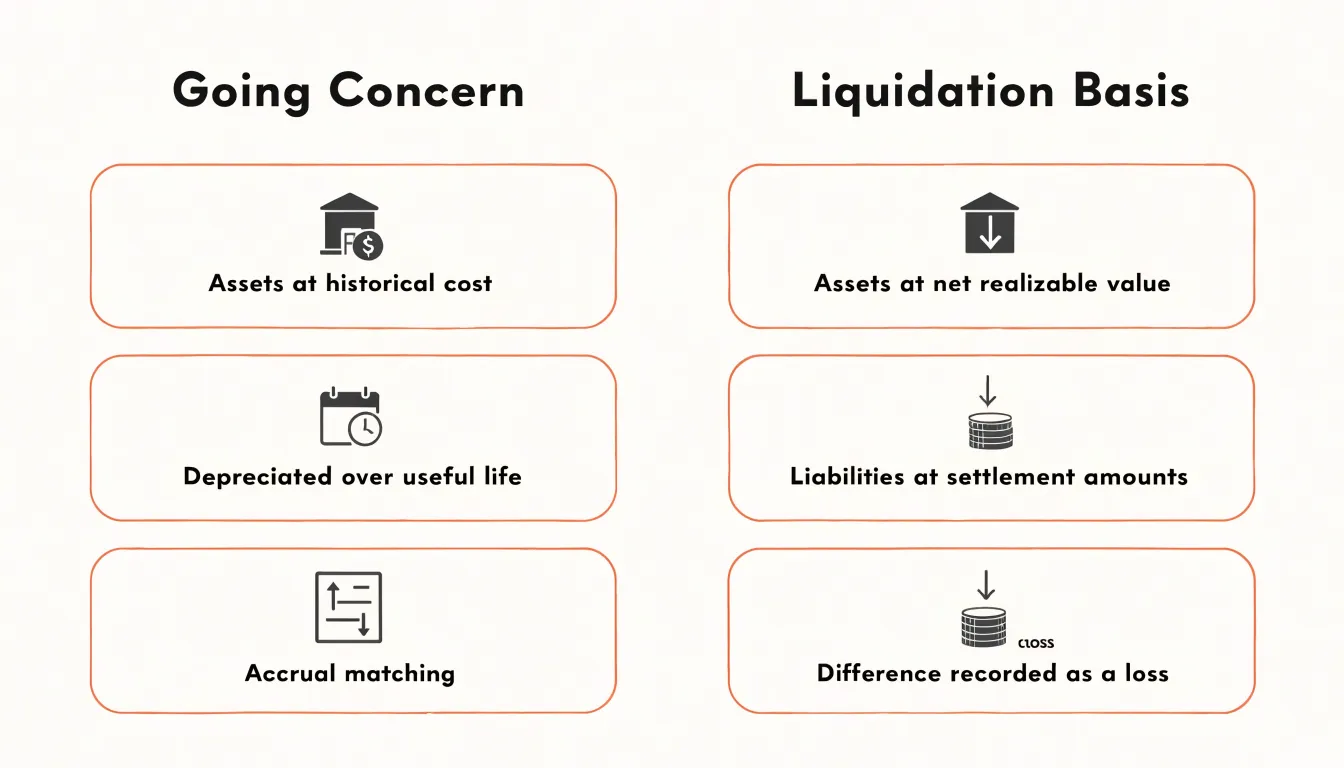
The going concern assumption is one of the foundational ideas behind the preparation of financial statements under GAAP. It holds that a business will continue operating for the foreseeable future, generally understood as at least twelve months from the date the statements are issued, without any intention or necessity to liquidate, cease trading, or seek protection from creditors. This assumption shapes nearly every number that appears on a balance sheet and income statement, because it establishes that the entity is being viewed as a living, functioning operation rather than a collection of assets about to be sold off.
The practical effect of this assumption is that assets are recorded at their historical cost and depreciated or amortized over their useful lives, with no adjustment made to reflect what they would fetch in a forced sale. Inventory is valued at the lower of cost or market in the ordinary course of business. Long-term liabilities are presented as obligations to be settled over time through ongoing operations rather than as claims coming due immediately. Revenue and expense recognition likewise follow the accrual model, matching costs to the periods in which they help generate revenue, because the business is expected to keep operating long enough for those matches to play out.
If an entity could not be viewed as a going concern, the entire basis of accounting would shift to a liquidation basis, under which assets are reported at estimated net realizable value and liabilities at amounts expected to be settled, with the difference treated as a loss. Preparing statements on a non-liquidation basis therefore depends entirely on the going concern assumption holding true. Management is responsible for assessing whether substantial doubt exists about the entity’s ability to continue operating, considering factors such as recurring losses, loan defaults, loss of a major customer, or difficulty renewing financing. When such doubt arises, GAAP requires disclosure and, in some cases, a revised presentation. Absent that determination, readers can interpret the statements as reflecting a business that intends to keep running, keep honoring its obligations, and keep using its assets productively, which gives the reported figures their meaning and comparability from one period to the next.
Dividing Business Activity Into Fixed Timeframes
The periodicity principle addresses a practical problem at the heart of financial reporting: a business operates as a continuous flow of transactions, yet anyone reading its financial statements needs information tied to defined windows of time. Sales occur daily, expenses accumulate steadily, and cash moves in and out without pause. To make sense of this activity, accounting divides it into fixed reporting periods, most commonly months, quarters, and fiscal years. These boundaries are artificial by design, chosen because readers of financial statements need regular, comparable snapshots rather than an endless stream of raw data. A lender evaluating a loan application wants to see results for a specific quarter or year, and an investor comparing two companies needs both to report over the same intervals.
Applying the principle requires accountants to decide where one period ends and the next begins, then assign transactions accordingly. Most activity falls neatly into the period in which it occurs, but some events straddle boundaries. A large equipment purchase, for example, is recorded as an asset and allocated as depreciation across the periods that benefit from its use. Revenue earned over several months, such as a service contract, is recognized in portions as the work is performed. Accruals and deferrals handle items like wages earned but not yet paid or insurance premiums paid in advance, moving them into the period where they economically belong. These adjustments keep each reporting period internally consistent and prevent distortion of results.
The choice of period length involves tradeoffs. Shorter periods give managers and investors more timely information, yet they require more estimates and cutoffs, which increases the chance of timing errors. Annual reporting allows more complete information but arrives too late to guide many decisions. Most organizations therefore report quarterly for internal and external purposes while closing the books formally at year-end. Consistency matters as well: keeping the same fiscal calendar from period to period allows meaningful trend analysis, and regulators such as the SEC require publicly traded companies to file reports on a predictable schedule. The periodicity principle ultimately makes financial statements comparable across time and across companies, which is what gives them their analytical value.
What Counts as Material Information in Financial Statements
Materiality is the threshold that determines which information must be disclosed in financial statements. Under GAAP, information is material when its omission or misstatement would influence the decisions of a reasonable person relying on those statements. This definition ties disclosure obligations directly to the needs of users such as investors, lenders, and creditors, who depend on financial reports to assess a company’s financial position and performance.
Applying materiality requires judgment rather than a fixed numerical cutoff. Accountants commonly evaluate materiality in both quantitative and qualitative terms. Quantitatively, a company might treat misstatements above a certain percentage of total assets, revenue, or net income as material. Qualitatively, even a small dollar amount can be material if it affects a key metric like compliance with a debt covenant, changes a reported loss into a profit, or involves a transaction with related parties. The context surrounding a figure matters as much as its size.
Materiality shapes the scope of note disclosures as well. Companies must disclose accounting policies, contingent liabilities, subsequent events, and segment information when those items are significant enough to affect user decisions. A pending lawsuit with an uncertain outcome may warrant disclosure even before any amount is recorded, because users need to understand the potential risk. Similarly, changes in accounting estimates or methods must be explained when they materially affect comparability across periods.
Materiality also interacts with the cost-benefit constraint in financial reporting. Preparing and auditing detailed disclosures carries real costs, so GAAP permits companies to omit immaterial items that would add clutter without adding decision-useful information. This keeps financial statements focused on the information that matters most to users.
Because materiality depends on professional judgment, auditors test management’s materiality assessments and evaluate whether disclosures are complete. Regulators such as the SEC also scrutinize whether companies have used materiality claims to justify omitting information investors would find important. A well-applied materiality standard supports financial statements that are both complete enough to inform decisions and concise enough to remain readable.
How GAAP Compares to International Financial Reporting Standards
U.S. GAAP and International Financial Reporting Standards (IFRS) are the two dominant accounting frameworks in global finance, and understanding how they diverge matters for anyone reading or preparing financial statements across borders. GAAP is issued by the Financial Accounting Standards Board (FASB) and is used primarily by U.S. public companies, while IFRS is set by the International Accounting Standards Board (IASB) and is required or permitted in more than 140 jurisdictions worldwide, including the European Union, the United Kingdom, Canada, and Australia.
One of the most frequently cited distinctions lies in the structure of each framework. GAAP is often described as rules-based: it provides detailed, prescriptive guidance with specific thresholds and industry-specific requirements that preparers must follow closely. IFRS leans toward a principles-based model, offering broader guidance that relies on professional judgment and the substance of a transaction rather than bright-line tests. In practice, this means a GAAP preparer may consult extensive implementation guidance to determine, for example, whether a lease qualifies for a particular classification, while an IFRS preparer applies a more general principle and documents the reasoning behind the conclusion.
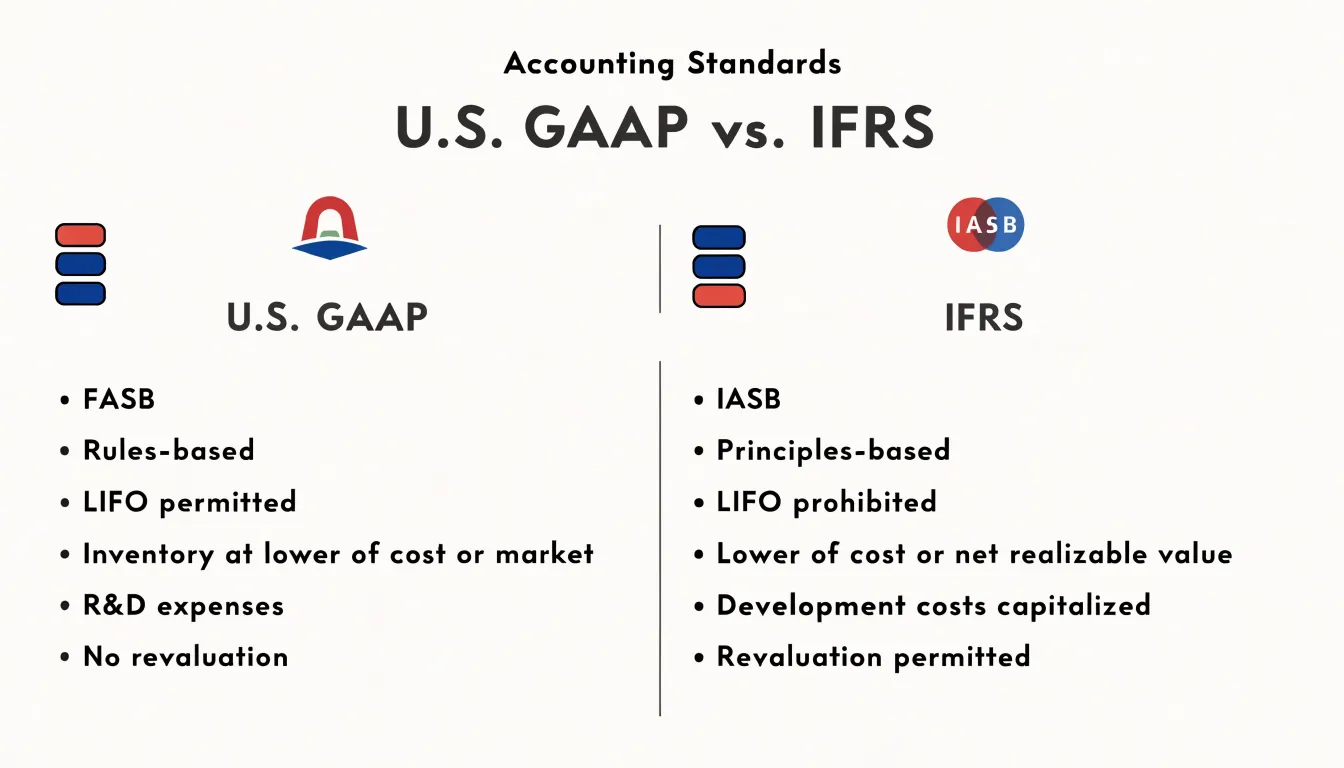
The differences carry through to specific accounting areas. Under GAAP, inventory is measured at the lower of cost or market, and reversals of inventory write-downs are prohibited. IFRS uses the lower of cost or net realizable value and permits write-down reversals when conditions improve. Research and development costs are largely expensed under GAAP, whereas IFRS allows development costs to be capitalized when specific criteria are met. GAAP generally prohibits revaluation of property, plant, and equipment, while IFRS permits it. Rules for revenue recognition, lease accounting, and financial instruments also differ in detail and application, even where the two boards have converged on high-level objectives.
For multinational companies, these differences have practical consequences. A parent company reporting under GAAP with foreign subsidiaries reporting under local IFRS-based standards may need to maintain two sets of records or perform reconciliation adjustments at consolidation. Dual reporting adds compliance cost, demands specialized expertise, and can complicate comparisons between the company and international peers. Analysts and investors evaluating cross-border companies should likewise confirm which framework was applied before drawing conclusions from ratios or margins. While the FASB and IASB have worked toward convergence on several projects, meaningful differences remain, and companies operating internationally should plan for them in their reporting processes and controls.
Practical Steps for Small Businesses Preparing GAAP Compliant Reports
Small business owners preparing GAAP compliant reports benefit from following a structured sequence of practical steps that make the process manageable and repeatable. Begin by selecting accounting software that supports double-entry bookkeeping, since every GAAP-compliant report rests on that foundation. Look for platforms that allow you to customize a chart of accounts, generate standard financial statements, and maintain an audit trail of every transaction. Many mid-range packages offer templates aligned with GAAP presentation conventions, which reduces formatting errors when you produce balance sheets, income statements, and statements of cash flows. Once the software is in place, invest time in setting it up correctly, mapping each account to the appropriate financial statement line, and establishing consistent transaction categories so reports remain comparable from period to period.
The next step involves bringing in qualified professionals. A certified public accountant or a bookkeeper with GAAP experience can review your setup, advise on revenue recognition and expense matching, and help you interpret the standards relevant to your industry. Engaging a professional early is usually less expensive than correcting misstated reports later, and their involvement lends credibility to financial statements shared with lenders or investors. Alongside professional support, document your accounting policies in writing. A concise policies manual should describe how you record revenue, depreciate assets, value inventory, and handle accruals. Written policies create consistency when multiple people touch the books and provide a reference point during audits or due diligence.
Finally, build a routine of regular reviews. Schedule monthly or quarterly reconciliations of bank and credit card accounts, compare actual results against budgets, and verify that adjusting entries such as depreciation and accrued expenses are recorded before closing each period. A review checklist helps catch omissions and ensures that reports reflect the underlying transactions accurately. Keep supporting documentation for every entry so that any figure in your statements can be traced back to source records. By combining the right software, professional guidance, written policies, and consistent review practices, small businesses can produce GAAP compliant reports with confidence and keep their financial reporting dependable as they grow.
Frequently Asked Questions
What is GAAP and why does it matter to investors and lenders?
GAAP establishes a common financial language, giving investors reliability and comparability in financial statements. Lenders often require GAAP-compliant reports as a condition for loan approvals because these standards reduce the risk of misinterpretation and fraud.
Why is consistency important in financial reporting?
Consistency means applying the same accounting methods, policies, and procedures from one period to the next, which gives financial statements comparative value. Frequent method changes make variances ambiguous and can shift reported profits with little connection to actual economic activity, though justified changes must be disclosed along with their nature, justification, and financial impact.
Can a business offset debts against assets under GAAP?
No. The non-compensation principle prohibits netting a liability against an asset, so both must be reported separately at their full amounts. For example, cash and a bank loan must be shown separately rather than as a single reduced net figure.
What is the prudence principle in accounting?
Prudence, often called conservatism, guides accountants to exercise careful judgment when amounts are uncertain. Probable losses are recognized as soon as they become reasonably evident, while uncertain gains are generally left unrecognized until they are genuinely realized or virtually certain.
What does going concern mean in GAAP?
The going concern assumption holds that a business will continue operating for the foreseeable future, generally understood as at least twelve months from the date the statements are issued, without intention or necessity to liquidate, cease trading, or seek protection from creditors. This assumption shapes how assets, liabilities, revenue, and expenses are recognized in the financial statements.
How does GAAP differ from IFRS?
GAAP is issued by the Financial Accounting Standards Board and is used primarily by U.S. public companies, while IFRS is set by the International Accounting Standards Board and is required or permitted in more than 140 jurisdictions worldwide. GAAP is often described as rules-based with detailed, prescriptive guidance, whereas IFRS leans toward a principles-based model that relies on professional judgment and the substance of a transaction. The frameworks also differ in areas such as inventory measurement, research and development costs, and revaluation of property, plant, and equipment.