
Working Capital
Working capital is the difference between a company’s current assets (cash, receivables, inventory) and current liabilities (payables, short-term debt, accrued expenses), calculated as current assets minus current liabilities. It measures the short-term liquidity available to fund daily operations, cover near-term obligations, and absorb unexpected costs without borrowing.
Table of Contents
- What working capital measures in your daily business operations
- The standard working capital formula and how to calculate it
- Working Capital Ratio
- How to calculate working capital using a real balance sheet example
- What counts as a healthy working capital ratio for growing companies
- Positive versus negative working capital and what each means for cash flow
- Actionable Strategies
- Optimizing inventory management to free up tied up operational cash
- Negotiating vendor payment terms without damaging supplier relationships
What working capital measures in your daily business operations
Working capital measures the money a business has available to fund its day-to-day operations. Calculated as current assets minus current liabilities, it captures the resources a company can put to work in the near term. In practical terms, working capital represents the cushion between what a business owns in the form of cash, receivables, and inventory, and what it owes in the form of short-term debts, supplier payments, and accrued expenses. That cushion determines how smoothly daily operations run.
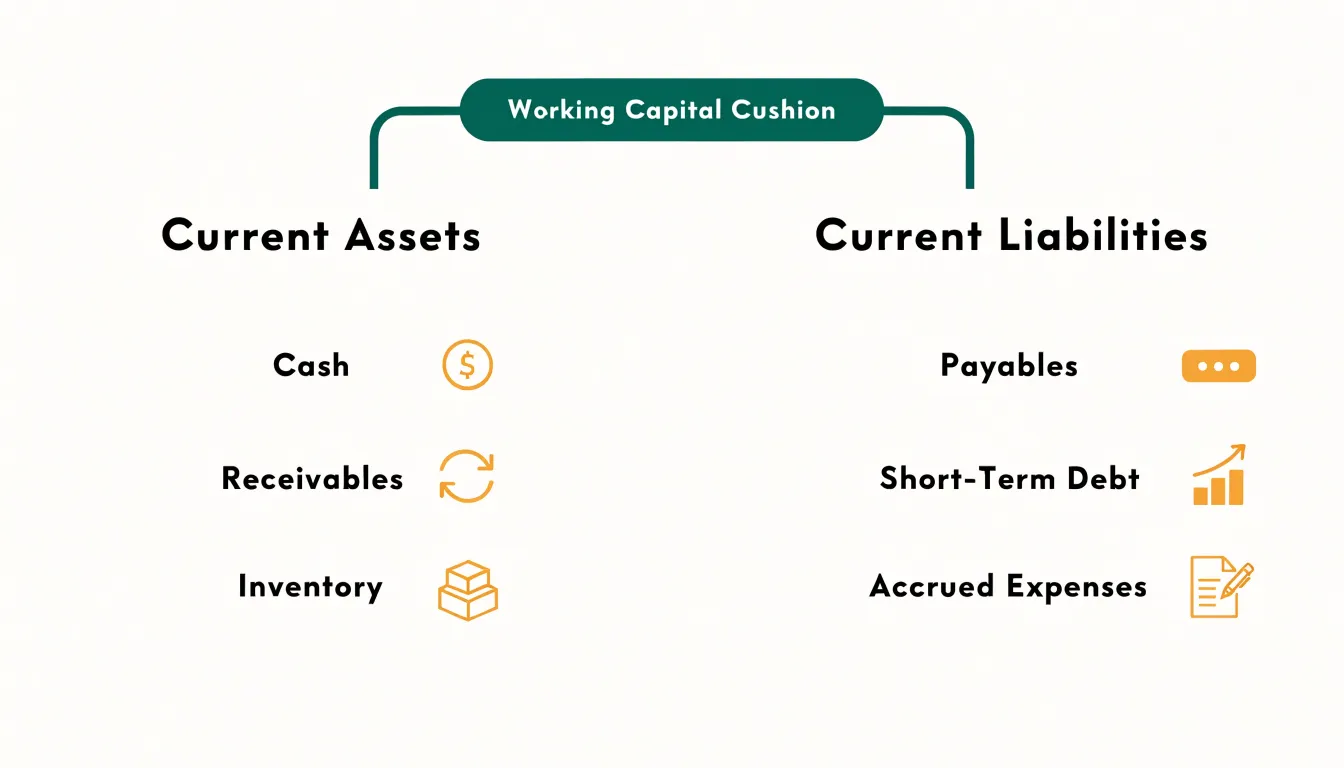
One of the clearest ways working capital shows up is in a company’s ability to cover short-term obligations. Every business faces a recurring cycle of bills: rent, utilities, loan installments, supplier invoices, and taxes. When working capital is sufficient, these obligations are met on time and without strain. When it tightens, payments get delayed, relationships with suppliers suffer, and the business may need to borrow at unfavorable terms just to stay current.
Working capital also funds the daily expenses that keep operations moving. Payroll is a constant, whether or not revenue has arrived that week. Inventory must be purchased and restocked before customers buy it. Marketing, maintenance, and routine supplies all draw on the same pool of resources. A healthy level of working capital allows a business to meet these costs as they arise, keeping production and service delivery uninterrupted.
Unexpected costs are another area where working capital proves its value. Equipment breaks down, a key customer pays late, or an unforeseen opportunity appears that requires quick investment. Businesses with adequate working capital can absorb these shocks without scrambling. Those running too lean may find themselves forced into reactive decisions, such as cutting staff or taking on high-interest debt.
Tracking working capital regularly gives managers a running picture of short-term financial health. It reveals whether the business is generating enough liquidity to sustain itself and highlights trends, such as rising receivables or swelling inventory, that can signal trouble ahead.
The standard working capital formula and how to calculate it
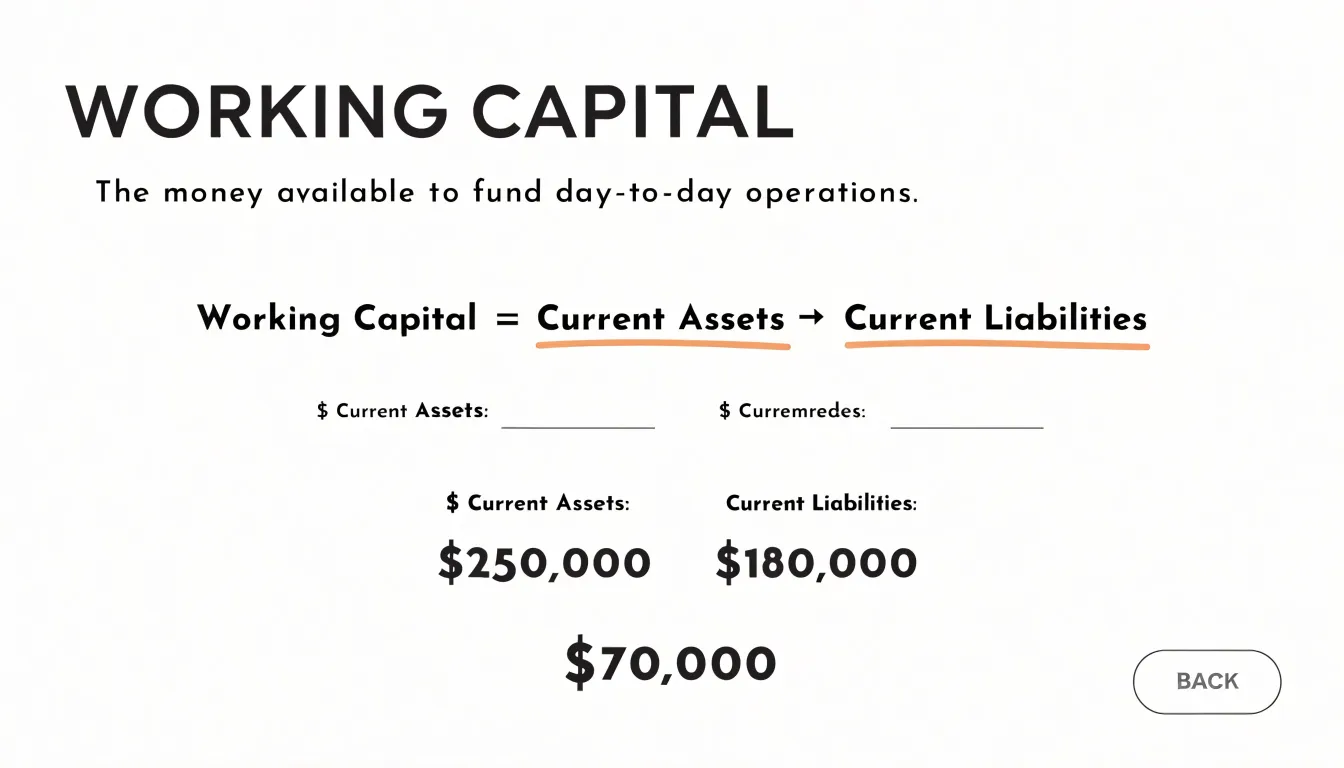
The standard working capital formula is straightforward: working capital equals current assets minus current liabilities. This single subtraction captures the short-term financial position of a business, measuring the liquid resources available to fund day-to-day operations after obligations due within a year are accounted for. The result, expressed as a dollar amount, tells a business owner or analyst how much cushion exists to absorb unexpected costs, seize supplier discounts, or bridge timing gaps between paying expenses and collecting revenue.
Current assets form the first component of the formula. These are resources expected to be converted into cash, sold, or consumed within one operating cycle, typically twelve months. Common examples include cash and cash equivalents, marketable securities, accounts receivable, inventory, and prepaid expenses. Each item represents value the business can draw upon in the near term, though the speed of conversion varies considerably; cash is immediately available while inventory must first be sold and receivables collected.
Current liabilities make up the second component. These are obligations the business expects to settle within the same twelve-month window. Typical items include accounts payable, accrued expenses such as wages and taxes, short-term debt, the current portion of long-term debt, and customer deposits or deferred revenue. These represent claims on the business’s resources that will come due in the near future and must be met to maintain operations and creditor relationships.
Calculating working capital follows a simple sequence of steps. First, gather the balance sheet for the period under review and identify the current assets section, totaling every line item classified as short-term. Second, locate the current liabilities section and sum all obligations due within a year. Third, subtract total current liabilities from total current assets. The resulting figure is the working capital balance. As an illustration, a company with $250,000 in current assets and $180,000 in current liabilities has working capital of $70,000. A positive result indicates sufficient short-term resources to cover near-term obligations, while a negative result signals a shortfall that may require additional financing or faster collection of receivables. Because the calculation relies on balance sheet figures from a single point in time, analysts often track the measure across multiple periods to observe trends rather than relying on one snapshot alone.
Working Capital Ratio
The working capital ratio, often called the current ratio, is one of the most direct measures of a company’s short-term financial health. It is calculated by dividing current assets by current liabilities. Current assets include cash, accounts receivable, inventory, and other items expected to be converted into cash within one year. Current liabilities cover obligations due within the same period, such as accounts payable, short-term debt, accrued expenses, and taxes owed. The resulting figure expresses how many dollars of liquid resources stand behind each dollar of near-term obligation.
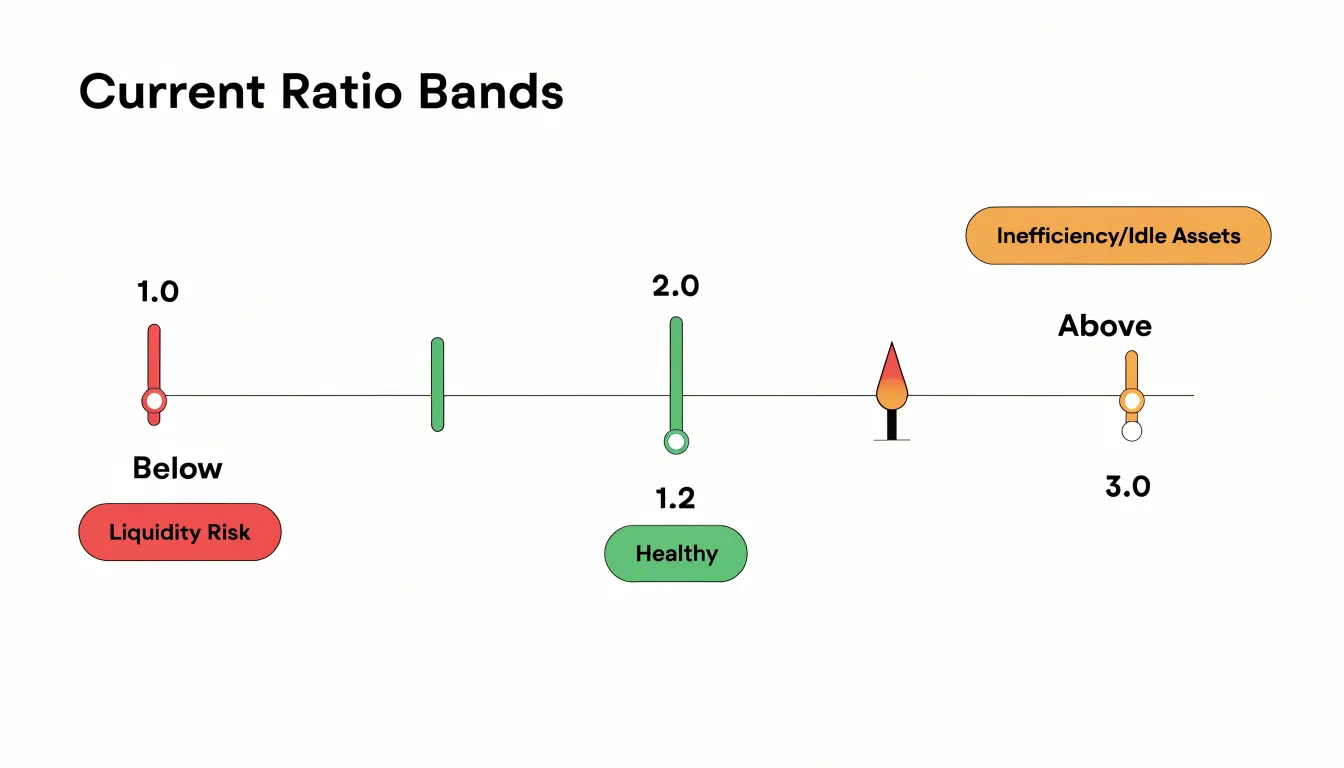
Interpreting the result begins with the number one. A ratio of 1.0 means current assets exactly cover current liabilities, leaving no cushion for surprises. A ratio above 1.0 indicates a surplus of liquid resources relative to obligations, while a ratio below 1.0 signals that near-term liabilities exceed the assets available to meet them, a condition that can force borrowing, asset sales, or delayed payments.
Different ranges carry different implications. Ratios between roughly 1.5 and 2.0 are commonly viewed as comfortable, offering enough buffer to absorb temporary shortfalls without tying up excessive resources. A ratio below 1.0 raises questions about liquidity and may indicate a company struggling to fund day-to-day operations. Very high ratios, say above 3.0, can point to inefficiency: excess cash sitting idle, inventory accumulating faster than it sells, or receivables that are not being collected promptly. In these cases, the company may be leaving returns on the table or masking operational problems behind a strong-looking balance sheet.
Context shapes the reading. Capital-intensive manufacturers may operate comfortably below 2.0 because inventory turns quickly, while service businesses with few physical assets may run leaner ratios. Seasonal businesses often show ratio swings across the year. Analysts therefore compare a company’s ratio to its own history and to industry peers rather than applying a fixed benchmark. The ratio also pairs well with faster-moving measures such as the quick ratio, which strips out inventory, to confirm whether liquidity is genuine or merely tied up in stock.
How to calculate working capital using a real balance sheet example
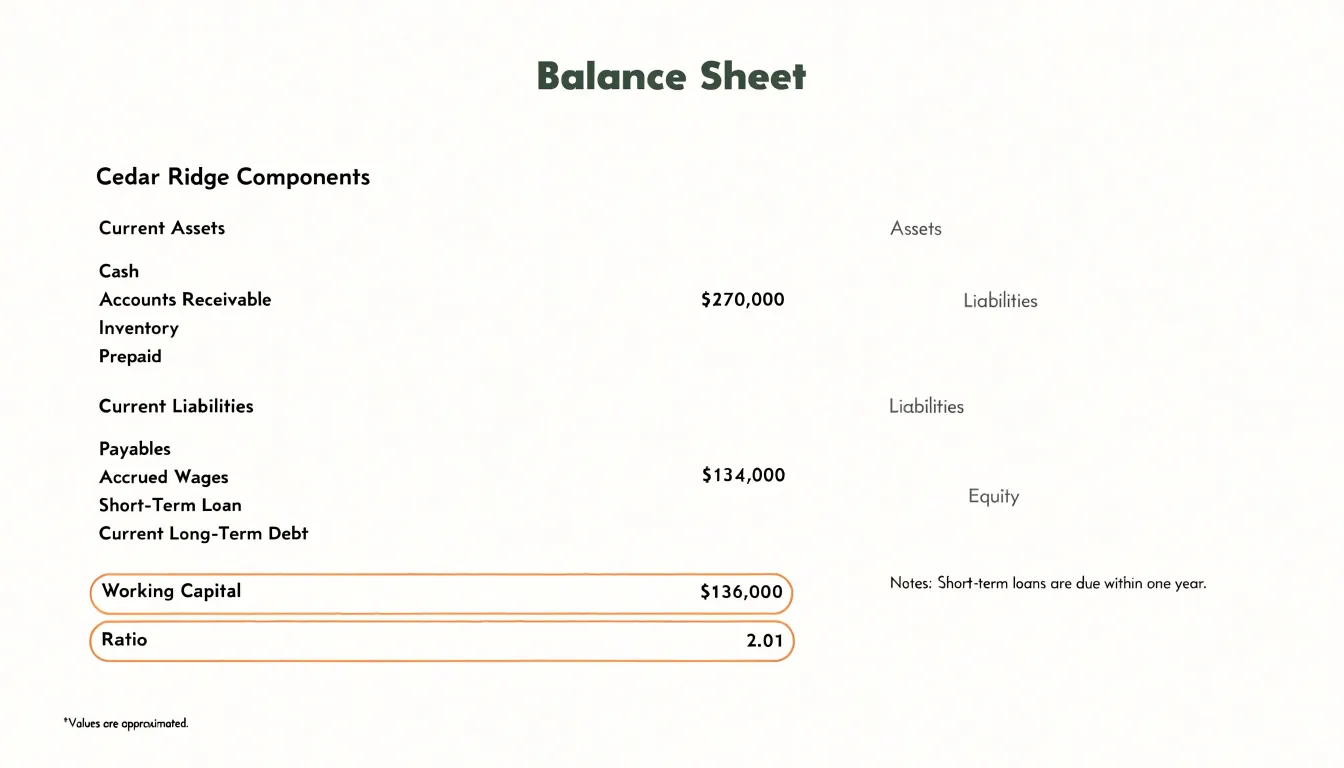
To see how working capital is calculated in practice, consider a sample balance sheet for a small manufacturing business, Cedar Ridge Components, at the close of its fiscal year. The asset side lists cash of $48,000, accounts receivable of $112,000, inventory of $95,000, and prepaid expenses of $15,000. These are the current assets, meaning items the company expects to convert into cash or consume within one year. Summing them gives total current assets of $270,000.
On the liabilities side, the same balance sheet shows accounts payable of $64,000, accrued wages of $18,000, a short-term loan of $40,000 due in eight months, and the current portion of long-term debt at $12,000. These obligations must be settled within the same one-year window, so they count as current liabilities. Together they total $134,000.
Working capital is simply current assets minus current liabilities: $270,000 minus $134,000 equals $136,000. That figure represents the cushion of liquid resources Cedar Ridge has left after covering its near-term obligations, money it can direct toward day-to-day operations, inventory purchases, or unexpected costs.
A raw dollar figure is useful, but it becomes far more meaningful alongside the current ratio, which divides current assets by current liabilities. For Cedar Ridge, that is $270,000 divided by $134,000, giving a current ratio of roughly 2.01. In practical terms, the company holds about two dollars of current assets for every dollar of current liabilities, a comfortable position for most manufacturers.
The exercise also highlights why classification matters. Each line item must be checked against the one-year threshold; a loan due in fourteen months, for instance, would move to long-term liabilities and change the result. Analysts often repeat this calculation across several periods, watching whether the ratio drifts upward or downward, and comparing it against industry norms. A ratio that climbs steadily may signal idle cash or slow-moving inventory, while one that falls toward 1.0 can warn of tightening liquidity. Walking through a real balance sheet line by line makes these judgments concrete and shows how two simple figures, drawn directly from the statement, capture a company’s short-term financial flexibility.
What counts as a healthy working capital ratio for growing companies
For most businesses, a working capital ratio between 1.2 and 2.0 is considered a reasonable target. A ratio of 1.2 means that for every dollar of current liabilities, the company holds $1.20 in current assets, providing a modest cushion to absorb short-term obligations. At the upper end, a ratio of 2.0 signals a comfortable buffer, with two dollars of current assets available for every dollar owed in the near term. Ratios within this band suggest that a company can meet its bills, payroll, and supplier commitments without strain, while still deploying a reasonable share of its resources toward growth rather than holding excessive idle assets.
Growing companies, however, often benefit from operating toward the higher end of that range, and sometimes above it. Expansion consumes cash in predictable ways: inventory levels rise to support larger sales volumes, receivables grow as new customers are added, and upfront spending on hiring, marketing, or equipment often precedes the revenue it generates. A company in this phase faces a working capital gap, and a thinner ratio can leave it exposed if a large order arrives before collections catch up or if a key customer pays late. Holding a ratio closer to 1.5 or 2.0 gives a growing business the flexibility to seize opportunities and absorb timing mismatches without resorting to emergency borrowing.
The ideal ratio depends on several factors that vary by industry and circumstance. Companies with fast inventory turnover, such as grocery retailers, can operate comfortably at lower ratios because their stock converts to cash quickly. Businesses with long production cycles or slow collection periods, such as manufacturers or construction firms, typically need higher ratios to cover the extended gap between spending and receiving payment. The predictability of cash flows also matters: steady, recurring revenue models require less of a buffer than seasonal or project-based businesses. Access to credit lines can reduce the need for a large asset cushion, since shortfalls can be covered through borrowing. Finally, the composition of current assets deserves attention, because inventory and receivables are less liquid than cash, and a ratio built largely on slow-moving stock may overstate true financial flexibility.
Positive versus negative working capital and what each means for cash flow
Working capital is calculated as current assets minus current liabilities, and the resulting figure can be either positive or negative. Each outcome tells a distinct story about a company’s liquidity, operational rhythm, and the way cash moves through the business.
Positive working capital means a company holds more short-term assets, such as cash, receivables, and inventory, than it owes in short-term obligations like payables and upcoming debt payments. This position generally signals financial stability. The business has a buffer that allows it to meet obligations as they come due, absorb unexpected expenses, and continue funding day-to-day operations without scrambling for emergency financing. From a cash flow perspective, positive working capital provides breathing room: incoming cash from sales covers outgoing payments with room to spare, and management can plan expenditures with greater confidence. The caveat is that excess working capital can also indicate inefficiency, such as cash sitting idle or inventory accumulating faster than it sells, which ties up resources that might otherwise be deployed productively.
Negative working capital occurs when current liabilities exceed current assets. On its face, this raises the prospect of liquidity issues. If obligations come due before receivables convert into cash, the company may struggle to pay suppliers, cover payroll, or service debt, potentially forcing reliance on credit lines or other short-term borrowing. Persistent negative working capital can strain cash flow management, since every payment cycle becomes a tight balancing act between what is owed and what has actually been collected. In severe cases, it can precede insolvency.
That said, negative working capital is not automatically a warning sign. Businesses that collect payment from customers upfront while paying suppliers on extended terms, such as certain retailers or subscription services, can operate with negative working capital quite comfortably, effectively using customer cash to fund operations. The meaning depends heavily on the underlying business model and the timing of cash inflows and outflows.
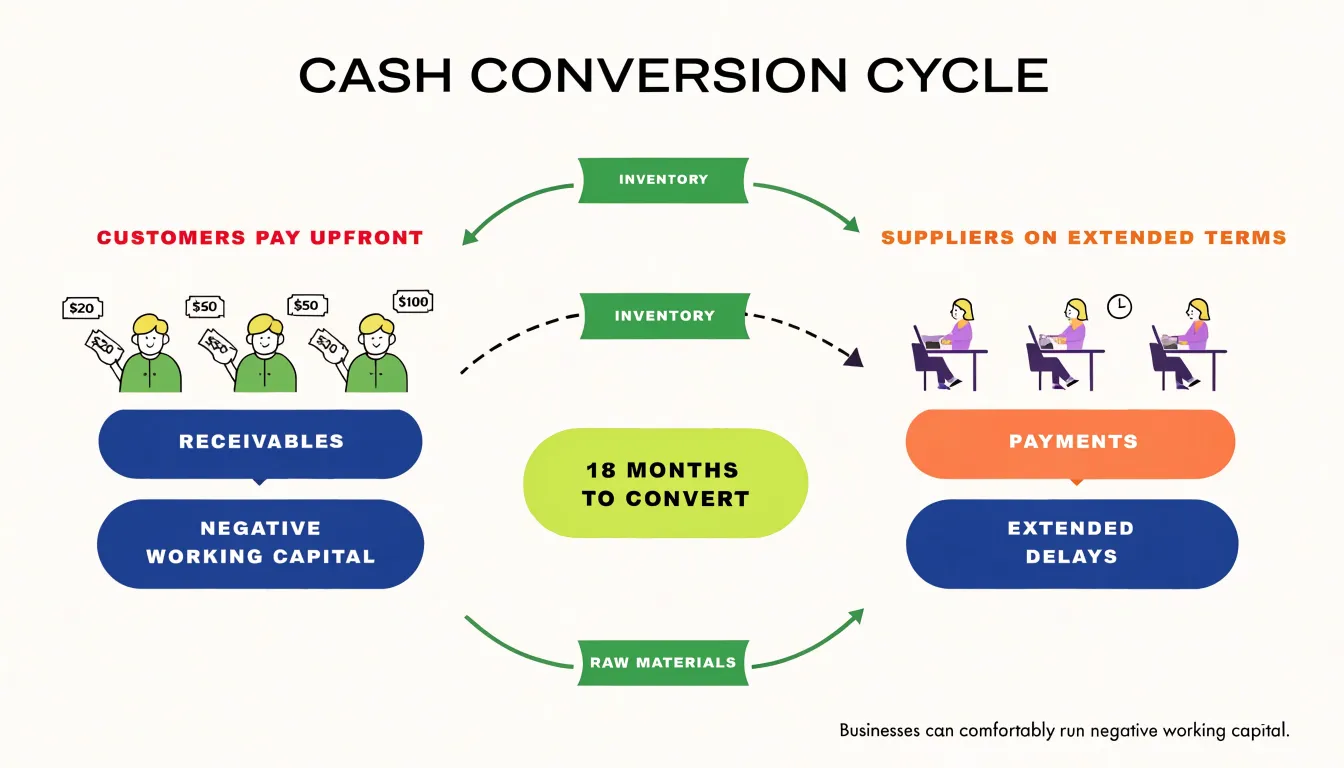
For cash flow management, the key task is understanding which situation applies and why. Positive working capital supports stability and planning; negative working capital demands vigilant monitoring of collection and payment cycles. Either way, tracking the composition of current assets and liabilities helps management anticipate cash shortfalls or surpluses and adjust operating decisions accordingly.
Actionable Strategies
Speeding up accounts receivable collections begins with the moment an invoice is issued. Invoicing promptly means sending bills the same day goods or services are delivered, rather than batching them at week’s end or month’s end. Each day of delay in invoicing adds a day to the collection cycle, and errors on invoices create further delays as customers request corrections. Sending accurate, complete invoices immediately after delivery establishes a clear expectation that payment is due and removes administrative excuses for slow payment. Pairing prompt invoicing with clearly stated payment terms, including the due date and accepted payment methods, gives customers everything they need to pay without follow-up questions.
Early payment discounts offer a direct financial incentive for customers to settle sooner. A common structure, such as a small percentage discount for payment within ten days, can meaningfully shorten collection periods, particularly with business customers who manage their own cash flow carefully. The discount costs a fraction of the invoice value, yet it can reduce the need for costly borrowing to cover shortfalls while receivables age. Setting the discount terms explicitly on each invoice and tracking how many customers take advantage of them helps refine the offer over time.
Automating reminders removes the reliance on staff memory and ensures consistency. A scheduled sequence of reminders, sent a few days before the due date and at set intervals afterward, keeps payment top of mind without requiring manual effort. Automated systems can also flag invoices that remain unpaid past a threshold, prompting a personal call from the finance team. The consistency of automated follow-up communicates that the business monitors receivables closely and expects timely payment.
Conducting credit checks before extending payment terms protects against slow or defaulting customers in the first place. Checking trade references and credit scores for new customers, and periodically reviewing limits for existing ones, helps direct attention toward reliable payers and set appropriate terms for riskier accounts. Together, these tactics form a practical system that accelerates cash inflows without straining customer relationships.
Optimizing inventory management to free up tied up operational cash
Inventory is one of the largest places where operational cash quietly accumulates and then sits idle. Every unit held in a warehouse represents money that has already left the business and cannot be redeployed until that unit is sold and converted back into cash. For many companies, the gap between cash spent on materials and cash received from customers is filled almost entirely by inventory, which makes inventory management a direct lever on working capital rather than a purely operational concern.
A first strategy is just-in-time inventory, in which goods are ordered and received close to the moment they are needed for production or sale. By aligning replenishment with actual consumption, a business can shrink the buffer stock it holds at any given time, releasing the cash that would otherwise be locked in warehouses and on shelves. This approach demands reliable supplier relationships and predictable lead times, since the cushion that protects against disruption is deliberately reduced.
Demand forecasting supports this discipline by giving the business a clearer picture of what will actually sell and when. Accurate forecasts reduce the temptation to over-order out of caution, and they help purchasing teams distinguish genuine demand from noise. Even modest improvements in forecast accuracy can meaningfully lower safety stock levels across a product range, and the freed cash flows directly back into operations.
Clearing obsolete stock is a complementary and often overlooked step. Slow-moving, damaged, or discontinued items tie up cash indefinitely and consume storage space that could hold more profitable goods. Systematic review of inventory aging, followed by discounting, bundling, or write-off where appropriate, converts dormant stock into usable funds and prevents the problem from compounding. Together, these practices turn inventory from a passive cash sink into a managed resource that supports liquidity and gives the business more flexibility to invest in growth.
Negotiating vendor payment terms without damaging supplier relationships
Vendor payment terms represent one of the most flexible levers available for improving working capital, and extending them begins with preparation. Before approaching a supplier, a business should gather data on its own payment history, order volumes, and seasonal cash patterns. This information supports a concrete proposal, such as moving from net 30 to net 45 or net 60, and gives the conversation a factual foundation. Framing the request around mutual benefit helps. A buyer who consistently pays on time and places predictable orders has real value to a supplier, and that reliability can be exchanged for a modest extension of terms. Many suppliers would rather keep a dependable customer on slightly longer terms than risk losing the account or spending time on collections.
Installment plans offer another route when a single large invoice would strain cash flow. Rather than missing a due date entirely, a business can propose splitting a balance into two or three scheduled payments. This approach works particularly well with suppliers who manufacture or ship in bulk. Agreeing on a schedule in advance keeps both parties aligned and removes the uncertainty that an unpaid invoice creates. Some suppliers will formalize these arrangements in writing, which protects the relationship on both sides.
Open communication is the thread that holds these negotiations together. Suppliers generally respond well to early notice of a cash constraint. A phone call before a due date, explaining the situation and proposing a realistic plan, preserves trust far better than silence followed by a late payment. Keeping the conversation regular, sharing forecasts where appropriate, and honoring whatever schedule is agreed all build credibility that pays off in future negotiations.
It also helps to think about which suppliers can absorb a change in terms. Large vendors with established credit departments often have standard programs for extended terms, while smaller suppliers may feel the delay more acutely. Tailoring the request to each relationship shows respect for the supplier’s own cash position. Businesses that approach these conversations with transparency, preparation, and a genuine willingness to compromise can often secure better terms while strengthening the partnerships that keep their operations running.
Frequently Asked Questions
What is working capital and how is it calculated?
Working capital measures the money a business has available to fund its day-to-day operations, and it is calculated as current assets minus current liabilities. It represents the cushion between cash, receivables, and inventory and the short-term debts, supplier payments, and accrued expenses owed.
What is a healthy working capital ratio for a growing company?
Most businesses consider a working capital ratio between 1.2 and 2.0 a reasonable target, while growing companies often benefit from operating toward the higher end or sometimes above it. The ideal ratio depends on factors such as inventory turnover, collection periods, cash-flow predictability, access to credit lines, and the composition of current assets. Very high ratios, such as above 3.0, can point to inefficiency like idle cash or slow-moving inventory.
What does negative working capital mean for a business?
Negative working capital occurs when current liabilities exceed current assets, which can raise liquidity issues and, in severe cases, precede insolvency. However, it is not automatically a warning sign because businesses that collect from customers upfront and pay suppliers on extended terms can operate with negative working capital comfortably.
How can a business speed up accounts receivable collections?
A business can invoice promptly and accurately, state clear payment terms, offer early payment discounts, automate reminders, and conduct credit checks before extending payment terms. These tactics help accelerate cash inflows without straining customer relationships.
How can inventory management free up working capital?
Inventory management can free up cash by using just-in-time inventory, improving demand forecasting, and clearing obsolete stock through discounting, bundling, or write-off where appropriate. These practices reduce cash tied up in warehouses and shelves.
How can a company negotiate longer vendor payment terms without damaging supplier relationships?
A company should prepare with data on its payment history, order volumes, and seasonal cash patterns, then propose concrete changes such as moving from net 30 to net 45 or net 60. It can also propose installment plans, communicate early about cash constraints, and tailor requests to each supplier’s ability to absorb a change in terms.